• 검색 결과가 없습니다.

Solitary Plasmacytoma of the RibHae Young Lee, M.D., Jong In Kim, M.D., Ki Nyun Kim, M.D.

N/A
N/A
Protected

Academic year: 2021

Share "Solitary Plasmacytoma of the RibHae Young Lee, M.D., Jong In Kim, M.D., Ki Nyun Kim, M.D."

Copied!
3
0
0

로드 중.... (전체 텍스트 보기)

전체 글

(1)

Korean J Thorac Cardiovasc Surg 2012;45:269-271 □ Case Report □ http://dx.doi.org/10.5090/kjtcs.2012.45.4.269 ISSN: 2233-601X (Print) ISSN: 2093-6516 (Online)

− 269 −

Department of Thoracic and Cardiovascular Surgery, Gospel Hospital, Kosin University College of Medicine Received: October 11, 2011, Revised: November 11, 2011, Accepted: November 11, 2011

Corresponding author: Jong In Kim, Department of Thoracic and Cardiovascular Surgery, Gospel Hospital, Kosin University College of Medicine, 262 Gamcheon-ro, Seo-gu, Busan 602-702, Korea

(Tel) 82-51-990-6466 (Fax) 82-51-990-3066 (E-mail) [email protected]

C

The Korean Society for Thoracic and Cardiovascular Surgery. 2012. All right reserved.

CC
This is an open access article distributed under the terms of the Creative Commons Attribution Non-Commercial License (http://creative- commons.org/licenses/by-nc/3.0) which permits unrestricted non-commercial use, distribution, and reproduction in any medium, provided the original work is properly cited.

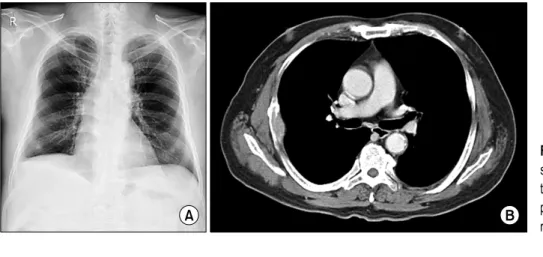
Fig. 1. (A) Simple chest X-ray showing pleural thickening around the right 5th rib. (B) Chest com- puted tomography scan demonstrates rib tumor with osteolytic lesion.

Solitary Plasmacytoma of the Rib

Hae Young Lee, M.D., Jong In Kim, M.D., Ki Nyun Kim, M.D.

Solitary plasmacytoma of the bone, and especially of a single rib, is a rare disease. Here we report a 73-year old male patient complaining of continuous chest wall pain around the right 5th rib shaft who underwent a wide ex- cision of the rib tumor with surrounding connective tissue. He was diagnosed with solitary plasmacytoma and will undergo radiation therapy. We report this case with a review of the literature.

Key words: 1. Tumor, malignant 2. Chest wall neoplasm 3. Plasmacytoma

CASE REPORT

A 73-year-old male patient with Herpes zoster of the right chest wall was referred for an incidental rib tumor. He com- plained of continuous chest wall pain that differed from post-zoster neuralgia, without palpation of a mass. The plain chest X-ray showed pleural thickening around the right 5th

rib shaft, and a computed tomography (CT) scan confirmed a single rib tumor containing an osteolytic lesion (Fig. 1). An additional bone scan found an abnormal increase in the up- take of radioisotope in the same lesion (Fig. 2). A wide ex- cision of the rib tumor with a 4 cm margin of normal bone and surrounding connective tissue was carried out (Fig. 3A).

There were no perioperative complications. Microscopic in-

(2)

Hae Young Lee, et al

− 270 − Fig. 2. Abnormally increased uptake of radioisotope in the right 5th rib in a bone scan.

Fig. 3. (A) Gross finding of excised rib. (B) Microscopic view shows abundant neoplastic plasma cells (H&E, ×400).

vasion was not noted. Monoclonal proliferative solitary plas- macytoma of bone (SPB) was suggested by the histopatho- logic report that the destructed bone marrow was substituted with abundant neoplastic plasma cells containing Russell bod- ies (Fig. 3B) and was supported by the immunohistochemical staining for lambda chain (+), kappa chain (−) and methyl green pyronine stain (+). A postoperative positron emission tomography scan did not detect any distant metastasis or oth- er bone lesions. We definitively diagnosed SPB by differ- ential diagnosis from multiple myeloma (MM) and extra-

medullary plasmacytoma using intact bone marrow biopsy and low levels of serum or urine monoclonal paraprotein (M-protein) by immunoelectrophoresis. We are planning to treat the patient with radiation therapy.

DISCUSSION

Plasmacytoma involving the chest wall is a relatively un- common primary tumor [1] classified as either MM, solitary plasmacytoma, extramedullary plasmacytoma or plasma cell leukemia. More than 95% of these tumors are MMs [2]. It is rare that the lesion of a solitary plasmacytoma is located on a rib, and this is only the second locally diagnosed case [3].

SPB occurs preferentially in relatively young patients below

the age of 55 years and is twice as common in men as it is

in women. The tumor can occur in any bone, but the spine is

the most common lesion location, followed by pelvis and

then rib. The most common symptoms are pain and spinal

nerve compression, and facial palsy may develop when the

skull is involved [4]. In the initial phase of progression, de-

tection of monoclonal proliferation in serum or urine is more

difficult and cellular levels are low. Diagnostic criteria are

the presence of a single radiologic bone lesion without other

bone lesions and deposition of plasma cells detected by tissue

biopsy. No myeloma cells should be detected in a random

bone marrow biopsy, but it is difficult to distinguish these

cells from others. In addition, there must be no evidence of

(3)

Solitary Plasmacytoma of the Rib

− 271 − hyperkalemia, anemia or nephropathy leading to myeloma in a hematologic study. With regard to radiologic evaluation, a CT scan is useful for a regional biopsy, and thoracic to lum- bar spinal magnetic resonance imaging can detect spinal le- sions to easily differentiate them from MM. However, a bone scan is not recommended due to poor reliability [2]. The pur- pose of treatment of SPB is to protect against transformation into MM and recurrence, mainly using radiation therapy.

Although there is no established relationship between dosage and response, 40 to 50 Gy radiation in 20 to 25 fractions has usually been recommended. A therapeutic response is usually observed in 90% to 100% of patients, and complete remission often reaches a maximum rate of 30% [2,5]. Even if ex- tended irradiation including the whole bone lesion adversely affects normal tissue, the therapeutic range should include an area of normal tissue at least 2 cm above the lesion. When performing surgical resection, the possibility of structural in- stability and nerve injury should be considered for spinal lesions. For other lesions, variable surgical strategies can be applied according to the tumor size, extent, patient’s general condition or surgeon’s experience [2]. In addition, some re- ports suggest the effectiveness of concurrent chemoradiation therapy, but little evidence has been presented [6]. In terms of prognosis, Weber [5] reported that most SPBs were trans- formed into MM within a maximum of 2 to 3 years and pro- posed their use as positive prognostic factors through reso- lution of M-protein or disappearance of other bone lesions for more than a year after radiation therapy. Reed et al. [7] ad- vocated that the location of the primary lesion and the initial level of serum M-protein at diagnosis were significant for prognosis, but that race, sex or urinary presentation of Bence Jones protein were not. Kilciksiz et al. [8] reported that age greater than 55 years old could be an independent factor re- lated to transition to MM. In another review of the literature, several prognostic factors such as tumor size greater than 5

cm, existence of spinal lesion, radiation dosage, and level of serum M-protein were suggested but are controversial and have little statistical significance [2,6,7]. The patient in this case study underwent a wide excision of a solitary rib tumor containing normal tissue without preoperative confirmation of diagnosis. The histopathologic diagnosis of SPB was con- firmed, and a minimal dose of radiation therapy is planned for protection against tumor recurrence. We report a rare case of solitary plasmacytoma of a single rib with its diagnosis and surgical treatment.

REFERENCES

1. Athanassiadi K, Kalavrouziotis G, Rondogianni D, Loutsidis A, Hatzimichalis A, Bellenis I. Primary chest wall tumors:

early and long-term results of surgical treatment. Eur J Cardiothorac Surg 2001;19:589-93.

2. Soutar R, Lucraft H, Jackson G, et al. Guidelines on the di- agnosis and management of solitary plasmacytoma of bone and solitary extramedullary plasmacytoma. Br J Haematol 2004;124:717-26.

3. Lee YO, Ryu KM, Cho SK, Lee EB. Solitary plasmacytoma of the rib: a case report. Korean J Thorac Cardiovasc Surg 2009;42:268-71.

4. Vijaya-Sekaran S, Delap T, Abramovich S. Solitary plasma- cytoma of the skull base presenting with unilateral sensor- ineural hearing loss. J Laryngol Otol 1999;113:164-6.

5. Weber DM. Solitary bone and extramedullary plasmacytoma.

Hematology Am Soc Hematol Educ Program 2005:373-6.

6. Aviles A, Huerta-Guzman J, Delgado S, Fernandez A, Diaz-Maqueo JC. Improved outcome in solitary bone plas- macytomata with combined therapy. Hematol Oncol 1996;14:

111-7.

7. Reed V, Shah J, Medeiros LJ, et al. Solitary plasmacytomas:

outcome and prognostic factors after definitive radiation therapy. Cancer 2011;117:4468-74.

8. Kilciksiz S, Celik OK, Pak Y, et al. Clinical and prognostic

features of plasmacytomas: a multicenter study of Turkish

Oncology Group-Sarcoma Working Party. Am J Hematol

2008;83:702-7.

수치

Fig. 1. (A) Simple chest X-ray  showing pleural thickening around  the right 5th rib. (B) Chest  com-puted tomography scan demonstrates  rib tumor with osteolytic lesion.

참조

관련 문서

Sandberg D, Lavyne M (1999) Symptomatic spinal epidural lipomatosis after local epidural corticosteroid injections:

▪ 실세계의 객체에서 불필요한 부분을 제거하여 필요한 부분만을 간결하고 이해하기 쉬운 클래스 로 만드는 작업. ▪

The close substitutes are R&D efforts, technologies, and goods that significantly constrain the exercise of market power with respect to the relevant

One might try to solve the problem by copying the first d elements of x to a temporary array, moving the remaining n − d elements left d places, and then copying the first d

A small percentage of patients have no detectable M-protein in serum or urine but do have myeloma-related organ impairment (ROTI) and increased bone marrow plasma cells

• 글로벌 거버넌스란 국제사회에서 과거 주권국가들이 유읷핚 행위자로서 그들의 관계로 형성되었던 국제관계가 다양핚 다른 행위자들이 등장하고 새로욲 행위자들이 국가들과

Clonal bone marrow plasma cells ≥ 10% or biopsy-proven bony or extramedullary plasmacytoma and any one or more of the following myeloma defining events:.. •

1 John Owen, Justification by Faith Alone, in The Works of John Owen, ed. John Bolt, trans. Scott Clark, "Do This and Live: Christ's Active Obedience as the