ABSTRACT
Objective: Women with cervical cancer (CC) found to have positive surgical margins, positive
lymph nodes, and/or parametrial invasion receive a survival benefit from postoperative chemoradiotherapy (CRT) vs. radiation therapy (RT) alone. However, older women may not benefit to the same extent, as they are at increased risk of death from non-oncologic causes as well as toxicities from oncologic treatments. This study sought to evaluate whether there was a survival benefit of CRT over RT in elderly patients with cervical cancer.
Methods: The National Cancer Database was queried for patients ≥70 years old with newly
diagnosed IA2, IB, or IIA CC and positive margins, parametrial invasion, and/or positive nodes on surgical resection. Statistics included logistic regression, Kaplan-Meier overall survival (OS), and Cox proportional hazards modeling analyses.
Results: Altogether, 166 patients met inclusion criteria; 62 (37%) underwent postoperative
RT and 104 (63%) underwent postoperative CRT. Younger patients and those living in areas of higher income were less likely to receive CRT, while parametrial invasion and nodal involvement were associated with an increased likelihood (p<0.05 for all). There were no OS differences by treatment type. Subgroup analysis by number of risk factors, as well as each of the 3 risk factors separately, also did not reveal any OS differences between cohorts.
Conclusion: In the largest such study to date, older women with postoperative risk factor(s)
receiving RT alone experienced similar survival as those undergoing CRT. Although causation is not implied, careful patient selection is paramount to balance treatment-related toxicity risks with theoretical outcome benefits.
Keywords: Chemotherapy; Elderly; Geriatrics; Cervical Cancer; Radiation Therapy
Original Article
Taylor R. Cushman ,
1Waqar Haque ,
2Hari Menon ,
1Chad G. Rusthoven ,
3E. Brian Butler ,
2Bin S. Teh ,
2Vivek Verma
41University of Arizona College of Medicine-Phoenix, Phoenix, AZ, USA
2Department of Radiation Oncology, Houston Methodist Hospital, Houston, TX, USA
3Department of Radiation Oncology, University of Colorado School of Medicine, Denver, CO, USA
4Department of Radiation Oncology, Allegheny General Hospital, Pittsburgh, PA, USA
Postoperative chemoradiotherapy versus radiotherapy alone for elderly cervical cancer patients with positive margins, lymph nodes, or parametrial invasion
Received: Jun 14, 2018 Revised: Jul 19, 2018 Accepted: Aug 9, 2018 Correspondence to Vivek Verma
Department of Radiation Oncology, Allegheny General Hospital, 320 East North Ave., Pittsburgh, PA 15212, USA.
E-mail: [email protected] Copyright © 2018. Asian Society of Gynecologic Oncology, Korean Society of Gynecologic Oncology
This is an Open Access article distributed under the terms of the Creative Commons Attribution Non-Commercial License (https://
creativecommons.org/licenses/by-nc/4.0/) which permits unrestricted non-commercial use, distribution, and reproduction in any medium, provided the original work is properly cited.
ORCID iDs Taylor R. Cushman
https://orcid.org/0000-0002-4513-5537 Waqar Haque
https://orcid.org/0000-0001-9364-2966 Hari Menon
https://orcid.org/0000-0001-5684-1405 Chad G. Rusthoven
https://orcid.org/0000-0002-2372-4154 E. Brian Butler
https://orcid.org/0000-0002-8363-0061 Bin S. Teh
https://orcid.org/0000-0003-1456-9444 Vivek Verma
https://orcid.org/0000-0002-5863-6023
Conflict of Interest
No potential conflict of interest relevant to this article was reported.
Author Contributions
Conceptualization: C.T.R., H.W., R.C.G., B.B., T.B.S., V.V.; Data curation: H.W., V.V.;
Formal analysis: C.T.R., H.W., M.H., V.V.;
Investigation: C.T.R., M.H., R.C.G., V.V.;
Methodology: C.T.R., R.C.G., B.B., V.V.;
Supervision: V.V.; Validation: C.T.R., R.C.G., B.B., T.B.S.; Writing - original draft: C.T.R., M.H., V.V.; Writing - review & editing: C.T.R., H.W., M.H., R.C.G., B.B., T.B.S., V.V.
INTRODUCTION
Women undergoing hysterectomy for cervical cancer (CC) and found to have positive surgical margins, positive lymph nodes, and/or parametrial invasion (the so-called “3 Ps”) achieve a survival benefit with adjuvant concurrent chemotherapy (CT) and pelvic radiation therapy (RT) over RT alone [1]. In a landmark trial, Peters and colleagues [1] found that clinical stage IA2, IB, and IIA patients with any of the three aforementioned risk factors experienced improved progression-free survival (PFS) and overall survival (OS) with the addition of CT to definitive pelvic RT following radical hysterectomy. Although there was no association between age and survival, most patients were quite young (median 38 and 41 years for the RT+CT and RT arms, respectively).
Due to the presence of underlying comorbid conditions that lead to greater treatment related toxicity as well as increased risk of death from non-oncologic causes, the elderly population represents unique challenges for oncologic management. Although less than 15% of all patients with CC are older than 65 years at diagnosis, these elderly patients comprise a large population, at an estimated 40,000 women in the United States [2]. In addition to a reduced life expectancy (thus potentially receiving comparatively less benefit from aggressive oncologic interventions), elderly patients are also more susceptible to treatment-related toxicities [1,3-6]. It is thus unknown whether elderly women should be aggressively treated similar to their younger counterparts, or whether single-modality adjuvant therapy would provide similar survival. It is unlikely that dedicated phase III trials addressing this question would ever take place, given the age distribution of CC as well as the well-known under- representation of older patients on clinical trials [7-12].
To address this knowledge gap, the goal of this investigation, the first of its kind, was to evaluate postoperative chemoradiotherapy (CRT) vs. RT alone for elderly (≥70 years old) women with positive surgical margins, positive lymph nodes, and/or parametrial invasion.
MATERIALS AND METHODS
This study retrospectively analyzed the National Cancer Database (NCDB), a jointly sponsored database by the Commission on Cancer (CoC) of the American College of Surgeons (ACS), and the American Cancer Society. Data includes de-identified information regarding treatments and outcomes from over 29 million cancers and approximately 70% of all malignant cancers diagnosed at CoC-accredited facilities within the United States [13].
Review from an internal review board was not required because the NCDB is exclusively comprised of de-identified information.
1. Patient selection
Deidentified data for patients in the NCDB from 2004–2013 were included in this dataset.
Inclusion criteria were patients ≥70 years of age with newly diagnosed IA2, IB, or IIA cervical cancer treated definitively with upfront surgery and either positive margins, parametrial invasion, or positive nodes found on pathology. This patient population was selected to allow direct comparison to historical trials [1]. The 70-year-old threshold was used because this is a commonly used cutoff to analyze “elderly” patients [14,15].
Patients were excluded if <70 years of age, M1 or unknown M stage, clinically stage IA1, IIB+
or unknown stage, no hysterectomy or unknown surgical status, no/unknown adjuvant RT,
or unknown CT status. Collected information on each patient broadly included demographic data, clinicopathologic parameters, and treatment data.
Median follow up was calculated using the reverse Kaplan-Meier method [16]. All statistical tests were 2-sided, with a threshold of p<0.05 for statistical significance, and were analyzed using IBM SPSS Statistics (version 24; IBM Corp., Armonk, NY, USA). Multivariable logistic regression modeling was utilized to identify characteristics that were predictive for receipt of CRT. The Kaplan-Meier method was used for survival analysis, and comparisons between groups were compared with log-rank test. OS was defined as the interval between date of diagnosis and death, or censored at the date of last contact. Univariate and multivariate Cox proportional hazard analysis was performed to determine factors associated with OS.
RESULTS
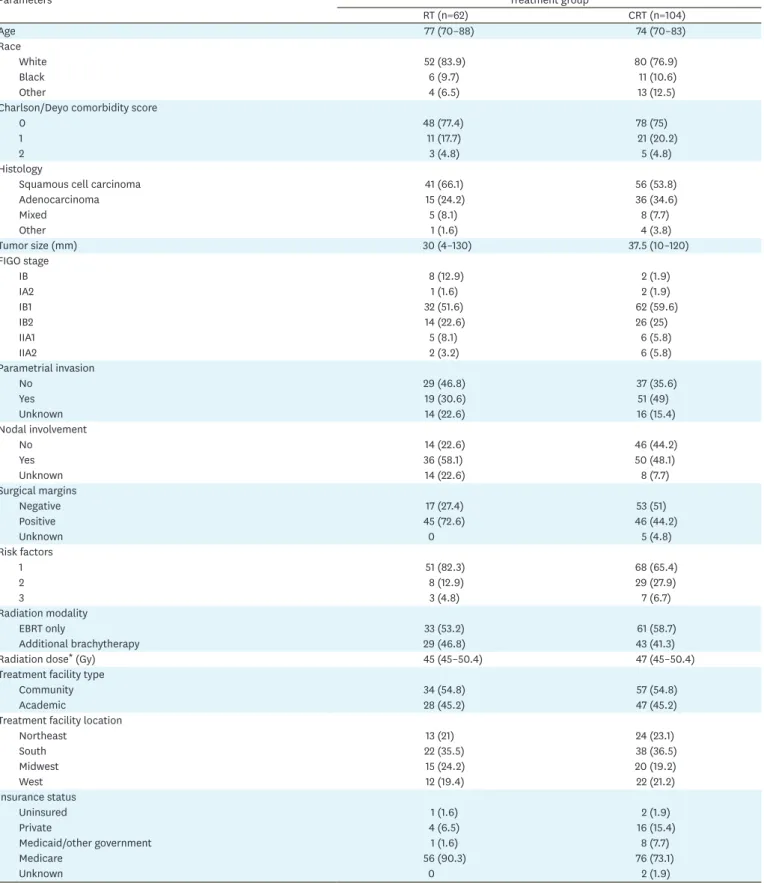
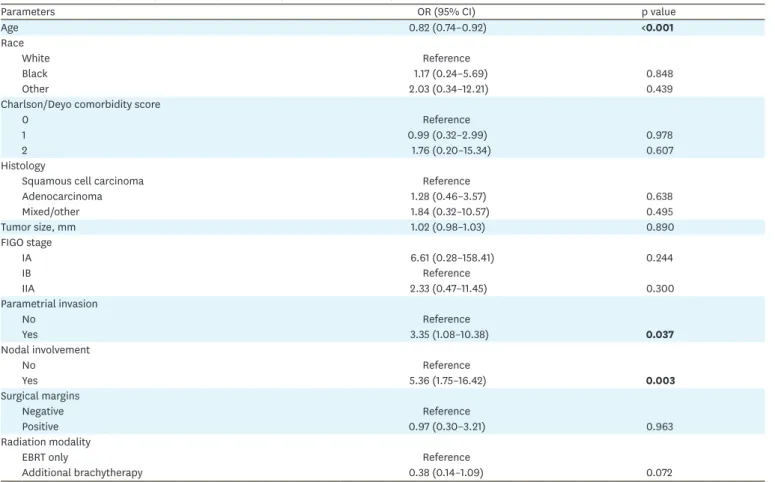
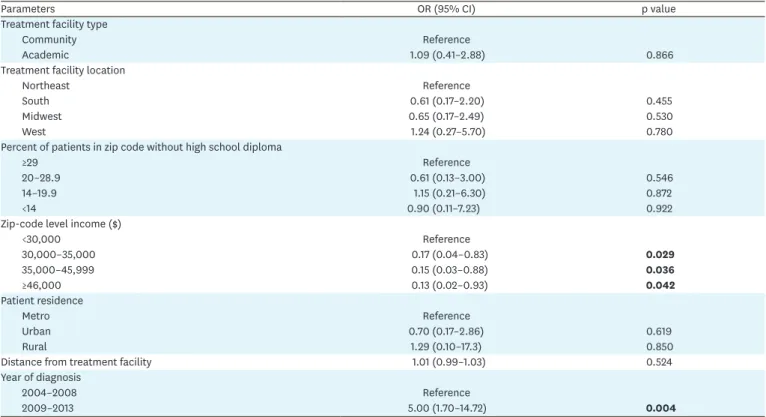
There were 98,347 patients in the NCDB CC database (Fig. 1), of which 166 met the pre- specified inclusion criteria. Table 1 displays the clinical characteristics of those patients, 62 of whom underwent RT alone (37.3%) and 104 underwent CRT (62.7%). Multivariable analysis revealed that increasing age (as a continuous variable) and higher zip-code level income (≥$30,000) (p<0.05 for all) were associated with decreased likelihood of CRT delivery (Table 2). Parametrial invasion (p=0.037), nodal involvement (p=0.003), and later years of diagnosis (2009 or after) (p=0.004) were significantly related with increased likelihood of CRT receipt, while positive surgical margins were not (p=0.963).
The median follow-up was 35.3 months (interquartile range=20.7–52.3 months). Kaplan- Meier estimates comparing OS in patients that received postoperative RT alone vs. CRT
Exclusions
• Age <70 (n=86,113)
• M1 or unknown M stage (n=1,599)
• Clinically node-positive (n=1,028)
• Unknown stage, stage IA1, or IIB+ (n=6,501)
• No hysterectomy/unknown (n=1,912)
• None of “3 Ps” (n=943)
• No/unknown adjuvant RT (n=82)
• Unknown CT status (n=3)
(n=104)CT
Study population (n=166)
RT alone (n=62) CC cases from 2004–2013 (n=98,347)NCDB
Fig. 1. Patient selection diagram.
3 Ps, positive surgical margins, positive lymph nodes, and/or parametrial invasion; CC, cervical cancer; CRT, chemoradiotherapy; NCDB, National Cancer Database; RT, radiation therapy.
Table 1. Baseline characteristics
Parameters Treatment group
RT (n=62) CRT (n=104)
Age 77 (70–88) 74 (70–83)
Race
White 52 (83.9) 80 (76.9)
Black 6 (9.7) 11 (10.6)
Other 4 (6.5) 13 (12.5)
Charlson/Deyo comorbidity score
0 48 (77.4) 78 (75)
1 11 (17.7) 21 (20.2)
2 3 (4.8) 5 (4.8)
Histology
Squamous cell carcinoma 41 (66.1) 56 (53.8)
Adenocarcinoma 15 (24.2) 36 (34.6)
Mixed 5 (8.1) 8 (7.7)
Other 1 (1.6) 4 (3.8)
Tumor size (mm) 30 (4–130) 37.5 (10–120)
FIGO stage
IB 8 (12.9) 2 (1.9)
IA2 1 (1.6) 2 (1.9)
IB1 32 (51.6) 62 (59.6)
IB2 14 (22.6) 26 (25)
IIA1 5 (8.1) 6 (5.8)
IIA2 2 (3.2) 6 (5.8)
Parametrial invasion
No 29 (46.8) 37 (35.6)
Yes 19 (30.6) 51 (49)
Unknown 14 (22.6) 16 (15.4)
Nodal involvement
No 14 (22.6) 46 (44.2)
Yes 36 (58.1) 50 (48.1)
Unknown 14 (22.6) 8 (7.7)
Surgical margins
Negative 17 (27.4) 53 (51)
Positive 45 (72.6) 46 (44.2)
Unknown 0 5 (4.8)
Risk factors
1 51 (82.3) 68 (65.4)
2 8 (12.9) 29 (27.9)
3 3 (4.8) 7 (6.7)
Radiation modality
EBRT only 33 (53.2) 61 (58.7)
Additional brachytherapy 29 (46.8) 43 (41.3)
Radiation dose* (Gy) 45 (45–50.4) 47 (45–50.4)
Treatment facility type
Community 34 (54.8) 57 (54.8)
Academic 28 (45.2) 47 (45.2)
Treatment facility location
Northeast 13 (21) 24 (23.1)
South 22 (35.5) 38 (36.5)
Midwest 15 (24.2) 20 (19.2)
West 12 (19.4) 22 (21.2)
Insurance status
Uninsured 1 (1.6) 2 (1.9)
Private 4 (6.5) 16 (15.4)
Medicaid/other government 1 (1.6) 8 (7.7)
Medicare 56 (90.3) 76 (73.1)
Unknown 0 2 (1.9)
(continued to the next page)
Parameters Treatment group
RT (n=62) CRT (n=104)
Percent of patients in zip code without high school diploma
≥29 11 (17.7) 23 (22.1)
20–28.9 16 (25.8) 29 (27.9)
14–19.9 23 (37.1) 35 (33.7)
<14 10 (16.1) 16 (15.4)
Zip-code level income ($)
<30,000 7 (11.3) 28 (26.9)
30,000–35,000 18 (29) 18 (17.3)
35,000–45,999 18 (29) 27 (26)
≥46,000 17 (27.4) 30 (28.8)
Patient residence
Metro 47 (75.8) 80 (76.9)
Urban 10 (16.1) 16 (15.4)
Rural 2 (3.2) 5 (4.8)
Distance from treatment facility 12.8 (1.2–154.9) 13.4 (1–611.6)
Year of diagnosis
2004–2008 31 (50) 30 (28.8)
2009–2013 31 (50) 74 (71.2)
Values are presented as number (%) or median (range)
CRT, chemoradiotherapy; EBRT, external beam radiation therapy; FIGO, International Federation of Gynecology and Obstetrics; RT, radiation therapy.
*Parenthesis value of ‘Radiation dose’ are interquartile range.
Table 1. (Continued) Baseline characteristics
Table 2. Multivariable logistic regression analysis evaluating predictors of receiving CRT
Parameters OR (95% CI) p value
Age 0.82 (0.74–0.92) <0.001
Race
White Reference
Black 1.17 (0.24–5.69) 0.848
Other 2.03 (0.34–12.21) 0.439
Charlson/Deyo comorbidity score
0 Reference
1 0.99 (0.32–2.99) 0.978
2 1.76 (0.20–15.34) 0.607
Histology
Squamous cell carcinoma Reference
Adenocarcinoma 1.28 (0.46–3.57) 0.638
Mixed/other 1.84 (0.32–10.57) 0.495
Tumor size, mm 1.02 (0.98–1.03) 0.890
FIGO stage
IA 6.61 (0.28–158.41) 0.244
IB Reference
IIA 2.33 (0.47–11.45) 0.300
Parametrial invasion
No Reference
Yes 3.35 (1.08–10.38) 0.037
Nodal involvement
No Reference
Yes 5.36 (1.75–16.42) 0.003
Surgical margins
Negative Reference
Positive 0.97 (0.30–3.21) 0.963
Radiation modality
EBRT only Reference
Additional brachytherapy 0.38 (0.14–1.09) 0.072
(continued to the next page)
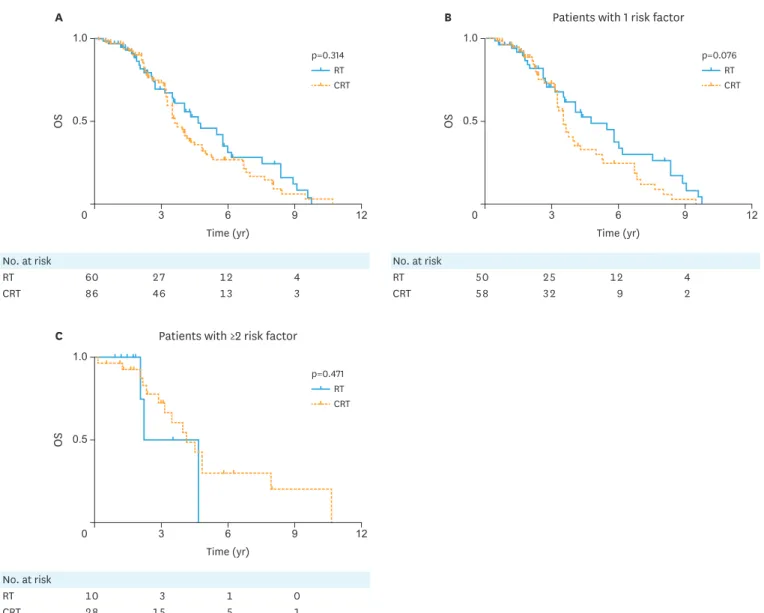
revealed no significant differences, with corresponding median OS times of 56.1 (95%
confidence interval [CI]=36.1–76) months and 43.5 (95% CI=36.3–50.6) months, (p=0.314), respectively (Fig. 2A).
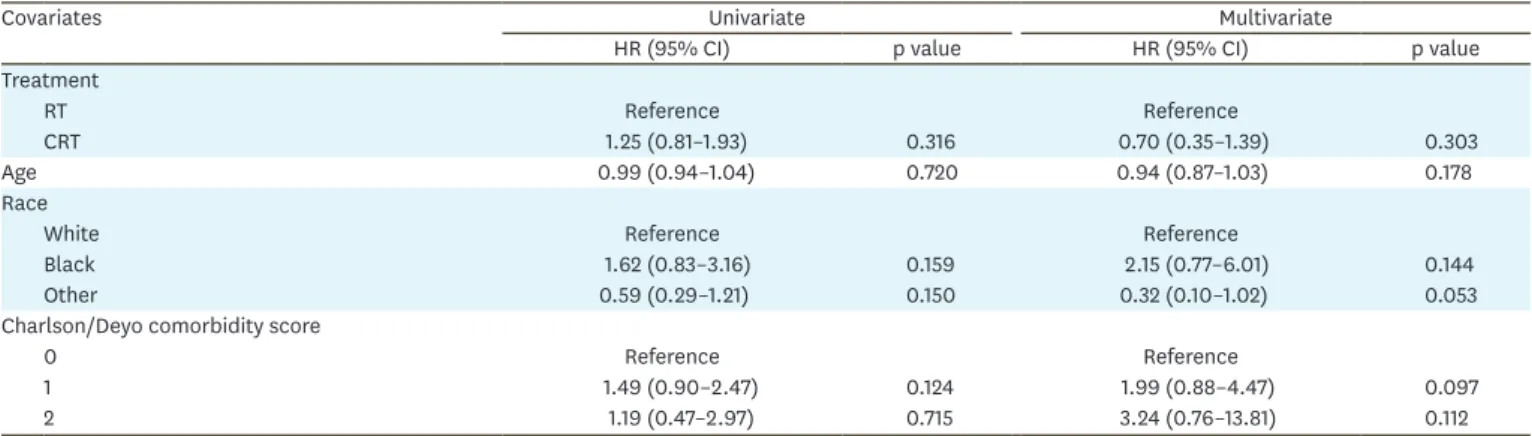
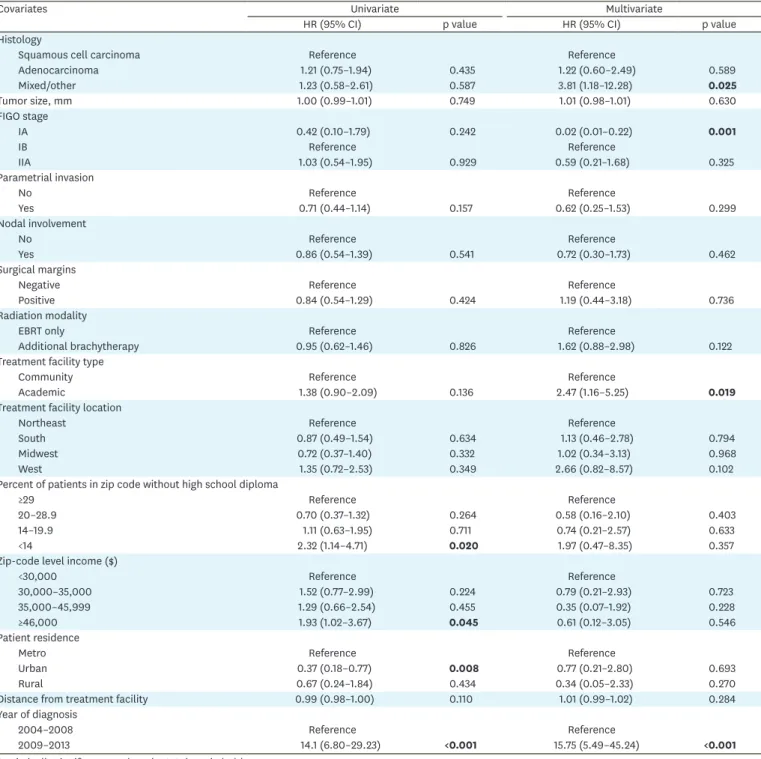
On univariate analysis, there were several variables predictive of OS: higher education, higher income, urban residence (relative to metro), and later years of diagnosis (Table 3). Of these, only year of diagnosis (2009–2013 vs. 2004–2008) remained a significant predictor of OS on multivariate analysis (hazard ratio [HR]=15.75; 95% CI=5.49–45.24; p<0.001). Other factors predictive of worse OS in the multivariate model were mixed/other histology (relative to squamous cell carcinoma) (HR=3.81; 95% CI=1.18–12.28; p=0.025) and treatment at an academic (vs. community) center (HR=2.47; 95% CI=1.16–5.25; p=0.019), while International Federation of Gynecology and Obstetrics (FIGO) stage IA (relative to IB) was associated with improved OS (HR=0.02; 95% CI=0.01–0.22; p=0.025, Table 3).
To further explore potential patients at increased risk of death, patients were stratified by 1 vs. 2 or more risk factors (parametrial invasion, positive surgical margins, or positive lymph nodes). There were no statistically significant differences in OS between CRT and RT alone in patients with 1 vs. 2 or more risk factors (Fig. 2B and C), nor were there any differences in OS when directly comparing 1 vs. 2 or more risk factors (Supplementary Fig. 1). Stratification by specific risk factors (parametrial invasion, positive margins, positive nodes; Fig. 3A, B, and
C, respectively) similarly showed no differences in OS between CRT vs. RT alone.Parameters OR (95% CI) p value
Treatment facility type
Community Reference
Academic 1.09 (0.41–2.88) 0.866
Treatment facility location
Northeast Reference
South 0.61 (0.17–2.20) 0.455
Midwest 0.65 (0.17–2.49) 0.530
West 1.24 (0.27–5.70) 0.780
Percent of patients in zip code without high school diploma
≥29 Reference
20–28.9 0.61 (0.13–3.00) 0.546
14–19.9 1.15 (0.21–6.30) 0.872
<14 0.90 (0.11–7.23) 0.922
Zip-code level income ($)
<30,000 Reference
30,000–35,000 0.17 (0.04–0.83) 0.029
35,000–45,999 0.15 (0.03–0.88) 0.036
≥46,000 0.13 (0.02–0.93) 0.042
Patient residence
Metro Reference
Urban 0.70 (0.17–2.86) 0.619
Rural 1.29 (0.10–17.3) 0.850
Distance from treatment facility 1.01 (0.99–1.03) 0.524
Year of diagnosis
2004–2008 Reference
2009–2013 5.00 (1.70–14.72) 0.004
Statistically significant p-values (p<0.05) are in bold.
CI, confidence interval; CRT, chemoradiotherapy; EBRT, external beam radiation therapy; FIGO, International Federation of Gynecology and Obstetrics; OR, odds ratio; RT, radiation therapy.
Table 2. (Continued) Multivariable logistic regression analysis evaluating predictors of receiving CRT
DISCUSSION
To the best of our knowledge, this is the largest known report assessing patterns of care and outcomes for elderly women with CC receiving either postoperative CRT or RT for positive surgical margins, positive lymph nodes, and/or parametrial invasion. Our study of a large, contemporary national database did not discern an additional OS benefit in combined- modality adjuvant therapy in the elderly CC patient population. As such, clinicians must continue to weigh the benefits of adjuvant CRT with additive toxicities associated with concurrent CT administration.
Similar survival outcomes between treatment groups may in part be attributed to only well- selected elderly patients with risk factors and comorbidities incompletely captured by the NCDB. Although the NCDB does not capture details such as cancer-related survival, PFS, and local/regional recurrence, there are several reasons this selection bias is unlikely. First, there
No. at riskRT 10 3 1 0
CRT 28 15 5 1
Time (yr) Patients with 1 risk factor
0.5
0 6 12
OS
1.0
3 9
p=0.076 RT CRT
Time (yr)
A B
0.5
0 6 12
OS
1.0
3 9
p=0.314 RT CRT
Time (yr) Patients with ≥2 risk factor C
0.5
0 6 12
OS
1.0
3 9
p=0.471 RT CRT No. at risk
RT 60 27 12 4
CRT 86 46 13 3
No. at risk
RT 50 25 12 4
CRT 58 32 9 2
Time (yr) Patients with 1 risk factor
0.5
0 6 12
OS
1.0
3 9
p=0.076 RT CRT
Time (yr)
A B
0.5
0 6 12
OS
1.0
3 9
p=0.314 RT CRT
Time (yr) Patients with ≥2 risk factor C
0.5
0 6 12
OS
1.0
3 9
p=0.471 RT CRT
Time (yr) Patients with 1 risk factor
0.5
0 6 12
OS
1.0
3 9
p=0.076 RT CRT
Time (yr)
A B
0.5
0 6 12
OS
1.0
3 9
p=0.314 RT CRT
Time (yr) Patients with ≥2 risk factor C
0.5
0 6 12
OS
1.0
3 9
p=0.471 RT CRT
Fig. 2. Kaplan-Meier curve of OS for (A) patients who received RT vs. CRT and OS stratified by (B) 1 risk factor and (C) 2 or more risk factors.
CRT, chemoradiation therapy; OS, overall survival; RT, radiation therapy.
No. at risk
RT 10 4 2 1
CRT 41 23 7 2
Time (mo) Positive margins
0.5
0 6 12
OS
1.0
3 9
p=0.661 RT CRT
Time (mo) Parametrial invasion
A B
0.5
0 6 12
OS
1.0
3 9
p=0.327 RT CRT
Time (mo) Positive nodes C
0.5
0 6 12
OS
1.0
3 9
p=0.755 RT CRT No. at risk
RT 18 10 6 2
CRT 41 20 6 2
No. at risk
RT 44 18 6 3
CRT 37 23 9 2
Time (mo) Positive margins
0.5
0 6 12
OS
1.0
3 9
p=0.661 RT CRT
Time (mo) Parametrial invasion
A B
0.5
0 6 12
OS
1.0
3 9
p=0.327 RT CRT
Time (mo) Positive nodes C
0.5
0 6 12
OS
1.0
3 9
p=0.755 RT CRT
Time (mo) Positive margins
0.5
0 6 12
OS
1.0
3 9
p=0.661 RT CRT
Time (mo) Parametrial invasion
A B
0.5
0 6 12
OS
1.0
3 9
p=0.327 RT CRT
Time (mo) Positive nodes C
0.5
0 6 12
OS
1.0
3 9
p=0.755 RT CRT
Fig. 3. Kaplan-Meier curve of OS for patients who received RT vs. CRT, stratified by (A) parametrial invasion, (B) positive surgical margins, or (C) positive nodes.
CRT, chemoradiation therapy; OS, overall survival; RT, radiation therapy.
Table 3. HRs determined by univariate and multivariate Cox proportional hazards model adjusted for covariates
Covariates Univariate Multivariate
HR (95% CI) p value HR (95% CI) p value
Treatment
RT Reference Reference
CRT 1.25 (0.81–1.93) 0.316 0.70 (0.35–1.39) 0.303
Age 0.99 (0.94–1.04) 0.720 0.94 (0.87–1.03) 0.178
Race
White Reference Reference
Black 1.62 (0.83–3.16) 0.159 2.15 (0.77–6.01) 0.144
Other 0.59 (0.29–1.21) 0.150 0.32 (0.10–1.02) 0.053
Charlson/Deyo comorbidity score
0 Reference Reference
1 1.49 (0.90–2.47) 0.124 1.99 (0.88–4.47) 0.097
2 1.19 (0.47–2.97) 0.715 3.24 (0.76–13.81) 0.112
(continued to the next page)
were similar baseline characteristics between treatment groups, including Charlson/Deyo comorbidity score (which is acknowledged is not synomymous with performance status), decreasing the likelihood of selection bias. Second, there were only three non-socioeconomic characteristics significant on multivariable logistic regression analysis that predicted for CRT use: age, parametrial invasion, and nodal involvement. Nonetheless, age and socioeconomic factors have been shown to be independent predictors of undertreatment and mortality in
Covariates Univariate Multivariate
HR (95% CI) p value HR (95% CI) p value
Histology
Squamous cell carcinoma Reference Reference
Adenocarcinoma 1.21 (0.75–1.94) 0.435 1.22 (0.60–2.49) 0.589
Mixed/other 1.23 (0.58–2.61) 0.587 3.81 (1.18–12.28) 0.025
Tumor size, mm 1.00 (0.99–1.01) 0.749 1.01 (0.98–1.01) 0.630
FIGO stage
IA 0.42 (0.10–1.79) 0.242 0.02 (0.01–0.22) 0.001
IB Reference Reference
IIA 1.03 (0.54–1.95) 0.929 0.59 (0.21–1.68) 0.325
Parametrial invasion
No Reference Reference
Yes 0.71 (0.44–1.14) 0.157 0.62 (0.25–1.53) 0.299
Nodal involvement
No Reference Reference
Yes 0.86 (0.54–1.39) 0.541 0.72 (0.30–1.73) 0.462
Surgical margins
Negative Reference Reference
Positive 0.84 (0.54–1.29) 0.424 1.19 (0.44–3.18) 0.736
Radiation modality
EBRT only Reference Reference
Additional brachytherapy 0.95 (0.62–1.46) 0.826 1.62 (0.88–2.98) 0.122
Treatment facility type
Community Reference Reference
Academic 1.38 (0.90–2.09) 0.136 2.47 (1.16–5.25) 0.019
Treatment facility location
Northeast Reference Reference
South 0.87 (0.49–1.54) 0.634 1.13 (0.46–2.78) 0.794
Midwest 0.72 (0.37–1.40) 0.332 1.02 (0.34–3.13) 0.968
West 1.35 (0.72–2.53) 0.349 2.66 (0.82–8.57) 0.102
Percent of patients in zip code without high school diploma
≥29 Reference Reference
20–28.9 0.70 (0.37–1.32) 0.264 0.58 (0.16–2.10) 0.403
14–19.9 1.11 (0.63–1.95) 0.711 0.74 (0.21–2.57) 0.633
<14 2.32 (1.14–4.71) 0.020 1.97 (0.47–8.35) 0.357
Zip-code level income ($)
<30,000 Reference Reference
30,000–35,000 1.52 (0.77–2.99) 0.224 0.79 (0.21–2.93) 0.723
35,000–45,999 1.29 (0.66–2.54) 0.455 0.35 (0.07–1.92) 0.228
≥46,000 1.93 (1.02–3.67) 0.045 0.61 (0.12–3.05) 0.546
Patient residence
Metro Reference Reference
Urban 0.37 (0.18–0.77) 0.008 0.77 (0.21–2.80) 0.693
Rural 0.67 (0.24–1.84) 0.434 0.34 (0.05–2.33) 0.270
Distance from treatment facility 0.99 (0.98–1.00) 0.110 1.01 (0.99–1.02) 0.284
Year of diagnosis
2004–2008 Reference Reference
2009–2013 14.1 (6.80–29.23) <0.001 15.75 (5.49–45.24) <0.001
Statistically significant p-values (p<0.05) are in bold.
CI, confidence interval; CRT, chemoradiotherapy; EBRT, external beam radiation therapy; FIGO, International Federation of Gynecology and Obstetrics; HR, hazard ratio; RT, radiation therapy.
Table 3. (Continued) HRs determined by univariate and multivariate Cox proportional hazards model adjusted for covariates
cervical cancer [17-20], possibly contributing to selection bias within our study population.
With this in mind, it is important to note that our results certainly do not imply causation.
While 2 of the “3 Ps” (parametrial invasion and positive nodes) were associated with increased likelihood of CRT, positive surgical margins were not. This may be due to positive surgical margins possibly being the most “localized” and thus decreasing the necessity of additional systemic therapy in addition to RT. It is also plausible that the patients with positive surgical margins received brachytherapy (38% and 10% in the RT and CRT groups, respectively) in place of CT.
Our results suggest that elderly patients, who are at risk of death from competing causes, may not receive as high of a benefit to additional postoperative CT, regardless of the number or type of risk factors. In a smaller single institution retrospective analysis, researchers similarly found no differences in survival by age groups [21]. Of note, the study also examined toxicity events and found no differences in toxicity rates among age cohorts receiving CRT. Similar lack of survival and toxicity differences have been reported in populations with relatively heterogeneous stages and/or treatments [22-26], but no studies to date, to our knowledge, have exclusively evaluated outcomes of elderly patients receiving postoperative RT vs. CRT.
The strengths of our study include a well-defined population from the validated NCDB, allowing for robust statistical analyses. However, although the NCDB provides a unique opportunity to study this important clinical question, this study did have some weaknesses that are inherent to all retrospective and/or NCDB analyses. First, selection and lead time bias are always a concern in retrospective studies. Second, as previously mentioned, toxicity data is not recorded within the NCDB. Third, the NCDB does not record details of CT, including agent, duration of treatment, dosage, number of cycles, and reasons for withholding CT.
Fourth, the NCDB does not provide data on performance status, number of positive lymph nodes and degree of involvement therein, degree of positive surgical margins (e.g., grossly vs.
microscopically positive), and the degree of parametrial invasion. Based on this lack of data, it is likely that the CRT group was, as a whole, “higher” risk and thus warranted receipt of CT.
Thus, it remains possible that these patients may have achieved a benefit from additional CT, though the magnitude of this benefit may not have been enough to overcome the potential for selection bias favoring the RT alone cohort. Lastly, the small sample size of this study severely limited the power of subgroup analysis, making it difficult to draw any definitive conclusions. Due to this prohibitively small sample size and similar characteristics between groups, propensity matching could not be reliably performed.
Another important consideration not fully captured by the NCDB is radiation therapy
technique. There is some prospective evidence that suggests intensity modulated radiation
therapy (IMRT) may lower toxicity over 3-dimensional conformal radiotherapy (3D CRT)
[27,28]. In a phase III multicenter randomized controlled trial, patients with cervical
or endometrial cancer were randomized to receive either traditional RT or IMRT. The
IMRT group had significantly less gastrointestinal and urinary toxicity compared to the
conventional RT group [27]. In a phase 2 trial, researchers reported that pelvic IMRT
resulted in acceptably low hematologic toxicity rates in cervical cancer patients receiving
postoperative chemoradiation therapy [28]. Together, these trials highlight the importance
of radiation therapy technique in consideration of outcomes and a limitation of our NCDB
analysis that warrants evaluation with prospective trials.
SUPPLEMENTARY MATERIAL
Supplementary Fig. 1
Kaplan-Meier curve of OS for patients who had 1 vs. 2 or more risk factors.
Click here to view
REFERENCES
1. Peters WA 3rd, Liu PY, Barrett RJ 2nd, Stock RJ, Monk BJ, Berek JS, et al. Concurrent chemotherapy and pelvic radiation therapy compared with pelvic radiation therapy alone as adjuvant therapy after radical surgery in high-risk early-stage cancer of the cervix. J Clin Oncol 2000;18:1606-13.
PUBMED | CROSSREF
2. American Cancer Society. Key statistics for cervical cancer [Internet]. Atlanta, GA: American Cancer Society [cited 2018 May 3]. Available from: https://www.cancer.org/cancer/cervical-cancer/about/key- statistics.html.
3. Sevin BU, Lu Y, Bloch DA, Nadji M, Koechli OR, Averette HE. Surgically defined prognostic parameters in patients with early cervical carcinoma. A multivariate survival tree analysis. Cancer 1996;78:1438-46.
PUBMED | CROSSREF
4. Verma V, Ganti AK. Concurrent chemoradiotherapy in older adults with squamous cell head & neck cancer: evidence and management. J Geriatr Oncol 2016;7:145-53.
PUBMED | CROSSREF
5. Siddiqui F, Gwede CK. Head and neck cancer in the elderly population. Semin Radiat Oncol 2012;22:321-33.
PUBMED | CROSSREF
6. Wang YM, Wang CJ, Fang FM, Chen HC, Hsu HC, Huang YJ, et al. Differences in the outcomes and complications between elderly and younger uterine cervical cancer patients treated by definitive radiotherapy: a propensity score-matched study. Gynecol Oncol 2017;145:277-83.
PUBMED | CROSSREF
7. Murthy VH, Krumholz HM, Gross CP. Participation in cancer clinical trials: race-, sex-, and age-based disparities. JAMA 2004;291:2720-6.
PUBMED | CROSSREF
8. Ford JG, Howerton MW, Lai GY, Gary TL, Bolen S, Gibbons MC, et al. Barriers to recruiting underrepresented populations to cancer clinical trials: a systematic review. Cancer 2008;112:228-42.
PUBMED | CROSSREF
9. Al-Refaie WB, Vickers SM, Zhong W, Parsons H, Rothenberger D, Habermann EB. Cancer trials versus the real world in the United States. Ann Surg 2011;254:438-43.
PUBMED | CROSSREF
10. Pang HH, Wang X, Stinchcombe TE, Wong ML, Cheng P, Ganti AK, et al. Enrollment trends and disparity among patients with lung cancer in National Clinical Trials, 1990 to 2012. J Clin Oncol 2016;34:3992-9.
PUBMED | CROSSREF
11. Hutchins LF, Unger JM, Crowley JJ, Coltman CA Jr, Albain KS. Underrepresentation of patients 65 years of age or older in cancer-treatment trials. N Engl J Med 1999;341:2061-7.
PUBMED | CROSSREF
12. Mishkin G, Minasian LM, Kohn EC, Noone AM, Temkin SM. The generalizability of NCI-sponsored clinical trials accrual among women with gynecologic malignancies. Gynecol Oncol 2016;143:611-6.
PUBMED | CROSSREF
13. Bilimoria KY, Stewart AK, Winchester DP, Ko CY. The National Cancer Data Base: a powerful initiative to improve cancer care in the United States. Ann Surg Oncol 2008;15:683-90.
PUBMED | CROSSREF
14. Wang W, Hou X, Yan J, Shen J, Lian X, Sun S, et al. Outcome and toxicity of radical radiotherapy or concurrent chemoradiotherapy for elderly cervical cancer women. BMC Cancer 2017;17:510.
PUBMED | CROSSREF
15. Walter LC, Covinsky KE. Cancer screening in elderly patients: a framework for individualized decision making. JAMA 2001;285:2750-6.
PUBMED | CROSSREF
16. Schemper M, Smith TL. A note on quantifying follow-up in studies of failure time. Control Clin Trials 1996;17:343-6.
PUBMED | CROSSREF
17. Greenwald HP, Polissar NL, Dayal HH. Race, socioeconomic status and survival in three female cancers.
Ethn Health 1996;1:65-75.
PUBMED | CROSSREF
18. Garner EI. Cervical cancer: disparities in screening, treatment, and survival. Cancer Epidemiol Biomarkers Prev 2003;12:242s-247s.
PUBMED
19. Akers AY, Newmann SJ, Smith JS. Factors underlying disparities in cervical cancer incidence, screening, and treatment in the United States. Curr Probl Cancer 2007;31:157-81.
PUBMED | CROSSREF
20. Downs LS, Smith JS, Scarinci I, Flowers L, Parham G. The disparity of cervical cancer in diverse populations. Gynecol Oncol 2008;109:S22-30.
PUBMED | CROSSREF
21. Goodheart M, Jacobson G, Smith BJ, Zhou L. Chemoradiation for invasive cervical cancer in elderly patients: outcomes and morbidity. Int J Gynecol Cancer 2008;18:95-103.
PUBMED | CROSSREF
22. Gao Y, Ma JL, Gao F, Song LP. The evaluation of older patients with cervical cancer. Clin Interv Aging 2013;8:783-8.
PUBMED | CROSSREF
23. Elit L. Cervical cancer in the older woman. Maturitas 2014;78:160-7.
PUBMED | CROSSREF
24. Laurentius T, Altendorf-Hofmann A, Camara O, Runnebaum IB, Wendt TG. Impact of age on morbidity and outcome of concurrent radiochemotherapy in high-risk FIGO stage I to IVA carcinoma of the uterine cervix following laparoscopic surgery. J Cancer Res Clin Oncol 2011;137:481-8.
PUBMED | CROSSREF
25. Mitsuhashi A, Uno T, Usui H, Nishikimi K, Yamamoto N, Watanabe M, et al. Daily low-dose cisplatin- based concurrent chemoradiotherapy in patients with uterine cervical cancer with emphasis on elderly patients: a phase 2 trial. Int J Gynecol Cancer 2013;23:1453-8.
PUBMED | CROSSREF
26. Moore KN, Java JJ, Slaughter KN, Rose PG, Lanciano R, DiSilvestro PA, et al. Is age a prognostic biomarker for survival among women with locally advanced cervical cancer treated with chemoradiation?
An NRG Oncology/Gynecologic Oncology Group ancillary data analysis. Gynecol Oncol 2016;143:294-301.
PUBMED | CROSSREF
27. Klopp AH, Yeung AR, Deshmukh S, Gil KM, Wenzel L, Westin SN, et al. Patient-reported toxicity during pelvic intensity-modulated radiation therapy: NRG Oncology-RTOG 1203. J Clin Oncol 2018;36:2538-44.
PUBMED | CROSSREF
28. Klopp AH, Moughan J, Portelance L, Miller BE, Salehpour MR, Hildebrandt E, et al. Hematologic toxicity in RTOG 0418: a phase 2 study of postoperative IMRT for gynecologic cancer. Int J Radiat Oncol Biol Phys 2013;86:83-90.
PUBMED | CROSSREF