A Randomized Controlled Trial of Comparison on Time and Rate of Cecal and Termianl Ileal Intubation according to Adult-
Colonoscope Length: Intermediate versus Long
For a complete colonoscopic examination, a high intubation rate and a short intubation time have been demanded to colonoscopists, if possible. The aim of the present study was to compare these examination parameters, intubation time and rate, according to the length of colonoscope. A total of 507 healthy Korean subjects were randomly assigned into two groups: intermediate length adult-colonoscope (n = 254) and long length adult- colonoscope (n = 253). There were significant differences in cecal intubation time and in terminal ileal intubation rate according to the length of the colonoscope. Time-to-cecal intubation was shorter for the intermediate-scope group than for the long-scope group (234.2 ± 115.0 sec vs 280.7 ± 135.0 sec, P < 0.001). However, the success rate of terminal ileal intubation was higher in the long-scope group than in the intermediate- scope group (95.3% vs 84.3%, P < 0.001). There were no significant differences in other colonoscopic parameters between the two groups. The intermediate length adult- colonoscope decreased the time to reach the cecum, whereas the long-scope showed a success rate of terminal ileal intubation. These findings suggest that it is reasonable to prepare and use these two types of colonoscope appropriate to the needs of the patient and examination, instead of employing only one type of colonoscope.
Keywords: Colonoscopy; Intubation Time; Intubation Rate; Colonoscope Length Kwang-Min Kim,1 Seung-Hwa Lee,1
Duck-Joo Lee,1 Kyu-Nam Kim,1 Sang-Wook Seo,1 Hyung-Suk Lee,2 and Dong-Ryul Lee3
1Health Promotion Center, and 2Department of Gastroenterology, Ajou University School of Medicine, Suwon; 3Health Promotion Center, Wonkwang University College of Medicine, Gunpo, Korea
Received: 8 August 2013 Accepted: 30 October 2013 Address for Correspondence:
Seung-Hwa Lee, MD
Health Promotion Center, Ajou University School of Medicine, 164 Worldcup-ro, Youngtong-gu, Suwon 443-721, Korea Tel: +82.31-219-7164, Fax: +82.31-219-5218 E-mail: [email protected]
http://dx.doi.org/10.3346/jkms.2014.29.1.98 • J Korean Med Sci 2014; 29: 98-105
INTRODUCTION
Colorectal cancer (CRC) is the most common malignant tumor in the developed parts of the world, such as North America and Europe (1), and the incidence of CRC appears to be increasing in East Asian countries including Korea (2). In Korea, according to the statistics of the Korea Central Cancer Registry and Natio- nal Cancer Center in 2007, CRC ranked fourth and fifth among the most common malignancies in males and females, respec- tively (3). Since its first introduction in 1969, colonoscopy has been accepted as a powerful screening tool for the early detec- tion of CRC (4-6). Also, it plays an important role in the preven- tion of CRC through the diagnosis and removal of adenomatous polyps, i.e., premalignant lesions of CRC (7). Thus, the need for colonoscopy is growing sharply around the world.
In order to perform a complete colonoscopy without missing pathologic lesions, especially in areas such as the terminal ile- um and proximal colon, it is important to achieve a high rate of cecal and terminal ileal intubation (8). Additionally, it is impor- tant to perform cecal and ileal intubation in as quickly as possi- ble. If intubation is prolonged, the total procedure time may also be prolonged. Prolonged procedural time is associated with colonoscopic complications, such as abdominal and anal dis-
comfort, flatulence, hypoxia due to increased sedation dose, and increased risk of iatrogenic perforation due to excessive air insufflation into the colonic lumen. Previous studies have in- vestigated factors affecting cecal intubation time (9-11). How- ever, most of these studies to date have focused on patient-re- lated factors, such as age, gender, body mass index (BMI), waist circumference, prior abdominopelvic surgery, and quality of bowel preparation, or examiner-related factors, such as num- ber of colonoscopies performed (expert vs beginner) and board- certification (gastroenterologist vs non-gastroenterologist) (9- 14). There have been only a few studies regarding colonoscope- related factors such as variable stiffness (15, 16), and length (pediatric vs adult; adult-intermediate vs adult-long) (17-22).
Also, to our knowledge, no research has investigated the effect of adult-colonoscope length on terminal ileal intubation time and rate.
Therefore, we conducted a randomized controlled trial of colonoscopy between two groups, the intermediate length adult- colonosocpe (ILAC) group versus the long length adult-colono- scope (LLAC) group. The primary aim of present study was to compare terminal ileal intubation time and rate, according to adult-colonoscope length. The secondary objective was to com- pare other parameters, such as cecal intubation time and rate,
withdrawal time, and total procedure time, between the two groups.
MATERIALS AND METHODS Study subjects and design
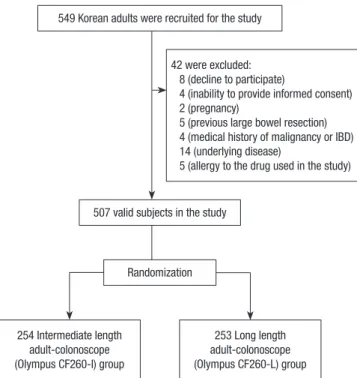
From May to July 2013, 549 Korean adults older than 20 yr were recruited for the study. Of the initial 549 subjects, 42 subjects were excluded because they declined to participate (n = 8), were unable to provide informed consent (n = 4), undergoing preg- nancy (n = 2), had a history of large bowel resection (n = 5), me dical history of malignancy or inflammatory bowel disease (IBD) (n = 4), underlying diseases including uncontrolled dia- betes mellitus (n = 2) and hypertension (n = 2), chronic renal failure (n = 4), heart failure (n = 3), and asthma (n = 3), or aller- gy to the drug used in the study (n = 5). Subsequently, 507 heal- thy Korean subjects were enrolled in the study.
The subjects were randomized into one of the two groups on the basis of a computer-generated list with a block size of four.
The ILAC group (n = 254) was assigned colonoscopic examina- tion with an intermediate length adult-colonoscope, whereas the LLAC group (n = 253) was assigned colonoscopic examina- tion with a long length adult-colonoscope. Enrollment and as- signment of participants were performed by one of the investi- gators not involved in the examinations at the study hospital. A flow diagram of the enrollment process was shown in Fig. 1. All subjects of this study, except for the colonoscopist, were blind- ed to the colonoscopes used.
Colonoscopic examination
As intubation time and success rate would most likely be affect- ed by the colonoscopist’s level of experience and skill, all colo- noscopic examinations were performed by a single experienc- ed colonoscopist. The examinations were performed with ei- ther Olympus CF-H260I (intermediate) or CF-H260L (long) video colonoscope (Olympus Optical Co., Ltd., Tokyo, Japan).
Both scopes had the same angulation ranges of bending sec- tion, insertion tube diameter (12.9 mm), and distal end diame- ter (13.2 mm). The two scopes differed only in the total and working lengths (CF-H260I = 165 and 133 cm, respectively; CF- H260L = 200 and 168 cm).
All included subjects underwent bowel preparation using 3 liters of polyethylene glycol solution (Colonlyte, Taejun Phar- maceutical Co., Seoul, Korea) the day before the day of colo- noscopy and then 1 liter of the solution on the day of colonos- copy. All colonoscopic examinations were performed under conscious sedation with combinations of intravenous midazol- am, propofol, and pethidine titrated as required. This study was designed for no difference in the degree of sedation (until the subject was asleep but arousing by shaking) between the two groups, because the degree of sedation can influence the colo- noscopic outcomes measured. Also, an antispasmodic agent, cimtropium bromide (Algiron, Green-Cross Pharmaceutical Co., Yongin, Gyeonggi-do, Korea), was given intravenously im- mediately before the procedure to prevent colonic wall spasms.
All colonoscopy began with the subject in the left lateral decu- bitus position. If the colonoscope could not be advanced dur- ing the procedure, one of the assistant nurses applied external abdominal compression at the discretion of the colonoscopist, as needed. If abdominal compression was not sufficient to al- low the scope to advance, the subject’s position was changed from the initial left lateral decubitus to the supine position and back again. The use of these extracolonoscopic maneuvers was recorded by another assistant nurse.
Outcome measurement
Prior to colonoscopy, each enrolled subject had completed a structured, self-administered questionnaire on the following:
current smoking habits (experience of regular smoking during the past 12 months), alcohol consumption (≥ 70 g/week or ≥ 10 g/day), exercise (at least once a week on a regular basis), previous history of colonoscopy, and history of abdominopel- vic surgery. Anthropometric data (height, body weight) were measured on the day of the procedure. Body mass index (BMI) was calculated as weight divided by height squared (kg/m2).
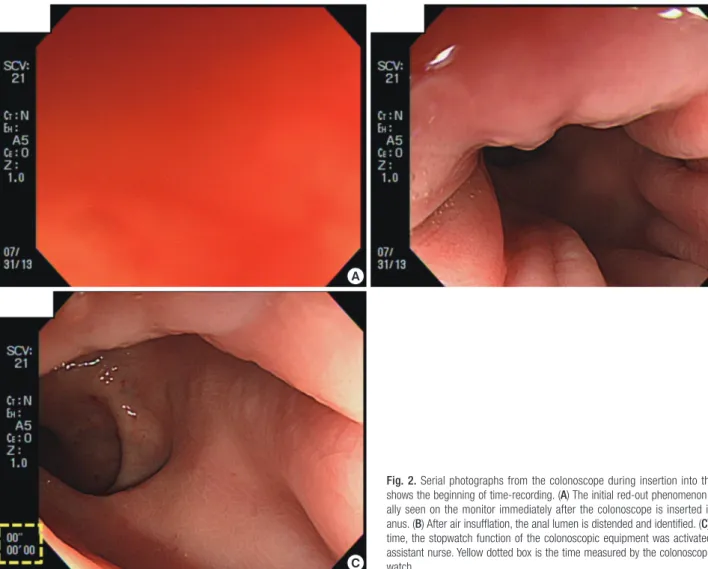
During and after the colonoscopy, data on procedure-related outcomes, such as cecal intubation time (CIT), cecal intubation rate (CIR), terminal ileal intubation time (TIIT), terminal ileal intubation rate (TIIR), and total procedure time (TPT), were collected. These procedure-related times were recorded by an 549 Korean adults were recruited for the study
507 valid subjects in the study
Randomization
254 Intermediate length adult-colonoscope (Olympus CF260-I) group
253 Long length adult-colonoscope (Olympus CF260-L) group 42 were excluded:
8 (decline to participate)
4 (inability to provide informed consent) 2 (pregnancy)
5 (previous large bowel resection) 4 (medical history of malignancy or IBD) 14 (underlying disease)
5 (allergy to the drug used in the study)
Fig. 1. Flow chart of study design. IBD, inflammatory bowel disease.
A
Fig. 2. Serial photographs from the colonoscope during insertion into the anus shows the beginning of time-recording. (A) The initial red-out phenomenon is usu- ally seen on the monitor immediately after the colonoscope is inserted into the anus. (B) After air insufflation, the anal lumen is distended and identified. (C) At this time, the stopwatch function of the colonoscopic equipment was activated by an assistant nurse. Yellow dotted box is the time measured by the colonoscopic stop- watch.
B
C assistant nurse using the stopwatch function on the endoscopy equipment (Fig. 2). Cecal intubation was considered successful through the visualization of colonoscopic landmarks, i.e., the il- eocecal valve (ICV) and appendiceal orifice (AO), and the CIT was defined as the time required from the introduction of the colonoscope to reach the base of the cecum (Fig. 3A, B). After the cecum was identified and still photographs of cecal land- marks were taken, ileal intubation was attempted. TIIT was de- fined as the time required for the colonoscope end to be ma- neuvered from the cecum to intubation of the terminal ileum (23). Intubation of the terminal ileum was confirmed with pho- tographic documentation of apparent villi in the terminal ileum by water-filling or using the narrow-band imaging method (Fig.
3C, D) (24). The cases in which the terminal ileum could not be intubated were not included in the analysis of TIIT. Withdrawal time (WT) was calculated by subtracting the TIIT or CIT (un- successful cases of terminal ileum intubation) from the TPT.
Additionally, the quality of bowel preparation was classified by the colonoscopist as excellent (absent or minimal solid stool with small amounts of clear fluid requiring suctioning), good (absent or minimal solid stool with large amounts of clear fluid
requiring suctioning), fair (presence of semisolid debris which is cleared with difficulty), and poor (solid or semisolid debris which cannot be effectively cleared) (25).
Statistical analysis
All continuous variables were expressed as means ± standard deviation, whereas categorical variables were presented as num- bers and percentages. Continuous variables were analyzed us- ing the independent t-test. Categorical variables were analyzed using the chi-square test or the Fisher-Freeman-Halton exten- sion of Fisher’s probability test, where appropriate. A P value less than 0.05 was considered statistically significant. In order to calculate the proper sample size, a pilot study was performed prior to the present study, due to the unavailability of published reports on colonoscopic parameters of terminal ileal intubation according to adult-colonoscope length. The sample size was calculated to be approximately 160 in each arm using a statisti- cal power of 80% (type II error, β error = 0.2) and a significance level of 0.05 (type I error, α error = 0.05) based on the difference of TIIR of our pilot study data (10%; ILAC vs LLAC, 85% vs 95%).
Statistical analyses were performed using MedCalc version 11.6
A
C
B
D Fig. 3. Colonoscopic landmarks in photographic documentation of complete cecal and terminal intubation. (A) Ileocecal valve (yellow arrow). (B) Appendiceal orifice (yellow ar- row). (C) Terminal ileum. Villi were seen in the terminal ileum (water-filling method). (D) Terminal ileum. Villi were seen in the terminal ileum (narrow-band imaging method).
(MedCalc software, Mariakerke, Belgium) for sample size cal- culation, and SPSS for Windows version 13.0 (SPSS Inc., Chica- go, IL, USA) for other analyses.
Ethics statement
This was a prospective, randomized, single-blinded controlled trial, which was approved by the institutional review board at Ajou University Hospital (AJIRB-DEV-DE2-12-423). Written inform- ed consent was obtained from all subjects enrolled in the study.
RESULTS
Baseline characteristics of enrolled subjects
Between May and July 2013, 507 colonoscopies were performed
by a single colonoscopist at our institution. A summary of the baseline characteristic of all subjects is shown in Table 1. The mean age was 49.8 ± 10.4 yr (range 23-84), and 63.1% of the subjects were men. Overall, 24.7% of subjects were smokers, 57.8% were alcohol users, and 47.1% exercised regularly. The mean BMI was 23.9 ± 3.1 kg/m2 (range 16.3-34.5). No serious complications, such as perforation or severe bleeding, occurred in the study patients during the colonoscopic examination.
Of all the participants, 47.1% had undergone colonoscopy once already, and 18.9% had undergone prior abdominopelvic surgery: simple appendectomy (n = 59, 39 males and 20 fema- les), laparoscopic cholecystectomy (n = 22, 12 males and 10 fe- males), and cesarean section without complications (n = 15, all females). Colonoscopist-assessed quality of bowel preparation
Table 1. Baseline characteristics of subjects
Characteristics All subjects (n = 507) ILAC group (n = 254) LLAC group (n = 253) P value
Age (yr) ≤ 40 41 ≤ 50 51 ≤ 60 ≥ 61
49.8 ± 10.4 104 (20.5%) 168 (33.1%) 164 (32.3%) 71 (14.0%)
50.3 ± 9.9 45 (17.7%) 88 (34.6%) 81 (31.9%) 40 (15.7%)
49.2 ± 10.9 59 (23.3%) 80 (31.6%) 83 (32.8%) 31 (12.3%)
0.222*
0.330†
Gender, No. (%) Male
Female 320 (63.1)
187 (36.9) 164 (64.6)
90 (35.4) 156 (61.7)
97 (38.3)
0.498†
BMI (kg/m2) < 23 23-25 > 25
23.9 ± 3.1 208 (41.0%) 121 (23.9%) 178 (35.1%)
24.1 ± 3.1 96 (37.8%) 65 (25.6%) 93 (36.6%)
23.8 ± 3.1 112 (44.3%) 56 (22.1%) 85 (33.6%)
0.324*
0.323†
Current smoker, No. (%) 125 (24.7) 61 (24.0) 64 (25.3) 0.738†
Alcohol user, No. (%) 293 (57.8) 146 (57.5) 147 (58.1) 0.887†
Exercise, No. (%) 239 (47.1) 118 (46.5) 121 (47.8) 0.757†
Experience of Previous CE, No. (%) Present
None
239 (47.1) 268 (52.9)
132 (52.0) 122 (48.0)
115 (45.5) 138 (54.5)
0.142† Hx of Abdominopelvic Surgery, No. (%)
Present None
96 (18.9) 411 (81.1)
44 (17.3) 210 (82.7)
52 (20.6) 201 (79.4)
0.353† Quality of Bowel Preparation, No. (%)
Excellent Good Fair Poor
48 (9.5) 301 (59.4) 132 (26.0) 26 (5.1)
32 (12.6) 149 (58.7) 60 (23.6) 13 (5.1)
16 (6.3) 152 (60.1)
72 (28.5) 13 (5.1)
0.092†
Subjects applied additional techniques during CE, No. (%) Abdominal compression
Positional change
160 (31.6) 109 (21.5)
82 (32.3) 52 (20.5)
78 (30.8) 57 (22.5)
0.725† 0.573† Data are described in mean ± standard deviation or number (percentage), as appropriate. *P value was calculated using the independent t-test; †P value was calculated using the chi-square test. ILAC, intermediate length adult-colonoscope; LLAC, long length adult-colonoscope; BMI, body mass index; CE, colonoscopic examination; Hx, history.
Table 2. Comparison of two groups with regard to colonoscopic examination parameters
Variables All subjects (n = 507) ILAC group (n = 254) LLAC group (n = 253) P value
CIR, No. (%) 505 (99.6) 252 (99.2) 253 (100.0) 0.499‡
CIT (sec) 257.5 ± 127.4 234.2 ± 115.0 280.7 ± 135.0 < 0.001*
TIIR, No. (%) 455 (89.7) 214 (84.3) 241 (95.3) < 0.001†
TIIT (sec) 36.4 ± 30.8 38.4 ± 29.5 34.7 ± 31.8 0.202*
TPT (sec) 1,033.7 ± 240.7 1,017.3 ± 246.9 1,050.1 ± 233.8 0.125*
WT (sec) 743.5 ± 196.8 750.5 ± 205.7 736.4 ± 187.7 0.421*
Data are expressed as mean ± SD or number (%), as appropriate. The WT was calculated by subtracting the TIIT or CIT (unsuccessful cases of intubation of terminal ileum) from the TPT. *P value was calculated using the independent t-test; †P value was calculated using the chi-square test; ‡P value was calculated using the Fisher-Freeman-Halton extension of Fisher’s probability test. ILAC, intermediate length adult-colonoscope; LLAC, long length adult-colonoscpe; CIR, cecal intubation rate; CIT, cecal intubation time;
TIIR, terminal ileal intubation rate; TIIT, terminal ileal intubation time; TPT, total preocedure time; WT, withdrawal time.
was excellent in 9.5%, good in 59.4%, fair in 26.0%, and poor in 5.1%. Abdominal compression and positional change were em- ployed in 32.3% and 20.5% of the subjects, respectively. No sig- nificant differences in baseline characteristics were observed between the two groups (ILAC vs LLAC) (Table 1).
Comparison of colonoscopic parameters between the two groups according to adult-colonoscope length
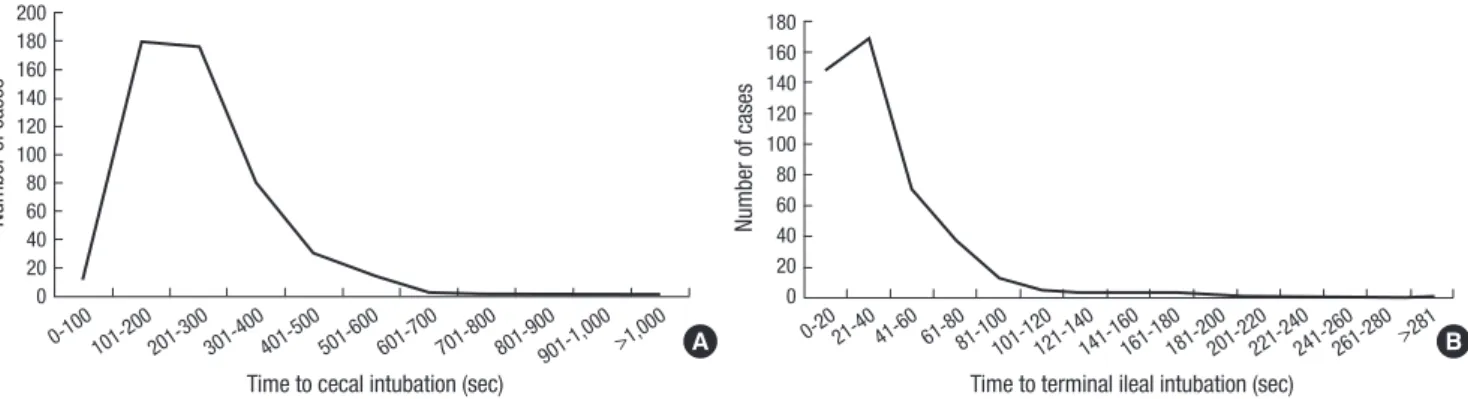
Table 2 summarizes the procedure-related outcomes. Overall, the CIR, CIT, TIIR, TIIT, TPT, and WT in all included subjects were 99.6%, 257.5 ± 127.4 sec (range 71-1,047, Fig. 4A), 89.7%, 36.4 ± 30.8 sec (range 3-290, Fig. 4B), 1,033.7 ± 240.7 sec (range
670-2,525), and 743.5 ± 196.8 sec (range 547-2,248), respective- ly. The cause of failure of cecal intubation was scope-looping (n = 2); the cause of failure of ileal intubation included scope- looping (n = 42) and difficult angulation of ICV (n = 8).
When the two groups were compared, as shown in Table 2 and Fig. 5, there were significant differences in CIT and TIIR: 1) Cecal intubation time was shorter for the ILAC group than for the LLAC group (234.2 ± 115.0 sec vs 280.7 ± 135.0 sec, P < 0.001);
2) Terminal ileal intubation rate was higher in the LLAC group than in the ILAC group (95.3% vs 84.3%, P = 0.001). No signifi- cant differences for CIR, TIIT, TPT, and WT were found between the two groups.
Fig. 5. Comparison of cecal intubation time and terminal ileal intubation rate according to adult-colonoscope length (intermediate versus long). (A) Cecal intubation time. (B) Terminal ileal intubation rate. ILAC, intermediate length adult-colonoscope; LLAC, long length adult-colonoscpe; CIT, cecal intubation time; TIIR, terminal ileal intubation rate.
CIT (sec)
ILAC group LLAC group
300 250 200 150 100 50 0
P value < 0.05
A
TIIR (%)
ILAC group LLAC group
100 80 60 40 20 0
P value < 0.05
B Fig. 4. The plot of time to cecal intubation and ileal intubation by the number of cases. (A) Cecal intubation time. (B) Terminal ileal intubation time.
Number of cases
Time to cecal intubation (sec)
0-100 101-200201-300301-400401-500501-600601-700701-800801-900901-1,000>1,000 200
180 160 140 120 100 80 60 40 20 0
A
Number of cases
Time to terminal ileal intubation (sec)
0-2021-40 41-60 61-8081-100101-120121-140141-160161-180181-200201-220221-240241-260261-280 >281 180
160 140 120 100 80 60 40 20 0
B
DISCUSSION
This study was a randomized, single-blinded, controlled trial aiming to evaluate the effect of colonoscope length on various procedural times and success rate parameters. The results of this study showed a higher intubation rate of terminal ileum (TIIR) in the LLAC group, but shorter intubation time of cecum (CIT) in the ILAC group.
The results of our study correspond with earlier studies. In this study, the mean CIT was significantly shorter in the ILAC group than that in the LLAC group, with no significant differ- ence in cecal intubate rate between the two groups. Previous studies have shown that the length of colonoscope influences CIT. Barthel et al. (17) had reported a comparison between in- termediate and long adult-colonoscopes. Although their evalu- ation was not done for CIT, the investigators found that the TPT was shorter with the intermediate-scope (ILAC) than with the long-scope (LLAC) and that cecal intubate rate was similar be- tween the two colonoscope-length groups. In a large-scale study, Lee et al. demonstrated that an ILAC appears to offer an advan- tage over a LLAC with regard to CIT (26). Controversy exists concerning the benefits of ILAC in CIT. Dickey and Garrett (18) reported that there were no differences in the CIR and CIT with respect to the length of colonoscope used. However, although
the difference was not statistically significant, there was a trend toward a shorter CIT in the ILAC group (ILAC group, 7.73 min vs LLAC group, 8.11 min; P = 0.44).
The finding of shorter cecal intubation time in the ILAC group is most likely due to the fact that intermediate length scopes do not loop in the sigmoid colon as much as longer scopes. In ad- dition, long scopes allow the colonoscopist to push through the loops without a concern for ‘‘running out of scope’’, whereas the intermediate-scopes force the colonoscopist to straighten the scope, reduce loops, and accordion-fold the colon over the scope.
In summary, shorter colonoscopes may be easier to manueu- ver and are less likely to develop colonic looping, thus facilitat- ing faster intubation.
Although there was a statistically significant reduction in CIT with the use of ILAC, the clinical relevance of this difference, which is only about 45 sec, is questionable. However, reduction of CIT means a decrease in the duration of patient discomfort and complication rates. In fact, most serious complications of colonoscopy including iatrogenic perforation occur during the intubation phase rather than the withdrawal phase (27, 28). In addition, if examinations are performed by less-experienced colonoscopists (beginner), this difference of CIT according to the length of colonoscope would be augmented. Previous stud- ies with regard to association with other colonoscope-related
factors (variable stiffness and trasparent hood) and intubation time revealed that the difference of intubation time was promi- nent in beginners (11, 29-31). Also, with the increasing demand of colonoscopy for CRC screening, this saving of time will be- come ever more important, i.e., “only one case of colonoscopy may be only 45 sec of time saving, 1,000 case of colonoscopy may be more than 45,000 sec of time saving”.
In order to perform a complete colonoscopy without missing pathologic lesions, especially in areas such as the terminal ile- um and proximal colon, it is important to achieve a high rate of cecal and terminal ileal intubation. However, the value of ter- minal ileal intubation during colonoscopy remains controver- sial (24, 32). Therefore, in clinical practice, intubation of the ter- minal ileum, i.e., ileoscopy, is not routinely performed during colonoscopy. However, ileoscopy has a few valuable advantag- es regarding colonoscopic examination (33). Ileoscopy is par- ticularly useful for patients with symptoms suggestive of IBD in order to exclude isolated ileal disease or to facilitate differential diagnosis between Crohn’s disease and ulcerative colitis. Fur- thermore, it may be useful to confirm the completeness of the colonoscopy, together with cecal landmarks (ICV and AO). The unreliability of cecal landmarks to document the extent of co- lonic examination is corroborated by previous prospective stu- dies (34, 35). Thus, we would like to recommend colonoscopists to intubate the terminal ileum during colonoscopy, especially for subjects with IBD symptoms, or in cases with unreliability of cecal intubation. In this aspect, it may be of importance to know factors affecting higher TIIR.
In our study, the TIIR was higher in the LLAC group than in the ILAC group, but there was no significant difference in TIIT between the two groups. In the past, De Silva et al. (23) investi- gated the association between the subject’s position and termi- nal ileal intubation. They reported that the prone position sig- nificantly reduces TIIT during colonoscopy, when compared to the left lateral (standard) position (P < 0.001). In addition, their study show ed that the TIIR was higher in the prone position group than that in the left lateral position group (98.7% vs 94.7%), 94.7%. However, no published data exist on how different leng- ths of adult-colonoscopes affect time and success rate in reach- ing the terminal ileum. Thus, the primary aim of this study was to evaluate TIIR and TIIT according to the length of colonoscope used. The results showed that long-scopes may offer a potential advantage over intermediate-sco pes with regard to TIIR. In the clinical setting, most colonoscopists may recognize that colo- noscope length may influence the completion rate of intuba- tion of the terminal ileum. Although there have been no studies directly investigating the association between the length of colo- noscope and terminal ileal intubation, previous studies have found plenty of evidence that long scopes offer the highest chance of successful cecal intubation (17, 18, 21, 22, 26). In this study, the longer scope also appeared to offer a higher success rate for
terminal ileal intubation. Even with the greatest efforts to pre- vent colonic loops during intubation by colonoscopists, it is im- possible to have no loops. Thus, in many cases, when an inter- mediate-scope reaches the cecal base, the portion of the unin- serted colonoscope may not be enough to intubate the terminal ileum. However, because long-scope still has additional length enough to intubate the terminal ileum, it is helpful for higher TIIR. Our study has the following limitations. First, it was impos- sible to apply the double-blind ed study method. Obviously, the colonoscopist performing the procedure could not be blinded to the instrument being used. Second, this study was conducted at a single center, which could have led to selection bias. Also, all colonoscopies were perform ed by a single colonoscopist, and individual preferences for longer or shorter colonoscope might have acted as an intraobserver bias. Hence, future studies will be necessary to assess whether or not the results of this study could be replicated with other colonoscopists, including training colo- noscopists. Despite these limitations, our study has the strength of being the study to evaluate the association between colono- scopic examination parameters and the length of adult colo- noscopies, which was assessed by randomization and not by the method of alternation of colonoscopes as done in previous studies (18, 26). Additionally, we tried to control other factors affecting examination parameters. Thus, we believe that this study may be helpful to physicians performing colonoscopy in clinicial practice and to medical researchers planning further large-scale studies.
In summary, no one colonoscope is ideal for all patients and purposes. On the basis of this study, intermediate length adult- colonoscopes decreased the amount of time required to reach the cecum. However, long length adult-colonoscopes offered an increased success rate of terminal ileal intubation. Therefore, in clinical practice, instead of insisting on one type of colono- scope or another, it may be reasonable to prepare two types of colonoscope and use the appropriate scope depending on the patient and the need for the colonoscopic examination.
DISCLOSURE
The authors have no conflicts of interest to disclose.
REFERENCES
1. Siegel R, Naishadham D, Jemal A. Cancer statistics, 2013. CA Cancer J Clin 2013; 63: 11-30.
2. Sung JJ, Lau JY, Goh KL, Leung WK; Asia Pacific Working Group on Col- orectal Cancer. Increasing incidence of colorectal cancer in Asia: impli- cations for screening. Lancet Oncol 2005; 6: 871-6.
3. Jung KW, Park S, Kong HJ, Won YJ, Boo YK, Shin HR, Park EC, Lee JS.
Cancer statistics in Korea: incidence, mortality and survival in 2006-2007.
J Korean Med Sci 2010; 25: 1113-21.
4. Kim YJ. What is a reasonable screening test for colorectal cancer. J Kore- an Soc Coloproctol 2010; 26: 375.
5. Bertelson NL, Kalkbrenner KA, Merchea A, Dozois EJ, Landmann RG, De Petris G, Young-Fadok TM, Etzioni DA. Colectomy for endoscopical- ly unresectable polyps: how often is it cancer? Dis Colon Rectum 2012;
55: 1111-6.
6. Baik SH, Lee KS, Jeong SY, Park YK, Kim HS, Lee DH, Oh HJ, Kim BC;
Korean Academy of Medical Sciences. Development of a rating system for digestive system impairments: Korean Academy of Medical Sciences Guideline. J Korean Med Sci 2009; 24: S271-6.
7. Choi YS, Lee JB, Lee EJ, Lee SH, Suh JP, Lee DH, Kim do S, Youk EG. Can endoscopic submucosal dissection technique be an alternative treatment option for a difficult giant (≥ 30 mm) pedunculated colorectal polyp?
Dis Colon Rectum 2013; 56: 660-6.
8. Zuber-Jerger I, Endlicher E, Gelbmann CM. Factors affecting cecal and ileal intubation time in colonoscopy. Med Klin (Munich) 2008; 103: 477- 81.
9. Kim WH, Cho YJ, Park JY, Min PK, Kang JK, Park IS. Factors affecting in- sertion time and patient discomfort during colonoscopy. Gastrointest Endosc 2000; 52: 600-5.
10. Hsu CM, Lin WP, Su MY, Chiu CT, Ho YP, Chen PC. Factors that influ- ence cecal intubation rate during colonoscopy in deeply sedated patients.
J Gastroenterol Hepatol 2012; 27: 76-80.
11. Bernstein C, Thorn M, Monsees K, Spell R, O’Connor JB. A prospective study of factors that determine cecal intubation time at colonoscopy. Gas- trointest Endosc 2005; 61: 72-5.
12. Arcovedo R, Larsen C, Reyes HS. Patient factors associated with a faster insertion of the colonoscope. Surg Endosc 2007; 21: 885-8.
13. Krishnan P, Sofi AA, Dempsey R, Alaradi O, Nawras A. Body mass index predicts cecal insertion time: the higher, the better. Dig Endosc 2012; 24:
439-42.
14. Hsieh YH, Kuo CS, Tseng KC, Lin HJ. Factors that predict cecal insertion time during sedated colonoscopy: the role of waist circumference. J Gas- troenterol Hepatol 2008; 23: 215-7.
15. Rex DK. Effect of variable stiffness colonoscopes on cecal intubation times for routine colonoscopy by an experienced examiner in sedated patients.
Endoscopy 2001; 33: 60-4.
16. Sola-Vera J, Uceda F, Brotons A, Sáez J, Girona E, Pérez E, Picó MD, Grau C, Sillero C. Does the use of a variable stiffness colonoscope offer advan- tages during colonoscopy under deep sedation? results of a randomized trial. Eur J Gastroenterol Hepatol 2011; 23: 593-7.
17. Barthel J, Hinojosa T, Shah N. Colonoscope length and procedure effi- ciency. J Clin Gastroenterol 1995; 21: 30-2.
18. Dickey W, Garrett D. Colonoscope length and procedure efficiency. Am J Gastroenterol 2002; 97: 79-82.
19. Hsieh YH, Zhou AL, Lin HJ. Long pediatric colonoscope versus interme- diate length adult colonoscope for colonoscopy. J Gastroenterol Hepatol 2008; 23: e7-10.
20. Shumaker DA, Zaman A, Katon RM. A randomized controlled trial in a training institution comparing a pediatric variable stiffness colonoscope, a pediatric colonoscope, and an adult colonoscope. Gastrointest Endosc
2002; 55: 172-9.
21. Marshall JB. Use of a pediatric colonoscope improves the success of total colonoscopy in selected adult patients. Gastrointest Endosc 1996; 44:
675-8.
22. Saifuddin T, Trivedi M, King PD, Madsen R, Marshall JB. Usefulness of a pediatric colonoscope for colonoscopy in adults. Gastrointest Endosc 2000; 51: 314-7.
23. De Silva AP, Kumarasena RS, Perera Keragala SD, Kalubowila U, Niriella M, Dassanayake AS, Pathmeswaran A, de Silva HJ. The prone 12 o’clock position reduces ileal intubation time during colonoscopy compared to the left lateral 6 o’clock (standard) position. BMC Gastroenterol 2011;
11: 89.
24. Powell N, Hayee BH, Yeoh DP, Rowbotham DS, Saxena V, McNair A.
Terminal ileal photography or biopsy to verify total colonoscopy: does the endoscope agree with the microscope? Gastrointest Endosc 2007; 66:
320-5.
25. Rex DK, Petrini JL, Baron TH, Chak A, Cohen J, Deal SE, Hoffman B, Ja- cobson BC, Mergener K, Petersen BT, et al. Quality indicators for colo- noscopy. Am J Gastroenterol 2006; 101: 873-85.
26. Lee HL, Eun CS, Lee OY, Jeon YC, Han DS, Sohn JH, Yoon BC, Choi HS, Hahm JS, Lee MH, et al. Significance of colonoscope length in cecal in- sertion time. Gastrointest Endosc 2009; 69: 503-8.
27. Lohsiriwat V, Sujarittanakarn S, Akaraviputh T, Lertakyamanee N, Loh- siriwat D, Kachinthorn U. What are the risk factors of colonoscopic per- foration? BMC Gastroenterol 2009; 9: 71.
28. Kim JH, Jeon EJ, Song JH, Lee SH, Jung JH, Cheung DY, Kim JI, Park SH, Kim JK. Colonoscopic perforation during a diagnostic colonoscopy. Ko- rean J Gastrointest Endosc 2011; 42: 289-92.
29. Shida T, Katsuura Y, Teramoto O, Kaiho M, Takano S, Yoshidome H, Miyazaki M. Transparent hood attached to the colonoscope: does it real- ly work for all types of colonoscopes? Surg Endosc 2008; 22: 2654-8.
30. Cheon YK, Jung IS, Cho YD, Kim JO, Lee MS, Shim CS. A comparative study for usefulness of a variable-stiffness colonoscope to a conventional colonoscope. Korean J Gastrointest Endosc 2002; 25: 132-6.
31. Westwood DA, Alexakis N, Connor SJ. Transparent cap-assisted colo- noscopy versus standard adult colonoscopy: a systematic review and me- ta-analysis. Dis Colon Rectum 2012; 55: 218-25.
32. Kennedy G, Larson D, Wolff B, Winter D, Petersen B, Larson M. Routine ileal intubation during screening colonoscopy: a useful maneuver? Surg Endosc 2008; 22: 2606-8.
33. Jeong SH, Lee KJ, Kim YB, Kwon HC, Sin SJ, Chung JY. Diagnostic value of terminal ileum intubation during colonoscopy. J Gastroenterol Hepa- tol 2008; 23: 51-5.
34. Rey JF, Lambert R; ESGE Quality Assurance Committee. ESGE recom- mendations for quality control in gastrointestinal endoscopy: guidelines for image documentation in upper and lower GI endoscopy. Endoscopy 2001; 33: 901-3.
35. Marshall JB, Brown DN. Photodocumentation of total colonoscopy: how successful are endoscopists? do reviewers agree? Gastrointest Endosc 1996;
44: 243-8.