The foot is a relatively rare site of neoplastic and non- neoplastic soft tissue masses. Although it contains a rela- tively small amount of somatic soft tissue elements, the foot is rich in tendons, fasciae, retinaculae, and synovi- um (1). In the Armed Forces Institute of Pathology se- ries[LKH1], 8% of benign soft-tissue tumors and 5% of malignant soft-tissue tumors occurred in the foot and ankle, suggesting an unexpectedly high incidence on a tissue volume basis. In general, benign tumors occur at least 10 times more frequently than malignant soft tis- sue tumors. In one series of soft-tissue tumors of the foot and ankle, 87% of lesions were benign (2).
Of all the imaging modalities, MRI demonstrates supe-
rior soft tissue characterization and is now considered the gold-standard imaging technique in their investiga- tion. Lately, we have encountered rare benign masses and malignant soft tissue tumors of the foot. The pre- sented cases include benign masses such as granuloma annulare, angiomyoma, neural fibrolipoma, and giant cell tumor of tendon sheath, as well as malignant tu- mors such as melanoma, synovial sarcoma, rhab- domyosarcoma and extraskeletal myxoid chondrosarco- ma. There are few published English reports addressing the MR appearance of these masses. This pictorial essay shows MR features of uncommon soft tissue tumors of the foot with associated clinicopathologic findings.
Benign masses of the foot
Granuloma annulare
Granuloma annulare is an uncommon benign inflam- matory dermatosis characterized by the formation of
MR Imaging of Uncommon Soft Tissue Tumors in the Foot: A Pictorial Essay1
Youn Joo Lee, M.D., Kyung Ah Chun, M.D., Jee Young Kim, M.D., Mi Sook Sung, M.D., Ki Tae Kim, M.D.
1Department of Radiology, The Catholic University of Korea Received December 21, 2006 ; Accepted March 23, 2007
Address reprint requests to : Kyung Ah Chun, M.D., Department of Radiology, The Catholic University of Korea, Uijeongbu St. Mary’s Hospital, Geumo-dong, Uijeongbu city, Gyeonggi-do 480-821, Korea.
Tel. 82-31-820-3137 Fax. 82-31-846-3080 E mail: [email protected]
A large variety of masses occur in the foot. The foot is a comparatively rare site of soft tissue neoplasms. MRI has greatly improved the ability to detect and delineate soft tissue lesions and is now considered the gold-standard imaging technique in their in- vestigation. Recently, we have encountered rare soft tissue tumors of the foot. The pre- sented cases include benign masses such as granuloma annulare, angiomyoma, neural fibrolipoma, and giant cell tumor of tendon sheath, as well as malignant tumors such as melanoma, synovial sarcoma, rhabdomyosarcoma and extraskeletal myxoid chon- drosarcoma. We wish to illustrate the MR findings of these uncommon soft tissue tu- mors to aid in their diagnosis.
Index words :Foot, neoplasms Neoplasms, MR
Magnetic resonance (MR), image display Soft tissues, neoplasms
Neoplasms, diagnosis
A B
C D
Fig. 1. Granuloma annulare in a 6- year-old boy.
A. Sagittal T1-weighted image shows a poorly-defined, isointense signal inten- sity subcutaneous lesion in the dorsal aspect of the foot.
B. Sagittal T2-weighted image shows heterogeneously low signal intensity.
C. Sagittal post-gadolinium T1-weight- ed image with fat saturation exhibits diffuse enhancement of the subcuta- neous lesion.
D. Photomicrograph (×100, H & E stain) shows well-circumscribed pal- isaded granuloma with granular and fibrillary, slightly basophilic material (mucin) around collagen bundles in the foci of histiocytic aggregation.
A B
C D
Fig. 2. Giant cell tumor of tendon sheath in a 29-year-old man
A, B. Axial T1-weighted (A) or sagittal T2-weighted (B) images show a large lobulated low signal intensity mass of the great toe.
C. Enhanced coronal fat saturated T1- weighted image shows prominent en- hancement of the mass surrounding the flexor tendon.
D. Photomicrograph (×100, H & E stain) demonstrates rounded or polyg- onal cells with focal collections of xan- thoma cells and scattered multinucle- ated giant cells throughout the mass.
dermal papules with a tendency to form rings (3).
Granuloma annulare represents about 2% of all benign soft tissue masses (4). About 7% of granuloma annulare present in the foot and ankle. There are several clinical- ly distinct forms: localized, generalized, perforating, and subcutaneous. The localized form is the most common type and presents as a nodular ringed skin eruption, typ- ically on the dorsum of the hands and feet, forearms, arms, legs, and thighs. It typically presents as a rapidly growing, solitary, painless, subcutaneous nodule. It is a disease of children and young adults, with two-thirds of patients presenting by age 30. The subcutaneous form presents with rapidly growing, painless, solitary superfi- cial nodule. Lesions are most common in the pretibial region, but may be seen in the scalp, foot, and ankle (3).
MR imaging reveals a subcutaneous mass with indis- tinct margin. This lesion has isointense signal intensity relative to the muscle on T1-weighted images, and low or heterogeneously hyperintense signal intensity on T2- weighted images (3). On enhanced T1-weighted images, mass shows extensive diffuse enhancement.
Giant cell tumor of tendon sheath
5-15% of giant cell tumors of tendon sheath present in the foot and ankle, typically in the first two toes (3).
Giant cell tumor of the tendon sheath represents about 4% of all benign soft tissue masses (4). It usually occurs in adults with a peak incidence in the third to fifth
decades and predominates in females. Pathologically, gi- ant cell tumor of tendon sheath is a highly vascular mass containing a mixture of multinucleated giant cells with deposition of intra-and extracellular hemosiderin due to repeated hemorrhage, as well as macrophages, fibrob- lasts, and xanthoma cells, which are the same histologic features as pigmented villonodular synovitis.
The main MR feature is a well-defined mass adjacent to the tendon. Typically the mass shows low signal in- tensity on both T1-weighted and T2-weighted images, due to the paramagnetic effect of hemosiderin.
A B
C D
Fig. 3. Angiomyoma in a 41-year-old woman
A, B. Sagittal (A) and coronal (B) T1- weighted images show small low sig- nal intensity mass in the plantar aspect of the foot.
C. Sagittal T2-weighted image with fat saturation shows heterogeneous high signal intensity mass.
D. Enhanced coronal fat saturated T1- weighted image demonstrates inho- mogeneous strong enhancement.
Fig. 4. Neural fibrolipoma in an 8-year-old boy.
Axial T1-weighted image shows heterogeneous lipomatous mass involving the second toe. Low signal areas correspond to neural tissue, while areas of high signal represent adipose tis- sue.
Gradient-echo sequences may be helpful because of the increased magnetic susceptibility effect produced by he- mosiderin. Areas with a high proportion of xanthoma cells may add regional MR characteristics of lipomatous tissue with fat-equivalent signal intensity on all pulse se- quences (1). Intense enhancement is frequently ob- served on postcontrast image (3).
Angiomyoma
The angiomyoma is a rare form of leiomyoma that usually occurs as a solitary subcutaneous form and origi- nates in the tunica media of vessels (1). They account for 5% of all benign soft tissue tumors. These tumors are frequent in women in their fourth to sixth decades.
Angiomyomas are typically small (0.5-2 cm), round, or oval tumors. The main symptoms are pain and tender- ness (3). Histologic features of angiomyoma are vascular channels with proliferation of smooth muscle cells.
MR shows low signal intensity on T1-weighted image and heterogeneous high signal intensity on T2-weighted image. Hyperintense regions on T2-weighted image demonstrated strong enhancement on post-contrast T1- weighted image, corresponding to bundles of smooth muscles around capillary-sized vessels. Areas with low signal intensity on T2-weighted image were related to tough fibrous tissue, with or without hyaline degenera- tion (1).
Neural fibrolipoma
Neural fibrolipoma, also known as lipofibromatous hamartoma, perineural lipoma, and intraneural lipoma, is a benign mass composed of hypertrophied fibrofatty tissues intermixed with nerve tissues. When it is associ- ated with macrodactyly, it is called macrodystrophia lipomatosa. This benign condition is characterized by a unilateral, gradually enlarging mass on a distal extremi- ty during early adulthood. The upper extremity, espe- cially the median nerve is the site most often affected.
Histologically, neural fibrolipoma is characterized by the proliferation of fibrofatty elements (5).
MR shows small, cylindrical, low signal intensities on high signal intensity background. This represents the nerve fascicles with epineural and perineural fibrosis on a background of fatty tissue.
Malignant masses of the foot
Malignant melanoma
Malignant melanoma (melanosarcoma) is a neoplasm containing fibroblast-like cells, some of which contain melanin. It can arise from the skin and produce local and distant osseous destruction. Melanomas on the foot are often detected at an advanced stage. Melanoma of the foot accounts for 3% to 15% of all cutaneous melanomas (6).
MR shows higher and relatively homogenous signal
A
B
C
Fig. 5. Malignant melanoma in a 79- year-old woman.
A. Axial T1-weighted image shows a large lobulated intermediate signal in- tensity mass of the great toe with adja- cent bone destruction.
B. Coronal T2-weighted image exhibits somewhat heterogeneous intermedi- ate signal intensity mass.
C. Enhanced sagittal fat saturated T1- weighted image shows heterogeneous enhancement extending to the bone and dorsal subcutaneous tissue of the foot.
intensity compared to muscle on T1-weighted image, with lower and more heterogeneous signal intensity rel- ative to muscle on T2?weighted image. Melanin causes shortening of T1 and T2 values, resulting in higher sig- nal intensity on T1-weighted and lower signal intensity on T2-weighted image. Signal intensities on T2-weight- ed image are influenced by the cellularity and the nucle- ocytoplasmatic index of the lesions, resulting in variable signals on T2-weighted image (1).
Rhabdomyosarcoma
Rhabdomyosarcoma was originally thought to arise from striated muscle, but is now regarded as a primary mesenchymal tumor in which rhabdomyoblastic differ- entiation has occurred (3). Rhabdomyosarcoma com- prises approximately 20% of all soft tissue sarcomas (7).
It may arise anywhere in the body, and the incidence in
the extremities is reported to be about 14% (4).
Rhabdomyosarco-mas vary widely in histological ap- pearance, depending on the growth pattern, cellularity, degree of differentiation, and configuration of the indi- vidual tumor cells. Rhabdomyosarcoma is classified into three main subgroups: embryonal, alveolar, and pleo- morphic. Embryonal is the most common type and oc- curs in the first decade of life. Embryonal rhab- domyosarcoma is composed of small cells with round or spindle-shaped hyperchromatic nuclei and varying numbers of larger cells that have eosinophilic cyto- plasm, which is characteristic of rhabdomyoblasts. The alveolar subtype is more common in adolescents and young adults and is usually intramuscular. It is com- posed of small, round to oval cells forming nests separat- ed by fibrous connective tissue. The pleomorphic type is typically seen in adults. Pathologic diagnosis of this type
A
B C
D
Fig. 6. Rhabdomyosarcoma in a 42-year-old woman
A. Sagittal T1-weighted image shows poorly-defined low signal intensity mass.
B. Axial T2-weighted image shows high signal intensity mass with low signal strand.
C. Axial post-gadolinium T1-weighted image with fat saturation reveals strong enhancement of the mass.
D. Photomicrograph (×200, H & E stain) shows ill-defined aggregation of poorly-differentiated round or oval cells, and formation of irregular alveolar spaces separated and surrounded by a framework of dense fibrous septa.
A B
C D
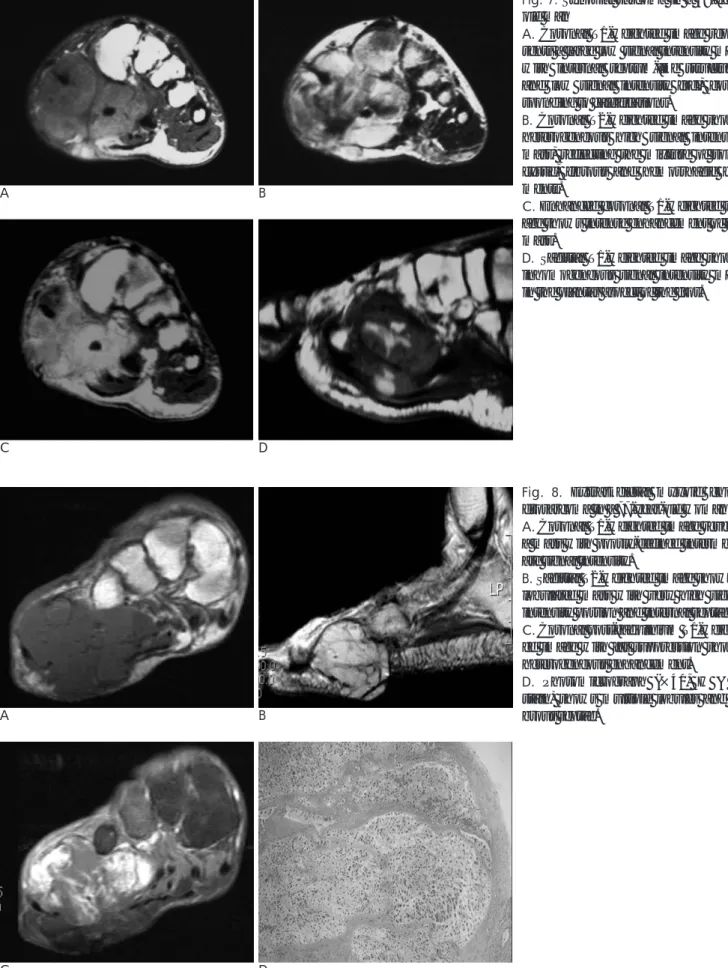
Fig. 8. Extraskeletal myxoid chon- drosarcoma in a 77-year-old woman A. Coronal T1-weighted image reveals a mass with poorly-defined intermedi- ate signal intensity.
B. Sagittal T2-weighted image shows a lobulated mass with very high signal intensity portion and internal septae.
C. Coronal post-gadolinium T1-weight- ed image with fat suppression shows heterogeneous enhancement.
D. Photomicrograph (×40, H & E stain) shows multiple lobules and fi- brous septae.
A B
C D
Fig. 7. Synovial sarcoma in a 38-year- old man
A. Coronal T1-weighted image repre- sents a large low signal intensity mass with internal septum-like structures and low signal intensity foci, corre- sponding to calcifications.
B. Coronal T2-weighted image shows heterogeneous high signal intensity mass, reflecting the mixture of solid, cystic, fibrous and hemorrhagic ele- ments.
C. Enhanced coronal T1-weighted im- age shows intense enhancement of the mass.
D. Sagittal T1-weighted image shows inhomogeneous signal intensity mass in the plantar aspect of the foot.
is difficult due to the absence of rhabdomyoblasts and the close resemblance to lesions of malignant fibrous histiocytoma and other pleomorphic sarcomas (3).
MR imaging shows nonspecific appearance, isointense to muscle on T1-weighted image, hyperintense on T2- weighted image, and marked enhancement on postcon- trast image. Extremity alveolar rhabdomyosarcoma fre- quently shows prominent vascularity with serpentine high-flow vessels. Intralesional hemorrhage is also not unusual (3).
Synovial sarcoma
Synovial sarcoma is a well-recognized soft tissue ma- lignancy, accounting for up to 10% of all malignant mes- enchymal tumors. It is the fourth-most common soft tis- sue sarcoma after malignant fibrous histiocytoma, li- posarcoma, and rhabdomyosarcoma. Almost 25% of all soft tissue sarcomas occur in the foot and ankle region.
Synovial sarcoma is of mesenchymal origin, named for its histologic similarity to synovium (1). Since synovial sarcoma has no relationship to synovial tissue, an intra- articular location is very rare. It predominates in young adults between 20 and 40 years, typically arises in the neighborhood of tendons, tendon sheaths, and bursae, and is less frequently related to fasciae, aponeuroses and ligaments. Most synovial sarcomas present as palpable masses, but in some cases localized pain may precede the presence of a mass for many years. The prognosis is generally poor with a 5-year survival rate of 50-60%
(8).
MR shows inhomogeneous signal intensity on T1- and T2-weighted images. The characteristic MR features are infiltrative margin, solid portions, septated areas of hem- orrhage, and necrosis. Viable solid portion usually rep- resents intense contrast enhancement. Calcifications within the tumor are frequent. MR appearance is also characterized by a peritendinous growth pattern. The tumors are commonly found in a juxta-articular location and are often large. However, particularly in smaller tu- mors, there is a reported tendency to present with well- defined margin and homogenous signal, possibly lead- ing to the mistaken diagnosis of a benign lesion (1).
Extraskeletal myxoid chondrosarcoma
Extraskeletal myxoid chondrosarcoma is a rare malig- nant soft tissue tumor composed of abundant myxoid matrix and malignant chondroblastic cells (9).
Extraskeletal chondrosarcomas are far less common than intraosseous chondrosarcomas, representing ap-
proximately 2% of all soft-tissue sarcomas. The histolog- ic types of lesions are myxoid and mesenchymal.
Extraskeletal myxoid chondrosarcoma is the most com- mon histologic type of soft tissue chondrosarcoma (10).
It predominates in adults aged 50-60 years, although patient ages range from 4 to 92 years (9). The vast major- ity of lesions are in the extremities, with the thigh being the single most common location. Pathologically, the le- sions are usually surrounded by a fibrous capsule and contain fibrous septa that divide the lesion into multiple lobules, frequently with areas of cyst formation and he- morrhage. Calcification and bone formation are not typ- ically present.
MR imaging shows a lobulated mass with hyperin- tense signal on T2-weighted image and variable signal on T1-weighted image. Extraskeletal myxoid chon- dro°°sarcoma, reflective of its extremely high water content, appears with very high signal intensity on T2- weighted MR image, with only mild peripheral to septal enhancement after contrast material administration (10).
Conclusion
Soft tissue masses in the foot are unusual. In this picto- rial essay, we described MR imaging features of uncom- mon benign and malignant tumors in the foot.
Correlation between the MR imaging and clinicopatho- logic appearance of these masses is also addressed.
Unfortunately, the MRI features of a soft tissue mass are not always specific; however, there are cases where the diagnosis can be made or a clue provided to aid in the di- agnosis.
References
1. Waldt S, Rechl H, Rummeny EJ, Woertler K. Imaging of benign and malignant soft tissue masses of the foot. Eur Radiol 2003;13:
1125-1136
2. Bos GD, Esther RJ, Woll TS. Foot tumors: diagnosis and Treatment. J Am Acad Orthop Surg 2002;10:259-270
3. Kransdorf MJ, Murphey MD. Imaging of soft tissue tumors. 2nd ed.
Philadelphia: Lippincott Williams & Wilkins. 2006;299:312- 321,386,563-565
4. Kransdorf MJ. Benign soft tissue tumors in a large referral popula- tion: distribution of specific diagnoses by ages, sex, and location.
AJR Am J Roentgenol 1995;164:395-402
5. Ly JQ, Bui-Mansfield LT, SanDiego JW, Beaman NA, Ficke JR.
Neural fibrolipoma of the foot. J Comput Assist Tomogr 2003;27:
639-640
6. Gray RJ, Pckaj BA, Vega ML, Connolly SM, DiCaudo DJ, Kile TA, et al. Diagnosis and treatment of malignant melanoma of the foot.
Foot Ankle Int 2006;27:696-705
7. Suzuki Y, Ehara S, Shiraishi H, Nishida J, Murooka G, Tamakawa Y. Embryonal rhabdomyosarcoma of foot with expansive growth between metatarsals. Skeletal Radiol 1997;26:128-130
8. Nakanishi H, Araki N, Sawai Y, Kudawara I, Mano M, Ishigura S, et al. Cystic synovial sarcomas: imaging features with clinical and histopathologic correlation. Skeletal Radiol 2003;32:701-707
9. Tateishi U, Hasegawa T, Nojima T, Takegami T, Arai Y. MRI fea- tures of extraskeletal myxoid chondrosarcoma. Skeletal Radiol 2006;35:27-33
10. Murphey MD, Walker EA, Wilson AJ, Kransdorf MJ, Temple HT, Cannon FH. Imaging of primary chondrosarcoma: radiologic- pathologic correlation. Radiographics 2003;23:1245-1278
대한영상의학회지 2007;56:585-592
발에서 드문 연부 조직 종양들의 자기공명영상소견: 임상화보1
1가톨릭대학교 의과대학 영상의학과 이윤주・천경아・김지영・성미숙・김기태
다양한 종류의 종괴들이 발에 생긴다. 발은 종양성과 비종양성의 연부 조직 종괴들이 비교적 드물게 생기는 곳 이다. 최근 자기공명영상을 통해 연부 조직 병변의 발견과 분석 능력이 크게 향상되었다. 저자들은 발에 생긴 연부 조직 종양 중 흔하지 않은 증례들을 경험하였기에 이들의 자기공명영상소견을 보고하고자 한다. 양성 종양으로는 원형 육아종(granuloma annulare), 맥관근종(angiomyoma), 신경성의 섬유지방종(neural fibrolipoma), 힘줄집의 거 세포종양(giant cell tumor of tendon sheath)이 있고 악성종양으로는 흑색종(melanoma), 윤활막 육종(synovial sarcoma), 횡문근육종(rhabdomyosarcoma), 골외성 점액양 연골육종(extraskeletal myxoid chondrosarcoma)이 있다.