Risk Factors of Permanent Stomas in Patients with Rectal Cancer after Low Anterior Resection with Temporary Stomas
Chul Min Lee,
1Jung Wook Huh,
1Yoon Ah Park,
1Yong Beom Cho,
1Hee Cheol Kim,
1Seong Hyeon Yun,
1Woo Yong Lee,
1and Ho-Kyung Chun
21Department of Surgery, Samsung Medical Center, Sungkyunkwan University School of Medicine, Seoul;
2Department of Surgery, Kangbuk Samsung Hospital, Sungkyunkwan University School of Medicine, Seoul, Korea.
Received: April 16, 2014 Accepted: June 23, 2014
Co-corresponding authors: Dr. Jung Wook Huh, Department of Surgery,
Samsung Medical Center,
Sungkyunkwan University School of Medicine, 81 Irwon-ro, Gangnam-gu,
Seoul 135-710, Korea.
Tel: 82-2-3410-1826, Fax: 82-2-3410-6980 E-mail: [email protected] and Dr. Seong Hyeon Yun,
Department of Surgery, Samsung Medical Center,
Sungkyunkwan University School of Medicine, 81 Irwon-ro, Gangnam-gu,
Seoul 135-710, Korea.
Tel: 82-2-3410-6546, Fax: 82-2-3410-6980 E-mail: [email protected]
∙ The authors have no financial conflicts of interest.
© Copyright:
Yonsei University College of Medicine 2015 This is an Open Access article distributed under the terms of the Creative Commons Attribution Non- Commercial License (http://creativecommons.org/
licenses/by-nc/3.0) which permits unrestricted non- commercial use, distribution, and reproduction in any medium, provided the original work is properly cited.
Purpose: The aim of this study was to identify risk factors influencing permanent stomas after low anterior resection with temporary stomas for rectal cancer. Mate- rials and Methods: A total of 2528 consecutive rectal cancer patients who had un- dergone low anterior resection were retrospectively reviewed. Risk factors for per- manent stomas were evaluated among these patients. Results: Among 2528 cases of rectal cancer, a total of 231 patients had a temporary diverting stoma. Among these cases, 217 (93.9%) received a stoma reversal. The median period between primary surgery and stoma reversal was 7.5 months. The temporary and perma- nent stoma groups consisted of 203 and 28 patients, respectively. Multivariate analysis showed that independent risk factors for permanent stomas were anasto- motic-related complications (p=0.001) and local recurrence (p=0.001). The 5-year overall survival for the temporary and permanent stoma groups were 87.0% and 70.5%, respectively (p<0.001). Conclusion: Rectal cancer patients who have tem- porary stomas after low anterior resection with local recurrence and anastomotic- related complications may be at increased risk for permanent stoma.
Key Words: Stoma, rectal cancer, low anterior resection
INTRODUCTION
The development of mechanical circular stapler devices and total mesorectal exci- sion with preoperative chemoradiation for the treatment of rectal cancer has al- lowed for sphincter-saving surgeries, improved oncologic outcomes, and also de- creased the prevalence of requiring a permanent stoma.1-4 Anastomotic leakage after sphincter-saving surgery is the most worrisome complication of stoma cre- ation, as it associated with numerous unfavorable clinical outcomes including postoperative morbidity and early mortality.5,6 Diverting stomas can minimize the fatal consequences of anastomotic leakage, although they do not substantially de- crease its incidence.7-9 While diverting stomas are intended to be temporary, they are also associated with permanent stomas, specifically non-reversal of the protec- tive stoma and secondary construction of a permanent stoma. Several recent stud- ies have shown that risk factors for permanent stomas include old age, anastomot-
the Institutional Review Board of Samsung Medical Cen- ter, and all patients gave informed consent.
Rectal cancer was determined by sigmoidoscopy and de- fined as a tumor with a lower border within 15 cm of the anal verge. Anastomosis-related complications included anasto- motic leakage, stricture, fistula, and pelvic abscess. Anasto- motic leakage was defined as clinical signs of peritonitis and radiological findings of extraluminal air, fistula, or in- tra-abdominal abscess. Patients with radiologically demon- strated anastomotic leakage without clinical evidence were excluded. Anorectal stricture was defined as stenosis requir- ing management either manually or with a Hegar dilator.
Early anastomotic-related complications were defined as those occurring within 90 days of the operation, while all others were considered late complications.
Patients were followed up at 3-month intervals for the first 2 years after surgery and then every 6 months for 5 years. Colon enema with water-soluble contrast media and colonoscopy were performed to evaluate any abnormalities such as leakage or stricture. If abnormal findings were ob- served, stoma closure was delayed until the leakage had healed or the stricture had improved by dilatation.
Statistical analyses were performed with SPSS (version 19; SPSS Inc., Chicago, IL, USA). The χ2 test or Fisher’s exact were used for univariate analyses for risk factors of permanent stomas. Independent risk factors were calculated by multivariate analysis with logistic regression. Only pa- ic-related complications, local recurrence, radiotherapy, and
poor anal function; however, these risk factors are not well established.10-13 In addition, there have been few reports fo- cusing on risk factors of permanent stomas after creating a primary diverting stoma.
The aim of this study was to identify the risk factors in- fluencing the need for a permanent stoma after low anterior resection with a temporary stoma for rectal cancer.
MATERIALS AND METHODS
We retrospectively reviewed a total of 2528 consecutive primary rectal cancer patients with histologically confirmed adenocarcinoma who underwent low anterior resection with temporary stomas from January 2000 to December 2009 at our institution. Patients who underwent palliative resection or emergency surgery or had recurrent cancer or distant metastasis were excluded from this study. In addi- tion, patients who died within 90 days after primary surgery were excluded. Ultimately, a total of 231 patients were en- rolled in our analysis (Fig. 1) and further divided into two groups: a temporary stoma group and a permanent stoma group. After placing patients into the two groups, the risk factors for permanent stoma were evaluated. Permanent stomas included stoma re-creation after reversal and stoma non-reversal after diversion. This study was approved by
Fig. 1. Patient selection flow chart. LAR, low anterior resection; APR, abdominoperineal resection.
Primary, LAR (n=2528)
No diverting stoma (n=2081)
Stoma reversal (+) (n=217)
Permanent stoma group (n=28)
Stoma recreation group (n=14) Stoma non-reversal group (n=14) Stoma free (n=203) Colostomy (n=9)
Temporary group (n=203)
APR (n=4) Hartmannʼs operation (n=14) Ileostomy (n=14) Diverting stoma (n=235)
Stoma reversal (-) (n=14) Elective, curative, non-distant metastasis (n=2312)
Emergency, palliation, distant metastasis
Death within 90 days after operation (n=4)
ileostomies (50.0%), eight colostomies (28.6%), and four abdominoperineal resections (14.3%), as well as one pa- tient (3.6%) who underwent Hartmann’s operation.
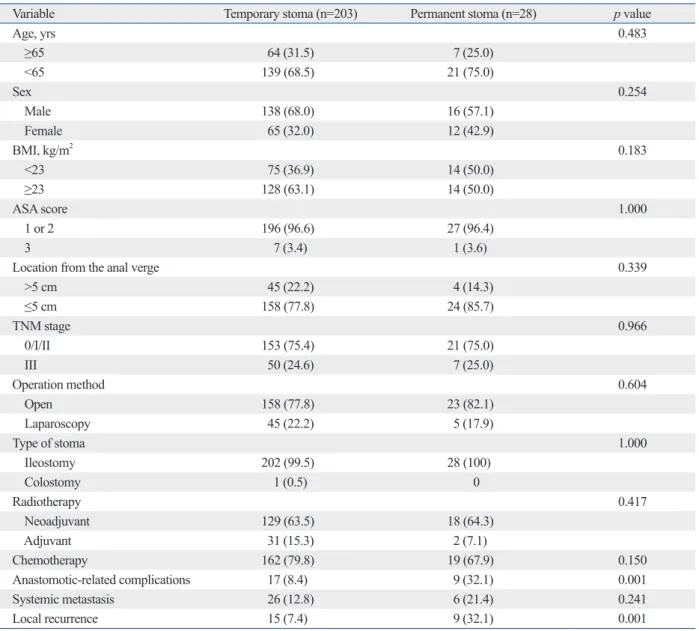
The characteristics of the temporary and permanent sto- ma groups are shown in Table 1. The risk of requiring a permanent stoma included anastomotic-related complica- tions (p=0.001) and local recurrence (p=0.001). Multivari- ate analysis showed that the independent risk factors for permanent stomas were local recurrence [odd ratio (OR), 5.050; 95% confidence interval (CI), 1.867‒13.659; p=
0.001] and anastomotic-related complications (OR, 4.369;
95% CI, 1.631‒11.701; p=0.001) (Table 2). The multivari- ate analysis revealed that sex, tumor-node-metastasis stage, and permanent stomas were independent prognostic factors for disease-free survival (Table 3).
rameters with values of p<0.20 were included in multivari- ate analysis. The overall survival rate was analyzed with the Kaplan-Meier method and the log-rank test. p-values <0.05 were considered statically significant.
RESULTS
There were 231 patients included in our study, and 217 (93.9%) received a stoma reversal. The median period be- tween primary surgery and stoma reversal was 7.5 months.
After a median follow-up of 50.4 months (range 4‒156 months), 203 patients were confirmed to have had a tempo- rary stoma while 28 patients required a permanent stoma.
Of the 28 permanent stoma patients (12.1%), there were 14
Table 1. Risk Factors for a Permanent Stoma among 231 Temporary Stoma Patients
Variable Temporary stoma (n=203) Permanent stoma (n=28) p value
Age, yrs 0.483
≥65 64 (31.5) 7 (25.0)
<65 139 (68.5) 21 (75.0)
Sex 0.254
Male 138 (68.0) 16 (57.1)
Female 65 (32.0) 12 (42.9)
BMI, kg/m2 0.183
<23 75 (36.9) 14 (50.0)
≥23 128 (63.1) 14 (50.0)
ASA score 1.000
1 or 2 196 (96.6) 27 (96.4)
3 7 (3.4) 1 (3.6)
Location from the anal verge 0.339
>5 cm 45 (22.2) 4 (14.3)
≤5 cm 158 (77.8) 24 (85.7)
TNM stage 0.966
0/I/II 153 (75.4) 21 (75.0)
III 50 (24.6) 7 (25.0)
Operation method 0.604
Open 158 (77.8) 23 (82.1)
Laparoscopy 45 (22.2) 5 (17.9)
Type of stoma 1.000
Ileostomy 202 (99.5) 28 (100)
Colostomy 1 (0.5) 0
Radiotherapy 0.417
Neoadjuvant 129 (63.5) 18 (64.3)
Adjuvant 31 (15.3) 2 (7.1)
Chemotherapy 162 (79.8) 19 (67.9) 0.150
Anastomotic-related complications 17 (8.4) 9 (32.1) 0.001
Systemic metastasis 26 (12.8) 6 (21.4) 0.241
Local recurrence 15 (7.4) 9 (32.1) 0.001
BMI, body mass index; ASA, American Society of Anesthesiologists; TNM, tumor-node-metastasis.
group was local recurrence, whereas in the stoma non-rever- sal group, the most common reasons were anastomotic-re- lated complications. However, this difference between the two groups was not significant. With respect to anastomotic- related complications between the two groups, the stoma rec- reation group was associated with late complications more often than early complications (early:late, 0:5) compared with the stoma non-reversal group (early:late, 2:3).
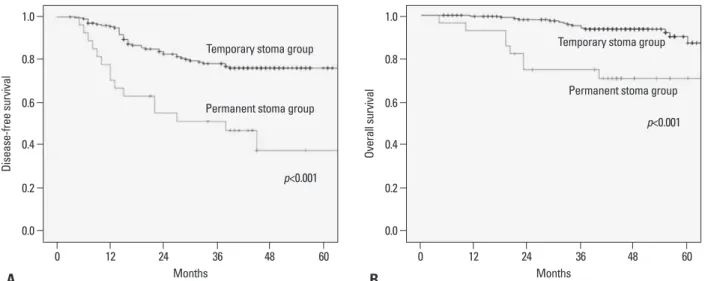
Survival data for the temporary and permanent stoma groups are presented in Fig. 2. Five-year disease-free sur- vival and overall survival curves were significantly differ- The characteristics of patients who needed a permanent
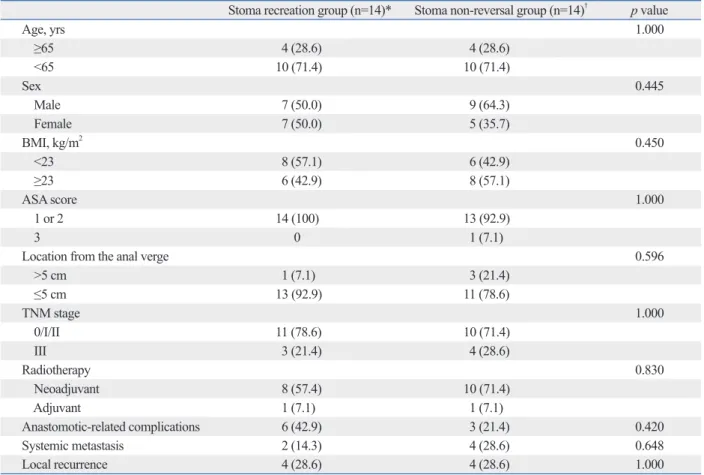
stoma, including stoma recreation after reversal (stoma rec- reation group, n=14) and stoma non-reversal after diversion (stoma non-reversal group, n=14) are shown in Table 4.
There were no differences between the two groups with re- spect to age, sex, body mass index, American Society of Anesthesiologists score, tumor location, stage, radiotherapy, anastomotic-related complications, systemic metastasis, or local recurrence. The reasons for requiring permanent sto- mas are compared between the two groups in Table 5. The main reason for permanent stomas in the stoma recreation Table 2. Multivariate Analysis of Risk Factors for a Permanent Stoma
OR (95% CI) p value
BMI 0.693 (0.296‒1.627) 0.400
Chemotherapy 1.350 (0.517‒3.524) 0.539
Anastomotic-related complications 4.369 (1.631‒11.701) 0.003
Local recurrence 5.050 (1.867‒13.659) 0.001
BMI, body mass index; OR, odd ratio; CI, confidence interval.
Table 3. Univariate and Multivariate Analysis for Disease-Free Survival in 231 Patients with Temporary Stomas
Variable Univariate
OR (95% CI) p value Multivariate
OR (95% CI) p value
Age, yrs 0.195 0.192
≥65 1 (referent) 1 (referent)
<65 1.505 (0.811‒2.7950) 1.513 (0.812‒2.818)
Sex 0.025 0.021
Male 1 (referent) 1 (referent)
Female 1.819 (1.077‒3.074) 1.869 (1.101‒3.173)
BMI, kg/m2 0.326
<23 1 (referent)
≥23 0.768 (0.455‒1.296)
ASA score 0.280
1 or 2 1 (referent)
3 0.046 (0.000‒12.175)
Location from the anal verge 0.274
>5 cm 1 (referent)
≤5 cm 1.464 (0.740‒2.899)
TNM stage <0.001 <0.001
0/I/II 1 (referent) 1 (referent)
III 2.866 (1.695‒4.848) 3.349 (1.956‒5.736)
Operation method 0.510
Open 1 (referent)
Laparoscopy 1.225 (0.670‒2.239)
Anastomotic-related complications 0.317
No 1 (referent)
Yes 1.438 (0.706‒2.932)
Permanent stoma <0.001 <0.001
No 1 (referent) 1 (referent)
Yes 3.250 (1.801‒5.864) 3.573 (1.963‒6.503)
BMI, body mass index; ASA, American Society of Anesthesiologists; TNM, tumor-node-metastasis; OR, odd ratio; CI, confidence interval.
quiring a permanent stoma in two outcomes, namely, non- reversal of the temporary stoma and recreation of the stoma after reversal.
The overall rate of permanent stomas after sphincter-sav- ing surgery of the rectum has been reported to be 3‒24%.10-14 In addition, some studies have shown that the non-reversal rate of diverting loop ileostomy is 13.8‒24.9%.9,15-18 In the present study, 12.1% of patients (28 of 231) had a perma- nent stoma, while 6.1% (14 of 231) had no reversals of di- verting loop ileostomy. We also found that anastomotic-re- ent between the two groups, respectively (both p<0.001).
DISCUSSION
Although it remains controversial whether diversion de- creases the incidence of anastomotic leakage, its use is nev- ertheless widespread due to the possibility of mitigating the consequences of anastomotic complications. However, di- verting stomas are associated with the potential risk of re- Table 4. Demographics of Permanent Stoma Patients
Stoma recreation group (n=14)* Stoma non-reversal group (n=14)† p value
Age, yrs 1.000
≥65 4 (28.6) 4 (28.6)
<65 10 (71.4) 10 (71.4)
Sex 0.445
Male 7 (50.0) 9 (64.3)
Female 7 (50.0) 5 (35.7)
BMI, kg/m2 0.450
<23 8 (57.1) 6 (42.9)
≥23 6 (42.9) 8 (57.1)
ASA score 1.000
1 or 2 14 (100) 13 (92.9)
3 0 1 (7.1)
Location from the anal verge 0.596
>5 cm 1 (7.1) 3 (21.4)
≤5 cm 13 (92.9) 11 (78.6)
TNM stage 1.000
0/I/II 11 (78.6) 10 (71.4)
III 3 (21.4) 4 (28.6)
Radiotherapy 0.830
Neoadjuvant 8 (57.4) 10 (71.4)
Adjuvant 1 (7.1) 1 (7.1)
Anastomotic-related complications 6 (42.9) 3 (21.4) 0.420
Systemic metastasis 2 (14.3) 4 (28.6) 0.648
Local recurrence 4 (28.6) 4 (28.6) 1.000
*Stoma recreation after reversal.
†Stoma non-reversal after diversion.
Table 5. Reasons for Requiring a Permanent Stoma
Cause Stoma recreation group (n=14)* Stoma non-reversal group (n=14)† p value
Local recurrence 6 (42.9) 1 (7.1) 0.077
Systemic recurrence 0 3 (21.4) 0.222
Anastomotic-related complications 5 (35.7) 5 (35.7) 1.000
Early:late 0:5 2:3
Poor anal function 1 (7.1) 0 1.000
Stoma complications 1 (7.1) 0 1.000
Obstruction 1 (7.1) 0 1.000
Others 0 4
*Stoma recreation after reversal.
†Stoma non-reversal after diversion.
Additional risk factors of permanent stomas include old age, radiation therapy, poor anal function, and distant me- tastasis. Interestingly, several previous studies have report- ed that old age is one of most significant risk factors for permanent stomas,10,15,21 while others have reported that it is not a risk factor.16,19,20 den Dulk, et al.15 suggested that fears of increased comorbidity in the elderly and patients’ refus- als to undergo additional surgeries may be responsible for the decreased frequency of stoma reversal in older patients.
In addition, some studies have shown that radiation therapy may also be a risk factor for permanent stomas12,19 due to the association between radiotherapy and anastomotic-re- lated complications.12 Conversely, Nelson, et al.11 reported that radiation therapy was found not to be a risk factor of permanent stomas. We concur with this finding after ob- serving that radiation therapy was not a risk factor of per- manent stoma in our study. Poor anal function and distant metastasis may also be risk factors for permanent stomas;
however, these were not evaluated in this retrospective anal- ysis. Specifically, we did not include these possible risk fac- tors given that postoperative anal function was not evaluat- ed as an objective measure in all patients at our institution and distant metastasis may have significantly influenced the high rate of permanent stomas due to disease progression.
The timing of stoma closure is highly variable. Some in- vestigators reported an average period between primary surgery and stoma closure of 4‒5.6 months.15,16,20 In the present study, the median time to stoma reversal was 7.5 months, which was a relatively longer interval to stoma re- versal than what described in other reports. One of the pos- sible reasons may have been a delay of stoma reversal after completion of postoperative adjuvant chemotherapy, which lated complications and local recurrence were independent
risk factors of permanent stomas in our study.
Local recurrence is a well-known risk factor of permanent stomas. Indeed, three recent studies reported that local recur- rence is the main reason for needing a permanent stoma and thus is more frequent than anastomosis-related complica- tions.11,16,19,20 In the present study, local recurrence was also the primary cause of the need for a permanent stoma and was followed by anastomotic related complications. Addi- tionally, the primary cause was the same for stoma recre- ation cases after reversal, though not for stoma non-reversal after diversion. Lim, et al.20 reported similar results, indicat- ing that local recurrence is the main reason for requiring stoma recreation after stoma closure. Specifically, they re- ported that 10 (55.6%) of 18 patients with permanent sto- mas due to local recurrence had received stoma recreation surgery.
Several recent studies have reported that anastomotic com- plications are predictive factors of permanent stomas. Jung- inger, et al.16 reported that the main reasons for needing a permanent stoma are anastomosis-related complications and local recurrence and that anastomosis-related complica- tions are the most commonly cited reason for allowing non- functioning stomas to remain in place (20 of 33 patients). In the present study, anastomotic-related complications were the second most common reason for requiring a permanent stoma; however, they were the primary reason for stoma non-reversal after diversion (5 of 14). Seo, et al.19 reported similar data showing the primary causes of non-reversal of diverting stomas to be anastomotic-related complications, which were also the main reasons for early permanent sto- mas (<1 year after surgery).
Fig. 2. Kaplan-Meier curves of 231 patients with temporary stomas. (A) Disease-free survival. (B) Overall survival.
Months Months
0.0 0.0
0.2 0.2
0.4 0.4
0.6 0.6
0.8 0.8
1.0 1.0
Disease-free survival Overall survival
0 12 24 36 48 60 0 12 24 36 48 60
A B
p<0.001
p<0.001 Permanent stoma group
Permanent stoma group
Temporary stoma group Temporary stoma group
1990;60:253-9.
7. Tan WS, Tang CL, Shi L, Eu KW. Meta-analysis of defunctioning stomas in low anterior resection for rectal cancer. Br J Surg 2009;
96:462-72.
8. Pakkastie TE, Ovaska JT, Pekkala ES, Luukkonen PE, Järvinen HJ. A randomised study of colostomies in low colorectal anasto- moses. Eur J Surg 1997;163:929-33.
9. Matthiessen P, Hallböök O, Rutegård J, Simert G, Sjödahl R. De- functioning stoma reduces symptomatic anastomotic leakage after low anterior resection of the rectum for cancer: a randomized mul- ticenter trial. Ann Surg 2007;246:207-14.
10. Lindgren R, Hallböök O, Rutegård J, Sjödahl R, Matthiessen P.
What is the risk for a permanent stoma after low anterior resection of the rectum for cancer? A six-year follow-up of a multicenter tri- al. Dis Colon Rectum 2011;54:41-7.
11. Nelson RS, Boland E, Ewing BM, Blatchford GJ, Ternent C, Shashidharan M, et al. Permanent diversion rates after neoadju- vant therapy and coloanal anastomosis for rectal cancer. Am J Surg 2009;198:765-70.
12. Hassan I, Larson DW, Wolff BG, Cima RR, Chua HK, Hahnloser D, et al. Impact of pelvic radiotherapy on morbidity and durability of sphincter preservation after coloanal anastomosis for rectal can- cers. Dis Colon Rectum 2008;51:32-7.
13. Maggiori L, Bretagnol F, Lefèvre JH, Ferron M, Vicaut E, Panis Y.
Conservative management is associated with a decreased risk of definitive stoma after anastomotic leakage complicating sphincter- saving resection for rectal cancer. Colorectal Dis 2011;13:632-7.
14. Mala T, Nesbakken A. Morbidity related to the use of a protective stoma in anterior resection for rectal cancer. Colorectal Dis 2008;
10:785-8.
15. den Dulk M, Smit M, Peeters KC, Kranenbarg EM, Rutten HJ, Wiggers T, et al. A multivariate analysis of limiting factors for sto- ma reversal in patients with rectal cancer entered into the total me- sorectal excision (TME) trial: a retrospective study. Lancet Oncol 2007;8:297-303.
16. Junginger T, Gönner U, Trinh TT, Lollert A, Oberholzer K, Berres M. Permanent stoma after low anterior resection for rectal cancer.
Dis Colon Rectum 2010;53:1632-9.
17. David GG, Slavin JP, Willmott S, Corless DJ, Khan AU, Sel- vasekar CR. Loop ileostomy following anterior resection: is it re- ally temporary? Colorectal Dis 2010;12:428-32.
18. Chun LJ, Haigh PI, Tam MS, Abbas MA. Defunctioning loop ile- ostomy for pelvic anastomoses: predictors of morbidity and non- closure. Dis Colon Rectum 2012;55:167-74.
19. Seo SI, Yu CS, Kim GS, Lee JL, Yoon YS, Kim CW, et al. Char- acteristics and risk factors associated with permanent stomas after sphincter-saving resection for rectal cancer. World J Surg 2013;37:
2490-6.
20. Lim SW, Kim HJ, Kim CH, Huh JW, Kim YJ, Kim HR. Risk fac- tors for permanent stoma after low anterior resection for rectal cancer. Langenbecks Arch Surg 2013;398:259-64.
21. Kairaluoma M, Rissanen H, Kultti V, Mecklin JP, Kellokumpu I.
Outcome of temporary stomas. A prospective study of temporary intestinal stomas constructed between 1989 and 1996. Dig Surg 2002;19:45-51.
took place for 6 months.
The limitations of the current study include its retrospec- tive and non-randomized design as well as the small num- ber of patients in the permanent stoma group. In addition, the indications for diverting stomas were not standardized and instead depended on the surgeons’ preferences, which may have resulted in selection bias. Lastly, as we did not use an objective measure, we also did not evaluate anal func- tion, which may be an important risk factor for permanent stomas. Although our study is not substantial enough to make definite conclusions, the conclusions that we did come to are still valid.
In conclusion, patients with rectal cancer who have had low anterior resection with a temporary stoma and experi- ence local recurrence or anastomotic-related complications may be at increased risk for a permanent stoma. Thus, it is necessary to be aware of the potential risks for the creation of a permanent stoma in these patients.
ACKNOWLEDGEMENTS
This research was supported by the Basic Science Research Program through the National Research Foundation of Ko- rea (NRF) funded by the Ministry of Education, Science and Technology (grant number 2012R1A1A1004888).
REFERENCES
1. Knight CD, Griffen FD. An improved technique for low anterior resection of the rectum using the EEA stapler. Surgery 1980;88:
710-4.
2. Heald RJ, Leicester RJ. The low stapled anastomosis. Br J Surg 1981;68:333-7.
3. Heald RJ, Ryall RD. Recurrence and survival after total mesorec- tal excision for rectal cancer. Lancet 1986;1:1479-82.
4. Sauer R, Becker H, Hohenberger W, Rödel C, Wittekind C, Fiet- kau R, et al. Preoperative versus postoperative chemoradiotherapy for rectal cancer. N Engl J Med 2004;351:1731-40.
5. Matthiessen P, Hallböök O, Rutegård J, Sjödahl R. Population- based study of risk factors for postoperative death after anterior resection of the rectum. Br J Surg 2006;93:498-503.
6. Bokey EL, Chapuis PH, Hughes WJ, Koorey SG, Hinder JM, Ed- wards R. Morbidity, mortality and survival following resection for carcinoma of the rectum at Concord Hospital. Aust N Z J Surg