http://e-nrp.org
Structural relations in the effect of convenience food satisfaction and quality of life according to dietary style
- Comparative study of singles in metropolitan area of Korea, Japan and China -
Boram Kim and Nami Joo
§Department of Food and Nutrition, Sookmyung Women’s University, 100 Cheongpa-ro 47-gil, Yongsan-gu, Seoul 140-742, Korea
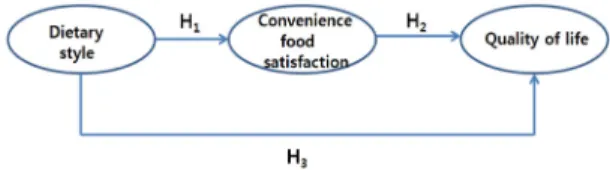
BACKGROUND/OBJECTIVES: Due to recent changes in social structure, single-person households are on the rise worldwide and therefore the interest in the quality of life of singles is increasing, but the research on the relationships related to their diet-related quality of life is scarce. This research analyzes the structural relations in the effect of convenience food satisfaction and quality of life according to dietary style of Korean, Japanese and Chinese singles.
SUBJECTS/METHODS: The targets of this study were Korean, Japanese, and Chinese singles, identified as adults between the ages of 25 and 54, having economic capabilities or working and living alone, either legally or in actuality having no partner.
A statistical analysis was conducted using SPSS12.0 for Windows and SEM using AMOS 5.0 statistics package. The reliability of these findings was supported by a Cronbach's alpha coefficient of 0.6 and higher for all the factors. In an attempt to study the level of satisfaction with convenience food in accordance to dietary style and the quality of life of singles, a structural equation model was constructed and analyzed.
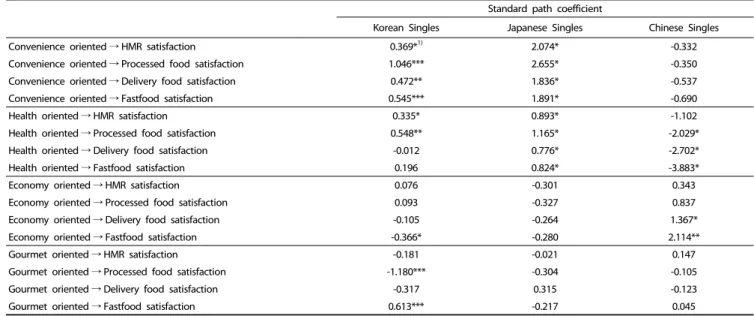
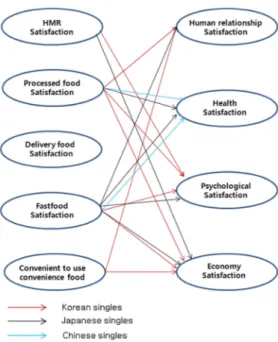
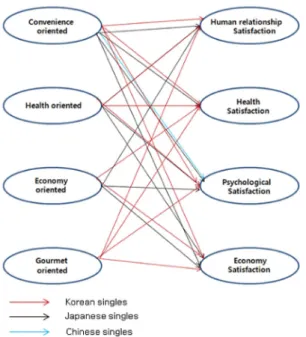
RESULTS: Of the three countries, regarding the effect of dietary style on singles’ quality of life, the convenience-oriented style was found to have a negative effect on Korean singles’ overall quality of life, but a positive effect on Japanese singles’ overall quality of life, and a negative effect on Chinese singles’ positive psychological aspect of quality of life. In addition, although Chinese singles have a high level of interest in health, they have an overall high level of satisfaction regarding fast food and its nutritional value.
CONCLUSIONS: The number of singles in Korea, Japan, and China has been consistently increasing in recent years, and there is a need for continuous interest in their healthy dietary lifestyles in terms of convenience, economy, and taste.
Nutrition Research and Practice 2014;8(3):312-318; doi:10.4162/nrp.2014.8.3.312; pISSN 1976-1457 eISSN 2005-6168 Keywords: Singles, SEM, dietary lifestyle, convenience food satisfaction, quality of life
INTRODUCTION 12)
Due to recent changes in social structure and way of thinking, single-person households are on the rise worldwide. The survey on single-person households in England and France showed that the increase in urban single-person households was striking and its major reasons were divorce and late marriage [1], and according to Mulder [2], it was reported that living arrange- ments of living alone or living together without marriage is on the rise in Netherland as well due to parents’ demand for independence. According to Korea Statistics [3], single-person households are increasing from 6.3% in 1980 to 15.5% in 2000, to 19.9% in 2005, and the number of single-person households was 23.9% in 2010, exceeding, for the first time, the proportion of the traditional four-person households which was 22.5% [4].
Also in Japan, it shows steady increase from 19.8% in 1980,
to 27.6% in 2000, and to 29.5% in 2005 [5] and in China, according to the 5th Census Report for People’s Republic of China [6], the number of single-person households in Beijing in 2000 was 494,553 out of 28,273,35 single-person households in China, which was noticeably large compared to 598,327 four-person households. As such, the number of singles is on the rise in Korea, Japan, and China, three countries in Northeast Asia, and the importance of singles in the society is growing accordingly.
In the case of traditional or dual-income families, family members gather and have meals together, able to consume various and plentiful foods, and often have homemade meals together on the weekends or holidays; however, in the case of singles, many skip meals, consume instant foods, or a consume limited variety and insufficient amounts of food because they usually eat alone [7]. The reality is that singles encounter
§