Comparison of the condyle-fossa relationship between skeletal class III malocclusion patients with and
without asymmetry: a retrospective three-dimensional cone-beam computed tomograpy study
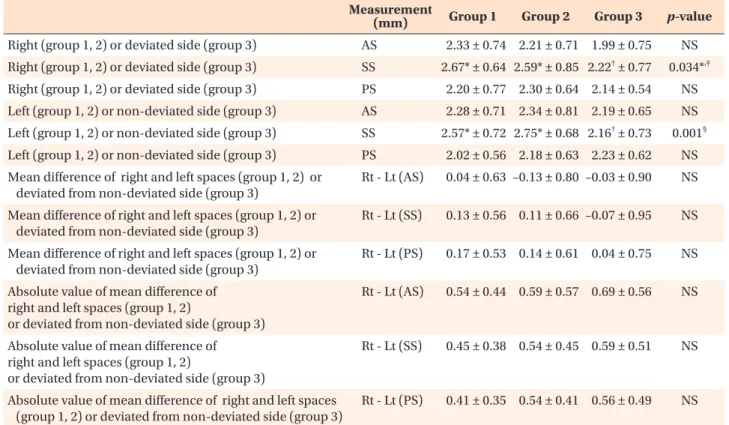
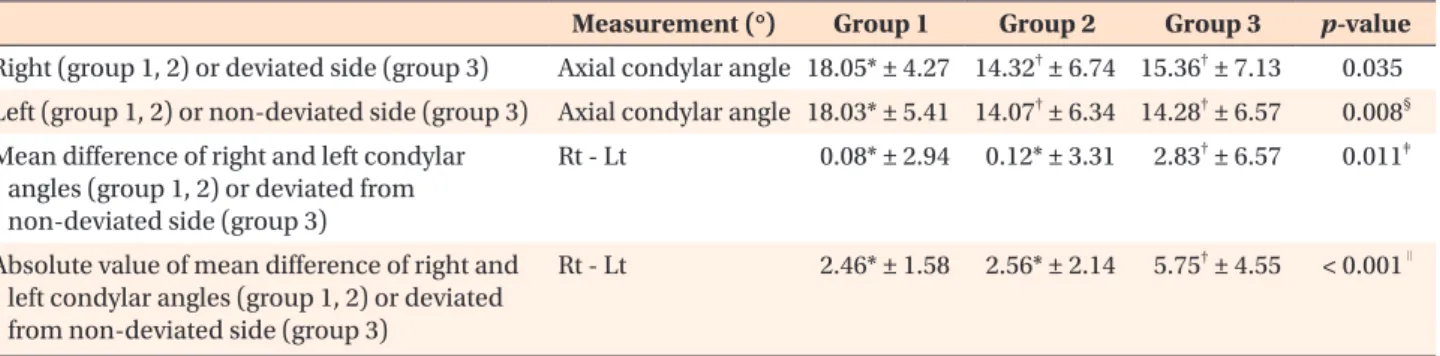
Objective: This study investigated whether temporomandibular joint (TMJ) condyle-fossa relationships are bilaterally symmetric in class III malocclusion patients with and without asymmetry and compared to those with normal occlusion. The hypothesis was a difference in condyle-fossa relationships exists in asymmetric patients. Methods: Group 1 comprised 40 Korean normal occlusion subjects. Groups 2 and 3 comprised patients diagnosed with skele- tal class III malocclusion, who were grouped according to the presence of mandibular asymmetry: Group 2 included symmetric mandibles, while group 3 included asymmetric mandibles. Pretreatment three-dimensional cone-beam computed tomography (3D CBCT) images were obtained. Right- and left-sided TMJ spaces in groups 1 and 2 or deviated and non-deviated sides in group 3 were evaluated, and the axial condylar angle was compared. Results: The TMJ spaces demonstrated no significant bilateral differences in any group. Only group 3 had slightly narrower superior spaces ( p < 0.001). The axial condylar angles between group 1 and 2 were not significant. However, group 3 showed a statistically significant bilateral difference (p < 0.001); toward the deviated side, the axial condylar angle was steeper. Conclusions: Even in the asymmetric group, the TMJ spaces were similar between deviated and non-deviated sides, indicating a bilateral condyle-fossa relationship in patients with asymmetry that may be as symmetrical as that in patients with symmetry. However, the axial condylar angle had bilateral differences only in asymmetric groups. The mean TMJ space value and the bilateral difference may be used for evaluating condyle-fossa relationships with CBCT.
[Korean J Orthod 2013;43(5):209-217]
Key words: TMJ, Facial asymmetry, Class III diagnosis, Three-dimensional cone- beam computed tomography, Condyle-fossa relationship
Hyoun Oak Kim
aWon Lee
bYoon-Ah Kook
a,cYoonji Kim
a,ca
Department of Orthodontics, Graduate School of Clinical Dental Science, The Catholic University of Korea, Seoul, Korea
b
Department of Oral and Maxillofacial Surgery, Dental Clinic, Uijeongbu St. Mary’s Hospital, The Catholic University of Korea, Uijeongbu, Korea
c
Department of Orthodontics, Seoul St. Mary’s Hospital, The Catholic University of Korea, Seoul, Korea
Received June 5, 2013; Revised September 7, 2013; Accepted September 10, 2013.
Corresponding author: Yoonji Kim.
Assistant Professor, Department of Orthodontics, Seoul St. Mary’s Hospital, The Catholic University of Korea, 222 Banpo-daero, Seocho-gu, Seoul 137-701, Korea
Tel +82-2-2258-1776 e-mail [email protected]
*This study was partially supported by the alumni fund of the Department of Dentistry and Graduate School of Clinical Dental Science, The Catholic University of Korea.
© 2013 The Korean Association of Orthodontists.
The authors report no commercial, proprietary, or financial interest in the products or companies described in this article.
This is an Open Access article distributed under the terms of the Creative Commons Attribution Non-Commercial License (http://creativecommons.org/licenses/by-nc/3.0) which permits unrestricted non-commercial use, distribution, and reproduction in any medium, provided the original work is properly cited.