INTRODUCTION
The prevalence of asthma in the United States has increased significantly over the last decade, and an estimated 24 million persons in the US were diagnosed with asthma in 2014.1,2 Asth- ma increases medical costs and may be associated with activi-
ty limitations, inability to work, increased number of sick days, and unemployment.3,4 The total incremental cost of asthma is estimated at $67–$75 billion (2015 dollars).5,6 Prescription drugs represent the biggest component of asthma medical costs, and job loss is estimated to account for 61% of the indirect costs at- tributable to asthma.7 Estimated missed work days attributable to asthma have been associated with an estimated $301 for each worker per year (2015 dollars).5
Obese individuals incur substantially greater medical costs, compared to normal-weight persons;8,9 per capita healthcare costs attributable to obesity are estimated at $1889–$4380 (2015 dollars), which is significantly higher than costs incurred by normal weight individuals.10,11 Furthermore, obesity also signifi- cantly increases absenteeism costs,12 and concurrent obesity ex- acerbates the impact of chronic diseases on medical expendi- tures, missed work days, and lost productivity.13
Costs Attributable to Overweight and Obesity in Working Asthma Patients in the United States
Chongwon Chang
1, Seung-Mi Lee
1, Byoung-Whui Choi
2, Jong-hwa Song
1, Hee Song
1, Sujin Jung
1, Yoon Kyeong Bai
1, Haedong Park
1, Seungwon Jeung
1, and Dong-churl Suh
11College of Pharmacy, Chung-Ang University, Seoul;
2Department of Internal Medicine, College of Medicine, Chung-Ang University, Seoul, Korea.
Purpose: To estimate annual health care and productivity loss costs attributable to overweight or obesity in working asthmatic patients.
Materials and Methods: This study was conducted using the 2003–2013 Medical Expenditure Panel Survey (MEPS) in the United States. Patients aged 18 to 64 years with asthma were identified via self-reported diagnosis, a Clinical Classification Code of 128, or a ICD-9-CM code of 493.xx. All-cause health care costs were estimated using a generalized linear model with a log function and a gamma distribution. Productivity loss costs were estimated in relation to hourly wages and missed work days, and a two- part model was used to adjust for patients with zero costs. To estimate the costs attributable to overweight or obesity in asthma patients, costs were estimated by the recycled prediction method.
Results: Among 11670 working patients with a diagnosis of asthma, 4428 (35.2%) were obese and 3761 (33.0%) were overweight.
The health care costs attributable to obesity and overweight in working asthma patients were estimated to be $878 [95% confi- dence interval (CI): $861–$895] and $257 (95% CI: $251–$262) per person per year, respectively, from 2003 to 2013. The productiv- ity loss costs attributable to obesity and overweight among working asthma patients were $256 (95% CI: $253–$260) and $26 (95%
CI: $26–$27) per person per year, respectively.
Conclusion: Health care and productivity loss costs attributable to overweight and obesity in asthma patients are substantial.
This study’s results highlight the importance of effective public health and educational initiatives targeted at reducing overweight and obesity among patients with asthma, which may help lower the economic burden of asthma.
Key Words: Asthma, obesity, treatment costs, productivity loss costs, attributable costs Yonsei Med J 2017 Jan;58(1):187-194
https://doi.org/10.3349/ymj.2017.58.1.187 pISSN: 0513-5796 · eISSN: 1976-2437
Received: May 19, 2016 Revised: June 22, 2016 Accepted: June 29, 2016
Corresponding author: Dr. Dong-Churl Suh, College of Pharmacy, Chung-Ang University, 84 Heukseok-ro, Dongjak-gu, Seoul 06974, Korea.
Tel: 82-2-820-5600, Fax: 82-2-816-7338, E-mail: [email protected]
•The authors have no financial conflicts of interest.
© Copyright: Yonsei University College of Medicine 2017
This is an Open Access article distributed under the terms of the Creative Com- mons Attribution Non-Commercial License (http://creativecommons.org/licenses/
by-nc/3.0) which permits unrestricted non-commercial use, distribution, and repro- duction in any medium, provided the original work is properly cited.
Body mass index (BMI) has been shown to be negatively as- sociated with various lung volume measures, and obesity has been correlated with lower lung function and more comorbid- ities among asthma patients.14 Increasing BMI has been found to be significantly associated with worsening asthma severity,15 greater asthma symptoms, poorer asthma control,16,17 more ac- tivity limitations, worse general physical health status, more missed workdays, and more medication use and hospitaliza- tion.15,18,19 Compared to normal-weight patients with asthma, overweight or obese patients tend to have more asthma-related hospitalizations, more emergency department visits, and more unscheduled urgent care visits, regularly scheduled visits, and follow-up visits for an asthma episode.19,20 Studies conducted among non-elderly and elderly asthma patient cohorts have demonstrated a significant impact of obesity on healthcare costs.10,21
Although previous studies have consistently shown the sig- nificant economic impact of asthma or obesity on medical costs and lost productivity, the total incremental costs of obesity among patients with asthma have not been estimated. The ob- jective of this study was to estimate the annual health care and productivity loss costs attributable to overweight or obesity in working asthma patients in the US from 2003 to 2013 using the Medical Expenditures Panel Survey (MEPS).
MATERIALS AND METHODS
Data source
The data source for this study was the 2003–2013 MEPS, which has been conducted annually since 1996 under the sponsor- ship of the Agency for Healthcare Research and Quality and the National Center for Health Statistics.22 The MEPS survey pro- vides nationally representative estimates of health care use, ex- penditures, sources of payment, and health insurance cover- age for the US civilian non-institutionalized population. The panel design of the survey, comprising five rounds of inter- views covering two full calendar years, allows for the examina- tion of person-level changes in expenditures, health insurance coverage, and health status. Eight years of pooled MEPS-HC data were merged with the full-year consolidated file using unique identifiers to ensure sufficient sample size and produce estimates with high reliability.22 For the pooled analysis, survey weights provided by MEPS were used to generate nationally representative results.
Study population
Patients with an asthma diagnosis were identified using Inter- national Classification of Diseases, 9th Revision (ICD-9) codes (493.xx), the Clinical Classification Code (CCC) (128), or a MEPS self-report of asthma. To estimate productivity loss costs, the study population was limited to working patients aged 18 to 64 years, who were selected if they answered yes to the question
“are you currently employed or employed” during the reference period (i.e., time period between the date of the previous round’s interview and the date of the current round’s interview)” at least once for the employment status question in each round. Exclu- sion criteria included a diagnosis of malignancy (ICD-9 code:
140–239, CCC: 011–045, or if they answered “yes” to “Have you ever been diagnosed as having cancer or a malignancy of any kind?”), pregnancy (ICD-9 code: 633–650 or CCC: 177–196), kidney dialysis (ICD-9 code: V56 or CCC: 158), human immu- nodeficiency virus (ICD-9 code: 042, 043, 996, V08, V42, V43, V49, or CCC: 005), or BMI <18.5 kg/m2.
Study outcomes
Study outcomes included treatment costs and productivity loss costs. All-cause health care costs were derived from the sum of expenditures associated with medical services (e.g., hospitalizations, office-based/outpatient visits, and emergen- cy department visits) and prescription drugs. These expendi- tures in MEPS were defined as the sum of the direct payments for care provided during the year, including out-of-pocket pay- ments and payments through private insurance, Medicaid, Medicare, and other sources. Payments for over-the-counter drugs and alternative care services were excluded.22
Productivity loss costs were estimated based on missed work days due to illness, injury, or mental or emotional problems during the reference period, and were valued using the aver- age hourly wage by occupation, obtained from the Unites States Bureau of Labor Statistics in 2015.23 Since the number of work days lost were provided in MEPS as ≥0.5 days, we could not distinguish half versus full days missed; one missed day was considered to be 6 hours, consistent with previous studies using MEPS.24 Annual missed work days were calculated using the reference period (the period of time during which the data for each person were collected).
Study variables
To examine the impact of overweight and obesity on costs, asthma patients were classified into three groups based on BMI calculated using self-reported height and weight from MEPS: normal (18.5 kg/m2 ≤BMI <25 kg/m2), overweight (25 kg/m2 ≤BMI <30 kg/m2), and obese (BMI ≥30 kg/m2).25,26 Self- reported patient characteristics were also evaluated to adjust for factors that may potentially confound the association be- tween BMI status and study outcomes, including patient age, gender, race/ethnicity, insurance status, smoking status, mari- tal status, income, and occupation. Insurance status was cate- gorized into public, private, both public and private, or unin- sured types. Smoking status was categorized into former/never smoker and current smoker types.
Comorbidities included the following: cardiovascular disease [ICD-9-CM code: 410–417, 428, 429, 798; CCC: 101–104, 108; or if they answered “yes” to “Have you ever been diagnosed as having heart disease (coronary heart disease, angina, angina
pectoris, heart attack, myocardial infarction, or any other kind of heart disease or condition)?”]; cerebrovascular disease (ICD-9-CM code: 430–438, CCC: 109–113, or if they answered
“yes” to “Have you ever been diagnosed as having had a stroke or transient ischemic attack?”); hypertension (ICD-9-CM code:
401–405, CCC: 98–99, or if they answered “yes” to “Have you ever been diagnosed as having high blood pressure?”); diabe- tes (ICD-9-CM code: 250, CCC: 49–50, or if they answered
“yes” to “Have you ever been diagnosed with diabetes?”); hy- perlipidemia (ICD-9-CM code: 272, 440, 445; CCC: 53, 114, 116; or if they answered “yes” to “Have you ever been diag- nosed as having high cholesterol?”); mental disorder (ICD-9-CM code: 295, 296, 300, 311; CCC: 657, 659, 670; or if they answered
“yes” to “Have you ever been diagnosed as having attention defi- cit hyperactivity disorder or attention deficit disorder?”); and a respiratory disease other than asthma (ICD-9-CM code: 460–492, 494–516; CCC: 122–127, 134; or if they answered “yes” to “Have you ever been diagnosed as having emphysema or chronic bronchitis?”).
Statistical analysis
Differences in demographic and clinical characteristics strati- fied by BMI category were compared using the chi-squared test and analysis of variance test. Unadjusted average all-cause an- nual medical costs and productivity loss costs were calculated, and a 95% confidence interval (CI) was obtained using boot- strap methods with 1000 iterations, since these costs did not follow a normal distribution.5,27
A generalized linear model (GLM) with log link function and a gamma distribution was used to identify the significant fac- tors associated with medical costs in asthma patients and to estimate regression coefficients.3,5,28,29 The dependent variable in the model was patient BMI, classified as either overweight, obese or normal-weight, and independent variables included age, gender, race/ethnicity, insurance status, marital status, in- come, and comorbidities. To estimate health care costs attrib- utable to overweight or obesity, the recycled prediction meth- od was used.29-32 Using the calculated coefficients of the study covariates, costs were estimated by assuming that everybody was obese (i.e., by treating the indicator variable as equal to 1), and then re-estimated by assuming that everybody was normal (i.e., by treating the indicator variable as equal to 0). The mean difference between the two estimated costs was calculated to reflect the costs attributable to obesity in asthma patients. The same process was used to estimate the medical costs attribut- able to overweight in asthma patients.
Productivity loss costs were calculated using the two-part mod- el since many patients incurred zero productivity loss costs.5,30,33 In the first part of the two-part model, a logistic model was used to predict the probability of any costs, and in the second part, a GLM with a log link function and a gamma distribution was used to predict productivity loss costs for positive costs only.
In both models, costs were estimated adjusting for age, gen-
der, race/ethnicity, insurance status, marital status, income, occupation, and comorbidities. Productivity loss costs attribut- able to overweight or obesity in asthma patients were estimat- ed using the same methodology as for medical costs described above.
For all analyses, MEPS sampling and variance adjustment weights were considered to reflect the survey design structure for the estimation of national representative values. All costs were converted to 2015 US dollars using the consumer price in- dex (CPI).34 Data were analyzed using SAS 9.2 (SAS Institute, Cary, NC, USA) and STATA 10.1 (STATA Corporation, College Station, TX, USA).
RESULTS
Among 381682 subjects in MEPS from 2003 to 2013, 11670 workers were identified as asthma patients aged 18 to 64 years based on study selection criteria. Of these patients, 3761 (33.0%) were overweight, and 4428 (35.2%) were obese. Demographic characteristics of asthma patients stratified by BMI category are shown in Table 1. Obese patients with asthma were significant- ly more likely to be older, female, and non-Hispanic white. Obese patients with asthma were more likely to have cardiovascular disease, hypertension, hyperlipidemia, and other respiratory disease as comorbidities.
Obese patients with asthma incurred significantly higher an- nual medical costs across all service categories than normal- weight and overweight asthma patients (Table 2). An unadjust- ed average annual medical costs for obese patients with asthma were $5412 (95% CI: $4899–$5817) per patient, 40% higher than overweight patients ($3873; 95% CI: $3395–$4226) and 60%
higher than normal-weight patients ($3385; 95% CI: $2527–
$4191). Furthermore, regardless of BMI category, outpatient vis- its accounted for the highest proportion of treatment costs, fol- lowed by prescription drugs, inpatient visits, and ED visits.
Obese patients with asthma also had higher productivity loss costs than overweight or normal-weight patients (Table 2).
The unadjusted average annual productivity loss costs for obese patients were $745 (95% CI: $664–$826) per patient, 72% higher than those of overweight ($434; 95% CI: $381–$487) and over two times those of normal weight ($353; 95% CI: $312–$393).
The increasing productivity loss costs by BMI category resulted from the increasing effect of BMI on missed work days. Total missed work days averaged 2.7 (95% CI: 2.4–3.0) in normal- weight patients, 3.3 days (95% CI: 2.9–3.7) in overweight patients, and 5.6 days (95% CI: 5.0–6.3) in obese patients. Obese and over- weight patients experienced an additional mean of 2.9 and 0.6 days lost from work per year, respectively, compared to normal- weight patients.
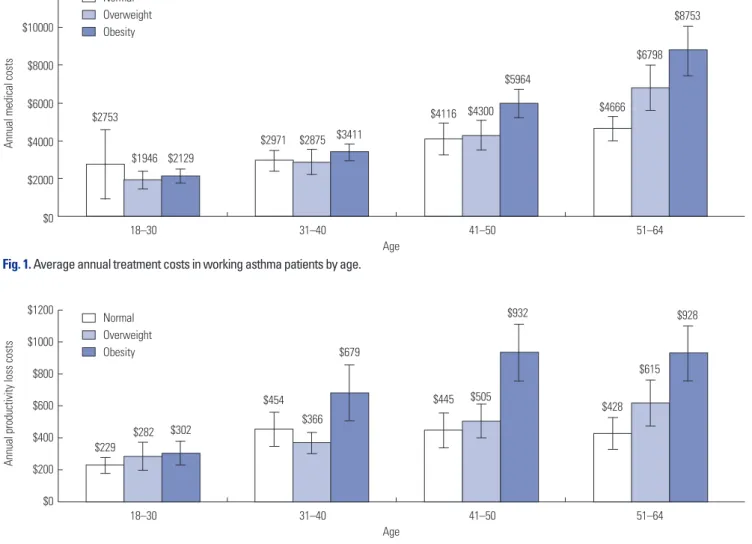
Average annual medical costs for working asthma patients increased with patient age (Fig. 1), and the increasing effect of BMI on average annual medical costs was consistent across all
age groups. Average annual productivity loss costs increased for the 41 to 50 years age group but declined for the 51 to 64 years age group, suggesting a lower labor force participation rate in the latter age group among the general population (Fig. 2).
Annual total treatment costs for working asthma patients in- creased significantly when patients were obese, older, female, or had comorbid cardiovascular disease, hypertension, or hy- perlipidemia (Table 3). Obese patients with asthma had signif- icantly higher treatment costs (cost ratio: 1.20; 95% CI: 1.04–
1.39) than normal-weight patients after adjusting for the study variables. Obese patients with asthma had productivity loss costs 46% higher (cost ratio: 1.46; 95% CI: 1.24–1.72) than those of normal-weight patients after adjusting for the study vari- ables.
Fig. 3 depicts the treatment costs and productivity loss costs attributable to obesity and overweight in working asthma pa- tients. The average total costs attributable to obesity were $1103 (95% CI: $1085–$1122), nearly four times the costs attributable Table 1. Characteristics of Asthma Patients by Body Mass Index
Total Normal weight Overweight Obesity
p value*
Sample No (000) % Sample No (000) % Sample No (000) % Sample No (000) %
Asthma patients 11670 10903 100 3481 3464 31.77 3761 3602 33.03 4428 3838 35.20
Age (mean±SD) (39.52±0.20) (36.00±0.35) (39.83±0.32) (42.44±0.31) <0.001
18–30 3649 3302 30.28 1544 1476 42.63 1122 1063 29.52 983 762 19.87 <0.001
31–40 2727 2509 23.01 711 756 21.82 883 838 23.26 1133 915 23.85
41–50 2617 2472 22.67 598 601 17.36 872 836 23.22 1147 1034 26.95
51–64 2677 2621 24.04 628 630 18.19 884 865 24.00 1165 1126 29.34
Gender <0.001
Male 5227 5073 46.53 1483 1451 41.89 2012 2000 55.53 1732 1622 42.26
Female 6443 5830 53.47 1998 2013 58.11 1749 1602 44.47 2696 2216 57.74
Race/ethnicity <0.001
Non-Hispanic white 5335 6304 57.82 1747 2126 61.38 1759 2127 59.05 1829 2051 53.44
Non-Hispanic black 1723 1057 9.70 392 234 6.76 498 318 8.84 833 505 13.16
Hispanic 2127 1201 11.02 526 320 9.25 740 425 11.80 861 456 11.88
Asian 335 235 2.15 162 110 3.17 110 83 2.31 63 42 1.09
Others 2150 2106 19.32 654 674 19.45 654 648 18.00 842 784 20.44
Comorbidities
CVD 1137 1083 9.93 277 276 7.96 306 297 8.25 554 510 13.28 <0.001
Cerebrovascular 180 146 1.34 36 30 0.86 46 34 0.96 98 82 2.14 0.001
Hypertension 2977 2688 24.65 378 347 10.02 851 800 22.22 1748 1540 40.13 <0.001
Diabetes 813 654 6.00 81 58 1.68 197 151 4.19 535 445 11.61 <0.001
Hyperlipidemia 2205 2095 19.21 332 332 9.59 689 664 18.43 1184 1099 28.63 <0.001
Mental disorder 342 353 3.24 106 121 3.48 103 114 3.16 133 119 3.10 0.745
Other respiratory 1802 1838 16.86 535 586 16.92 540 541 15.02 727 711 18.53 0.013
No, number; CVD, cardiovascular disease; Cerebrovascular, cerebrovascular disease; Other respiratory, other respiratory disease.
*p value was calculated by chi-square test for category variable and ANOVA test for continuous variable.
Table 2. Average Annual Treatment Costs and Productivity Loss Costs in Asthma Patients by BMI*
Cost types All patients Normal weight Overweight Obesity
p value† Mean Bootstrap 95% CI Mean Bootstrap 95% CI Mean Bootstrap 95% CI Mean Bootstrap 95% CI
Total treatment costs $4260 ($3889–$4536) $3385 ($2527–$4191) $3873 ($3395–$4226) $5412 ($4899–$5817) <0.001 Medical services $2896 ($2639–$3054) $2099 ($1843–$2290) $2663 ($2256–$2947) $3835 ($3347–$4212) <0.001
Inpatients $882 ($703–$979) $454 ($302–$555) $894 ($534–$1130) $1256 ($990–$1452) <0.001
Outpatients $1730 ($1592–$1853) $1428 ($1254–$1587) $1543 ($1394–$1703) $2178 ($1840–$2475) <0.001
Emergency room $284 ($253–$313) $217 ($182–$253) $225 ($185–$257) $401 ($330–$472) <0.001
Prescription drugs $1364 ($1112–$1619) $1286 ($513–$2072) $1211 ($1022–$1396) $1577 ($1483–$1674) 0.013 Productivity loss $517 ($481–$555) $353 ($312–$393) $434 ($381–$487) $745 ($664–$826) <0.001 Missed work days 3.9 days (3.7–4.2) days 2.7 days (2.4–3.0) days 3.3 days (2.9–3.7) days 5.6 days (5.0–6.3) days <0.001 BMI, body mass index; CI, confidence interval.
*All costs were converted to 2015 US dollars, †p value represented the significance of mean costs among three BMI groups within each variable category.
to overweight (mean: $280; 95% CI: $274–$286).
DISCUSSION
In this study, we estimated that 68.2% of asthma patients were overweight or obese, which is comparable to the age-adjusted prevalence of overweight and obesity (68%) in the general US adult population.25 Mean annual all-cause health care costs for obese asthma patients were $5412 per patient, 40% higher than those for overweight ($3873) and 60% higher than those for normal weight ($3385) patients. Furthermore, mean annual pro- ductivity loss costs of obese asthma patients were $745 per pa- tient, 72% higher than those of overweight ($434) and over two times those of normal weight ($353) patients. Health care costs attributable to obesity and overweight in working asthma pa- tients were estimated to be $878 and $257 per person per year, respectively, and productivity loss costs attributable to obesity and overweight among working asthma patients were $256 and
$26 per person per year, respectively.
In the current study, mean annual all-cause health care costs
for asthma patients were $4260 per patient. Of these treatment costs, in our estimation, outpatient visits and prescription drugs were the largest components, accounting for 40.6% and 32.0% of total treatment costs, respectively. Previous studies have estimated the annual incremental health care costs asso- ciated with asthma: estimates per person range from $2340 (2015 US dollars) to $9337 (2015 US dollars) in adults and $3876 (2015 US dollars) in both adults and children.3-5,35 Kamble and Bharmal3 also reported that prescription medications and physician office visits were the major drivers of total asthma- related expenditures, constituting 49% of the total incremental costs of asthma in adults. Similarly, Sullivan, et al.4 found that prescription drugs represented the largest contributor to all- cause health care expenditures for asthma patients, followed by hospitalization. While these previous studies provided valu- able insight into the economic burden of asthma, they did not account for the possibility that the BMI status of asthma pa- tients can also influence the direct medical costs associated with asthma.
We estimated the direct and indirect costs attributable to overweight and obesity in patients with asthma at $280 and
Fig. 1. Average annual treatment costs in working asthma patients by age.
$12000
$10000
$8000
$6000
$4000
$2000
$0
Annual medical costs
18–30 31–40 41–50 51–64
Age
$2753
$1946
$2971
$2129
$2875 $3411
$4116 $4300
$5964
$4666
$6798
$8753 Normal
Overweight Obesity
Fig. 2. Average annual productivity loss costs in working asthma patients by age.
$1200
$1000
$800
$600
$400
$200
$0
Annual productivity loss costs
18–30 31–40 41–50 51–64
Age
$229
$282
$454
$302 $366
$679
$445 $505
$932
$428
$615 Normal $928
Overweight Obesity
were normal weight, total all-cause healthcare expenditures (including prescription medications) would be expected to be decreased by $2066 (2015 US dollars) and $4378 (2015 US dol- lars) respectively. The incremental cost of obesity among older adult asthmatic patients was estimated at $6204 (2015 US dol- lars) in all-cause health care costs.21
$1103 (in 2015 dollars), respectively, suggesting that excessive weight in asthma patients can have an incrementally substan- tial economic consequence on asthma treatment costs. While the total incremental cost of overweight/obesity among pa- tients with asthma has not previously been studied, Sarpong10 estimated that if younger adult obese patients with asthma
Table 3. Factors Influencing Treatment Costs or Productivity Loss Costs in Working Asthma Patients
Treatment costs* Productivity loss costs†
Cost ratio 95% CI p value Cost ratio 95% CI p value
BMI
Normal 1 1
Overweight 1.04 0.88–1.23 0.657 1.06 0.90–1.25 0.467
Obesity 1.20 1.04–1.39 0.014 1.46 1.24–1.72 <0.001
Age
18–30 1 1
31–40 1.34 1.10–1.63 0.004 1.24 1.01–1.52 0.037
41–50 1.86 1.55–2.24 <0.001 1.52 1.23–1.88 <0.001
51–64 2.46 1.98–3.07 <0.001 1.62 1.28–2.06 <0.001
Gender
Male 1 1
Female 1.43 1.26–1.62 <0.001 1.20 1.04–1.38 0.012
Race/ethnicity
Non-Hispanic white 1 1
Non-Hispanic black 0.65 0.55–0.77 <0.001 1.24 1.01–1.53 0.038
Hispanic 0.75 0.62–0.90 0.002 1.00 0.83–1.21 0.968
Others 0.98 0.80–1.20 0.838 0.92 0.78–1.07 0.276
Comorbidities
Cardiovascular disease 1.39 1.18–1.65 <0.001 0.98 0.84–1.13 0.748
Hypertension 1.38 1.22–1.55 <0.001 1.04 0.91–1.20 0.539
Hyperlipidemia 1.24 1.10–1.40 0.001 1.07 0.92–1.25 0.396
BMI, body mass index; CI, confidence interval.
*Medical costs were estimated by the generalized linear model with a log link function and a gamma distribution, adjusted for the study variables, †Productivity loss costs were estimated by a two-part model, adjusted for the study variables.
Fig. 3. Costs attributable to overweight or obesity in working asthma patients. All costs were converted to 2015 US dollars. Dollars in the parenthesis rep- resents 95% confidence interval (CI) calculated using bootstrapping method with 1000 iterations.
$26 (95% CI: $26–$27) Treatment costs
Productivity loss costs
Total attributable costs
$1200
$1000
$800
$600
$400
$200
$0
$257 (95% CI: $251–$262)
$280 (95% CI: $274–$286)
Costs attributable to overweight Costs attributable to obesity
$1103 (95% CI: $1085–$1122)
$256 (95% CI: $253–$260)
$878 (95% CI: $861–$895)
In addition to direct medical costs, asthma patients suffered productivity loss at the rate of four missed work days per year per patient on average, and these costs increased with increas- ing BMI. The average productivity loss cost for obese patients with asthma was estimated at $745 per patient per year, more than twice the cost of productivity loss for normal-weight asth- ma patients ($434). Our estimates of productivity loss costs, even for normal-weight patients, were greater than was the es- timate ($353) of the value of additional days lost due to asthma calculated by Barnett and Nurmagambetov5 Moreover, our es- timates of incremental productivity loss costs for obesity ($256) relative to normal weight were greater than the costs of absen- teeism associated with obesity and morbid obesity estimated by Cawley, et al.,12 which were $152 (2015 dollars) and $314 (2015 dollars) per worker, respectively, regardless of disease.
Although this study found that concurrent obesity in asthma patients had a strongly negative impact on productivity loss, further research is needed to examine how the incremental negative consequences of obesity on productivity among asth- ma patients compare to the other segments of the population.
Our findings suggest that the benefits of weight reduction in asthma patients could be substantial, especially when the effort is focused on those with higher BMI. In fact, it is well-docu- mented that weight reduction can offer potential clinical bene- fits to asthma management.36 Weight reduction among obese patients with asthma through low-calorie dieting was associat- ed with a reduction in airway obstruction and peak expiratory flow variability in one study.37 Another randomized weight re- duction program among obese people with asthma improved lung function variables such as forced vital capacity (FVC) and forced expiratory volume in one second (FEV1) and the im- proved lung function was sustained even after the program ended.38 Additionally, the weight reduction was shown to be beneficial in reducing the number of asthma symptoms that obese asthmatic people experienced and improving physical activities that had previously been limited by breathlessness.
While our study provides valuable information on the total incremental cost of obesity in asthma using advanced estima- tion methods that have not previously been used, our findings must be interpreted in light of several study limitations. We ex- amined the economic impact of comorbid obesity in asthma patients, but could not determine the causality between obesi- ty and costs due to the cross-sectional nature of the study. Asth- ma patients were identified based on self-reported diagnosis or the Clinical Classification or ICD-9 code used by physicians rather than on confirmed diagnoses of asthma through pul- monary function tests. The unavailability of pulmonary func- tion data also precluded the consideration of asthma severity in this study. In addition, this study may have underestimated the costs attributable to obesity or overweight in asthma pa- tients, as we did not include caregiver time costs and mortality costs. Premature mortality associated with obesity can incur increased indirect costs to employers through increased life in-
surance premiums and to employees through lost earnings.39 Finally, the prevalence of obesity in asthma patients may have been underestimated since BMI was based on self-reported height and weight, as suggested by other studies.40
In conclusion, the direct and indirect costs attributable to overweight and obesity in patients with asthma are substantial.
This study’s findings highlight the importance of targeted pub- lic health interventions for obese patients with asthma to re- duce the economic burden of asthma. Public health programs to promote weight reduction and weight management among obese and overweight patients with asthma may play an im- portant role in curbing the economic burden of asthma.
ACKNOWLEDGEMENTS
The preliminary abstract of this study were presented and this study was chosen to receive the Best Research Poster Award at the International Society of Pharmacoeconomics and Out- comes (ISPOR) 14th Annual European Congress, November, 2011 in Madrid, Spain. The authors would like to thank In- Myung Song, Ph.D. for contribution with manuscript prepara- tion. This research was supported by a grant of the Korea Health Technology R&D Project through the Korea Health Industry Development Institute (KHIDI), funded by the Ministry of Health
& Welfare, Republic of Korea (grant number: HI13C1480). No authors has a conflict of interest with the work contained within this article.
REFERENCES
1. U.S. Department of Health and Human Services, Centers for Dis- ease Control and Prevention, National Center for Health Statistics.
Summary Health Statistics for U.S. Children: National Health In- terview Survey, 2012; 2013. [accessed on 2016 March 15]. Available at: http://www.cdc.gov/nchs/data/series/sr_10/sr10_258.pdf.
2. U.S. Department of Health and Human Services, Centers for Dis- ease Control and Prevention, National Center for Health Statistics.
Summary Health Statistics for U.S. Adults: National Health Inter- view Survey, 2012; 2014. [accessed on 2016 March 15]. Available at: http://www.cdc.gov/nchs/data/series/sr_10/sr10_260.pdf.
3. Kamble S, Bharmal M. Incremental direct expenditure of treating asthma in the United States. J Asthma 2009;46:73-80.
4. Sullivan PW, Ghushchyan VH, Slejko JF, Belozeroff V, Globe DR, Lin SL. The burden of adult asthma in the United States: evidence from the Medical Expenditure Panel Survey. J Allergy Clin Immu- nol 2011;127:363-369.
5. Barnett SB, Nurmagambetov TA. Costs of asthma in the United States: 2002-2007. J Allergy Clin Immunol 2011;127:145-52.
6. Jang J, Gary Chan KC, Huang H, Sullivan SD. Trends in cost and outcomes among adult and pediatric patients with asthma: 2000- 2009. Ann Allergy Asthma Immunol 2013;111:516-22.
7. Cisternas MG, Blanc PD, Yen IH, Katz PP, Earnest G, Eisner MD, et al. A comprehensive study of the direct and indirect costs of adult asthma. J Allergy Clin Immunol 2003;111:1212-8.
8. Trogdon JG, Finkelstein EA, Feagan CW, Cohen JW. State- and payer-specific estimates of annual medical expenditures attribut- able to obesity. Obesity (Silver Spring) 2012;20:214-20.
9. Withrow D, Alter DA. The economic burden of obesity worldwide:
a systematic review of the direct costs of obesity. Obes Rev 2011;
12:131-41.
10. Sarpong EM. The impact of obesity on medication use and ex- penditures among nonelderly adults with asthma. J Health Care Poor Underserved 2014;25:1245-61.
11. Finkelstein EA, Trogdon JG, Cohen JW, Dietz W. Annual medical spending attributable to obesity: payer-and service-specific esti- mates. Health Aff (Millwood) 2009;28:w822-31.
12. Cawley J, Rizzo JA, Haas K. Occupation-specific absenteeism costs associated with obesity and morbid obesity. J Occup Envi- ron Med 2007;49:1317-24.
13. Sullivan PW, Ghushchyan V, Ben-Joseph RH. The effect of obesity and cardiometabolic risk factors on expenditures and productivi- ty in the United States. Obesity (Silver Spring) 2008;16:2155-62.
14. Pakhale S, Doucette S, Vandemheen K, Boulet LP, McIvor RA, Fitzgerald JM, et al. A comparison of obese and nonobese people with asthma: exploring an asthma-obesity interaction. Chest 2010;
137:1316-23.
15. Taylor B, Mannino D, Brown C, Crocker D, Twum-Baah N, Hol- guin F. Body mass index and asthma severity in the National Asth- ma Survey. Thorax 2008;63:14-20.
16. Saint-Pierre P, Bourdin A, Chanez P, Daures JP, Godard P. Are overweight asthmatics more difficult to control? Allergy 2006;61:
79-84.
17. Peters-Golden M, Swern A, Bird SS, Hustad CM, Grant E, Edel- man JM. Influence of body mass index on the response to asthma controller agents. Eur Respir J 2006;27:495-503.
18. Lavoie KL, Bacon SL, Labrecque M, Cartier A, Ditto B. Higher BMI is associated with worse asthma control and quality of life but not asthma severity. Respir Med 2006;100:648-57.
19. Rodrigo GJ, Plaza V. Body mass index and response to emergency department treatment in adults with severe asthma exacerba- tions: a prospective cohort study. Chest 2007;132:1513-9.
20. Mosen DM, Schatz M, Magid DJ, Camargo CA Jr. The relationship between obesity and asthma severity and control in adults. J Al- lergy Clin Immunol 2008;122:507-11.
21. Shah R, Yang Y. Health and economic burden of obesity in elderly individuals with asthma in the United States. Popul Health Man- ag 2015;18:186-91.
22. Agency for Healthcare Research and Quality. MEPS HC-163: 2013 Full Year Consolidated Data File. 2015 [accessed on 2016 March 31]. Available at: http://meps.ahrq.gov/mepsweb/data_stats/
download_data/pufs/h163/h163doc.pdf.
23. United States Bureau of Labor Statistics. May 2015 national occu- pational employment and wage estimates United States. [ac- cessed on 2016 March 15]. Available at: http://www.bls.gov/oes/
current/oes_nat.htm.
24. Sullivan PW, Ghushchyan V, Wyatt HR, Wu EQ, Hill JO. Productiv- ity costs associated with cardiometabolic risk factor clusters in the United States. Value Health 2007;10:443-50.
25. Flegal KM, Carroll MD, Ogden CL, Curtin LR. Prevalence and trends in obesity among US adults, 1999-2008. JAMA 2010;303:235- 41.
26. Valerio MA, Gong ZM, Wang S, Bria WF, Johnson TR, Clark NM.
Overweight women and management of asthma. Womens Health Issues 2009;19:300-5.
27. Honeycutt AA, Segel JE, Hoerger TJ, Finkelstein EA. Comparing cost-of-illness estimates from alternative approaches: an applica- tion to diabetes. Health Serv Res 2009;44:303-20.
28. Buntin MB, Zaslavsky AM. Too much ado about two-part models and transformation? Comparing methods of modeling Medicare expenditures. J Health Econ 2004;23:525-42.
29. Manning WG, Mullahy J. Estimating log models: to transform or not to transform? J Health Econ 2001;20:461-94.
30. Duan N, Manning WG Jr, Morris CN, Newhouse JP. A comparison of alternative models for the demand for medical care. J Bus Econ Stat 1983;1:115-26.
31. Basu A, Rathouz PJ. Estimating marginal and incremental effects on health outcomes using flexible link and variance function models. Biostatistics 2005;6:93-109.
32. Basu A, Arondekar BV, Rathouz PJ. Scale of interest versus scale of estimation: comparing alternative estimators for the incremental costs of a comorbidity. Health Econ 2006;15:1091-107.
33. Mullahy J. Much ado about two: reconsidering retransformation and the two-part model in health econometrics. J Health Econ 1998;
17:247-81.
34. United States Bureau of Labor Statistics. Consumer price indexes.
[accessed on 2016 March 31]. Available at: http://www.bls.gov/cpi/
35. Carrier E, Cunningham P. Medical cost burdens among nonelder- ly adults with asthma. Am J Manag Care 2014;20:925-32.
36. Maniscalco M, Zedda A, Faraone S, Cerbone MR, Cristiano S, Giardi- ello C, et al. Weight loss and asthma control in severely obese asthmatic females. Respir Med 2008;102:102-8.
37. Hakala K, Stenius-Aarniala B, Sovijärvi A. Effects of weight loss on peak flow variability, airways obstruction, and lung volumes in obese patients with asthma. Chest 2000;118:1315-21.
38. Stenius-Aarniala B, Poussa T, Kvarnström J, Grönlund EL, Ylikahri M, Mustajoki P. Immediate and long term effects of weight reduc- tion in obese people with asthma: randomised controlled study.
BMJ 2000;320:827-32.
39. Trogdon JG, Finkelstein EA, Hylands T, Dellea PS, Kamal-Bahl SJ.
Indirect costs of obesity: a review of the current literature. Obes Rev 2008;9:489-500.
40. Cawley J, Meyerhoefer C. The medical care costs of obesity: an in- strumental variables approach. J Health Econ 2012;31:219-30.