Study of Combustion and Emission Characteristics for DI Diesel Engine with a Swirl-Chamber
Yu Liu * and S. S. Chung †
Key Words : Gas motion, Swirl-chamber, Simulation, ω -chamber, Injection duration
Abstract
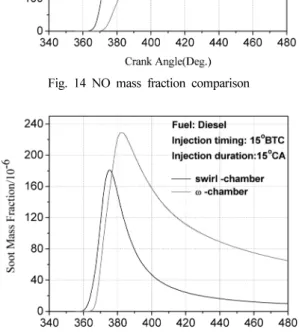
Gas motion within the engine cylinder is one of the major factors controlling the fuel-air mixing and combustion pro- cesses in diesel engines. In this paper, a special swirl-chamber is designed and applied to a DI (direct injection) diesel engine to generate a strong swirl motion thus enhancing gas motion. Compression, combustion and expansion strokes of this DI diesel engine with the swirl-chamber have been simulated by CFD software. The simulation model was first val- idated through comparisons with experimental data and then applied to do the simulation of the spray and combustion process. The velocity and temperature field inside the cylinder showed the influences of the strong swirl motion to spray and combustion process in detail. Cylinder pressure, average temperature, heat release rate, total amount of heat release, indicated thermal efficiency, indicated fuel consumption rate and emissions of this DI diesel engine with swirl-chamber have been compared with that of the DI diesel engine with ω -chamber. The conclusions show that the engine with swirl- chamber has the characteristics of fast mixture formulation and quick diffusive combustion; its soot emission is 3 times less than that of a ω -chamber engine; its NO emission is 3 times more than that of ω -chamber engine. The results show that the DI diesel engine with the swirl-chamber has the potential to reduce emissions.
1. Introduction
Gas motion within the engine cylinder is one of the major factors that controls the fuel-air mixing and combustion processes in diesel engines. The swirl, incline swirl and squish are three kinds of large-scale rotating flow patterns within the cylinder. These flows are strongly dependent on the inlet port, valve, and cylinder head geometry. During the intake or the compression process, these flows become unstable and break down into three-dimensional turbulent motions. Both the bulk gas motion and the turbu- lence characteristics of the flow are important.
To enhance gas motion, much research has been conducted over a long period of time. Tindal, M. J. et
al investigated the effect of inlet port design and found that helical ports normally impart more angu- lar momentum at medium lifts than do directed ports (1) . Brandl, F. et al. conducted an investigation about the swirl modification within the cylinder and came to the conclusion that swirl ratios in bowl-in- piston and flat-topped piston engine designs are dif- ferent and the tangential velocity into the bowl will increase rapidly toward the end of the compression stroke (2) . Shimamoto, Y. et al. compared the squish velocities in bowl-in-piston combustion chambers with different bowl diameter/bore ratios and clear- ance heights (3) .
Many researches also studied IDI (indirect injec- tion) diesel engines to enhance air motion (4-7) . The IDI diesel engine is a typical engine using a prechamber to obtain a strong swirl flow (both in the prechamber and the main chamber) and the swirl is used to pro- mote more rapid mixing and speed up the combus- tion process. In an IDI diesel engine swirl is created
(2010
년8
월12
일접수~2010
년9
월20
일심사완료, 2010
년9
월27
일게재확정)
* Dept. of Mechanical Engineering, Dong-A University, Korea
† Dept. of Mechanical Engineering, Dong-A University, Korea
E-mail : [email protected]
swirl flow, the IDI diesel engine generates less pollu- tion and less noise while still producing a good per- formance at a high speed. But compared with DI (direct injection) combustion engines, the IDI engines have larger heat transfer surfaces and separate pre- chambers. Also IDI still has disadvantages such as a high fuel consumption rate and a difficult engine start.
In this paper, the advantages of both IDI diesel engines and DI diesel engines are combined. Instead of the prechamber inside the cylinder head, a special swirl-chamber is designed inside the cylinder. This swirl-chamber in the DI diesel engines and the pre- chamber in the IDI diesel engines have similar func- tions. With the movement of the piston, a strong swirl motion can be created in the swirl-chamber. As a result, the swirl will influence the air-fuel mixing rate and combustion process. It also influences com- bustion efficiency and engine emissions.
The main purpose of this paper is to investigate the influences of the strong swirl flow generated by the swirl-chamber on the air-fuel mixing rate and com- bustion process of DI a diesel engine, and find out if this kind of new swirl-chamber design is good for combustion efficiency and engine emissions. For this purpose, both numerical simulation methods and experimental methods were used. CFD software was used to simulate the spray and combustion process.
An engine experimental system was set up and then cylinder pressure and temperature data were mea- sured. Good agreement between calculated and mea- sured results is obtained to validate calculation models.
The velocity and temperature field have been obtained by this simulation and then analyzed in detail to see the influences of the strong swirl flow on the spray and combustion process. Some combustion charac-
2. Design of swirl-chamber
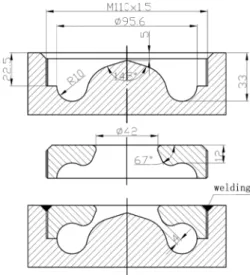
A special swirl-chamber is designed and applied to the DI diesel engine. Figure 1 shows the structure drawing of swirl-chamber. This piston is consisted of two parts and these two parts screwed together. A high platform is set in the center of the reentrant bowl-in-piston combustion chamber. In this way, a ringy passage is formed and the swirl-chamber is made. There are some important geometrical param- eters for this swirl-chamber design. Radius of swirl- chamber is the parameter to control the volume ratio of swirl-chamber to main chamber and the width of passage influences the swirl velocity in the swirl- chamber. Different values lead to different spray and combustion characteristics. In this paper, radius of swirl-chamber and the width of passage are 10 mm and 4 mm respectively.
Figure 2 is a sketch map of the DI diesel engine
Fig. 1 Structure drawing of swirl chamber
with this swirl-chamber. With the motion of the pis- ton, the flow into the swirl-chamber during the com- pression process creates the rotating flow. Fuel is injected into this swirl-chamber through passage, and then air-fuel mixing and combustion start in the swirl-chamber. The strong swirl and squish flow accelerate the air-fuel mixing process and well mixed gas can be obtained in a short time. After self-igni- tion, the high pressure and temperature mixture rushes out of the swirl-chamber to the main chamber through the ringy passage and then mix with the fresh air in the main chamber. Eventually the fuel burns completely in the main chamber.
3. Simulation for DI diesel spray and combustion process with swirl-chamber
The CFD software is used to simulate the spray and combustion process of this DI diesel engine with swirl-chamber.
3.1 Setup of calculation mesh
Our calculation was performed between the inlet valve closure (IVC) and the exhaust valve open (EVO). Because it is a centric and rotational sym- metric combustion chamber, and the fuel mass flow is the same for all the holes of the injector, only a segment of the geometry for one injected spray is used. According to the number of holes in the injec-
tion nozzle, we use 1/4 cylinder to simulate. The Fig- ure 3 shows the calculation mesh.
3.2 Initial and boundary conditions
The specification of in-cylinder conditions at IVC is done by the initialization of gas temperature, gas pressure or gas density. The gas temperature and pressure can be measured directly. The gas density is calculated automatically if the gas temperature and pressure are known (equation of state).
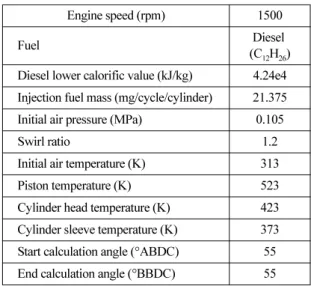
The specification of wall surface temperatures (cylinder liner, cylinder head, and piston) was based on experimental experiences and depended on the load and speed operating condition. The boundary condition of the cylinder head was specified as a fixed wall, and the boundary condition of the piston bowl was specified as a moving wall. Table 1 shows
Fig. 2 Sketch map of DI diesel engine with swirl-chamber
Fig. 3 Calculation mesh
Table 1. Initial and boundary conditions
Engine speed (rpm) 1500
Fuel Diesel
(C 12 H 26 ) Diesel lower calorific value (kJ/kg) 4.24e4 Injection fuel mass (mg/cycle/cylinder) 21.375 Initial air pressure (MPa) 0.105
Swirl ratio 1.2
Initial air temperature (K) 313
Piston temperature (K) 523
Cylinder head temperature (K) 423
Cylinder sleeve temperature (K) 373
Start calculation angle (°ABDC) 55
End calculation angle (°BBDC) 55
the nozzle hole diameter.
For the low Weber numbers, the break-up time is:
(1) and the stable drop radius is:
(2) For the high Weber numbers, the break-up time is:
(3) and the stable drop radius is:
(4) where Λ is the wavelength and Ω is the growth rate.
The model WALLJET1 was used to describe what happens if droplets hit the wall. The angle of reflec- tion and the droplet diameter were changed accord- ing to a function of the Weber number (9) .
(5) The Zeldovich model was used as a NOx forma- tion model (10) . In combination with the Magnussen combustion model or CFM model, the NO formation rate is based on temperature distribution. The reac- tion mechanism can be expressed in terms of the extended Zeldovich mechanism:
(6)
The Kennedy_Hiroyasu_Magnussen model was
equation. is the nucleation source. is the sur- face growth source. is the oxidation source.
Nucleation source:
(8) Surface growth source:
(9) Chemical kinetic oxidation source:
(10)
4. Setup of experimental system and validation of calculation models
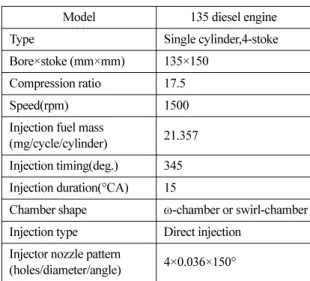
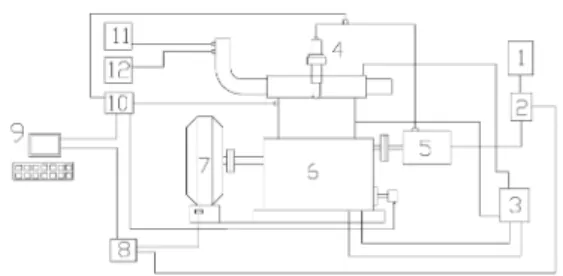
To validate the calculation models, experimental system was set up. In this study, a single cylinder
τ 0.82 B 1 ρ a 3
--- σ
=
r min 3 ( πa 2 U ⁄ 2 Ω ) 0.33 3 a 2 Λ ⁄ 4
( ) 0.33
⎩ ⎭
⎨ ⎬
⎧ ⎫
=
τ = ( B 1 a U ⁄ ) ρ 1 ⁄ ρ 2
r B = 0 Λ
We 50:d<
1
=d0
50 We 140:d≤ ≤
1
=(1.07 1.01 10× ×– 2
×We×3.29 10×– 5
×We2
) d⋅0
140 We 300:d≤ <
1
=0.416 10×( – 1.02 10 ×
–3× We )
×d0
we 300:d>