INTRODUCTION
The incidence and death rate from gastric cancer are second and third most common, respectively in Korea.
1,2The proportion of patients with early gastric cancer (EGC) is increasing annually due to the national screening program and frequent self-check endoscopy based on concerns about gastric cancer. The standard EGC treatment is gastric resection with radical lymph node dissection, depending on the preoperative evaluation, except the absolute indication for endoscopic resection (ER).
3The 5-year overall survival rate in patients with EGC is > 90% using this standard surgery, and patients are living as long-term survivors. However, this standard
surgery for patients with EGC produces various short-term surgical complications and long-term impaired of quality of life (QOL) in terms of suboptimal diet, altered bowel habits, and poor nutrition. Thus, new concepts and trials have been discussed for long-term surviving patients after EGC.
After an increase in the use of minimally invasive surgery, such as laparoscopy and robotics for gastric cancer surgery, short-term QOL improved with similar morbidity to that of he conventional laparotomy but long-term oncological outcomes await prospective trials.
4,5However, long-term QOL after laparoscopic gastric cancer surgery is similar to that of conventional laparotomy due to the same gastric resection and lymph node dissection approach. Various surgical techniques,
Laparoscopic Sentinel Node Navigation Surgery for Gastric Cancer
Keun Won Ryu, M.D.,Ph.D., SENORITA (Sentinel Node Oriented Tailored Approach) Study Group
Gastric Cancer Branch, Research Institute and Hospital, National Cancer Center, Goyang, Korea
Short-term surgical results of gastric cancer improve with use of a laparoscopic approach compared to those after conventional laparotomy, particularly in patients with early gastric cancer (EGC).
However, due to gastric resection and lymph node dissection, poor long-term quality of life (QOL) after gastric cancer surgery is equivalent between the approaches. Thus, gastric resection and lymph node dissection should be minimized to avoid injury to innervating nerves and the sphincter, to maintain gastric function, preserve gastric volume, and improve long-term QOL. Such a procedure should not impair the oncological outcome by removing the primary tumor and metastasis to lymph nodes. After analysis of the many single center feasibility studies, sentinel node biopsy (SNB) is useful for this purpose but sensitivity varies and is unsatisfactory. A large multicenter Japanese feasibility study showed promising results after clinical application of SNB in patients with EGC. Based on those results, a multicenter prospective randomized phase III trial of laparoscopic SNB conducted by the Korean surgical study group, the SENORITA (SEntinel Node ORIented Tailored Approach), is now ongoing. Prior to this phase III trial, a quality control study of participating institutions was completed in an effort to standardize and overcome the SNB learning curve. Laparoscopic SNB with gastric volume and function-preserving surgery to improve the long-term QOL without impairing the oncological outcome may be a surgical option after this trial in the subgroup of patients with EGC.
Keywords:
Early gastric cancer, Sentinel Node Biopsy, Stomach preserving surgeryReceived August 21, 2015 Accepted September 2, 2015
Corresponding author Keun Won Ryu
Gastric Cancer Branch, Research Institute and Hospital, National Cancer Center, 323 Ilsan-ro, Ilsandong-gu, Goyang 10408, Korea Tel: +82-31-920-1628
Fax: +82-31-920-0069 E-mail: [email protected]
This is an Open Access article distributed under the terms of the Creative Commons Attribution Non-Commercial License (http://
creativecommons.org/licenses/by-nc/4.0/) which permits unrestricted non-commercial use, distribution, and reproduction in any medium, provided the original work is properly cited.
Copyright © 2015 The Journal of Minimally Invasive Surgery. All rights reserved.
Journal of Minimally Invasive Surgery
J Minim Invasive Surg 2015;18(3):63-68
such as proximal gastrectomy, pylorus preserving gastrectomy, and vagus nerve preserving surgery, have been used to improve long-term QOL but the results are not confirmative or encouraging.
6,7Injury to innervation and sphincters must be minimized to preserve gastric function and volume and improve long-term QOL. The type of minimal approach should not impair the oncologic outcomes in patients with EGC by removing the entire tumor burden from the primary tumor and metastatic lymph nodes. ER is a minimally invasive and organ-preserving procedure used only for absolute indicated patients with a very low possibility of lymph node metastasis. Many studies have been performed to expand the indications for ER, but the risk of recurrence due to lymph node metastasis has limited expansion.
8,9The sentinel node biopsy (SNB) concept was developed to minimize lymph node dissection if no metastasis are present in the SN. This approach minimizes damage to nerves and sphincters and preserves gastric volume by resecting small EGC lesions. This concept was postulated to preserve the gastric function and improve the troublesome long-term QOL in patients with EGC.
FEASIBILITY STUDIES AND META ANALSYS OF SENTINEL NODE BIOPSY IN PATIENTS WITH GASTRIC CANCER
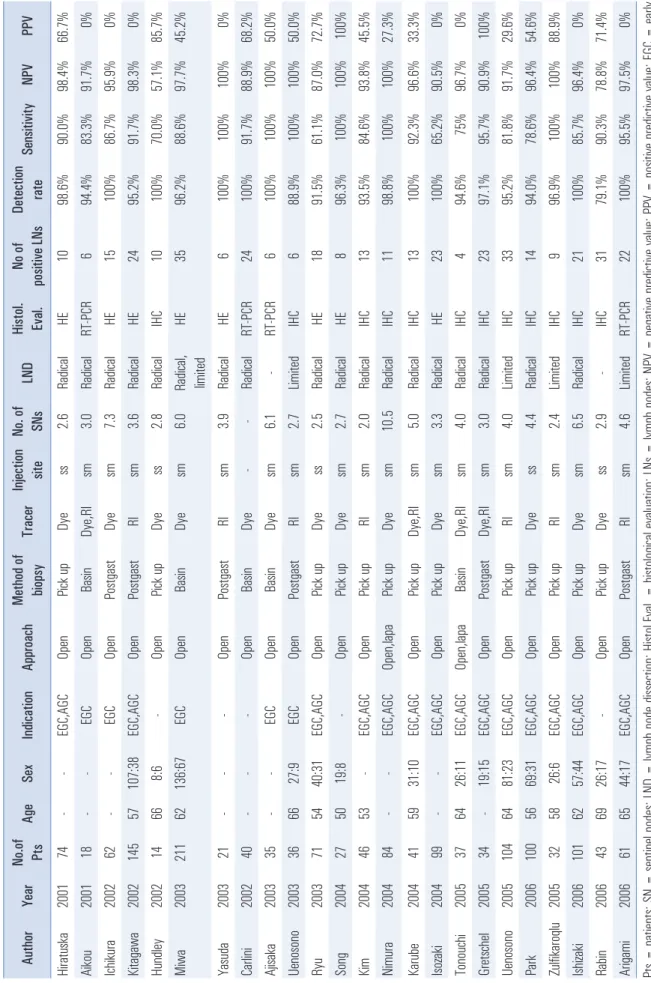
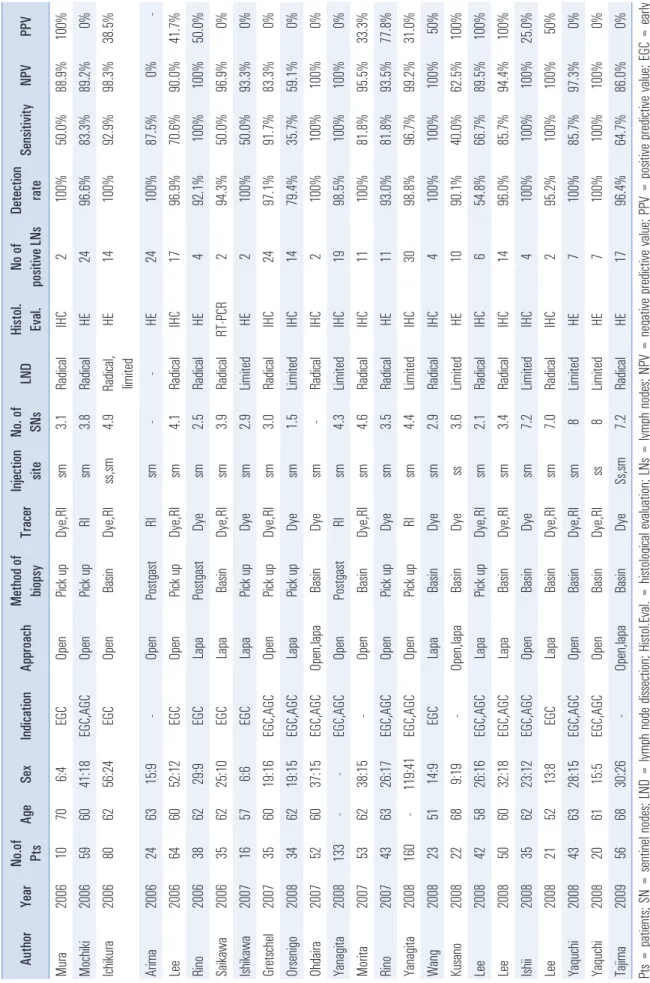
Many SNB gastric cancer feasibility studies have been published in the last decade mainly from Korea and Japan (Table 1). However, most were performed by a single institution with small numbers of patients. The SNB indication and techniques, such as biopsy method, tracers, injection site, and pathological evaluations, were not standardized so procedural details differ. Several review articles and meta-analyses have been reported about this topic in gastric cancer.
10-12The pooled detection rate estimate was > 90% but sensitivity was 80%, with heterogeneity between studies. Several points have been suggested to improve SNB results, such as harvesting five or more SNs, preference for EGC rather than advanced gastric cancer, double tracers rather than a single tracer, submucosal rather than subserosal injection, and more precise pathological evaluations. The conclusion from all of these meta-analyses is that SNB is unsatisfactory for clinical application and should be used cautiously. Additional methods have been investigating recently to improve SNB results in patients with gastric cancer, particularly in terms of sensitivity.
PUBLISHED SENTINEL NODE BIOPSY CLINCAL TRIALS IN PATIENTS WITH GASTRIC CANCER
Two large-scale multicenter SNB feasibility studies
in patients with gastric cancer have been performed in Japan. The first is the Japan Clinical Oncology Group trial (JCOG0302) and the other is the Japanese Society for Sentinel Node Navigation Surgery (SNNS) trial. Several of the protocols differed between the studies and the final published results were totally different.
13Miyashiro et al.
reported that the JCOG0302 study was stopped before all patients were recruited due to the high false-negative rate.
14The cause of the high false-negative rate was the simple pathological evaluation and insufficient experience of the participating institutions. Kitagawa et al. reported promising results for clinical applicability from the SNNS trial.
15They reported 97.5% detection rate with a mean of 5.6 SNs and 93%
sensitivity. Among the four false-negative cases, two were T2 lesions, and the location of missed metastatic nodes was at the same sentinel basin in three cases. These results suggested that the optimal indication is T1 lesions, and that sentinel basin dissection rather than a pick-up biopsy is an adequate biopsy method.
A small phase II trial was reported from a single institution of Japan.
16Ichikura et al. reported that limited gastrectomy with SNB was satisfactory for short-term outcomes and recurrence during the observation period. Another single- center phase II trial from Korea is closing patient recruitment and we are waiting for the final results.
17ONGOING PHASE III TRIAL OF
LAPAROSCOPIC SENTINEL NODE BIOPSY IN PATIENTS WITH GASTRIC CANCER
The controversial issue of SNB in gastric cancer has been
investigated by many academic societies and institutional
researchers. Several points were suggested to improve the
SNB results. Moreover, most patients with EGC who will be
long-term survivors want to save their stomach for improved
QOL, and clinicians have the responsibility to solve this
problem. A study group called SENORITA (SEntinel Node
ORIented Tailored Approach) was launched by a Korean
academic society that includes surgeons, gastroenterologists,
pathologists, and nuclear medicine specialists to solve this
problem in a phase III trial.
18The protocol for the SENORITA
multicenter phase III trial has been developed and patient
recruitment is ongoing.
19Briefly, the study is a non-inferior
design of laparoscopic SNB with stomach preserving surgery
compared to conventional standard laparoscopic gastrectomy
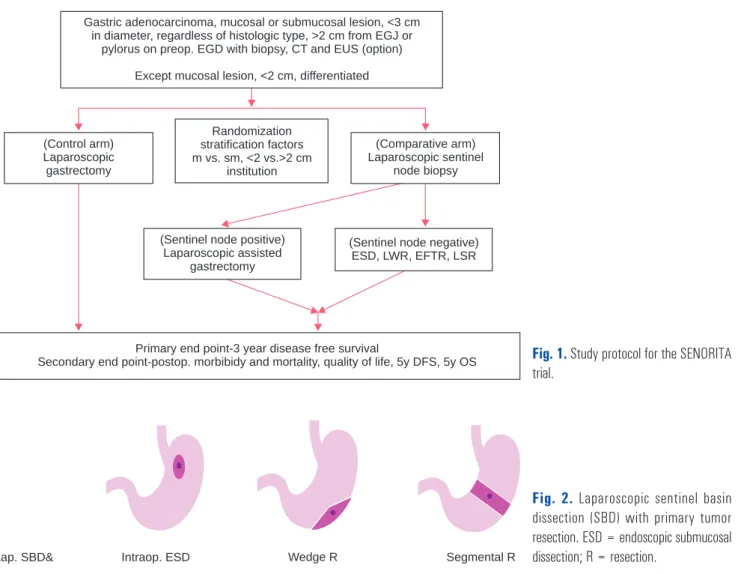
(Fig. 1). The primary endpoint is 3-year disease free survival
and the secondary endpoints are postoperative complications,
QOL, 5-year disease free survival, and overall survival. The
calculated sample size was 290 patients for each arm and the
indication was cT1N0 < 3 cm, regardless of the histological
Table 1. Detai ls of publ ished feasi bil ity studi es on senti nel node bi opsy
10Author Year No.of Pts Age Sex Indication Approach Method of biopsy Tracer Inj ection site No. of SNs LND Histol. Eval . No of positive LNs Detecti on rate Sensiti vity NPV PPV Hi ratuska 2001 74 - - EGC,AGC Open Pick up Dye ss 2.6 Radical HE 10 98.6% 90.0% 98.4% 66.7% Ai kou 2001 18 - - EGC Open Basi n Dye,RI sm 3.0 Radi cal RT-PCR 6 94.4% 83.3% 91.7% 0% Ichi kura 2002 62 - - EGC Open Postgast Dye sm 7.3 Radi cal HE 15 100% 86.7% 95.9% 0% Ki tagawa 2002 145 57 107:38 EGC,AGC Open Postgast RI sm 3.6 Radi cal HE 24 95.2% 91.7% 98.3% 0% Hundl ey 2002 14 66 8:6 - Open Pick up Dye ss 2.8 Radi cal IHC 10 100% 70.0% 57.1% 85.7% Mi wa 2003 211 62 136:67 EGC Open Basi n Dye sm 6.0 Radi cal , limi ted HE 35 96.2% 88.6% 97.7% 45.2% Yasuda 2003 21 - - - Open Postgast RI sm 3.9 Radi cal HE 6 100% 100% 100% 0% Carl ini 2002 40 - - - Open Basi n Dye - - Radi cal RT-PCR 24 100% 91.7% 88.9% 68.2% Aj isaka 2003 35 - - EGC Open Basi n Dye sm 6.1 - RT-PCR 6 100% 100% 100% 50.0% Uenosono 2003 36 66 27:9 EGC Open Postgast RI sm 2.7 Limi ted IHC 6 88.9% 100% 100% 50.0% Ryu 2003 71 54 40:31 EGC,AGC Open Pick up Dye ss 2.5 Radi cal HE 18 91.5% 61.1% 87.0% 72.7% Song 2004 27 50 19:8 - Open Pick up Dye sm 2.7 Radi cal HE 8 96.3% 100% 100% 100% Ki m 2004 46 53 - EGC,AGC Open Pick up RI sm 2.0 Radi cal IHC 13 93.5% 84.6% 93.8% 45.5% Ni mura 2004 84 - - EGC,AGC Open,l apa Pick up Dye sm 10.5 Radi cal IHC 11 98.8% 100% 100% 27.3% Karube 2004 41 59 31:10 EGC,AGC Open Pick up Dye,RI sm 5.0 Radi cal IHC 13 100% 92.3% 96.6% 33.3% Isozaki 2004 99 - - EGC,AGC Open Pick up Dye sm 3.3 Radi cal HE 23 100% 65.2% 90.5% 0% Tonouchi 2005 37 64 26:11 EGC,AGC Open,l apa Basi n Dye,RI sm 4.0 Radi cal IHC 4 94.6% 75% 96.7% 0% Gretschel 2005 34 - 19:15 EGC,AGC Open Postgast Dye,RI sm 3.0 Radi cal IHC 23 97.1% 95.7% 90.9% 100% Uenosono 2005 104 64 81:23 EGC,AGC Open Pick up RI sm 4.0 Limi ted IHC 33 95.2% 81.8% 91.7% 29.6% Park 2006 100 56 69:31 EGC,AGC Open Pick up Dye ss 4.4 Radi cal IHC 14 94.0% 78.6% 96.4% 54.6% Zul fikaroqlu 2005 32 58 26:6 EGC,AGC Open Pick up RI sm 2.4 Limi ted IHC 9 96.9% 100% 100% 88.9% Ishi zaki 2006 101 62 57:44 EGC,AGC Open Pick up Dye sm 6.5 Radi cal IHC 21 100% 85.7% 96.4% 0% Rabi n 2006 43 69 26:17 - Open Pick up Dye ss 2.9 - IHC 31 79.1% 90.3% 78.8% 71.4% Ari gami 2006 61 65 44:17 EGC,AGC Open Postgast RI sm 4.6 Limi ted RT-PCR 22 100% 95.5% 97.5% 0% Pts = pati ents; SN = senti nel nodes; LN D = lymph node di ssecti on; Hi stol .Eval . = hi stol ogi cal eval ua tion; LNs = lymph node s; NPV = negati ve pre dicti ve val ue; PPV = posi tive predi cti ve val ue ; EGC = earl y gastri c cancer; AGC = advanced gastri c ca ncer; ss = subserosal ; sm = submucosal ; HE = Hema toxyl in eosi n; IHC = immunohi stochemi stry; RT-PCR = reverse transcri ptase pol ymerase chai n reacti on.
Table 1. Conti nued Author Year No.of Pts Age Sex Indication Approach Method of biopsy Tracer Inj ection site No. of SNs LND Histol. Eval . No of positive LNs Detecti on rate Sensiti vity NPV PPV Mura 2006 10 70 6:4 EGC Open Pick up Dye,RI sm 3.1 Radical IHC 2 100% 50.0% 88.9% 100% Mochi ki 2006 59 60 41:18 EGC,AGC Open Pick up RI sm 3.8 Radi cal HE 24 96.6% 83.3% 89.2% 0% Ichi kura 2006 80 62 56:24 EGC Open Basi n Dye,RI ss,sm 4.9 Radi cal , limi ted HE 14 100% 92.9% 98.3% 38.5% Arima 2006 24 63 15:9 - Open Postgast RI sm - - HE 24 100% 87.5% 0% - Lee 2006 64 60 52:12 EGC Open Pick up Dye,RI sm 4.1 Radi cal IHC 17 96.9% 70.6% 90.0% 41.7% Ri no 2006 38 62 29:9 EGC Lapa Postgast Dye sm 2.5 Radi cal HE 4 92.1% 100% 100% 50.0% Sai kawa 2006 35 62 25:10 EGC Lapa Basi n Dye,RI sm 3.9 Radi cal RT-PCR 2 94.3% 50.0% 96.9% 0% Ishi kawa 2007 16 57 6:6 EGC Lapa Pick up Dye sm 2.9 Limi ted HE 2 100% 50.0% 93.3% 0% Gretschel 2007 35 60 19:16 EGC,AGC Open Pick up Dye,RI sm 3.0 Radi cal IHC 24 97.1% 91.7% 83.3% 0% Orseni go 2008 34 62 19:15 EGC,AGC Lapa Pick up Dye sm 1.5 Limi ted IHC 14 79.4% 35.7% 59.1% 0% Ohdai ra 2007 52 60 37:15 EGC,AGC Open,l apa Basi n Dye sm - Radi cal IHC 2 100% 100% 100% 0% Yanagi ta 2008 133 - - EGC,AGC Open Postgast RI sm 4.3 Limi ted IHC 19 98.5% 100% 100% 0% Mori ta 2007 53 62 38:15 - Open Basi n Dye,RI sm 4.6 Radi cal IHC 11 100% 81.8% 95.5% 33.3% Ri no 2007 43 63 26:17 EGC,AGC Open Pick up Dye sm 3.5 Radi cal HE 11 93.0% 81.8% 93.5% 77.8% Yanagi ta 2008 160 - 119:41 EGC,AGC Open Pick up RI sm 4.4 Limi ted IHC 30 98.8% 96.7% 99.2% 31.0% Wang 2008 23 51 14:9 EGC Lapa Basi n Dye sm 2.9 Radi cal IHC 4 100% 100% 100% 50% Kusano 2008 22 68 9:19 - Open,l apa Basi n Dye ss 3.6 Limi ted HE 10 90.1% 40.0% 62.5% 100% Lee 2008 42 58 26:16 EGC,AGC Lapa Pick up Dye,RI sm 2.1 Radi cal IHC 6 54.8% 66.7% 89.5% 100% Lee 2008 50 60 32:18 EGC,AGC Lapa Basi n Dye,RI sm 3.4 Radi cal IHC 14 96.0% 85.7% 94.4% 100% Ishi i 2008 35 62 23:12 EGC,AGC Open Basi n Dye sm 7.2 Limi ted IHC 4 100% 100% 100% 25.0% Lee 2008 21 52 13:8 EGC Lapa Basi n Dye,RI sm 7.0 Radi cal IHC 2 95.2% 100% 100% 50% Yaquchi 2008 43 63 28:15 EGC,AGC Open Basi n Dye,RI sm 8 Limi ted HE 7 100% 85.7% 97.3% 0% Yaquchi 2008 20 61 15:5 EGC,AGC Open Basi n Dye,RI ss 8 Limi ted HE 7 100% 100% 100% 0% Taj ima 2009 56 68 30:26 - Open,l apa Basi n Dye Ss,sm 7.2 Radi cal HE 17 96.4% 64.7% 86.0% 0% Pts = pati ents; SN = senti nel nodes; LND = lymph node di ssecti on; Hi stol .Eva l. = hi stol ogi cal e val uati on; LNs = lymph nodes; NPV = negati ve predi cti ve val ue; PPV = posi tive predi cti ve val ue; EGC = earl y gastri c cancer; AGC = advanced gastri c ca ncer; ss = subserosal ; sm = submucosal ; HE = Hematoxyl in eosi n; IHC = immunohi stochemi stry ; RT-PCR = reverse transcri ptase pol ymera se chai n reacti on.
result. Laparoscopic SNB will be done using basin dissection, and all harvested sentinel basin nodes will be examined by intraoperative frozen section with 2 mm slices. Primary tumor resection was proposed based on our previous publication but will be modified based on intraoperative findings (Fig. 2).
The most essential point for a SNB phase III surgical trial is to standardize and overcome the learning curve. The preceding quality control study of the participating institutions prior to the phase III trial is finished.
21,22This study was based on completing a checklist consisting of seven essential SNB steps associated with the endoscopic, surgical, and pathological procedures. If SNB was performed perfectly in 10 patients by completing these seven steps, that institution can participate in the phase III trial. The results showed 92.6% detection rate and 100% sensitivity.
CONCLUSION
Laparoscopic SNB with gastric organ and function- preserving surgery in patients with EGC may be a good
surgical option to improve short- and long-term QOL without impairing the surgical or oncologic outcomes in selected patients with EGC after validation by the SENORITA phase III trial
ACKNOWLEDGEMENTS
This study was supported by the National Cancer Center, Republic of Korea (Grant 1410140-2).
REFERENCES
1) Jung KW, Won YJ, Kong HJ, et al. Cancer statistics in Korea:
incidence, mortality, survival, and prevalence in 2012. Cancer Res Treat 2015;47:127-141.
2) Shin A, Kim J, Park S. Gastric cancer epidemiology in Korea. J Gastric Cancer 2011;11:135-140.
3) Japanese Gastric Cancer Association. Japanese gastric cancer treatment guidelines 2010 (ver. 3). Gastric Cancer 2011;14:113- 123.
Fig. 1. Study protocol for the SENORITA trial.
Gastric adenocarcinoma, mucosal or submucosal lesion, <3 cm in diameter, regardless of histologic type, >2 cm from EGJ or
pylorus on preop. EGD with biopsy, CT and EUS (option) Except mucosal lesion, <2 cm, differentiated
(Control arm) Laparoscopic gastrectomy
(Comparative arm) Laparoscopic sentinel
node biopsy Randomization
stratification factors m vs. sm, <2 vs.>2 cm
institution
Primary end point-3 year disease free survival
Secondary end point-postop. morbibidy and mortality, quality of life, 5y DFS, 5y OS (Sentinel node negative)
ESD, LWR, EFTR, LSR (Sentinel node positive)
Laparoscopic assisted gastrec omyt
Fig. 2. Laparoscopic sentinel basin dissection (SBD) with primary tumor resection. ESD = endoscopic submucosal dissection; R = resection.
Lap. SBD& Intraop. ESD Wedge R Segmental R
4) Kim YW, Baik YH, Yun YH, et al. Improved quality of life outcomes after laparoscopy-assisted distal gastrectomy for early gastric cancer: results of a prospective randomized clinical trial.
Ann Surg 2008;248:721-727.
5) Kim HH, Hyung WJ, Cho GS, et al. Morbidity and mortality of laparoscopic gastrectomy versus open gastrectomy for gastric cancer: an interim report--a phase III multicenter, prospective, randomized Trial (KLASS Trial). Ann Surg 2010;251:417-420.
6) Suh YS, Han DS, Kong SH, et al. Laparoscopy-assisted pylorus- preserving gastrectomy is better than laparoscopy-assisted distal gastrectomy for middle-third early gastric cancer. Ann Surg 2014;259:485-493.
7) Ahn SH, Lee JH, Park do J, Kim HH. Comparative study of clinical outcomes between laparoscopy-assisted proximal gastrectomy (LAPG) and laparoscopy-assisted total gastrectomy (LATG) for proximal gastric cancer. Gastric Cancer 2013;16:282-289.
8) Son SY, Park JY, Ryu KW, et al. The risk factors for lymph node metastasis in early gastric cancer patients who underwent endoscopic resection: is the minimal lymph node dissection applicable? A retrospective study. Surg Endosc 2013;27:3247-3253.
9) Ryu KW, Choi IJ, Doh YW, et al. Surgical indication for non- curative endoscopic resection in early gastric cancer. Ann Surg Oncol 2007;14:3428-3434.
10) Ryu KW, Eom BW, Nam BH, et al. Is the sentinel node biopsy clinically applicable for limited lymphadenectomy and modified gastric resection in gastric cancer? A meta-analysis of feasibility studies. J Surg Oncol 2011;104:578-584.
11) Lips DJ, Schutte HW, van der Linden RL, Dassen AE, Voogd AC, Bosscha K. Sentinel lymph node biopsy to direct treatment in gastric cancer. A systematic review of the literature. Eur J Surg Oncol 2011;37:655-661.
12) Wang Z, Dong ZY, Chen JQ, Liu JL. Diagnostic value of sentinel lymph node biopsy in gastric cancer: a meta-analysis. Ann Surg Oncol 2012;19:1541-1550.
13) Miyashiro I. What is the problem in clinical application of sentinel node concept to gastric cancer surgery? J Gastric Cancer 2012;12:
7-12.
14) Miyashiro I, Hiratsuka M, Sasako M, et al. High false-negative proportion of intraoperative histological examination as a serious problem for clinical application of sentinel node biopsy for early gastric cancer: final results of the Japan Clinical Oncology Group multicenter trial JCOG0302. Gastric Cancer 2014;17:316-323.
15) Kitagawa Y, Takeuchi H, Takagi Y, et al. Sentinel node mapping for gastric cancer: a prospective multicenter trial in Japan. J Clin Oncol 2013;31:3704-3710.
16) Ichikura T, Sugasawa H, Sakamoto N, Yaguchi Y, Tsujimoto H, Ono S. Limited gastrectomy with dissection of sentinel node stations for early gastric cancer with negative sentinel node biopsy.
Ann Surg 2009;249:942-947.
17) Kim HH. Laparoscopic Sentinel Node Navigation Surgery for Gastric Cancer [Internet]. Bethesda: U.S. National Institutes of Health; 2015 [cited 2015 August 20]. Available from: https://www.
clinicaltrials.gov/ct2/show/NCT01441310.
18) Ryu KW. The future of sentinel node oriented tailored approach in patients with early gastric cancer. J Gastric Cancer 2012;12:1-2.
19) Ryu KW. Multicenter Phase III Trial of Laparoscopic Sentinel Node Biopsy [Internet]. Bethesda: U.S. National Institutes of Health; 2015 [cited 2015 August 20]. Available from: https://www.
clinicaltrials.gov/ct2/show/NCT01804998.
20) Park JY, Ryu KW, Eom BW, et al. Proposal of the surgical options for primary tumor control during sentinel node navigation surgery based on the discrepancy between preoperative and postoperative early gastric cancer diagnoses. Ann Surg Oncol 2014;21:1123- 1129.
21) Ryu KW. Quality Control Study of Laparoscopic Sentinel Node Biopsy in Early Gastric Cancer [Internet]. Bethesda: U.S. National Institutes of Health; 2015 [cited 2015 August 20]. Available from:
https://www.clinicaltrials.gov/ct2/show/NCT01544413.
22) Ryu KW, Lee YJ, Jeong S-H, et al., editors. Prospective multicenter feasibility study of laparoscopic sentinel basin dissection for organ preserving surgery in gastric cancer: Quality control study for phase III trial. ASCO Annual Meeting Proceedings; 2015.