ABSTRACT
Purpose: This study aimed to compare the oncologic and short-term outcomes of laparoscopic distal gastrectomy (LDG) and open distal gastrectomy (ODG) for advanced gastric cancer (AGC).
Materials and Methods: From July 2006 to November 2016, 384 patients underwent distal gastrectomy for AGC. Data on short- and long-term outcomes were prospectively collected and reviewed. Propensity score matching was applied at a ratio of 1:1 to compare the LDG and ODG groups.
Results: The operative times were longer for the LDG group than for the ODG group.
However, the time to resumption of diet and the length of hospital stay were shorter in the LDG group than in the ODG group (4.7 vs. 5.6 days, P=0.049 and 9.6 vs. 11.5 days, P=0.035, respectively). The extent of lymph node dissection in the LDG group was more limited than in the ODG group (P=0.002), although there was no difference in the number of retrieved lymph nodes between the 2 groups. The 3-year overall survival rates were 98% and 86.9%
(P=0.018), and the 3-year recurrence-free survival rates were 86.3% and 75.3% (P=0.259), respectively, in the LDG and ODG groups.
Conclusions: LDG is safe and feasible for AGC, with earlier recovery after surgery and long- term oncologic outcomes comparable to those of ODG.
Keywords: Stomach neoplasms; Laparoscopy; Disease-free survival
INTRODUCTION
Laparoscopic surgery for gastric cancer has been widely practiced since it was first described in 1994 [1]. However, there are insufficient multi-institutional prospective randomized controlled trials (RCTs) comparing the surgical safety and long-term outcomes of laparoscopic distal gastrectomy (LDG) with those of open distal gastrectomy (ODG).
Multicenter prospective RCTs, such as the KLASS-01 study in Korea [2] and JCOG 0912 study in Japan [3], showed favorable short-term outcomes for LDG in early gastric cancer (EGC), with lower postoperative wound complication rates, less intraoperative bleeding,
Original Article
Sang Hyun Kim 1, Yoona Chung 1, Yong Ho Kim 2, Sung Il Choi 1
1 Department of Surgery, Kyung Hee University Hospital at Gangdong, Kyung Hee University School of Medicine, Seoul, Korea
2 Department of Surgery, Kyung Hee University Medical Center, Kyung Hee University School of Medicine, Seoul, Korea
Oncologic Outcomes after Laparoscopic and Open Distal Gastrectomy for
Advanced Gastric Cancer: Propensity Score Matching Analysis
Received: Jan 16, 2019 Revised: Jan 29, 2019 Accepted: Jan 30, 2019 Correspondence to Sung Il Choi
Department of Surgery, Kyung Hee University Hospital at Gangdong, Kyung Hee University School of Medicine, 892 Dongnam-ro, Gangdong-gu, Seoul 05278, Korea.
E-mail: [email protected]
Copyright © 2019. Korean Gastric Cancer Association
This is an Open Access article distributed under the terms of the Creative Commons Attribution Non-Commercial License (https://
creativecommons.org/licenses/by-nc/4.0) which permits unrestricted noncommercial use, distribution, and reproduction in any medium, provided the original work is properly cited.
ORCID iDs Sang Hyun Kim
https://orcid.org/0000-0002-0345-7044 Yoona Chung
https://orcid.org/0000-0002-2812-8714 Yong Ho Kim
https://orcid.org/0000-0003-4934-8422 Sung Il Choi
https://orcid.org/0000-0002-0662-0951 Author Contributions
Conceptualization: C.S.I.; Data curation: C.Y.;
Formal analysis: K.S.H.; Investigation: K.S.H.;
Methodology: K.S.H.; Project administration:
C.S.I.; Resources: K.Y.H.; Supervision: C.S.I.;
Validation: C.S.I.; Writing - original draft:
K.S.H.; Writing - review & editing: C.Y.
Conflict of Interest
No potential conflict of interest relevant to this article was reported.
and shorter hospital stays, but long-term outcomes have not been reported. The CLASS-01 study in China [4] is the only multicenter study of surgical safety in advanced gastric cancer (AGC) and showed comparable postoperative morbidity for LDG and ODG. The JLSSG 0901 study in Japan [5] demonstrated the technical safety of LDG for AGC in a phase II trial and is on-going to confirm the non-inferiority of LDG to ODG in terms of long-term outcomes.
Some meta-analyses and 1 case-matched study showed short-term benefits including reduced wound complication rates for laparoscopic gastrectomy (LG) in AGC [6-9]. However, 2 RCTs reported similar rates of postoperative complications for LG and open gastrectomy (OG) [4,10] and 1 RCT demonstrated that anastomotic leakage tended to be more frequent in LDG than in ODG [4]. Therefore, the short-term benefits of LG remain unclear. Although many retrospective cohort studies have compared the long-term outcomes of laparoscopic surgery with those of open surgery in AGC [11-14], to the best of our knowledge, only 1 small RCT [10]
reported these data. This RCT demonstrated that laparoscopic gastrectomy in AGC is a safe and feasible procedure with good curability and survival rates comparable to those of open surgery. Although a few meta-analyses [6,7,9,15] and case-matched studies [16-19] concluded that the long-term results of open and laparoscopic surgery were comparable, some studies included in the meta-analyses compared unmatched groups of patients [7,9]. Therefore, definitive evidence for survival is needed.
This study was designed to evaluate short-term and long-term outcomes in patients who underwent LDG compared with those of well-matched patients who underwent ODG for gastric cancer to acquire further evidence supporting this widely-performed procedure.
MATERIALS AND METHODS
This study investigated 384 patients who were diagnosed with pathologic stage II and III gastric cancer after distal gastrectomy from July 2006 to November 2016. All patients were given sufficient information and written informed consent was obtained. This study was approved by the institutional review board of Kyung Hee University Hospital at Gangdong.
Among the 384 patients, the following were excluded: 33 with follow-up loss after surgery, 25 with clinical T1N0 stage, 23 whose medical records did not provide an accurate clinical stage, 5 who underwent emergency surgery due to cancer perforation, 3 with a history of gastric surgery, 2 with double primary cancer (colon cancer, hepatocellular carcinoma), 2 who had undergone endoscopic submucosal dissection, 1 with remnant gastric cancer, 1 who received concomitant nephrectomy, and 1 with para-aortic lymph node metastasis on clinical staging. The remaining 288 patients were recruited to our study and were divided into 2 groups according to the operative method (open versus laparoscopic). We performed propensity score matching analysis to minimize bias between the LDG group and ODG group. Propensity scores were calculated using a logistic regression model and the following variables: sex, age, body mass index (BMI), American Society of Anesthesiologists (ASA) score, clinical tumor staging (cTNM), pathological tumor staging (pTNM) according to the American Joint Committee on Cancer/Union for International Cancer Control 7th edition, histologic grade, tumor size, and adjuvant chemotherapy. After 1:1 propensity score matching, 60 patients were included in the LDG group and 60 in the ODG group.
The following variables were obtained from our prospective gastric cancer database:
patient and tumor characteristics; surgical outcomes including the length of resection margin, extent of lymph node dissection, number of retrieved lymph nodes, and operative
time; and postoperative outcomes including recovery, complications, and mortality.
Postoperative complications and mortality were defined as those occurring within 30 days after surgery. Postoperative complications were considered either surgical or medical and either Grade I/II or Grade III/IV using the Clavien-Dindo Classification (CDC) [20].
Tumors were pathologically classified in accordance with the Japanese Classification of Gastric Carcinoma, 4th English edition [21]. Papillary or tubular adenocarcinomas were classified as differentiated adenocarcinomas, and poorly differentiated, signet-ring cell, or mucinous adenocarcinomas as undifferentiated adenocarcinomas, in accordance with the histological classification of the World Health Organization. All procedures were performed by 3 surgeons with experience of more than 100 gastric surgeries. We tried to perform D2 lymph node dissection in patients who were diagnosed with AGC preoperatively according to the treatment guidelines of the Japanese Gastric Cancer Association, and the extent of lymphadenectomy was decided by the operative record and not by the pathology report.
Clinical stage was decided by the combination of preoperative endoscopic findings, stomach or abdominopelvic computed tomography, and/or positron emission tomography-computed tomography. The LDG and ODG groups were compared for the following short-term outcomes after gastrectomy: operative time, number of retrieved lymph nodes, time to resumption of food intake, postoperative hospital stay, and postoperative complications. To assess long-term outcomes, recurrence-free and overall survival rates were evaluated and compared between the LDG and ODG groups.
Statistical analysis
Categorical data were compared with the χ2 test or Fisher's exact test, as appropriate. The Mann-Whitney test was used to compare continuous variables. The length of recurrence-free survival (RFS) and overall survival (OS) was assessed. Survival curves were plotted using the Kaplan-Meier method and compared with the log-rank test. A P-value <0.05 was considered significant. All statistical analysis was performed with R version 3.2.1 (R Foundation for Statistical Computing, Vienna, Austria; https://www.R-project.org/).
RESULTS
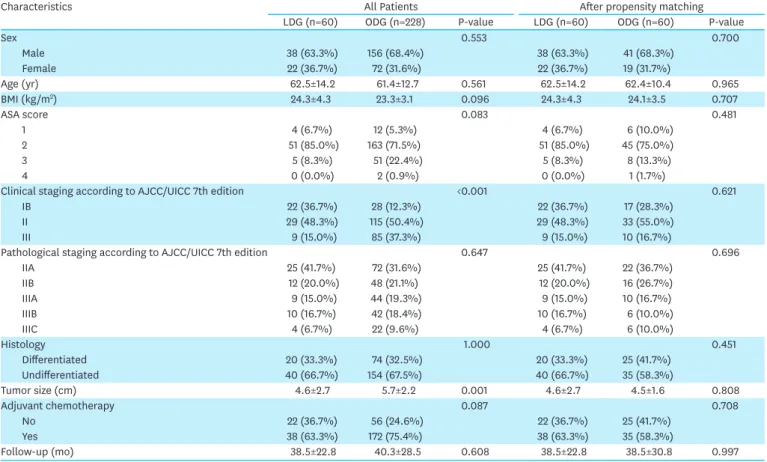
The clinicopathological characteristics of the unmatched and matched patient populations are summarized in Table 1. Before propensity score matching, there seemed to be significant differences in BMI (P=0.096), ASA score (P=0.083), cTNM (p<0.001), tumor size (P=0.001), and use of adjuvant chemotherapy (P=0.087) between the LDG and ODG groups. However, there was no significant difference between the 2 groups after propensity score matching.
Because of poor general condition, refusal of further treatment by the patient or family, or advanced age, some AGC patients did not receive adjuvant chemotherapy.
Perioperative outcomes are shown in Table 2. The extent of lymph node dissection in the LDG group (D2/D2+, 76.7%) was more limited than in the ODG group (D2/D2+, 91.7%) (P=0.002); however, there was no difference in the number of retrieved lymph nodes between the 2 groups (LDG vs. ODG, 30.5±15.5 vs. 32.8±16.9). Operative time was significantly longer in the LDG group (234.8±46.9 minutes) than in the ODG group (217.2±48.0 minutes) (P=0.045), whereas time to resumption of food intake (4.7±1.1 days vs.
5.6±3.3 days, P=0.049) and length of hospital stay (9.6±4.3 days vs. 11.5±5.1 days, P=0.035) were shorter in the LDG group than in the ODG group. Mortality and readmission rates were similar between the 2 groups.
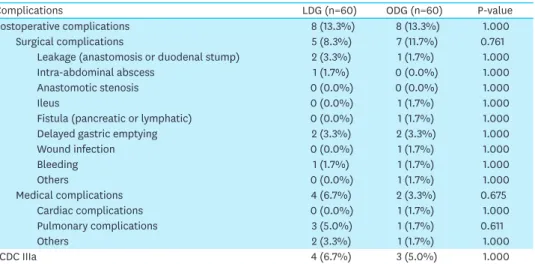
Postoperative complications are summarized in Table 3. The incidence of all-grade overall, surgical, and medical complications did not differ significantly between the LDG and ODG groups (13.3% vs. 13.3%, P=1.000; 8.3% vs. 11.7%, P=0.761; and 6.7% vs. 3.3%, P=0.675;
respectively). Severe overall complications ≥CDC IIIa were similar in the 2 groups (LDG vs.
ODG, 6.7% vs. 5.0%, P=1.000). Individual surgical complications, cardiac complications, and pulmonary complications also did not differ significantly between the groups.
The median overall follow-up period was 38.5±26.8 months, with 38.5±22.8 months in the LDG group and 38.5±30.8 months in the ODG group. The Kaplan-Meier survival curves Table 1. Clinicopathological characteristics
Characteristics All Patients After propensity matching
LDG (n=60) ODG (n=228) P-value LDG (n=60) ODG (n=60) P-value
Sex 0.553 0.700
Male 38 (63.3%) 156 (68.4%) 38 (63.3%) 41 (68.3%)
Female 22 (36.7%) 72 (31.6%) 22 (36.7%) 19 (31.7%)
Age (yr) 62.5±14.2 61.4±12.7 0.561 62.5±14.2 62.4±10.4 0.965
BMI (kg/m2) 24.3±4.3 23.3±3.1 0.096 24.3±4.3 24.1±3.5 0.707
ASA score 0.083 0.481
1 4 (6.7%) 12 (5.3%) 4 (6.7%) 6 (10.0%)
2 51 (85.0%) 163 (71.5%) 51 (85.0%) 45 (75.0%)
3 5 (8.3%) 51 (22.4%) 5 (8.3%) 8 (13.3%)
4 0 (0.0%) 2 (0.9%) 0 (0.0%) 1 (1.7%)
Clinical staging according to AJCC/UICC 7th edition <0.001 0.621
IB 22 (36.7%) 28 (12.3%) 22 (36.7%) 17 (28.3%)
II 29 (48.3%) 115 (50.4%) 29 (48.3%) 33 (55.0%)
III 9 (15.0%) 85 (37.3%) 9 (15.0%) 10 (16.7%)
Pathological staging according to AJCC/UICC 7th edition 0.647 0.696
IIA 25 (41.7%) 72 (31.6%) 25 (41.7%) 22 (36.7%)
IIB 12 (20.0%) 48 (21.1%) 12 (20.0%) 16 (26.7%)
IIIA 9 (15.0%) 44 (19.3%) 9 (15.0%) 10 (16.7%)
IIIB 10 (16.7%) 42 (18.4%) 10 (16.7%) 6 (10.0%)
IIIC 4 (6.7%) 22 (9.6%) 4 (6.7%) 6 (10.0%)
Histology 1.000 0.451
Differentiated 20 (33.3%) 74 (32.5%) 20 (33.3%) 25 (41.7%)
Undifferentiated 40 (66.7%) 154 (67.5%) 40 (66.7%) 35 (58.3%)
Tumor size (cm) 4.6±2.7 5.7±2.2 0.001 4.6±2.7 4.5±1.6 0.808
Adjuvant chemotherapy 0.087 0.708
No 22 (36.7%) 56 (24.6%) 22 (36.7%) 25 (41.7%)
Yes 38 (63.3%) 172 (75.4%) 38 (63.3%) 35 (58.3%)
Follow-up (mo) 38.5±22.8 40.3±28.5 0.608 38.5±22.8 38.5±30.8 0.997
LDG = laparoscopic distal gastrectomy; ODG = open distal gastrectomy; BMI = body mass index; ASA = American Society of Anesthesiologists; AJCC/UICC = American Joint Committee on Cancer/Union for International Cancer Control.
Table 2. Perioperative outcomes
Outcomes LDG (n=60) ODG (n=60) P-value
Proximal resection margin (cm) 3.9±2.7 5.1±3.9 0.195
Distal resection margin (cm) 5.2±3.7 4.1±2.1 0.176
Extent of lymph node dissection 0.002
D1 0 (0.0%) 2 (3.3%)
D1+ 14 (23.3%) 3 (5.0%)
D2 43 (71.7%) 43 (71.7%)
D2+ 3 (5.0%) 12 (20.0%)
Retrieved lymph nodes 30.5±15.5 32.8±16.9 0.449
Operative time (min) 234.8±46.9 217.2±48.0 0.045
Postoperative time to food intake (day) 4.7±1.1 5.6±3.3 0.049
Hospital stay (day) 9.6±4.3 11.5±5.1 0.035
Mortality 0 (0.0%) 1 (1.7%) 1.000
Readmission 2 (3.2%) 0 (0.0%) 0.476
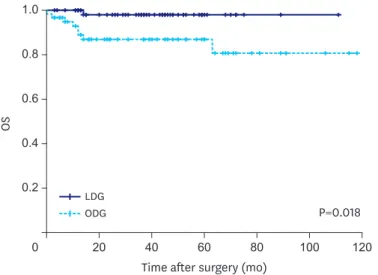
after propensity score matching are shown in Figs. 1 and 2. Before matching, 3-year RFS did not differ significantly between the LDG and ODG groups (86.3% vs. 78.7%, P=0.35);
however, 3-year OS was significantly longer in the LDG group than in the ODG group (98.0% vs. 85.7%, P=0.0121). After matching, 3-year RFS did not differ between the LDG and ODG groups (86.3% vs. 75.3%, P=0.259); however, 3-year OS was longer in the LDG group (98.0% vs. 86.9%, P=0.0176). In subgroup analysis, 3-year RFS and 3-year OS did not differ significantly between the LDG group and ODG group for stage II disease (3-year RFS, 91.0%
vs. 90.7%, P=0.632; 3-year OS, 100.0% vs. 91.9%, P=0.068) or stage III disease (76.8% vs.
45.2%, P=0.0827; 94.1% vs. 76.1%, P=0.104, respectively).
DISCUSSION
The results of this study suggest that LDG might be a promising treatment for clinical and pathological AGC in terms of short-term and long-term outcomes. One small RCT and a few retrospective case-matched studies on AGC showed no significant differences in overall Table 3. Postoperative complications
Complications LDG (n=60) ODG (n=60) P-value
Postoperative complications 8 (13.3%) 8 (13.3%) 1.000
Surgical complications 5 (8.3%) 7 (11.7%) 0.761
Leakage (anastomosis or duodenal stump) 2 (3.3%) 1 (1.7%) 1.000
Intra-abdominal abscess 1 (1.7%) 0 (0.0%) 1.000
Anastomotic stenosis 0 (0.0%) 0 (0.0%) 1.000
Ileus 0 (0.0%) 1 (1.7%) 1.000
Fistula (pancreatic or lymphatic) 0 (0.0%) 1 (1.7%) 1.000
Delayed gastric emptying 2 (3.3%) 2 (3.3%) 1.000
Wound infection 0 (0.0%) 1 (1.7%) 1.000
Bleeding 1 (1.7%) 1 (1.7%) 1.000
Others 0 (0.0%) 1 (1.7%) 1.000
Medical complications 4 (6.7%) 2 (3.3%) 0.675
Cardiac complications 0 (0.0%) 1 (1.7%) 1.000
Pulmonary complications 3 (5.0%) 1 (1.7%) 0.611
Others 2 (3.3%) 1 (1.7%) 1.000
≥CDC IIIa 4 (6.7%) 3 (5.0%) 1.000
LDG = laparoscopic distal gastrectomy; ODG = open distal gastrectomy; CDC = Clavien-Dindo Classification.
Time after surgery (mo)
P=0.259
RFS
0.6
0 20 60 100 120
1.0
0.8
0.4
0.2
40 80
LDG ODG
Fig. 1. RFS after propensity score matching analysis.
RFS = recurrence-free survival; LDG = laparoscopic distal gastrectomy; ODG = open distal gastrectomy.
survival between LG and OG [10,16-19]. Similar survival was also reported in retrospective cohort studies of patients with AGC who underwent gastrectomy [11-14]. Our results are consistent with the findings of previous studies. However, the present study included only patients with clinical and pathological diagnoses of AGC as well as well-matched variables. In our study population, the 3-year OS rate in the LDG group was higher than in the ODG group, probably because the LDG group tended to have lower clinical and pathological staging than the ODG group, although the difference was not statistically significant. Moreover, the small number of patients in the study and the insufficient follow-up period made it difficult to determine long-term survival rates. The ultimate explanation can be derived from previous colon cancer research [22], which demonstrated that stage III patients who underwent laparoscopic colectomy had a higher survival rate than patients with open colectomy, and proposed that this was due to the impact of laparoscopy on the surgical stress response, cellular immunity, cytokine release, intraoperative tumor manipulation, complication rates, and blood transfusion factors. In a western study comparing LG with OG, the OS and RFS did not differ significantly, although the follow-up period was not equal between the 2 groups and some early-stage cancers were included [23].
In this study, the extent of lymphadenectomy was significantly limited in the laparoscopic group compared to the open group. According to the Japanese Gastric Cancer Treatment Guidelines [21], D2 lymph node dissection is the standard treatment for curable cT2-T4or cT1N+ gastric cancer; however, 23.3% of the LDG group and 8.3% of the ODG group underwent lymphadenectomy that was less than D2. Although not shown in the results, limited lymph node dissection was reported in 31.8% (7/22 patients) of the LDG group and in 11.8% (2/17) of the ODG group among cTNM IB patients, and 24.1% (7/29) and 9.1% (3/33), respectively, among cTNM II patients. All cTNM III patients received standard D2 lymph node dissection. Despite the high rate of limited lymphadenectomy in the laparoscopic group, there was no difference in survival between the 2 groups. This result suggests that the standard treatment of D2 lymphadenectomy may not be necessary in patients with clinical T1b or TII disease, consistent with previous reports [24-26]. Moreover, the therapeutic index for No. 11p and 12a dissection in earlier advanced disease was decreased in the COACT1001 study [27]. An ongoing multi-institutional RCT [28] is expected to clarify the optimal extent of lymph node dissection for patients with cTNM IB/II gastric cancer.
Time after surgery (mo)
P=0.018
OS
0.6
0 20 60 100 120
1.0
0.8
0.4
0.2
40 80
LDG ODG
Fig. 2. OS after propensity score matching analysis.
OS = overall survival; LDG = laparoscopic distal gastrectomy; ODG = open distal gastrectomy.
Our study showed earlier resumption of oral intake and earlier discharge with LDG than with ODG; these results are supported by the findings of previous studies on AGC [7,9,10,16], and are mainly due to changes in postoperative patient care, especially the dietary schedule.
Since 2010, a number of studies have confirmed the safety and efficacy of the Early Recovery after Surgery (ERAS) program in gastric cancer [29-33]. In our hospital, the dietary schedule was accelerated by 1 day since 2013, although the ERAS program was not applied. During this period, 48.3% (29 of 60 patients) of the LDG group and 25.0% (15/60) of the ODG group were enrolled. Otherwise, the dietary schedule was determined by the recovery of bowel motility and severity of abdominal pain. Although we did not evaluate the postoperative time to first flatus and the visual analog scale or number of injected analgesic doses for pain assessment, our finding of no difference in readmission rates or surgical complications such as postoperative ileus or delayed gastric emptying in both groups indirectly demonstrates the safety of earlier resumption of oral intake in the LDG group.
Postoperative complications did not differ significantly between LDG and ODG groups in our study, concordant with 2 RCTs [4,10] and 2 propensity score matched analyses [16,18]. However, some case-matched studies and meta-analyses showed that the overall complication rates were significantly lower in the laparoscopic group than in the open group [6-9]. Regarding specific complications, 1 RCT [10] reported that pulmonary infection was observed more frequently in the open group and 1 case-matched study [8] demonstrated that wound infection was significantly more common in the open group than in the laparoscopic group, whereas our results showed similar rates in both groups. Overall, studies to date suggest that the laparoscopic group shows results that are better or similar to those of the open group, and that laparoscopy may be superior with regard to surgical safety.
Limitations of our study are as follows: we investigated only a small number of patients in a single institution; the follow-up periods were insufficient to obtain longer survival data;
and despite good propensity score matching, the slight imbalance in pathologic stage, an important factor that affects survival, could create a hidden bias. We believe that this study could serve as important background research for future RCTs on LDG for AGC.
LDG is safe and feasible in terms of recovery after surgery and long-term oncologic outcomes. LDG may be a treatment option for both AGC and EGC.
REFERENCES
1. Kitano S, Iso Y, Moriyama M, Sugimachi K. Laparoscopy-assisted Billroth I gastrectomy. Surg Laparosc Endosc 1994;4:146-148.
PUBMED
2. Kim W, Kim HH, Han SU, Kim MC, Hyung WJ, Ryu SW, et al. Decreased morbidity of laparoscopic distal gastrectomy compared with open distal gastrectomy for stage I gastric cancer: short-term outcomes from a multicenter randomized controlled trial (KLASS-01). Ann Surg 2016;263:28-35.
PUBMED | CROSSREF
3. Katai H, Mizusawa J, Katayama H, Takagi M, Yoshikawa T, Fukagawa T, et al. Short-term surgical outcomes from a phase III study of laparoscopy-assisted versus open distal gastrectomy with nodal dissection for clinical stage IA/IB gastric cancer: Japan Clinical Oncology Group Study JCOG0912. Gastric Cancer 2017;20:699-708.
PUBMED | CROSSREF
4. Hu Y, Huang C, Sun Y, Su X, Cao H, Hu J, et al. Morbidity and mortality of laparoscopic versus open D2 distal gastrectomy for advanced gastric cancer: a randomized controlled trial. J Clin Oncol 2016;34:1350-1357.
PUBMED | CROSSREF
5. Inaki N, Etoh T, Ohyama T, Uchiyama K, Katada N, Koeda K, et al. A multi-institutional, prospective, phase II feasibility study of laparoscopy-assisted distal gastrectomy with D2 lymph node dissection for locally advanced gastric cancer (JLSSG0901). World J Surg 2015;39:2734-2741.
PUBMED | CROSSREF
6. Huang YL, Lin HG, Yang JW, Jiang FQ, Zhang T, Yang HM, et al. Laparoscopy-assisted versus open gastrectomy with D2 lymph node dissection for advanced gastric cancer: a meta-analysis. Int J Clin Exp Med 2014;7:1490-1499.
PUBMED
7. Zou ZH, Zhao LY, Mou TY, Hu YF, Yu J, Liu H, et al. Laparoscopic vs open D2 gastrectomy for locally advanced gastric cancer: a meta-analysis. World J Gastroenterol 2014;20:16750-16764.
PUBMED | CROSSREF
8. Li Q, Wang J, Zhang G, Wang J, Yang B, Zhang Z. Feasibility and safety comparison of laparoscopy- assisted versus open gastrectomy for advanced gastric carcinoma with D2 lymphadenectomy. Jpn J Clin Oncol 2016;46:323-328.
PUBMED | CROSSREF
9. Quan Y, Huang A, Ye M, Xu M, Zhuang B, Zhang P, et al. Comparison of laparoscopic versus open gastrectomy for advanced gastric cancer: an updated meta-analysis. Gastric Cancer 2016;19:939-950.
PUBMED | CROSSREF
10. Cai J, Wei D, Gao CF, Zhang CS, Zhang H, Zhao T. A prospective randomized study comparing open versus laparoscopy-assisted D2 radical gastrectomy in advanced gastric cancer. Dig Surg 2011;28:331-337.
PUBMED | CROSSREF
11. Zhao Y, Yu P, Hao Y, Qian F, Tang B, Shi Y, et al. Comparison of outcomes for laparoscopically assisted and open radical distal gastrectomy with lymphadenectomy for advanced gastric cancer. Surg Endosc 2011;25:2960-2966.
PUBMED | CROSSREF
12. Hamabe A, Omori T, Tanaka K, Nishida T. Comparison of long-term results between laparoscopy- assisted gastrectomy and open gastrectomy with D2 lymph node dissection for advanced gastric cancer.
Surg Endosc 2012;26:1702-1709.
PUBMED | CROSSREF
13. Gordon AC, Kojima K, Inokuchi M, Kato K, Sugihara K. Long-term comparison of laparoscopy-assisted distal gastrectomy and open distal gastrectomy in advanced gastric cancer. Surg Endosc 2013;27:462-470.
PUBMED | CROSSREF
14. Shinohara T, Satoh S, Kanaya S, Ishida Y, Taniguchi K, Isogaki J, et al. Laparoscopic versus open D2 gastrectomy for advanced gastric cancer: a retrospective cohort study. Surg Endosc 2013;27:286-294.
PUBMED | CROSSREF
15. Choi YY, Bae JM, An JY, Hyung WJ, Noh SH. Laparoscopic gastrectomy for advanced gastric cancer: are the long-term results comparable with conventional open gastrectomy? A systematic review and meta- analysis. J Surg Oncol 2013;108:550-556.
PUBMED | CROSSREF
16. Kim KH, Kim MC, Jung GJ, Choi HJ, Jang JS, Kwon HC. Comparative analysis of five-year survival results of laparoscopy-assisted gastrectomy versus open gastrectomy for advanced gastric cancer: a case-control study using a propensity score method. Dig Surg 2012;29:165-171.
PUBMED | CROSSREF
17. Lin JX, Huang CM, Zheng CH, Li P, Xie JW, Wang JB, et al. Is all advanced gastric cancer suitable for laparoscopy-assisted gastrectomy with extended lymphadenectomy? A case-control study using a propensity score method. Ann Surg Oncol 2016;23:1252-1260.
PUBMED | CROSSREF
18. Inokuchi M, Nakagawa M, Tanioka T, Okuno K, Gokita K, Kojima K. Long- and short-term outcomes of laparoscopic gastrectomy versus open gastrectomy in patients with clinically and pathological locally advanced gastric cancer: a propensity-score matching analysis. Surg Endosc 2018;32:735-742.
PUBMED | CROSSREF
19. Zhang Y, Qi F, Jiang Y, Zhai H, Ji Y. Long-term follow-up after laparoscopic versus open distal gastrectomy for advanced gastric cancer. Int J Clin Exp Med 2015;8:13564-13570.
PUBMED
20. Dindo D, Demartines N, Clavien PA. Classification of surgical complications: a new proposal with evaluation in a cohort of 6336 patients and results of a survey. Ann Surg 2004;240:205-213.
PUBMED | CROSSREF
21. Japanese Gastric Cancer Association. Japanese gastric cancer treatment guidelines 2014 (ver. 4). Gastric Cancer 2017;20:1-19.
PUBMED | CROSSREF
22. Lacy AM, Delgado S, Castells A, Prins HA, Arroyo V, Ibarzabal A, et al. The long-term results of a randomized clinical trial of laparoscopy-assisted versus open surgery for colon cancer. Ann Surg 2008;248:1-7.
PUBMED | CROSSREF
23. Kelly KJ, Selby L, Chou JF, Dukleska K, Capanu M, Coit DG, et al. Laparoscopic versus open gastrectomy for gastric adenocarcinoma in the west: a case-control study. Ann Surg Oncol 2015;22:3590-3596.
PUBMED | CROSSREF
24. Memon MA, Subramanya MS, Khan S, Hossain MB, Osland E, Memon B. Meta-analysis of D1 versus D2 gastrectomy for gastric adenocarcinoma. Ann Surg 2011;253:900-911.
PUBMED | CROSSREF
25. Seevaratnam R, Bocicariu A, Cardoso R, Mahar A, Kiss A, Helyer L, et al. A meta-analysis of D1 versus D2 lymph node dissection. Gastric Cancer 2012;15 Suppl 1:S60-S69.
PUBMED | CROSSREF
26. An JY, Heo GU, Cheong JH, Hyung WJ, Choi SH, Noh SH. Assessment of open versus laparoscopy-assisted gastrectomy in lymph node-positive early gastric cancer: a retrospective cohort analysis. J Surg Oncol 2010;102:77-81.
PUBMED | CROSSREF
27. Park YK, Yoon HM, Kim YW, Park JY, Ryu KW, Lee YJ, et al. Laparoscopy-assisted versus open D2 distal gastrectomy for advanced gastric cancer: results from a randomized phase II multicenter clinical trial (COACT 1001). Ann Surg 2018;267:638-645.
PUBMED | CROSSREF
28. Kim J, Eom B, Nam B, Yoon H, Kim Y. 423. ADDICT – a multicenter randomized clinical trial of D1+
versus D2 distal gastrectomy for stage IB & II advanced gastric cancer: design and rationale. Eur J Surg Oncol 2014;40:S162.
CROSSREF
29. Hur H, Si Y, Kang WK, Kim W, Jeon HM. Effects of early oral feeding on surgical outcomes and recovery after curative surgery for gastric cancer: pilot study results. World J Surg 2009;33:1454-1458.
PUBMED | CROSSREF
30. Grantcharov TP, Kehlet H. Laparoscopic gastric surgery in an enhanced recovery programme. Br J Surg 2010;97:1547-1551.
PUBMED | CROSSREF
31. Wang D, Kong Y, Zhong B, Zhou X, Zhou Y. Fast-track surgery improves postoperative recovery in patients with gastric cancer: a randomized comparison with conventional postoperative care. J Gastrointest Surg 2010;14:620-627.
PUBMED | CROSSREF
32. Kim JW, Kim WS, Cheong JH, Hyung WJ, Choi SH, Noh SH. Safety and efficacy of fast-track surgery in laparoscopic distal gastrectomy for gastric cancer: a randomized clinical trial. World J Surg 2012;36:2879-2887.
PUBMED | CROSSREF
33. Yamada T, Hayashi T, Cho H, Yoshikawa T, Taniguchi H, Fukushima R, et al. Usefulness of enhanced recovery after surgery protocol as compared with conventional perioperative care in gastric surgery.
Gastric Cancer 2012;15:34-41.
PUBMED | CROSSREF