INTRODUCTION
Since the first laparoscopy-assisted distal gastrectomy (LADG) for early gastric cancer (EGC) was reported in 1994, there have been major breakthroughs in the field of gastric cancer surgery.
1Numerous studies have evaluated the feasibility and effectiveness of applying this emerging technique for gastric cancer, and many reports reveal the superiority of the laparoscopic approach compared with the conventional open method, most significantly in terms of less estimated blood loss, less postoperative pain, faster postoperative recovery and shorter hospital stays.
2-6Although the long-term results of phase III trials are yet to be published, many retrospective studies showed that laparoscopic distal gastrectomy (LDG) has long-term results that were comparable with those of open distal gastrectomy (ODG), and LDG is now considered to be accepted for EGC in Korea and Japan.
7-9As the accumulation of laparoscopic experience increases, the
laparoscopic technique is being used as a less invasive approach for more radical procedures, such as totally laparoscopic distal gastrectomy (TLDG) with D2 lymphadenectomy.
10,11Thus, there is much interest in the application of LDG for advanced gastric cancer (AGC), and some experienced surgeons are extending the indication of laparoscopic gastrectomy from locally to far advanced cases.
12-16However, there remain controversies concerning its application for AGC, including its indication, whether it will achieve adequate lymphadenectomy and recurrences.
17,18Therefore, despite the numerous cases performed, laparoscopic gastrectomy is still considered as an investigational treatment in most published guidelines, including those of the Japanese Gastric Cancer Association (JGCA), the National Comprehensive Cancer Network (NCCN) in the United States, and the European Society of Medical Oncology (ESMO).
19-21LDG is the most common procedure for gastric cancer in Korea where distal tumors are the predominant type. However,
Laparoscopic Distal Gastrectomy for Gastric Cancer
Sang-Yong Son, M.D., Sang-Uk Han, M.D., Ph.D.
Department of Surgery, Ajou University School of Medicine, Suwon, Korea
Laparoscopic distal gastrectomy for gastric cancer has rapidly gained popularity because of its short- term benefits, including less blood loss, less postoperative pain, earlier postoperative recovery, and shorter hospital stay, compared to the conventional open method. Although the long-term results of phase III trials have yet to be published, laparoscopic distal gastrectomy is now considered to be accepted for early-stage gastric cancer. As advances in instruments and the accumulation of laparoscopic experience increase, laparoscopic distal gastrectomy is being used for advanced gastric cancer. However, due to the technical difficulty of performing D2 lymphadenectomy, this application remains controversial. Well-designed clinical trials will clarify the surgical feasibility and oncological safety of laparoscopic distal gastrectomy for advanced gastric cancer in the near future.
Keywords:
Stomach neoplasms, Laparoscopy, GastrectomyReceived February 12, 2015 Accepted March 4, 2015
Corresponding author Sang-Uk Han
Department of Surgery, Ajou University School of Medicine, 206 Worldcup-ro, Yeongtong-gu, Suwon 443-749, Korea
Tel: +82-31-219-5200 Fax: +82-31-219-5755 E-mail: [email protected]
This is an Open Access article distributed under the terms of the Creative Commons Attribution Non-Commercial License (http://
creativecommons.org/licenses/by-nc/3.0/) which permits unrestricted non-commercial use, distribution, and reproduction in any medium, provided the original work is properly cited.
Copyright © 2015 The Journal of Minimally Invasive Surgery. All rights reserved.
Journal of Minimally Invasive Surgery
J Minim Invasive Surg 2015;18(1):1-6
the application of this procedure in AGC has progressed slowly due to the technical difficulty of performing D2 lymphadenectomy and the lack of evidence of its long-term oncological safety.
22,23Here, we aim to provide an overview of the current status of LDG for gastric cancer, focusing on its oncological safety and technical aspects.
ONCOLOGICAL SAFETY OF LDG
Current evidence
Several of the randomized controlled trials (RCTs) con- ducted to evaluate the oncological outcomes of LDG for EGC, have been unable to provide any conclusive evidence due to their limited sample sizes and follow-up periods.
Recently, however, the results of a number of meta-analyses and a long-term trial have provided evidence of the benefits of LDG in EGC. Vinuela et al. conducted a meta-analysis of six RCTs and 19 non-RCTs with a total of 3,055 patients, and reported that LDG was associated with longer operation times (weighted mean difference (WMD) 48.3 minutes; p<0.001) and lower overall complications (odds ratio 0.59; p<0.001), lower estimated blood loss (WMD -118.9 ml; p<0.001), and shorter hospital stays (WMD -3.6 days; p<0.001). A similar meta- analysis of five RCTs and 17 non-RCTs, conducted Zeng et al., reported that LDG showed similar oncologic outcomes to ODG in terms of the mean number of retrieved lymph nodes and the long-term survival rates. The long-term results of the COACT 0301 RCT reported by Kim et al. showed that the LADG and ODG groups had similar survival rates (5-year overall survival: 97.6% vs. 96.3%, respectively; p=0.721) with reductions in mild complications observed with LADG (23.2%
vs. 41.5%; p=0.012), and better short-term functional and symptom scores, but no long-term advantages in quality of life.
There are a few reports on the outcomes of LDG in AGC.
A meta-analysis of one RCT and nine cohorts with a total of 1,819 patients by Choi et al. found that there was no statistical difference in survivals between LDG and ODG.
24Park et al. reported the long-term outcomes of 239 patients who underwent a LDG for AGC. These patients, from a multicenter retrospective study, were diagnosed preoperatively as having EGC but on final pathological examination were diagnosed with AGC. The 5-year overall survival rates were 90.5% in stage IB, 86.4% in IIA, 52.8% in IIIA, 52.9% in IIIB, and 37.5%
in IIIC, and the results were comparable to those of previous reports for ODG.
25Gordon et al. compared the long-term outcomes of LADG with those of ODG for AGC in a study of 206 patients with cT2-T3N0 gastric cancer (66 of whom received a LADG). They found no significant difference
between LADG and ODG in terms of overall survival and disease-specific survival, with a mean follow-up period of 49.2 months.
26Fang et al. also compared long-term results after treatment for AGC with LADG or ODG, both with D2 lymph node dissection, and reported similar results.
27Recently, the Korean Laparoscopic Gastrointestinal Surgery Study (KLASS) group reported the long-term results of a large-scale multicenter retrospective study comparing 1,477 laparoscopic procedures and 1,499 open procedures. The analysis, case-matched using a propensity score model, revealed that the overall survival, disease-specific survival, and recurrence-free survival were not statistically different for each cancer stage (from IA to IIIC), and they concluded that the long-term oncological outcomes of LDG for patients with gastric cancer were comparable to those of ODG.
28,29Ongoing clinical trials
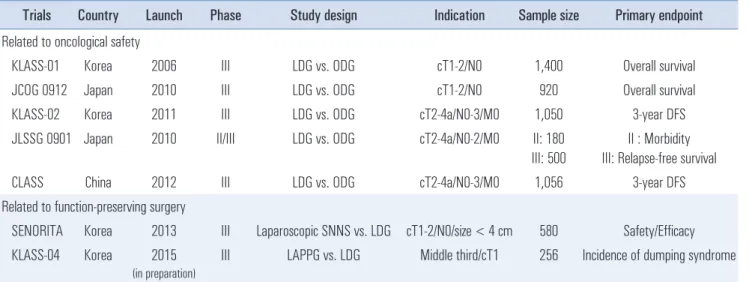
There are presently several multicenter trials underway on examining the use of LDG for gastric cancer. These trials can be classified into two major categories: those concerned with the feasibility and oncological safety of LDG, and those examining function-preserving surgery comparing with LDG (Table 1).
Of the ongoing feasibility and oncologic safety trials, KLASS-01 and Japanese Clinical Oncology Group (JCOG) 0912 are representative of those examining the use of LDF for EGC. KLASS-01 is the first large-scale multicenter (13 institutions) RCT to compare LADG and ODG in patients with clinical stage I gastric cancer. From 2006 to 2010, the study enrolled 1,416 patients (705 patients in the LADG, and 711 patients in the ODG arm), and the final results are expected to be reported in the near future.
30,31The JCOG0912 RCT launched in 2010 is also multicenter (33 institutions), and compares LADG and ODG in a total of 920 patients.
32KLASS-02 is a phase III study evaluating the efficacy of LADG with D2 lymph node dissection for AGC. The primary endpoint of this study is 3-year disease-free survival. Before beginning the trial, surgeons underwent a quality control assessment of their laparoscopic D2 lymphadenectomy perfor- mance by review of six unedited videos of their procedures.
All were required to be standardized. This study aims to enroll
a total of 1,050 patients, which it is expected to reach this
year.
23In 2010, the Japanese Laparoscopic Surgery Study Group
(JLSSG) launched a multicenter phase II/III study, entitled
JLSSG 0901, to compare LADG and ODG in patients with cT2-
T4aM0 gastric cancer. Phase II study has finished after the
accrual of 180 patients and the study is now continuing as a phase
III trial. The analysis of the incidence of major complications
from the phase II study will be published soon. The Chinese
Laparoscopic Gastrointestinal Surgical Study (CLASS) group is performing a phase III study entitled CLASS-01 and recently finished enrollment of 1,056 patients. Like the KLASS-02 trial, this study aims to evaluate the oncological safety of LDG for AGC.
Two trials designed to investigate the function-preserving surgery comparing with LDG are currently underway or in preparation. SENORITA is a multicenter phase III trial aimed at validating the clinical role of laparoscopic sentinel node biopsy. The inclusion criterion is a cT1N0 tumor of size less than 3 cm and the estimated sample size is 580. The results of this clinical trial are expected to provide perspectives on the future of laparoscopic sentinel node navigation surgery for EGC. KLASS-04 is a multicenter phase III trial designed to evaluate the clinical benefits (for example, reduced incidence of dumping syndrome and gallstones, and better nutritional outcomes) of laparoscopy-assisted pylorus-preserving gastrec- tomy compared with LDG, and is expected to be launched this year.
TECHNICAL CONSIDERATIONS DURING LDG
Extent of lymph node dissection
The incidence of gastric cancer metastasis to lymph nodes increases with the depth of the tumor, occurring in 2~5% of mucosal cases, 6~23% of submucosal cases, 10~41% of cases involving muscularis prorpia or subserosa, and in 70% of cases with serosa-exposed gastric cancer. Thus, the adequate extent of lymphadenectomy required should be considered
preoperatively as indicated by the the clinical T stage.
33According to the JGCA treatment guidelines (version 3; 2010), a D1+ lymphadenectomy is recommended for cT1N0 tumors, and a D2 lymphadenectomy for cN+ or cT2-T4 tumors. D1 lymphadenectomy is only indicated for T1a tumors that are excluded from the criteria for endoscopic resection and for cT1bN0 tumor that are of differentiated type and less than 1.5cm in diameter. For distal gastrectomy, the adequate extent of lymphadenectomy required is as follows; D1: regional lymph nodes numbers (nos) 1, 3, 4sb, 4d, 5, 6, and 7; D1+: D1 lymph nodes + nos.8a and 9; and for D2: D1 lymph nodes + nos. 8a, 9, 11p, and 12a.
21Theoretically, the extent of lymph node dissection during LDG is not different from that undertaken in an ODG. However, D2 lymphadenectomy for AGC remains a challenging step laparoscopically due to technical difficulty in suprapancreatic area. Conventionally, laparoscopic suprapancreatic lymph node dissection proceeds from nodes 12a to 11p, as in the open procedure. However, this procedure is complicated and requires slinging of the vessels to properly expose portal and splenic veins. Recently, a new technique for suprapancreatic lymph node dissection, the ‘medial approach’, was introduced by Kanaya et al.
34In contrast to the conventional slinging method, the medial approach starts by identifying and ligating the left gastric vessels, and then proceeds toward both lateral sides, nodes 12a and 11p. This method continues to gain popularity, and is also reported to have good results, including less intraoperative blood loss, more retrieved lymph nodes, and shorter hospital stays.
35Table 1. Ongoing clinical trials for LDG
Trials Country Launch Phase Study design Indication Sample size Primary endpoint Related to oncological safety
KLASS-01 Korea 2006 III LDG vs. ODG cT1-2/N0 1,400 Overall survival
JCOG 0912 Japan 2010 III LDG vs. ODG cT1-2/N0 920 Overall survival
KLASS-02 Korea 2011 III LDG vs. ODG cT2-4a/N0-3/M0 1,050 3-year DFS
JLSSG 0901 Japan 2010 II/III LDG vs. ODG cT2-4a/N0-2/M0 II: 180 III: 500
II : Morbidity III: Relapse-free survival
CLASS China 2012 III LDG vs. ODG cT2-4a/N0-3/M0 1,056 3-year DFS
Related to function-preserving surgery
SENORITA Korea 2013 III Laparoscopic SNNS vs. LDG cT1-2/N0/size < 4 cm 580 Safety/Efficacy KLASS-04 Korea 2015
(in preparation)
III LAPPG vs. LDG Middle third/cT1 256 Incidence of dumping syndrome
LDG = Laparoscopic distal gastrectomy; ODG = Open distal gastrectomy; SNNS = Sentinel node navigation surgery; LAPPG = Laparoscopy-assisted
pylorus preserving gastrectomy; DFS = Disease-free survival.
Reconstruction after LDG
Reconstruction after LDG can be performed either extra- corporeally, in which case the procedure is referred to as a
‘laparoscopy-assisted’ DG, or intracorporeally, which is a
‘totally laparoscopic’ DG. In LADG, the reconstruction can either be hand-sewn or performed with a stapler via a mini- laparotomy incision made on the epigastrium. The type of reconstruction used is the surgeon ’s preference, but three types, the Billroth I and Billroth II operations, and Roux-en-Y gastrojejunostomy are usually favored.
LADG was by far the most performed technique, but TLDG is gaining popularity since Kanaya et al. developed the delta- shaped anastomosis technique.
36The delta-shaped anastomosis is a functional end-to-end gastroduodenostomy technique performed using only linear staplers, and it offers technical simplicity, wider lumen anastomosis, and better cosmesis in comparison to the extracorporeal Billroth I methods, and a good surgical field even in obese patients.
10However, it requires sufficient length of duodenal stump and remnant stomach, so it is not recommended when the tumor is located above the angle of the stomach or very close to the pylorus.
To date, other intracorporeal TLDG methods have been introduced, including the Billroth II, Roux-en-Y, uncut Roux- en-Y and beta-shaped anastomosis. These procedures are usually performed as a side-to-side anastomosis using linear staplers.
37-40The advantage of TLDG over LADG has not been esta- blished, but recently a few reports have implied several bene- fits, such as smaller wounds, less invasiveness, and a higher feasibility of achieving a secure reconstruction.
41Furthermore, Kim et al. report that TLDG can improve early surgical outcomes in obese patients compared with LADG, including shorter operative time, faster recovery of bowel movement, reduced pain, lower complication rates, and shorter hospital stays.
42,43Tumor localization during TLDG
In TLDG, the site of the tumor can be a particular challenge to achieving an adequate proximal resection margin; this is especially true in those located in the middle third of the stomach. In conventional LADG, the tumor site can be easily identified and the resection line can be determined in AGC by manipulation of the tumor, or in EGC with the use of preoperatively placed clips. In TLDG, all the procedures including gastric resection and reconstruction are performed intracorporeally, and thus surgeons cannot feel the extent of tumor and decide the appropriate extent of resection as in LADG.
Several techniques have been introduced to solve this problem. Yi et al. reported the usefulness of intraoperative gastroscopy.
44After the clamping of the duodenum, indigo carmine can be injected via intraoperative gastroscopy into the muscular layer. This method can avoid the need for additional preoperative gastroscopy for clipping and identifies the exact tumor localization. Some surgeons use a laparoscopic ultrasonography instrument or portable radiography.
45,46However, such methods require additional skills and a little more time to identify the location of the tumor.
47CONCLUSION
LDG for gastric cancer is an emerging technique and considered to be accepted as an alternative treatment modality promising better short-term outcomes. However, further concrete evidence is required to confirm the oncological safety of LDG, and its appropriate indication.
ACKNOWLEDGEMENTS
This study was supported by a grant from the National R &
D Program for Cancer Control, Ministry of Health & Welfare, Republic of Korea (1320270). This funding source had no role in the design of this article and will not have any role during its execution or publication.
REFERENCES
1) Kitano S, Iso Y, Moriyama M, Sugimachi K. Laparoscopy-assisted Billroth I gastrectomy. Surg Laparosc Endosc 1994;4:146-148.
2) Kitano S, Shiraishi N, Fujii K, Yasuda K, Inomata M, Adachi Y.
A randomized controlled trial comparing open vs laparoscopy- assisted distal gastrectomy for the treatment of early gastric cancer:
an interim report. Surgery 2002;131:S306-311.
3) Lee JH, Han HS, Lee JH. A prospective randomized study comparing open vs laparoscopy-assisted distal gastrectomy in early gastric cancer: early results. Surg Endosc 2005;19:168-173.
4) Lee SI, Choi YS, Park DJ, Kim HH, Yang HK, Kim MC. Com- parative study of laparoscopy-assisted distal gastrectomy and open distal gastrectomy. J Am Coll Surg 2006;202:874-880.
5) Kim YW, Yoon HM, Yun YH, et al. Long-term outcomes of laparoscopy-assisted distal gastrectomy for early gastric cancer:
result of a randomized controlled trial (COACT 0301). Surg Endosc 2013;27:4267-4276.
6) Kim HH, Hyung WJ, Cho GS, et al. Morbidity and mortality of laparoscopic gastrectomy versus open gastrectomy for gastric cancer: an interim report--a phase III multicenter, prospective, randomized Trial (KLASS Trial). Ann Surg 2010;251:417-420.
7) Vinuela EF, Gonen M, Brennan MF, Coit DG, Strong VE.
Laparoscopic versus open distal gastrectomy for gastric cancer: a meta-analysis of randomized controlled trials and high-quality nonrandomized studies. Ann Surg 2012;255:446-456.
8) Zeng YK, Yang ZL, Peng JS, Lin HS, Cai L. Laparoscopy-assisted versus open distal gastrectomy for early gastric cancer: evidence from randomized and nonrandomized clinical trials. Ann Surg 2012;256:39-52.
9) Jiang L, Yang KH, Guan QL, et al. Laparoscopy-assisted gastrec- tomy versus open gastrectomy for resectable gastric cancer: an update meta-analysis based on randomized controlled trials. Surg Endosc 2013;27:2466-2480.
10) Kanaya S, Kawamura Y, Kawada H, et al. The delta-shaped anas- tomosis in laparoscopic distal gastrectomy: analysis of the initial 100 consecutive procedures of intracorporeal gastroduodenostomy.
Gastric Cancer 2011;14:365-371.
11) Chen K, Xu X, Mou Y, et al. Totally laparoscopic distal gastrec- tomy with D2 lymphadenectomy and Billroth II gastrojejunostomy for gastric cancer: short- and medium-term results of 139 con- secutive cases from a single institution. Int J Med Sci 2013;10:
1462-1470.
12) Lee CM, Rao J, Son SY, et al. Laparoscopic gastrectomy for gastric cancer with simultaneous organ resection. J Laparoendosc Adv Surg Tech A 2013;23:861-865.
13) Son SY, Lee CM, Lee JH, et al. Laparoscopy-assisted gastrectomy with para-aortic lymphadenectomy after palliative chemotherapy for advanced gastric cancer with isolated para-aortic lymph node metastasis. J Korean Surg Soc 2013;84:304-308.
14) Son T, Hyung WJ, Lee JH, Kim YM, Noh SH. Minimally invasive surgery for serosa-positive gastric cancer (pT4a) in patients with preoperative diagnosis of cancer without serosal invasion. Surg Endosc 2014;28:866-874.
15) Li P, Huang CM, Zheng CH, et al. Laparoscopic spleen-preserving splenic hilar lymphadenectomy in 108 consecutive patients with upper gastric cancer. World J Gastroenterol 2014;20:11376-11383.
16) Hu Y, Ying M, Huang C, et al. Oncologic outcomes of laparo- scopy-assisted gastrectomy for advanced gastric cancer: a large- scale multicenter retrospective cohort study from China. Surg Endosc 2014;28:2048-2056.
17) Santoro R, Ettorre GM, Santoro E. Subtotal gastrectomy for gastric cancer. World J Gastroenterol 2014;20:13667-13680.
18) Antonakis PT, Ashrafian H, Isla AM. Laparoscopic gastric surgery for cancer: where do we stand? World J Gastroenterol 2014;20:
14280-14291.
19) Ajani JA, Bentrem DJ, Besh S, et al. Gastric cancer, version 2.2013:
featured updates to the NCCN Guidelines. J Natl Compr Canc Netw 2013;11:531-546.
20) Okines A, Verheij M, Allum W, Cunningham D, Cervantes A.
Gastric cancer: ESMO Clinical Practice Guidelines for diagnosis, treatment and follow-up. Ann Oncol 2010;21 Suppl 5:v50-54.
21) Japanese gastric cancer treatment guidelines 2010 (ver. 3). Gastric
Cancer 2011;14:113-123.
22) Lee HJ, Shiraishi N, Kim HH, et al. Standard of practice on laparoscopic gastric cancer surgery in Korea and Japan: experts' survey. Asian J Endosc Surg 2012;5:5-11.
23) Kim HI, Hur H, Kim YN, et al. Standardization of D2 lympha- denectomy and surgical quality control (KLASS-02-QC): a prospective, observational, multicenter study [NCT01283893].
BMC Cancer 2014;14:209.
24) Choi YY, Bae JM, An JY, Hyung WJ, Noh SH. Laparoscopic gastrectomy for advanced gastric cancer: are the long-term results comparable with conventional open gastrectomy? A systematic review and meta-analysis. J Surg Oncol 2013;108:550-556.
25) Park do J, Han SU, Hyung WJ, et al. Long-term outcomes after laparoscopy-assisted gastrectomy for advanced gastric cancer: a large-scale multicenter retrospective study. Surg Endosc 2012;
26:1548-1553.
26) Gordon AC, Kojima K, Inokuchi M, Kato K, Sugihara K. Long- term comparison of laparoscopy-assisted distal gastrectomy and open distal gastrectomy in advanced gastric cancer. Surg Endosc 2013;27:462-470.
27) Fang C, Hua J, Li J, et al. Comparison of long-term results between laparoscopy-assisted gastrectomy and open gastrectomy with D2 lymphadenectomy for advanced gastric cancer. Am J Surg 2014;208:391-396.
28) Kim HH, Han SU, Kim MC, et al. Long-term results of laparo- scopic gastrectomy for gastric cancer: a large-scale case-control and case-matched Korean multicenter study. J Clin Oncol 2014;
32:627-633.
29) Kim HH, Son SY, Ahn S, Han SU. Reply to M. Honda et al. J Clin Oncol 2014;32:3201-3202.
30) Kim HH, Han SU, Kim MC, et al. Prospective randomized con- trolled trial (phase III) to comparing laparoscopic distal gastrec- tomy with open distal gastrectomy for gastric adenocar cinoma (KLASS 01). J Korean Surg Soc 2013;84:123-130.
31) Kim HH, Han SU, Kim MC, et al. ERRATUM: Correction for the number of the recruited patients and the participating institutions.
Prospective randomized controlled trial (phase III) to comparing laparoscopic distal gastrectomy with open distal gastrectomy for gastric adenocarcinoma (KLASS 01). Ann Surg Treat Res 2014;87:51-52.
32) Nakamura K, Katai H, Mizusawa J, et al. A phase III study of laparoscopy-assisted versus open distal gastrectomy with nodal dissection for clinical stage IA/IB gastric Cancer (JCOG0912). Jpn J Clin Oncol 2013;43:324-327.
33) Yi Y, Yu J, Li B, et al. Pattern of lymph node metastases and its implication in radiotherapeutic clinical target volume delineation of regional lymph node in patients with gastric carcinoma.
Radiother Oncol 2010;96:223-230.
34) Kanaya S, Haruta S, Kawamura Y, et al. Video: laparoscopy distinctive technique for suprapancreatic lymph node dissection:
medial approach for laparoscopic gastric cancer surgery. Surg Endosc 2011;25:3928-3929.
35) Shinohara T, Hanyu N, Kawano S, et al. Clinical significance of medial approach for suprapancreatic lymph node dissection during laparoscopic gastric cancer surgery. Surg Endosc 2014;28:1678- 1685.
36) Kanaya S, Gomi T, Momoi H, et al. Delta-shaped anastomosis in totally laparoscopic Billroth I gastrectomy: new technique of intraabdominal gastroduodenostomy. J Am Coll Surg 2002;195:
284-287.
37) Du J, Shuang J, Li J, et al. Totally laparoscopic Billroth II gastrec- tomy with a novel, safe, simple, and time-saving anastomosis by only stapling devices. J Gastrointest Surg 2012;16:738-743.
38) Motoyama K, Kojima K, Hayashi M, Kato K, Inokuchi M, Sugihara K. beta-Shaped intracorporeal Roux-en-Y recon- struction after totally laparoscopic distal gastrectomy. Gastric Cancer 2014;17:588-593.
39) Ahn SH, Son SY, Lee CM, Jung do H, Park do J, Kim HH.
Intracorporeal uncut Roux-en-Y gastrojejunostomy reconstruction in pure single-incision laparoscopic distal gastrectomy for early gastric cancer: unaided stapling closure. J Am Coll Surg 2014;218:e17-21.
40) Yun SC, Choi HJ, Park JY, Kim YJ. Total laparoscopic uncut Roux-en-Y gastrojejunostomy after distal gastrectomy. Am Surg 2014;80:E51-53.
41) Ikeda O, Sakaguchi Y, Aoki Y, et al. Advantages of totally
laparoscopic distal gastrectomy over laparoscopically assisted distal gastrectomy for gastric cancer. Surg Endosc 2009;23:2374-2379.
42) Kim MG, Kawada H, Kim BS, et al. A totally laparoscopic distal gastrectomy with gastroduodenostomy (TLDG) for improvement of the early surgical outcomes in high BMI patients. Surg Endosc 2011;25:1076-1082.
43) Kim MG, Kim KC, Kim BS, et al. A totally laparoscopic distal gastrectomy can be an effective way of performing laparoscopic gastrectomy in obese patients (body mass index>/=30). World J Surg 2011;35:1327-1332.
44) Xuan Y, Hur H, Byun CS, Han SU, Cho YK. Efficacy of intraoperative gastroscopy for tumor localization in totally laparoscopic distal gastrectomy for cancer in the middle third of the stomach. Surg Endosc 2013;27:4364-4370.
45) Hyung WJ, Lim JS, Cheong JH, et al. Intraoperative tumor localization using laparoscopic ultrasonography in laparoscopic- assisted gastrectomy. Surg Endosc 2005;19:1353-1357.
46) Kim HI, Hyung WJ, Lee CR, et al. Intraoperative portable abdominal radiograph for tumor localization: a simple and accurate method for laparoscopic gastrectomy. Surg Endosc 2011;25:958-963.
47) Kim BS, Yook JH, Kim BS, Jung HY. A simplified technique for tumor localization using preoperative endoscopic clipping and radio-opaque markers during totally laparoscopic gastrectomy.
Am Surg 2014;80:1266-1270.