Uncut Roux-en-Y Reconstruction after Laparoscopic Distal Gastrectomy Can Be a Favorable Method in Terms of
Gastritis, Bile Reflux, and Gastric Residue
Ji Yeon Park and Yong Jin Kim
Department of Surgery, Soonchunhyang University Hospital Seoul, Seoul, Korea
Purpose: Laparoscopic distal gastrectomy (LDG) is a well-established procedure for the treatment of early gastric cancer. Several recon- struction methods can be adopted after LDG according to tumor characteristics and surgeon preference. This study aimed to compare the remnant gastric functions after different reconstructions.
Materials and Methods: In total, 221 patients who underwent LDG between March 2005 and October 2013 were reviewed retrospec- tively. The patients were classified into four groups based on the reconstructive procedure: Billroth I (BI) anastomosis, Billroth II (BII) with Braun anastomosis, Roux-en-Y (RY) reconstruction, or uncut RY reconstruction. Patient demographics, surgical outcomes, and postoperative endoscopic findings were reviewed and compared among groups.
Results: Endoscopic evaluations at 11.8±3.8 months postoperatively showed less frequent gastritis and bile reflux in the remnant stom- ach in the RY group compared to the BI and BII groups. There was no significant difference in the gastric residue among the BI, BII, and RY groups. The incidence of gastritis and bile reflux in the uncut RY group was similar to that in the RY group, while residual gastric content in the uncut RY group was significantly smaller and less frequently observed than that in the RY group (5.8% versus 35.3%, P=0.010).
Conclusions: RY and uncut RY reconstructions are equally superior to BI and BII with Braun anastomoses in terms of gastritis and bile reflux in the remnant stomach. Furthermore, uncut RY reconstruction showed improved stasis compared to conventional RY gastrojeju- nostomy. Uncut RY reconstruction can be a favorable reconstructive procedure after LDG.
Key Words: Stomach neoplasms; Gastrectomy; Reconstructive surgical procedures; Anastomosis, Roux-en-Y; Bile reflux
Correspondence to: Yong Jin Kim
Department of Surgery, Soonchunhyang University Hospital Seoul, 59 Daesagwan-ro, Yongsan-gu, Seoul 140-743, Korea
Tel: +82-2-709-9479, Fax: +82-2-795-1687 E-mail: [email protected]
Received September 1, 2014 Revised October 7, 2014 Accepted October 8, 2014
Copyrights © 2014 by The Korean Gastric Cancer Association www.jgc-online.org
This is an open-access article distributed under the terms of the Creative Commons Attribution Non-Commercial License (http://creativecommons.org/
licenses/by-nc/3.0) which permits unrestricted noncommercial use, distribution, and reproduction in any medium, provided the original work is properly cited.
Introduction
Gastric cancer is the most common cancer and the second most common cause of cancer deaths in Korea.1 Early gastric cancer (EGC) accounts for >50% of all gastric cancer cases in Korea ow- ing to early detection on nationwide screening; consequently, the
overall survival rates of patients with gastric cancer have markedly improved over the past few decades.2,3 Quality of life after surgery has become an important issue in these patients in Korea.
Laparoscopic distal gastrectomy (LDG) is already a well-estab- lished procedure for EGC treatment. Many previously published studies demonstrated its feasibility and oncologic safety as well as better quality of life with minimal invasiveness compared to con- ventional open surgery.4-6 However, many patients still experience post-gastrectomy symptoms including malabsorption, dumping syndrome, alkaline reflux, and delayed gastric emptying even after laparoscopic surgery; these symptoms originate from the inevi- table anatomic deviation encountered during surgical procedures.
Additionally, detection of metachronous cancer in the remnant
stomach in patients after distal gastrectomy has increased owing to prolonged survival. Therefore, surgeons are seeking a better recon- struction method that features better long-term quality of life and reduces the risk of remnant gastric cancer after distal gastrectomy.
The reconstruction method used after LDG might vary accord- ing to tumor characteristics or surgical conditions, but this seems to largely depend on the surgeons’ preferences. We assumed that reconstruction type following distal gastrectomy would influence remnant gastric function and quality of life after surgery.
The current study aimed to compare the different reconstructive procedures after LDG in terms of surgical outcomes, remnant gas- tric function, and postoperative nutritional status.
Materials and Methods
A review of the prospectively established gastric cancer database identified 211 patients who underwent LDG for histopathologically confirmed gastric cancer between March 2005 and October 2013 at our institution; the medical records of these patients were reviewed retrospectively. All patients were evaluated preoperatively with endoscopy and abdominal computed tomography to predict the disease extent. Laparoscopic surgery was offered to those patients who were clinically diagnosed with stage IA or IB gastric cancer according to the seventh edition of the American Joint Committee on Cancer staging system.7
The patients underwent either laparoscopy-assisted distal gas- trectomy (LADG) or totally laparoscopic distal gastrectomy (TLDG)
along with D1+ or greater lymphadenectomy. A single surgeon performed all surgical procedures. The LDG procedures have been previously described in detail.8,9 The tumor location largely influenced the decision between Billroth I and Billroth II recon- structions when extracorporeal anastomosis was used before 2008.
When TLDG with intracorporeal anastomosis was adopted thereafter, the reconstruction method was selected based on the surgeon’s tem- porary preference among Billroth II with Braun, Roux-en-Y, and uncut Roux-en-Y reconstructions without distinct indications. The patients were classified into four groups according to the recon- struction method used: Billroth I gastroduodenostomy (BI), Billroth II gastrojejunostomy with Braun anastomosis (BII), Roux-en-Y gastrojejunostomy (RY), and uncut Roux-en-Y reconstruction (uncut RY). The clinical data and surgical outcomes were compared among the groups.
1. Perioperative data
Demographics, clinicopathological characteristics, surgical out- comes, and follow-up data were obtained from the medical records for the analyses. Patient surgical risk was assessed preoperatively according to the American Society of Anesthesiologists classifica- tion as follows: I, healthy patient; II, mild systemic disease; III, se- vere systemic disease; IV, severe systemic disease that is a constant threat to life; and V, moribund patient unlikely to survive 24 hours with or without operation.10 The operating time was defined as the time from skin incision to wound closure, while intraoperative blood loss was estimated from the amount of blood suctioned from
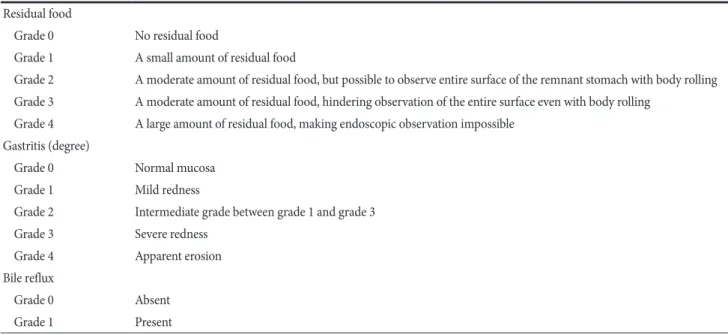
Table 1. The residue, gastritis, bile classification Residual food
Grade 0 No residual food
Grade 1 A small amount of residual food
Grade 2 A moderate amount of residual food, but possible to observe entire surface of the remnant stomach with body rolling Grade 3 A moderate amount of residual food, hindering observation of the entire surface even with body rolling
Grade 4 A large amount of residual food, making endoscopic observation impossible Gastritis (degree)
Grade 0 Normal mucosa
Grade 1 Mild redness
Grade 2 Intermediate grade between grade 1 and grade 3 Grade 3 Severe redness
Grade 4 Apparent erosion Bile reflux
Grade 0 Absent
Grade 1 Present
the operative field as described on the anesthetic chart. Postopera- tive complication severity was classified according to the Accordion Severity Grading System of Postoperative Complications.11 Clinical stasis was diagnosed when the patient did not tolerate the diet pro- gression as scheduled in the early postoperative period and required fasting or a clear liquid diet for >2 days after diet progression.
The neutrophil-lymphocyte ratio (NLR) was calculated to assess the systemic inflammatory response during the early postoperative period, and the changes were compared among groups to evaluate the differences in systemic inflammatory responses after using the different reconstruction methods.
2. Nutritional status
Body weight and serum hemoglobin, total protein, and albumin levels were collected retrospectively to investigate the changes in nutritional status after different reconstruction methods were per- formed. Postoperative values at 1 year of follow-up were retrieved, and the relative values to the preoperative levels were calculated to compare the outcomes.
3. Classification of endoscopic findings
The patients received follow-up upper gastrointestinal endos- copy 1 year postoperatively. An experienced gastroenterologist reviewed the endoscopic findings retrospectively. Gastric residue, degree of gastritis, and bile reflux in the remnant stomach were evaluated using the endoscopic ‘residue, gastritis, bile’ (RGB) clas- sification proposed by Kubo et al.12 The detailed classification of endoscopic findings in the remnant stomach is shown in Table 1.
According to the RGB classification, higher scores indicate worse symptoms or signs in the remnant stomach.
4. Statistical analysis
All statistical analyses were performed using SPSS ver. 14 for Windows (SPSS Inc., Chicago, IL, USA). All values are expressed as mean±standard deviation. Either the Pearson χ2 test or the Fisher’s exact test was used to compare categorical variables. The mean difference among the four groups was analyzed using a one-way analysis of variance, and multiple comparisons using the Tukey honestly significant difference test were conducted post hoc to assess differences between pairs of groups. Two-sided P-values were calculated for all tests, and P-values <0.05 were considered statistically significant.
Table 2. Clinicopathologic characteristics of the patients (n=211)
Variable Value
Age (yr) 57.6±11.9
Sex
Male 126 (59.7)
Female 85 (40.3)
BMI at operation (kg/m2) 24.4±3.5
History of previous abdominal surgery 7 (3.3)
History of endoscopic resection 19 (9.0)
ASA score
I 105 (49.8)
II 104 (49.3)
III 2 (0.9)
Operation
LADG 77 (36.5)
TLDG 134 (63.5)
Extent of lymph node dissection*
D1+ 181
D2 11
Reconstruction
Billroth I 39 (18.5)
Billroth II 76 (36.0)
Roux-en-Y 55 (26.1)
Uncut Roux-en-Y 41 (19.4)
Combined operation 26 (12.3)
Cholecystectomy 13
Colorectal surgery 4
Therapeutic endoscopy 4
Miscellaneous 5
Laparotomic conversion 1 (0.5)
Number of retrieved lymph nodes 24.7±12.6
Pathologic stage†
0 3 (1.4)‡
IA 177 (83.9)
IB 19 (9.0)
IIA 10 (4.7)
IIB 1 (0.5)
IIIA 1 (0.5)
Values are presented as mean±standard deviation, number (%), or number only. BMI = body mass index; ASA = American Society of Anesthesiologists; LADG = laparoscopy-assisted distal gastrectomy;
TLDG = totally laparoscopic distal gastrectomy. *Extent of lymph node dissection following the Japanese gastric cancer treatment guidelines 2010. †Pathological stage according to the seventh edition of the American Joint Committee on Cancer staging manual. ‡Three patients, who were preoperatively diagnosed with gastric cancer by endoscopic biopsy, were proved to have tubular adenoma with high- grade dysplasia after surgery.
Results
The patients’ clinicopathological characteristics are shown in Table 2. The mean patient age was 57.6±11.9 years, and the popu- lation included 126 men (59.7%) and 85 women (40.3%). Nineteen patients had a history of endoscopic resection for gastric cancer lesions, and they were referred to the surgical department because of lymph node metastasis risk or complications during endoscopic procedures.
Seventy-seven patients underwent LADG and the other 134 underwent TLDG. The most commonly used reconstruction method was BII anastomosis (76/211, 36.0%), followed by conven- tional RY reconstruction (55/211, 26.1%). Braun anastomosis was performed in all but 3 patients who underwent BII reconstruction.
1. Perioperative surgical outcomes
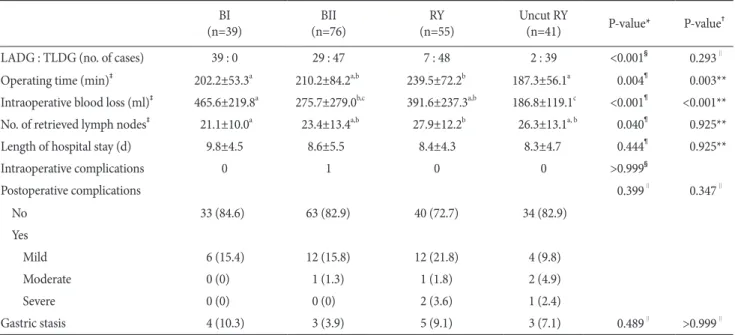
The surgical outcomes were compared among the different reconstruction groups (Table 3). All patients in the BI group under- went LADG contrary to the other reconstruction groups (P<0.001).
The operating time was significantly prolonged in the RY group (239.5±72.2 minutes), and it was the shortest in the uncut RY group (187.3±56.1 minutes, P=0.004). Blood loss was the lowest
in the uncut RY group (186.8±119.1 ml) and the highest in the BI group (391.6±237.3 ml, P<0.001). When the differences between the conventional RY and uncut RY groups were further analyzed, surgical outcomes including operating time and blood loss in the uncut RY group were significantly better than those in the RY group (P=0.003 and P<0.001, respectively). The mean hospital stay was similar between the groups.
One patient in the BII group underwent laparotomic conver- sion for intraoperative bleeding from the right gastric artery. Severe postoperative complications requiring invasive intervention devel- oped in 2 patients in the RY group and in 1 patient in the uncut RY group; 2 patients with intra-abdominal bleeding and an incisional hernia in the RY group required reoperation, while 1 in the uncut RY group who presented with intraluminal bleeding underwent endoscopic intervention. However, the overall incidence and dis- tribution of complication severity did not differ statistically among the groups (P=0.399). Clinical stasis occurred in 15 of 211 patients in the early postoperative period, and the incidence was similar among the groups (P=0.489).
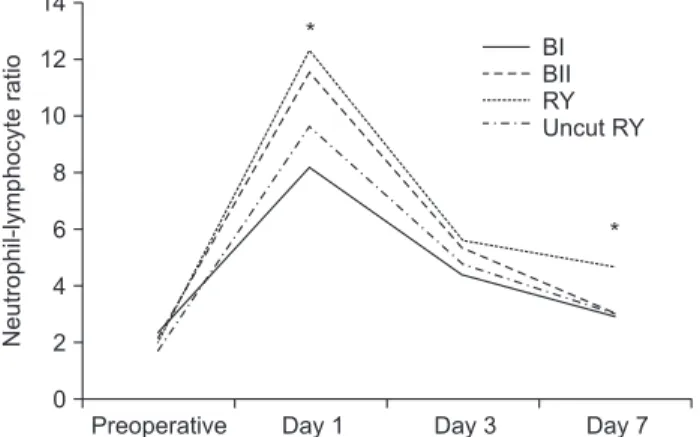
Regarding the postoperative systemic inflammatory response measured by NLR, the RY group showed a greater increase in the ratio compared to the other groups on the first postoperative day
Table 3. Comparison of surgical outcomes according to the reconstructive procedures
(n=39)BI BII
(n=76) RY
(n=55) Uncut RY
(n=41) P-value* P-value†
LADG : TLDG (no. of cases) 39 : 0 29 : 47 7 : 48 2 : 39 <0.001§ 0.293∥
Operating time (min)‡ 202.2±53.3a 210.2±84.2a,b 239.5±72.2b 187.3±56.1a 0.004¶ 0.003**
Intraoperative blood loss (ml)‡ 465.6±219.8a 275.7±279.0b,c 391.6±237.3a,b 186.8±119.1c <0.001¶ <0.001**
No. of retrieved lymph nodes‡ 21.1±10.0a 23.4±13.4a,b 27.9±12.2b 26.3±13.1a, b 0.040¶ 0.925**
Length of hospital stay (d) 9.8±4.5 8.6±5.5 8.4±4.3 8.3±4.7 0.444¶ 0.925**
Intraoperative complications 0 1 0 0 >0.999§
Postoperative complications 0.399∥ 0.347∥
No 33 (84.6) 63 (82.9) 40 (72.7) 34 (82.9)
Yes
Mild 6 (15.4) 12 (15.8) 12 (21.8) 4 (9.8)
Moderate 0 (0) 1 (1.3) 1 (1.8) 2 (4.9)
Severe 0 (0) 0 (0) 2 (3.6) 1 (2.4)
Gastric stasis 4 (10.3) 3 (3.9) 5 (9.1) 3 (7.1) 0.489∥ >0.999∥
Values are presented as ratio, mean±standard deviation, number only, or number (%). BI = Billroth I gastroduodenostomy; BII = Billroth II gastrojejunostomy; RY = Roux-en-Y reconstruction; LADG = laparoscopy-assisted distal gastrectomy; TLDG = totally laparoscopic distal gastrectomy. *Statistical significances among groups; †statistical significances between RY vs. uncut RY groups. ‡The same superscript letters indicate insignificant difference between groups based on the Tukey multiple comparison test. §Pearson’s chi-square test. ∥Fisher’s exact test. ¶One- way analysis of variance. **Multiple comparison with Tukey honestly significant difference test.
(P=0.003), especially the BI group, and the ratio was still signifi- cantly higher a week after the surgery (P=0.005; Fig. 1).
2. Outcomes at the 1-year follow-up
There were no significant differences in body weight change among the reconstructive procedures at 1 year after surgery. The nutritional status was assessed using the relative values to the pre- operative hemoglobin, protein, and albumin levels, and the changes were not significantly different among the groups (Table 4).
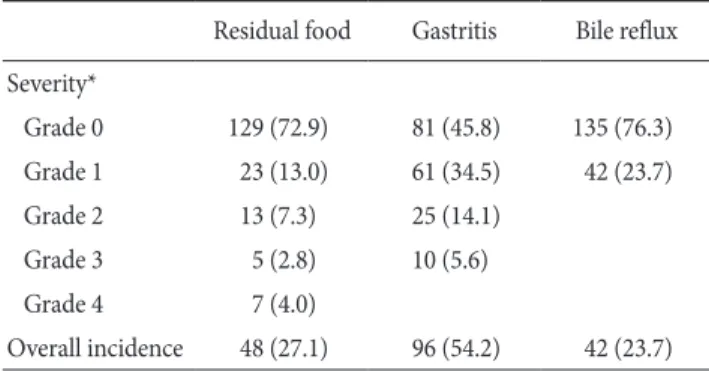
Remnant gastric function was evaluated considering the endo- scopic findings, and 177 patients (83.9%) received follow-up en- doscopy 1 year postoperatively. The mean interval between surgery and endoscopic surveillance was 11.8±3.8 months. The overall incidences of gastric stasis, gastritis, and bile reflux after LDG were 27.1%, 54.2%, and 23.7%, respectively (Table 5). There was a sig-
nificant correlation between bile reflux and gastritis (P<0.001);
when bile reflux was observed, 88.1% of the patients showed a cer- tain degree of gastritis (Table 6).
Remnant gastric function was further compared considering the reconstructive procedure. There was no significant difference in the amount of gastric residue between the BI (15/32, 46.9%), BII (13/60, 21.7%), and RY (18/51, 35.3%) groups, but the uncut RY group showed significantly improved stasis compared to the BI and RY groups; residual food was detected only in 2 of 34 patients (5.8%) who underwent uncut RY reconstruction and were followed-up endoscopically (Fig. 2A). Gastritis in the RY (15/51, 29.4%) and uncut RY (9/34, 26.5%) groups was equally less severe and less fre- quently observed than that in the BI (27/32, 84.4%) or BII (45/60, 75.0%) groups (Fig. 2B). Bile reflux also was less frequently de- tected in the RY (5/51, 9.8%) and uncut RY (0/34, 0%) groups than in the BI (11/32, 34.4%) and BII (26/60, 43.3%) groups (Fig. 2C).
Discussion
After distal gastrectomy, several reconstruction methods are available, and preferences vary among surgeons. Controversy re- mains regarding which method is the best after distal gastrectomy.
BI gastroduodenostomy is the only way to preserve the physiologi- cal continuity of the gastrointestinal tract, and it has been preferred owing to its technical simplicity during open surgery. However, the risk of anastomosis failure is known to be higher, and the surgical technique could be rather challenging during laparoscopic surgery. BII gastrojejunostomy enables wide stomach resection without anastomotic tension and is relatively easy during laparo- scopic surgery; however, postoperative bile reflux into the remnant Fig. 1. Systemic inflammatory response after surgery according to
the reconstructive procedures. BI = Billroth I gastroduodenostomy;
BII = Billroth II gastrojejunostomy; RY = Roux-en-Y reconstruction.
*P<0.05; by one-way analysis of variance.
Preoperative 14
12
10
8
6
4
ratioNeutrophil-lymphocyte 2
0
BI BII RY Uncut RY
Day 1 Day 3 Day 7
*
*
Table 4. Change in nutritional status at 1 year postoperatively
(n=39)BI BII
(n=76) RY
(n=55) Uncut RY
(n=41) P-value*
Follow-up rate 33 (84.6) 64 (84.2) 51 (92.7) 35 (85.4)
Time interval (mo)† 11.4±4.4a,b 10.9±3.6a 12.3±3.4a,b 12.9±2.2a,b 0.028
Body weight (%)‡ 93.0±6.8 91.3±6.9 90.0±7.3 90.4±8.6 0.559
Laboratory results‡
Hemoglobin (%) 95.0±9.2 97.6±11.3 94.3±9.4 96.1±8.5 0.328
Protein (%) 99.8±9.2 101.5±6.6 98.5±7.1 100.7±7.2 0.180
Albumin (%) 102.5±10.3 103.8±6.7 101.6±9.9 103.2±9.2 0.638
Values are presented as number (%) or mean±standard deviation. BI = Billroth I gastroduodenostomy; BII = Billroth II gastrojejunostomy; RY = Roux-en-Y reconstruction. *One-way analysis of variance. †The same superscript letters indicate insignificant difference between groups based on the Tukey multiple comparison test. ‡Comparison with relative values to preoperative levels.
stomach is bothersome, and although rare, afferent loop syndrome can develop. RY gastrojejunostomy is known to prevent bile reflux, but the high incidence of Roux stasis syndrome is one of its major drawbacks.13
According to a nationwide survey conducted in 2009 in Ko- rea, BI was the most frequently adopted reconstruction after distal gastrectomy (63.4%), followed by BII reconstruction (33.1%); RY reconstruction was seldom performed and comprised only 3.3%.3 This finding is probably because BI reconstruction is considered simple and safe owing to the use of mechanical staplers, particu- larly during open surgery, and BII reconstruction serves as an al- ternative when BI reconstruction is not applicable. In Japan, on the other hand, the most common method of reconstruction was BI, followed by RY. The popularity of RY reconstruction seems to have increased recently owing to its low complication rate and ability to prevent postoperative bile reflux.14 In the survey, it was revealed that the incidence of Roux stasis reached 71%.
Uncut RY reconstruction was first devised with the purpose of
Fig. 2. Comparison of endoscopic findings after different reconstruc- tion methods following laparoscopic distal gastrectomy: residual food (A), degree of gastritis (B), and bile reflux (C). BI = Billroth I gastro- duodenostomy; BII = Billroth II gastrojejunostomy; RY = Roux-en-Y reconstruction. *P<0.05; **P<0.005 by Pearson’s chi-square test or Fisher’s exact test.
BI BII RY
100 90 80 70 60 50 40 30 20 10
%
Residual food
0
Uncut RY
BI BII RY
100 90 80 70 60 50 40 30 20 10
%
Degree of gastritis
0
Uncut RY Grade 4
Grade 3 Grade 2 Grade 1
*
**
Grade 3 Grade 2 Grade 1
**
**
**
BI BII RY
100 90 80 70 60 50 40 30 20 10
%
Bile reflux
0
Uncut RY Grade 1
*
**
**
**
**
A
B
C Table 5. Incidence of gastric stasis, gastritis, and bile reflux (n=177)
Residual food Gastritis Bile reflux Severity*
Grade 0 129 (72.9) 81 (45.8) 135 (76.3) Grade 1 23 (13.0) 61 (34.5) 42 (23.7)
Grade 2 13 (7.3) 25 (14.1)
Grade 3 5 (2.8) 10 (5.6)
Grade 4 7 (4.0)
Overall incidence 48 (27.1) 96 (54.2) 42 (23.7) Values are presented as number (%). *The severity was classified according to the endoscopic ‘residue, gastritis, bile’ classification proposed by Kubo et al.12
Table 6. Correlation between bile reflux and the degree of gastritis (n=177)
Bile reflux
P-value
Grade 0 Grade 1
Gastritis Grade 0 76 (56.3) 5 (11.9) <0.001
Grade 1 40 (29.6) 21 (50.0)
Grade 2 14 (10.4) 11 (26.2)
Grade 3 5 (3.7) 5 (11.9)
Total 135 (100) 42 (100)
Values are presented as number (%).
preventing Roux stasis syndrome.15 Uncut RY is a simple modi- fication of the BII with Braun anastomosis method in which the jejunogastric pathway is occluded with a non-bladed linear stapler.
It is known to reduce Roux stasis syndrome by maintaining the integrity of the intestinal canal and allowing normal conduction of the myenteric impulses.16,17 However, the original uncut technique was associated with a high rate of recanalization of the uncut sta- pled line.17,18 In the present study, a 6-row linear stapler was used to minimize the risk of staple line dehiscence, and no recanalization was noticed on endoscopic evaluation at 1 year. A longer follow-up period would be required to evaluate the exact incidence of staple line dehiscence.
The operating time was the shortest in the uncut RY group, and it was significantly prolonged in the RY group. Blood loss was the lowest in the uncut RY group and the highest in the BI group. This might be attributable to the difference in surgical experience, as BI was only used during the period of laparoscopy-assisted lapa- roscopic surgery and it was never adopted after the surgical skill had evolved towards total laparoscopic surgery with intracorporeal anastomosis. Nonetheless, the application of BII, RY, and uncut RY reconstructions was contemporaneous, and uncut RY reconstruction shows at least comparable surgical outcomes to those of BII and RY reconstructions. The operative procedures of uncut RY recon- struction resemble those of BII with Braun anastomosis, and they are less complicated than those of conventional RY reconstruction;
this seems to be associated with a lower incidence of complications such as bleeding or gastric stasis than conventional RY reconstruc- tion, although the difference was not statistically significant.
NLR represents an easily measured, reproducible, and inexpen- sive marker of systemic inflammation that reflects the degree of surgical stress and helps identify patients at high risk of postopera- tive complications.19,20 NLR is also known to be associated with oncological outcomes in multiple malignancies, including colorectal and gastric cancers.21-24 In the present study, the RY group exhib- ited the highest surgical stress, and patients in this group recovered the slowest over a week among all four reconstructive procedures.
The uncut RY group showed relatively reduced systemic inflam- mation compared to the conventional RY group; this might be related to the decreased intraabdominal organ manipulation during the surgery in order to avoid additional mesenteric division of the proximal jejunum for establishing the Roux limb. Interestingly, the BI group showed the lowest NLR despite losing the most blood and all BI anastomoses being established extracorporeally, which is considered more invasive than the intracorporeal method. The
surgeon’s familiarity with the procedure, the physiological integrity, and fewer anastomoses could have relieved the surgical stress. The long-term influence of these factors on oncological outcomes re- quires further investigation in the future.
Regarding postoperative nutritional status, all reconstructive procedures showed similar changes in body weight as well as se- rum hemoglobin, albumin, and protein levels. Nutritional demerits of the RY method compared to the BI method, which might occur because of the non-physiological food passage, could not be dem- onstrated in the current study with a 1-year follow-up. This find- ing is consistent with the results of previous reports that short and long-term nutritional status estimated by considering body weight and serum albumin and total cholesterol levels was similar after RY and BI reconstructions.25-27 It might be necessary to evaluate other nutritional indexes including various kinds of micronutrients to as- sess the impact of food bypass after the RY procedure.
Bile reflux into the remnant stomach and esophagus can cause gastritis or esophagitis, and it might increase the risk of cancer de- velopment in the remnant stomach and lower esophagus. Although the exact mechanisms for this are not yet clearly understood, many investigators have asserted that the refluxate of duodenal content is directly related to the development of Barrett esophagus and esophageal cancer.28,29 Duodenogastric reflux has also been sug- gested as a causal factor of gastric carcinogenesis in numerous ex- perimental models despite scarce human data.30,31 Furthermore, bile reflux can cause clinical symptoms such as heartburn or regurgita- tion, impairing patient quality of life and requiring prolonged med- ical therapy. Takiguchi et al.32 reported that reflux symptoms were significantly worse after BI than after RY anastomosis according to the questionnaire survey, although BI and RY reconstructions featured equivalent short-term quality of life. As the number of patients with EGC is increasing and survival after treatment is ex- pected to be longer, the issue of metachronous cancer development or postoperative quality of life should be carefully considered when the reconstructive procedure is chosen.
Many studies, particularly those from Japan, have advocated RY over BI reconstructions in terms of avoiding duodenogastric reflux.26,27 Braun anastomosis was once used in an attempt to divert duodenal content away from the remnant stomach and esophagus,33 but this was proven ineffective by some authors.34,35 The cur- rent study also showed that bile reflux was present in the remnant stomach in 43.3% of patients after BII with Braun anastomosis, which was an even worse rate than the 33.3% seen after BI recon- struction. For now, RY reconstruction appears to be the most ef-
fective way to prevent bile reflux after distal gastrectomy. However, many surgeons reportedly experienced gastric stasis after the RY procedure.14,25 The clinical symptoms from Roux stasis could have a negative influence on dietary habits and, consequently, impair patient quality of life. The present study demonstrated that uncut RY reconstruction could evidently resolve gastric stasis, a major disadvantage of RY reconstruction, as expected. Maintaining intes- tinal continuity without mesenteric division could facilitate bowel peristaltic movement and reduce gastric residue. Furthermore, uncut RY reconstruction showed a relatively lower incidence of bile re- flux compared to conventional RY reconstruction despite the same length of the Roux limb, although it was not statistically different;
enhanced antegrade peristalsis in the uncut Roux limb might be associated with reduced bile reflux into the remnant stomach.
Admittedly, the current study has several limitations. First, it is based on the retrospective analysis of cases with reconstructive procedures chosen based on surgeon preference and availabil- ity, which could have produced a bias. Second, the difference in surgical experience among reconstructive procedures could have resulted in deviation of the results, and the reconstruction approach (intracorporeal or extracorporeal) was not uniform. As such, a well-designed randomized clinical trial is needed to elucidate the definite superiority of a certain reconstruction method after distal gastrectomy.
In conclusion, RY and uncut RY reconstructions are equally superior to BI and BII reconstructions in terms of gastritis and bile reflux in the remnant stomach after LDG. Furthermore, uncut RY reconstructions showed improved stasis compared to conventional RY reconstructions. Therefore, uncut RY can be a favorable recon- struction method after LDG.
Acknowledgments
This research was supported by the Soonchunhyang University Research Fund.
This study was presented at Korea International Gastric Cancer Week 2014 held in Daejeon, Korea.
References
1. Jung KW, Won YJ, Kong HJ, Oh CM, Lee DH, Lee JS. Cancer statistics in Korea: incidence, mortality, survival, and preva- lence in 2011. Cancer Res Treat 2014;46:109-123.
2. Kim YG, Kong SH, Oh SY, Lee KG, Suh YS, Yang JY, et al. Ef-
fects of screening on gastric cancer management: comparative analysis of the results in 2006 and in 2011. J Gastric Cancer 2014;14:129-134.
3. Jeong O, Park YK. Clinicopathological features and surgical treatment of gastric cancer in South Korea: the results of 2009 nationwide survey on surgically treated gastric cancer patients.
J Gastric Cancer 2011;11:69-77.
4. Kim YW, Yoon HM, Yun YH, Nam BH, Eom BW, Baik YH, et al. Long-term outcomes of laparoscopy-assisted distal gastrec- tomy for early gastric cancer: result of a randomized controlled trial (COACT 0301). Surg Endosc 2013;27:4267-4276.
5. Kim YW, Baik YH, Yun YH, Nam BH, Kim DH, Choi IJ, et al.
Improved quality of life outcomes after laparoscopy-assisted distal gastrectomy for early gastric cancer: results of a prospec- tive randomized clinical trial. Ann Surg 2008;248:721-727.
6. Yasunaga H, Horiguchi H, Kuwabara K, Matsuda S, Fushimi K, Hashimoto H, et al. Outcomes after laparoscopic or open distal gastrectomy for early-stage gastric cancer: a propensity- matched analysis. Ann Surg 2013;257:640-646.
7. Washington K. 7th edition of the AJCC cancer staging manual:
stomach. Ann Surg Oncol 2010;17:3077-3079.
8. Han G, Park JY, Kim YJ. Comparison of short-term postopera- tive outcomes in totally laparoscopic distal gastrectomy versus laparoscopy-assisted distal gastrectomy. J Gastric Cancer 2014;
14:105-110.
9. Yun SC, Choi HJ, Park JY, Kim YJ. Total laparoscopic uncut Roux-en-Y gastrojejunostomy after distal gastrectomy. Am Surg 2014;80:E51-E53.
10. Wolters U, Wolf T, Stützer H, Schröder T. ASA classification and perioperative variables as predictors of postoperative out- come. Br J Anaesth 1996;77:217-222.
11. Strasberg SM, Linehan DC, Hawkins WG. The accordion severity grading system of surgical complications. Ann Surg 2009;250:177-186.
12. Kubo M, Sasako M, Gotoda T, Ono H, Fujishiro M, Saito D, et al. Endoscopic evaluation of the remnant stomach after gastrectomy: proposal for a new classification. Gastric Cancer 2002;5:83-89.
13. Piessen G, Triboulet JP, Mariette C. Reconstruction after gas- trectomy: which technique is best? J Visc Surg 2010;147:e273- e283.
14. Kumagai K, Shimizu K, Yokoyama N, Aida S, Arima S, Aikou T; Japanese Society for the Study of Postoperative Morbidity after Gastrectomy. Questionnaire survey regarding the current
status and controversial issues concerning reconstruction after gastrectomy in Japan. Surg Today 2012;42:411-418.
15. Tu BN, Kelly KA. Elimination of the Roux stasis syndrome us- ing a new type of "uncut Roux" limb. Am J Surg 1995;170:381- 386.
16. Morrison P, Miedema BW, Kohler L, Kelly KA. Electrical dys- rhythmias in the Roux jejunal limb: cause and treatment. Am J Surg 1990;160:252-256.
17. Miedema BW, Kelly KA. The Roux stasis syndrome. Treatment by pacing and prevention by use of an 'uncut' Roux limb. Arch Surg 1992;127:295-300.
18. Tu BN, Sarr MG, Kelly KA. Early clinical results with the uncut Roux reconstruction after gastrectomy: limitations of the sta- pling technique. Am J Surg 1995;170:262-264.
19. Cook EJ, Walsh SR, Farooq N, Alberts JC, Justin TA, Keeling NJ. Post-operative neutrophil-lymphocyte ratio predicts com- plications following colorectal surgery. Int J Surg 2007;5:27-30.
20. Tabuchi T, Shimazaki J, Satani T, Nakachi T, Watanabe Y, Ta- buchi T. The perioperative granulocyte/lymphocyte ratio is a clinically relevant marker of surgical stress in patients with colorectal cancer. Cytokine 2011;53:243-248.
21. Sharaiha RZ, Halazun KJ, Mirza F, Port JL, Lee PC, Neugut AI, et al. Elevated preoperative neutrophil:lymphocyte ratio as a predictor of postoperative disease recurrence in esophageal cancer. Ann Surg Oncol 2011;18:3362-3369.
22. Ishizuka M, Nagata H, Takagi K, Iwasaki Y, Kubota K. Com- bination of platelet count and neutrophil to lymphocyte ratio is a useful predictor of postoperative survival in patients with colorectal cancer. Br J Cancer 2013;109:401-407.
23. Yamanaka T, Matsumoto S, Teramukai S, Ishiwata R, Nagai Y, Fukushima M. The baseline ratio of neutrophils to lympho- cytes is associated with patient prognosis in advanced gastric cancer. Oncology 2007;73:215-220.
24. Shimada H, Takiguchi N, Kainuma O, Soda H, Ikeda A, Cho A, et al. High preoperative neutrophil-lymphocyte ratio predicts poor survival in patients with gastric cancer. Gastric Cancer 2010;13:170-176.
25. Ishikawa M, Kitayama J, Kaizaki S, Nakayama H, Ishigami H, Fujii S, et al. Prospective randomized trial comparing Billroth I
and Roux-en-Y procedures after distal gastrectomy for gastric carcinoma. World J Surg 2005;29:1415-1420.
26. Kojima K, Yamada H, Inokuchi M, Kawano T, Sugihara K. A comparison of Roux-en-Y and Billroth-I reconstruction after laparoscopy-assisted distal gastrectomy. Ann Surg 2008;247:
962-967.
27. Inokuchi M, Kojima K, Yamada H, Kato K, Hayashi M, Motoyama K, et al. Long-term outcomes of Roux-en-Y and Billroth-I reconstruction after laparoscopic distal gastrectomy.
Gastric Cancer 2013;16:67-73.
28. Dixon MF, Neville PM, Mapstone NP, Moayyedi P, Axon AT.
Bile reflux gastritis and Barrett's oesophagus: further evidence of a role for duodenogastro-oesophageal reflux? Gut 2001;49:
359-363.
29. Theisen J, Peters JH, Fein M, Hughes M, Hagen JA, Demeester SR, et al. The mutagenic potential of duodenoesophageal re- flux. Ann Surg 2005;241:63-68.
30. Mason RC. Duodenogastric reflux in rat gastric carcinoma. Br J Surg 1986;73:801-803.
31. Kondo K. Duodenogastric reflux and gastric stump carcinoma.
Gastric Cancer 2002;5:16-22.
32. Takiguchi S, Yamamoto K, Hirao M, Imamura H, Fujita J, Yano M, et al; Osaka University Clinical Research Group for Gastro- enterological Study. A comparison of postoperative quality of life and dysfunction after Billroth I and Roux-en-Y reconstruc- tion following distal gastrectomy for gastric cancer: results from a multi-institutional RCT. Gastric Cancer 2012;15:198- 205.
33. Vogel SB, Drane WE, Woodward ER. Clinical and radionu- clide evaluation of bile diversion by Braun enteroenterostomy:
prevention and treatment of alkaline reflux gastritis. An alter- native to Roux-en-Y diversion. Ann Surg 1994;219:458-465.
34. Chan DC, Fan YM, Lin CK, Chen CJ, Chen CY, Chao YC.
Roux-en-Y reconstruction after distal gastrectomy to reduce enterogastric reflux and Helicobacter pylori infection. J Gas- trointest Surg 2007;11:1732-1740.
35. Lee MS, Ahn SH, Lee JH, Park do J, Lee HJ, Kim HH, et al.
What is the best reconstruction method after distal gastrec- tomy for gastric cancer? Surg Endosc 2012;26:1539-1547.