8
배추김치 저장 조건별 품질 특성 및 김치유산균의 지방세포분화 억제 효능
박기범1,*·전종인1·차연수2
1㈜대유위니아 연구소, 2전북대학교 식품영양학과
Quality Characteristics of Kimchi Storage Conditions and Adipocyte Differentiation Inhibitory Effects of Lactic Acid Bacteria
Ki Bum Park1,*, Jong In Jeon1, and Youn Soo Cha2
1Research and Development Center, DAYOU WINIA Co., Ltd., Asan 336-843, Korea
2Department of Food Science and Human Nutrition, BK21 Plus Project, Chonbuk National University, Jeonju 561-756, Korea
Abstract: Obesity, most often defined as a body mass index (BMI) of ≥ 30 kg/m2 caused by an imbalance between energy intake and expenditure. It is widely recognized as the largest and fastest growing public health problem in the developed and developing world. Obesity results by an increase in adipose tissue mass, resulting from the multiplication of fat cells fol- lowed by adipogenesis and increased deposition of intracellular cytoplasmic triglycerides. In this study, we investigated the anti-adipogenic properties of the extracts (KEs) obtained from Kimchi (Korean traditional fermented vegetable) fermented using Kimchi refrigerator under different storage conditions. The intracellular lipid droplets in the differentiated adipocytes were also measured. We observed that the KEs significantly lower the contents of cellular triglyceride and formation of intracellular lipid droplets. These results suggested that KEs have anti-adipogenic effects and may contribute to food indus- tries in developing functional.
Keywords: kimchi, adipocyte, ornithine, Weissella koreensis
서 론
김치는 한국의 대표적인 채소 발효 식품으로 원부재료 유 래 성분과 유산균 및 그 발효 성분으로 인해서 성인병예방 효과, 항암 효과, 소화 및 강장효과, 항비만 및 항당뇨 효 과 등의 다양한 생리활성 기능을 가지고 있는 것으로 알려 져 있다(Choi et al., 2013; Moon et al., 2012; Park et al., 2012; Park et al., 2014). 김치에서 발견되는 대표적인 유산 균은 Lactobacillus 속, Weissella 속, Leuconostoc 속 균이 있으며, 이들 속의 분포는 김치의 재료와 숙성 시간 및 온 도 그리고 저장조건에 따라서 크게 달라지는 것으로 알려 져 있다(Cho et al., 2006; Jung et al., 2011; Kim et al., 2012; Lee et al., 2008; Oh et al., 2008; Park et al., 2013).
예를 들면, Weissella속 균의 경우 15oC에서 48시간 발효시
킨 후 김치냉장고(-1oC)에 40일 보관한 김치에서 전체 유 산균 속의 50%를 차지하고 있었고, 발효 시간이 줄어들면 Weissella유산균 속의 분포도 줄어드는 것으로 나타났다 (Park et al., 2013; Park et al., 2014).
김치의 유산균 분포는 김치의 기능성 물질 함량과도 밀 접한 관련이 있다. 예를 들면, 김치 유산균 Weissella Koreen- sis는 오르니틴을 잘 생성하는 것으로 알려져 있고(Moon et al., 2012; Yu et al., 2009), 김치 중의 오르니틴 함량은 Wei- ssella 속 유산균의 분포도와 관련이 있는 것으로 나타났다 (Park et al., 2012, 2013). 또한 Weissella 속 분포도가 높으 면 높을수록 김치에서 오르니틴 함량이 많이 검출되는 것 으로 나타났다(Park et al., 2013).
오르니틴은 비단백태의 의약용 아미노산으로 항비만, 간 보호, TNF-α 생산촉진과 NK세포의 활성화 등 기능이 알려 져 있다(Bucci et al., 1990, 1992; Elam et al., 1989; Moi- nard et al., 2000; Moon et al., 2012; Robinson et al., 1999).
또한 발효식품미생물 유래의 오르니틴 생성 효소인 arginine deiminase (ADI) 및 arginase는 항암 효과가 있는 단백질로 알려져 있다(Hsueh et al., 2012; Kim et al., 2009; Park et al., 2014).
*Corresponding author: Ki Bum Park, Research and Develop- ment Center, DAYOU WINIA Co., Ltd., Asan 336-843, Korea Tel: 82-41-530-6066, Fax: 82-41-530-3378
E-mail: [email protected]
Received May 23, 2015; Revised May 28, 2015;
Accepted May 30, 2015
따라서 본 연구에서는 김치 제조 후 15oC 조건에서 숙성 시간을 달리하여 숙성한 김치를 김치 냉장고 저장을 한 경 우와 숙성시간 없이 김치 냉장고에 저장한 김치의 일반특 성 및 김치유산균 비율을 분석하고, 이들 김치 추출물 및 김치 추출물 내에서 가장 많이 발견되는 김치유산균의 지 방세포 분화 억제 효능에 대하여 분석하였다. 이를 통해 소 비자들에게는 최적 숙성 김치의 기능성 물질 제공 및 김치 유산균의 지방세포 분화 억제 효능에 대한 가능성을 검토 하고자 수행하였다.
재료 및 방법 김치 제조, 숙성 및 저장
본 실험에 사용한 배추김치 시료는 김치 제조 후 15oC 김 치냉장고에서의 익힘 시간에 따라 44시간, 46시간, 48시간 숙성하여 김치냉장고(-1.4oC)에 보관한 것을 S44h, S46h, S48h라 하였고, 익힘 과정 없이 김치냉장고에 바로 보관한 것을 S0h라 명명하였다. 15oC 36시간 (S36h)과 3oC 56시간 (3S56h)이라고 명명하였다. 김치 제조에 사용한 원/부재료 의 % 비율은 박 등(2013)에서 기술된 바와 같다. 김치는 제조 후 각 김치냉장고별 익힘모드를 온도 및 시간별로 익 힘과정을 거친 후 내부온도 -1.4oC, 김치냉장고 (DHE575 QQW, ㈜대유위니아, Korea), (R-D574PBAW, 엘지전자㈜, Korea), (RQ57H92617H,삼성전자㈜, Korea)에 60일간 보 관하면서 채취하여 시료 조제에 사용하였다.
김치 시료 조제
김치는 제조직후, 그리고 익힘과 저장 시작 후 10일 간 격으로 채취하였고, 채취 후 브랜더(HR-1861, Philip)로 마 쇄하여 일반 분석 시료로 사용하였다.
pH 변화 측정
각 배추김치 시료의 pH 변화는 50 mL tube에 시료 25 mL 담아 pH meter (FE20 - FiveEasyTM, Mettler Toledo)를 이 용하여 측정하였다.
유산균 수 변화 측정
각 배추김치 시료를 펩톤 수 희석 방식을 통하여 bromo- cresol purple (BCP)가 첨가된 MRS agar 고체 배지에 100 µL를 도말하여 25oC 배양기에 48시간 배양하여 생성된 노 란색 colony를 계수하여 시료 mL당 colony forming unit (CFU)로 나타내었다.
유산균 속 변화 측정
배추김치 유산균 속의 변화는 유산균 수 변화 측정시에 사용된 plate에서 각 시료 군마다 콜로니를 10개씩 채취하여 MRS 액체 배지에 접종 후 25oC 배양기에서 현탁배양을 하
였다. 시료를 1 mL 채취하여 원심분리를 통해 세포를 수집 한 뒤 genomic DNA 추출 키트(Bioneer)를 이용하여 gDNA 를 추출하였다. 추출된 gDNA 농도를 측정한 뒤 Primer (27F: AGAGTTTGATCMTGGCTCAG, 1392R: ACGGGC GGTGTGTRC), Dr. Taq DNA Polymerase (Doctor Potein) 이용하여 얻어진 PCR 산물을 (주)마크로젠에 sequence를 의뢰하여 획득한 16S rDNA 결과를 토대로 분석하였다(Kim
& Chun 2005; Kim et al., 2012; Park et al., 2013).
TG농도 및 oil red O staining 실험
분화된 지방세포에서 지방구 축적량은 Triglyceride quantification kit (Biovision Inc., USA)로 측정하였다. 3T3- L1 preadipocyte를 adipocyte로 분화 후 배지를 완전히 제 거하고 PBS로 2회 세척한 후 5% triton-X100으로 homo- genize하고, heating과 실온에서 식히기를 2회 반복하였다.
이후 원심분리하고 상등액을 취한 뒤 희석하여 protocol에 따라 정량분석하였다. 지방구 염색법인 Oil red O staining을 위해서3T3-L1 preadipocyte를 adipocyte로 분화 후 배지를 완전히 제거하고 PBS로 2회 세척한 다음 10% formalin으 로 실온에서 세포를 고정하고, Oil red O로 염색하였다. Oil red O 제거 후 60% isopropanol로 5초간 탈색하고 증류수 로 세척 후 완전히 건조하여 현미경(CKK41, olympus)으로 염색된 지방구를 관찰하였다.
유산균의 오르니틴 함량 분석
선발된 유산균의 오르니틴 함량은 Park 등(2013)의 방법 에 따라 TLC (Thin Layer chromatography. Merck사)를 이 용하여 측정하였다. 분석을 위해 사용한 시약은 특급 시약 (Junsei사)이었으며, 오르니틴 함량은 표준 오르니틴의 분석 결과와 비교하여 산출하였다(Park et al., 2013; Yu and Oh, 2010).
결과 및 고찰
김치를 제조한 후 숙성 시간(44, 46, 48시간), 36시간(S36h) 과 3oC 56시간(3S56h)을 달리하여 익힌 후 김치냉장고에 저 장한 시료(S44h, S46h, S48h), 36시간(S36h)과 3oC 56시간 (3S56h)의 60일간 저장에 따른 pH, 유산균 수, 유산균 속, 김치추출물과 김치유산균의 지방세포분화억제에 대하여 조 사하였다. 숙성시간을 주지 않고 바로 김치냉장고에 저장한 시료(S0h)를 대조군으로 삼았다.
pH 변화는 초기 10일까지의 변화 폭이 큰 것으로 조사되 었다(Fig. 1). S48h구는 S44h, S46h, S36h, 3S56h구에 비하 여 pH 감소가 빠르게 나타났으며, 보관 시간이 지남에 따라 pH가 4.3-4.4 범위까지 낮아지는 것을 알 수 있었다. 반면 S0h구는 다른 구에 비하여 pH 감소 속도가 숙성에 비해 완 만함을 알 수 있었다(Fig. 1). 이와 같은 결과는 김치냉장고
보관 전 숙성 시간을 달리하여 초기 pH변화 속도를 달리할 수 있음을 보여준 것이며, 숙성 시간에 따른 pH 변화 패턴 은 김치 숙성 및 저장 과정 중 일어나는 pH 변화 패턴과 유사한 것이다(Jung et al., 2011; Oh et al., 2008; Park et al., 2014).
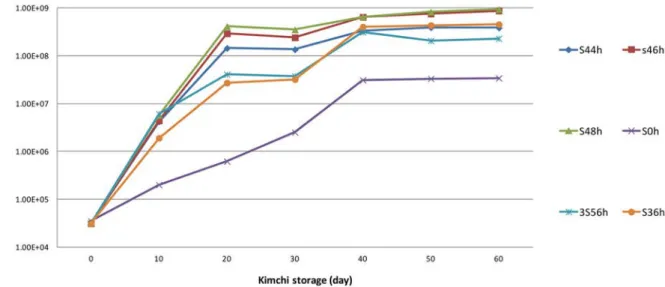
배추김치의 유산균 수는 김치제조 직후인 0 d 시료에서 3.1×10⁴-3.5×10⁴ CFU/mL 범위에 있었으며, 숙성 및 저장 시간에 따른 유산균 수 변화는 20일까지가 가장 많았고, 20 일째에는 1.4×10⁷-4.1×10⁸ CFU/mL로 급격히 증가하였으며, 20일 이후부터는 완만하게 증가하는 경향을 보였다. 김치 냉장고 보관 모드로 전환하기 전 15oC에서의 숙성시간을 준 구에서 유산균 수 증가는 뚜렸하게 나타났지만 숙성구 간 차이는 거의 없었으며, 대조구는 상대적으로 매우 완만
한 증가경향을 보였다(Fig. 2). 이러한 유산균 수의 변화 경 향은 다른 보고(Rhee et al., 2011)에서와 유사한 것으로 판 단된다. 일반적으로 발효초기에는 Leuconostoc citreum, Leu- conostoc mesenteroides 등이 주를 이루고, pH가 낮아지면 서(pH 4.0-4.3) Weissella Koreensis 등이 주를 이루는 것으 로 알려져 있다(Cho et al., 2006; Kim & Chun 2005). 이 러한 유산균 종의 변화 경향은 김치제조에 사용하는 레시 피, 숙성 환경인 온도와 시간에 따라서 그리고 저장 조건 등에 따라 크게 달라질 수 있다(Kim et al., 2012; Park et al., 2013; Park et al., 2014; Yu & Oh 2010).
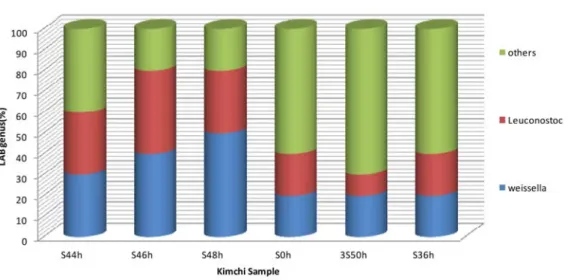
김치냉장고에 40일간 저장한 배추김치의 유산균 속 패 턴을 분석한 결과 익힘시간을 준 후 저장한 S44h, S46h, S48h 시료의 경우 Leuconostoc 속 균과 Weissella속 균이 전체 유산균 속의 70% 이상을 차지하였으며, S36h, 3S56h 조건의 김치는 S44h, S46h, S48h에 비해서 상대적으로 Wei- ssella속 비율이 적은 것으로 분석되었으며, 익힘 시간을 주지 않은 S0h 시료는 Leuconostoc속 균과 Weissella속 균 이 40% 이하를 차지하였다(Fig. 3). S44h, S46h, S48h 시 료 중에서 S44h는 Leuconostoc 속 균이 우세하였고, S48h 시료는 Weissella속 균이 우세함을 알 수 있었다(Fig. 3).
배추김치 발효단계별 유산균 속 분포는 일반적으로 발효 초기에는 Leuconostoc속이, 발효 중기에는 Weissella 속이 우점하는 것으로 알려져 있어(Cho et al., 2006) 상기의 결 과는 발효시간 조건에 따른 차이가 나타난 결과라 판단된 다. 또 다른 연구결과에 의하면 적숙기에 Leuconostoc속, Lactobacillus속, Weissella속이 거의 대등하게 분포함을 알 수 있는데(Jung et al., 2011), 이러한 차이점은 김치 원부재 료의 종류 및 숙성 온도와 시간의 차이에 기인한 것으로 판단된다.
Fig. 1. Changes in the pH of kimchi samples. After making kimchi (0 d samples, S0h), the S44h, S46h, S48h, S36h and 3oC 56 (3S56h) samples were fermented at 15oC for 44h, 46h, 48h, S36h, of the first 10 d. 3S56h was fer- mented for 56 h are 3oC and subsequently stored at -1.4oC up to 60 d. The S0h sample was stored at -1.4oC without fermentation.
Fig. 2. Changes in the number of lactic acid bacteria of kimchi samples. After making kimchi (0 d samples, S0h), the S44h, S46h, S48h, S36h and 3oC 56 (3S56h) samples were fermented at 15oC for 44h, 46h, 48h, S36h, of the first 10 d. 3S56h was fermented for 56 h are 3oC and subsequently stored at -1.4oC up to 60 d. The S0h sample was stored at -1.4oC without fermentation.
숙성시간 조건에 따른 배추김치 추출물의 지방세포 억제 효능을 분석한 결과는 Fig. 4와 같다. 3T3-L1세포에 대한 세포독성을 알아보기 위하여 100~500 ug/mL의 농도에서 cell viability가 95% 이상인 것으로 측정되어 세포 독성이 없는 것으로 확인되었다(data not shown). 지방세포로 분화 시 생성되는 중성지방의 축적 정도를 알아보는 Oil red O staining과 TG 분석법을 통하여 확인한 결과 저장시간이 길 어질수록 지방구 축적이 유의적으로 감소하여 지방분화억 제 효능이 증가하는 결과를 나타냈다. 또한 익힘 시간 없 이 바로 저장한 대조군 김치추출물(S0h)은 지방구 축적 억 제 효능이 S48h에 비해 상대적으로 낮은 경향을 보였다.
익힘 시간을 준 시료 중에서는 48시간 시료인 S48h에서 저
장 40일째 가장 높은 지방세포 분화억제 효과를 보였다.
Oil red O staining 분석결과 Fig. 5와 같이 지방구의 축적 억제 정도가 다른 군에 비해서 S48h가 유의적으로 높음을 확인하였다. 이러한 지방세포분화 억제 효능이 있는 40일 째 김치추출물에서 분리된 유산균 중 가장 많은 비율을 차 지하고 있는 Weissella koreensis 유산균을 단독 배양하여 TG 농도, Oil red O staining 에 대한 효과를 조사하였다.
그 결과 유산균 40 ug/mL 처리 시 Fig. 4와 같이 TG축적 정도는 대조군 대비 약 50% 억제 효과가 있었으며, 이는 김치유산균에 의한 지방세포분화가 억제된 요소 중 하나 라고 생각되어진다.
이러한 결과는 김치가 보유하고 있는 다양한 생리 기능 활성 물질, 유산균 수 및 유산균 구성비율 차이, 그리고 발 효과정에 다양한 요인에 따른 효능차이라 생각된다. 발효 산물 중 항비만 효능을 보유하고 있는 것으로 알려진 것 중 에는 GABA 및 ornithine 등이 있으며, 유산균체 및 그 구 성 성분도 지방세포 억제 효능이 있는 것으로 알려져 있다 (Fava et al., 2005; Joseph et al., 2002; Park et al., 2013;
Park et al., 2014; Robinson et al., 1999; Sun et al., 2003;
Tang et al., 2011; Tatsuta et al., 1992).
본 실험에 사용한 김치 중 저장 40일째 시료에서 가장 많이 발견된 유산균인 Weissella koreensis 유산균의 오르니 틴 함량을 TLC 분석을 통하여 조사한 결과는 Fig. 6과 같 다. 그림에서와 같이 Weissella koreensis 오르니틴 함량 및 ornithine 전환효과 또한 월등하게 높은 것으로 나타났고, 분석 김치 시료 중 S48h 샘플에서 Weissella koreensis가 가 장 많이 발견되었다. 따라서 본 연구와 다른 연구결과를 통 해 김치에 존재하는 오르니틴과 오르니틴 사이클 내 관련 효소도 항암 및 지방세포억제 관련되어 있는 것으로 알려 Fig. 3. Changes in the genus of lactic acid bacteria of kimchi samples. After making kimchi (0 d samples, S0h), the S44h, S46h, S48h, S36h and 3oC 56 (3S56h) samples were fermented at 15oC for 44h, 46h, 48h, S36h, of the first 10 d. 3S56h was fermented for 56 h are 3oC and subsequently stored at -1.4oC up to 60 d. The S0h sample was stored at -1.4oC without fermentation. The kimchi samples were harvested at 40th day of storage.
Fig. 4. Lipid accumulation of differentiated adipocytes trea- ted with or without Kimchi extract. After making kim- chi (0 d samples, S0h), the S44h, S46h, S48h, S36h and 3oC 56 (3S56h) samples were fermented at 15oC for 44h, 46h, 48h, S36h, of the first 10 d. 3S56h was fermented for 56 h are 3oC and subsequently stored at -1.4oC up to 60 d. The S0h sample was stored at -1.4oC without fer- mentation.
지고 있다(Hsueh et al., 2012; Kim et al., 2009; Park et al., 2014). 또한 본 연구결과는 배추김치 발효 및 저장조건에 따른 김치 추출물의 지방세포 억제 효능과 기능성 물질인 오르니틴 함량과 상호 연관 가능성을 제공해주는 것으로 향후 구체적인 지방세포 억제 물질 및 기능성 유산균의 규 명 및 표준화 연구에 필요한 기초자료를 제공해주는 것이다.
요 약
배추김치 제조 후 익힘 온도/시간이 다른 조건이 김치냉 장고 저장 기간에 따른 김치와 김치유산균의 지방세포 증 식 억제 효능 변화를 측정해 본 결과 저장 40일 김치 시료 기준으로 익힘 과정을 거치지 않은 S0h시료에 비하여 48 시간의 익힘 과정을 거친 S48h시료의 효능이 가장 우수하 였고, 이어서 S44h, S46h 시료의 효능이 우수하였다. 이는 적정 발효 및 발효환경에 따른 발효 대사산물, 그리고 김 치 유산균 속 및 종 변화에 기인한 결과로 판단되며 지방 세포 분화억제 물질로 알려진 ornithine의 농도와도 연관이 있을 수 있음을 제안해주고 있다. 김치는 다양한 재료 유 래의 기능성 물질, 대사산물 및 유산균을 보유하고 있는 발 효식품이다. 따라서 본 연구는 김치제조 후 최적의 숙성 시 간과 저장 기간을 선택하면 지방세포 억제 기능성이 증진 된 김치를 섭취할 수 있는 것을 제안해주고 있다.
감사의 글
본 연구는 ㈜대유위니아 연구비 지원으로 수행되었으며, 연구비 지원에 감사드립니다.
참고문헌
Bucci L, Hickson JF, Pivarnik JM, Woimsky Ira, McMahon JC, Fig. 5. Lipid accumulation of differentiated adipocytes treated with or without Kimchi extract and lactic acid bacteria. Cells
were stained with Oil Red O and observed under the microscope.
Fig. 6. TLC analysis of ornithine in the culture medium and cytoplasmic fraction of weissella koreensis cells. A: spot of standard arginine; B: spot of standard ornithine; C:
cell-free supernatant, and D: cytoplasmic fraction of cells (D) cultured in MRS broth with 1%ARG.
and Tumer SD (1990) Ornithine ingestion and growth hor- mone release in body-builders. Nutr. Res. 10, 239-245.
Bucci LR, Hickson JF Jr, Wolinsky I, and Pivarnik JM (1992) Ornithine supplementation and insulin release in bodybuild- ers. Int. J. Sport Nutr. 2, 287-291.
Cho JH, Lee DY, Yang CN, Jeon JI, Kim JH, and Han HU (2006) Microbial population dynamics of kimchi, a fermented cab- bage product. FEMS Microbial. Lett. 257, 262-267.
Choi IH, Noh JS, Han JS, Kim HJ, Han ES, and Song YO (2013) Kimchi, a fermented vegetable, improves serum lipid pro- files in healthy young adults: randomized clinical trial. J.
Med. Food 16, 223-229.
Elam RP, Hardin DH, Sutton RA, and Hagen L (1989) Ef- fects of arginine and ornithine on strength, lean body mass and uri- nary hydroxyproline in adult males. J. Sports Med. Phys. Fit- ness 29, 52-56.
Fava G, Marucci L, Glaser S, Francis H, Morrow SD, Benedetti A, Alvaro D, Venter J, Meininger C, Patel T, Taffetani S, Marzioni M, Summers R, Reichenbach R, and Alpini G (2005) γ-Aminobutyric acid inhibits cholangiocarcinoma growth by cyclic AMP-dependent regulation of the protein kinase A/extracellular signal-regulated kinase1/2 pathway.
Cancer Research 65, 11437-11446.
Hsueh, EC, Knebel1 SM, Lo WH, Leung YC, Cheng PNM, and Hsueh CT (2012) Deprivaion of arginine by recombinant human arginase in prostate cancer cells. J. Hematol. Oncol.
5, 17 doi:10.1186/1756-8722-5-17.
Joseph J, Niggemann B, Zaenker KS, and Entschladen F (2002) The neurotransmitter γ-aminobutyric acid is an inhibitory regulator for the migration of SW 480 colon carcinoma cells.
Cancer Research 62, 6467-6469
Jung JY, Lee SH, Kim JM, Park MS, Bae JW, Hahn YS, Madsen EL, and Jeon JO (2011) Metagenomic analysis of kimchi, a traditional Korean fermented food. Appl. Environ. Micro- biol. 77, 2264-2274.
Kim, JE, Kim SY, Lee KW, and Lee HJ (2009) Arginine deimi- nase originating from Lactococcus lactis spp. lactis Ameri- can Type Culture Collection (ATCC) 7962 induces G1-phase cell-cycle arrest and apoptosis in SNU-1 stomach adenocar- cinoma cells. Bri. J. Nutr. 102, 1469-1476.
Kim B, Seo WT, Kim MG, Yun HD, and Cho KM (2012) Metage- nomic lactic acid bacterial diversity during Mulkimchi fer- mentation based on 16S rRNA sequence. J. Korean Soc.
Appl. Biol. Chem. 55, 787-792
Kim M and Chun J (2005) Bacterial community structure in kim- chi, a Korean fermented vegetable food, as revealed by 16S rRNA gene analysis. Int. J. Food Microbiol. 103, 91-96.
Lee D, Kim S, Cho J and Kim J (2008) Microbial population dynamics and temperature changes during fermentation of kimjang kimchi. J. Microbial. 46, 590-593.
Moinard E. Caldefie E Walrand S. Felgines C. Vasson MP, and
Cynober L (2000) Involvement of glutamine, arginine, and polyamines in the action of ornithine a -ketoglutarate on macrophage functions in stressed rats. J. Leukocyte Biol. 67, 834-840.
Moon YJ, Soh JR, Yu JJ, Sohn HS, Cha YS, and Oh SH (2012) Intracellular lipid accumulation inhibitory effect of Weissella koreensis OK1-6 isolated from Kimchi on differentiating adipocyte. J. Appl. Microbiol. 113, 652-658.
Oh SH, Kim HJ, Kim YH, Yu JJ, Park KB, and Jeon JI (2008) Changes in some physic-chemical properties and γ-aminobu- tyric acid content of kimchi during fermentation and storage.
J. Food Sci. Nutr. 13, 219-224.
Park KB, Kim SG, Yu JH, Kim JS, Kim ES, Jeon JI, and Oh SH (2013) Changes in fermentation properties and ornithine lev- els of Baechu Kimchi by storage condition Korean J. Food Nutr. 26, 945-951.
Park KB, Kim SG, Oh CH, Jeon JI, Oh SH (2014) Gastric cancer cell growth inhibitory effects of cabbage Kimchi by fermen- tation and storage conditions. Korean J. Food Nutr. 27, 692- 698.
Park JA, Tirupathi Pichiah PB, Yu JJ, Oh SH, Daily J.III, and Cha YS (2012) Anti-obesity effect of kimchi fermented with Wei- ssella koreensis OK1-6 as starter in high-fat diet-induced obese C57BL/6J mice. J Appl. Microbiol. 113, 1507-1516.
Park JE, Oh SH, and Cha YS (2013) Lactobacillus planta- rum LG42 Isolated from Gajami Sik-Hae Inhibits Adipogenesis in 3T3-L1 Adipocyte. BioMed Research International Arti- cle ID 460927, 7 pages
Robinson LE, Bussiere FI, Le Boucher J. Farges Me. Cynober LA, Field C1, and Baracos VE (1999) Amino acid nutrition and immune function in tumour-bearing rats: A comparison of glutamine-, arginine- and ornithine 2 oxoglutarate-supple- mented diets. Clinical Science 97, 657-69,
Rhee SJ, Lee JE, and Lee CH (2011) Importance of lactic acid bacteria in Asian fermented foods. Microbial Cell Factories 10(Suppl 1), S5, 1-13.
Tatsuta M, Iishi H, Baba M, and Taniguchi H (1992) Attenuation by the GABA receptor agonist baclofen of experimental car- cinogenesis in rat colon by azoxymethane. Oncology 49, 241-245.
Tang Y, Chen Y, Jiang H, and Nie D (2011) The role of short- chain fatty acids in orchestrating two types of programmed cell death in colon cancer. Autophagy 7, 235-237.
Yu JJ, Park HJ, Kim SG, and Oh SH (2009) Isolation, identifica- tion and characterization of Weissella strains with high orni- thine producing capacity from kimchi. Kor. J. Microbiol. 45, 339-345.
Yu JJ and Oh SH (2010) Isolation and characterization of lactic acid bacteria strains with ornithine producing capacity from natural sea salt. J. Microbiology 48, 467-472.