• 검색 결과가 없습니다.

IEG 환경지질연구정보센터

N/A
N/A
Protected

Academic year: 2021

Share "IEG 환경지질연구정보센터"

Copied!
11
0
0

로드 중.... (전체 텍스트 보기)

전체 글

(1)

Faunal affinity of Toarcian-Aalenian (Early Jurassic) bivalves from Mae Sot and Umphang (Tak Province), Northwestern Thailand

ABSTRACT: In the Mae Sot and Umphang areas (NW Thailand), Jurassic strata seal the Permian and Triassic substratum of the Shan-Thai terrane with a brecciated conglomerate. Pliensbachian to Early Bajocian shallow marine strata are intercalated within the partly terrestrial Jurassic sequence. Thirty-five Toarcian-Aale- nian bivalve species from Mae Sot and Umphang were identified.

Among these, Eomiodon chumphonensis Hayami is known only from Thailand, whereas Parvamussium donaiense (Mansuy), Myo- phoriella saurini Hayami, Thracia loducensis Hayami, Pholadomya (Bucardiomya) fontainei Hayami, Thracia loducensis Hayami and Modiolus sestiniae Hayami were originally described in Vietnam.

M. sestiniae also occurs in Iran. The greater part of the fauna, however, shows varying degrees of affinity with Myanmar (6 spe- cies), Cutch (10 species), Japan (13 species) and Europe (9 species), Levant (2 species). In view of these, it appears that these highly endemic Toarcian-Aalenian bivalves from Thailand characterize the Southeastern Asian Province of Tethys.

Key words: Toarcian-Aalenian, Jurassic, marine bivalves, Thailand, SE Asian Province

1. INTRODUCTION

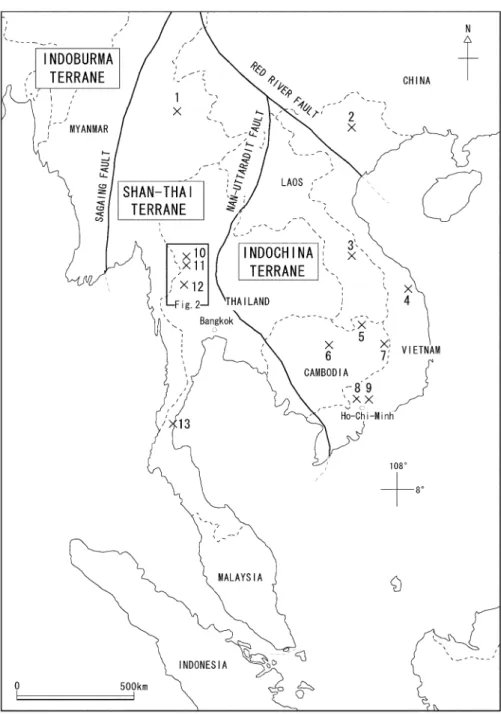
Jurassic shallow-marine deposits are widely distributed in Southeast Asia. Marine bivalves have been described from Myanmar (Healey, 1908; Reed, 1931, 1936), Thailand (Hayami, 1960; Meesook, 1994; Meesook and Grant-Mackie, 1994, 1996, 1997), Laos and Vietnam (Counillon, 1909; Mansuy, 1914; Saurin, 1935; Hayami, 1964; Hayami, 1972) (Fig. 1).

The facies of these marine formations contribute to the understanding of the environmental changes that took place after closure of the Paleotethys and help unravel the pale- obiogeography of the southeast Asian Tethys. In Thailand, Jurassic marine formations cover wide areas of the freshly consolidated Shan-Thai terrane. These extend from Mae Hong Son in northwestern Thailand to the Kanchanaburi basin in Western Central Thailand, and in Peninsular Thailand from Chumphon in its northern part to Nakhon Si Thammarat in the south. The first description of bivalves from Thailand goes back to Hayami (1960), who described two species,

including one new species. These were regarded Pliensba- chian to Aalenian in age by Meesook and Grant-Mackie (1994, 1996). Meesook (1994) undertook a systematic review of Jurassic bivalves of Thailand at the generic level, and Meesook and Grant-Mackie (1997) recognized several fau- nal associations and paleo-environments. The detailed tax- onomic study of the Jurassic bivalves from Thailand is only at its beginning. The only other bivalve investigation in the region is that of Hayami (1972) on the marine Toarcian bivalves of Vietnam.

The present paper is based on the Jurassic bivalves of the Mae Sot and Umphang areas in northwest Thailand. The preliminary results will shed light on the correlation of the Jurassic bivalves in Southeast Asia.

2. GEOLOGICAL SETTING

Southeast Asia is generally divided into three tectonic ter- ranes, i.e. Indo-Burma, Shan-Thai and Indochina. The Shan- Thai and Indochina terranes spread over Thailand. Marine Jurassic deposits in Thailand cover only areas of the Shan- Thai Terrane. The Jurassic strata in northwestern Thailand is composed regionally of the Huai Pong Group in the Mae Hong Son area, the Huai Fai Group in the Mae Sot area and the Umphang Group in the Umphang area (Meesook and Grant-Mackie, 1996).

At Mae Sot and Umphang (Fig. 2), the Jurassic strata seal the Permian - Triassic substratum of the Shan-Thai terrane.

Starting with a conglomerate of brecciated nature at the base of the sequence (Ishida et al., 2004), the Jurassic sequence is mostly continental with substantial marine intercalations. These intercalations range from the Toarcian to the Early Bajocian. The latter age is based on ammonite evidence showing that marine conditions were still main- tained during the Lower Bajocian, before the emersion of Shan Thai. The corals are of Tethyan affinity (Fontaine and Suteethorn, 1988). The large benthic foraminifera and algae provide clues for a wide subtropical to tropical lat- itudinal range (Elliot, 1983).

T. Kozai*

F. Hirsch K. Ishida A. Meesook

} Laboratory of Geology, Faculty of Science Education, Naruto University of Education, 748 Takashima, 772-8502 Naruto, Japan

Laboratory of Geology, Faculty of Integrated Arts and Sciences, University of Tokushima, 1-1 Minamijosanjima, Tokushima 770-8502, Japan

Geological Survey Division, Department of Mineral Resources, Bangkok 10400, Thailand

*Corresponding author: [email protected]

(2)

3. JURASSIC STRATIGRAPHY 3.1. Mae Sot Basin

In the Mae Sot area, the marine Lower Jurassic Hua Fai Group was established and subdivided into three forma- tions, from oldest to youngest, Khun Huai, Doi Yot and Pha De (Meesook and Grant-Mackie, 1996). The 900 m in thick Hua Fai Group is exposed 10 km east of Mae Sot along the road to the Huai Mae Sot power station and along the Huai Mae Sot stream. The group consists of limestone-marl- mudstone-dominated sequences which have yielded bivalves and ammonites macrofaunas. The basal conglomerate of the

Khun Huai Formation unconformably rests on Triassic strata. The contact among the other formations is apparently conformable and the top of the group is interrupted at the fault-bounded margin of the Tertiary basin.

The Khun Huai Formation consists in the type section, of 140 m thick limestone-marl dominated sequences, inter- bedded with mudstone. About half-way between the Weir and Ban Kun Huai streams, the basal conglomerate (TM4), overlies unconformably marine Triassic strata and consists of Triassic limestone and chert fragments. Based on the ammonite Dactylioceras sp., the formation is dated as Early Toarcian. The upper part is conformably overlain by the Doi Yot Formation.

Fig. 1. Map showing the localities of Early Jurassic bivalves in southeast Asia (modified after Hayami, 1960, 1972; Reed, 1936; Healey, 1908), 1:

Rhaetian-Lower Lias, Bathonian-Call- ovian or Oxfordian, 2: Hettangian or Sienemurian, 3: Early Jurassic, 4: Het- tangian and /or Sinemurian, 5: Toarcian, 6: Sienemurian, 7: Toarcian, 8: Toar- cian, 9: Toarcian, 10: Aalenian, 11:

Toarcian, 12: Toarcian, 13: Middle or

Late Jurassic.

(3)

The Doi Yot Formation is 370 m thick and is composed of mudstone, interbedded with limestones. Occurrence of Onychoceras sp., Pseudolioceras sp. and Leioceras sp. indi- cates a Late Early Toarcian–Early Aalenian age.

The Pha De Formation is 390 m thick and consists mainly of upwards thinning limestone-marl dominated sequences.

A Late Aalenian–early Bajocian age is based on by the occurrence of ammonites as Graphoceras sp., Eutmetoceras sp., and Docidoceras sp.

3.2. Umphang Basin

In the Umphang area, the marine Lower Jurassic Umphang Group consists predominantly of sandstone, limestone and

mudstone, subdivided into four formations, from the oldest to youngest, Klo Tho, Ta Sue Kho, Pu Kloe Khi and Lu Kloc Tu (Meesook and Grant-Mackie, 1996).

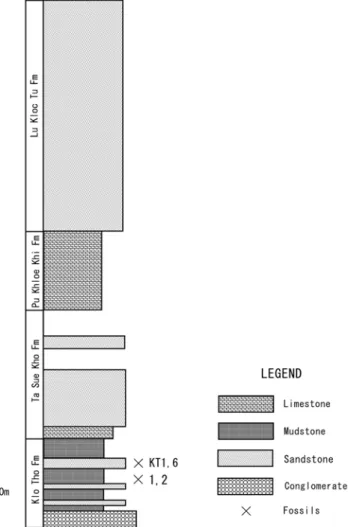
The Klo Tho Formation is approximately 60 m thick and consists mainly of calcareous sandstone, intercalated with dark gray, thinly bedded mudstone. The mudstone is richly fossiliferous, mostly bivalves, ammonites and plant remains. The ammonites Dactylioceras sp. and Eleganticeras sp. confer an Early Toarcian age to the formation.

The Ta Sue Kho Formation is approximately 105 m thick Its main lithology consists of thinly bedded, medium - to coarse-grained arkosic sandstone with plant remains.

Fossils are rare.

The Pu Khloe Khi Formation is approximately 60 m

Fig. 2. Map showing the fossil locali- ties in the Mae Sot-Umphang area.

The localities numbers are the same as

in Table 1.

(4)

thick. Its lithology consists of dark gray massive to thickly bedded oncolithic limestones. Fossils are abundant and diverse consisting of corals, brachiopods, gastropods, bivalves, echinoids and the foraminifera Timidonella sp. and the algae Holosporella sp., suggesting an early Aalenian age.

The Lu Kloc Tu Formation consists of 200 m thick bar- ren arkosic sandstones.

4. JURASSIC BIVALVES FROM MAE SOT AND UMPHANG (Fig. 2)

4.1. Mae Sot area

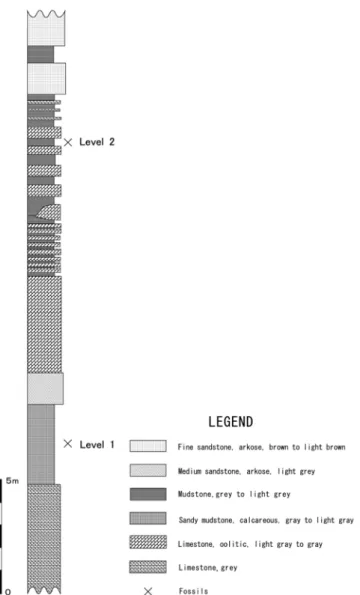
Marine bivalves mainly occur in the Khun Huai and Doi Yot formations. A short interval of the Khun Huai Forma- tion is well exposed in the open pit of the Tak zinc mine, about 10 km east of Mae Sot, where the sequence of lime- stone, sandy mudstone, sandstone, oolitic limestone and alternating beds of mudstone and limestone is topped by sandstone and mudstone (Fig. 3). The Tak mine sequence has two fossiliferous levels, at 5 m and 20 m above the base repectively.

Level 1 is composed of muddy sandstone that contains ammonites, brachiopods and the marine bivalves including Mytilus sp. aff. heranius Hayami, Modiolus sestiniae Hayami, Lima sp. cf. L. wynnei Cox, Lima sp. cf. L. callovica Coss- mann, Entolium sp. aff. E. lunare Roemer, Bositra sp. cf. B.

ornata (Quenstedt), Astarte sp. aff. A.deltoidea Moberg.

Level 2 consists of a mudstone that yields Parallelodon sp. aff. P. infraliassicus Hayami, Inoperna sp. aff. I . plicata (Sowerby), Modiolus sestiniae Hayami, Ostreomya sp . cf.

O . dilata (Phillips), Parvamussium donaiense (Mansuy), Myo- phorella saurini Hayami, Trigonia sp. aff. T. tumida Kitchin, Protocardia sp. aff. P. contusa Healey, Integricardium sp.

aff. I. hayamii (Keen and Kasey), Lucina sp. aff. L. hasei Hayami, Bositra sp. cf. B.ornata (Quenstedt), Astarte sp. cf. A. fimbriata Walton, Eomiodon chumphonensis Hayami, Opis sp. aff. O.

tanourensis Tamura, Pholadomya fontainei Hayami, Thra- cia loducensis Hayami, Thracia sp. aff. T. prisca Healey.

Hayami (1960) also found Bositra sp. cf. B. ornata (Quenstedt) at Mae Sot. At the same locality, some Aale- nian ammonites were described by Sato (1961), and therefore these bivalves are regarded as Toarcian–Aalenian in age.

4.2. Umphang Area

In the Umphang area, bivalves were collected from four localities (Fig. 4). In the localities 1 and 2, the mudstone in the middle part of the Klo Tho Formation contains Toarcian marine bivalves, including Grammatodon sp. aff. G. juri- anus Cox, Arcomytilus sp. aff. A. laitmairensis (de Loriol), Inoperna sp. aff. I. plicata (Sowerby), Modiolus sp. aff. M.

inbricatus J. Sowerby, Kobayashites sp. aff. K. hemicylin- dricus Hayami, Ostreomya sp. cf. O. dilata (Phillips), Somapecten

sp. aff. S. kamimaensis Kimura, Camptonectes sp. aff. C.

fromageti Hayami, Entolium sp. aff. E. lunare Roemer, Par- vamussium donaiense (Mansuy), Plagiostoma sp. aff. P.

tenuistriata Münster, Myophorella saurini Hayami, Trigonia sp. aff. T. tumida Kitchin, Integricardium sp. aff. I. hayamii (Keen and Kasey), Integricardium sp. aff. I. elliptica (Yokoyama), Lucina sp. aff. L. hasei Hayami, Bositra sp. cf. B. ornata (Quenstedt), Pholadomya fontainei Hayami, Homomya sp.

aff. H. satoi Hayami, Thracia loducensis Hayami, and Thracia sp. aff. T. prisca Healey.

The calcareous sandstone of localities KT1 and KT6, in the upper part of the Klo Tho Formation, yields the marine bivalves Ostreomya sp. cf. O. dilata (Phillips), Entolium sp.

aff. E. partitum (Sowerby), Trigonia sp. aff. T. elongata Sowerby, Geratrigonia sp. aff. G. kurumensis Kobayashi, Integricardium sp. aff. I. hayamii (Keen and Kasey), Astarte sp.

aff. A. fimbriata Walton, Eomiodon sp. aff. E. namtuensis Reed and Thracia loducensis Hayami.

Fig. 3. Columnar section of the outcrop in the Tak Mine near Mae

Sot.

(5)

5. PALEOGEOGRAPHIC CONSIDERATIONS A paleogeographic relationship exists between the 35 Toarcian Aalenian bivalve species that were identified in the sedimentary cover of the Shan-Thai Terrane with fau- nas from other Early Jurassic localities in Southwest Asia (Table 1).

5.1. Vietnam

Hayami (1972) pointed out that the Toarcian bivalve fauna of Vietnam is similar to that of the western Tethyan region, although many species are endemic. The compari- son between Vietnam and other parts of Asia and Europe shows a low ratio of similarity of its Early Jurassic bivalve species with that of northwestern Thailand. Only two local- ities yielded Early Jurassic bivalves. Earliest Jurassic strata in the Huu-Nien area of the eastern part of the Indochina Terrane, yielded probably Hettangian ammonites, From these strata Counillon (1909) and Hayami (1964) described 19 bivalve species that show no affinities to any known

bivalves from Thailand. Toarcian deposits occur in south- ern Vietnam, near Ho-Chi-Minh, from which Mansuy (1914), Saurin (1935) and Hayami (1972) described 65 bivalve species. Eight of these, Modiolus sestiniae Hayami, Ostreomya sp. cf. O. dilate (Philips), Parvamus- sium donaiense (Mansuy), Entolium sp. aff. E. partitum (Sowerby), Myophorella saurini Hayami, Pholadomya fontainei Hayami and Thracia loducensis Hayami occur also in the Toarcian of the Tak Province, northwestern Thailand. It is noteworthy that Hayami (1972) erected Modiolus sestiniae Hayami for a species also found in Per- sia, which suggests a northern Tethyan link.

5.2. Myanmar

Among 68 bivalve species, Astarte sp. cf. A. imbriata Walton, described by Healey (1908) from the Rhaetian - Lower Liassic Napeng beds in the northern Shan States, is the only species found in common with Thailand. From the two horizons of the Namyau series, Northern Shan States, 63 bivalves species identified largely differ from those found in Thailand, probably due to age difference (Bathonian, Callovian or Lower Oxfordian) (Reed, 1931, 1936).

5.3. Japan

Out of 85 Liassic bivalve species, 20 species are Toarcian, among which 13 species show some affinity with Thailand (Hayami, 1957a-e; 1958a-e; 1959).

5.4. Cutch (India)

Abundant bivalve species were described by Kitchin (1903), Cox (1937, 1940, 1941 1952a-b). The geological age of the Cutch sequence ranges from Middle to Late Jurassic.

Eleven species from Thailand show some affinities to the Cutch fauna, including Lima wynnei Cox, Lima callovica Cossmann and Bositra ornata (Quenstedt). However, one has to consider the cosmopolitan nature of these long rang- ing forms. It confers a low paleobiogeographic evidence with respect to the relationship between the northern Tethyan shallow subtropical environment of SE Asia and the high latitude cold environment of the Indian mass, which is still solidly attached to Gondwana in Jurassic times. It should be noted that the affinities between Western Europe and Cutch (India) were highest during the Callovian, when the north- ern opening of the Atlantic Ocean brought cold waters into Western Europe (Hirsch, 1980).

5.5. Levant (Sinai and Israel)

Bivalves of this area show similarities with some forms from Western Europe, North and East Africa. Though it shares the subtropical–tropical climatic conditions with

Fig. 4. Generalized columnar section of the Umphang Group (mod-

ified after Meesook and Grant-Mackie, 1996).

(6)

southeastern SE Asia, only two cosmopolitan species show affinity between the Levant and Thailand (Hirsch, 1980).

6. CONCLUSION

The Jurassic bivalves of the Mae Sot and Umphang areas in northwest Thailand shed some light on the possible cor- relation of Jurassic faunas in Southeast Asia. The identified Toarcian to Aalenian bivalves of Thailand and Vietnam reveal a high degree of endemism and only one, Modiolus sestiniae Hayami, is common with Iran, suggesting a north- ern Tethyan affinity. Among those taxa that show affinity with Cutch and the Levant figure cosmopolite species. The

fauna identified here seems thus to characterize a widely endemic SE Asian Province at the edge of Eastern Tethyan Eurasia.

These findings corroborate a Late Triassic–Lowermost Jurassic consolidation of the Shan Thai and Indochina ter- ranes (Hirsch et al., 2006; Ishida et al., 2006). The amal- gamation of various allochtonous terranes of Gondwanian origin with several Paleozoic Paleo-Tethyan imprints gen- erated a new landmass at the edge of the Eurasian super- continent. The Toarcian–Early Bajocian marine transgres- sions on this new land was thus characterized by widely low latitude endemic faunas with certain northern Neo- Tethyan affinities.

Table 1. Occurrence of marine Jurassic bivalves from the Mae Sot-Umphang area in Thailand and its neighboring countries. : same species.

Localities

Species Thai(Umphang) Thai(MaeSot) Vietnam Myanmar Iran Japan Eope LevantCutch

1 2 KT1 KT6 1 2

Parallelodon infraliassicus Hayami aff ○

Grammatodon jurianus Cox aff

Arcomytilus laitmairensis (de Loriol) aff cf

Mytilus heranius Hayami aff

Inoperna plicata (Sowerby) aff aff

Modiolus inbricatus J. Sowrby aff

Modiolus sestiniae Hayami

Kobayashites hemicylindricus Hayami aff

Limawynnei Cox cf

Limacallovica Cossmann cf cf ○ ○

Plagiostoma tenuistriata Münster aff

O streomya dilata (Phillips) cf cf

Somapecten kamimaensis Kimura aff

Camptonectes fromageti Hayami aff Åõ

Entolium lunare Roemer aff aff cf

Entolium partitum (Sowrby) aff aff

Parvamussium donaiense (Mansuy)

Oxytoma sp. ap sp

Myophorella saurini Hayami

Trigonia (Trigonia ) tumida Kitchin aff aff

Trigonia elongata J. de C. Sowerby aff

Geratrigonia kurumensis Kobayashi aff

Protocardia contusa Healey aff

Integricardium hayamii (Keen and Kasey) aff aff aff aff

Lucina hasei Hayami aff aff

Bositra ornata (Quenstedt) cf cf

Astarte fimbriata Walton cf cf cf cf cf

Astarte deltoidea Moberg aff aff aff

Eomiodon chumphonensis Hayami

Eomiodon namtuensis Reed aff

Opis tanourensis Tamura aff

Pholadomya (Bucardiomya ) fontainei

Homomya satoi Hayami aff

Thracia loducensis Hayami

Thracia prisca Healey aff aff

(7)

ACKNOWLEDGMENTS: We thank our colleagues Wattana Tan- sathien and Wirote Saengsrichan (Bureau of Geological Survey, Bangkok, Thailand) who assisted us in the field. The Thai Department of Mineral Resources provided scientific and logistical support in the field. The authors also thank the reviewers, especially Hisao Ando (Ibaraki University, Japan) for comments that improved our manu- script. Last but not least, we are indebted to Graciano Yumul Jr., Carla Dimalanta and Edanjarlo Marquez (University of the Philippines) for their efficient editorial work.

REFERENCES

Counillon, H., 1909, Sur le gisement liasique de Huu-Nien province de Quang-Nam (Annam). Bulletin de la Société Géologique de France, 8, 524 − 532.

Cox, L.R., 1937, Notes on Jurassic Lamellibranchia II. On Indogram- matodon, a new Subgenus from the Jurassic of the Indo-African Province. Proceedings of the Malacological Society of .London, 22, 194 204.

Cox, L.R., 1940, The Jurassic Lamellibranch fauna of Kuchii (Cutch). Memoires the Geological Survey of India, Palaeontolo- gia Indica, 3, 1 − 157.

Cox, L.R., 1941, Note on Jurassic Lamellibranchia VIII. On the Genus Velata Quenstedt, Proceedings of the Malacological Soci- ety of London, 25, 119 124.

Cox, L.R., 1952a, The Jurassic Lamellibranch fauna of Cutch (Kachh).

No. 3, Familes Pectinidae, Amussuudae, Plicatulidae, Limidae, Ostreidae and Trigoniidae (Supplement). Memoires of the Geo- logical Survey of India, Palaeontologia Indica, 3, 1 128.

Cox, L.R., 1952b, Notes on the Trigoniidae, with outlines of a clas- sification of the Family. Proceedings of the Malacological Soci- ety of London, 29, 45 − 70.

Elliott, G.F, 1983, Distribution and affinities of the Jurassic dasycla- dacean alga Sarfatiella. Palaeontology, 26, 671 − 675.

Fontaine, H., and Suteethorn, V., 1988, Late Paleozoic and Mesozoic fossils of West Thailand and their environments. Committee for Cooperation of Joint Prospecting for Mineral Resources in Asian Offshore Areas (CCOP), 20, 1 108.

Hayami, I., 1957a, Liassic Bakevellia in Japan, Japanese Journal of Geology and Geography, 28, 95 − 106.

Hayami, I., 1957b, Liassic Gervillia and Isognomon in Japan, Japa- nese Journal of Geology and Geography, 28, 95 − 106.

Hayami, I., 1957c, On the Occurrence of Cardinioidea from the Lias- sic Kuruma Group in Central Japan. Transactions and Proceed- ings of the Palaeontological Society of Japan, N.S., 26, 69 − 73.

Hayami, I., 1957d, Radulonectites, a new Pectinid genus, from the Liassic Kuruma Group in Central Japan. Transactions and Pro- ceedings of the Palaeontological Society of Japan, N.S., 27, 89 93.

Hayami, I., 1957e, Liassic Chlamys , “ Champtonectes ” and other Pectinida from the Kuruma Group in Central Japan. Transactions and Proceed- ings of the Palaeontological Society of Japan, N.S., 28, 119 − 127.

Hayami, I., 1958a, Liassic Volsella , Mytilus and some other Dysod- ont species in Japan. Transactions and Proceedings of the Palae- ontological Society of Japan, N.S., 29, 155 − 165.

Hayami, I., 1958b, A review of the so-called Liassic “Cyrenoids” in Japan. Japanese Journal of Geology and Geography, 29, 11 − 27.

Hayami, I., 1958c, Taxonomic notes on Cardinia with description of a new species from the Lias of Western Japan. Journal of the Fac- ulty of Science, University of Tokyo, 11, 115 130.

Hayami, I., 1958d, An additional note on the Liassic “Cyrenoids” in Japan. Transactions and Proceedings of the Palaeontological Society of Japan, N.S., 34, 78.

Hayami, I., 1958e, Supplementary descriptions of the Liassic pele- cypods from the Kuruma and Shizukawa groups in Japan. Trans- actions and Proceedings of the Palaeontological Society of Japan, N.S., 30, 193 200, p.128.

Hayami, I., 1959, Pelecypods of the Mizunuma Jurassic in Miyagi Prefecture, with some stratigraphical remarks. Transactions and Proceedings of the Palaeontological Society of Japan, N.S., 34, 66 − 77, p.17.

Hayami. I., 1960, Two Jurassic pelecypods from west Thailand.

Transactions and Proceedings of the Palaeontological Society of Japan, N.S., 38, 284.

Hayami, I., 1964, Some LowerJurassic pelecypods from South Viet- Nam, collected by Dr. H. Fontaine. Japanese Journal of Geology and Geography, 35, 163 174.

Hayami, I., 1972, Lower Jurassic Bivalvia from the Environs of Saigon.

Geology and Paleontology of Southeast Asia, 10, 179 − 230.

Healey, M., 1908, The Nappeng beds of Upper Burma. Memoires the Geological Survey of India, Palaeontologia Indica 2, 1 − 88.

Hirsch, F., 1980, Jurassic Bivalves and Gastropods from Northern Sinai. Israel Journal of Earth-Sciences, 28, 128 − 163.

Hirsch, F., Ishida, K., Kozai, T. and Meesook, A, 2006, The welding of Shan-Thai. Geoscience Journal, this volume.

Ishida K., Nanba, A., Hirsch, F., Kozai, T. and Meesook, A., 2004, Microfossil analysis of the Shan-Thai terrane Jurassic basal con- glomerate in NW Thailand. Proceedings and abstracts of the six International Symposium of IGCP 434 in Hanoi, 29 − 30.

Ishida, K., Nanba, A., Hirsch, F., Kozai, T. and Meesook, A., 2006, New Micro-palaeontological evidence for the Late-Triassic Shan-Thai orogeny. Geoscience Journal, this volume.

Kitchhin, F.L., 1903, The Jurassic fauna of Cutch. The Lamellibran- chiata, Genus Trigonia . Memoires the Geological Survey of India, Palaeontologia Indica, 3, 1 122.

Mansuy, H., 1914, Gisement liasique des schistes de Trian (Cochinchine).

Mémmoires du Service Géolgique de Indochine, 3, 37 39.

Meesook, A., 1994, Marine Jurassic stratigraphy and bivalve pale- ontology of Thailand. Unpublished Ph.D. Thesis, University of Auckland Library.

Meesook, A. and Grant-Mackie, J.A., 1994, Biostratigraphic corre- lation of marine Jurassic rocks within Thailand and Southeast Asia. Proceedings of the International Symposium on Stratigra- phy and Correlation of Southeast Asia, Bangkok, 160 169.

Meesook, A. and Grant-Mackie, J.A., 1996, Marine Jurassic lithos- tratigraphy of Thailand. Journal of Southeast Asia Earth Sci- ences, 14, 377 391.

Meesook, A. and Grant-Mackie, J.A., 1997, Faunal associations, paleoecology and paleoenvironments of the Thai marine Jurassic:

a preliminary study. Proceedings of the International Conference on Stratigraphy and Tectonic Evolution of Southeast Asia and the South Pacific, Bangkok, 164 − 176.

Reed, F.R.C., 1931, Notes on some Jurassic fossils from the Northern Shan States. Records of the Geological Survey of India, 65, 185 − 187.

Reed, F.R.C., 1936, Jurassic Lamellibranchs from the Namyau Series, Northern Shan States. The Annals and Magazine of Natural His- tory, 18, 1 29.

Sato, T., 1961, Une Ammonite aalénienne de la Région de Mae Sot, Thai- land. Japanese Journal of Geology and Geography, 32, 137 − 139.

Saurin, E., 1935, tudes géologique sur l’Indochine du sud-est (Sud- Annam-Cochine-Cambodge oriental). Mémoires du Service Géologique de Indochine, 22, 1 − 419.

Manuscript received September 16, 2005 Manuscript accepted July 24, 2006

E -

(8)
(9)

Plate 1. Figs. 1-3, Pholadomya fontainei Hayami. 1: NU-TL-0002, from level 2 (Khun Huai Fm), ×1.7, right valve, 2: NU- TL-0003, from level 2 (Khun Huai Fm), ×1.7, left valve, 3: NU-TL-0005, from level 2 (Khun Huai Fm), ×1, left valve. Fig.

4, Inoperna sp. aff. I. plicata (Sowerby), NU-TL-0001, from loc. 2 (Klo Tho Fm), ×1.5, left valve. Fig. 5, Modiolus sestiniae Hayami, NU-TL-0046, from level 1 (Khun Huai Fm), ×1, left valve. Figs. 6-7, Parvamussium donaiense (Mansuy). 6: NU- TL-0013, from loc. 2 (Klo Tho Fm), ×1, right internal mold, 7: NU-TL-0044, from loc. 2 (Klo Tho Fm), ×1, left internal mold.

Figs. 8-9, Protocardia sp. aff. P. contusa Healey. 8: NU-TL-0031, from level 2 (Khun Huai Fm), ×1.5, left valve, 9: NU-TL- 0047, from level 2 (Khun Huai Fm), ×1.5, right valve. Figs. 10-11, Astarte sp. aff. A. fimbriata Walton. 10: NU-TL-0023, from from loc. KT-1 (Klo Tho Fm), ×2.5, left valve. Figs. 12-13, Thracia loducensis Hayami. 12: NU-TL-0019, from loc. 2 (Klo Tho Fm), ×2, left valve, 13: NU-TL-0020, from loc. 2 (Klo Tho Fm), ×2, right valve. Fig. 14, Eomiodon sp. aff. E. namtuensis Reed, NU-TL-0028, from loc. KT-6 (Klo Tho Fm), ×1.5, right valve. Figs. 15-16, Thracia sp. aff. T. prisca Healey. 15: NU- TL-0041, from level 2 (Khun Huai Fm), ×1, left valve, 16: NU-TL-0040 from level 2 (Khun Huai Fm), ×1, left valve. Figs.

17-18, Eomiodon chumphonensis Hayami. 17: NU-TL-0037,from loc. 1 (Klo Tho Fm), ×1.5, left valve, 18: NU-TL-0032 from level 2 (Khun Huai Fm), ×4, left valve. Figs. 19-20, Ostreomya sp. cf. O. dilata (Phillips). 19: NU-TL-0010 from level 2 (Khun Huai Fm), ×1.2, right valve, 20: NU-TL-0011 from level 2 (Khun Huai Fm), ×1, right valve. Figs. 21-22, Lucina sp. aff. L.

hasei Hayami. 21: NU-TL-0030 from level 2 (Khun Huai Fm), ×1.7, left valve, 22: NU-TL-0048 from level 2 (Khun Huai

Fm), ×1.5, right valve. Figs. 23, Entolium sp. aff. E. partitum (Sowerby), NU-TL-0035, from loc. KT-6 (Klo Tho Fm), ×1,

left valve. Fig. 24, Grammatodon jurianus Cox, NU-TL-0014, from loc.1 (Klo Tho Fm), ×1.5, left valve. Figs. 25-26, Astarte

sp. aff. A. deltoidea Moberg. 25: NU-TL-0036, from loc. KT-1 (Klo Tho Fm), ×4, right valve, 26: NU-TL-0049, from loc. KT-

1 (Klo Tho Fm), ×4, right valve. Fig. 27, Arcomytilus sp. aff. A. laitmailensis (de Loriol), NU-TL-0018, from loc.2 (Klo Tho

Fm), ×4, left valve. Fig. 28, Parallelodon sp. aff . P. infraliassicus Hayami. NU-TL-0033 from level 2 (Khun Huai Fm), ×1.7,

left valve. Figs. 29-30, Myophorella saurini Hayami. 29: NU-TL-0043, from loc. 2 (Klo Tho Fm), ×0.7, right valve, 30: NU-

TL-0039 from level 1 (Khun Huai Fm), ×2, right and left valves. Fig. 31, Bositra sp. cf. B. ornata (Quenstedt), NU-TL-0008

from level 1 (Khun Huai Fm), ×2, left and right valves.

(10)
(11)

Plate 2. Figs. 1-2, Plagiostoma sp. aff. P. oepybolus (Whidborne). 1: NU-TL-0025 from level 1 (Khun Huai Fm), ×1.2, left valve.

Fig. 2, NU-TL-0026 from level 1 (Khun Huai Fm), ×1.5, left valve. Fig. 3, Somapecten sp. aff. S. kamimaensis Kimura, NU-TL- 0021, from loc.2 (Klo Tho Fm), ×2, right valve. Fig. 4, Camptonectes sp. aff. C. fromageti Hayami. NU-TL-0012, from loc.1 (Klo Tho Fm), ×2, right valve. Fig. 5, Lima sp. cf. L. callovica Cossmann, NU-TL-0038 from level 1 (Khun Huai Fm), ×1, left valve.

Figs. 6-7, Plagiostoma sp. aff. P. tenuistriata Münster. 6: NU-TL-0050, from loc.2 (Klo Tho Fm), ×1.2, right valve, 7: NU-TL-

0045, from loc.2 (Klo Tho Fm), ×1.5, left valve. Fig. 8, Mytilus sp. aff. M. heranius Hayami, NU-TL-0006 from level 1 (Khun

Huai Fm), ×1, left and right valves. Fig. 9, Kobayashites sp. aff. K. hemicylindricus Hayami, NU-TL-0017, from loc.1 (Klo Tho

Fm), ×1.2, left valve. Fig. 10, Trigonia sp. aff . T. elongata J. de C. Sowerby, NU-TL-0024, from loc.KT-6 (Klo Tho Fm), ×1,

left valve. Fig. 11, Homomya sp. aff. H. satoi Hayami, NU-TL-0016, from loc.1 (Klo Tho Fm), ×1, left valve. Fig. 12, Modiolus

inbricatus J. Sowerby, NU-TL-0015, from loc.2 (Klo Tho Fm), ×1, right valve. Fig. 13, Trigonia sp. aff. T. tumida Kitchin, NU-

TL-0004 from level 2 (Khun Huai Fm), ×2, right valve. Fig. 14, Opis sp. aff. O. tanourensis Tasmura, NU-TL-0029 from level

2 (Khun Huai Fm), ×2, right valve. Fig. 15, Geratrigonia sp. aff. G. kurumensis Kobayashi, NU-TL-0022, from loc.KT-1 (Klo

Tho Fm), ×1, gum cast of external mold of left valve. Figs. 16:-17, Integricardium sp. aff. I. hayamii (Keen and Kasey). 16: NU-

TL-00426, from loc.1 (Klo Tho Fm), ×0.5, right valve, 17: NU-TL-0034, from loc.1 (Klo Tho Fm), ×0.5, right valve. Figs. 18-

19, Entolium sp. aff. E. lunare Roemer. 18: NU-TL-0009 from level 1 (Khun Huai Fm), ×1, left valve, 19: NU-TL-0027 from

level 1 (Khun Huai Fm), ×0.8, right valve. Fig. 20, Lima sp. cf. L. wynnei Cox, NU-TL-0007 from level 1 (Khun Huai Fm), ×1,

left valve.

수치

Fig. 1.  Map showing the localities of  Early Jurassic bivalves in southeast  Asia (modified after Hayami, 1960,  1972; Reed, 1936; Healey, 1908), 1:
Fig. 2.  Map showing the fossil locali- locali-ties in the Mae Sot-Umphang area.
Fig. 3.  Columnar section of the outcrop in the Tak Mine near Mae Sot.
Fig. 4.  Generalized columnar section of the Umphang Group (mod- (mod-ified after Meesook and Grant-Mackie, 1996)
+2

참조

관련 문서

 The Dutch physicist Pieter Zeeman showed the spectral lines emitted by atoms in a magnetic field split into multiple energy levels...  With no magnetic field to align them,

Modern Physics for Scientists and Engineers International Edition,

Five days later, on 15 January 1975, the Portuguese government signed an agreement with the MPLA, FNLA and UNITA providing for Angola to receive its independence on 11

Ross: As my lawfully wedded wife, in sickness and in health, until

glen plaids 글렌 플레이드와 캐시미어 카디건, 캐리지 코트, 그리고 케이프 -> 격자무늬의 캐시미어로 된 승마용 바지, 마부용 코트, 말 그림이 수

다양한 번역 작품과 번역에 관한 책을 읽는 것은 단순히 다른 시대와 언어, 문화의 교류를 넘어 지구촌이 서로 이해하고 하나가

frequency of the first channel in the group is used as the fundamental frequency for all channels in the group, and all phase measurements are relative to the phase reference

The index is calculated with the latest 5-year auction data of 400 selected Classic, Modern, and Contemporary Chinese painting artists from major auction houses..