• 검색 결과가 없습니다.

Differences in the Activation of Abdominal Muscles During Sit-to-Stand between Smokers and Non-smokers

N/A
N/A
Protected

Academic year: 2021

Share "Differences in the Activation of Abdominal Muscles During Sit-to-Stand between Smokers and Non-smokers"

Copied!
6
0
0

로드 중.... (전체 텍스트 보기)

전체 글

(1)

| Abstract |

Purpose: This study aimed to determine whether the abdominal muscles, which are the major lumbar stabilizers along with the respiratory muscles, are affected by smoking. We compared abdominal muscle activity between smokers and non-smokers during the sit-to-stand movement.

Methods: A total of 28 healthy adult males (14 smokers and 14 non-smokers) in their 20s–30s voluntarily participated in the study. The subjects performed the sit-to-stand movement, and then their abdominal muscle activity was measured. The surface electromyography system was employed to measure the maximal voluntary isometric contraction (MVIC) values of the subjects’

rectus abdominis, external oblique abdominal, internal oblique abdominal, and transversus abdominis muscles. Then, the values were quantified into %MVIC.

Results: The activity of the rectus abdominis muscle was higher in the smokers than in the non-smokers. Conversely, the activity of the internal oblique abdominal and transversus abdominis muscles, which are deep abdominal muscles, was higher in non-smokers than in smokers, but the difference was not statistically significant.

Conclusion: Smoking can inhibit the activity of smokers’ deep abdominal muscles and increase the activity of their superficial muscles, thus making it detrimental to their musculoskeletal system.

Key Words: Smoking, Sit-to-stand, Abdominal muscle activation

†Corresponding Author : Jong-Soon Kim ([email protected])

Original Article Open Access

흡연자와 비흡연자의 앉은 자세에서 일어서는 동작 시 배근육 활성도 차이
유종훈⋅이동률 1 ⋅이민형⋅김종순 2†

1)

부산가톨릭대학교 대학원 물리치료학과, 1 좋은강안병원 물리치료실,

2 부산가톨릭대학교 보건과학대학 물리치료학과

Differences in the Activation of Abdominal Muscles During Sit-to-Stand between Smokers and Non-smokers

Jong-Hoon Yoo⋅Dong-Rour Lee 1 ⋅Min-Hyung Rhee⋅Jong-Soon Kim 2†

Department of Physical Therapy, Graduate School, Catholic University of Pusan

1 Department of Physical Therapy, Good Gang-An Hospital

2 Department of Physical Therapy, College of Health Sciences, Catholic University of Pusan

Received: July 2, 2018 / Revised: July 25, 2018 / Accepted: July 25, 2018

ⓒ 2018 Journal of Korea Proprioceptive Neuromuscular Facilitation Association

This is an Open Access article distributed under the terms of the Creative Commons Attribution Non-Commercial License

(http://creativecommons.org/licenses/by-nc/3.0) which permits unrestricted non-commercial use, distribution, and reproduction

in any medium, provided the original work is properly cited.

(2)

Ⅰ. 서 론

현대 사회로 접어들면서 운동부족, 식습관의 변화, 흡연, 대기오염, 각종 스트레스 등으로 인하여 심혈관 계 질환으로 인한 사망률이 증가하고 있다. 특히 흡연 은 성인은 물론 태아나 유아의 건강까지도 위협하며 각종 허혈성심장질환 , 심혈관계 질환, 고혈압 등 각종 질환을 유발한다(Ezzati et al., 2005). 따라서 장기간의 흡연은 호흡기계에 문제 뿐 아니라 인체의 건강 체력 (physical fitness)에 부정적인 영향을 미칠 수 있다 (Moslemi-Haghighi et al., 2011).

배곧은근(rectus abdominis), 배바깥빗근(external oblique), 배속빗근(internal oblique), 그리고 가로막 (diaphragm)과 같은 근육은 배속압력(intra-abdominal pressure)을 증가시키고 동시에 허리뼈의 안정성을 높 이는 역할을 하는 척추 안정화 근육인 동시에(Hodges et al., 2003) 호흡에도 관여하는 근육이다. 흡연으로 인한 근골격계의 영향에 관한 연구를 살펴보면 , 흡연 자를 대상으로 비 특이성 허리 통증의 발병률 및 유병 률을 조사한 결과 , 근육 수축 활동 메커니즘의 변화로 인해 흡연자의 근육이 위협을 받는 것으로 나타났고 (Goldberg et al., 2000), de Oca 등(2008)은 흡연자의 Type Ⅰ, Type Ⅱa 근섬유 횡단 직경의 감소를 확인함 으로써 흡연이 골격근에 영향을 미치는 것으로 보고 하였다. Kim과 Kim (2012)은 흡연자와 비흡연자 사이 에 호흡과 관련한 강제 호기 시 배속빗근과 배가로근 의 최대 횡단직경의 변화를 분석한 결과, 흡연자의 경우 비흡연자에 비해 배 심부 근육인 배가로근 보다 는 배속빗근의 사용이 많았으며 비흡자는 배가로근을 더 많이 활용하는 것으로 나타났다고 보고하였다. 또 한, 흡연 유무에 따라 기침을 할 때 배 심부 근육의 활성도를 비교 분석한 결과 흡연자에게서 배 심부 근 육의 활성도가 더 낮게 나타났고(Rhee et al., 2016), 몸통을 펼 때 비흡연자에 비해서 흡연자의 배 심부 근육의 활성도가 더 낮게 나타났다(Rhee & Kim, 2017).

이와 같이 흡연이 골격근에 미치는 영향에 대한 관심이 높아지고는 있으나, 기존의 연구들은 특정 행

위 시 흡연으로 인한 골격근의 작용 변화에 대한 연구 들이 주를 이루고 있으며 실제 일상생활과 직접적으 로 연계된 상황에서 흡연 여부에 따른 골격근 활성 변화에 대한 연구는 매우 부족한 실정이다. 특히 앉은 자세에서 일어서는 동작(sit-to-stand)은 일상생활 중 굉장히 빈번하게 일어나는 중요한 동작으로서(Riley et al., 1991) 앉은 자세에서 확보되는 안정성을 스스로 무너트리고 상대적으로 불안정한 선 자세로 이동하는 과정을 포함한다 (Cronin, 2014; Dehail et al., 2007). 또한 다른 일상생활 동작들 보다 큰 근력 , 가동범위, 적절한 신경근 협응 그리고 자세 조정을 요구하는 동작으로 (Boonstra et al., 2008; Hong et al., 2013; Nam et al., 2014) 몸통의 안정성이 매우 중요한 동작이다(Handa et al., 2000). 그리고 앉은 자세에서 일어서는 동작 시 몸통의 안정화를 위해서는 배근육의 동시 수축이 선 행 되어야한다(Lee et al., 2015).

이에 본 연구는 앉은 자세에서 일어서는 동작 시 흡연의 유무에 따라 호흡과 연계된 몸통 안정화 근육 의 활성도 차이를 연구하여 흡연이 일상생활과 연계 된 동작에 영향을 미칠 수 있는지의 여부에 대해 알아 보고자 하였다.

Ⅱ. 연구 방법

1. 연구대상

본 연구는 B시에 거주중인 건강한 성인남성 28명을

흡연자 14명과 비흡연자 14명으로 나누어 실시하였

다 . 피검자들은 최근 6개월 이내에 허리 통증을 경험한

적이 없고 근골격계 및 신경계병변이 없는 자 중 실험

일 기준 6개월 동안 정규적인 운동프로그램에 참여한

적이 없는 성인 남성으로 제한하였으며, 실험에 앞서

참가자들에게 본 연구의 목적을 설명하고 실험참여에

대한 동의를 얻었다.

(3)

2. 실험 절차 및 측정방법

앉은 자세에서 일어서는 동작 시 배 근육의 활성도 를 측정하기 위하여 표면 근전도 시스템(Telemyo 2400, Noraxon, USA)을 사용하였고, 측정 근육은 배곧 은근 , 배바깥빗근, 배속빗근과 배가로근으로 표면 근 전도 부착 부위와 부착 방법은 선행 연구를 기준으로 부착하였다(Cram, 2011; Marshall & Murphy, 2003). 배 곧은근은 배꼽을 기준으로 바깥쪽으로 2cm, 아래쪽으 로 2cm 되는 지점에 근섬유 주행 방향을 따라 부착하 였고, 배바깥빗근은 앞위엉덩뼈가시(anterior superior iliac spine)와 갈비뼈 사이 1/2 지점에 근섬유 주행 방향 을 따라 부착하였으며, 배속빗근과 배가로근은 앞위 엉덩뼈가시에서 안쪽으로 2cm, 아래쪽으로 2cm 되는 부분에 근섬유 주행 방향을 따라 부착하였다(Cram, 2011; Marshall & Murphy, 2003).

표면 근전도 신호 수집의 정확도를 높이기 위하여 표면 근전도 부착 부위를 제모 후 가는 사포로 3∼4회 문질러 피부 표층의 각질층을 제거한 후 , 소독용 알코 올 솜으로 피부를 깨끗이 하였다. 수집된 표면 근전도 신호를 최대 자발적 등척성 수축(maximal voluntary isometric contraction, MVIC)으로 정규화하기 위하여 맨손근력검사(manual muscle test)에 기초하여 각각의 근육에 대하여 MVIC를 10초간 실시하고, 처음 3초와 마지막 3초를 제외한 4초동안 근육에서 발생한 신호 량을 측정하여 자료분석에 사용하였다. 연속적인 실 험으로 인해 발생할 수 있는 피험자들의 근 피로를 줄여주기 위해서 각 검사 후 휴식을 10분간 취하도록 하였다 . 측정하고자 하는 근육의 MVIC를 측정한 후, 피험자들은 높낮이 조절이 가능한 테이블에서 앉았다

일어서기 동작을 3회 반복하여 그 평균값을 사용하여

%MVIC로 정규화 하였다. 앉은 자세는 엉덩관절 굽힘 90°, 무릎관절 굽힘 120°로 설정하였고, 선 자세는 엉 덩관절 폄 각도를 0°로 설정하였다(Schenkman et al., 1990).

3. 자료 분석

본 연구의 결과는 SPSS for Window 20.0 프로그램을 사용하여 유의수준은 0.05로 설정하여 분석하였다. 각 집단간의 동질성 검정을 위하여, 연구대상자의 일반 적인 특성을 독립 표본 t-test를 통하여 분석하였고, 흡연자와 비흡연자간의 복부 근육 활성도 측정값을 독립 표본 t-test를 통하여 분석하였다.

Ⅲ. 연구 결과

1. 연구 대상자의 일반적인 특성

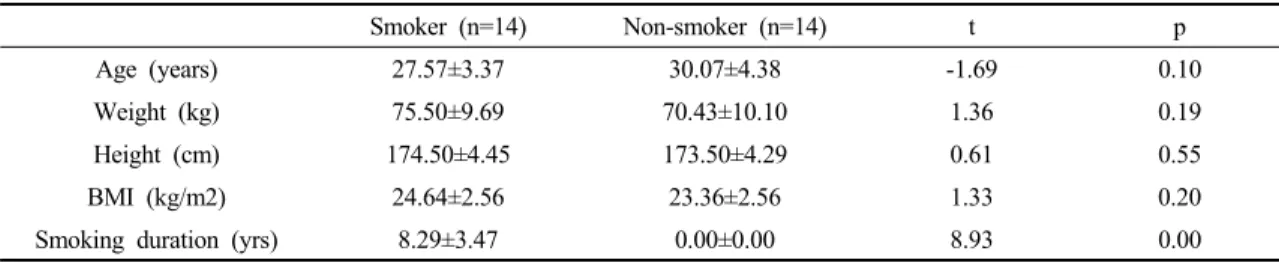
연구 대상자의 나이, 몸무게, 신장, 신체질량지수 (BMI) 그리고 흡연기간을 비교 분석한 결과 흡연기간 을 제외하고는 유의한 차이가 없었다.

2. 흡연자와 비흡연자의 앉은 자세에서 일어서는 동작 시 배 근육 활성도 비교

흡연자와 비흡연자의 앉은 자세에서 일어서는 동 작 시 배 근육 활성도 차이를 비교한 결과 배곧은근에 서 유의한 차이가 있었다(p<0.05).

Smoker (n=14) Non-smoker (n=14) t p

Age (years) 27.57±3.37 30.07±4.38 -1.69 0.10

Weight (kg) 75.50±9.69 70.43±10.10 1.36 0.19

Height (cm) 174.50±4.45 173.50±4.29 0.61 0.55

BMI (kg/m2) 24.64±2.56 23.36±2.56 1.33 0.20

Smoking duration (yrs) 8.29±3.47 0.00±0.00 8.93 0.00

Table 1. The general characteristics of the subjects (N=28)

(4)

Ⅳ. 고 찰

흡연에 대한 사회적 심각성이 점차 대두되고 있으 며 , 최근 흡연에 따른 근골격계의 변화에 대한 연구가 많이 이루어지고 있다(Goldberg et al., 2000). 흡연으로 인해 영향을 받는 근육 중 , 배곧은근, 배바깥빗근, 배속 빗근 , 그리고 배가로근은 호흡근인 동시에 몸통 안정 화 근육으로서의 역할을 수행한다 (Kim & Kim, 2012).

그리고 이들 근육들은 앉은 자세에서 일어서는 동작 과 같은 인간의 일상생활 동작 중 필수적인 움직임 (Riley et al., 1991)에서 몸통 협응 운동에 중요한 역할 을 하며 (Kim et al., 2014) 효율적인 앉은 자세에서 일어 서는 동작을 위해서는 몸통의 안정성 확보를 위한 배 근육의 수축이 필수적으로 수반되어야 한다(Handa et al., 2000). 이에 본 연구는 일상생활 동작과 밀접하게 연계된 동작 중 , 호흡과 몸통 안정화에 관여하는 근육 의 흡연 유무에 따른 작용 양상의 차이를 분석하고자 하였다.

본 연구의 결과 배근육 중 , 얕은 부위의 근육인 배곧 은근의 근육 활성도는 통계적으로 유의하게 비흡연자 비하여 흡연자에게서 48.05% 더 높게 활성화 되는 것 으로 나타났으며(p<0.05) 중간에 위치한 배바깥빗근 은 비흡연자 비하여 흡연자에게서 6.90% 더 높게 활성 화 되는 것으로 나타났다(p>0.05). 또한, 심부에 위치 한 배근육인 배속빗근 및 배가로근의 근육활성도는 통계학적으로는 유의한 차이가 없었지만(p>0.05) 흡 연자에 비하여 비흡연자에게서 29.81% 더 높게 활성 화 되는 것으로 나타났다 . 이는, 앉은 자세에서 일어서 는 동작 시 , 흡연자에 비해 비흡연자의 배 표층 근육인 배곧은근은 억제되고 배 심부 근육인 배속빗근과 배

가로근이 보다 많이 활성화 되는 경향을 의미하는 것 이다.

Kim과 Kim (2012)은 건강한 흡연자와 비흡연자를 대상으로 배속빗근과 배가로근의 최대 횡단 직경을 초음파영상으로 분석한 결과를 보고하였는데 안정시 근육의 최대 횡단 직경과 강제 호기 시 근육의 최대 횡단 직경을 비교 분석한 결과 흡연자의 배가로근의 변화율은 94.48%인데 반하여 비흡연자의 배가로근의 변화율은 154.42%로 통계적으로 유의하게 큰 변화를 보고 하였다 . 이러한 결과는 본 연구의 결과와 마찬가 지로 비흡연자의 경우 배 심부 근육을 보다 더 활성화 시킨다는 것을 의미하는 것으로 비흡연자의 경우 심 부 배근육의 활용 의존도가 높다는 것을 알 수 있다 . Rhee 등(2016)은 건강한 흡연자와 비흡연자를 대상으 로 기침을 하는 동안 배근육의 활성도를 비교하였는 데 , 흡연자에 비하여 비흡연자의 배 심부 근육인 배속 빗근 및 배가로근의 활성도가 약 71% 높게 나타났다 고 보고하였는데 본 연구에서도 흡연자에 비하여 비 흡연자의 배속빗근 및 배가로근의 활성도가 약 29.81% 높게 나타났다. 이는 Rhee 등(2016)의 경우, 기침을 하는 동안 유도된 강한 배근육의 수축 하에서 측정한 결과이고 본 연구의 경우, 앉은 자세에서 일어 서는 동작 시 몸통 안정성을 유지하기 위해 배근육의 강한 수축이 유도되었음을 고려할 때, 그 경향성이 일치하는 것으로 사료된다. 이와 같이 선행연구에서 흡연의 유무에 따라 특정근육의 횡단직경의 변화와 근활성도의 차이가 나타나며, 따라서 흡연이 내과적 인 문제뿐만 아니라, 근골격계에도 영향을 미친다고 볼 수 있다 . 특히 본 연구의 결과와 같이 흡연자에게서 배 심부 근육보다 배 표층 근육의 활성화가 더 높게

Variables Smoker (n=14) Non-smoker (n=14) t p

RA 5.70±0.77 3.85±0.53 1.97 0.04*

EO 5.73±0.99 5.36±0.91 0.27 0.78

IO&TrA 7.85±0.86 10.19±0.86 -1.92 0.06

RA: rectus abdominis, EO: external oblique, IO&TrA: internal oblique & transversus abdominis Units: %MVIC

Table 2. The abdominal muscle activation of smokers and non-smokers during the sit-to-stand

(5)

나타나는 경향을 보인다는 것은 척추에 역학적 변화 를 일으키고 향후 흡연자의 허리 통증 발생 위험이 상대적으로 높을 수 있을 것으로 사료된다.

Al-Obaidi 등(2004)은 76명을 대상으로 흡연 유무와 허리 통증에 따라 4개 그룹으로 구분하고 7단계로 허 리뼈 굽힘 각도를 나누어 등척성 허리뼈 폄 근력 (isometric lumbar extensor strength)을 측정 하였는데 그 결과, 비흡연자에서는 허리 통증을 가진 그룹에 비해 허리 통증이 없는 그룹의 근력이 더 컸던 반면에 흡연자의 경우 허리 통증이 있는 그룹과 허리 통증이 없는 그룹의 근력은 비슷하였다. 즉, 흡연자는 허리 통증이 없더라도 근력이 약해져 허리 통증이 있는 그 룹과 유사한 근력 정도를 보였다. 이는 흡연이 근력의 감소를 유발할 수 있음을 의미한다 . Rhee와 Kim (2017) 은 건강한 성인 흡연자 15명, 비흡연자 15명을 대상으 로 몸통을 펼 때 표면 근전도를 사용하여 배근육의 활성도를 %MVIC값으로 측정하였는데 몸통을 펼 때 배속빗근 및 배가로근의 활성도가 흡연자에 비하여 비흡연자에서 약 77% 더 높게 나타났다. 본 연구에서 도 앉은 자세에서 일어서는 동작 시 흡연자보다 비흡 연자의 배속빗근 및 배가로근의 활성도가 29.81% 더 높게 나타나 Rhee와 Kim (2017)의 연구와 유사한 결과 를 보였으며 이는 흡연자의 배 심부 근육의 약화로 인한 허리 통증이 상대적으로 높아 질 수 있으므로, 흡연자의 허리 통증에 대한 예방적 치료접근이 이루 어져야할 것으로 사료된다.

본 연구의 제한점은 본 연구가 어떠한 근골격계 질환도 가지고 있지 않은 건강한 피검자를 대상으로 이루어진 연구로서 본 연구의 결과를 일반화하기에는 무리가 있는 것으로 사료된다. 따라서 이후 연구에서 는 근골격계 질환자를 대상으로 앉은 자세에서 일어 서는 동작 시, 흡연에 따른 배근육의 활성화 정도에 실제로 어떤 변화가 일어나는지 확인해볼 필요가 있 을 것이다. 그와 더불어 근육활성화의 양적인 분석뿐 만 아니라 활성화되는 시점에 대해서 연구를 통해 근 육이 동원되는 양상에 대한 논의도 이루어져야 할 것 으로 생각된다 . 또한, 대상자의 나이가 아직 젊고 흡연

기간이 길지 않아 실험결과를 일반화시키기에는 한계 가 있을 것이다 . 향후 연구에서는 다양한 연령대별로 흡연 기간을 고려한 분석이 필요할 것으로 사료된다 .

Ⅴ. 결 론

본 연구의 결과 앉은 자세에서 일어서는 동작 시 흡연자의 경우 표층의 배근육을 많이 사용하는 경향 이 관찰되었으며 비흡연자의 경우 심부의 배근육을 많이 사용하는 경향이 관찰되었다 . 이는 흡연이 배근 육의 활성도 차이를 유발할 수 있으며 이러한 몸통 근육 활성 변화와 연계된 근골격계 질환의 유발에 대 한 심도 있는 연구가 필요할 것으로 사료된다.

References

Al-ObaidiSM, AnthonyJ, Al-ShuwaiN, et al. Differences in back extensor strength between smokers and nonsmokers with and without low back pain. The Journal of Orthopaedic and Sports Physical Therapy.

2004;34(5):254-260.

Boonstra MC, De Waal Malefijt MC, Verdonschot N. How to quantify knee function after total knee arthroplasty?.

The Knee. 2008;15(5):390-395.

Cronin NJ. The effects of high heeled shoes on female gait:

a review. Journal of Electromyography and Kinesiology. 2014;24(2):258-263.

Dehail P, Bestaven E, Muller F, et al. Kinematic and electromyographic analysis of rising from a chair during a “Sit-to-Walk” task in elderly subjects: role of strength. Clinical Biomechanics. 2007;22(10):

1096-1103.

de Oca MM, Loeb E, Torres SH, et al. Peripheral muscle alterations in non-copd smokers. Chest. 2008;133(1):

13-18.

(6)

Ezzati M, Henley SJ, Thun MJ, et al. Role of smoking in global and regional cardiovascular mortality.

Circulation. 2005;112(4):489-497.

Goldberg MS, Scott SC, Mayo NE. A review of the association between cigarette smoking and the development of nonspecific back pain and related outcomes. Spine.

2000;25(8):995-1014.

Handa N, Yamamoto H, Tani T, et al. The effect of trunk muscle exercises in patients over 40 years of age with chronic low back pain. Journal of Orthopaedic Science. 2000;5(3):210-216.

Hodges P, Holm AK, Holm S, et al. Intervertebral stiffness of the spine is increased by evoked contraction of transversus abdominis and the diaphragm: in vivo porcine studies. Spine. 2003;28(23):2594-2601.

Hong WH, Lee YH, Lin YH, et al. Effect of shoe heel height and total-contact insert on muscle loading and foot stability while walking. Foot and Ankle International.

2013;34(2):273-281.

Jeffery R. Cram. Cram’s introduction to surface electromyography, 2nd ed. California. Jones & Bartlett Learning. 2011.

Kim BJ, Lee SK, Lee JH, et al. The effects of lower limb and trunk muscle activation on seat angle and height during sit to stand and stand to sit. Journal of Korean Society of Physical Medicine. 2015;10(4):107-112.

Kim LJ, Kim N. Difference in lateral abdominal muscle thickness during forceful exhalation in healthy smokers and non-smokers. Journal of Back and Musculoskeletal Rehabilitation. 2012;25(4):239-244.

Kim SG, Yong MS, Na SS. The effect of trunk stabilization exercises with a swiss ball on core muscle activation in the elderly. Journal of Physical Therapy Science.

2014;26(9):1473-1474.

Lee TH, Choi JD, Lee NG. Activation timing patterns of the abdominal and leg muscles during the sit-to-stand movement in individuals with chronic hemiparetic stroke. Journal of physical therapy science.

2015;27(11):3593-3595.

Marshall P, Murphy B. The validity and reliability of surface emg to assess the neuromuscular response of the abdominal muscles to rapid limb movement. Journal of Electromyography and Kinesiology. 2003;13(5):

477-489.

Moslemi-Haghighi F, Rezaei I, Ghaffarinejad F, et al.

Comparison of physical fitness among smoker and non-smoker men. Addict Health. 2011;3(1-2):15-19.

Nam SJ, Kim MJ, Yim SJ, et al. Influence of walking speed on electromyographic activity of the rectus abdominis and erector spinae during high-heeled walking.

Journal of Back and Musculoskeletal Rehabilitation.

2014;27(3):355-360.

Rhee MH, Kim LJ. Differences in the activation of abdominal muscles during trunk extension between smokers and non-smokers. Journal of Back and Musculoskeletal Rehabilitation. 2017;30(1):35-38.

Rhee MH, Lee DR, Kim LJ. Differences in abdominal muscle activation during coughing between smokers and nonsmokers. Journal of Physical Therapy Science.

2016;28(4):1147-1149.

Riley PO, Schenkman ML, Mann RW, et al. Mechanics of a constrained chair-rise. Journal of Biomechanics.

1991;24(1):77-85.

Schenkman M, Berger RA, Riley PO, et al. Whole-body movements during rising to standing from sitting.

Physical Therapy. 1990;70(10):638-648.

수치

Table 1. The general characteristics of the subjects  (N=28)
Table 2. The abdominal muscle activation of smokers and non-smokers during the sit-to-stand

참조

관련 문서

The purpose of this study was to investigate how the BOSU Ball exercise, which can develop core muscles in middle-aged women, affects body composition and

This study was to do a comparative analysis on kinematic differences and differences in muscle activity between the skilled and the unskilled in windsurfing

Ross: As my lawfully wedded wife, in sickness and in health, until

relative contributions of differences in genetic and non-genetic factors to the total phenotypic variance in a population. For instance, some

- leaves the abdominal cavity lateral to the inferior epigastric vessels and enters the deep inguinal ring. - traverses the entire inguinal canal - exits through

다양한 번역 작품과 번역에 관한 책을 읽는 것은 단순히 다른 시대와 언어, 문화의 교류를 넘어 지구촌이 서로 이해하고 하나가

The index is calculated with the latest 5-year auction data of 400 selected Classic, Modern, and Contemporary Chinese painting artists from major auction houses..

1 John Owen, Justification by Faith Alone, in The Works of John Owen, ed. John Bolt, trans. Scott Clark, &#34;Do This and Live: Christ's Active Obedience as the