• 검색 결과가 없습니다.

Suggestions for More Reliable Measurement of Korean Nuclear Power Industry Safety Culture

N/A
N/A
Protected

Academic year: 2021

Share "Suggestions for More Reliable Measurement of Korean Nuclear Power Industry Safety Culture"

Copied!
10
0
0

로드 중.... (전체 텍스트 보기)

전체 글

(1)

JESK http://jesk.or.kr eISSN:2093-8462

Suggestions for More Reliable Measurement of Korean Nuclear Power Industry Safety Culture

Dhong Ha Lee

Department of Industrial Engineering, The University of Suwon, Suwon, 18323

Corresponding Author Dhong Ha Lee

Department of Industrial Engineering, The University of Suwon, Suwon, 18323 Mobile : +82-10-5207-9603

Email : [email protected]

Received : March 03, 2016 Revised : March 06, 2016 Accepted : April 05, 2016

Objective: The aim of this study is to suggest some improvement ideas based on the validity and the reliability analyses of the current safety culture measurement method applied to the Korean nuclear power industry.

Background: Wrong safety culture is known as one of the major causes of the disasters such as the space shuttle Columbia disaster or the Fukushima Nuclear Power Plant accident. Assessment of safety culture of an organization is important to build a safer organizational environment as well as to identify the risks hidden in the organization.

Method: A face validity of the current safety culture measurement method was analyzed by comparison of the key factors of safety culture in the Korean nuclear power industry with those factors reviewed in the previous studies. The current interview method was analyzed to identify the problems which degrade the consistency of evaluation.

Results: Most safety culture factors reviewed in the literatures are covered in the list of the Korean nuclear power industry safety culture factors. However the unstructured questions used in the interview may result in inconsistency of safety culture evaluation among interviewers.

Conclusion: This study suggests some examples which might improve the consistency of interviewers' evaluation on safety culture such as a post interview evaluation form.

Application: An extended post interview evaluation form might help to increase the accuracy of the interviewing method for Korean nuclear industry safety culture evaluation.

Keywords: Nuclear power, Safety culture, Safety culture factor, Interview, Face validity, Reliability

Copyright@2016 by Ergonomics Society of Korea. All right reserved.

ccThis is an open-access article distributed under the terms of the Creative Commons Attribution Non-Commercial License (http://

creativecommons.org/licenses/by-nc/3.0/), which permits unrestricted non-commercial use, distribution, and reproduction in any medium, provided the original work is properly cited.
1. Introduction

Safety culture refers to attitudes related to the safety of individuals and organizations

(habit, behavior and thinking). There have been many cases pointing out wrong safety

culture as one of the root causes of recent various large scale accidents. Such typical

cases include the space shuttle Challenger and space shuttle Columbia accidents

(Stanton et al., 2010). Wrong safety culture is also recognized as a major cause in the

accidents occurring in nuclear power plants.Fukushima Nuclear Power Plant accident

or Gori Nuclear Power Plant SBO accident can be representative cases (Lee, 2013).

(2)

As organization's sound safety culture is perceived to play a key role in preventing accidents, the efforts to evaluate organization's safety culture have become popular. The importance of safety culture evaluation lies in checking whether an organization maintains safety culture at an acceptable level. The management diagnosis technique has been popular to find out organization's enterprise problems. Nowadays, a safety culture assessment is also known to be effective in such area. Safety culture can be collected from thinking and words on individuals and organizations. So an interview may be the most effective tool to measure them.

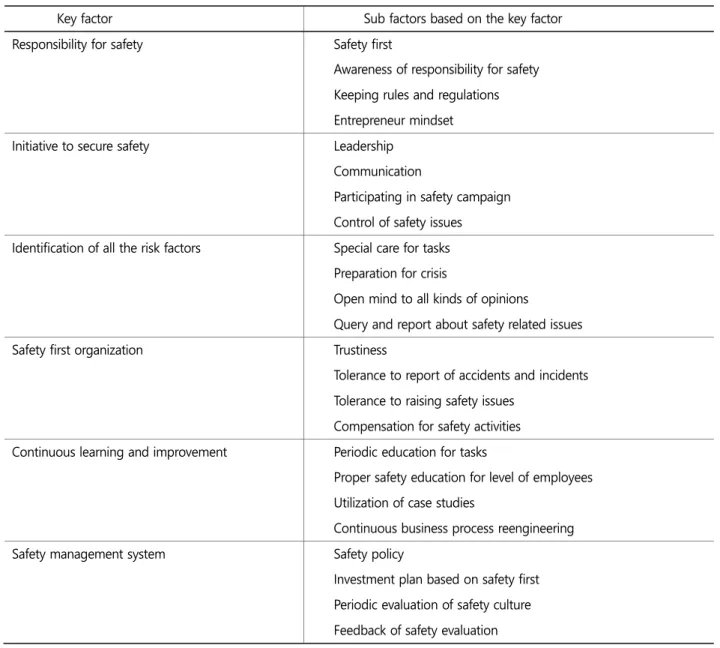
The questions for Korean nuclear power Industry's safety culture evaluation consist of the Korean Nuclear Industry Safety Culture Factors (KNISCF) accompanying some related items (Table 1). The KNISCF have been periodically revised to reflect the business environmental changes on safety culture (KHNP-CRI, 2015). The example of Table 1 is based on the version used in the

Table 1. An example of Korean nuclear power industry safety culture factors (KNISCF)

Key factor Sub factors based on the key factor

Responsibility for safety Safety first

Awareness of responsibility for safety Keeping rules and regulations Entrepreneur mindset

Initiative to secure safety Leadership

Communication

Participating in safety campaign Control of safety issues Identification of all the risk factors Special care for tasks

Preparation for crisis

Open mind to all kinds of opinions

Query and report about safety related issues

Safety first organization Trustiness

Tolerance to report of accidents and incidents Tolerance to raising safety issues

Compensation for safety activities Continuous learning and improvement Periodic education for tasks

Proper safety education for level of employees Utilization of case studies

Continuous business process reengineering

Safety management system Safety policy

Investment plan based on safety first

Periodic evaluation of safety culture

Feedback of safety evaluation

(3)

safety culture evaluation carried out in the year 2013 (KHNP-CRI, 2013).

The organization members from various management level of each nuclear power plant were recruited to sample interviewees.

The sample interviewee group consisted of a power plant director as a top management level to partner firms' lower level managers. The interviewer group is comprised of the experienced retired high rank managers and the experts in nuclear power plant operations.

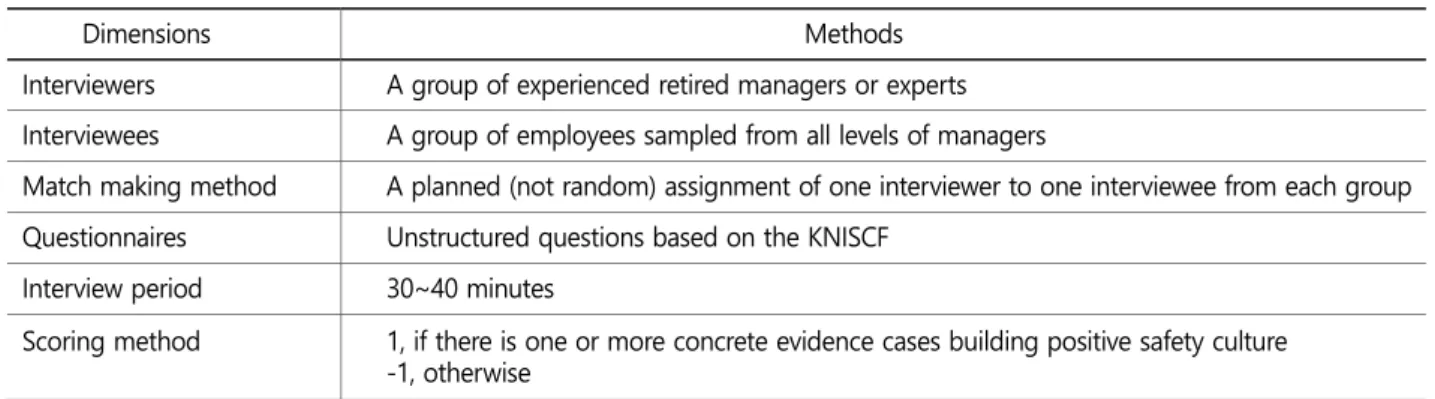
The questions used for interview were based on the key safety culture factors in Table 1, but adjusted to suit for interviewee's positions. An interview was carried out by composing an interviewer-interviewee pair selected from the 8-people interviewer group and the 100 to 200-people interviewee group. To each pair, 30~40 minutes of question and answer time was provided. A topic from the key factors in Table 1 was chosen to proceed an in-depth question and answer during the interview. As a scoring method, +1 was given, if there was at least one specific practical evidence case building positive safety culture, and -1, if not. Table 2 summarizes the example of safety culture evaluation method applied to the Korean nuclear power industry.

This study reviews the validity and reliability aspects of the method used to measure the safety culture of the Korean nuclear power industry, pointing out problems and presenting suggestions for improvement of the method.

2. Face Validity of the KNISCF

The face validity of a safety culture measurement is related to the suitability of the questions used for interview to safety culture contents (Schultz and Schultz, 1986).

Stanton et al. (2010) reviewed previous studies pointing out common safety culture factors such as vigilance to risk, commitment to safety, availability of safety management system, open mind to discuss and reporting the safety related issues, and learning from accidents and incidents. Multiple concepts on safety culture being defined and suggested, it is difficult to have a unified view on safety culture concept. However the key factors can be summarized as in Table 3.

The questions used for the measurement of Korean nuclear power industry safety culture are based on the KNISCF (Table 1).

The grouping of safety culture factors reviewed in the previous studies by the KNISCF according to conceptual closeness can be tabulated as in Table 4.

Table 2. An example of the Interview method used to measure safety culture of Korean nuclear power industry

Dimensions Methods

Interviewers A group of experienced retired managers or experts Interviewees A group of employees sampled from all levels of managers

Match making method A planned (not random) assignment of one interviewer to one interviewee from each group Questionnaires Unstructured questions based on the KNISCF

Interview period 30~40 minutes

Scoring method 1, if there is one or more concrete evidence cases building positive safety culture

-1, otherwise

(4)

Table 3. Key factors in safety culture reviewed by Stanton et al. (2010)

Authors Key safety culture factors (code)

Pidgeon and O'Leary (1994) Commitment to safety (PO1)

Shared care and concern for hazards (PO2) Realistic and flexible norms and rules (PO3) Organizational learning (PO4)

Reason (1997) Reporting culture (R1)

Just culture (R2) Flexible culture (R3) Learning culture (R4) Ball and Scotney (1998) Leadership (BS1)

Training (BS2)

Human resource management (BS3) Self-assessment (BS4)

Communication (BS5) Risk perception (BS6) Safety behavior (BS7) Rule and procedure (BS8) Safety organization (BS9) Quality management (BS10) Stress management (BS11) Employee involvement (BS12) Hale and Hovden (1998) Commitment to safety (HH1)

Safety training system (HH2) Communication channel (HH3) Stable work force (HH4) Learning system (HH5) Leadership style (HH6) Openness to criticism (HH7)

HSE (2005) Leadership (HSE1)

Communication (HSE2) Employee involvement (HSE3) Learning culture (HSE4) Attitude toward blame (HSE5)

Olive et al. (2005) Commitment to safety (O1)

Communication (O2)

(5)

Table 3. Key factors in safety culture reviewed by Stanton et al. (2010) (Continued)

Authors Key safety culture factors (code)

Olive et al. (2005) Resilience and flexibility (O3) Vigilance (O4)

Muniz et al. (2007) Safety policy (M1)

Incentive for safety activities (M2) Provide information about the risk (M3) Plan to avoid accidents (M4)

Feedback about the safety control (M5) Commitment to safety (M6)

Continuous training (M7)

Participating in safety campaign (M8) Stanton et al. (2010) Vigilant to risk (S1)

Commitment to safety (S2)

Available safety management system (S3)

Open mind to discuss and report the safety related issues (S4) Learning from accidents and incidents (S5)

Table 4. Conceptual closeness between the KNISCF and safety culture factors reviewed in the literatures Key safety culture factors of Korean nuclear power

industry (Table 1) Related safety culture factor codes reviewed in the literatures (Table 3)

Everybody in the organization is responsible for safety PO1, BS8, HH1, O1, M6, S2 - safety first

- aware of responsibility for safety - keep rules and regulations - with entrepreneur mindset

Take initiative to secure safety BS1, BS5, HH3, HH6, HSE2, O2, M8 - leadership

- communication

- participating in safety campaign - control safety issues

Identify all the risk factors PO2, BS6, BS7, BS11, BS12, R1, HSE3, O4, S1, S4, M4, M3 - take special care for tasks

- preparation for crisis

- open mind to all kind of opinions

- question and report about safety related issues

(6)

Table 4 shows all the key factors used for safety culture evaluation in the Korean nuclear power industry are closely related to the key factors suggested in the previous studies on safety culture. Therefore the KNISCF shown in Table 1 can be said to be valid as a safety culture measure from the face validity aspect.

3. Reliability of the Interview Method using the KNISCF

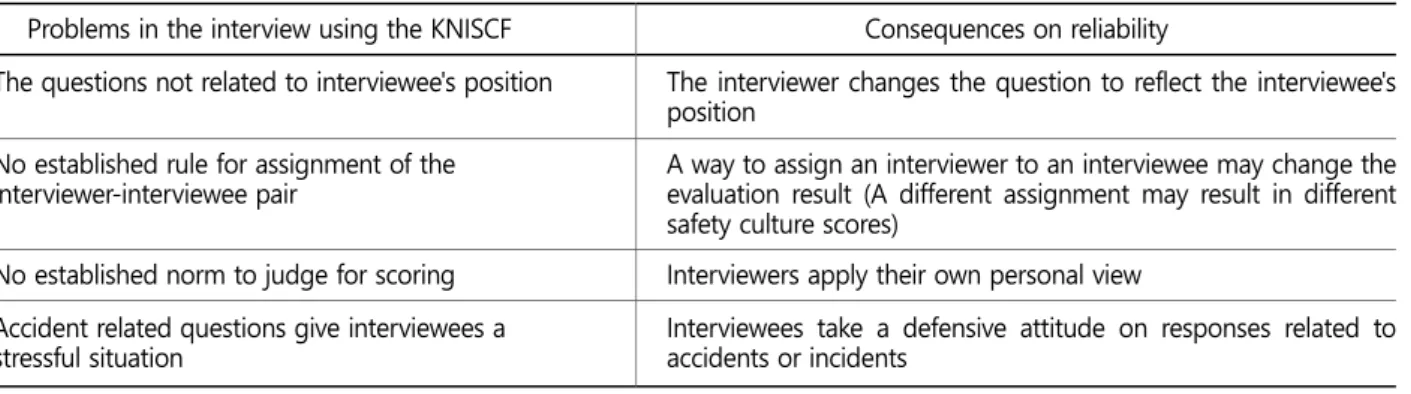
The KNISCF have been applied to all levels of organization members from organization's top management to subcontractor's field workers. However, the interview process applying the KNISCF has some problems as follows:

(1) There were some cases in which the questions were not directly related to the interviewee's position. For example, a question on the highest business goal like safety policy is not a direct concern to a partner firms' field worker. In this case, the interviewee may not answer properly. The interviewer had to inevitably change the question to adapt to the interviewee's position.

(2) Answers were dependent on an interviewer-interviewee pair. As an example of pairing method, one of the 8 interviewers was allocated to one of the 8 interviewee groups consisting of decades of managers. In this case, multiple combinations of the interviewer-interviewee pair can be made. Accordingly the responses might be different depending on how the pair was made. A problem is there was no documented rule on the pairing method.

(3) Norms to judge whether a safety culture level refers to individual employee level or entire organizational level were not established. Currently, interviewers subjectively judge about the level, and therefore the scoring on the safety culture level depends on the interviewer's personal view. Let's take an example of the question on the attitude of 'safety first', one of the KNISCF. Because it is not clear whether the attitude is about an individual, the department where the interviewee belongs Table 4. Conceptual closeness between the KNISCF and safety culture factors reviewed in the literatures (Continued)

Key safety culture factors of Korean nuclear power

industry (Table 1) Related safety culture factor codes reviewed in the literatures (Table 3)

Safety first organization R2, R3, BS9, HH7, HSE5, M2, S4

- trust each other

- tolerance to report of accidents and incidents - tolerance to raising safety issues

- compensate for safety activities

Continuous learning and improvement PO4, R4, BS2, HH2, HH5, HSE4, M7, S5 - periodic education for tasks

- proper safety education for level of employees - use case study

- continuous process innovation

Safety management system BS10, M1, M5, S3

- safety policy

- safety first investment

- periodic evaluation of safety culture

- feedback of safety evaluation

(7)

to, or the entire organization, the interviewer had no choice but to apply his or her own judgment norm.

(4) An interviewee usually gets a feeling of being interrogated, when he or she is questioned about of an accident regardless of his or her involvement. In this case getting stressed and nervous, the interviewee usually takes a defensive attitude. Such a defensive attitude may lead safety culture evaluation to a more optimistic conclusion.

The reliability of safety culture evaluation is defined as the consistency of the results repetitively measured under similar conditions.

Table 5 summarizes the disadvantages of the current interview method using the KNISCF in the aspect of the reliability. Table 5 implies that the current interview method needs to be improved to obtain more reliable responses.

4. Results and Conclusions

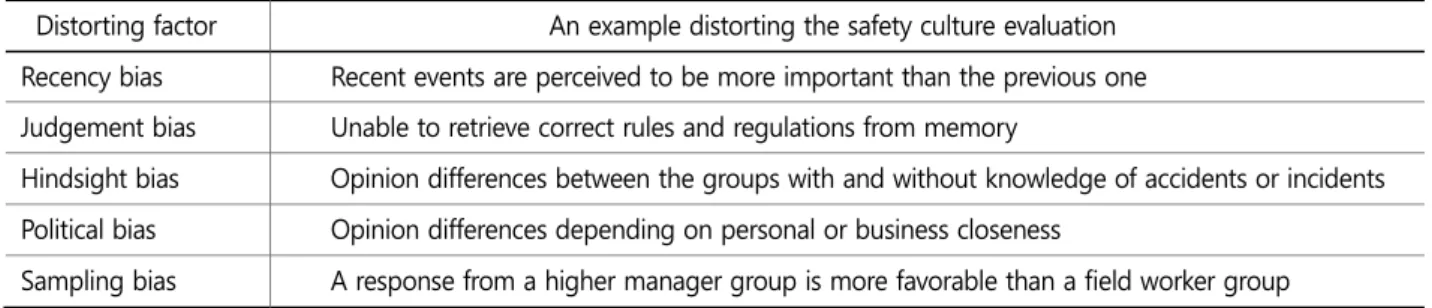
In addition to reliability problem the following interviewee's psychological biases may disturb the accuracy of safety culture evaluation (Table 6).

Concerning a case that occurred a long time ago, the memory of it becomes obscure. This tendency may result in a misperception that a case occurring a longtime ago is perceived less important than a recently occurred case (recency bias).

When an interviewee recalls whether there is a case someone violate the rules of conduct, the interviewee may make a judgmental mistake, since he or she cannot remember all the details of the rules (judgment bias).

There may be a difference in opinions between the group experiencing an accident and the group without the same experience (hindsight bias).

An interviewee's view on an accident may change or the details of his or her response may be disturbed due to personal or organizational closeness with those experiencing the accident (political bias).

Interviews need to be carried out targeting all levels of an organization from top management to field workers, but the sample interviewees tend to be distributed to manager levels due to administrative and recruiting convenience (sampling bias). Especially most hard and dirty field work is carried out by subcontractor's low level workers or temporary employees. Nevertheless there have been few cases in which they were selected as interviewees in the safety culture evaluation.

Table 5. Disadvantages of the interview method using KNISCF on reliability

Problems in the interview using the KNISCF Consequences on reliability

The questions not related to interviewee's position The interviewer changes the question to reflect the interviewee's position

No established rule for assignment of the

interviewer-interviewee pair A way to assign an interviewer to an interviewee may change the evaluation result (A different assignment may result in different safety culture scores)

No established norm to judge for scoring Interviewers apply their own personal view Accident related questions give interviewees a

stressful situation Interviewees take a defensive attitude on responses related to

accidents or incidents

(8)

The current method uses unstructured questions based on the structured KNISCF items. Because the limited KNISCF items are not able to cover organization's all levels, an interviewer should find impromptu questions suitable for each interviewee's position.

The interviewer's interest, career, domain knowledge and personal bias related to an interviewee might influence the questions. In this case, the problem is that the consistency of questions declines. To complement the inconsistency of unstructured questions, a structured checklist to rate the interviewee's responses after free questions would be helpful. Table 7 shows an example of a post interview evaluation form that can complement unstructured questions.

If an interviewee is a subcontractor's employee, it will be effective to provide the post interview evaluation form as shown in Table 8 reflecting the position in the company. It will be more effective to prepare such a checklist for each of the organizational management levels.

The targets for safety culture evaluation include both individuals and organizations. If the target is an organization, detailed individual safety attitudes may be ignored. Questions on the overall organizational attitude may result in obscure responses. While questioning it is better to make it clear whether the question is about individual attitude, or organization's overall attitude.

To point out the organization's recent problems on safety, the questions need to be updated periodically to identify the opinions on the recently occurred critical accidents. As pointed out by Lee (2013), the accidents occurring in a highly reliable nuclear power plant are rare in frequency. Therefore the accident experiences should be treated valuably, and should be reflected in the safety culture evaluation. The interview method based on the KNISCF has had a weakness in identification of organization's attitude or personal view on the recent critical accidents because there has been no systematic way to reflect the recent safety issues to the questions.

Despite the extensive interviews covering all organizational levels, the results has had high correlation with the opinions of a Table 6. Potential personal biases of interviewees distorting the safety culture evaluation

Distorting factor An example distorting the safety culture evaluation Recency bias Recent events are perceived to be more important than the previous one Judgement bias Unable to retrieve correct rules and regulations from memory

Hindsight bias Opinion differences between the groups with and without knowledge of accidents or incidents Political bias Opinion differences depending on personal or business closeness

Sampling bias A response from a higher manager group is more favorable than a field worker group

Table 7. An example of post interview evaluation form

Ask any free questions based on "strict observance on the safety rules and regulations" and then evaluate the following aspects of safety culture

Safety rules are complicated Quite agree Agree Neutral Disagree Quite disagree The interviewee has felt time

pressure while doing his/her job Quite agree Agree Neutral Disagree Quite disagree

Severe intervention from supervisor. Quite agree Agree Neutral Disagree Quite disagree

(9)

specific level, especially upper or middle decision maker groups, while the correlations with field worker groups has been relatively low. Therefore such a sampling plan needs to be fixed.

The stakeholder groups plays an indirect but huge role in building an organization's safety culture. The major stakeholder groups influencing the safety culture of Korean nuclear power plants include the decision makers of the ministry of Trade Industry and Energy, the ministry of Science ICT and Future Planning, the Nuclear Safety and Security Commission and the Korea Institute of Nuclear Safety. While the impacts of their roles and decision making on safety culture are very high, the opportunities to evaluate the feedback of their influences are very rare.

This study reviewed the validity and the reliability of the interview method used for safety culture evaluation of the Korean nuclear power industry. It was confirmed that the KNISCF has no face validity problem because the KNISCF includes most of the safety culture factors presented by previous studies. However, the current interview method using unstructured questions derived from the KNISCF has some problems to draw consistent results. In this regard, suggestions to improve the accuracy and the reliability of safety culture evaluation can be summarized as follows:

(1) It would be better to make clear whether the questions are about an individual or an organization.

(2) It is desirable to periodically update the questions to include asking about attitudes or opinions on the recent critical accidents.

(3) The sampling ratio of the field worker group should be increased in the interviewee groups.

(4) It is desirable to include the questions evaluating the key stakeholder groups' influences on safety culture.

(5) To complement the unstructured questions’ low consistency, a structured post interview evaluation form might be useful.

References

Ball, P.W. and Scotney, V., Approaches to Safety Culture Enhancement , Daresbury, U.K., British Nuclear Fuels, Ltd., 1998.

Hale, A. and Hovden, J., Management and Culture: the Third Age of Safety. A Review of Approaches to Organizational Aspects of Safety, Health, and Environment. In A. Feyer and A. Williamson (Eds.), Occupational Injury: Risk Prevention, and Intervention , Taylor & Francis, London, 129-166, 1998.

Health and Safety Executive (HSE), A Review of the Safety Culture and Safety Climate Literature for the Development of the Safety Culture Toolkit, HSE Research Report 367, London, HSE Books, 2005.

KHNP-CRI, Nuclear Safety Culture Assessment Report for Hanul Nuclear Power Plant 3 , Korea Hydro and Nuclear Power Co., 2013.

Table 8. An example of post interview evaluation form for the employees from a subcontractor company

Ask any free questions based on "build the organization environment where safety comes first" and then evaluate the following aspects of safety culture

Keeping schedule is more important than keeping safety

rules to the manager of a subcontractor company Quite agree Agree Neutral Disagree Quite disagree Hiring a part time employee is more beneficial than

hiring a full time employee Quite agree Agree Neutral Disagree Quite disagree

A reduced contract budget means reduced workforce Quite agree Agree Neutral Disagree Quite disagree

(10)

KHNP-CRI, Nuclear Safety Culture Assessment Report for Hanul Nuclear Power Plant 2 , Korea Hydro and Nuclear Power Co., 2015.

Lee, Y.H., A revisit to the recent human error events in nuclear power plants focused to the organizational and safety culture, Journal of the Ergonomics Society of Korea , 32(1), 117-124, 2013.

Muniz, B.F., Peon, J.M.M. and Ordas, C.J.V., Safety culture: analysis and the causal relationships between its key dimensions, Journal of Safety Research , 38, 627-641, 2007.

Olive, C., O'Conner, M.T. and Mannan, S.M., Relationship of safety culture and process safety, Journal of Hazardous Materials , 130, 133-140, 2006.

Pidgeon, N.F. and O'Leary, M., Organizational Safety Culture: Implications for Aviation Practice. In N. Johnston, N. McDonald and R. Fuller (Eds.), Aviation Psychology in Practice , 21-43, Aldershot, Avebury, 1994.

Reason, J., Managing the Risks of Organizational Accidents , Burlington, VT, Ashgate, 1997.

Schultz, D.P. and Schultz, S.E., Psychology and Industry Today , 4th ed., Macmillan, 1986.

Stanton, N.A., Salmon, P., Jenkins, D. and Walker, G., Human Factors in the Design and Evaluation of Central Control Room Operations , CRC Press, 2010.

Author listings

Dhong Ha Lee: [email protected]

Highest degree: PhD, Department of Industrial Engineering, KAIST

Position title: Professor, Department of Industrial Engineering, the University of Suwon

Areas of interest: Human Factors in Nuclear Power Plant, Risk Management, System Analysis

수치

Table 1. An example of Korean nuclear power industry safety culture factors (KNISCF)
Table 2. An example of the Interview method used to measure safety culture of Korean nuclear power industry
Table 3. Key factors in safety culture reviewed by Stanton et al. (2010)
Table 3. Key factors in safety culture reviewed by Stanton et al. (2010) (Continued)
+5

참조

관련 문서

그러나 우리나라를 포함한 많은 나라가 전력시장에 경쟁을 도입하고, 원전의 설계, 건설, 관련 기자재 및 핵연료 시장에도 경쟁을 도입함에 따라 경쟁과

Korean government have supported the foreign internship system for plant industry to bring up the professional personnel for this industry. The purpose of

12 that절 내의 주어를 문장의 주어로 쓰고 that절 내의 동사를 to부정사로 써 서 수동태 문장을 만들 수 있다... 13 반복되는 the reason을 관계대명사 which로 바꿔주고

In conclusion, this study confirmed that the factors influencing nurses' intention to report medication administration errors comprised patient safety culture and

A Study on the Relationships among Perception about Patient Safety Culture, Patient Safety Competence, and Safety Nursing Activities of

웹 표준을 지원하는 플랫폼에서 큰 수정없이 실행 가능함 패키징을 통해 다양한 기기를 위한 앱을 작성할 수 있음 네이티브 앱과

- In the future, the retail structure of power distribution may resemble the existing structure of the telephone industry.. Center for Power IT CENTER

1 John Owen, Justification by Faith Alone, in The Works of John Owen, ed. John Bolt, trans. Scott Clark, "Do This and Live: Christ's Active Obedience as the