5-Fluorouracil과 Capsaicin의 병용에 의한 HT-29 대장암세포 사멸 증진 효과
이윤석·이종숙·김정애# 영남대학교 약학대학
(Received April 6, 2009; Revised April 24, 2009; Accepted May 4, 2009)
Combined Treatment with 5-Fluorouracil and Capsaicin Induces Apoptosis in HT-29 Human Colon Cancer Cells
Yun Seok Lee, Jong-Suk Lee and Jung-Ae Kim
#College of Pharmacy, Yeungnam University, Gyeongsan 712-749, Korea
Abstract
— Fluorouracil (5-FU) is one of the most widely used chemotherapeutic drugs in the treatment of advanced col- orectal cancer patients. Capsaicin (N-vanillyl-8-methyl-alpha-nonenamide), a spicy component of hot pepper, is a homo- vanillic acid derivative that preferentially induces cancer cells to undergo apoptosis. The purpose of the present study is to examine whether capsaicin enhances the anticancer effect of 5-fluorouracil in HT-29 human colon cancer cells by inducing apoptosis, and whether PPARgamma is involved in the capsaicin action in combination treatment with 5-FU. Treatment of the cells with either 5-FU or capsaicin alone for 48 h had little effect on the cell viability up to 50
µM concentration, whereas co-treatment of the cells with capsaicin in the presence of 5-FU for 48 h significantly decreased the cell viability in a con- centration-dependent manner. In addition, caspase-3 activity, a marker enzyme for apoptosis, was significantly increased by the combined treatment with 5-FU and capsaicin compared to the 5-FU or capsaicin alone treatment. Also, treatment with troglitazone, a peroxisome proliferator-activated receptor gamma (PPAR
γ) agonist, further enhanced the effect of the com- bination treatment on the cell viability and caspase-3 activity, and bisphenol A diglycidyl ether (BADGE), a PPAR
γantag- onist, blocked the effect of the combination treatment. These results suggest that the combination treatment of HT-29 cells with 5-FU and capsaicin induces apoptotic cell death at relatively low concentration than each drug alone, and the com- bination treatment may be associated with the PPAR
γpathway activation.
Keywords □
5-fluorouracil, capsaicin, HT-29 human colon adenocarcinoma cells, peroxisome proliferator-activated recep- tor
γ(PPAR
γ), combination therapy
대장암
(colon cancer)
은현재우리나라암발생빈도에서위암,
폐암
,
간암에이어네번째를차지하는암으로최근단백질이나 동물성지방섭취의급격한증가에따르는식생활의서구화와더 불어그발생빈도가크게늘어나고있다.
1)5-Fluorouracil(5-FU)
은대장암을포함하여소화선암,
비뇨생 식기암,
피부암, Hodgkin
병,
임파육종등과같은다양한고형암치료에 널리 이용되는약물이다
.
2)5-FU
는thymidylate syn-
thetase
를억제하여DNA
합성을억제하는항대사성항암제로서DNA
복제는물론RNA
에의한단백질합성을억제하고,
세포막기능억제등의작용을나타낸다
.
3)그러나,
다른항암제들과마 찬가지로5-FU
는표적효소thymidylate synthase(TS)
의과발현과약물의대사관련효소
,
세포주기조절및세포사멸에관련 된인자들의변화등고유내성및유도내성의발현에인한감 수성의저하로약물의효율성이떨어진다고알려져있다.
4)암세포의
5-FU
에대한반응율은20~35%
정도로낮다.
이런5-FU
의감수성저하를극복하기위한일환으로
DNA
의탈메틸화또 는히스톤의탈아세틸화저해제등을이용한유전자의불활성화,
화학요법과의병용사용에대한연구가진행되고있다
.
5-7)뿐만 아니라,
다른항암제와의병용(
예, cisplatin, mitomycin C, DTIC, methotrexate, doxorubicin)
투여시에도단독투여시보다뚜렷한효능의차이를보이지않는다고알려져있다
.
8)따라서,
새로운 기작의화합요법제(Chemotherapeutic agent)
를발굴하여5-FU
와병용시항암효능을획기적으로높이고자하는연구가진행 되고있다
.
5,6)Capsaicin(8-Methyl-N-vanilyl-6-nonenamide)
은homovanillic acid
유도체로서고추의매운맛을가진성분이다. Capsaicin
의#본논문에관한문의는저자에게로
(
전화) 053-810-2816 (
팩스) 053-810-4654
(E-mail) [email protected]
고용량섭취는위암의발생을촉진하는위험인자로보고되었으
나최근에는
capsaicin
의위장보호효과및암세포사멸유도효과에대한연구결과가발표되고있다
.
9,10)Capsaicin
은여러종류 의형질변환세포주의성장억제와leukemia, stomach cancer, glioblastoma, neuroblastoma
와같은암세포에서apoptosis
유도 효과를나타냄이보고되었다.
11-14)또한, Kim
등은capsaicin
의 대장암 세포 사멸 작용은peroxisome proliferator-activated receptor gamma(PPAR
γ) pathway
를경유하여apoptosis
를유도 한다고발표하였다.
15)PPAR
γ는steroid receptor superfamily
에 속해있는ligand- activated nuclear hormone receptor
의 α,
γ,
δ의3
개의subtype
중하나이며
,
지방세포의분화와당대사에관여할뿐아니라,
세포증식과염증반응의조절에도관여한다
.
또한, PPAR
γ는악성조직에서광범위하게발현되고있으며
, PPAR
γligand
들이암 세포의성장저해와대장암,
유방암등암세포의괴사를유도한 다고보고되고있다.
16)이에본연구에서는인체대장암에항암효과가있다고알려진 고추의매운성분인
capsaicin
이5-FU
와병용하였을때의암세포사멸효능여부및그작용기전에서
PPAR
γ과의관련성을조사하고자하였다
.
실험방법
시약
본 실험에 사용한
fetal bovine serum(FBS)
와penicillum/
streptomycin(PS), RPMI1640
배지는Hyclone
사(Rockville, MA, U.S.A.)
에서 구입하였다. Trypsin solution, 3-[4,5- dimethylthiazol-2-yl]-2,5-diphenyltetrazolium bromide(MTT), sodium pyruvate, dimethyl sulfoxide(DMSO), capsaicin, 5- fluorouracil(5-FU) salt powder
는Sigma
사(St. Louis, MO, USA)
에서구입하였다.
세포배양(Cell culture)
HT-29
사람 대장 상피세포는10% FBS, 1% penicillin/
streptomycin(PS), 10 mM 4-(2-hydroxyethyl)-1-piperazineethane- sulfonic acid(HEPES), 1 mM sodium pyruvate, 1.5 g/
lsodium bicarbonate
가함유된RPMI1640
배지로37
oC, 5% CO
2조건하 에서배양하였으며,
세포가배양flask
에80%
이상자라면1 : 4
의비율로계대하면서본실험에사용하였다
.
세포생존율측정(MTT assay)
HT-29
세포를96 well plate
에1×10
5cells/cm
2농도가되게배양한 후시료들을 처리하였다
.
일정시간처리후에3-[4,5- dimethylthiazol-2-yl]-2,5-diphenyltetrazolium bromide(MTT) 5
mg/m
l용액을각well
에처리하여37
oC
에서4
시간동안반응시켰다
.
배지를제거한후dimethyl sulfoxide(DMSO)
를넣어형성된
formazan
크리스탈을녹여서540 nm
의파장에서microplate reader(Molecular Devices, VersaMAX, U.S.A.)
를이용하여흡광도를측정하였다
.
Caspase (cysteinyl aspartate-specific proteinases)-3 activity assay
Caspase-3
활성은Apoalert caspase colormetric assay kit (BD Bioscience, CA, USA)
로측정하였다.
즉, cell lysate
에50
µ
M DEVD-pNa, caspase-3 substrate
가포함되어 있는10 mM DTT
를혼합하여37°C
에서1
시간동안반응시킨다음pNA
의enzyme-catalyzed
방출을405 nm
의파장에서microplate reader
를이용하여흡광도를측정하였다
.
실험결과 및 고찰
항암제5-FU와천연성분capsaicin의병용에의한암세포독성 증가효과
사람대장암세포
HT-29
에capsaicin
과5-FU
를농도별로각 각2
일또는6
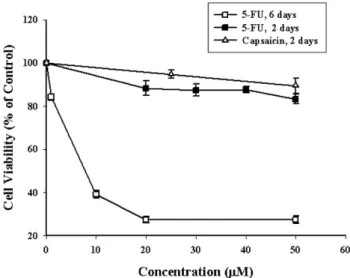
일간처리하여세포생존율을조사한결과(Fig. 1), capsaicin
또는5-FU
각각을48
시간동안처리한경우50
µM
농도까지세포생존율에큰영향이없는반면
, 5-FU
를6
일간지속 적인처리를하였을경우에는10
µM
농도에서도세포생존율이40%
이하로감소하는것으로나타났다.
Capsaicin
과5-FU
의약물간의병용효과를조사하고자, 5-FU
Fig. 1 −
The Effect of 5-FU or capsaicin alone on the viability of HT-
29 cells. Cells treated for 2 days and 6days with 5-FU and
2 days with capsaicin were analysed for viability by MTT
assay. The data represent the mean±SEM of three
independent experiments.
와
capsaicin
을병용하여48
시간처리한후세포생존율을측정하였다
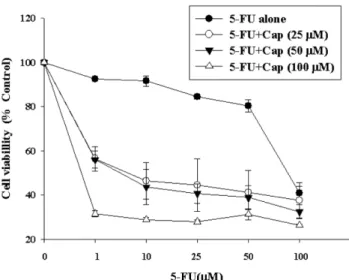
. 5-FU
단독처리에서50
µM
농도까지80%
이상유지되던세포생존율이
capsaicin
과의병용처리시에는세포생존율이농도의존적으로현저히저하되었다
(Fig. 2).
이러한결과는천연성분
capsaicin
이항암제5-FU
의세포독성을상승시킬수있음 을나타내주는것이다.
Capsaicin
과5-FU
병용에의한세포독성이apoptosis
에의한Fig. 4 −
The effect of troglitazone and BADGE on the viability of 5- FU and capsaicin co-treated HT-29 cells. Cells were treated with or without troglitazone (50
µM) or BADGE (50
µM) in the presence or absence of 5-FU (10
µM) and capsaicin (50 µM), for 48h. Cell viability was measured by MTT assay. The data represent the mean±SEM of three independent experiments. * P <0.05, compared to control,
#
P <0.05, compared to combination treatment.
Fig. 2 −
The Effect of combinated treatment with 5-FU and capsaicin on the viability of HT-29 cells. Cells treated with 5-FU either alone or 5-FU and capsaicin for 2 days were analysed for viability by MTT assay. The data represent the mean±SEM of three independent experiments.
Fig. 3 −
Time dependent activation of caspase-3 by 5-FU, capsaicin, and combined treatment with 5-FU and capsaicin in HT-29 cells. Cells were incubated with 5-FU (10
µM) alone or in the presence of capsaicin (50
µM) for each designated time.
The caspase-3 activity was determined using a caspase-3 assay kit. The data represent the mean±SEM of three independent experiments. * P <0.05, compared to control.
것인지확인하기위해
apoptosis
유도의결정적marker
분자로잘알려진
caspase-3
의활성을측정하였다.
17,18)Capsaicin
단독 처리의경우,
시간의존적으로caspase-3
의활성이증가되었으 나, 5-FU
단독처리의경우, caspase-3
의활성에유의한효과를발휘하지못하였다
. Capsaicin
과5-FU
의병용처리의경우,
각 약물단독처리의경우보다caspase-3
활성이더욱증가됨을확인하였다
(Fig. 3).
항암제5-FU와capsaicin병용효과에서PPARγ의역할
Capsaicin
의대장암세포사멸작용이PPAR
γ를경유한다고보고된바있는것처럼13)
HT-29
대장암세포에서5-FU
와capsaicin
의병용에의한세포사멸증가효과가
PPAR
γligand
를경유하여나타나는지를조사하기위해
, PPAR
γagonist
인troglitazone
과
PPAR
γantagonist
인BADGE
를전처리한후세포사멸효 과를측정하였다. PPAR
γligand
들이암세포의성장저해와대장암
,
유방암등암세포의괴사를유도한다는기존의보고14)와마찬가지로본연구에서도
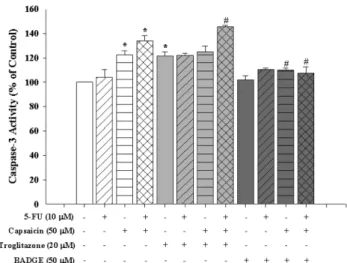
troglitazone
의경우단독투여가HT- 29
암세포의생존율을감소시키고(Fig. 4), caspase-3
활성은증가시키는작용을나타내었다
(Fig. 5). Troglitazone
의전처리는 세포생존율에대한5-FU
와capsaicin
의병용효과를증가시키 는반면, PPAR
γantagonist
인BADGE
의전처리에의해서는5- FU
와capsaicin
의병용효과가약화되는것으로나타났다(Fig.
4).
뿐만아니라, caspase-3
활성에대한5-FU
와capsaicin
의병용효과가
troglitazone
에의해더욱증가하고, BADGE
에의해서는그병용효과가차단됨을확인하였다
(Fig. 5).
이는5-FU
와capsaicin
의병용에의한암세포사멸효과는PPAR
γ경로를경유 하여진행됨을의미한다.
결 론
5-FU
는thymidylate synthase
효소를억제하여세포내뉴클레 오타이드생합성을방해함으로써암세포의증식을저해하는항 암제로여러종류의암치료에널리쓰이고있으나,
그부작용또한크다고알려져있다
.
본연구에서는세포생존율및caspase- 3
활성에큰영향이없는저용량의5-FU
를capsaicin
과병용처 리하였을경우에농도의존적으로세포독성및caspase-3
활성증가가유도됨을확인하였다
.
뿐만아니라, 5-FU
와capsaicin
의병용효과는
PPAR
γ경로를경유하여나타남을확인하였다.
이상의연구결과는저용량의항암제와암세포사멸작용이있는천 연성분을병용함으로써항암제의부작용발현을낮추는동시에 효율적인암세포사멸효과를발휘하는효과적인항암병용요법 제로서의가능성이큼을의미한다
.
감사의 말씀
이논문은
2005
년정부(
교육인적자원부)
의재원으로한국학술 진흥재단의지원을받아수행된연구임(KRF-2005-204-E00119).
참고문헌
1) Kim, D. W., Bang, Y. J., Heo, D. S. and Kim, N. K. : Colon cancer in Korea: characteristics and trends. Tumori
88, 262 (2002).
2) Poon, M. A., O'Connell, M. J., Moertel, C. G., Wieand, H. S., Cullinan, S. A., Everson, L. K., Krook, J. E., Mailliard, J. A., Laurie, J. A. and Tschetter, L. K. : Biochemical modulation of fluorouracil: evidence of significant improvement of survival and quality of life in patients with advanced colorectal carcinoma. J. Clin. Oncol.
7, 1407 (1989).
3) Santi, D. V., McHenry, C. S. and Sommer, H. : Mechanism of interaction of thymidylate synthetase with 5-fluorodeoxy- uridylate. Biochemistry
13, 471 (1974).
4) Violette, S., Poulain, L., Dussaulx. E., Pepin, D., Faussat, A. M., Cahambaz, J., Lacorte, J. M., Staedel, C. and Lesuffleur, T. : Resistance of colon cancer cells to long-term 5-flurouracil exposure is correlated to the relative level of Bcl-2 and Bcl- X(L) in addition to Bax and p53 status. Int. J. Cancer
98, 498 (2002).
5) Zhang, Y. Q., Tang, X. Q., Sun, L., Dong, L., Qin, Y., Liu, H. Q., Xia, H. and Cao, J. G. : Rosiglitazone enhances fluorouracil- induced apoptosis of HT-29 cells by activating peroxisome proliferator-activated receptor gamma. World J. Gastroenterol.
13
, 1534 (2007).
6) Kim, M. Y., Son, J. K., Lee, S. K. and Kuh, H. J. : Combinatorial effect of 5-FU and epigenetic silencing repressors in human colorectal cancer cells. Yakhak Hoeji
49, 511 (2005).
7) Kanda, T., Tada, M., Imazeki, F., Yokosuka, O., Nagao, K. and Saisho, H. : 5-aza-2'-deoxycytidine sensitizes hepatoma and pancreatic cancer cell lines. Oncol. Rep.
14, 975 (2005).
8) Kessinger, M. A., Foley, J. F. and Lemon, H. M. : Adriamycin, mitomycin C, and 5-fluorouracil in combination for advanced colorectal adenocarcinoma previously treated with 5- fluorouracil. Cancer. Clin. Trials
2, 317 (1979).
9) Szolcsanyi, J. and Bartho, L. : Capsaicin-sensitive afferents and their role in gastroprotection: an update. J. Physiol. Paris
95, 181 (2001).
10) Surh, Y. J., Lee, E. and Lee, J. M. : Chemoprotective properties of some pungent ingredients present in red pepper and ginger.
Mutat. Res.
402, 259 (1998).
11) Ito, K., Nakazato, T., Yamato, K., Miyakawa, Y., Yamada, T., Hozumi, N., Segawa, K., Ikeda, Y. and Kizaki, M. : Induction of apoptosis in leukemic cells by homovanillic acid derivative, capsaicin, through oxidative stress: implication of phosphoryla- tion of p53 at Ser-15 residue by reactive oxygen species.
Cancer Res.
64, 1071 (2004).
12) Kim, J. D., Kim, J. M., Pyo, J. O., Kim, S. Y., Kim, B. S., Yu, R.
and Han, I. S. : Capsaicin can alter the expression of tumor
Fig. 5 −
The effect of troglitazone and BADGE on the caspase-3
activity in 5-FU and capsaicin co-treated HT-29 cells. Cells
were treated with or without troglitazone (50
µM) or
BADGE (50
µM) in the presence or absence of 5-FU
(10
µM) and capsaicin (50
µM), for 48 h. The caspase-3
activity was determined using a caspase-3 assay kit. The
data represent the mean±SEM of three independent
experiments. * P <0.05, compared to control,
#P <0.05,
compared to combination.
forming-related genes which might be followed by induction of apoptosis of a Korean stomach cancer cell line, SNU-1. Cancer Lett.
120, 235 (1997).
13) Lee, Y. S., Nam, D. H. and Kim, J. A. : Induction of apoptosis by capsaicin in A172 human glioblastoma cells. Cancer Lett.
161
, 121 (2000).
14) Lee, Y. S., Kwon, E. J., Jin da, Q., Park, S. H., Kang, Y. S., Huh, K. and Kim, J. A. : Redox status-dependent regulation of cyclooxygenases mediates the capsaicin-induced apoptosis in human neuroblastoma cells. Environ. Pathol. Toxicol. Oncol.
21