• 검색 결과가 없습니다.

Effect of PCB118 on expression of COX-2 and cPLA2 in rat testes

N/A
N/A
Protected

Academic year: 2021

Share "Effect of PCB118 on expression of COX-2 and cPLA2 in rat testes"

Copied!
5
0
0

로드 중.... (전체 텍스트 보기)

전체 글

(1)

345

Effect of PCB118 on expression of COX-2 and cPLA2 in rat testes Dae-Yong Han

1,†

, Kwang-Il Park

1,†

, Hyeon-Soo Park

1

, Sang-Rim Kang

1

, Jae-Hyeon Cho

1

, Hu-Jang Lee

1

,

Eun-Hee Kim

2

, Gon-Sup Kim

1,

*

1

Research Institute of Life Science and College of Veterinary Medicine, Gyeongsang National University, Jinju 660-701, Korea

2

Department of Physical Therapy, International University of Korea, Jinju 660-759, Korea (Accepted: December 1, 2009)

Abstract : Polychlorinated biphenyls (PCBs) are synthetic organic compounds with two benzene rings and well known environmental pollutants. This study examined the effect of persistent exposure to 2,3´,4,4´,5- pentachlorobiphenyl (PCB118) on the proinflammatory and proapoptotic factors in male rats. Male Sprague Dawley rats were administered weekly intraperitoneal injections of either PCB118 (20 mg/kg) dissolved in corn oil or corn oil alone. One week after 2 and 5 administrations, the rats were sacrificed by a pentobarbital injection. The effect of PCB118 on the expression of cyclooxygenase 2 (COX-2), cytosolic phospholipase A2 (cPLA2), peroxisome proliferator-activated receptor gamma, Bcl and Bcl-2-associated X protein (BAX) was investigated. The level of COX-2 and cPLA2 expression was higher in the PCB118- treated rats than the control. These results suggest that PCB118 has a proinflammatory effect in rats.

Keywords : COX-2, cPLA2, PCB118, proinflammatory effect

Introduction

Polychlorinated biphenyls (PCBs) are persistent environmental pollutants that are quite toxic to biological systems. They are lipophilic and can accumulate in humans and animals. PCBs cause a range of health problems due to their their stability and persistence in the environment. They are composed of 209 congeners based on the number and position of the chlorine atoms attached to the two benzene rings. It was reported that the mechanism for the toxicity of PCB might differ according to the PCB congener. Dioxin-like PCBs (non-ortho-substituted PCBs) mediate the aryl hydrocarbon receptor (AhR)-dependent mechanism and non-dioxin- like PCBs (ortho-substituted PCBs) do not activate AhR [14, 17].

Studies on PCBs show that they have produced toxic responses. PCBs increase the mortality rate from stomach and intestinal cancer [16]. Exposure to PCBs has toxic effects on the nervous system [6, 25], reproductive function [26, 27] and inflammation on the expression of cPLA

2

and cyclooxygenase 2 (COX-2) [1, 3]. PCBs disturb the thyroid hormone in rats [5, 9].

It was previously reported that PCB 126 (200

µ

g/kg) affects the reproductive function in rats. Toxic equivalency factor (TEF) of PCB 126 is approximately 1000 times more toxic than PCB 118 [27]. In this study, a PCB118 concentration (20 mg/kg) was used. In addition, previously report showed that PCBs have a negative effect on the female reproductive system [4, 15, 18, 20, 21]. As mentioned previously, PCBs have an impact on the female reproductive system.

This study examined the effect of persistent exposure to PCB118 (non-dioxin-like) on the pro-apoptotic and proinflammatory signaling pathway in male rats. The proapoptotic and proinflammatory properties of PCB118 were examined by measuring the levels of peroxisome proliferator-activated receptor gamma (PPAR

γ

), Bcl-xL, Bcl-2–associated X protein (BAX), cytosolic phospholipase A2 (cPLA2) and COX-2 expression.

Materials and Methods

Animals and treatments

Six week old Sprague Dawley male rats (Animal Bio Resources Bank, Korea) were used. The rats were

*Corresponding author: Gon-Sup Kim

Research Institute of Life Science and College of Veterinary Medicine, Gyeongsang National University, Jinju, 660-701, Korea [Tel: +82-55-751-5823, Fax: +82-55-751-5803, E-mail: [email protected]]

The first two authors contributed equally to the completion of this study.

(2)

housed in cages with a 12 h light/dark cycle at 21

±

2

o

C and 50

±

5% humidity, and given a commercial diet (standard formular) and water ad libitum . PCB118 at 99.0% purity was obtained from Dr. Ehrenstorfer Company (Germany). Stock solutions were prepared by dissolving PCB118 in n -hexane. A PCB stock solution was added to corn oil (20 mg/mL) and vortexed.

The n -hexane was then removed by evaporation. The rats were divided into 2 groups: PCB118-treated and control.

Each group was subdivided into 2 groups: 2 and 5 injections groups. A total of 20 rats were divided into 4 groups containing 5 rats each. The rats in each group received weekly intraperitoneal injections of either PCB118 (20 mg/kg) dissolved in corn oil (0.2 mL) or corn oil (0.2 mL) alone (control). One week after 2 and 5 administrations, the animals were sacrificed by a pentobarbital injection. The testes and liver were collected and the samples were stored at

70

o

C until needed. The animal experiment was performed according to the Gyeongsang National University Experimental Animals guidelines (Approval No: GNU-LA-011).

Western blotting

25 mg of tissue was added to a lysis buffer consisting of 0.05 M Tris-Hcl (pH 8.0), 1.5 M sodium chloride, 0.02% sodium azide, 0.1% SDS, 1% NP-40, 0.05%

sodium deoxycholate and a protease inhibiter (Halt Protease Inhibitro Cocktail Kit; Pierce, USA). The samples were sonicated for 6 min (total processing time:

pursing for 3 min, resting for 3 min) in an ice slurry.

The homogenized sample was centrifuged at 13,000 rpm at 4

o

C for 30 min. The clear supernatant was then transferred to an Eppendorf tube and stored at

70

o

C until needed. The protein concentration was estimated using a Bradford protein assay kit (Bio-Rad, USA).

The sample was mixed with ×5 sample buffer [60 mM Tris-Hcl (pH 6.8), 25% glycerol, 2% SDS, 14.4 mM

2-mercaptoethanol, a few grains of bromophenol blue], and boiled for 5min. The sample underwent electrophoreses through a 12% polyacrylamide gel.

The gel was then transferred to a polyvinyldene fluoride (PVDF) membrane (Immobilon-P, 0.45 mm; Millipore, USA) using a TE 77 Semi-Dry Transfer Unit (GE Healthcare Life Sciences, USA). The PVDF membrane was blocked with 5% skim milk in phosphate buffered saline (pH 7.4) for 30 min. The membrane was then incubated with the primary antibody for 90 min. After washing with 0.05% PBST, the membrane was incubated for 1 hour with the secondary antibody. After washing again with 0.05% PBST, the membrane was soaked in an ECL Western Blotting Detection Reagent (GE Healthcare Life Sciences, USA) and exposed to X-ray film (Fuji, Japan).

Statistical analysis

All statistical analyses were performed using the SPSS 14.0 program. A t -test was used to analyze the data and a p value < 0.05 was considered significant.

Results

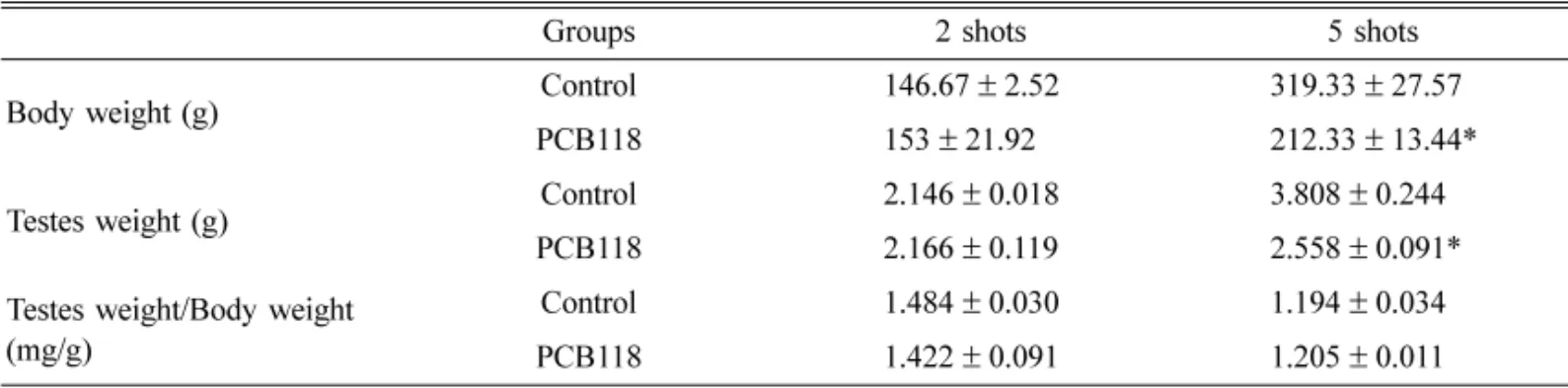
Table 1 shows the body weight, testes weight and testes/body weight. There were a significantly lower body and testes weights in the PCB118-treated rats given 5 shots than the control ( p < 0.05). However, no significant changes in the testes/body weight ratios were observed.

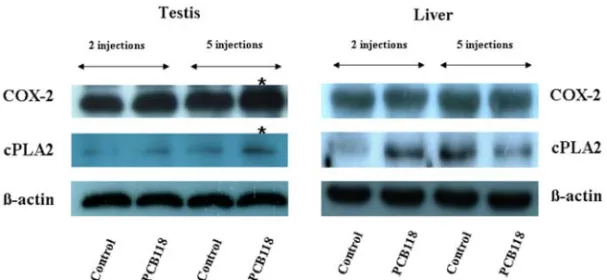
The effect of persistent exposure to PCB118 on the expression of the proinflammatory and proapoptotic mediators was examined by separating the liver and testes lysates by SDS-PAGE, and transferring the proteins onto a PVDF membrane. The level of COX- 2 expression in the testes of the PCB118-treated rats given 5 shots was significantly higher than the control.

Table 1. Body weight, testes weight and testis/body weight of the rats exposed to PCB118

Groups 2 shots 5 shots

Body weight (g) Control 146.67

±

2.52 319.33

±

27.57

PCB118 153

±

21.92 212.33

±

13.44*

Testes weight (g) Control 2.146

±

0.018 3.808

±

0.244

PCB118 2.166

±

0.119 2.558

±

0.091*

Testes weight/Body weight

(mg/g) Control 1.484

±

0.030 1.194

±

0.034

PCB118 1.422

±

0.091 1.205

±

0.011

The values are represented as the mean

±

SD. *Significantly different from the control values at

p

< 0.05.

(3)

On the other hand, there was no difference in the level of COX-2 expression in the liver of the PCB118- treated rats given 2 and 5 shots (Fig. 1). The level of cPLA2 expression in the testes of the PCB118-treated rats given 5 shots was significantly higher than the control. However, there was no significant difference in level of cPLA2 expression in the liver of the PCB118-treated rats given 2 and 5 shots (Fig. 1). The levels of PPAR

γ

, Bcl-xL and BAX expression were relatively unchanged in all groups (Fig. 2).

Discussion

This study examined the effect of PCB118 on proinflammatory and proapoptotic signaling at the protein level. The levels of cPLA2 and COX-2 expression were significantly higher in the testes of the PCB118- treated rats given 5 shots. This shows that persistent exposure to PCB118 can have proinflammatory effect in the rat testes. Previous studies reported that both dioxin-like and non-dioxin-like PCBs affect the proinflammatory factors, such as NF-

κ

B, IL-6 and COX-2 [7, 10]. In

Fig. 1. Expression of the proinflammatory factors in the Rat Testes and Liver after administering corn oil and PCB118 (20 mg/kg). a-actin was used as the standard. Exposure to PCB118 (20 mg/kg) increased the level of cyclooxygenase 2 (COX-2) and cytosolic phospholipase A2 (cPLA2) translation in the testis. The asterisks indicate significant differences from the controls (

p

< 0.05).

Fig. 2. Expression of the proapoptotic factors in the Rat Testes and Liver after the administration of corn oil and PCB118

(20 mg/kg). a-actin was used as the standard. The expression of Bcl-2-associated X protein (BAX), Bcl-xL and peroxisome

proliferator-activated receptor gamma (PPARa) were relatively unchanged in all groups.

(4)

addition, Umannová et al . [23] suggested that non- dioxin-like PCBs might have a toxic effect by inducing arachidonic acid. The effects of PCBs on arachidonic acid are well known. The precise mechanism for PCB- mediated inflammation is unclear. cPLA2 is activated by mitogen-activated protein kinase (MAPK) and cPLA2 induces the release of arachidonic acid. Prostaglandin E2 is then produced from the arachidonic acid released by COX-2. Therefore, the MAPK signaling pathway should be examined to obtain information on the precise mechanism.

The levels of cPLA2 and COX-2 expression were relative unchanged in the liver sample. The tissue distribution of PCB118 in the liver decreased in a time- dependent manner. In a previous study, 5 days after administration, the distribution ratio of PCB118 was 0.1 compared to the PCB118 concentration 6 hours after administration [13]. Therefore, the changes in the cPLA2 and COX-2 levels in liver are due to the half- life of PCB118.

BAX, Bcl-xL and PPAR

γ

expression were also investigated at the protein level. BAX and Bcl-xL mediate the apoptotic signaling pathway. BAX causes the release of cytochrome c from the mitochondria, which can lead to cell death. The antiapoptotic Bcl- 2 family, such as Bcl-xL and Bcl-2, prevent the BAX- mediated response [11, 12, 22]. PPARã is involved in pathological changes, such as obesity, diabetes and cancer. In previous reports, exposure to PCBs causes apoptosis via BAX and Bcl-2 [8, 19].

In this study, the level of BAX, Bcl-xL and PPARã were relatively unchanged. The level of BAX expression in the testes of the PCB118-treated rats given 5 shots was lower than the control, whereas the level of Bcl- xL expression in the liver of the PCB118-treated rats given 2 shots was higher than the control. However, the expression level was not changed significantly.

Although the various apoptotic factors were not examined sufficiently, it is believed that apoptosis was not induced at this PCB118 dose. The potential toxicity of PCBs is generally evaluated by the TEFs [24]. In this study, the PCB118 dose was quite low considering the TEFs of the other PCBs.

In conclusion, persistent exposure to PCB118 may induce inflammation in the testes. PCB118 have a proinflammatory effect by up-regulating cPLA2 and COX-2.

Acknowledgments

This study was supported by National Research Foundation of Korea (NRF) grant (2006-0049788, 2007-0051780, 2009-0084454) funded by the Korea government (MEST).

References

1. Bezdecny SA, Roth RA, Ganey PE. Effects of 2,2´,4,4´-tetrachlorobiphenyl on granulocytic HL-60 cell function and expression of cyclooxygenase-2.

Toxicol Sci 2005, 84 , 328-334

2. Bhavsar SP, Reiner EJ, Hayton A, Fletcher R, MacPherson K. Converting Toxic Equivalents (TEQ) of dioxins and dioxin-like compounds in fish from one Toxic Equivalency Factor (TEF) scheme to another.

Environ Int 2008, 34 , 915-921

3. Brant KA, Caruso RL. PCB 50 stimulates release of arachidonic acid and prostaglandins from late gestation rat amnion fibroblast cells

.

Reprod Toxicol 2006, 22 , 591-598

4. Fein GG, Jacobson JL, Jacobson SW, Schwartz PM, Dowler JK. Prenatal exposure to polychlorinated biphenyls: effects on birth size and gestational age. J Pediatr 1984, 105 , 315-20.

5. Fisher JW, Campbell J, Muralidhara S, Bruckner JV, Ferguson D, Mumtaz M, Harmon B, Hedge JM, Crofton KM, Kim H, Almekinder TL. Effect of PCB 126 on hepatic metabolism of thyroxine and perturbations in the hypothalamic-pituitary-thyroid axis in the rat. Toxicol Sci 2006, 90 , 87-95.

6. Gurley GH, Jelaso AM, Ide CF, Spitsbergen JM.

Effects of polychlorinated biphenyls (PCBs) on expression of neurotrophic factors in C6 glial cells in culture. Neurotoxicology 2007, 28 , 1264-1271.

7. Hennig B, Meerarani P, Slim R, Toborek M, Daugherty A, Silverstone AE, Robertson LW.

Proinflammatory properties of coplanar PCBs:

In vitro

and

in vivo

evidence. Toxicol Appl Pharmacol 2002, 181 , 174-183.

8. Hsu PC, Pan MH, Li LA, Chen CJ, Tsai SS, Guo YL. Exposure in utero to 2,2,3,3,4,6-hexachlorobiphenyl (PCB 132) impairs sperm function and alters testicular apoptosis-related gene expression in rat offspring.

Toxicol Appl Pharmacol 2007, 221 , 68-75.

9. Kato Y, Ikushiro S, Haraguchi K, Yamazaki T, Ito

(5)

Y, Suzuki H, Kimura R, Yamada S, Inoue T, Degawa M. A possible mechanism for decrease in serum thyroxine level by polychlorinated biphenyls in Wistar and Gunn rats. Toxicol Sci 2004, 81 , 309-315.

10. Kwon O, Lee E, Moon TC, Jung H, Lin CX, Nam KS, Baek SH, Min HK, Chang HW. Expression of cyclooxygenase-2 and pro-inflammatory cytokines induced by 2,2´,4,4´,5,5´-hexachlorobiphenyl (PCB 153) in human mast cells requires NF-kB activation. Biol Pharm Bull 2002, 25 , 1165-1168.

11. Narita M, Shimizu S, Ito T, Chittenden T, Lutz RJ, Matsuda H, Tsujimoto Y. Bax interacts with the permeability transition pore to induce permeability transition and cytochrome c release in isolated mitochondria. Proc Natl Acad Sci USA 1998, 95 , 14681-14686.

12. Nutt LK, Pataer A, Pahler J, Fang B, Roth J, McConkey DJ, Swisher SG. Bax and Bak promote apoptosis by modulating endoplasmic reticular and mitochondrial Ca

2+

stores. J Biol Chem 2002, 277 , 9219-9225.

13. Öberg M, Sjödin A, Casabona H, Nordgren I, Klasson-Wehler E, Håkansson H. Tissue distribution and half-lives of individual polychlorinated biphenyls and serum levels of 4-hydroxy-2,3,3´,4´,5-pentachlorobiphenyl in the rat. Toxicol Sci 2002, 70 , 171-182.

14. Pocar P, Klonisch T, Brandsch C, Eder K, Fröhlich C, Hoang-Vu C, Hombach-Klonisch S. AhR-agonist- induced transcriptional changes of genes involved in thyroid function in primary porcine thyrocytes. Toxicol Sci 2006, 89 , 408-414.

15. Polishuk ZW, Wassermann D, Wassermann M, Cucos S, Ron M. Organochlorine compounds in mother and fetus during labor. Environ Res 1977, 13 , 278-284.

16. Prince MM, Ruder AM, Hein MJ, Waters MA, Whelan EA, Nilsen N, Ward EM, Schnorr TM, Laber PA, Davis-King KE. Mortality and exposure response among 14,458 electrical capacitor manufacturing workers exposed to polychlorinated biphenyls (PCBs).

Environ Health Perspect 2006, 114 , 1508-1514.

17. Rowlands JC, Gustafsson JA. Aryl hydrocarbon receptor-mediated signal transduction. Crit Rev Toxicol 1997, 27 , 109-134.

18. Rylander L, Strömberg U, Hagmar L. Dietary intake of fish contaminated with persistent organochlorine compounds in relation to low birthweight. Scand J

Work Environ Health 1996, 22 , 260-266.

19. Sánchez-Alonso JA, López-Aparicio P, Recio MN, Pérez-Albarsanz MA. Polychlorinated biphenyl mixtures (Aroclors) induce apoptosis via Bcl-2, Bax and caspase-3 proteins in neuronal cell cultures. Toxicol Lett 2004, 153 , 311-326.

20. Taylor PR, Lawrence CE, Hwang HL, Paulson AS.

Polychlorinated biphenyls: influence on birthweight and gestation. Am J Public Health 1984, 74 , 1153-1154.

21. Taylor PR, Stelma JM, Lawrence CE. The relation of polychlorinated biphenyls to birth weight and gestational age in the offspring of occupationally exposed mothers. Am J Epidemiol 1989, 129 , 395-406.

22. Tsujimoto Y. Bcl-2 family of proteins: life-or-death switch in mitochondria. Biosci Rep 2002, 22 , 47-58.

23. Umannová L, Neèa J, Andrysík Z, Vondráèek J, Upham BL, Trosko JE, Hofmanová J, Kozubík A, Machala M. Non-dioxin-like polychlorinated biphenyls induce a release of arachidonic acid in liver epithelial cells: a partial role of cytosolic phospholipase A

2

and extracellular signal-regulated kinases 1/2 signalling.

Toxicology 2008, 247 , 55-60.

24. Van den Berg M, Birnbaum LS, Denison M, De Vito M, Farland W, Feeley M, Fiedler H, Hakansson H, Hanberg A, Haws L, Rose M, Safe S, Schrenk D, Tohyama C, Tritscher A, Tuomisto J, Tysklind M, Walker N, Peterson RE. The 2005 world health organization reevaluation of human and mammalian toxic equivalency factors for dioxins and dioxin-like compounds. Toxicol Sci 2006, 93 , 223-241.

25. Venkataraman P, Muthuvel R, Krishnamoorthy G, Arunkumar A, Sridhar M, Srinivasan N, Balasubramanian K, Aruldhas MM, Arunakaran J. PCB (Aroclor 1254) enhances oxidative damage in rat brain regions:

Protective role of ascorbic acid. Neurotoxicology 2007, 28 , 490-498.

26. Wakui S, Takagi F, Muto T, Yokoo K, Hirono S, Kobayashi Y, Shirota K, Akahori F, Suzuki Y, Hano H, Endou H, Kanai Y. Spermatogenesis in aged rats after prenatal 3,3´,4,4´,5-pentachlorobiphenyl exposure.

Toxicology 2007, 238 , 186-191.

27. Yamamoto M, Narita A, Kagohata M, Shirai M,

Akahori F, Arishima K. Effects of maternal exposure

to 3,3´,4,4´,5-pentachlorobiphenyl (PCB126) or 3,3´,4,4´,5,5´-

hexachlorobiphenyl (PCB169) on testicular steroidogenesis

and spermatogenesis in male offspring rats. J Androl

2005, 26 , 205-214.

수치

Table 1 shows the body weight, testes weight and testes/body weight. There were a significantly lower body and testes weights in the PCB118-treated rats given 5 shots than the control ( p &lt; 0.05)
Fig. 1.  Expression of the proinflammatory factors in the Rat Testes and Liver after administering corn oil and PCB118 (20 mg/kg)

참조

관련 문서

Also, Magnolia extract increased hormone sensitive lipase (HSL) protein level, and decreased the adipogenic transcription factor peroxisome proliferator activated receptor (PPAR)-γ

Ten genes, retinoid X receptor alpha, peroxisome proliferator-activated receptor gamma (PPARG), phospholipid transfer protein, stearoyl- CoA desaturase,

Objective: This study investigated the effect of rosiglitazone, a synthetic peroxisome proliferator- activated receptor-γ (PPAR-γ) agonist, on pro-inflammatory gene expressions

배양된 자궁내막 세포에서 reverse transcription polymerase chain reaction을 이용하여 HOXA10, prolactin, cyclooxygenase (COX)-2, peroxisome proliferator-activated receptor

The mRNA levels of sirtuin-1 (SIRT1), peroxisome proliferator-activated receptor γ coactivator- 1α (PGC1α), and peroxisome proliferator-activated receptor α (PPARα)

Anticipated regulatory effects of selective peroxisome proliferator-activated receptor-γ (PPAR-γ) antagonists in adi- pocytes and macrophages: improved expression of

Ehrengruber MU, Chen YE: Early stimulation and late inhibition of peroxisome proliferator-activated receptor gamma (PPAR gamma) gene expression by transforming

ꠏꠏꠏꠏꠏꠏꠏꠏꠏꠏꠏꠏꠏꠏꠏꠏꠏꠏꠏꠏꠏꠏꠏꠏꠏꠏꠏꠏꠏꠏꠏꠏꠏꠏꠏꠏꠏꠏꠏꠏꠏꠏꠏꠏꠏꠏꠏꠏꠏꠏꠏꠏꠏꠏꠏ PPAR: peroxisome proliferator-activated receptor, ELOVL: fatty acid elongase, PgK1: phosphoglycerate kinase