• 검색 결과가 없습니다.

[특별기고] Particle Technology History of Science and Industry

N/A
N/A
Protected

Academic year: 2021

Share "[특별기고] Particle Technology History of Science and Industry"

Copied!
5
0
0

로드 중.... (전체 텍스트 보기)

전체 글

(1)

Particle Technology History of Science and Industry

Shigeki Toyama

Department of Chemical Engineering, Nagoya University, Japan [email protected]

INTRODUCTION

The Chemical Society of Japan has launched

“Symposium on Powder Science and Technology” in 1963 with an aim to activate widely covering interdisciplinary fields, and The Society of Powder Technology, Japan, has established in advance by substituting “Chemical” of “Chemical Engineering”

by “Powder” in 1956. Since then, industries developed from mass production with scaled up plants to an age of intelligence technology to develop functional material and information technology. The paper provides statistical data with analysis, and interpolate them from a historical view point of science and industries.

ANALYSIS OF SESSION THEMES IN “SYMPOSIUM ON POWDER SCIENCE AND TECHNOLOGY”

“Symposium on Powder Science and Technology”

was started from 1963 and those researchers and engineers with a common interest in studying on powder have assembled and earnestly discussed to have accumulated a tremendous achievement.

It accounts 43rd Symposium in 2005. All session

themes in the coming symposium are classified and they are allocated as in Fig. 1 [Sewaninkai, Proceedings of Symposium on Powder Science and Technology, (1963~2004)], where numbers are order of the symposium. The most frequent theme is “General”

(23), and suggests little dependence on the age. The term is allocated at the top of center and others are blocked into such 4 categories as “Apparatus and Process”(37), “Bulk Particle Behavior &

Phenomena”(26), “Build up of Powder and Properties

& Characterization” (43) and “Application”(26) as described by vertical lines in Fig. 1. Numbers in parenthesis are taken up times of respective themes.

The category “Apparatus and Process” complies those session themes as “Powder Technology”(6),

“Unit Operation”(3), “Process and Unit Operation”(14),

“Process”(11) and others(3), and the total is 37. They

are corresponded to activity of machinery makers in

industries. A term “Unit Operation” was initially used

and gradually shifted to “Unit Operation and

Process”. In these years when the symposium was

started, Departments of Chemical Engineering were

successively founded in Japanese universities. “Unit

Operation” was a core course in the curriculum,

which is evolved to “Process Engineering” in 1970s

owing to the development in computer science. The

(2)

the Properties & Characterization”(19), “Measurement and Evaluation of the Properties”(9), “Chemicals”(6) within the block of category “Build up of Powder and Properties & Characterization”. The total is same to the left side being 43. The category is an essential

major, since societies of chemical field took a leadership when the symposium was launched.

Those session themes are allocated from right to

left in the lower part as ‘Material Series of Ultra Fine

Particles”(4), “Functional Material Series”(10) and

(3)

Particle Technology History of Science and Industry

“Public & Market Series”(11).

Fundamental subjects are allocated from upper right, and industrial subjects are allocated to lower right. Those terms as “functional” and “ultra fine particles” are interested to enhance market value of powder materials and products, and they were seen from the later half of the symposium. This is attributed to the transfer of industries from “mass production and large scale” to “Intelligence Technology”. There is only one session with the term

“Nano-technology” which was proposed from United States. It may be attributed that Japanese industries have noticed this subject earlier. The symposium has taken up the subject as “Ultra Fine Particles” several times with interest in various functions to create high market values, and discussed the Intelligence Technology to support industries.

It is a recent tendency that those themes associated with public and market has been notified and discussed as “Environment”, “Energy”, “Bio” and their total times are 9, but it has not been found any theme directly representing “Information Technology”.

Themes associated with subjects on bulk particles blocked as a category “Bulk Particle Behavior &

Phenomena(26)” are allocated at the middle part in Fig. 1. They are key subjects on designing apparatus and plants. Themes as “Packing” and “Adhesion and Aggression” were discussed in earlier half of the symposium, and themes were shifted to “Dispersion and Aggression” in later half.

REVIEW OF PAST AND FORECAST OF FUTURE

Session themes “Unit Operation” and “Process” are allocated left side in Fig.1, which are correspond to the field relevant to machinery and plant makers. The

Association of Powder Process and Engineering, Japan, surveyed the market of machinery and plant dealing with powder by postulating definition of the territory as a memorial task of The 25th Anniversary of the Foundation in 1996. Followings are the data quoted from the report [AIPPIE, The Association of Powder Process and Engineering, Japan, Homepage (April 2005)].

The market scale of machinery and plant dealing with powder (×10

8

Yen)

1992: 1,788 1993: 1,674 1994: 1,717 The items (%)

Bulk handling Apparatus : 16.3 Granulator : 13.6

Dust collector : 13.1 Pulverizer : 10.4 Dryer : 10.1

Mixer & Kneader : 10.0 Classifier : 4.0

Feeder & Discharger : 3.4 Instrument : 2.5

Measuring and controlling device : 0.8 Others : 15.8

A matrix of technology hybridization indicating

degree of repetition was connected with relevance to

15 Technical Groups in The Association of Powder

Process and Engineering, Japan, in 1996 as shown in

Fig. 2 [AIPPIE, The Association of Powder Process

and Engineering, Japan ed., The 25 years History of

The Association of Powder Process and Engineering,

Japan (1996)]. Based on these data, a vision of 21st

century was described for powder technology as

shown in Fig. 3 [AIPPIE, The Association of Powder

Process and Engineering, Japan, Homepage(April

2005)].

(4)

Mixing and Forming, Measurement and Control, Wet Process, Particle Sintering and Reaction, Particle Modification Technology, Transportation, Clean Technology, Fluidization, Crystallization, Battery Manufacturing Technology, Food Process Technology, and Fine Powder Nano-technology.

These technical groups have respectively indicated their guidelines in such two items as “Recent Subject”

and “Near Future Technology”[Sewaninkai, Proceedings of Symposium on Powder Science and Technology, (1963~2004)]. These subjects and technologies are classified here into following 4 items:

process, and so on B : Unit operation oriented item

i.e., Extension or based on respective conventional technology

C : Market needs oriented item

i.e., Micro structure control, intelligent material, Multi-function complex, Nano-territory, Drug delivery

D : Public and social needs oriented item

i.e., Energy and resource saving, Continue-able

Society, Legal control, International standard,

Sanitary and safety administration

(5)

Particle Technology History of Science and Industry

Those classified subjects are summarized as follows.

“Recent Subject” “Near Future Technology”

A 6.4% 7.0%

B 42.9 44.2

C 18.2 27.9

D 32.5 20.1

These numbers indicate a tendency that the item D oriented to public and social needs is decreased in

“Near Future Technology” from “Recent Subject”.

This may be attributed to a state of severe competition in industries.

Technology forecast on 21st century surveyed in 1996 has now turned out correctly. Subjects in near future are almost within the prediction. The market scale of particle apparatus and plants would almost be unchanged in coming ten years.

Followings are predicted as themes in 21st century, namely, “Lifestyle and senior people”, “Wave of

information innovation”, “Global environment, Release of legal control” and “Quality of public investment”.

POSTSCRIPT

A many good studies were reported in 20th Century for predicting technology and society in 21st Century, but little report take account any proper prediction for changes in the triangle of Asia and middle east territory, and also in Africa. Waves of globalization covering tremendous culture and lifestyle would be much larger than that of technology innovation. It becomes important to sincerely discuss the role of science and technology in connection with these themes [Toyama, S., “Nuclear Fission: A Picture Scroll - Berlin-Hiroshima - 21st Century” Nagoya University Museum(2005)]. Now, it becomes obvious the collaborative symposium Busan is greatly worthy as an event in the year of friendship promotion between Korea and Japan.

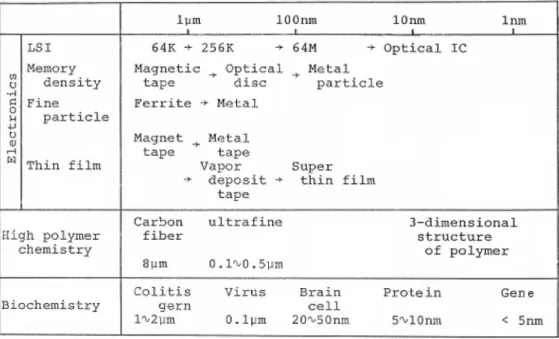
Fig. 3 Basic Technologies to Open 21st Century - from Macro to Micro.

수치

Fig. 3 Basic Technologies to Open 21st Century - from Macro to Micro.

참조

관련 문서

The meeting was attended by Assistant Foreign Minister for GCC Affairs, Ambassador, Nasser Al-Muzayyen, and Deputy Assistant Foreign Minister for the Office of the

“ Sheikh Nasser has a written message from HH the Amir, Sheikh Sabah Al-Ahmad Al-Jaber Al-Sabah to the Chinese President, Chi Gen Beng related to enhancing mutual

On his part, CEO of Express Roads Authority, Saud Al-Naqqi said that the heavy rains of the previous day led to clogging parts of the express

Kuwait will celebrate on Sunday the fourth anniversary of the UN honoring and proclamation of His Highness the Amir, Sheikh Sabah Al-Ahmad Al-Jaber Al-Sabah as

• 이명의 치료에 대한 매커니즘과 디지털 음향 기술에 대한 상업적으로의 급속한 발전으로 인해 치료 옵션은 증가했 지만, 선택 가이드 라인은 거의 없음.. •

Nonlinear Optics Lab...

The proposal of the cell theory as the birth of contemporary cell biology Microscopic studies of plant tissues by Schleiden and of animal tissues by Microscopic studies of

웹 표준을 지원하는 플랫폼에서 큰 수정없이 실행 가능함 패키징을 통해 다양한 기기를 위한 앱을 작성할 수 있음 네이티브 앱과