Address for correspondence: Hee Soon Chung, M.D., Ph.D.
Department of Internal Medicine, Seoul National University Boramae Medical Center, 425, Shindaebang 2-dong, Dongjak-gu, Seoul 156-707, Korea
Phone: 82-2-870-2211, Fax: 82-2-870-3866 E-mail: [email protected]
Received: Apr. 15, 2010 Accepted: Apr. 21, 2010
Tuberc Respir Dis 2010;68:273-279
CopyrightⒸ2010. The Korean Academy of Tuberculosis and Respiratory Diseases. All rights reserved.
폐동맥고혈압이 동반된 만성폐쇄성폐질환 환자에서 혈중 Brain Natriuretic Peptide, 폐동맥압 및 St. George Respiratory Questionnaire의 상관성과 안지 오텐신전환효소억제제 치료 효과
1
서울대학교 의과대학 내과학교실,
2서울대학교 서울특별시 보라매병원 내과
김명아1,2, 김덕겸1,2, 이창훈1,2, 정희순1,2The Correlation of Brain Natriuretic Peptide (BNP), Pulmonary Ar- terial Pressure, and St. George Respiratory Questionnaire (SGRQ) and Their Changes with a Trial of an Angiotensin Converting Enzyme Inhibitor
Myung-A Kim, M.D.
1,2, Deog-Kyeom Kim, M.D.
1,2, Chang-Hoon Lee, M.D.
1,2, Hee Soon Chung, M.D.
1,2Department of Internal Medicine,
1Seoul National University College of Medicine,
2Seoul National University Boramae Medical Center, Seoul, Korea
Background: Pulmonary hypertension is considered as a poor prognosis factor in patients with chronic obstructive pulmonary disease (COPD). There has been reported brain natriuretic peptide (pro-BNP) is related with increased right ventricular (RV) workloads. However, there are few studies that evaluate the relationship between BNP and pulmonary arterial pressure (PAP), RV function and St. George Respiratory Questionnaire (SGRQ) score in patients with COPD, and the effects of angiotensin converting enzyme inhibitor (ACEI) on these parameters.
Methods: Pulmonary function test, echocardiography, blood BNP, and SGRQ score were evaluated in stabilized moderate degree COPD patients (FEV1/FVC<70%, 50%≤FEV1<80%) aged 45 years and over, without worsening of symptoms within recent 3 months. After treating with ramipril 10 mg for 3 months, the same evaluation was repeated.
Results: Twenty-two patients were included in this study. BNP was significantly correlated with PAP (Pearson coefficient ρ=0.51, p=0.02), but not with RV ejection fraction (EF) and predicted FEV1%. The values for predicted FEV1% showed significant correlation with SGRQ total score and activity score, but not with BNP or PAP. After ramipril treatment, PAP showed significant decrease (42.8±8.1 vs. 34.5±4.5 mm Hg p=0.0003), tricuspid annular plane systolic excursion significant increase (21.5±3.3 vs. 22.7±3.1 mm p=0.009). BNP showed a tendency to decrease without statistical significance (40.8±59.6 vs. 18.0±9.1 pg/mL p=0.55). SGRQ scores showed no significant change.
Conclusion: BNP showed significant correlation with resting PAP, which means BNP could be used as markers for pulmonary hypertension. Treatment with ACEI didn’t show significant change in the level of BNP, while pulmonary hypertension and RV function were improved.
Key Words: Natriuretic Peptide, Brain; Pulmonary Disease, Chronic Obstructive; Hypertension, Pulmonary;
Angiotensin-Converting Enzyme Inhibitors
서 론
만성폐쇄성폐질환의 질병경과 중 폐실질 및 모세혈관 의 파괴 및 저산소혈증에 동반된 혈관수축 등의 기전으로 폐동맥압이 상승하고, 말기에는 폐동맥 고혈압과 이에 수 반되는 우심실부전으로 진행하여, 중등도 이상의 만성폐 쇄성폐질환 환자의 20∼90%에서 폐동맥압 상승이 보고 되어 있다1. 이런 폐동맥고혈압 및 이에 따른 우심부전은 만성폐쇄성폐질환 환자의 예후에 나쁜 영향을 미친다.
폐동맥고혈압은 안정 시 평균 폐동맥압(mean pulmo- nary artery pressure, mPAP)이 >25 mm Hg이고, 운동 시 mPAP >30 mm Hg인 경우로 정의되며, 이는 침습적 인 우심도자 검사를 통해 얻은 값으로 일반적으로 사용할 수 있는 진단 방법으로서 측정하는 데 제한이 있다1. 현재 까지 심초음파를 제외하고는 직접 우심실기능이나 폐동 맥 고혈압의 진행 정도를 예측하거나 주기적인 측정을 통 하여 예후를 판정할 수 있는 비침습적인 검사 방법은 없는 실정이다. 또 만성폐쇄성폐질환 환자에서 사망률, 이환율 과 관련이 있는 우심실기능을 판정하는 것은 매우 중요하 다. 우심실은 삼각형모양의 독특한 3차원구조를 가지고 있어 기능을 평가하기 쉽지 않으나 심초음파를 이용한 용 적계산법으로 구한 우심실 박출계수는 신뢰할 만한 검사 법으로 인정받고 있다. 또 삼첨판윤운동의 감소가 우심실 기능부전과 관련이 있다고 보고되어 있고2-4 측정이 간편 하여 우심실기능의 평가에 용이한 방법 중의 하나하다.
이들 방법으로 평가한 우심실기능부전의 정도는 brain natriuretic peptide (BNP) level과 유의한 상관관계가 있 다5-7.
BNP는 심장호르몬으로 심실 과부하의 정도에 따라 심 실에서 분비된다. BNP의 변화는 좌심실 기능장애와 심부 전 증상, 또 치료 효과 판정 및 예후와도 관련되어 있다고 알려져 있어8-10, 좌심부전의 조기진단 및 예후 예측에 유 용한 검사이다11,12. 좌심실 기능장애에 따른 BNP의 변화 에 대한 연구는 매우 많으나 우심실 기능장애와 관련된 연구는 부족한 실정이다. 일부 연구에서 우심실 기능부전 시 BNP 수치의 상승을 보고하였고, 특히 만성폐쇄성폐질 환이나 폐색전증 시 BNP가 상승한다는 일부 보고가 있으
나13,14, 만성폐쇄성폐질환에서 안정 시 우심실 기능의 정
도 및 치료 경과에 따른 변화와 BNP의 상관성에 대한 연 구는 없다.
만성폐쇄성폐질환 환자에서 우심부전의 비침습적 평가 방법이 부족한 현실에서 BNP가 우심실 기능 및 폐동맥압
을 반영할 수 있는 유용한 지표인가 평가하는 것은 중요하 다. 또한, 이들 지표들과 만성폐쇄성폐질환 환자의 호흡 곤란 정도 및 운동 능력 등을 포함한 포괄적 삶의 질을 평가하는 데 널리 이용되는 St. George Respiratory Ques- tionnaire (SGRQ)와의 상관성을 살펴보는 것은 폐동맥고 혈압이 동반된 만성폐쇄성폐질환 환자의 임상 경과를 예 측하고 치료 효과를 판정하는 데 매우 중요하다. 본 연구 에서는 호흡곤란을 동반한 중등도 이상의 만성폐쇄성폐 질환 환자에서 혈중 N-terminal pro-BNP (BNP)와 폐동맥 고혈압, 우심기능 및 SGRQ와의 상관성을 확인하고자 하 였다.
안지오텐신전환효소억제제는 좌심부전에 널리 쓰이는 치료제 중의 하나로 강력한 혈관수축 물질인 안지오텐신 II의 생성을 억제하고 혈관을 확장시켜 전부하, 후부하를 감소시킨다15. 만성폐쇄성폐질환에 사용 시 혈관 확장 작 용으로 폐동맥고혈압을 개선하며 후부하를 감소시켜 우 심부전을 개선할 수 있을 것으로 기대된다. 본 연구에서 는 안지오텐신전환효소억제제인 ramipril이 우심기능 및 폐동맥압, SGRQ에 미치는 효과를 보고자 하였다.
대상 및 방법
15갑년 이상의 흡연력이 있는 45세 이상의 중등도 및 중증의 만성폐쇄성폐질환(FEV1/FVC<70%, 50%≤FEV1
<80%) 환자 중 최근 3개월간 급성 악화가 없고, 최근 1년에 1회 미만의 급성 악화가 있었던 안정된 환자들 중 주관적인 호흡곤란이 있는 경우만을 대상으로 하였다. 이 들 중 심초음파를 이용하여 측정한 폐동맥압이 35 mm Hg 이상인 환자들만 최종적으로 연구 대상군에 포함하였 다. 결핵성 병변에 의한 반흔으로 폐쇄성 기류장애를 나 타내는 것으로 판단되는 경우, 심초음파검사상 좌심실 기 능부전(좌심실 박출계수 <50%)이 있거나 과거에 심부전 병력이 있는 경우, 조절되지 않는 고혈압이 있는 경우, 신 기능저하가 동반된 경우, angiotensin converting enzyme inhibitor, 베타차단제, 칼슘길항제 등을 복용하는 경우, 중등도 이상의 판막질환이 있는 경우, 관동맥 질환이 있는 경우는 제외하였다. D-dimer 및 심전도 결과를 바탕으로 폐색전증에 의한 이차성 폐동맥 고혈압의 가능성을 배제 하였다.
폐기능검사는 Vmax 22 (Sensormedics Co., Yorva Lin- da, CA, USA) 및 body plethysmography (Vmax V62J;
Sensormedics Co.)를 이용하여 미국흉부학회의 지침에
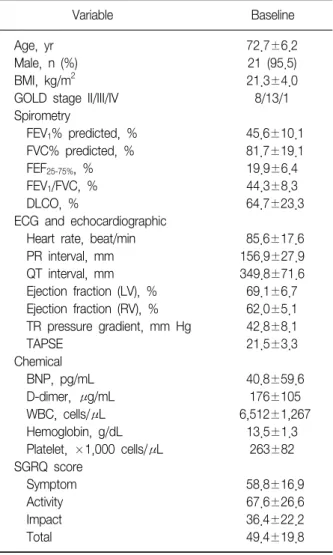
Table 1. Baseline characteristics of study subjects
Variable Baseline
Age, yr 72.7±6.2
Male, n (%) 21 (95.5)
BMI, kg/m
221.3±4.0
GOLD stage II/III/IV 8/13/1
Spirometry
FEV
1% predicted, % 45.6±10.1
FVC% predicted, % 81.7±19.1
FEF
25-75%, % 19.9±6.4
FEV
1/FVC, % 44.3±8.3
DLCO, % 64.7±23.3
ECG and echocardiographic
Heart rate, beat/min 85.6±17.6
PR interval, mm 156.9±27.9
QT interval, mm 349.8±71.6
Ejection fraction (LV), % 69.1±6.7 Ejection fraction (RV), % 62.0±5.1 TR pressure gradient, mm Hg 42.8±8.1
TAPSE 21.5±3.3
Chemical
BNP, pg/mL 40.8±59.6
D-dimer, μg/mL 176±105
WBC, cells/μL 6,512±1,267
Hemoglobin, g/dL 13.5±1.3
Platelet, ×1,000 cells/μL 263±82 SGRQ score
Symptom 58.8±16.9
Activity 67.6±26.6
Impact 36.4±22.2
Total 49.4±19.8
BMI: body mass index; FEV
1: forced expiratory volume for a second; FVC: forced vital capacity; DLCO: CO diffusing ca- pacity; LV: left ventricular; RV: right ventricular; TAPSE: tricuspid annular plane systolic excursion; BNP: brain natriuretic peptide;
SGRQ: St. George Respiratory Questionnaire.
의거하여 전폐용적을 포함하여 1초 간 강제호기량(forced expiratory volume for a second, FEV1), 강제폐활량 (forced vital capacity, FVC), 일산화탄소 폐확산능(CO diffusing capacity, DLCO)을 측정하였고 결과는 같은 연 령, 성별, 체중 및 신장으로부터 예측된 값에 대한 백분율 (%)을 기준으로 표시하였다. 심초음파검사는 Philips사의 iE 33 (Philips Ultrasound, Bothell, WA, USA)을 이용하여 검사하였다. 좌심실크기 및 박출계수를 구하였고, 삼첨판 폐쇄부전 혈류를 측정하여 우심실과 우심방 사이 압력차 를 구하고 통상 우심방압을 10 mm Hg로 가정하여 폐동 맥압을 산출하였다. 우심실 수축기능을 평가하기 위하여 우심실 박출계수와 삼첨판윤운동(tricuspid annular plane systolic excursion, TAPSE)을 사용하였다. 우심실 박출계 수는 심첨부(apical 4-chamber view)와 검상 하 위치(sub- xyphoid view)에서 biplane modified Simpson method를 사용하여 측정하였고, 각각 3회 측정하여 평균값을 사용 하였다. TAPSE는 4-chamber view에서 측부 삼첨판 윤의 운동을 3회 측정하여 평균값을 사용하였다. BNP는 전박 정맥에서 채취하여 1시간 이내에 혈청을 분리한 후 - 20oC에 보관하였고 자동화된 non-competitive immunor- adiometric assay (Roche Inc., Mannheim, Germany)로 측정하였다. 임상증상의 평가척도로 기존에 정형화된 SGRQ를 이용하여 증상점수(symptom score), 활동력점 수(activity score), 영향력점수(impact score) 및 총점 (total score)을 구하였다.
연구 대상군에게 ramipril 10 mg을 3개월 간 투여하였 다. BNP, 심초음파 지표 및 SGRQ score는 초기 및 ram- ipril 3개월 후 동일한 방법으로 측정하여 비교하였다.
본 연구는 보라매병원 임상연구윤리위원회의 승인을 받아 시행하였다.
통계는 SPSS (version 13.0; SPSS Inc., Chicago, IL, USA)를 이용하였다. 모든 결과는 평균±표준편차로 표시 하였고, 상관 분석 및 치료 전후 변화에 대해서는 Wilcox- on signed rank test를 시행하여 통계량을 산출하였으며, p<0.05인 경우 통계적으로 유의하다고 판단하였다.
결 과
연구 대상자는 총 22명으로 평균 나이는 72.7±6.2세, 남자가 21명이었다. 이들의 기저 임상 특징과 폐기능검사, 심초음파검사의 측정치, SGRQ score들은 Table 1과 같다.
혈중 BNP는 폐동맥압과 유의한 상관관계가 있었으나
(Pearson coefficient ρ=0.51, p=0.02) (Figure 1), 우심실 박출계수나 폐기능 감소 정도(FEV1% predicted)와는 관련 이 없었다. 폐기능 감소 정도(FEV1% predicted)는 SGRQ 총점과 활동점수와의 상관성은 유의한 반면(Figure 2), BNP 및 폐동맥압과의 상관성은 관찰되지 않았다(FEV1% predicted vs. BNP: ρ=0.25, p=0.28; FEV1%predicted vs.
PAP: ρ=-0.05, p=0.83) (Figure 3).
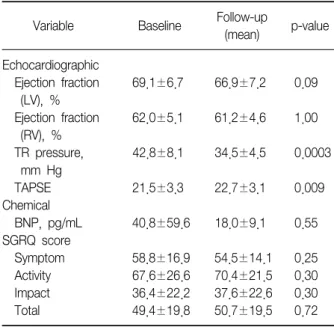
Ramipril 투여 후 PAP는 유의하게 감소하였고(42.8±
8.1 vs. 34.5±4.5 mm Hg, p=0.0003), TAPSE는 유의하게 증가하였다(21.5±3.3 vs. 22.7±3.1 mm, p=0.009). BNP 는 감소하는 경향을 보였으나 통계적으로 유의하지 않았
Figure 1. The relationship between brain natriuretic pep- tide (BNP) level and pulmonary artery pressure (PAP).
BNP was significantly correlated with PAP (p=0.02).
Figure 2. The relationship between FEV1% and St.
George Respiratory Questionnaire (SGRQ) total score.
FEV1% predicted was significantly correlated with SGRQ total score (SGRQ score=104.3-1.16×FEV1% pre- dicted, p=0.03).
Figure 3. The relationship between FEV1 and brain natriu- retic peptide (BNP) levels or pulmonary artery pressure (PAP). There was no significant correlation between FEV1% and BNP level or PAP (sPAP=44.6-0.04×
FEV1% predicted, p=0.83; BNP=-26.1+1.5×FEV1% predicted, p=0.28).
Table 2. The changes of echocardiographic variables, the level of BNP, and SGRQ score
Follow-up
Variable Baseline p-value
(mean) Echocardiographic
Ejection fraction 69.1±6.7 66.9±7.2 0.09 (LV), %
Ejection fraction 62.0±5.1 61.2±4.6 1.00 (RV), %
TR pressure, 42.8±8.1 34.5±4.5 0.0003 mm Hg
TAPSE 21.5±3.3 22.7±3.1 0.009
Chemical
BNP, pg/mL 40.8±59.6 18.0±9.1 0.55 SGRQ score
Symptom 58.8±16.9 54.5±14.1 0.25 Activity 67.6±26.6 70.4±21.5 0.30 Impact 36.4±22.2 37.6±22.6 0.30
Total 49.4±19.8 50.7±19.5 0.72
BNP: brain natriuretic peptide; SGRQ: St. George Respiratory Questionnaire; LV: left ventricular; RV: right ventricular; TAPSE:
tricuspid annular plane systolic excursion.
다(40.8±59.6 vs. 18.0±9.1 pg/mL, p=0.55). SGRQ 점 수의 유의한 변화는 관찰되지 않았다(Table 2).
고 찰
1. 우심실기능부전, 폐동맥고혈압과 BNP의 관계
BNP는 심실에서 분비되는 호르몬으로 좌심실 기능부 전 시 증가한다16. BNP는 좌심부전의 진단 및 치료효과 판정에 유용하게 쓰일 뿐 아니라 외래 치료 시 질병의 진 행을 판정하는 데도 매우 유용하다17-19. 이런 BNP는 우심 실 기능장애와도 관련이 있다13. 여러 연구에 의하면 BNPlevel로 우심실 기능을 추정할 수 있고20,21, 또 BNP가 우심 실 박출계수 및 폐동맥고혈압과 유의한 상관관계가 있다 고 보고되어 있다20,22. 본 연구에서는 BNP와 폐동맥압 사 이에는 유의한 관계가 있었으나 우심실 박출계수와는 상 관관계를 발견하지 못하였다. 이는 본 연구에 포함된 환
자들이 대부분 우심실 박출계수가 정상이어서 안정 시에 는 유의한 상관관계를 증명하지 못하였을 수 있다. 저자 들의 지난 연구에서 보면 우심실 박출계수가 안정 시에 정상이어도 운동 직후 감소하는 것을 관찰하였다23. Gemici 등24은 우심기능이 정상인 만성폐쇄성폐질환 환자 에서 운동에 의한 일시적 우심기능부하에도 BNP가 상승 함을 보고하였다. 따라서 본 연구에서도 운동 후 또는 급 성 악화 후 우심실 박출계수를 구하여 보았다면 유의한 상관관계를 발견할 수 있었을 것으로 예상된다. 그러나 본 연구의 목적이 안정 시 BNP로 폐동맥고혈압이나 우심 실부전을 예측할 수 있는가를 보고자한 것이었으며, 폐동 맥고혈압과의 연관성은 있었으나 우심실 박출계수와의 연관성은 발견되지 않았다.
2. 폐질환과 BNP의 관계
비록 정도는 덜 하나 폐질환에서도 BNP가 상승하는 것 으로 알려져 있다. 일반적으로 BNP는 좌심실 기능부전 시 심실의 용적과부하나 압력과부하가 생길 때 심실 벽장 력 증가에 의해 분비되는 것으로 알려져 있다25. 그러나 폐질환과 관련된 분비는 이 외에도 만성폐질환 시 발생하 는 저산소증이나26 폐렴 시에 분비되는 IL-1B 등의 cyto- kine이 관련되어 있다27-29. 좌심실 기능부전이 없는 환자 에서 BNP level은 폐질환 및 이와 관련된 폐동맥고혈압 의 주요한 예후 판정 인자로 알려져 있다30-32. 그러나 어떤 연구자들은 급성악화 시 BNP level은 질병의 중증을 대변 하기는 하나 독립된 예후 인자로는 관련성이 떨어진다고 도 보고하였다33. 따라서 BNP와 만성폐질환에 의한 우심 실 기능부전 및 폐동맥고혈압과의 관계는 분명해 보이나 독립된 예후 인자로 인정받기에는 더 많은 연구가 필요할 것으로 판단된다. 폐기능과 관련하여 BNP가 폐기능 장애 의 정도를 직접 나타낸다는 보고는 거의 없다. Maeder 등34 이 만성폐쇄성폐질환 환자에서 peak VO2와 BNP의 관련 성을 보고한 것은 있으나 FEV1이나 그 외의 다른 폐기능 변수들과의 직접 상관관계는 보고된 바 없다. 본 연구에 서도 FEV1%predicted와 BNP와의 유의한 관계는 발견되 지 않았다. 따라서 현재로서는 BNP로 폐기능 장애 정도 를 판정할 수는 없을 것으로 사료된다.
3. 만성폐질환에서 안지오텐신전환효소억제제의 치료
만성폐쇄성폐질환 및 이에 동반된 우심실 기능부전과 폐동맥고혈압 치료에 안지오텐신전환효소억제제의 효과 는 아직도 논란이 있다. Rubin35은 폐혈관저항이 20% 감소하거나, 심박출량이 증가하거나, 폐동맥압이 감소하거 나, 혈압에 큰 변화가 없을 때로 국한하여 혈관확장제 치 료를 하도록 권하고 있다. 본 연구에서는 좌심실 및 우심 실 박출계수 모두 정상이었고 혈압의 변화도 없었다. 또 치료 후 폐동맥압은 유의하게 감소하였고 삼첨판윤운동 은 유의하게 증가하여 우심실부하 정도가 개선되었음을 알 수 있다. 우심실 박출계수는 대상 환자 모두 정상이어 서 치료에 의한 큰 변화는 관찰할 수 없었다. 만성폐쇄성 폐질환에서 폐실질 및 모세혈관의 파괴, 소동맥 수축 등에 의하여 혈관저항이 증가하고, 이로 인하여 폐동맥고혈압 이 생기고 우심실부하가 증가한다. 이렇게 우심실부하가 증가되고 폐동맥고혈압이 발생한 상황에서는 전부하, 후 부하를 감소시키기 위한 혈관확장 치료가 도움이 될 수 있다. 혈관확장제 중 안지오텐신전환효소억제제는 동맥 과 정맥을 모두 이완시켜 전부하, 후부하를 모두 감소시킨 다. 또 좌심부전 시 레닌-안지오텐신 시스템은 심부전 상 태를 극복하기 위한 보상반응으로 활성화되나, 여기서 생 성된 안지오텐신 II로 인하여 심부전을 악화시키는 양면 성을 가진다. 이 때 안지오텐신전환효소억제제의 치료는 심부전을 개선하는 효과가 있음이 입증되어 있다36,37. 우 심부전에도 같은 효과를 기대할 수 있다. 즉, 폐동맥고혈 압과 우심부하를 개선시킬 수 있을 것으로 예상된다.
최근 Di Marco 등38은 만성폐쇄성폐질환 환자에게 ena- lapril을 쓴 후 work rate, O2 pulse가 개선되었다고 보고 하며 안지오텐신전환효소억제제가 만성폐쇄성폐질환 환 자의 운동에 대한 심폐기능의 개선효과가 있음을 시사하 였다. 또 Mortensen 등39은 안지오텐신전환효소억제제가 3개월-사망률을 개선시킨다고 보고하였다. 향후 더 많은 연구가 필요할 것으로 판단되나, 만성폐질환에서 안지오 텐신전환효소억제제의 효과는 충분히 기대해 볼만하다.
만성폐쇄성폐질환 환자에서 BNP와 폐동맥압 사이에 유의한 상관관계를 보여 BNP가 폐동맥고혈압을 나타내 는 유용한 지표임을 의미한다. 그러나 우심실기능이 정상 일 경우 우심실 박출계수의 변화는 관찰 할 수는 없었다.
BNP는 폐기능의 장애를 대변하지는 못한다. 안지오텐신 전환효소억제제의 사용은 폐동맥고혈압 및 우심부하를 개선시키는 효과를 보여 만성폐색성폐질환에서 안지오텐 신전환효소억제제의 효과는 기대해 볼 만하다.
감사의 글
This study was performed with a research grants of
Seoul National University Boramae Medical Center.
참 고 문 헌
1. Chaouat A, Bugnet AS, Kadaoui N, Schott R, Enache I, Ducoloné A, et al. Severe pulmonary hypertension and chronic obstructive pulmonary disease. Am J Respir Crit Care Med 2005;172:189-94.
2. Hammarström E, Wranne B, Pinto FJ, Puryear J, Popp RL. Tricuspid annular motion. J Am Soc Echocardiogr 1991;4:131-9.
3. Kaul S, Tei C, Hopkins JM, Shah PM. Assessment of right ventricular function using two-dimensional echo- cardiography. Am Heart J 1984;107:526-31.
4. Ghio S, Recusani F, Klersy C, Sebastiani R, Laudisa ML, Campana C, et al. Prognostic usefulness of the tricuspid annular plane systolic excursion in patients with con- gestive heart failure secondary to idiopathic or ischemic dilated cardiomyopathy. Am J Cardiol 2000;85:837-42.
5. Passino C, Maria Sironi A, Favilli B, Poletti R, Prontera C, Ripoli A, et al. Right heart overload contributes to cardiac natriuretic hormone elevation in patients with heart failure. Int J Cardiol 2005;104:39-45.
6. Mariano-Goulart D, Eberlé MC, Boudousq V, Hejazi- Moughari A, Piot C, Caderas de Kerleau C, et al. Major increase in brain natriuretic peptide indicates right ven- tricular systolic dysfunction in patients with heart failure. Eur J Heart Fail 2003;5:481-8.
7. Troisi F, Greco S, Brunetti ND, Di Biase M. Right heart dysfunction assessed with echography, B-type natriu- retic peptide and cardiopulmonary test in patients with chronic heart failure. J Cardiovasc Med (Hagerstown) 2008;9:672-6.
8. Stein BC, Levin RI. Natriuretic peptides: physiology, therapeutic potential, and risk stratification in ischemic heart disease. Am Heart J 1998;135:914-23.
9. Harrison A, Morrison LK, Krishnaswamy P, Kazanegra R, Clopton P, Dao Q, et al. B-type natriuretic peptide predicts future cardiac events in patients presenting to the emergency department with dyspnea. Ann Emerg Med 2002;39:131-8.
10. Omland T, Aakvaag A, Vik-Mo H. Plasma cardiac na- triuretic peptide determination as a screening test for the detection of patients with mild left ventricular impairment. Heart 1996;76:232-7.
11. Mair J, Friedl W, Thomas S, Puschendorf B. Natriuretic peptides in assessment of left-ventricular dysfunction.
Scand J Clin Lab Invest Suppl 1999;230:132-42.
12. Cheng V, Kazanagra R, Garcia A, Lenert L, Krishnaswa- my P, Gardetto N, et al. A rapid bedside test for B-type peptide predicts treatment outcomes in patients admit- ted for decompensated heart failure: a pilot study. J Am Coll Cardiol 2001;37:386-91.
13. Ishii J, Nomura M, Ito M, Naruse H, Mori Y, Wang JH, et al. Plasma concentration of brain natriuretic peptide as a biochemical marker for the evaluation of right ven- tricular overload and mortality in chronic respiratory disease. Clin Chim Acta 2000;301:19-30.
14. Logeart D, Lecuyer L, Thabut G, Tabet JY, Tartière JM, Chavelas C, et al. Biomarker-based strategy for screen- ing right ventricular dysfunction in patients with non- massive pulmonary embolism. Intensive Care Med 2007;33:286-92.
15. Turini GA, Brunner HR, Gribic M, Waeber B, Gavras H. Improvement of chronic congestive heart-failure by oral captopril. Lancet 1979;1:1213-5.
16. Cowie MR, Struthers AD, Wood DA, Coats AJ, Thompson SG, Poole-Wilson PA, et al. Value of natriu- retic peptides in assessment of patients with possible new heart failure in primary care. Lancet 1997;350:
1349-53.
17. Maeda K, Tsutamoto T, Wada A, Hisanaga T, Kinoshita M. Plasma brain natriuretic peptideas a biochemical marker of high left ventricular end-diastolic pressure in patients with symptomatic left ventricular dysfunction.
Am Heart J 1998;135:825-32.
18. Mair J, Hammerer-Lercher A, Puschendorf B. The im- pact of cardiac natriuretic peptide determination on the diagnosis and management of heart failure. Clin Chem Lab Med 2001;39:571-88.
19. Bettencourt P. NT-proBNP and BNP: biomarkers for heart failure management. Eur J Heart Fail 2004;6:359- 63.
20. Reesink HJ, Tulevski, II, Marcus JT, Boomsma F, Kloek JJ, Vonk Noordegraaf A, et al. Brain natriuretic peptide as noninvasive marker of the severity of right ven- tricular dysfunction in chronic thromboembolic pulmo- nary hypertension. Ann Thorac Surg 2007;84:537-43.
21. Pieralli F, Olivotto I, Vanni S, Conti A, Camaiti A, Targioni G, et al. Usefulness of bedside testing for brain natriuretic peptide to identify right ventricular dysfunction and outcome in normotensive patients with acute pulmonary embolism. Am J Cardiol 2006;97:1386- 90.
22. Inoue Y, Kawayama T, Iwanaga T, Aizawa H. High plasma brain natriuretic peptide levels in stable COPD without pulmonary hypertension or cor pulmonale.
Intern Med 2009;48:503-12.
23. Kim MA, Kim SH, Zo JH, Hwangbo B, Lee JH, Chung HS. Right heart dysfunction in post-tuberculosis emphy- sema. Int J Tuberc Lung Dis 2004;8:1120-6.
24. Gemici G, Erdim R, Celiker A, Tokay S, Ones T, Inanir S, et al. B-type natriuretic peptide levels in patients with COPD and normal right ventricular function. Adv Ther 2008;25:674-80.
25. King L, Wilkins MR. Natriuretic peptide receptors and the heart. Heart 2002;87:314-5.
26. Lang CC, Coutie WJ, Struthers AD, Dhillon DP, Winter JH, Lipworth BJ. Elevated levels of brain natriuretic peptide in acute hypoxaemic chronic obstructive pul- monary disease. Clin Sci (Lond) 1992;83:529-33.
27. Yetkin O, Hacievliyagil SS, Gunen H. Assessment of B-type natriuretic peptide in patients with pneumonia.
Int J Clin Pract 2008;62:488-91.
28. He Q, LaPointe MC. Interleukin-1betaregulation of the human brain natriuretic peptide promoter involves Ras-, Rac-, and p38 kinase-dependent pathways in car- diac myocytes. Hypertension 1999;33:283-9.
29. Mueller C, Laule-Kilian K, Scholer A, Perruchoud AP.
B-type natriuretic peptide for risk stratification in com- munity-acquired pneumonia. J Intern Med 2005;258:
391-3.
30. Leuchte HH, Baumgartner RA, Nounou ME, Vogeser M, Neurohr C, Trautnitz M, et al. Brain natriuretic peptide is a prognostic parameter in chronic lung disease. Am J Respir Crit Care Med 2006;173:744-50.
31. Burke MA, Cotts WG. Interpretation of B-type natriu- retic peptide in cardiac disease and other comorbid conditions. Heart Fail Rev 2007;12:23-36.
32. Leuchte HH, Holzapfel M, Baumgartner RA, Ding I,
Neurohr C, Vogeser M, et al. Clinical significance of brain natriuretic peptide in primary pulmonary hyper- tension. J Am Coll Cardiol 2004;43:764-70.
33. Stolz D, Breidthardt T, Christ-Crain M, Bingisser R, Miedinger D, Leuppi J, et al. Use of B-type natriuretic peptide in the risk stratification of acute exacerbations of COPD. Chest 2008;133:1088-94.
34. Maeder MT, Brutsche MH, Christ A, Reichlin T, Staub D, Noveanu M, et al. Natriuretic peptides for the pre- diction of severely impaired peak VO2 in patients with lung disease. Respir Med 2009;103:1337-45.
35. Rubin LJ. Cardiovascular effects of vasodilator therapy for pulmonary arterial hypertension. Clin Chest Med 1983;4:309-19.
36. The CONSENSUS Trial Study Group. Effects of enalapril on mortality in severe congestive heart failure: results of the Cooperative North Scandinavian Enalapril Survi- val Study (CONSENSUS). N Engl J Med 1987;316:1429- 35.
37. The SOLVD Investigators. Effect of enalapril on survival in patients with reduced left ventricular ejection frac- tions and congestive heart failure. N Engl J Med 1991;
325:293-302.
38. Di Marco F, Guazzi M, Vicenzi M, Santus P, Cazzola M, Pappalettera M, et al. Effect of enalapril on exercise cardiopulmonary performance in chronic obstructive pulmonary disease: a pilot study. Pulm Pharmacol Ther 2010;23:159-64.
39. Mortensen EM, Copeland LA, Pugh MJ, Restrepo MI, de Molina RM, Nakashima B, et al. Impact of statins and ACE inhibitors on mortality after COPD exacerbations.
Respir Res 2009;10:45.