Research in Plant Disease pISSN 1598-2262, eISSN 2233-9191 www.online-rpd.org
The Korean Society of Plant Pathology
This is an open access article distributed under the terms of the Creative Commons Attribution Non-Commercial License (http://creativecommons.org/licenses/
by-nc/4.0/), which permits unrestricted non-commercial use, distribution, and reproduction in any medium, provided the original work is properly cited.
Note Open Access https://doi.org/10.5423/RPD.2017.23.4.383
호야에서 발생한 봉선화괴저반점바이러스 국내 첫 보고
First Report of Impatiens necrotic spot virus in Hoya carnosa in Korea
김미경1† · 강효중2† · 곽해련1 · 김정은1 · 김재덕1 · 서장균3 · 최홍수1*
1국립농업과학원 작물보호과, 2충청북도농업기술원, 3서울대학교 국제농업기술학과
Mikyeong Kim1†, Hyo-Jung Kang2†, Hae-Ryun Kwak1, Jeong-Eun Kim1, Jaedeok Kim1, Jang-Kyun Seo3, and Hong-Soo Choi1*
1Crop Protection Division, National Institute of Agricultural Sciences, Wanju 55365, Korea
2Chungcheongbuk-do Agricultural Research and Extension Services, Boeun 28902, Korea
3Graduate School of International Agricultural Technology, Seoul National University, Pyeongchang 25354, Korea
In 2016, less than 30% of virus-like symptoms such as chlorosis, necrosis and ringspots were observed in Hoya carnosa from commercial greenhouse in Eumseong, Korea. A total of 6 samples from Hoya carnosa were collected both symptomatic and asymptomatic plants and tested for virus infection by RT-PCR of 3 viruses known to infect Hoya spp. including Tomato spotted wilt virus (TSWV), Impatiens necrotic spot virus (INSV) and Tomato chlorotic spot virus (TCSV). Three symptomatic samples were positives for INSV. Also, it was not the virus detected in three asymptomatic samples. To further confirm the presence of INSV, complete nucleocap- sid (N) gene of the virus were amplified and sequenced from two samples. BLAST analysis of the consensus sequence showed that two isolates (INSV-Hy1 and -Hy2) shared nucleotide sequence identities of 99% with each other and 97-99% with other INSV isolates available in the GenbBank. Phylogenetic analysis showed that these isolates closely related to the INSV isolates from ornamental from China. This is the first report of INSV on Hoya carnosa from Korea.
Keywords: Hoya carnosa, Impatiens necrotic spot virus, Orthotospovirus
호야(Hoya carnosa) 덩굴성 다년생 초본성 관엽류로 동남아시 아 등 열대 아열대에 걸쳐 100여 종이 분포하며, 번식은 3-5월 경에 전 년생 가지(삽목묘)를 꽂아서 한다. 실내 공기정화 효율이 높은 식물로 알려지면서 국내에서 많이 재배되고 있다(Yang 등, 2009).
봉선화괴저반점바이러스(Impatiens necrotic spot virus, INSV)는 Tospoviridae 과, Orthotospovirus 속에 속하며, 꽃노랑 총채벌레(Frankliniella occidentalis), 대만총채벌레(F. intonsa)
두 종의 총채벌레를 통한 전염 및 즙액을 통한 전염이 보고되었 다(Simko등, 2017; Sakurai 등, 2004). 1990년 미국에서 서양 봉 선화 감염을 정식으로 보고 이후 뉴질랜드, 아프리카, 아메리 카, 유럽 등 세계적으로 36개 국가에서 발생하여 피해를 초래하 고 있다(Crosslin과 Hamlin, 2010; Daughtrey 등, 1997; De Avila 등, 1992; Kuo 등, 2014; Law와 Moyer, 1990). 일본에서 2005년 (Horita와 Sasaki, 2005), 중국에서는 2010년 처음 발생 보고되 었으며(Ding 등, 2011), 국내에서는 2009년 국립원예특작과학 원 고추 줄기 괴사증상 원인구명 결과에 따르면 강원도 삼척, 태백, 홍천, 정선 고추재배 농가 150농가 20 ha에 발생하였고, 2014년 국립농업과학원 국가관리 바이러스 전국 모니터링 및 예방 대책 수립 완결과제 보고서에 따르면 2010-2012년 강원
*Corresponding author Tel: +82-63-238-3300 Fax: +82-63-238-3838 E-mail: [email protected]
†These authors contributed equally to this work as co-first authors.
Received October 26, 2017 Revised October 31, 2017 Accepted November 1, 2017
도 삼척, 원주, 홍천 고추에 대한 조사 결과 삼척 농가 1주에서 발생 되어 자체방제 이후 추가적인 발생 보고는 없었다.
봉선화괴저반점바이러스(INSV)는 잎의 황색, 갈색 반점, 모 자이크, 엽맥 퇴록(vein clearing), 잎 또는 줄기의 괴사 등 토마 토반점위조바이러스(Tomato spotted wilt virus, TSWV)와 유사 한 증상을 보이며, 전신감염이 되어 있음에도 병징 발현은 국 부에 한정되어 나타나기도 한다. 고추, 오이 등 채소 작물과 특 히 봉선화, 스타티스, 거베라, 리시안서스 등 관상용, 원예 식물 에 발생되어 경제적으로 문제가 되고 있으며, 국내에서는 검역 관리병으로 지정되어 관리되고 있다(Brisco-McCann와 Haus- beck, 2016; Shin, 2013; Roggero 등, 1999; Vicchi 등, 1999).
2016년 충청북도 음성의 호야 재배농가에서 잎에 퇴록 및 괴 사 등 원형의 괴사 반점 및 조기 낙엽 피해가 발생됨에 따라 식 물체를 채집하여 RT-PCR 및 외피단백질 염기서열 분석을 통한 바이러스를 정확하게 동정하고, 국내에서 처음으로 호야에서 의 봉선화괴저반점바이러스(INSV)에 대한 발생상황을 보고하 고자 한다.
바이러스병 발생조사 및 증상. 2016년 충청북도 음성군에 위치한 관엽식물 호야 재배 농가(약 1,000 m2, 15만본 재배 연 동하우스)에서 바이러스 전형적인 증상인 원형 윤문의 퇴록 및 괴사반점 및 괴사 후 조기 낙엽 등의 병징이 발견되었다. 육안조 사를 통해 삽목 40일 묘에서는 1% 미만, 60일 묘에서는 10% 미 만, 90일 묘에서는 30% 미만으로 바이러스 발생을 확인하였다.
농가에서는 원형반점, 괴저 등 이상 증상의 잎을 계속적으로 제 거하면서 삽목을 하고 있었다. 바이러스의 정확한 동정을 위하
여 원형, 괴저 반점 증상 및 건전주 처럼 보이는 호야 각 3 화분 (여러 개 삽목묘가 심겨져 있는 화분) 채집하였다(Fig. 1). 그리고 호야 하우스 바로 옆에 심겨져 있는 퇴록 및 괴사 반점 증상을 보이는 고추 7점을 추가로 채집하였다.
전자현미경 검경. 호야 및 고추에 감염된 바이러스 입자를 관찰하기 위하여 딥(Quick DIP) 방법으로 염색액(2% PTA) 후 바이러스 입자를 관찰하였다. 채집한 호야 6 화분의 잎 시료에 대하여 전자현미경 검경을 실시한 결과, 호야에서는 바이러스 입자는 관찰되지 않았으며, 고추 1점에서 750-780 nm 크기의 사상형 입자가 관찰되었다.
전체 RNA 추출 및 RT-PCR 진단. 바이러스를 진단하기 위 하여 이상 증상을 보인 호야 3개 화분에서 원형반점 증상 등을 보이는 잎을 혼합하여 화분 당 1점씩 3점, 대조구로 건전해 보 이는 호야 3개 화분에서 잎을 혼합하여 화분 당 1점씩 3점, 총 호야 6점, 고추 7점(50-150 mg)을 액체질소를 이용하여 막자 와 막자사발로 마쇄한 뒤, 게놈 추출 키트(BCS Plant RNA Prep Kit, BioCube System, Gwacheon, Korea) 등을 이용하여 Total RNA를 추출하였다.
Orthotopsovirus 속의 바이러스 중 의심되는 토마토반점위조 바이러스(TSWV), 봉선화괴저반점바이러스(INSV) 및 토마토 퇴록반점바이러스(Tomato chlorotic spot virus, TCSV) 3종의 바 이러스 등에 대한 특이 프라이머를 이용하여 RT-PCR 하였다 (Table 1). 결과 원형반점 등의 증상을 보인 호야 3점은 봉선화 괴저반점바이러스(INSV)에만 양성반응을 보였다. 건전해 보이
Fig. 1. Disease symptoms induced in Hoya carnosa plants by Impatiens necrotic spot virus (INSV). (A) Chlorotic and necrotic ring spots on leaves in natural field. (B) Brown to dark brown, necrotic spotting in middle leaves of the plant. (C, D) Chlorotic spots and necrosis of leaves.
는 호야 3점 및 괴사 반점을 보이는 고추 7점은 토마토반점위조 바이러스(TSWV), 봉선화괴저반점바이러스(INSV) 및 토마토퇴 록반점바이러스(TCSV)에서 음성을 보였다. 추가로 실시된 고추 바이러스 검정결과 고추 7점 중 사상형이 관찰된 1점을 제외하 고는 6점에서 모두에서 오이모자이크바이러스(Cucumber mo- saic virus, CMV) 양성반응을 보였다(Table 2).
추가적으로 호야 화분 하나에서 심겨져 있는 3개 삽목묘 각 각에 대하여 부위별 증상이 보이는 잎(Ls), 건전해 보이는 잎 (La), 줄기(S), 뿌리(R)에 대하여 봉선화괴저반점바이러스(INSV) 검정한 결과, 건전해 보이는 잎과, 뿌리에서는 바이러스가 검정 되지 않았으며, 증상이 보이는 잎과, 줄기에서 바이러스가 검정 되었다(Fig. 2). 이 결과는 봉선화괴저반점바이러스(INSV)는 전 신감염이 되어 있어도 병징이 국부에 한정되어 나온다는 보고 (Vicchi 등, 1999)와 유사하게 육안을 통한 증상이 보이는 잎을 만을 제거해서는 바이러스 제거가 어렵다는 것을 확인할 수 있 었다.
염기서열 및 유연관계 분석. RT-PCR 진단결과 봉선화괴 저반점바이러스(INSV) 양성반응을 보인 호야 3점에서 약 800 bp PCR 산물은 정제 후 direct sequencing을 통하여 염기서 열을 결정하였다. 미국국립생물정보센터(National Center for Biotechnology Information, NCBI, USA)의 BLAST 검색 결과 Genbank에 등록된 INSV 분리주들과 97-99% 높은 뉴클레오 티드 상동성을 보였다. 추가적으로 봉선화괴저반점바이러스 (INSV) 두 분리주(INSV-Hy1,-Hy2)에 대한 전체 핵단백질 유전 자(Nucleocapsid gene) 영역을 증폭하기 위하여 forward 프라 이머 INSV-N (5’ CACAACACAAAGCAAACCAAGC’ 3), reverse 프라이머 J13 (5’ CCCGGATCCAGAGCAAT’ 3) (Cortez 등, 2001) 를 이용하였고, PCR 산물은 ExpinTM ComboGP (GeneAll Bio., Seoul, Korea)를 이용하여 정제 후, 이를 pGEM-T Easy vector (Promega, WI, USA)로 클로닝 하였다. 콜로니 각각 3개를 선발 Table 1. Sequences of primers for detection of TSWV, INSV, TCSV, CMV and BBWV2 in this report
Virusesa Name Sequence (5’-3’) Product size (bp)
TSWV TSWV-6F GAGATTCTCAGAATTCCCAGT
459 bp
TSWV-6R AGAGCAATCGTGTCAATTTTATTC
INSV INSV-1F ATCAATAGTAGCATTAAACAT
800 bp
INSV-1R GACTCAATCTGATTCCTTAGA
TCSV TCSV-F TCCCTTGGTTTCATTGACCAAACGC
590 bp
TCSV-R ACATG ACACTTGCAAATGAGACTCC
CMV CMV DP u1 CGTCGTGGTTCCCGCTCCG
473 bp
CMV DP d2 AGCGCGCATCGCCGAAAGAT
BBWV2 BBWV2 1-1u AAACAAACAGCTTTCGTTCCG
380 bp
BBWV2 1R GCCATCTCATTGGCATGGA
a TSWV, Tomato spotted wilt virus; INSV, Impatiens necrotic spot virus; TCSV, Tomato chlorotic spot virus; CMV, Cucumber mosaic virus and BBWV2, Broad bean wilt virus 2.
Fig. 2. Detection of Impatiens necrotic spot virus (INSV) in Hoya carnosa stocks by RT-PCR. Samples were collected from symptomatic leaf (Ls), asymptomatic leaf (La), stem (S) and root (R) from each of stocks (lanes 1,2 and 3). M, DNA ladder; N, negative; P, positive control.
Table 2. Analysis of leaves of Hoya carnosa for five viruses using specific primers by RT-PCR
Hosta No. of positive samplesb
TSWV INSV TCSV CMV BBWV2
Hoya-S 3 0 3 0 - -
Hoya-A 3 0 0 0 - -
Pepper-S 7 0 0 0 6 0
aNumber of samples collected; S = symptomatic samples and A = asymptomatic samples.
bViruses: TSWV, Tomato spotted wilt virus; INSV, Impatiens necrotic spot virus; TCSV, Tomato chlorotic spot virus; CMV, Cucumber mosaic virus and BBWV2, Broad bean wilt virus 2; -, not tested.
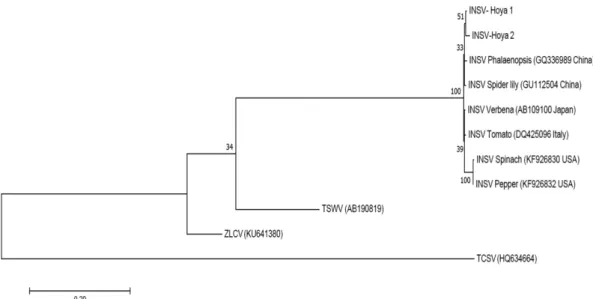
하여 제노텍(Genotech., Daejeon, Korea)에 염기서열 분석을 의뢰하였다. BLAST 검색 결과 Genbank에 등록된 INSV 분리주 들과 97-99% 염기서열 상동성을 보였다. 또한 호야 두 분리주 간 그리고 INSV-HDL 분리주(GU112504, 중국, 스파이더백합), INSV–J 분리주(AB109100, 일본, 버베나) 각각 99% 높은 상동성 을 보였다. 계통학적 유연관계를 분석하기 위하여 MEGA 7 프 로그램을 사용하였고, 외집단(outgroup)으로 Orthotospovirus 속 토마토반점위조바이러스(TSWV), 토마토퇴록반점바이러스 (TCSV), 쥬키니심한퇴록바이러스(Zucchini lethal chlorosis virus, ZLCV) 사용하였다. 염기서열 배열은 Clustal W 를 이용하였다.
중국, 일본, 미국, 유럽 등 화훼류 및 채소류에서 분리된 봉선화 괴저반점바이러스(INSV)와 유연관계를 분석한 결과, 팔레놉시 스(GQ336989) 및 스파이더 백합(GU112504)에서 분리된 중국 분리주와 높은 유연관계를 가지는 것을 확인할 수 있었다(Fig. 3).
요 약
2016년 충북 음성의 호야 농가에서 30% 미만으로 퇴록, 괴사 및 원형반점 등 바이러스 같은 증상이 관찰되었다. 바이러스 의 심 증상 및 건전주로 보이는 호야 6 시료를 채집하였고, 이들 시 료에 대한 바이러스 감염 여부를 확인하기 위하여 호야 속 식물 의 감염이 확인된 토마토반점위조바이러스(TSWV), 봉선화괴저 반점바이러스(INSV) 및 토마토퇴록반점바이러스(TCSV) 3종 특 이 진단 프라이머를 이용하여 RT-PCR 수행하였다. 그 결과 원
형, 괴사 반점 등 증상을 보인 호야 3 시료에서 봉선화괴저반점 바이러스(INSV) 양성반응을 보였고, 증상이 보이지 않는 호야 3 시료에서 음성반응을 보였다. 호야 2 시료에서 대하여 추가 적으로 봉선화괴저반점바이러스(INSV) 감염을 확인하기 위하 여 전체 핵단백질(N) 유전자 염기서열을 증폭하였고, 염기서열 을 얻었다. 호야의 봉선화괴저반점바이러스(INSV) Hy-1과 Hy-2 에서 얻어진 공통염기서열의 BLAST 분석 결과 두 분리주 간은 99% 상동성을 보였고, Genbank에 등록된 봉선화괴저반점바 이러스(INSV) 분리주들과는 97-99% 염기서열 상동성을 보였 다. 계통학적 유연관계분석 결과 호야 분리주는 중국의 화훼류 분리주들과 밀접한 유연관계를 가지는 것을 확인하였다. 본 보 고는 국내에서 처음으로 호야에서의 봉선화괴저반점바이러스 (INSV) 보고이다.
Conflicts of Interest
No potential conflict of interest relevant to this article was re- ported.
Acknowledgement
This study was carried out with the support of Cooperative Research program for Agricultural Science & Technology Devel- opment (Project No. PJ01011301) Rural Development Adminis- tration, Republic of Korea.
Fig. 3. Phylogenetic analysis by Maximum likelihood method showing the relationship of Impatiens necrotic spot virus (INSV) isolates from various hosts and countries based on an alignment of complete nucleocapsid (N) gene sequences. The percentage of trees in which the associated texa clustered together is shown next to the branches. The Tomato spotted wilt virus (TSWV), Zucchini lethal chlorosis virus (ZLCV) and Tomato chlorotic spot virus (TCSV) were used as an outgroup.
References
Brisco-McCann, E. I. and Hausbeck, M. K. 2016. Handbook of Florists’
Crops Diseases, pp. 1-28.
Cortez, I., Saaijer, J., Wongjkaew, K. S., Pereira, A. M., Goldbach, R., Preters, D. and Kormelink, R. 2001. Identification and charac- terization of a novel tospovirus species using a new RT-PCR approach. Arch Virol. 146: 265-278.
Crosslin, J. M. and Hamlin, L. L. 2010. First report of Impatiens ne- crotic spot virus infecting greenhouse-grown potatoes in Wash- ington state. Plant Dis. 94: 1507.
Daughtrey, M. L., Jones, R. K., Moyer, J. W., Daub, M. E. and Baker, J.
R. 1997. Tospoviruses strike the greenhouse industry: INSV has become a major pathogen on flower crops. Plant Dis. 81: 1220- 1230.
De Avila, A. C., Haan, P. D., Kitajima, E. W., Kormelink, R., Resende, R. D., Goldbach, R. W. and Peters, D. 1992. Characterization of a dis- tinct isolate of Tomato spotted wilt virus (TSWV) from Impatiens sp. in the Netherlands. J. Phytopathol. 134: 133-151.
Ding, M., Yin, Y., Fang, Q., Li, S. and Zhang, Z. 2011. First report of Impatiens necrotic spot virus in Gentiana macrophylla in China.
Plant Dis. 95: 357.1.
Horita, H. and Sasaki, J. 2005. Necrotic spot of lisianthus caused by Impatiens necrotic spot virus in Hokkaido. Jpn. J. Phytopathol. 71:
83. (Abstract, In Japanese)
Kuo, Y. W., Gilbertson, R. L., Turini, T., Brennan, E. B., Smith, R. F. and Koike, S. T. 2014. Characterization and epidemiology of out- breaks of Impatiens necrotic spot virus on lettuce in coastal Cali- fornia. Plant Dis. 98: 1050-1059.
Law, M. D. and Moyer, J. W. 1990. A tomato spotted wilt-like virus with a serologically distinct N protein. J. Gen. Virol. 71: 933-938.
Shin, Y.-G. 2013. List of plant quarantine viruses in Korea newly revised in 2013. Res. Plant Dis. 19: 67-75.
Roggero, P., Ciuffo, M., Dellavalle, G., Gutta, P., Gallo, S. and Peters, D. 1999. Additional ornamental species as hosts of Impatiens necrotic spot tospovirus in Italy. Plant Dis. 83: 967.
Sakurai, T., Inoue, T. and Tsuda, S. 2004. Distinct efficiencies of Impatiens necrotic spot virus transmission by five thrips vector species (Thysanoptera: Thripidae) of tospoviruses in Japan. Appl. Entomol.
Zool. (Jpn.) 39: 71-78.
Simko, I., Richardson, C. and Wintermantel, W. 2017. Variation within Lactuca spp. for resistance to Impatiens necrotic spot virus. Plant Dis. doi: 10.1094/PDIS-06-17-0790-RE. (In press)
Vicchi, V., Fini, P. and Cardoni, M. 1999. Presence of Impatiens necrotic spot tospovirus (INSV) in horticultural crops in Emilia-Romagna.
Informatore Fitopatologico 4: 53-55.
Yang, D. S., Pennisi, S. V., Son, K. C. and Kays, S. J. 2009. Screening indoor plants for volatile organic pollutant removal efficiency.
HortScience 44: 1377-1381.