우리나라 파프리카 수출단지 및 선과장의 병해충 조사
김기돈
1†ㆍ이시원
1,2†ㆍ강은하
1,3ㆍ신용길
1ㆍ전재용
1ㆍ허노열
1*ㆍ이흥식
1**
1농림수산검역검사본부 식물검역기술개발센터, 2성균관대학교 유전공학과
The pests survey of paprika export complexes and packing house in Korea
Gi-Don Kim
1†, Siwon Lee
1,2†, Eun-Ha Kang
1,3, Yong-Gil Shin
1, Jae-Yong Jeon
1, Noh-Yeol Heo
1*, Heung-Sik Lee
1**
1
Plant Quarantine Technology Center, Animal and Plant Quarantine Agency, Suwon 443-440, Korea
2
Department of Biotechnology and Bioengineering, Sungkyunkwan University, Suwon 440-746, Korea
Received on 20 February 2013, revised on 10 June 2013, accepted on 10 June 2013
Abstract : The disease and insect were surveyed locally in greenhouse, fruit packing house and store house of 51 farms in 13 towns having purpose of paprika exportation. By analysis, various disease and insect were not only founded locally but more ones detected in farms having old facilities and no natural enemy. We found 15 pathogens such as Fusarium spp., Alternaria solani, Leveilluila taurica, PepMV (Pepino mosaic virus) and TMV (Tobacco mosaic virus) in greenhouse, Fusarium spp. in fruit packing house and Penicillium spp. in store house. We found 15 insects in greenhouse such as Bemisia tabaci, rialeurodes vaporariorum and Myzus persicae in greenhouse, Hylobitelus haroldi in fruit packing house.
However, the problem quarantine disease and insect for importation and exportation were not detected in inspection time.
Key words : Paprika, Exportation, Pathogen, Quarantine, Importation
†
These authors are equally contributed to this work.
*Corresponding author: Tel: +82-31-202-6966 E-mail address: [email protected]
I. 서 론
최근, 생활수준의 향상으로 건강에 대한 관심이 증가함 에 따라 채식위주 식습관과 자연식품을 선호하여, 곡류와 채소를 중심으로 웰빙(well-being)과 관련된 신선 농산물 의 소비가 증가하고 있다(Yu et al., 2009). 신선 농산물의 대표 작물인 파프리카는 가지과( Solanacae ), 고추속( Capsicum ), 고추종( Annuum )에 속하는 한해살이 식물로 6개의 아종이 있으며(Hwang and Jang, 2001), 4가지 품종(annuum, grossum, lycopersiciforme 및 glabriusculum)이 있다 (GRIN national genetic resources program; http://
www.ars-grin.gov). 파프리카는 capsanthin, β-cryptoxanthin 및 zeaxanthin 등 카로티노이드계 색소를 함유하고 있으
며, 비타민 A, B1 및 C가 풍푸한 알칼리성 강장식품으로 샐러드, 향신료, 두부, 국수 등 많은 음식에서 이용하고 있 고(Fisher and Kocis, 1987; Yu et al ., 2006; Jung et al., 2007; Oh et al., 2007; Park et al., 2007; Cho et al., 2008;
Park and Jeon, 2008)은 암예방 효소로 알려진 quinone reductase 활성 유도에 효능이 있는 것으로 보고하였다.
국내에서는 1994년 제주도에서 처음 재배하기 시작하여 (Jung et al., 2007), 1995년 전북 김제의 참샘영농조합법 인이 생산 전량을 일본에 수출하면서 본격적으로 재배가 시작되었고, 2000년에는 생산량이 7,500 톤에 이르렀다.
그 후 지속적으로 재배면적이 증가하여, 2009년 전국적으
로 410 ha의 재배면적에서 36,023 톤을 생산하였다. 2009
년 파프리카의 지역별 재배 면적은 강원도(30.0%), 경남
(27.8%), 전남(15.9%) 순으로 3개 지역이 전국 파프리카
재배면적의 73.7%를 차지하고 있으며, 생산량은 경남
(32.8%), 강원(21.9%), 전남(20.2%) 순으로 3개 지역이 전
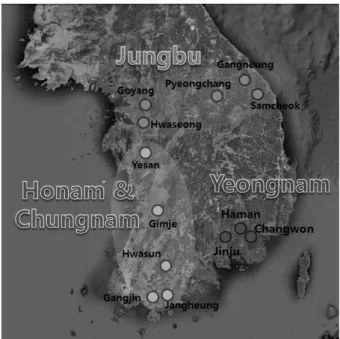
Fig. 1. The survey area of paprika pests in Korea.
프리카는 국제시장에서도 네덜란드, 뉴질랜드 및 중국 등 과의 경쟁이 치열하게 전개되고 있는 가운데, 일본으로 수 출을 시작한지 10여 년 만에 네덜란드를 제치고 시장 점유 율 66%를 차지하였다. 또한 국내소비량이 40% 이상 증가 되고 있고, 일본 이외에 미국, 러시아 및 대만 등 수출시장 의 확대를 모색하고 있는 만큼, 파프리카는 우리나라 주요 수출 작물로서 농업에 큰 역할을 하고 있다(Jung et al., 2009).
이러한 파프리카의 생장, 재배조건, 저장, 품종, 화학성 분, 농약을 비롯하여 파프리카를 이용한 음식에 이르기까 지 국내외의 다양한 연구들은 파프리카의 품질향상과 이용 에 많은 기여를 하였다(Jung et al., 2006; Cho et al., 2008; Park and Jeon, 2008; Jung et al., 2009; Choi et al., 2011). 그 뿐만 아니라, 생물학적 위해요소에 대한 연구에서 대장균군(Coliform group), 황색포도상구균( Staphylococcus aureus ), 기생충, Salmonella spp. 및 Escherichia coli O157 등 미생물 오염실태를 모니터링하여 수출농산물의 생물학적 안전성을 확인하였다(Yu, et al., 2009; Yu, et al., 2011).
파프리카는 크게 생리적인 장해와 병해충으로 병이 발생 하는데, 생리적 장해는 주로 칼슘과 붕소 흡수가 저해되어 과실의 끝과 옆부분이 검게 썪는 배꼽썩음병이 많이 발생 하며, 그 외에 석과(石果), 변형과, 착색과 및 일소과(日梳 果) 현상이 나타난다(Bosland, 1999). 국내외 파프리카 병 해충에 대한 연구는 고추에 발생하는 병해충에 대한 연구 (Park et al., 1998; Lee et al., 1999; Lim and Kim, 2003;
Kang et al., 2005; Jung et al., 2008)에 비해 아직 많이 부족한 실정이다.
국내 파프리카 병해충에 관한 연구로는 진딧물, 총채벌 레, 담배나방 및 응애류 등의 해충과 흰가루병, 잿빛곰팡이 병, Sclerotinia scleotiorum (Jeon et al., 2006), Fusarium oxyporum (Cha et al., 2007) 및 Botrytis cinerea (Yoon et al., 2008) 등 진균병에 대한 보고가 있었으나, 전국적인 모니터링 연구와 파프리카 재배온실, 선과장 및 저장고를 대상으로 한 병해충 조사는 아직까지 이루어지지 않았다.
따라서 본 연구에서는 2010-2011년까지 수출을 목적으 로 파프리카를 생산하는 전국 13개 도시, 50개 농가의 재배 온실, 선과장 및 저장고를 대상으로 각각의 지역에서 나타 나는 병해충을 조사하여 모니터링 하였다.
II. 재료 및 방법
1. 시료채취
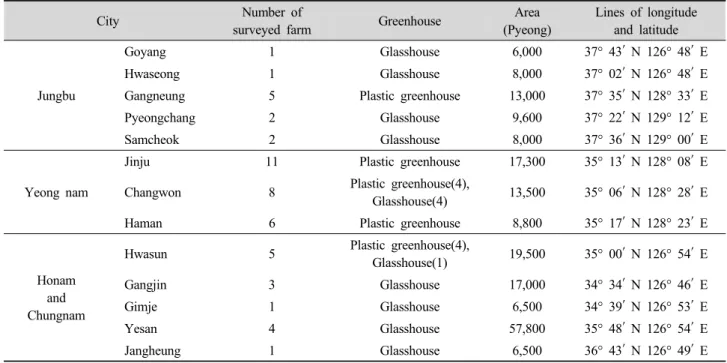
본 연구에서는 파프리카를 해외로 수출하는 농가를 대상 으로 병해충 조사를 수행하였다. 조사를 실시한 지역은 중 부(고양, 화성, 평창, 강릉 및 삼척), 영남(진주, 창원 및 함안) 및 호남과 충청(화순, 강진, 장흥, 김제 및 예산)으로 크게 3개로 분류하여 13개 도시, 총 50농가(Fig. 1, Table 1)에 대하여 2010년 4월부터 2011년 12월까지 방문 조사 하였 다. 각각의 지역별로 고양 1농가(10회), 화성 1농가(11회), 평창 5농가(합계 방문 42회), 강릉 2농가(합계 방문 10회), 삼척 2농가(합계 방문 14회), 진주 11농가(합계방문 74회), 창원 8농가(합계 방문 48회), 함안 6농가(합계 방문 41회), 화순 5농가(합계 방문 36회), 강진 3농가(합계 방문 23회), 장흥 1농가(9회), 김제 4농가(합계 방문 24회) 및 예산 1농 가(12회)를 방문하여 시료를 채취하였다. 파프리카 농가의 재배지, 선과장 및 저장고에서 세균, 곰팡이, 바이러스 병 이 의심되는 잎, 줄기와 과실 시료를 채취하여 멸균 봉투에 넣고 아이스박스에 담아 실험실로 이동하여 검사하였다.
해충시료는 채집 후 70% 에탄올이 담긴 바이알에 담아 실
험실로 옮겼다.
Table 1. The survey area information of paprika pests.
City Number of
surveyed farm Greenhouse Area
(Pyeong)
Lines of longitude and latitude
Jungbu
Goyang 1 Glasshouse 6,000 37° 43′ N 126° 48′ E
Hwaseong 1 Glasshouse 8,000 37° 02′ N 126° 48′ E
Gangneung 5 Plastic greenhouse 13,000 37° 35′ N 128° 33′ E
Pyeongchang 2 Glasshouse 9,600 37° 22′ N 129° 12′ E
Samcheok 2 Glasshouse 8,000 37° 36′ N 129° 00′ E
Yeong nam
Jinju 11 Plastic greenhouse 17,300 35° 13′ N 128° 08′ E
Changwon 8 Plastic greenhouse(4),
Glasshouse(4) 13,500 35° 06′ N 128° 28′ E
Haman 6 Plastic greenhouse 8,800 35° 17′ N 128° 23′ E
Honam and Chungnam
Hwasun 5 Plastic greenhouse(4),
Glasshouse(1) 19,500 35° 00′ N 126° 54′ E
Gangjin 3 Glasshouse 17,000 34° 34′ N 126° 46′ E
Gimje 1 Glasshouse 6,500 34° 39′ N 126° 53′ E
Yesan 4 Glasshouse 57,800 35° 48′ N 126° 54′ E
Jangheung 1 Glasshouse 6,500 36° 43′ N 126° 49′ E
2. 세균과 바이러스 검사
파프리카 시료에서 세균 감염 의심 시료는 Xantomonas campestris pv. vesicatoria , Clavibacter michiganensis subsp. michiganensis , Erwinia carotovora subsp.
carotovora 및 Ralstonia solanacearum 에 대하여 검사하 였다. 바이러스 의심 시료는 Pepper mottle virus (PepMoV), Pepper veinal mottle virus (PVMoV), Tobacco mosaic virus (TMV), Pepper mild mottle virus (PMMoV), Cucumber mosaic virus (CMV), Alfalfa mosaic virus (AMV), Potato virus X (PVX), Potato virus Y (PVY), Tomato spotted wilt virus (TSWV), Broad bean wilt virus (BBWV) 및 Tomato mosaic virus (ToMV)에 대하여 검사하였다. 세균 과 바이러스는 모두 Adgen(UK)과 Agdia(USA)사의 Das- ELISA (enzyme-linked immunosorbent assay) 방법으 로 검사하였으며, 제품의 매뉴얼에 따라서 수행하였다.
3. 곰팡이 동정
곰팡이병 의심 시료에 대한 검사는 잿빛곰팡이병( Botrytis cinerea ), 잘록병( Phythium spp.), 흰가루병( Leveilluia taurica ), 썩음병( Fusarium spp.), 반점병( Cladosporium
capsici ), 탄저병( Colletorichum loeosporioides ), 과실썩 음병( Nectria haematococca ), 누룩곰팡이병( Aspergillus spp.), 저장병( Penicillium spp.), 흰얼룩병( Acremonium spp.) 및 잎마름병( Nigrospora spp.) 등을 중심으로 검사 하였다. 곰팡이 의심 시료의 병변부위를 잘라 70% 에탄올 에 소독 후 멸균 증류수에 씻어내어 물기를 닦아내고 potato dextrose agar (BD, USA)배지에 올려 4일간 배양 하였다. PDA배지는 리터 당 potato starch 4 g, dextrose 20 g 및 agar 15 g으로 제작하였다. 각각의 곰팡이를 순수 배양하여 현미경으로 포자를 관찰하여 형태 동정하였다.
4. 해충 동정
채집한 해충시료들은 바이알에서 꺼내, 해부현미경 S8APO (Leica, German) 하에서 형태 동정하였다.
III. 결과 및 고찰
1. 파프리카 병해충 모니터링
세균병 의심 시료에 대한 검사결과, Xantomonas campestris
pv. vesicatoria (4회), Clavibacter michiganensis subsp.
(A), Detection number of bacteria, fungi and virus. B1, Clavibacter michiganensis subsp. michiganensis; B2, Erwinia carotovora subsp. carotovora; B3, Ralstonia solanacearum; B4, Xantomonas campestris pv. Vesicatoria; F1, Acremonium spp.; F2, Alternaria solani; F3, Aspergillus spp.; F4, Botrytis cinerea; F5, Clado- sporium spp.; F6, Colletorichum loeosporioides; F7, Fusarium spp.; F8, Leveilluia taurica; F9, Nectria haematococca; F10, Nigrospora spp. F11, Phytophthora capsici; V1, Cucumber mosaic virus; V2, Pepper mottle virus; V3, Pepper veinal mottle virus; V4, Tobacco mosaic virus; V5, Tomato mosaic virus; V6, Tomato spotted wilt virus.
(B), Detection number of insects. A01, Aphis gossypii; A02, Baculum elongatum; A03, Bemisia tabaci; A04, Frankliniella intonsa; A05, Frankliniella occidentalis; A06, Helicoverpa assulta; A07, Hylobitelus haroldi; A08, Liriomyza trifolii; A09, Magoura crassicauda; A10, Myzus persicae; A11, Polypago- tarsonemus latus; A12, Spodoptera litura; A13, Tetranychus urticae; A14, Thrips palmi rarny; A15, Trialeurodes vaporariorum.
Fig. 2. Pests monitoring occurred in paprika export complexes and packing house.
(4회) 및 Ralstonia solanacearum (5회)이 검출되었다 (Fig. 2A). 파프리카 곰팡이병 의심 시료에 대한 검사결과, Fusarium spp.가 26회로 가장 많았으며, Alternaria solani 25회, Leveillula taurica 10회, Botrytis cinerea 7회, Cladosporium spp. 2회, Colletorichum loeosporioides 2회, Phytophthora capsici 2회 검출되었고, Acremonium spp., Aspergillus spp., Nectria haematococca , Nigrospora spp.가 각각 1회씩 검출되었다(Fig. 2A). 바이러스병 의심 시료에 대한 검사결과, PepMoV와 TMV가 각각 8회와 7회 로 가장 많았으며, PVMoV 2회, CMV 1회, ToMV 1회 및 TSWV 1회 검출되었다(Fig. 2A). 파프리카 수출단지에서 채집된 해충으로는 가루이 37회(담배가루이 20회, 온실가 루이 17회), 점박이응애 17회, 복숭아혹진딧물 14회, 목화 진딧물 10회, 꽃노랑총채벌레 10회, 오이총채벌레 7회, 대 만총채벌레 7회, 차먼지응애 3회, 담배거세미나방 3회, 담 배나방 2회, 아메리카잎굴파리 2회, 긴꼬리볼록진딧물 1 회, 솔곰보바구미 1회 및 대벌레 1회가 동정되었다(Fig.
2B).
2. 지역별 모니터링
병해충 46종(세균 4종, 곰팡이 13종, 바이러스 11종 및 해충 18종)을 대상으로 지역별 모니터링을 한 결과, 호남・
충청지역에서 127건(방문 당 1.2건)으로 가장 많은 병해충 검출 수를 기록하였고, 영남에서 73건(방문 당 0.4건), 중 부에서 29건(방문 당 0.3건)이 검출되었다. 방문 당 검출 건수를 세부 지역별로 살펴보면, 예산에서 2건(13종, 총 24 건)으로 가장 많이 검출되었으며, 강진 1.3건(11종, 총 29 건), 김제 1.2건(18종, 총 29건), 화순 1.0건(18종, 총 36 건), 장흥 1.0건(6종, 총 9건), 고양 0.7건(7종, 총 7건), 진주 0.6건(19종, 총 45건), 함안 0.6건(13종, 총 23건), 화성 0.4건(4종, 총 4건), 평창 0.3건(11종, 총 13건), 강릉 0.3건(3종, 총 3건), 삼척 0.1건(2종, 총 2건) 및 창원 0.1건 (4종, 총 5건) 순으로 나타났다(Table 2, 3).
방문 당 병(세균, 곰팡이 및 바이러스) 검출 건수는 예산
이 1건으로 가장 많았고, 고양 0.6건, 화순, 강진 및 김제에
서 0.5건 순으로 나타났으며, 창원에서는 병이 검출되지
않았다. 방문 당 해충의 검출 건수는 예산이 1건으로 가장
Table 2. The pests information of paprika at survey region.
Disease and insect of Solanaceae Goyang Hwaseong Pyeongchang Gangneung Samcheok Jinju Changwon Haman Hwasun Gangjin Gimje Yesan Jangheung Total
Bacteria
Clavibacter michiganensis
subsp. michiganensis 1 - - - - 1 - - - - - 1 - 3
Erwinia carotovora
subsp. carotovora - - - - - - - - - 1 1 2 - 4
Ralstonia solanacearum - - - - - - - - - 2 - 3 - 5
Xantomonas campestris
pv. Vesicatoria - - 1 1 - - - 1 1 - - - - 4
Fungi
Acremonium spp. - - - - - - - - 1 - - - - 1
Alternaria solani 1 1 3 1 3 1 4 3 5 2 1 - 25
Aspergillus spp. - - - - - - - 1 - - - - - 1
Botrytis cinerea - - 1 1 - 1 - 2 1 - 1 - - 7
Cladosporium spp. - - 1 - - 1 - - - - - - - 2
Colletorichum loeosporioides - 1 1 - - - - - - - - - - 2
Fusarium spp. 1 - 1 - - 5 1 3 5 3 3 2 2 26
Leveilluia taurica 1 - - - - 1 - 1 2 - 3 2 - 10
Nectria haematococca - - - - - - - - - 1 - - - 1
Nigrospora spp. - - - - - - - - - - - 1 - 1
Phytophthora capsici - - - - - 1 - - 1 - - - - 2
Virus
Cucumber mosaic virus - - - - - - - - 1 - - - - 1
Pepper mottle virus - - - 1 - 2 - 1 3 - 1 - - 8
Pepper veinal mottle virus 1 - - - - - - - - - - - 1 2
Tobacco mosaic virus 1 - - - - 4 - 1 1 - - - - 7
Tomato mosaic virus - - - - - - - - - - 1 - - 1
Tomato spotted wilt virus - - - - - - - - - - 1 - - 1
Animal pest
Aphis gossypii - - 1 - - 1 - 1 1 4 2 - - 10
Baculum elongatum - - 1 - - - - - - - - - - 1
Bemisia tabaci - - - - - 5 - 4 2 2 3 3 1 20
Frankliniella intonsa - 1 - - - 2 1 - 3 - - - - 7
Frankliniella occidentalis - - - - - 1 2 - 3 2 1 1 - 10
Helicoverpa assulta - - 1 - - - - - - - - 1 - 2
Hylobitelus haroldi - - - - - - - - - - 1 - - 1
Liriomyza trifolii - - - - - 1 - 1 - - - - - 2
Magoura crassicauda - - - - - - - - - - 1 - - 1
Myzus persicae - - 1 - - 3 - - 1 3 2 2 2 14
Polypagotarsonemus latus - - - - - 2 - - - - 1 - - 3
Spodoptera litura - 1 - - - 1 - - - - 1 - - 3
Tetranychus urticae - - - - - 3 - - 4 4 3 3 - 17
Thrips palmi rarny - - - - - 3 - 1 1 - - - 2 7
Trialeurodes vaporariorum 1 - 1 - 1 4 - 2 2 2 1 2 1 17
Total Jungbu Yeongnam Honam and Chungnam
29 73 127 229
Table 3. The pests detection number for survey of paprika farm.
Detection class Goyang Hwaseong Pyeongchang Gangneung Samcheok Jinju Changwon Haman Hwasun Gangjin Gimje Yesan Jangheung
Disease
(bacteria, fungi, virus) 0.6 0.2 0.2 0.3 0.1 0.3 - 0.3 0.5 0.5 0.5 1.0 0.3
Animal pest 0.1 0.2 0.1 - 0.1 0.4 0.1 0.2 0.5 0.7 0.7 1.0 0.7
Disease and animal pest 0.7 0.4 0.3 0.3 0.1 0.6 0.1 0.6 1.0 1.3 1.2 2.0 1.0
Jungbu Yeongnam Honam and Chungnam
많았고, 강진, 김제 및 장흥 0.7건, 화순 0.5건, 진주 0.4건 순으로 나타났으며, 강릉에서는 해충이 검출되지 않았다 (Table 3).
본 연구에서 조사한 파프리카 수출단지의 온실은 총 50 개 중 20개가 유리온실이었다(Table 1). 우리나라 원예시 설 중 유리온실이 0.6%정도인 다른 원예온실(Jeon et al., 2011)에 비해 파프리카 수출단지의 온실은 재배조건이 좋 은 편이라고 할 수 있으나, 병에 대한 피해는 낙후된 시설에 서 많이 나타났다. 총 73건의 병해충 검출을 보인 영남지역 의 경우 플라스틱 하우스 재배를 하는 함안과 노지재배를 하는 진주의 농가에서 많은 병해충 피해를 볼 수 있었다.
몇몇 농가에서 유리온실을 운영하고 있는 창원은 상대적으 로 적은 병해충이 검출되었다. 파프리카 병 피해의 또 다른 이유는 해충의 천적 사용이다. 미끌애꽃노린재를 이용하여 꽃노랑총채벌레를 억제할 수 있고, 지중해이리응애를 이용 하여 담배가루이를, 칠리이리응애를 이용하여 차응애를, 콜레마니진디벌을 이용하여 진딧물을 억제할 수 있다는 것 이 잘 알려져 있는데(Choi et al., 2009; Kim et al., 2010), 이러한 천적을 잘 사용하고 있는 중부지역의 경우 해충 피해가 적게 나타났다(Table 2). 이 뿐만 아니라, 농가 규모에 따른 인력과 관리 등의 문제 또한 병해충 발생과 밀접한 연관이 있을 것이라고 예상된다.
3. 재배지, 선과장 및 저장고의 병해충
총 36종(병 21종, 해충 15종)의 검출된 병해충 중 재배 온실에서 34종(병 21종, 해충 13종)으로 가장 많은 병해충 이 검출되었고, 선과장과 저장고에서는 Fusarium spp.와 Erwinia carotovora subsp. carotovora 가 검출되었다.
또한, 선과장에서 특이적으로 솔곰보바구미를 발견하였고, 재배온실과 주변에서 대벌레를 발견하였다. 외교통상부 자 유무역협정으로 인해 농산물의 해외 수출입이 증가함에 따 라 검역량이 증가되고, 나라에 대한 상품성이 평가되는 가 운데, 이에 따라 국내 파프리카의 해외 수출시장에서의 상 품성을 위한 농민들의 세심한 노력도 필요 할 것이다. 또한 재배온실, 선과장 및 저장고의 낙후된 시설 개선과 보수가 필요하며, 적절한 농약과 천적의 사용으로 알맞은 방제를 해야 할 것이다.
IV. 결 론
수출을 목적으로 파프리카를 생산하는 전국 13개 도시, 50개 농가의 재배온실, 선과장 및 저장고를 대상으로 각각 의 지역에서 나타나는 병해충을 조사하였다. 그 결과 지역 적으로 다양한 병해충이 검출되었으며, 시설이 낙후되고 천적을 사용하지 않은 농가에서는 더 많은 병해충이 검출 되었다. 파프리카 재배온실에서 발견된 병원체는 총 21종 이며, 주요 병원체는 열매썩음병( Fusarium spp.), 겹무늬 병( Alternaria solani ), 흰가루병( Leveilluila taurica ), PepMV 및 TMV였으며, 선과장에서도 열매썩음병( Fusarium spp.)이 발견되었다. 재배온실에서 발견된 해충은 총 15종 이고, 담배가루이( Bemisia tabaci ), 온실가루이( Trialeurodes vaporariorum ) 및 복숭아혹진딧물( Myzus persicae )이 주요 해충으로 조사되었으며, 선과장에서 솔곰보바구미 ( Hylobitelus haroldi )가 발견되었다.
감사의 글
본 연구는 2009-2011년도 농림축산검역본부 R&D 사업 지원에 의해 수행되었다.
참 고 문 헌