Vol. 29, No. 1, pp. 58-70, February, 2013 http://dx.doi.org/10.7747/JFS.2013.29.1.58
Collective Forest Management System in Japan:
a Case Study in Osawa Property Ward Forest
Mangala Premakumara De Zoysa1,*, Makoto Inoue2, Utako Yamashita3 and Okuda Hironori4
1Faculty of Agriculture, University of Ruhuna, Mapalana, Kamburupitiya 8001, Sri Lanka
2Departments of Global Agricultural Sciences, The University of Tokyo, Tokyo, Japan
3JSPS Research Fellow (PD) / Faculty of Agriculture, Tokyo University of Agriculture and Technology, Tokyo, Japan
4Kansai Research Center, Forestry and Forest Products Research Institute, Kyoto, Japan
Abstract
Iriai an Indigenous forest management system in Japan from the viewpoint of “common pool resources” was a success resilient institution and resulted with sustainable production system and environmental conservation. This study was conducted in Osawa of the Nagano prefecture through group discussions, field observations and an in-depth field survey.
Osawa Property Ward Forest is managed under the concept very much similarly to traditional “Iriai”. This study firstly examined the changes of collective forest management system in terms of awareness and interest in forest management;
forest management activities; role of forest; and collection of forest products. Then it analyzed the current threats for collective forest management have been identified as: land abandonment due to loss of benefits and lack of active community participation; deterioration of forest environment particularly the micro-climate and aesthetic values; conflict with local government authorities restraining the use of money in property ward forest and conflict with outsiders on damping of the garbage. Community cantered forestry management rules; livelihood contribution; protection of environment; local initiatives for protection and economic activities are the prevailing opportunities for collective forest management. The main requirements for revitalization of collective forest management are explained as local reciprocity;
imposition of community based forest rules; encouraging local innovations; and building partnerships with stakeholders.
Collective forest management system addresses the limitations of conventional forestry models, which had invalidated traditional ‘iriai’ institutions, and key to restoring sustainable use of forest and environmental resources. Cross-institutional collaborations together with responsibilities of local communities would ensure the revitalization of forest resources..
Key Words: collective forest management, threats, opportunities, revitalization
Received: October 5, 2012. Revised: January 16, 2013. Accepted: January 28, 2013.
Corresponding author: Mangala Premakumara De Zoysa
Faculty of Agriculture, University of Ruhuna, Mapalana, Kamburupitiya 8001, Sri Lanka Tel: 94-776051540, Fax: 94-4192384, E-mail: [email protected]
Introduction
The property of commons was evolved in many parts in Japan during the medieval period (1185-1600). The Iriai system prevailed during the Tokugawa period (1600-1867) without change because of its importance for the local communities. The Iriai system was subjected to little changes during the Meiji period (1867-1912) (McKean
1991). The strict management rules including dates and time, and places and amounts of specific resources allowed to be extracted from Iriai forests were implemented to pre- vent overexploitations. Even use of tools in Iriai forests was strictly regulated (Kijima et al. 2000). The local village communities had depended on a variety of essential non- timber forest products for many centuries. The most im- portant products were: water supply for rice fields and
household use; fuelwood and charcoal for domestic cooking and heating; and leaf litter for fertilizer and grass for live- stock (Marten 2008). The important decisions concerning the management of Iriai forests require the unanimous con- sent of all its members. The households not individuals constitute the Iriai group required the unanimous consent to take decision to use the Iriai forests for some specific pur- pose (Goto 2007).
“Iriaiken tenure” the community access to forest re- sources became “joint-owned property” controlled after the Meiji government taken over the control of forest from lo- cal overloads (Curtis 2007). After the World War II, not a few scholars of law spoke about Iriai, asserting that the ob- scure, ambiguous, and outdated arrangement for common ownership should by all means be abolished and replaced by a modern legal relationship based on private ownership (Goto 2007). Under the market economy after the World War II, the demand for main products of Iriai forests such as grasses and fuel wood drastically declined with the avail- ability of substitutes and change of consumer preferences.
Therefore, in the felled forest, the conifers such as cedars came to be performed planting of Iriai forests. The Iriai Forestland Modernization Law was established in 1966 with view of creating modernize forestry and mountain vil- lages (Goto 2007). By this law, a possession form of 574 thousand ha became in modern possession form among Iriai forest of 2,000 thousand ha in 2007. As for the break- down, 308 thousand ha is owned by an association, and 31 thousand ha is co-ownership, and 235 thousand ha is owned by an individual. The other Iriai forest is to stay in a state as is (Forest Agency 2009). Some Iriai forests changed to property of “Authorized Neighborhood Association (ANAs)” a formal local institution with corporate status, by the village community under the “Local Autonomy Law”
revised in 1991. A new law enacted the Modernization Policy in 1966 attempts to modernize Iriai rights in order to adopt joint forest operations.
Recently, the forest where appropriate management is not accomplished increases with the decline of timber price in Japan. So, Iriai was not perceived as scarce in a strictly economic sense but considered as an aspect of the limited environment, necessary for the community’s survival and necessary for different groups in different ways (Illich 1982). Local forms of community organizations and in-
tensive sustainable management systems under traditional forestry practices done by local people in the country are somewhat similar to what have been documented in many Asia countries. The ideas behind the community forestry were to involve people in forestry activities with the under- stand that the rural people were part of the problem, then meeting some of their needs for forest products and involv- ing them in forest management activities were part of the solution (FAO 1978). Iriai system of forest management experiencing in Japan which is an institutional settings of commons in the western sense has become a vital research interest at this age of global and local environmental crises (Murota 2003). Japan has almost 66.4% forest covering 25.10 million hectares of which 10.34 million hectares is plantation and (Curtis 2007). And it is estimated that about 1.5 million hectares of forests are managed in common at local level (Yamashita 2009). But, recently, the planted for- est where appropriate management is not accomplished in- creases with the decline of timber price in Japan. There is an urgent necessity to reconsider the collective forest man- agement system, and emphasized the need to understand the challenges and possibilities for the promotion of collec- tive forest management system. Hence, study of the collec- tive forest management systems as a sustainable indigenous forest management system has become practical importance to promote the community participation in sustainable for- est management system.
The objectives of this study were to examine the com- munity based forest management system in Osawa Property Ward in Saku City in Nagano Prefecture; to ana- lyze the current threat and prevailing opportunities in forest management; to ascertain the potential for revitalization of forest management; and to make suggestions in order to promote sustainable property ward forest management sys- tem in the property ward.
Materials and Methods
The study was conducted in Osawa Property Ward be- long to Saku city in Nagano prefecture (Fig. 1). Osawa is one of the oldest villages in Nagano Prefecture. It could be observed that the Nagano prefecture is one of the very pop- ular areas where the community based forest management is still practicing in Japan. Osawa Property Ward has 273 ha
Fig. 1. Rank of forest management activities.
forest area which are presently managed under the concept very much similarly to traditional “Iriai”. Osawa Property Ward forest had used to bemanaged under Iriai system in Tokugawa period. After the Meiji Restoration when Osawa village established, it had changed to Osawa village’s forest.
But in consolidations of municipalities in 1954, Osawa vil- lage’s forest had changed its status into Osawa Property Ward forest. Property ward system has following origin.
There were two major consolidations of municipalities in the 1880s and 1950s in Japan. These enabled local govern- ment to appropriate forests previously owned by villages and towns, most of which were Iriai forests. But many vil- lages and towns rejected the merger because they did not want to part with their Iriai forests. This compelled the gov- ernment to allow villages and towns to maintain their forest rights by establishing a property ward (Zaisanku) (Yamashita et al. 2009). Property ward is classified as one of local gov- ernments in Local Autonomy Law, so now Osawa Property Ward forest is not Iriai forest in proper sense. But even after changing into Property Ward institutionaly, forest manage- ment system had not changed much as that of Iriai forest.
The study was initiated through a search methodology reviewing the available literature written on community based forest management with special reference to the col- lective forest management systems in Japan. The literature provided important insights to prepare the first draft of the questionnaire for the filed survey. The questionnaire was revised and restructured based on feedback received from Manager and forest officer and other officers of Osawa Property Ward Council during the exploratory study. The group discussion held with President of the Forest Manage-
ment Committee and several households in Osawa Proper- ty Ward facilitated to collect more information and pre-test the questionnaire with the aim of collecting data and in- formation on broad aspects as well as in in-depth di- mensions concerning the “Iriai”.
The study was based on the field survey conducted in Osawa Property Ward interviewing 28 households with the help of the Manager, Property Ward Council Office and President of the Forest Management Committee, using the pre-tested questionnaire. This study which was based on sustainability of indigenous forest management system, at- tempted to examine changes taken place in collective forest management system during the three major important peri- ods of forest sector in Japan: 1. Before the World War II common forests in villages played an important role in pro- ducing basic domestic needs; 2. After the War until 1970’s before dropping the market price of timber; and 3. After 1970’s followed by low demand and market price of timber as well as rapid change of the economy. Although the Osawa Property Ward Council Office could find lists of 574 households, more than 30% were not permanently re- siding in the ward. The President of the Forest Management Committee and the Forest Officer of the Osawa Property Ward could identify less than 200 households in the lists who were involving in forest activities. Therefore, 50 households from the list were randomly selected for the field survey. Due to the prevailed weather conditions, per- sonal reasons of the selected households and time limi- tation, only 28 households could be interviewed. Further, the researchers visited the property ward forest for the field observation and understand the ground reality of the col- lected information through interviews.
The collected data were analyzed descriptively and also using the statistical tools. Under the statistical tools simple descriptive statistics as well as non-parametric statistics were utilized to analyze the quantitative and qualitative data. Correlations of the factors particularly given in Likert Scales were analyzed through the Spearman’s rho non-para- metric statistical test. Spearman’s rho is a measure of the lin- ear relationships between two variables.
, are converted to ranks , and ρ is computed from these:
Table 1. Correlations of overall conditions of forest management
Before war After war-before 1970s After 1970s
Correlation
coefficient* (ρ) Probability Correlation
coefficient* (ρ) Probability Correlation
coefficient* (ρ) Probability Group participation
Decision making Product collection Benefit sharing Rules imposition
1.000 1.000 0.330 1.000 1.000
0.000**
0.000**
0.062
0.000**
0.000**
0.851 0.046 0.061 0.511 0.829
0.000**
0.861 0.816 0.036**
0.000**
0.597 0.347 0.275 0.183 0.945
0.001**
0.071 0.156 0.351 0.000**
*Spearman’s rho; **Correlation is significant at the 0.05 level.
Results and Discussion
Community based forest management system Forest management activities
Among the member of community in the property ward, only 25% were living before the World War II (period-1).
During the period of after the War until 1970’s and before rapid economic development (period-2), about 61% of the respondents were living in the property wards. The period after 1970’s followed by the rapid economic development of the country (period-3) all the respondents are living in the property ward.
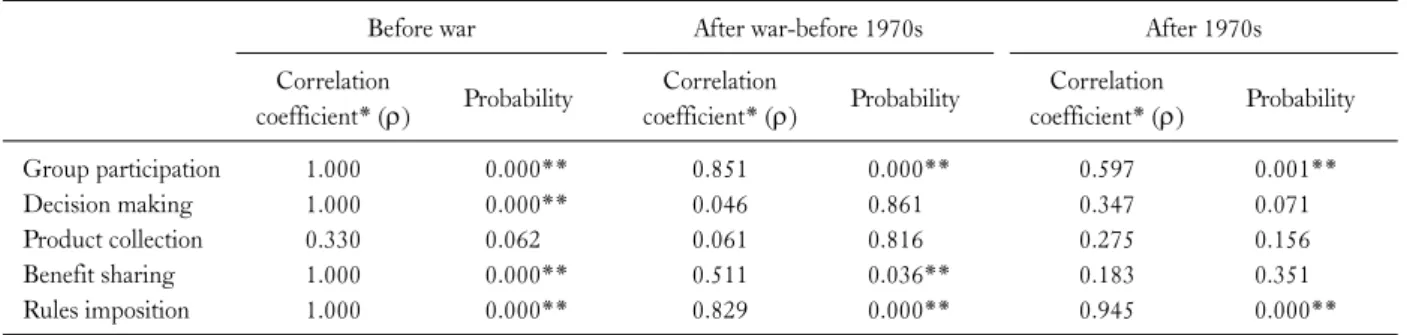
Tenure security, clear ownership, congruence between biophysical and socioeconomic boundaries of the resources, effective enforcement of rules and regulations, monitoring, sanctioning, strong leadership with capable local organ- ization, expectation of benefits, common interests among community members, and local authority have significant influence on the sustainability of common forest resource management (Pagdee et al. 2006). The mean values of the ranks given by the members of community for each forest management activities during the main three periods are given in the Fig. 1. It is noteworthy that the overall con- dition of forest management has been deteriorated from be- fore the World War II; after the War and before 1970s; to after 1970s periods. Similarly all the related activities of for- est management: group participation; decision making;
product collection; benefit sharing; and rules imposition
have been qualitatively reduced. However the condition of any of the forest management activities has not yet been de- graded to a bad condition (mean of the rank less than 2).
The overall forest management activities before the War had been not only very highly significant but very highly in- fluenced by the group participation, decision making, bene- fit sharing and rules imposition (ρ=1) (Table 1). However, collection of forest products had not influenced the man- agement significantly (ρ=0.730 and p=0.062). During the period after the War and before reducing the market price of timber in 1970s the community could maintain the forest management in good with significantly very high in- fluence of group participation (ρ=0.851); and rules im- position (ρ=0.829). Although the rules imposition also had some influence (ρ=0.511) significantly, decision mak- ing (ρ=0.046 and p=0.861) and forest products collection (ρ=0.061 and p=0.816) have not influenced the manage- ment. The reduction of quality of forest management after 1970s, according the community is being significantly in- fluenced greatly by rule imposition (ρ=0.829) and moder- ately by group participation (ρ=597). Decision making, product collection and, benefit sharing has no significant influence for the community members to rank the forest management as indifferent in quality.
Role of forest in the property ward
Forest resources in Japan were managed on the basis that the diverse functions of forests taking into consideration the needs of the public and natural, social and economic con- ditions (Forestry Agency Ministry of Agriculture, Forestry and Fisheries Government of Japan 1998). The members of the community have ranked the role of forest in their
Fig. 2. Rank of role of forest in the property ward.
Table 2. Correlations of overall and specific role of forest
Functions
Before war After war-before 1970s After 1970
Correlation
coefficient* (ρ) Probability Correlation
coefficient* (ρ) Probability Correlation
coefficient* (ρ) Probability Protect micro-climate
Regulate water supply Aesthetic value Place for recreations Waste dumping Mushroom Fuel wood Charcoal
Leaf liter for fertilizer Grass for livestock Thatch grass Construction timber Agric. timber
Industrial raw materials Academic purposes
-0.242 1.000 0.091 0.354 -0.471 1.000 1.000 0.322 0.354 0.354 0.354 -0.322 -0.322 0.354 0.354
0.602 0.014**
0.846 0.437 0.286 0.014**
0.014**
0.481 0.437 0.437 0.437 0.481 0.481 0.437 0.437
0.663 0.575 0.318 0.033 -0.474 -0.228 -0.011 -0.216 -0.341 -0.193 -0.404 0.440 -0.325 -0.274 -0.378
0.003**
0.013**
0.199 0.896 0.047 0.362 0.964 0.388 0.165 0.444 0.097 0.133 0.188 0.271 0.122
0.425 -0.172 0.384 0.245 0.180 0.093 -0.269 0.337 0.467 -0.467 -0.467 0.440 0.200 -0.394 0.333
0.294 0.556 0.195 0.398 0.537 0.774 0.352 0.239 0.147 0.147 0.147 0.133 0.513 0.163 0.244
*Spearman’s rho; **Correlation is significant at the 0.05 level.
property ward in lowering order from “very strong” before the War, “strong” after the War until 1970s and to “some what” after 1970s (Fig. 2). Protection of micro climate, reg- ular water supply, have been almost similarly as “strong”
and “very strong” respectively during these three periods.
The role of the forest creating aesthetic value has been re- duced from mainly due to the change of natural forest structure with forest plantations. The forest as a place for recreation has been increased after the War. The members have recognized the importance of forest for recreational purposes particularly for their young generation. Although
they did not consider the forest as a waste dumping place before the War and even before 1970s at all, after 1970s for- est has become a place for waste dumping. Before the War forest played a “very strong” role in supplying Mushroom and fuel-wood had been reduced after the War. Role of mushroom has further reduced while fuel-wood has lost its role of forest after 1970s. Although Charcoal played a somewhat strong role before the War and before 1970s in their property ward, but lost the role after 1970s. Leaf liter, grass for livestock and Thatch grass have played not an im- portant role during the three periods. Construction timber from forest has reduced its importance in the property ward. Even the role of Agricultural timber, the poles used for drying rice with straw also has followed almost the same pattern of reduced roles. Supply of Industrial raw materials had no role before the War and after 1970s but play a
“little” role during the period of after the War and before 1970s. The only role of the forest that has been increased gradually is the academic purpose during the three periods.
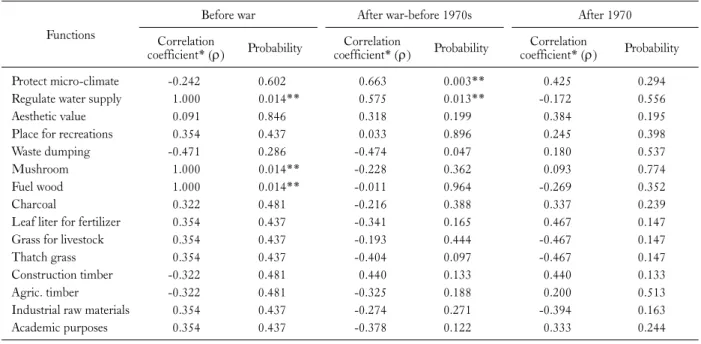
Although the members have identified many roles of the forest in their property ward as only regulate water supply, Mushroom and fuel-wood had significantly correlated (at p=0.5) with the overall role of the forest in the property ward before World War II (Table 2). These main roles have
Table 3. Use of forest products in property ward by community members
Before war After war and before 1970s After 1970s
Personal
use Shared with
others Sold Personal
use Shared with
others Sold Personal
use Shared with others Sold Mushroom
Fuel wood Charcoal
Leaf liter for fertilizer Grass for livestock Thatch grass Construction timber Agric. timber
Industrial raw materials Total
04 (57) 04 (57) 03 (43) 00 (00) 02 (00) 00 (00) 02 (29) 03 (43) 00 (00) 07 (10)
03 (43) 00 (00) 01 (14) 00 (00) 00 (00) 00 (00) 00 (00) 00 (00) 00 (00) 07 (100)
00 (00) 00 (00) 01 (14) 00 (00) 00 (00) 00 (00) 00 (00) 00 (00) 00 (00) 07 (100)
16 (94) 15 (88) 11 (65) 02 (12) 09 (53) 03 (18) 05 (29) 10 (59) 01 (06)
17 (100)
07 (41) 00 (00) 01 (06) 00 (00) 00 (00) 00 (00) 00 (00) 00 (00) 00 (00)
17 (100)
00 (00) 01 (06) 01 (06) 00 (00) 00 (00) 00 (00) 00 (00) 00 (00) 00 (00)
17 (100)
17 (61) 05 (18) 02 (07) 00 (00) 00 (00) 00 (00) 01 (04) 05 (18) 02 (07)
28 (100)
05 (18) 00 (00) 00 (00) 00 (00) 00 (00) 00 (00) 00 (00) 00 (00) 00 (00)
28 (100)
00 (00) 00 (00) 00 (00) 00 (00) 00 (00) 00 (00) 00 (00) 00 (00) 00 (00)
28 (100)
*Percentages are in parenthesis.
mainly influenced them to consider the strong role of forest in their property ward. During the period of after the War and before reduction of timber price in 1970s, protection of micro-climate (ρ=0.663) and regulate water supply (ρ=
0.575) have significantly influenced the overall strong forest role. With the good market for timber the members have gained enough benefits from the timber trade other than other fringe forest benefits. Therefore they were much con- cern the environmental benefits other than the benefits from non-timber forest products. However, there is no any significantly correlated role significantly related with over all forest role after 1979s. After 1970s the members loose the importance of forest role to with the very poor timber trade. Even though the each specific role of forest does not significantly correlate to their overall forest role in the prop- erty ward they have recognized the importance of these spe- cific roles separately as described previously. The members it seems have presently not properly recognized about the specific roles of the forest and the general importance of the common forest in their property ward under the prevailing socio-economic circumstances.
Use of forest products
The local village communities had depended on a variety of essential non-timber forest products extracted from Iriai forests such as water supply for rice fields and household use; fuel wood and charcoal for domestic cooking and heat- ing; and leaf litter for fertilizer and grass for livestock for
many centuries (Marten 2005). The extracted grasses were used as green manure on paddy fields and raw materials for making compost and as feed for horses. They commonly used firewood as the main domestic energy source (Kijima et al. 2000).
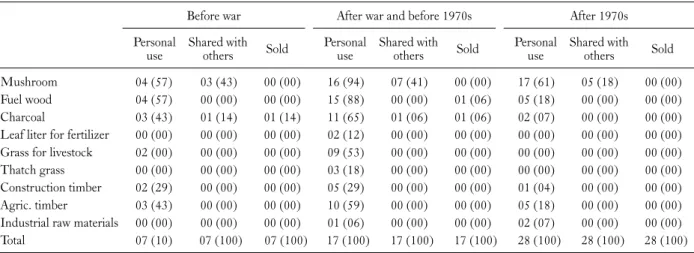
Among the different forest products collected from the property ward forest, Mushroom was the most popular product collected for personal use by the community mem- bers before the War (57%), after the War and before 1970s (94%) and also after 1970s (61%) (Table 3). The highest number of members (94%) had collected Mushroom as they were highly involve in forest management in the prop- erty ward during the period of after the War and before 1970s while enjoying the highest financial returns. They have collected Mushroom average 10 kg per one time and 3 times per season during the autumn. In addition to the per- sonal use many of them shared their collected Mushrooms among other fellow members. Nobody has sold Mushroom for financial gain at all considering Mushroom as a non- commercial forest product in their property ward. The col- lection of Fuel-wood from the forest for personal use also followed almost the similar pattern by the members during the all three periods. They collected fuel-wood also in three times per year. However, nobody had shared or even sold the collected fuel-wood other than their personal use. With the modernization of economy after 1970s, most of the community households had shifted their sources of energy for domestic purposes from fuel-wood to gas and electricity.
The preparation of charcoal using the forest material was some what popular before the War and after the War and before 1970s but not after the modernization of economy after 1970s. Contrary to the fuel-wood few members have shared and sold the charcoal during the early two periods before 1970s.
The community members have not collected leaf-liter as fertilizer for agricultural crops from their forest in the prop- erty ward except very few during the period of after the War and before 1970s. They had prepared compost fertilizer in their home gardens and also utilized in-organic fertilizer purchased from the market for their agricultural purposes.
Similarly the use of Thatch grasses for roof of houses was not a common practice in the property ward expect very few houses during the same period. It could be observed that even the very old houses in the property ward have clay tiles or galvanized sheets in the roofs. Some of the community members have collected grasses for their own livestock farming particularly cattle, from the forest in property ward during the periods of before the War, and after the War and before 1970s. The collected grasses from the forest as well as the apparatuses they had used for haymaking could be still observed in their abandoned huts remaining in the forest. However, they are not collecting grasses with the re- duction of livestock farming practices in the property ward after modernization of economy and establishment of
“Super Market” marketing strategies during 1970s. Neither sharing of grasses nor selling of grasses was ever practiced at all in the property ward. Collection of timber the poles for construction purposes in the property ward was very lim- ited during before the War and even after the War and be- fore 1970s. After the modernization of economy in 1970s only few members have used small poles as construction timber from the forest just to construct their small farm huts. They usually purchase this timber from the commer- cial timber traders as it is more convenient and somewhat cheaper than preparing their own timber. Compared to small poles as construction timber, some members of the community have used poles from the forest only for their own agricultural purposes mainly for drying rice with pad- dy during the three periods. They use timber particularly for the drying of rice with straw in their rice fields. After 1970s they could easily purchase synthetic sticks as sub- stitute for the timber collected from the forest in the prop-
erty ward. The collection of industrial raw materials partic- ularly small timber for house construction, from the forest was rarely done only by few members for personal use dur- ing the latter two periods.
Current threats for forest management
Land abandonment and deterioration of forest environ- ment
In most communities in mountain villages regardless of the forest management system, the number of households is decreasing and facing a problem of aging (Kijima et al.
2000). Though property wards don’t have to pay taxes, most of the rights-holders of Iriai forests find it difficult to earn enough income even to pay the real-estate tax on the forest- lands (Goto 2007). The problems of using and managing the village forests lead the abandonment (Kambu and Nishi 2008). The majority (63%) of the community members de- ny any forest land abandonment in the property ward.
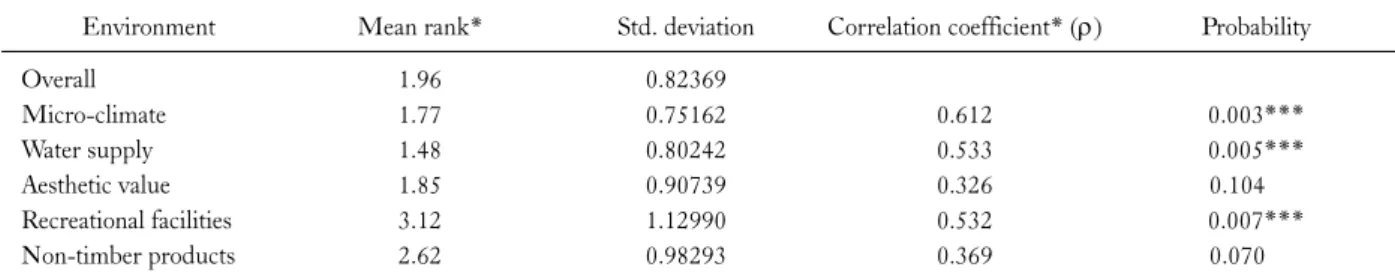
However 33% of the members have recognized the average 19 hectare of forest lands ranging from 5 to 40 hectares have been abandoned mainly due to lost benefits (67%), lack of active community member (33%) and lack of funds (22%) to maintain the forest resources. They do not agree that there is any management conflict or legal problem created the forest land abandonment. They have sited that members becoming old, searching for jobs in cities, married to other distance places and left for education as the main reasons for the lack of active members available for forest management in the property ward. According to the members of the com- munity there is a little deterioration in the forest environ- ment presently in the forest of the property ward (Table 4).
Specifically there is little deterioration in the micro-climate and aesthetic value in the property ward. They have rated the deterioration of recreational facilities and non-timber products as somewhat high in their forest. On the other hand deterioration of micro-climate (ρ=0.612), recrea- tional facilities (ρ=0.532) and water supply (ρ=0.533) have significantly influenced the little deterioration of the over all forest environment in the property ward. Even water supply is closer to the little deterioration.
Conflict with local / Government authorities and outsiders Disputes between local communities and municipalities have been reported concerning the different management
Table 4. Ranks for rate of deterioration of forest environment
Environment Mean rank* Std. deviation Correlation coefficient* (ρ) Probability Overall
Micro-climate Water supply Aesthetic value Recreational facilities Non-timber products
1.96 1.77 1.48 1.85 3.12 2.62
0.82369 0.75162 0.80242 0.90739 1.12990 0.98293
0.612 0.533 0.326 0.532 0.369
0.003***
0.005***
0.104 0.007***
0.070
*Key: 1-Not at all, 2-Little, 3-Somewhat, 4-High, 5-Very High; **Spearman’s rho; ***Correlation is significant at the 0.05 level.
issues in Iriai forests (Mitsumata et al. 2007). The village communities make effort to ameliorate the impacts of gov- ernment rules imposed according to the modern law sys- tem, by stressing the importance of their collective reso- lutions (Torigoe 2007). It is revealed that there is a divided experience of the members about the conflicts with the authorities. Almost half of the members say that they have conflicts (47%) with the local authority while the rest 46%
says that they do not have any conflict. According to 31% of the members who have confronted with the conflict blame the authority for restraining the use of money in property ward forest. The insufficiency of subsidies is also consid- ered as the major conflict by 23%. Conflicts concerning road maintenance and poor official relations are also cited as other factors creating conflicts. However, most of the com- munity members (78%) have faced conflicts with outsiders of property ward concerning the management of forest re- sources while 18% have not recognized the conflicts. All the members who have the conflicts have problems concerning the dumping of garbage by the people living in nearby city.
They transport garbage by trucks and dump them in the forest belong to the property ward illegally. The other major conflict experienced by 27% is the picking of edible wild plants and mushrooms available in the forest belong to the property ward. Disturbance by outsiders for the 14% of the members also has become a considerable conflict which re- quires quick resolution. Further, 9% of them are worried about the involvement of outsiders in establishing Golf Court in their property ward forest.
Prevailing opportunities for forest management Community centered forestry management rules All the community members are aware about the ex-
istence of community centered forest management rules and also they follow these rules in their property ward. The pre- vailing situation of community awareness of exiting forest management rules developed by the community are very important opportunity for the promotion of the community based forest management in the property ward. Among the different types of rules, most of them (86%) are aware that every member of the community should participate in the maintenance of the forest resources. According to the rules the members who are unable to attend the maintenance should pay the compensation of Jap Yen 4,000 per half a day for their absence. Majority of the members (68%) are aware that they should collect non-timber forest products in the property ward according to the prevailing rules and 57% al- so aware that the rules restrict the exploitation of forest products. There are rules also particularly for collection of timber poles for the drying of rice with straw, from the prop- erty ward forest. Further the rules restrict the over ex- ploitation of edible wild plants from the forest especially by the outsiders in order to maintain their continuous supply for the purpose of community use. Only few of the members are aware about the community centered rules existence in the property ward in order to make important decisions (32%) regarding the forest resources and even for use of the timber (29%) available in the property ward forest.
Effectiveness of management
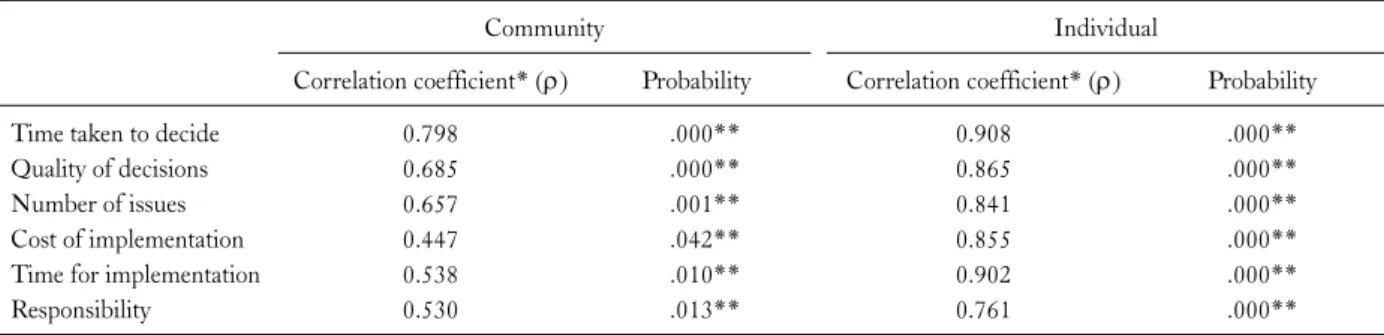
The members of the property ward community feel that the overall effectiveness of the forest management activities is very high under the community management compared to the individual management (Fig. 3). The time taken to take decision is highly effective under both community and individual decision makings. Similarly the quality of the de-
Table 5. Correlation of overall effectiveness of each activity
Community Individual
Correlation coefficient* (ρ) Probability Correlation coefficient* (ρ) Probability Time taken to decide
Quality of decisions Number of issues Cost of implementation Time for implementation Responsibility
0.798 0.685 0.657 0.447 0.538 0.530
.000**
.000**
.001**
.042**
.010**
.013**
0.908 0.865 0.841 0.855 0.902 0.761
.000**
.000**
.000**
.000**
.000**
.000**
*Spearman’s rho; **Correlation is significant at the 0.05 level.
Fig. 3. Effectiveness of management activites by community vs individual.
cision taken on forest management under both community and individual are equally highly effective. However, the members have the opinion that the numbers of forest man- agement issues taken for consideration within a limited pe- riod are highly effective under community management than under the individual management. The cost of im- plementing forest management activities is very highly ef- fective under community management system though it is highly effective under individual management. According to the members, times taken to implement the forest man- agement decisions under both community as well as in- dividual management system are highly effective. It is a vi- tal importance that the responsibility taken for forest man- agement activities is very highly effective under community management systems though it is highly effective under in- dividual management system. Considering all the forest management activities the community members have ranked that the effectiveness of each activity is at least bit higher than that of under individual management. As
shown in the Table 5, all the ranks the members have given on each activity of forest management both under commun- ity and individual management systems are significantly correlated to their over all ranks. They consider the time taken to decide (ρ=0.798 and 0.908); quality of decisions (ρ=0.685 and 0.865); number of issues (ρ=0.657 and 0.841), cost of implementation (ρ=0.447 and 0.855); time for implementation (ρ=0.538 and 0.902); and taking re- sponsibility (ρ=0.530 and 0.761) under both community as well as individual respectively are very important for the effective management of forest resources in their property ward.
Protect property ward environment, livelihood contri- bution and local initiatives
Almost all the members of the community (93%) believe that they provide protection to the environment of the prop- erty ward through their community based forest manage- ment strategies. Through their management activities most of them protect the environment by maintaining the forest resources (89%) as well as preventing the dumping of gar- bage (79%) by the outsiders of the property ward. Some of them (43%) are involving in protecting the forest environ- ment in the property ward from establishing Golf Courts also through their strong pretests as forest management group. Further 29% of the members are able to attract the government authorities and draw their concern in protect- ing the property ward environment through community base forest management. Awareness campaigns organized by 21% of the member have become important aspects to protect the environment by the community members.
Many of the community members (71%) consider that
Table 6. Purpose of revitalization of forest resources
Purpose Mean rank* Std. deviation Correlation coefficient* (ρ) Probability
Overall importance Protect micro-climate Regulate water supply Aesthetic value Place for recreations Waste dumping Mushroom Fuel wood Charcoal
Leaf liter for fertilizer Grass for livestock Thatch grass Construction timber Agric. timber
Industrial raw materials Academic purposes
4.4 4.3 4.7 4.3 3.2 2.3 3.3 2.4 2.1 1.3 1.3 1.3 1.8 1.7 1.4 3.2
0.74642 1.05560 0.52569 1.00000 1.41476 1.16718 1.15092 1.45002 1.37851 0.61373 0.67823 0.90000 1.14479 1.07417 0.88353 1.49718
0.570 0.655 0.479 0.235 -0.054 0.329 0.094 -0.107 -0.307 -0.178 -0.268 -0.403 -0.059 -0.120 -0.065
0.017**
0.001**
0.028**
0.318 0.832 0.157 0.685 0.645 0.201 0.465 0.267 0.070 0.800 0.604 0.786
*Key=1-Not important, 2-Little important, 3-Somewhat important, 4-Very important, 5-Esstential; **Spearman’s rho; **Correlation is sig- nificant at the 0.05 level.
the forest resources in their property ward still make con- tribution for their livelihood even under the modernization of the economy. However, the forest contribution for their livelihood is restricted. They still believe that they can pro- mote the property ward forest to produce some food materi- als particularly edible wild plants and mushrooms. It is very unlikely that they can promote fuel wood, charcoal, leaf liter for fertilizer, grass for livestock, thatch grass, small poles as construction timber, poles as agricultural timber or scaf- folding poles for house building as industrial raw materials for the contribution to their livelihood under the prevailing circumstances. Among the members only 39% are involved in the local initiatives. The rest 61% are not interested in any initiative in the property ward forest. The members who have local initiatives are involving in collection of non-timber products (09%), processing non-timber prod- ucts (09%), eco-tourism (09%), environment conservation (45%) and others (55%). Not even a single member is in- volving in local industries. Mainly the thinning of the prop- erty ward forest is categorized under the other initiatives.
Revitalization of forest resources Purpose for revitalization
The government has dissolved the traditional form of
Iriai rights and transformed into different forms of property rights blaming that it is hampering the development efforts of the villages (Goto 2007). A new law enacted to modern- ize Iriai rights under the modernization Policy in 1966 changed the forest ownership in order to adopt joint forest operations for efficient forest production (Yamashita et al.
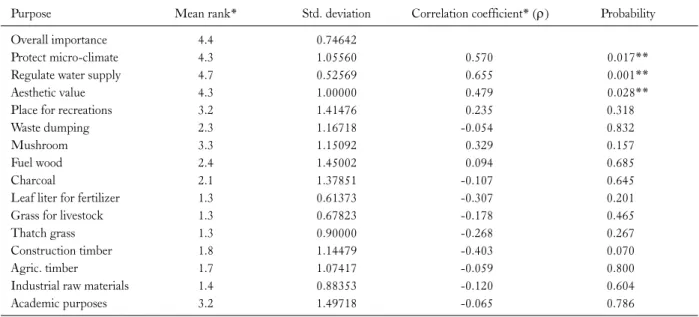
2009). The members of property ward community have ranked the overall importance in revitalization of their for- est resources as a very important requirement (Table 6).
They have identified the regulating water supply as an es- sential purpose of the revitalization. Further, protect mi- cro-climate and preservation of the aesthetic value of the property ward environment are considered as very im- portant purposes. Place for recreations, supply of Mush- room, and use of property ward forest for academic pur- poses have also become somewhat important for the mem- bers of the property ward for the revitalization of their forest. The members consider the use of property ward for- est as sources of fuel wood, supply of charcoal, production of construction timber and obtaining agricultural timber are little important as purposes for the revitalization of forest. However they do not consider the purposes of col- lecting leaf liter for fertilizer, cutting grass for livestock feed, supplying thatch grass for domestic huts, and as
source of industrial raw materials as the requirement of re- vitalization of the property ward forest resources. Although the members of community has identified many purposes only the protection of micro-climate (ρ=0.570); regulation of water supply (ρ=0.655) and preservation of aesthetic value of the property ward (ρ=0.479) are the purposes sig- nificantly correlated to their overall very importance of re- vitalization of the forest resources. In addition to the supply of timber trees they are highly conscious about the pro- tection of environment other than producing non-timber forest products for domestic use from their property ward forest.
Improvement of local reciprocity and livelihood con- tribution
The members feel that the improvement of local reci- procity is very much important for the revitalization of their forest resources of their property ward. The majority of the members (64%) suggest that the utilization of forest bene- fits for public purpose would leads to forest revitalization.
They prefer to utilize the benefits only for common activ- ities other than among the households. Some of them have suggested organizing forest related events (46%) partic- ularly for the children and also the property ward meetings (39%) as important strategies to promote local reciprocity required for forest revitalization. Few of the members (11%) have other opinions such as promotion of public re- lations and establishment of reward system for the members would develop the local reciprocity and lead to the forest re- vitalization in their property ward.
The members of the property ward have recognized somewhat importance of improving livelihood requirement for the revitalization of their forest resources. They have made different suggestion to improve the livelihood con- tribution of the forest. Among the suggestions many of them (46%) have considered the encouragement of active community participation would improve the livelihood con- tribution that will lead to the revitalization of forest resources. About 17% of the members have suggested that the equitable distribution of forest resources would promote the livelihood contribution and their active participation in forest management. Few of the members (14%) feel that the improvement of the resources may promote the livelihood contribution required for revitalization of forest resources
in their property ward. Further 17% proposes other strat- egies such as management of property ward forest for pub- lic purposes and introduce strategies to make profit from the forest resources to promote the livelihood contribution required for revitalization of forest resources. However the members who suggest the systematic collection and storage of non-timber forest products to promote the livelihood contribution is almost negligible (03%).
Imposition of community based forest rules and protect environment
The internal law of the common valid within a commun- ity as a “living law” in contrast with the current national law, as well as similar to the “Internal Village Regulations”, the common forest bond and agreement on Iriai forest (Mitsu- mata and Murota 2007). The community based forest rules are considered as an important factor for the revitalization of forest resources in the property ward. The majority (57%) suggest that the revision of existing community based forest management rules is required for the forest revitalization. They feel that the existing rules are outdated and need to be revised according the current needs based on socio-economics and cultural advances taking place in the property ward. Few of the members have the opinion that the existing rules have to be strictly imposed (21%) in order to revitalize the forest resources. According to them there are many community based forest management rules but not imposed properly to improve the property ward for- est resources. Some 21% of the members suggest that legal- izing of the existing community based forest management rules is required for the revitalization of forest resources.
They believe that without legal recognition, the members and the outsiders do not properly respect their community based forest management rules. Some of the members (25%) have the idea that the community based forest man- agement rules can be properly use for the revitalization of property ward forest resources if they are given sufficient publicity as well as organizing awareness programs for the community members.
The members of the property ward feel that the pro- tection of environment is much required for the revital- ization of the forest resources. In order to protect the envi- ronment 39% of the members suggest organizing com- munity forestry events as well as educational program re-
lated to forest and environment protection particularly for the school children. Some of the members (29%) suggest community awareness programs on protection of forest en- vironment in order to encourage the community members to involve in revitalization of property forest resources.
According to the members they have already distributed the community news letter among every household. Impor- tance of a collective control system of environment pro- tection has been suggested by 21% of the members as a strategy for revitalization of forest resources.
Development of local innovations and building partner- ships
The members of the property ward have suggested many local innovations in order to revitalize the property ward forest and community based forest management. Most of them (71%) have suggested the involvement of community in timber processing and marketing using timber available in their property ward forest. Some of them (21%) have the idea that they can promote eco-tourism or nature tourism based on their property ward forest. They have already rec- ognized the Nagano prefecture as a very strategic tourist destination as well as the potential attraction of local and foreign tourist to the Saku city. Few of the members (11%) suggest the promotion of agricultural and forest based in- dustries and marketing initiatives as another important in- novation for the revitalization of property ward forest.
Further 7% of the members suggest that processing of food products obtained from the property ward forest a potential innovation. Few of the members suggest the processing of non-timber forest product as an innovation. The other sug- gestions are collection of edible wild plants and provide fa- cilities for mountain bicycles as innovation for the revital- ization of property ward forest.
The members of the property ward feel that the building of partnerships is much required for the revitalization of their forest resources as well as their community based for- est management. Although almost all the members have understood the importance of the building of partnerships only 54% have clear idea about the activities which they can build partnership in order to revitalize their property ward forest. Among the members 32% suggest building partner- ships mainly with city council (local government authority) and private sector for timber processing and marketing
activities. They expect expert knowledge; appropriate tech- nology and equipment; and also the marketing facilities form the city council and private sector in order to promote timber processing and marketing activities. Some of the members expect partnership with city council, private sec- tor and other non-governmental organizations particularly environment and nature interest groups to promote eco- tourism and nature tourism in their property ward forest.
They believe that the partners would be able to contribute with expert knowledge as well as necessary funds require for promotion of eco-tourism and nature tourism based on their forest. Few members feel that they can promote proc- essing of food products collected from the forest as well as processing of other non-timber forest products if they can build partnership with the city council. The city council has strengthened their control over the management of prop- erty ward forest, though the people want to keep their autonomy. The city council has to provide required knowl- edge technology and equipment as well as to create market for processed products.
Conclusion
Although the overall condition of Osawa Property Ward collective forest management system has been deteriorated gradually over generations the condition has not yet been degraded to a bad as a result of high influence of group par- ticipation and rules imposition. Community members have recognized the protection of micro climate and regular wa- ter supply as very important role played by the Osawa Property Ward collective forest. With the change of so- cio-economic circumstances the community members have presently confused about the specific roles of their property ward forest. Among the many forest products used for do- mestic purposes before the economic development, only Mushroom is remaining as an important product for the community used for domestic purpose as well as to share with fellow members. Land abandonment has affected so- cial linkages between ecosystem services and human well-being developed through community based forest management leads to the deterioration of the environment.
Existence of community centered forest management rules and effective forest management activities are strong oppor- tunities to continue the collective forest management sys-
tem in the property ward. Revitalization of the collective system to manage Osawa Property Ward forest has become a key to restoring sustainable use of forest and environ- mental resources. Cross-institutional collaborations among local communities, governmental organizations and private sector, together with management responsibilities of local communities would ensure the revitalization of forest resources.
References
Curtis D. 2007. Active citizenship, forest governance institutions and the public or common good. Discussion Paper150, Graduate School of International Development, Nagoya University, Japan, 32.
Forest Agency. 2009. Forest and forestry statistics handbook 2009.
Tokyo, Japan.
Forestry Agency Ministry of Agriculture, Forestry and Fisheries Government of Japan. 1998. Asia-Pacific Forestry Sector Out- look Study Working Paper Series, Working Paper APFSOS/
WP/15, Japan - In-Depth Country Study, FAO Bangkok 67- 74.
FAO. 1978. Forestry for local community development. FAO Forestry Paper 7, Food and Agriculture Organization of the United Nations, Rome. 58-64.
Goto K. 2007. Iriai forests have sustained the livelihood and au- tonomy of villagers: experience of commons in Ishimushiro hamlet in northeastern Japan. Working Paper Series 30, Afrasian Centre for Peace and Development Studies, Ryukoku Univer- sity, Shiga, Japan. 32.
Illich I. 1982. Silence is a Commons. Proceedings of Asahi Sym- posium Science and Man - The computer-managed Society,”
Tokyo, Japan. (http://www.preservenet.com/theory/Illich/Silence.
html. Accessed 28 Jul 2012.
Kambu A, Nishi M. 2008. Satoyama Conservation in Southeast
Asia and Japan; United Nations University, Tokyo Japan.
http://www.ias.unu.edu/sub_page.aspx?catID=130&ddlID=
475. Accessed 18 Jun 2012.
Kijima Y, Sakurai T, Otsuka K. 2000. Iriaichi: Collective versus in- dividualized management of community forests in postwar Japan.
Economic Development and Cultural Change 48: 867-886.
Marten G. 2005. Environmental tipping points: A new paradigm for restoring ecological security. Journal of Policy Studies (Japan) 20:75-87.
McKean MA. 1991. Defining and dividing property rights in the Japanese commons; presented at the annual, meeting of the International Association for the Study of Common Property, Winnipeg, Canada, 26-30. Http://dlc.dlib.indiana.edu/archive/
00002625/01/Defining_and_Dividing_Property_Rights_in_the_
Japanese_Commons.pdf. Accessed 28 Jul 2012.
Mitsumata G, Murota T. 2007. Overview and current status of the Iriai (commonage commons) system in the three regions of Japan from the Edo era through the beginning of the 21st century. Discussion paper 07-04 http://common-threads.org.
uk/html/facts/pdf/japan.pdf. Accessed 28 Nov 2012.
Murota T. 2003. Common-pool Resources in Japan and World- wide from the Historical and Contemporary Perspectives; The Doshisha University Research Center for World Wide Business (RCWOB), Japan. http://www.rcwob.doshisha.ac.jp/review/5_1/
5_1_129.pdf. Accessed 16 Jun 2012.
Pagdee A, Kim Y, Daugherty PJ. 2006. What makes community forest management successful: a meta-study from community forests throughout the world. Society & Natural Resources 19:
33-52.
Torigoe H. 2007. Land ownership for the preservation of environ- ment and livelihood; Working paper series 29, Afrasian Center for Peace and Development Studies, Ryukoku University, Shiga, Japan 26.
Yamashita U, Balooni K, Inoue M. 2009. Effect of instituting
“Authorized Neighborhood Associations” on communal (Iriai) forest ownership in Japan. Society & Natural Resources 22:
464-473.