ORIGINAL ARTICLE
고유수용성 신경근 촉진법을 이용한 뒤넙다리근의 스트레칭 동안 휴대용 근력계를 이용하여 측정된 고관절 신전력과 뒤넙다리근 유연성 사이의 상관관계
임우택
우송대학교 보건복지대학 물리치료학과, 첨단융합 스포츠재활 연구소
The Relationship between Hip Extension Force Measured by Using a Hand-held Dynamometer and the Effect of Proprioceptive Neuromuscular Facilitation
Stretching on Hamstring Flexibility
Wootaek Lim
Department of Physical Therapy, College of Health and Welfare & Advanced Institute of Convergence Sports Rehabilitation, Woosong University, Daejeon, Korea
Received October 20, 2016 Revised October 27, 2016 Accepted October 28, 2016
Corresponding author Wootaek Lim
Department of Physical Therapy, College of Health and Welfare, Advanced Institute of Convergence Sports Rehabilitation, Woosong University, 171 Dongdaejeon-ro, Dong-gu, Daejeon 34606, Korea Tel: +82-42-630-4624 Fax: +82-42-630-4611 E-mail: [email protected] Copyright © 2016 by The Korean Journal of Stress Research. All rights reserved.
Key messages
본 연구의 목적은 고유수용성 신경근 촉진법을 이용한 뒤넙다리근의 스트레칭 동안 휴대용 근력계를 이용하여 측정된 고관절 신전력과 스트레칭으로 인해 증가된 뒤넙다리근 유연성 사이의 관계를 보는 것이었다. 스트레칭은 1세트 (총 6회, 회당 5초) 수행되었다. 스트레칭 전, 후 능동 무릎 폄 검사가 즉청 되었으며, 뒤넙다리근의 최대 신전력은 휴대용 근력계로 측정되었다. 신전력과 유연성 사이의 상관관계 는 없었으나, 6회 동안 측정된 평균 신전력의 최소값과 최대값은 유의한 차이를 보였다. 일정하지 않은 신전력의 적용은 스트레칭 효과를 감소할지 모른다. 스트레칭 동안 휴대용 근력계를 이용하여 피험자의 스트레칭 수행정도를 관찰하고 실시간으로 피드백을 줄 수 있다면, 임상 및 스포츠물리치료현장에서 매 우 유용할 것이다.
중심단어: 근력계, 뒤넙다리근, 고유수용성 신경근 촉진법 스트레칭
Abstract
The purpose of this study was to investigate the relationship between hip extension force measured by using a hand-held dynamometer (HHD) and the effect of proprioceptive neuromuscular facilitation (PNF) stretching on hamstring flexibility. Many athletes try to avoid strains by excessive stress while maintaining or improving performance. It has been widely demonstrated that PNF stretching increases hamstring flexibility by decreasing active resistance. Thirty-four young men and women participated in the study. Active knee extension (AKE) was measured with a goniometer before and after hold-relax PNF stretching. Additionally, AKE data were collected at 2, 6, 10, 20, and 30 min. The maximal isometric contraction force of the hamstring was measured by using a HHD during a single set of PNF stretches (6 trials×5 s/trial). The mean forces measured by using the hand-held dynamometer were not significantly different between the trials; however, the averages of the maximum and minimum values obtained for each trial were significantly different. Hamstring flexibility at pre-stretch differed between men and women, but the immediate and sustained effects of stretching did not differ between the sexes. The isometric contraction force of the hip extensor during hold-relax PNF stretching was successfully measured and quantified with the use of a HHD. The inconsistencies in the isometric contraction force between trials might diminish the effect of stretching. The use of a HHD to monitor the effort applied by a subject and provide real-time feedback might enhance the effectiveness of stretching in the clinical field or in sports physiotherapy.
Key Words: Dynamometer, Hamstring, Proprioceptive neuromuscular facilitation stretching
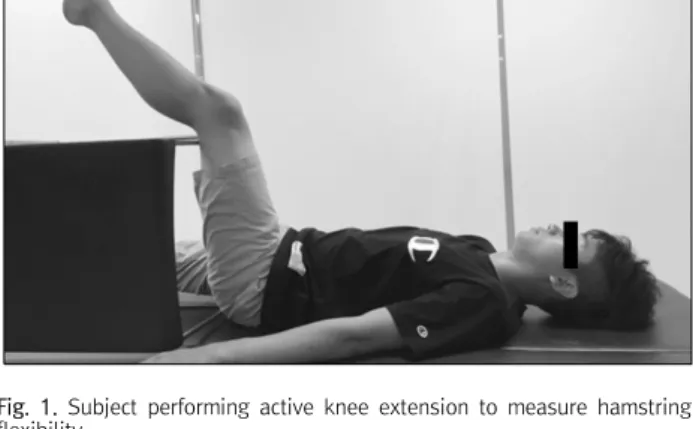
Fig. 1. Subject performing active knee extension to measure hamstring flexibility.
Introduction
A variety of injuries that occur during exercise can result in serious muscle damage. Among them, strain injury is the most common injury, and the hamstring muscle is the most commonly injured multi-joint muscle (Safran
et al
., 1989). Individuals who have limited flexibility are more prone to hamstring injuries by excessive stress, and such injuries can negatively affect physical fitness and running economy (Kim MH 2008; Kim OH 2009).Therefore, hamstring flexibility is considered to be important for improving athletic performance and preventing injuries during exercise. This is appli- cable for both senior and young athletes. (Feland
et al
., 2001). Many studies have been conducted to determine effective stretching techniques to in- crease hamstring flexibility under a variety of con- ditions. Among the various stretching techniques, static stretching, ballistic stretching, and proprio- ceptive neuromuscular facilitation (PNF) stretching are widely used these days (Covertet al
., 2010; Lim CH 2011; Kirmizigilet al
., 2014; Ciniet al
., 2016;Hill
et al
., 2016; Rodriguez Fernandezet al
., 2016).In comparison with other stretching techniques, PNF stretching is known to be highly effective in increasing range of motion (ROM) (Etnyre
et al
., 1986a; Etnyreet al
., 1986b; Osterniget al
., 1990;Magnusson 1998), but the effectiveness is different by specific conditions, such as stretching time, fre- quency, and duration (Borms
et al
., 1987; Sullivanet al
., 1992; Bandyet al
., 1994; Bandyet al
., 1997). During PNF stretching, the ROM is increased by the autogenic inhibition of the stretched muscle as a result of the stimulation of the Golgi tendon organ due to the increased tension (Mooreet al
., 1980; Bae SS 1993; Yuktasiret al
., 2009). Many studies have demonstrated that motor pool excita- bility was significantly decreased by the PNF tech- nique when compared with static stretching; this inhibitory effect enables effective muscle stret- ching without stimulating the stretch reflex (Etnyre 1986a; Manoelet al
., 2008).The PNF stretching technique involves the following: hold-relax, contract-relax, and contract- relax-antagonist-contract. However, unlike in the case of passive static stretching, the PNF technique requires voluntary muscle contraction by the subject.
For example, in hold-relax, the intensity of stret-
ching is driven by the voluntary contraction effort applied by the subject as the practitioner passively withstands the resistance created as a result of the contraction. However, although the voluntary con- traction effort by the subject is an important factor that determines the effectiveness of stretching, it is difficult to quantify the contraction effort in the clinical field or in sports physiotherapy. It is not possible for the practitioner to quantitatively mea- sure the contraction effort through touch. In addi- tion, it is difficult for a subject to determine the amount of his/her own muscle contraction.
In this study, hip extension force was measured with a hand-held dynamometer (HHD) while the subjects performed the hold-relax PNF stretching and its effect on hamstring flexibility was deter- mined. Differences between sexes were also inves- tigated to consider strength variations between men and women.
Materials and Methods
1. Subjects
Thirty-four individuals (17 men; 17 women; mean age=21.2±1.1 years), who were college students, were recruited for this experiment. Informed consent was obtained from all subjects prior to participating in the study.
2. Procedure
Knee extension ROM was measured with a double- arm goniometer with the individual in a supine position. Before beginning the experiment, the lateral epicondyle of the femur, greater trochanter of the femur, and the lateral malleolus of the
Table 1. The mean force measured with hand-held dynamometer
1
sttrial 2
ndtrial 3
rdtrial 4
thtrial 5
thtrial 6
thtrial Min Max Average (N) 155.3±35.8 155.1±41.8* 160.4±40.5 158.9±30.0 160.9±37.3 161.6±41.0 135.5±30.5 183.7±36.5*
Min: average minimum values, Max: average maximum values.
*p < 0.05, significant difference compared to Min.
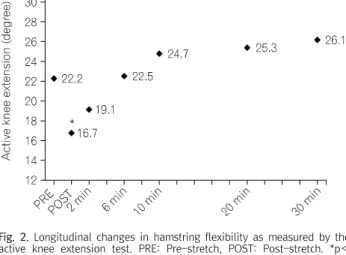
Fig. 2. Longitudinal changes in hamstring flexibility as measured by the active knee extension test. PRE: Pre-stretch, POST: Post-stretch. *p < 0.05, significant difference compared to pre-stretch.
fibular were palpated to determine the landmarks for ROM measurement. Active knee extension (AKE) was measured after the subjects performed knee extension until the discomfort point was reached while maintaining 90-degree hip flexion. To main- tain 90-degree hip flexion, a custom-made metal brace was used (Fig. 1). To warm-up, all subjects performed a total of six AKEs before the experiment and the sixth AKE was recorded as pre-stretch.
After the hold-relax technique, AKE was measured again and recorded as post-stretch. The subjects were given a rest break on the table after post- stretch, and additional AKE data were collected at 2, 6, 10, 20, and 30 min.
3. Stretching protocol
During each stretch, subjects performed isometric contraction of the hamstring toward the table while opposing the resistance applied by the practitioner for 5 s. At this time, a HHD (MicroFET3, Hoggan Health Industries Co., UT, USA) was placed under the heel to measure the hip extension muscle force.
After performing isometric contraction, the subject’s leg was lifted by the practitioner until the discom- fort point was reached. The set involved performing hold-relax PNF stretching for 5 s and repeating this 6 times; hip extension muscle force was measured with a HHD during each session.
4. Statistical analysis
Data analysis was performed using IBM SPSS version 23 for Windows (IBM Corp., Armonk, NY, USA). The repeated measures analysis of variance was used to determine the differences in the mean number of AKEs over the test periods. The Bon- ferroni test was used to test for pairwise diffe- rences. All values are presented as mean±standard deviation. The significance level was set at p
<
0.05.Results
There was no significant difference in mean force measured by the HHD (Table 1). When all six trials
were considered, the mean force did not decrease, and the range remained constant (155.1 to 161.6).
However, the average minimum (min) and maximum (max) values for each subject differed considerably (p
<
0.001).The post-stretch AKE value measured immedia- tely after stretching significantly decreased (p
<
0.001). and did not differ from the AKE value at 6 min (p=0.451) (Fig. 2). The rapid rise of AKE values was observed until 10 min. The AKE values at 10, 20, and 30 min remained constant and did not differ from the pre-stretch values.The pre-stretch values differed between men and women, but there was no difference in the sus- tained effect of stretching on hamstring flexibility over time. A significant difference was only obser- ved in both men (p=0.021) and women (p=0.015) at post-stretch when compared with pre-stretch (Table 2). The AKE values at pre-stretch were not different compared with the AKE values even at 2 min.
Discussion
Hamstring strain injury is one of the most common exercise-induced injuries, and increased hamstring flexibility can prevent such injuries.
Various stretching techniques are used to improve
Table 2. The difference in active knee extension values between men and women
PRE POST 2 min 6 min 10 min 20 min 30 min
Men 27.6±11.4 20.8±10.0* 22.3±8.9 27.2±7.7 29.2±7.2 29.7±8.4 30.7±9.7
Women 16.8±11.6 12.6±9.9* 15.9±10.0 17.8±11.6 20.2±12.6 21.2±13.3 22.0±13.2
PRE: Pre-stretch, POST: Post-stretch.
*p < 0.05, significant difference compared to pre-stretch.
flexibility (Chang
et al
., 2002), among which the PNF technique is known to be highly effective in increasing ROM; however, there is still some controversy regard this technique. During stret- ching, resistance is affected by both the viscoelastic properties of the tissues and the contractile components (Condonet al
., 1987). The PNF techni- que is considered to increase flexibility by decrea- sing active resistance (Osterniget al
., 1990). Unlike other stretching techniques, the PNF stretching technique requires voluntary muscle contraction by the subject, and it is hard to quantitatively measure the extent of contraction. In this study, the isome- tric contraction of the hip extensor was successfully measured and quantified with a hand-held dyna- mometer during hold-relax PNF stretching.The mean forces were constant from the 1
st
to the 6th
trial, and no significant difference in values was observed between trials. A decrease in strength due to fatigue over time was not observed in this study.However, a significant difference was noted when the total average of each min and max value was calculated for the 6 trials. That is, no difference between trials was observed during the 6 trials if the total average value for the group was consi- dered, but the values of each subject were not constant during the 6 trials. The strength applied by the subjects was not constant between trials, and there was a considerable difference between the max and min values. During isometric contrac- tion, the strength can be changed for each trial. To ensure that PNF stretching has the desired effect, the practitioner should continuously provide verbal encouragement and stimulation to encourage the subject to maintain constant isometric contraction.
The AKE value at pre-stretch did not differ from the value obtained at 2 min. Although there was no significant difference between the values taken at the different time points, the values gradually increased from 6 min. The 5 AKEs performed during warm-up might have temporarily improved ham- string flexibility, decreasing the AKE value at
pre-stretch. However, the warm-up effects were diminished because permanent deformity caused by sustained stimulation was not observed in this study. After 10 min, the AKE value returned to the pre-warm-up value and was considerably higher than the pre-stretch AKE value. From pre-stretch to 30 min, two distinct trend lines
—
one with a rapid increase and the other in a steady state—
were observed. The AKE value that decreased due to stretching increased quickly and reached the pre- stretch level within 10 min. The sudden rise in the AKE value remained steady after 10 min. These results were consistent with the results of other previous study (Spernogaet al
., 2001).With regard to differences in hamstring flexibility between men and women, women were observed to have slightly higher flexibility before stretching;
however, there was no statistically significant diffe- rence in effects of stretching on hamstring flexibility between the sexes. The higher value observed in the women during pre-stretch could be explained by the fact that the women have relatively higher ROM than men (James
et al
., 1989; Chaparroet al
., 2000; Doriotet al
., 2006). However, there was no difference in the increase in knee extension ROM after PNF stretching and in the sustained effect between the 2 groups. In conclusion, there was a fundamental difference in flexibility between the men and women; however, the hold-relax PNF stretching performed for a total of 30 s (6 trials×5 s/trial) did not significantly affect this fundamental difference in flexibility between men and women.This study had limitations. The first one was that the effect of the intensity could not be fully studied owing to the short time and total duration of stretching. A single stretch is not enough to cause a deformity that would lead to permanent tissue change. The increased flexibility due to the viscoe- lastic properties of the tissues quickly returns to the original condition, and the decrease in stiffness induced by stretching get reversed due to the thixotropic properties of the tissue if there is no
additional movement after stretching (Lakie
et al
., 1984; Hagbarthet al
., 1985; Lakieet al
., 1988;Walsh 1992). It is known that routine stretching is required to maintain the effect that is transiently acquired after stretching (Tanigawa 1972; Osternig
et al
., 1990). The other limitation of this study was that the value measured with the HHD was not the mean force for the entire 5-s duration of a trial because the max value is only displayed on the screen of the device after completion of a trial.Therefore, future studies will be required to inves- tigate the relationship between hip extension strength represented by the mean force, and not a max value, and hamstring flexibility during long- duration stretching.
In conclusion, hip extension muscle force was successfully measured with a HHD during hold-relax PNF stretching to increase hamstring flexibility, and it was found that the voluntary effort applied by the subjects was not consistently maintained between trials. Apart from the duration and frequency of stretching, the voluntary effort applied by a subject during PNF stretching is important, and ensuring that a constant intensity is maintained by mea- suring the subject’s quantitative strength between attempts will be beneficial to achieving a durable stretching effect. Additionally, providing feedback to subjects in real time based on the value displayed on the screen will be very useful in motivating subjects and achieving effective stretching in the clinical field or sports physiotherapy.
References