• 검색 결과가 없습니다.

The Relationship of Radiation Dose and Image Quality According to the Condition of Chest PA

N/A
N/A
Protected

Academic year: 2021

Share "The Relationship of Radiation Dose and Image Quality According to the Condition of Chest PA"

Copied!
5
0
0

로드 중.... (전체 텍스트 보기)

전체 글

(1)

◈ Original Article ◈

The Relationship of Radiation Dose and Image Quality According to the Condition of Chest PA

4)

Jin Hyun Son

1

·Jung Whan Min

1

·Byung Sam Kang

1

·Kyung Rae Dong

2,3

1

Department of Radiological Technology, Shingu University·

2

Department of Radiological Technology, Gwangju Health College University·

3

Department of Nuclear Engineering, Chosun University

Abstract

The purpose of this study is to compare the measurement result of radiation dose by using standard thoracic phantom and ionization chamber to advice proposal in the shooting condition of chest PA projection at hospitals recently. And to understand the change between radiation dose and resolution in different conditions. The period this study was from August 2010 to September 2010 and the subjects of the study was 3 general hospitals, 4 personal hospitals and 1 laboratory at the college. Finally we study with 6 DR, 1 CR, and 4 F/S equipments. Most hospitals met advice proposal, but some of the hospitals exceed advice dose from the result of our study. We can lower radiation dose about 25% when kVp is lowered about 20% in DR equipment. And we can lower radiation dose about 50% when mAs is lowered about 35%. The image quality was similar to the original in the study. Most hospitals which exceed advice dose were personal hospitals. The reason why it happened is that radiation dose for chest PA projection at personal hospitals is higher than general hospitals and the personal hospitals´ equipments are older than general hospitals´ equipments. We guess that patients´ radiation dose of chest PA projection can be lowered from the result.

Key word : Standard thoracic phantom, Ionization chamber, Radiation dose, chest PA

Ⅰ. Introduction

Usage of radiation has been contributed in medical field for 100 years since W.C. Röntgen discovered the X-ray in 1985. Recently, interests of health and well-being life are getting higher

Received September 27, 2011/ 1st Revised October 10, 2011/ 2nd Revised October 29, 2011/ Accepted for Publication November 12, 2011

Corresponding Author: Kyung Rae Dong

Department of Radiological Technology, Gwangju Health College University

(506-701) 683, Shinchang-dong, Gwangsan-gu, Gwangju, Republic of Korea

Tel: 062) 958-7668 Fax: 062) 958-7669 E-mail: [email protected]

due to development of the medical appliances and the facilities as well as national income level.

One research shows in case of being treated at the same radiation treatment in EC(European Comission) and OECD(Organization for Economic Cooperation and Development), however, there is 10 to 20 times difference of exposure dose.

Moreover, the radiation exposure dose in medical field takes around 90% of all artificial radiation.

Improvement of exposure for patients, an measu-

rement and an evaluation of exposure dose are

needed for certain patients who are receiving the

X-ray treatment in clinics. And also, establishing

and introducing the low cost program which is

(2)

suitable for our community so that the patients are able to receive the X-ray without any concerns.

1~4

The purpose of this examination is to confirm if the diagnosis organizationin metro- politan area follow the international advice dose for the chest PA(Posterior-Anterior) radiography which is so called a fundamental of the radio therapeutics examination. The international orga- nization recommends the advicedose of the chest PA radiography for IAEA(International Atomic Energy Agency) is 0.4 mGy, EC 0.3 mGy, IPEM (Institute of Physics and Engineering in Medicine) 0.3 mGy, JRTA(Jejudo Radiological Technologists Association) 0.3 mGy which these numbers tell us 0.3 mGy is an optimal recommendation for the advice dose. Another purpose of this examination is to understand the condition of the chest PA which is able to satisfy the spatial resolution of diagnosis region and a reduction measurement of exposure.

Ⅱ. Material & Method

1. Object and examination equipment

The examination was tested with 6 DR, 1 CR and 4 F/S from 3 general hospitals, 4 private hospitals and 1 university lavatory. The examin- ation wastaken from August, 2010 to September, 2010 with using the standard chest phantom, ion-chamber(2026C, USA) and the spatial resolu- tion pattern(Fig. 1).

2. Examination method

1) Attaching the chart of spatial resolution in area of 1/2 standard chest phantom heart shadow and attaching the ion-chamber in area of 6th thoracic spine(Fig. 2).

2) Taking the X-ray after setting up the standard chest phantom on a table and putting the chest PA radiography in position.

A

B

C
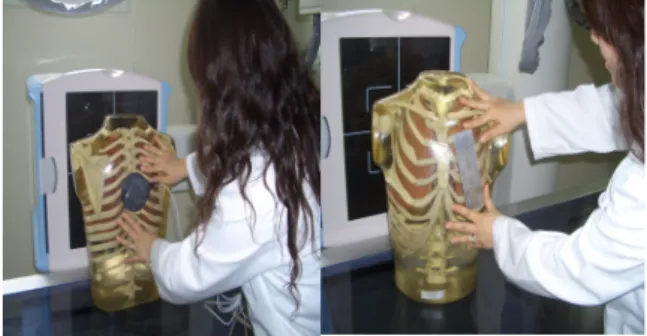
Fig. 1. (A) Standard chest phantom, (B) Ion-chamber (60 ml), (C) Spatial resolution pattern

Fig. 2. Install the Ion-chamber and the Spatial resolusion chart

3) Lower the ± 10 kVp from the standard and 30% from mAs.

4) Comparing the dose and the spatial resolu- tion after measuring from each film.

Ⅲ. Result

Image qualities and doses are evaluated and compared from 4 F/S, 1 CR and 6 DR which is the sum of 11 equipments from 8 different institutions. The current condition of filming in a hospital, the average of kVp is 101.45, the average of mAs is 13.06 and the average of 0.33 mGy. Over 100 kVp is less than under 100 kVp in terms of the dose(Table 1).

CR has the highest dose which is 0.42 mGy and DR has the lowest dose which is 0.16 mGy.

Especially, DR's flat panel type is relatively lower

(3)

Table 1. Comparison of kVp N Mean

(kVp)

Mean (mAs)

Dose (mGy)

Resolution (lp/㎜)

≥100 8 113 7 0.32 1.40

<100 3 70 29 0.37 1.40

Table 2. Comparison of the device Type N Mean

(kVp)

Mean (mAs)

Dose (mGy)

Resolution (lp/㎜)

F/S 4 80 26 0.41 1.40

CR 1 102 8 0.42 1.50

DR 5 113 5 0.16 1.40

DR

(CCD) 1 130 8 0.74 1.30

Table 3. Comparison of medical institution Class N Mean

(kVp)

Mean (mAs)

Dose (mGy)

Resolution (lp/㎜)

Clinic 4 78 24 0.38 1.43

HospitalI 5 113 5 0.16 1.40

laboratory 2 120 12 0.65 1.35

Table 4. Compare the installation of light Installation(year) N Dose

(mGy)

Resolution (lp/㎜) More than 5 year 6 0.34 1.42 Less than 5 year 5 0.32 1.38

than CCD type and there is not much difference in the spatial resolution(Table 2).

General hospital has the lowest dose which is 0.16 mGy and university lavatory has the highest dose which is 0.56 mGy(Table. 3).

The international recommendation for dose is not that high and the used equipment that has been used for over 5 years indicates little bit higher(Table 4).

Fig. 3. Fluctuate kVp condition

Fig. 4. Fluctuate mAs condition

For a reduction measurement of dose, when the examination was tested in every 10 kVp forst- andard image condition of chest PA radiography that is 130 kVp and 8 mAs, the dose was reduced about 25% and the quantum mottle was formed in condition of 100 kVp(Fig. 3).

When mAs was reduced around 35%, the dose was able to be reduced around 40% and the quantum mottle was formed as mAs was reduced about 50%(Fig. 4).

Ⅳ. Discussion

For the diagnosis reference, 0.2 mGy is right

per 1 time for a test of chest PA radiography

X-ray and they are trying not to go over 0.4

mGy. In case of Samsung hospital, especially,

they set 0.3 mGy for the diagnosis reference.

2~9

Currently the general hospitals are using DRs and

the dose level keeps lower than recommended

international chest dose level. But most private

hospitals are using F/S equipment and indicating

(4)

higher average value.

10~11

It shows that mAs value is higher than other facilities and it is hard to maintain for over 5 years. In comparing with CR and F/S, DR was measured lower value than international recommended dose. But the DR in university lavatory is CCD(Charge coupled device) type and it shows higher value than other facilities. For the reduction of dose which patie- nts get received in chest PA radiography, the dose and resolution were evaluated after filming as kVp and mAs were getting reduced. The result was kVp and mAs values were reduced and also current spatial resolution was kept which is needed for medical examination. Specially, this research tells us the condition for reduced mAs value was able to reduce 15% more than the condition of reduced kVp value. To minimize the dose, therefore, reducing mAs value and good maintenance of equipment are extremely important.

Ⅴ. Conclusion

Most hospitals have a good result in terms of international recommendation but all private hospitals reach 0.3 mGy except only one private hospital in metropolitan area. As kVp was reduced about 20%, dose was able to reduced about 25%

and about 40% reduced when mAs was reduced by 35% and high resolution image was able to developed. Greater effect was tested when mAs was reduced by 35%.

References

1. Park EG, Lee KY, Jung YT, Dong KR, Ji YS.

The Usefulness of Magnification of the Heart Shadow in Chest Radiography. Korean J Digit Imaging Med 2010; 12: 119-25.

2. Graybiel A, Strieder JW, Boyer NH. An attempt to obliterate the patient ductus arteriosus in a patient with subacute bacterial endocarditis.

Am cardiac J 1938; 15: 621-4.

3. Dong KR, Lee SJ, Kweon DC, Goo EH, Jung JE, Lee KS. Actual Condition of Quality Control of X-ray Imaging System in Primary Care Institution: focused on Gwangju Metropolitan City. J Korea Asso Radiat Prot 2010; 35: 34-42.

4. Jung JH, Sung DW, Park BJ, Son KK, Kang HD.

A Compatibility Assessment and Verification of Suitable to DICOM of PACS DATA CD : Current Situation Investigation of Korea. Korean J Digit Imaging Med 2008; 10: 29-34.

5. International commission on radiation protection.

Recommendations of the International Commi- ssion on Radiological Protection; 1990. Contract No.: ICRP Publication 60.

6. Park JH, Im IC, Dong KR, Kang SS. A Perfo- rmance Evaluation of Diagnostic X-ray Unit Depends on the Hospitals Size. J Korea Asso Radiat Prot 2009; 34: 31-6.

7. Shin GS, Min GY, Kim DH, Lee GJ, Park JH, Lee GW. Entrance Skin Dose According to Age and Body Size for Pediatric Chest Radiography.

Journal of Radiological and Science and Technology 2010; 33: 327-34.

8. Jung MJ, Dong KR, Ji YS, Choi JG, Jeon JD.

Usefulness of FTP Module on OCS for PACS Registration of External Medical Images.

Korean J Digit Imaging Med 2009; 11: 35-41.

9. LeeIJ, Kim YH, Kim CN, Lee CY, Park GY.

Evaluation of Image According to Exposure Conditions using Contrast-Detail Phantom for Chest Digital Radiography. Journal of Radiolo- gical and Science and Technology 2009; 32: 25-32.

10. Dong KR, Kim CB, Choi JG, Hong SI. Cause and Solution of an Artifact Generation by Parameter in Computed Radiography System.

Journal of the Korea Contents Association 2009; 9: 145-55.

11. Shin SI, Kim JI, Kim SC. The Study on the

Reduction of Patient Surface Dose Through

the use of Copper Filter in a Digital Chest

Radiography. Journal of Radiological and

Science and Technology 2008; 31: 223-8.

(5)

12. Kim CB, Dong KR, Chung WK, Ryu YH.

Analysis on Difference Between X-ray Field

and Light Field. J of Advanced Engineering

and Technology 2010; 3: 481-4.

수치

Fig.  2.  Install  the  Ion-chamber  and  the  Spatial  resolusion  chart
Table  3.  Comparison  of  medical  institution Class N Mean  (kVp) Mean (mAs) Dose (mGy) Resolution (lp/㎜) Clinic 4 78 24 0.38 1.43 HospitalI 5 113 5 0.16 1.40 laboratory 2 120 12 0.65 1.35

참조

관련 문서

The purpose of this study is to analyze the interest and self-confidence of middle school students in learning English grammar and to examine the

Purpose: The aim of this study is to identify the relationship between knowledge and awareness of radiation department students and their intent in

The purpose of this study is to examine the relationship among marketing mix factors, motivation for watching, relationship quality, and consumption

The purpose of this study is to compare the degrees of conversion of light curing resin cement specimens cured by the light transmitted different thickness of zirconia

In the analysis of the dose constraint of nuclear medical radiation workers using chi-square test statistics, the dose constraint at (the time of) the highest

The purpose of this study is to establish and design the characteristics of summer resorts according to the design manual, develop cultural products using

Objective: The purpose of this study is to investigate the relationship between employee satisfaction and patient safety and quality improvement after compulsory certification

Objective: The purpose of this study is to investigate the relationship between depression and evening meals for adult women by using the National Health and Nutrition Survey