Veterinary Science
http://dx.doi.org/10.4142/jvs.2012.13.2.127
Received: 31 May 2011, Revised: 22 Jul. 2011, Accepted: 17 Mar. 2012
Original Article
*Corresponding authors: Tel: +82-2-880-1262; Fax: +82-2-877-8284; E-mails: [email protected], [email protected]
ⓒ 2012 The Korean Society of Veterinary Science.
This is an Open Access article distributed under the terms of the Creative Commons Attribution Non-Commercial License (http://creativecommons.org/licenses/by-nc/3.0) which permits unrestricted non-commercial use, distribution, and reproduction in any medium, provided the original work is properly cited.
Sequence variations of the bovine prion protein gene (PRNP) in native Korean Hanwoo cattle
Sangho Choi1, Hee-Jong Woo1,*, Jeongmin Lee1,2,*
1Laboratory of Immunology, and 2Research Institute for Veterinary Science, College of Veterinary Medicine, Seoul National University, Seoul 151-742, Korea
Bovine spongiform encephalopathy (BSE) is one of the fatal neurodegenerative diseases known as transmissible spongiform encephalopathies (TSEs) caused by infectious prion proteins. Genetic variations correlated with susceptibility or resistance to TSE in humans and sheep have not been reported for bovine strains including those from Holstein, Jersey, and Japanese Black cattle. Here, we investigated bovine prion protein gene (PRNP) variations in Hanwoo cattle [Bos (B.) taurus coreanae], a native breed in Korea. We identified mutations and polymorphisms in the coding region of PRNP, determined their frequency, and evaluated their significance. We identified four synonymous polymorphisms and two non-synonymous mutations in PRNP, but found no novel polymorphisms. The sequence and number of octapeptide repeats were completely conserved, and the haplotype frequency of the coding region was similar to that of other B. taurus strains. When we examined the 23-bp and 12-bp insertion/deletion (indel) polymorphisms in the non-coding region of PRNP, Hanwoo cattle had a lower deletion allele and 23-bp del/12-bp del haplotype frequency than healthy and BSE-affected animals of other strains. Thus, Hanwoo are seemingly less susceptible to BSE than other strains due to the 23-bp and 12-bp indel polymorphisms.
Keywords: bovine spongiform encephalopathy, genetic polymorphisms, prion
Introduction
Bovine spongiform encephalopathy (BSE), better known to the public as mad cow disease, is one of the fatal neurodegenerative diseases that are collectively known as transmissible spongiform encephalopathies (TSEs). These also include Kuru and Creutzfeldt-Jakob disease (CJD) in
humans, scrapie in sheep, and chronic wasting disease in deer [28]. Most TSEs are characterized by a long incubation period and a neuropathological feature of multifocal spongiform changes such as astrogliosis, neuronal loss, or an absence of inflammatory response.
The causative agent of TSEs is an infectious prion protein (PrPSc), that is a structurally abnormal and protease- resistant isoform of the prion protein (PrP) [2]. PrPSc is derived from the endogenous cellular prion protein (PrPC) that has undergone post-translational modification resulting in conformational changes [27,29]. PrPC is known to play a role in copper metabolism [21,37] but its normal function(s) in cells are not well defined.
It is generally believed that BSE epidemics in cattle are caused by the unusual ingestion of meat and bone meal contaminated with PrPSc from BSE-affected cattle or scrapie-affected sheep [28]. BSE likely poses a threat not only to cattle but also to humans because variant CJD in humans is also reportedly caused by consuming meat or other products from BSE-affected cattle [3,35]. Therefore, many nations have focused their research efforts on BSE epidemics and implemented protocols to prevent BSE in cattle.
Recent studies on resistance or susceptibility to TSEs have focused on investigating the genetic structure of the prion protein gene (PRNP). In cattle, PRNP is located on chromosome 13 and the prion protein-coding region is positioned in exon 3 [31]. Polymorphisms of the prion protein-coding region can induce structural changes within the protein itself. Eventually, such structural changes in the prion protein reportedly result in the molecular pathology of TSEs. It has been reported that single nucleotide polymorphisms (SNPs) of PRNP have various effects on the susceptibility and incubation time of prion diseases in humans, mice, and sheep [1,22]. In sheep, polymorphisms
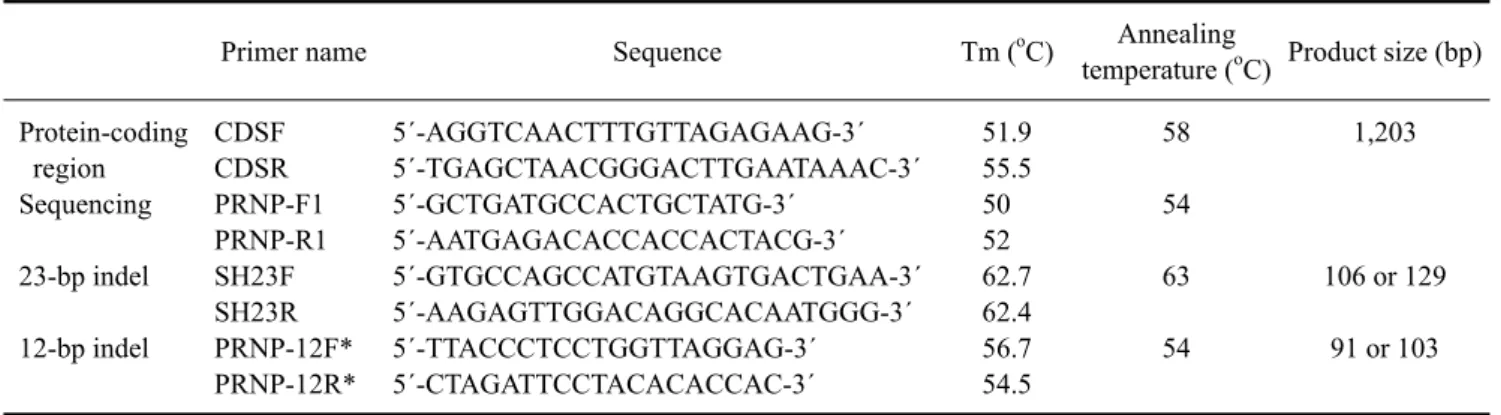
Table 1. Oligonucleotides used for PCR, sequencing, and genotyping in this study
Primer name Sequence Tm (oC) Annealing
temperature (oC) Product size (bp) Protein-coding
region Sequencing 23-bp indel 12-bp indel
CDSF CDSR PRNP-F1 PRNP-R1 SH23F SH23R PRNP-12F*
PRNP-12R*
5´-AGGTCAACTTTGTTAGAGAAG-3´
5´-TGAGCTAACGGGACTTGAATAAAC-3´
5´-GCTGATGCCACTGCTATG-3´
5´-AATGAGACACCACCACTACG-3´
5´-GTGCCAGCCATGTAAGTGACTGAA-3´
5´-AAGAGTTGGACAGGCACAATGGG-3´
5´-TTACCCTCCTGGTTAGGAG-3´
5´-CTAGATTCCTACACACCAC-3´
51.9 55.5 50 52 62.7 62.4 56.7 54.5
58 54 63 54
1,203 106 or 129
91 or 103
*The PRNP-12F and PRNP-12R primer sequences were previously reported by Sander et al. [33].
in codons 136, 154, and 171 are correlated with susceptibility to scrapie and can thus be used to control disease incidence [8], whereas in humans, a polymorphism in codon 129 has a critical influence to variant CJD incidence [38]. To date, there are no known polymorphisms within the prion protein-coding region associated with BSE susceptibility in cattle. Although E211K (which is analogous to the E200K variant in humans that contributes to CJD) has been reported, it is not associated with typical BSE but rather an atypical form of this disease [10,25].
Susceptibility or resistance to TSE is also associated with variations in the non-coding region of PRNP, including the promoter and/or enhancer. Nucleotide changes in the non-coding region may affect mammalian PrPC expression, which is also known to affect TSE susceptibility or resistance [33]. In cattle, strong associations between susceptibility to classical BSE and two insertion/deletion (indel) polymorphisms located in two regulatory regions of bovine PRNP have been identified [16,33]. These polymorphisms are a 23-bp indel at position −1594 and a 12-bp indel at position +300 (the positions of the polymorphisms are given with respect to the transcription start site in GenBank accession No. AJ298878); both are associated with promoter activity and bovine PrPC expression levels in vitro [32]. Therefore, these polymorphisms can both seemingly influence BSE incubation times and susceptibility.
The two indel polymorphisms and their frequencies have been previously identified and characterized in a number of bovine strains such as Holstein, Brown Swiss, Fleckvieh, and Japanese Black [9,16,24,33].
Hanwoo cattle [Bos (B.) taurus coreanae] were created by crossbreeding between B. indicus and B. taurus, and are now widely raised in Korea as a native strain [12]. To date, no BSE cases have been reported in Hanwoo. Genotypic descriptions of BSE-related genetic factors, such as SNPs or the number of octapeptide repeats in PRNP, have rarely been reported for Hanwoo, and the genetic frequencies and features related to BSE susceptibility have been observed
in only a limited number of samples [14,15]. In the present study, we performed a detailed analysis of both sequence variations in the coding region of PRNP and prevalent indel polymorphisms in the non-coding region of PRNP using a large number of samples from Hanwoo cattle.
Furthermore, we analyzed the genetic frequency and haplotype of gene variations associated with BSE susceptibility and compared them to those of other cattle breeds.
Materials and Methods
Animal samples and genomic DNA isolation
Muscle and hair samples for genomic DNA isolation were collected from 300 Hanwoo cattle in Korea. After collection, all samples were frozen until analysis. Genomic DNA was extracted both from 20 mg of muscle samples using a Puregene core kit (Qiagen, Germany) and from hair samples using a DNeasy blood and tissue kit (Qiagen, Germany) according to the manufacturer’s instructions.
Genotype analysis of protein coding region of PRNP The PCR primers CDSF and CDSR were designed to amplify a 1,203-bp DNA fragment that included the entire protein-coding region of bovine PRNP. The primer sequences, melting temperature (Tm), and the annealing temperatures used for the amplification reaction are presented in Table 1. Each 40 μL of PCR mixture consisted of 100 ng of genomic DNA, 5 pmol of each primer, and 20 μL of PCR pre-mix (Superbio, Korea). The amplification for the entire coding region was performed using an initial denaturation step at 95oC for 5 min followed by 35 cycles of denaturation at 95oC for 30 sec, annealing at 58oC for 30 sec, and extension at 72oC for 30 sec. Finally, an extension step at 72oC for 5 min was performed. The amplified DNA fragments were analyzed by electrophoresis on a 1%
agarose gel. Direct sequencing of the PCR products was performed using a 3730xl DNA analyzer (Applied
Table 2. Single nucleotide changes in the coding region of the prion protein gene in Hanwoo cattle
Nucleotide Amino
acid Genotype frequency* Allele frequency (%) 234
467 555 576 630 669
78Q Y156C
185N 192N 210T Q223H
G/G 106 (35.3)
A/A 299 (99.7)
C/C 285 (95.0)
C/C 200 (66.7)
C/C 285 (95.0)
A 299 (99.7)
G/A 150 (50.0)
A/G 1 (0.3)
C/T 15 (5.0)
C/T 96 (32.0)
C/T 15 (5.0)
A/C 1 (0.3)
A/A 44 (14.7)
G/G 0 (0.0)
T/T 0 (0.0)
T/T 4 (1.3)
T/T 0 (0.0)
C/C 0 (0.0)
G 60.3
A 99.8
C 97.5
C 82.7
C 97.5
A 99.8
A 39.7
G 0.2
T 2.5
T 17.3
T 2.5
C 0.2
*Values represent the number (%).
Biosystems, USA) according to the manufacturer’s instructions. The primers PRNP-F1 (5´-GCTGATGCCA CTGCTATG-3´) and PRNP-R1 (5´-AATGAGACACCAC CACTACG-3´) were used for the sequencing reactions.
Genotype analysis of the 23-bp and 12-bp indel polymorphisms
SH23F and SH23R primers were used for detecting the 23-bp indel polymorphism at position −1594, and PRNP-12F and PRNP-12R primers were used to detect the 12-bp indel polymorphism at position +300 (the positions of the polymorphisms are given with respect to the transcription start site in GenBank accession No.
AJ298878). The specific primer sequences, Tm, and annealing temperatures used for amplification are presented in Table 1. Based on a previous report by Sander et al. [33], the SH23F/SH23R primer pair was designed to amplify a 106- or 129-bp DNA fragment, and the PRNP-12F/PRNP-12R primer pair was designed to amplify a 91- or 103-bp DNA fragment. Each 20 μL of PCR mixture consisted of 50 ng of genomic DNA, 10 pmol of each primer, and 10 μL of PCR pre-mix (Superbio, Korea). DNA amplification was performed using an initial denaturation step at 95oC for 3 min followed by 30 cycles of denaturation at 94oC for 20 sec, annealing at 63oC for the 23-bp indel or 54oC for the 12-bp indel for 20 sec, and extension at 72oC for 20 sec. Finally, an extension step at 72oC for 3 min was performed. The genotypes of the indels were analyzed by electrophoresis on a 4% agarose gel (3 : 1, NuSieve-SeaKem; Lonza, Switzerland) based on the size of the PCR product.
Haplotype analysis
Unphased genotypes were tested for deviation from Hardy−Weinberg Equilibrium with the exact test using HapAnalyzer software (ver. 1.0.1; Korea National Institute of Health, Korea), which is a minimum haplotype analysis system for association studies, with a cutoff of 0.01 as previously described [17].
Statistical analysis
Allele, genotype, and haplotype frequencies were calculated using SPSS Statistics software (ver. 17.0; SPSS, USA). The associations between the allele, genotype, and haplotype frequencies were analyzed by cross-tabulation using Chi-square (for 2 × 2 tables) and Fisher’s exact tests.
Results
Variations in protein coding region of PRNP
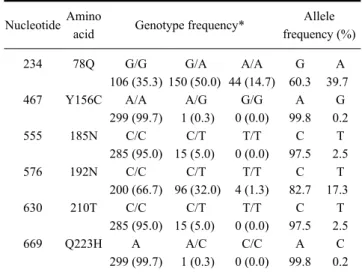
We assessed the protein-coding region sequences of PRNP in 300 Hanwoo cattle and discovered a total of six SNPs.
The genotype and allele frequencies of these six SNPs are shown in Table 2. Four of the variations (G234A, C555T,
C576T, and C630T) were synonymous polymorphisms that have been previously described by Brunelle et al. [4]. None of these particular substitutions resulted in an amino acid replacement in the corresponding protein sequence. Two other SNPs, A467G and A669C, were non-synonymous.
That is, the point mutation (G for A) at nucleotide 467 encoded Cys (TGT) instead of Tyr (TAT) at residue 156, and the point mutation (C for A) at nucleotide 669 encoded His (CAC) instead of Gln (CAA) at residue 223 (Fig. 1).
However, each of these mutations was found only once in this study.
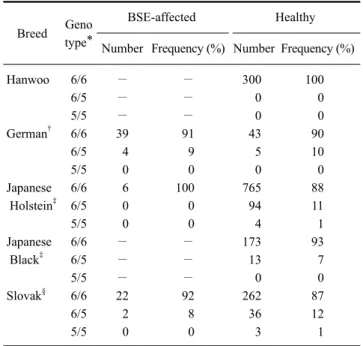
We also identified that both the amino acid sequence and number of the octapeptide repeats were highly conserved.
The numbers of octapeptide repeats in the PRNP SNPs are shown in Table 3. Furthermore, we did not find any sequence alteration or variation in the number of octapeptide repeats in the Hanwoo PRNP gene in our study. Table 3 includes a comparison of the number of octapeptide repeats in several breeds of cattle including German, Japanese Holstein, Japanese Black, and Slovak [11,16,24,33]. All of the Hanwoo animals examined in this study had six octapeptide repeats homozygously in the PRNP gene.
Variations in frequencies of the 23-bp and 12-bp indel polymorphisms
We performed a PCR-based genetic analysis of the 23-bp and 12-bp indel polymorphisms in the Hanwoo samples.
Specifically, we assessed allele frequency, genotype frequency, and the haplotype data of the 23-bp and 12-bp indel polymorphisms in the Hanwoo cattle. We also analyzed data of other cattle breeds from previous reports [16,24] and compared these with our own results from the
Fig. 1. Schematic diagram of the genetic variations of PRNP described in this study. Polymorphisms of the 23-bp indel at −1594 and 12-bp indel at +300 are in the non-coding region. Six single nucleotide changes, including four synonymous SNPs and two non-synonymous mutations (indicated with an asterisk), are found in the coding region of PRNP in this study. The functional roles of each domain are also shown. The positions of the polymorphisms are relative to the transcription start site in GenBank accession No.
AJ298878.
Table 3. Number of octapeptide repeats in the PRNP gene
Breed Geno type*
BSE-affected Healthy
Number Frequency (%) Number Frequency (%) Hanwoo
German†
Japanese Holstein‡
Japanese Black‡ Slovak§
6/6 6/5 5/5 6/6 6/5 5/5 6/6 6/5 5/5 6/6 6/5 5/5 6/6 6/5 5/5
−
−
− 39 4 0 6 0 0
−
−
− 22 2 0
−
−
− 91 9 0 100 0 0
−
−
− 92 8 0
300 0 0 43 5 0 765 94 4 173 13 0 262 36 3
100 0 0 90 10 0 88 11 1 93 7 0 87 12 1
*The number of octapeptide repeats reported by †Sander et al. [33],
‡Nakamitsu et al. [24], and §Hresko et al. [11].
present study.
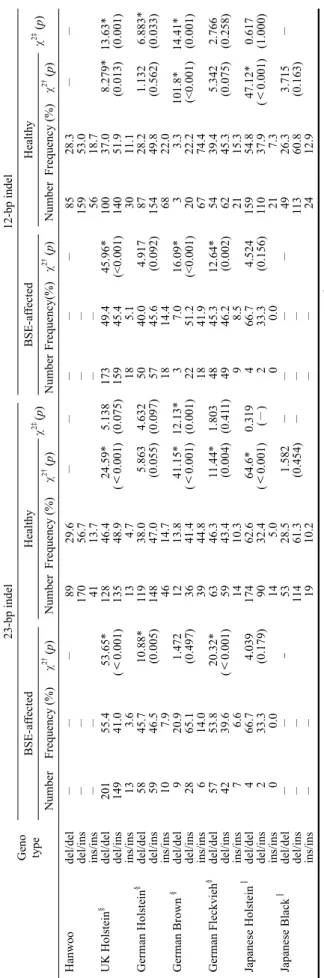
Results of the Chi-square (for 2 × 2 tables) and Fisher’s exact tests revealed significant associations between each polymorphism of the 23-bp and 12-bp indels, and BSE occurrence in the reported populations (Table 4). When comparing the data from the various groups of healthy animals, we found that Hanwoo cattle had a lower deletion frequency (58.0%) of the 23-bp indel polymorphism than all other breeds (70.8% in UK Holstein, 61.7% in German Holstein, 68.0% in German Fleckvieh, 78.8% in Japanese Holstein, and 59.1% in Japanese Black) except for German Brown (34.5%). Additionally, Hanwoo had a lower deletion frequency (54.8%) of the 12-bp indel polymorphism than the other breeds (63.0% in UK Holstein, 62.0% in German Fleckvieh, 73.8% in Japanese Holstein, and 56.7% in Japanese Black) except for German Holstein (53.1%) and German Brown (14.4%).
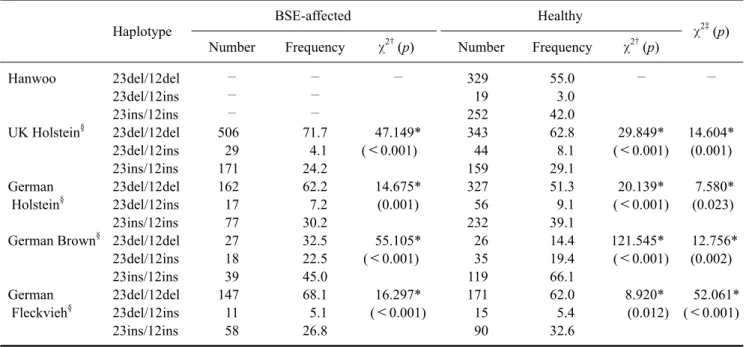
Upon comparing the results from the healthy and BSE-affected groups, we found that both the 23-bp and 12-bp deletion allele frequencies of the BSE-affected group were significantly higher than those of the healthy UK Holstein, German Holstein, and German Brown cattle.
Table 4. Allele frequencies and statistical comparisons for the 23-bp and 12-bp indels Allele
23-bp indel 12-bp indel BSE-affectedHealthy χ2‡ (p)BSE-affectedHealthy χ2‡ (p) NumberFrequency (%) χ2† (p)NumberFrequency (%)χ2† (p)NumberFrequency (%) χ2† (p)NumberFrequency (%)χ2† (p) Hanwoo UK Holstein§ German Holstein§ German Brown§ German Fleckvieh§ Japanese Holstein║ Japanese Black║
del ins del ins del ins del ins del ins del ins del ins
– – 551 175 175 79 46 40 156 56 10 2 – –
– – 75.9 24.1 68.9 31.1 53.5 46.5 73.6 26.4 83.3 16.7 – –
– 48.186* (<0.001) 8.928* (0.003) 0.626 (0.484) 16.161* (<0.001) 3.110 (0.136) –
348 252 391 161 386 240 60 114
185 87 438 118
220 152
58.0 42.0 70.8 29.2 61.7 38.3 34.5 65.5 68.0 32.0 78.8 21.2 59.1 40.9
– 20.589* (<0.001) 1.709 (0.200) 29.928* (<0.001) 7.899* (0.005) 57.243* (<0.001) 0.123 (0.738)
– 4.146* (0.047) 4.094* (0.045) 8.609* (0.005) 1.776 (0.193) 0.146 (1.000) –
– – 505 195 157 93 28 58 145 67 10 2 – –
– – 72.1 27.9 62.8 37.2 32.6 67.4 68.4 31.6 83.3 16.7 – –
– 42.093* (<0.001) 4.574* (0.033) 14.954* (<0.001) 11.859* (0.001) 3.867 (0.075) –
329 271 340 200 328 290 26 154 170 104 428 152 211 161
54.8 45.2 63.0 37.0 53.1 46.9 14.4 85.6 62.0 38.0 73.8 26.2 56.7 43.3
– 7.747* (0.006) 0.379 (0.565) 91.08* (<0.001) 3.992* (0.047) 46.099* (<0.001) 0.331 (0.595)
– 11.834* (0.001) 6.829* (0.010) 11.801* (0.001) 2.115 (0.152) 0.556 (0.740) – Allele frequencies were compared using Fisher’s exact and Chi-square tests. *Cases in which a significant difference (p < 0.05) was observed.† Chi-square test comparing experimental group and Hanwoo cattle (p, p-values from Fisher’s exact tests). ‡ Chi-square test comparing healthy and BSE-affected groups (p, p-values from Fisher’s exact tests). These data were reported by § Juling et al. [16] and ║ Nakamitsu et al. [24]. Table 5. Comparison of genotype frequencies for the 23-bp and 12-bp indels Geno type
23-bp indel
12-bp indel BSE-affectedHealthy χ2‡ (p)BSE-affectedHealthy χ2‡ (p) NumberFrequency (%) χ2† (p)NumberFrequency (%)χ2† (p) NumberFrequency(%)χ2† (p)NumberFrequency (%)χ2† (p) Hanwoo UK Holstein§ German Holstein§ German Brown § German Fleckvieh§ Japanese Holstein║ Japanese Black║
del/del del/
ins
ins/ins del/del del/
ins
ins/ins del/del del/
ins
ins/ins del/del del/
ins
ins/ins del/del del/
ins
ins/ins del/del del/
ins
ins/ins del/del del/
ins ins/ins
− − − 201 149 13 58 59 10 9 28 6 57 42 7 4 2 0 − − −
− − − 55.4 41.0 3.6 45.7 46.5 7.9 20.9 65.1 14.0 53.8 39.6 6.6 66.7 33.3 0.0 − − −
− 53.65* (<0.001
)
10.88* (0.005
)
1.472 (0.497
)
20.32* (<0.001
)
4.039 (0.179
)
–
89 170 41 128 135 13 119 148 46 12 36 39 63 59 14 174 90 14 53 114 19
29.6 56.7 13.7 46.4 48.9 4.7 38.0 47.0 14.7 13.8 41.4 44.8 46.3 43.4 10.3 62.6 32.4 5.0 28.5 61.3 10.2
− 24.59* (<0.001) 5.863 (0.055) 41.15* (<0.001) 11.44* (0.004) 64.6* (<0.001) 1.582 (0.454)
− 5.138 (0.075) 4.632 (0.097) 12.13* (0.001) 1.803 (0.411) 0.319 (−) − −
− − − 173 159 18 50 57 18 3 22 18 48 49 9 4 2 0 − − −
− − − 49.4 45.4 5.1 40.0 45.6 14.4 7.0 51.2 41.9 45.3 46.2 8.5 66.7 33.3 0.0 − − −
− 45.96* (<0.001) 4.917 (0.092) 16.09* (<0.001) 12.64* (0.002) 4.524 (0.156) −
85 159 56 100 140 30 87 154 68 3 20 67 54 62 21 159 110 21 49 113 24
28.3 53.0 18.7 37.0 51.9 11.1 28.2 49.8 22.0 3.3 22.2 74.4 39.4 45.3 15.3 54.8 37.9 7.3 26.3 60.8 12.9
− 8.279* (0.013) 1.132 (0.562) 101.8* (<0.001) 5.342 (0.075) 47.12* (<0.001) 3.715 (0.163)
− 13.63* (0.001) 6.883* (0.033) 14.41* (0.001) 2.766 (0.258) 0.617 (1.000) − Genotype frequencies were compared using Fisher’s exact and Chi-square tests.
†* Cases in which a significant difference (p < 0.05) was observed. Chi-square test comparing experimental group and Hanwoo ‡§║ cattle (p, p-values from Fisher’s exact tests). Chi-square test comparing healthy and BSE-affected groups (p, p-values from Fisher’s exact tests). These data were reported by Juling et al. [16] and Nakamitsu et al. [24].
Table 6. Comparison of haplotype frequencies for the 23-bp and 12-bp indels
Haplotype BSE-affected Healthy
χ2‡ (p) Number Frequency χ2† (p) Number Frequency χ2† (p)
Hanwoo
UK Holstein§
German Holstein§ German Brown§
German Fleckvieh§
23del/12del 23del/12ins 23ins/12ins 23del/12del 23del/12ins 23ins/12ins 23del/12del 23del/12ins 23ins/12ins 23del/12del 23del/12ins 23ins/12ins 23del/12del 23del/12ins 23ins/12ins
−
−
− 506 29 171 162 17 77 27 18 39 147 11 58
−
−
− 71.7
4.1 24.2 62.2 7.2 30.2 32.5 22.5 45.0 68.1 5.1 26.8
−
47.149*
(<0.001) 14.675*
(0.001) 55.105*
(<0.001) 16.297*
(<0.001)
329 19 252 343 44 159 327 56 232 26 35 119 171 15 90
55.0 3.0 42.0 62.8 8.1 29.1 51.3 9.1 39.1 14.4 19.4 66.1 62.0 5.4 32.6
−
29.849*
(<0.001) 20.139*
(<0.001) 121.545*
(<0.001) 8.920*
(0.012)
−
14.604*
(0.001) 7.580*
(0.023) 12.756*
(0.002) 52.061*
(<0.001)
Haplotype frequencies were compared using Fisher’s exact and Chi-square tests. *Cases in which a significant difference (p < 0.05) was observed. †Chi-square test comparing experimental group and Hanwoo cattle (p, p-values for Fisher’s exact tests). ‡Chi-square test comparing the healthy and BSE-affected groups (p, p-values of Fisher’s exact tests). §These data were reported by Juling et al. [16].
Among UK Holstein animals, the 23-bp deletion allele frequencies for the BSE-affected and healthy groups were 75.9 and 70.8% (p < 0.05), respectively, while the 12-bp deletion allele frequencies were 72.1 and 63.0% (p < 0.01), respectively. Among German Holsteins, the 23-bp deletion allele frequencies for the BSE-affected and healthy groups were 68.9 and 61.7% (p < 0.05), respectively, while the 12-bp deletion allele frequencies were 62.8 and 53.1%
(p < 0.05), respectively. For German Brown, the 23-bp deletion allele frequencies for the BSE-affected and healthy groups were 53.5 and 34.5% (p < 0.01), respectively, while the 12-bp deletion allele frequencies were 32.6 and 26.0%
(p < 0.01), respectively.
In addition, the deletion frequencies of the BSE-affected groups in the other two breeds (German Fleckvieh and Japanese Holstein) were higher than those of the healthy groups although this difference was not statistically significant. For German Fleckvieh, the 23-bp deletion allele frequencies for the BSE-affected and healthy groups were 73.6 and 68.0%, respectively, while the 12-bp deletion allele frequencies were 68.4 and 62.0%, respectively. In Japanese Holstein, the 23-bp deletion allele frequencies for the BSE-affected and healthy groups were 83.3 and 78.8%, respectively, and the 12-bp deletion allele frequencies were 83.3 and 73.8%, respectively.
BSE-affected animals of almost all breeds had significantly higher deletion frequencies than the healthy groups for both the 23-bp and 12-bp indel polymorphisms.
Hanwoo cattle had lower deletion frequencies for both the 23-bp and 12-bp indel polymorphisms compared to other breeds. Thus, differences in the deletion frequencies for the 23-bp and 12-bp indels between Hanwoo cattle and BSE-affected animals of other breeds were more significant (for the 23-bp indel: p < 0.001 for UK Holstein, p < 0.01 for German Holstein, and p < 0.001 for German Fleckvieh; for the 12-bp indel: p < 0.001 for UK Holstein, p < 0.05 for German Holstein, p < 0.001 for German Brown, and p < 0.01 for German Fleckvieh).
Genotype frequencies of the 23-bp and 12-bp indel polymorphisms are shown in Table 5. For the 23-bp indel polymorphism in the healthy groups of various breeds, the del/del frequency for Hanwoo cattle was 29.6%. This was significantly lower than those of all other breeds (46.4%
for UK Holstein, 38.0% for German Holstein, 46.3% for German Fleckvieh, and 62.6% for Japanese Holstein) except for German Brown (13.8%) and Japanese Black (28.5%). For the 12-bp indel polymorphism in the healthy animals, the del/del frequency for Hanwoo cattle was 28.3%. This was significantly lower than those of UK Holstein (37.0%), German Fleckvieh (39.4%), and Japanese Holstein (54.8%) but not German Holstein (28.2%), German Brown (3.3%), or Japanese Black (26.3%).
In general, BSE-affected cattle had a relatively higher del/del frequency for both the 23-bp and 12-bp indel polymorphisms than the healthy animals of each breed.
Table 7. Haplotypes and their respective frequencies for Hanwoo, Bos (B.) taurus, and B. indicus
23-bp 12-bp 69 75 108 126 oct 234 339 361 555 576 630 675 678 Frequency (%)
B. indicus* Hanwoo B. taurus*
1 2 3 4 5 6 7 8 9 10 11 12 13 14 15 16 17 18 19
D D D D D D D D D D D D I I I I I I I
D D D D D I I I I I I I I I I I I I I
C C C C C C C C C C C T C C C C C C T
G G G G G G G G G G G G G G G G G A G
T T T T T T T T T T T T T T T T A A T
A A A A A A A A A A A A A A A A G G A
6 6 6 6 6 5 5 6 6 6 6 6 6 6 6 6 6 6 6
A G G G G – – A A A G G A A G G A G G
C T C C C C C C C C C C C C T C C C C
G G G G G G G G G G G G G G G G A A G
C C C C T C C T T C C C C C C C C C C
C C C T C C C C C T C C C C C C C C C
C C C C C C C C T C C C C T C C C C C
C C C C C C C C C C C C C C C C T C C
T T T T T T C T T T T T T T T T C C T
– 1 12 – – – 2 10 14 – 30 17 5 – – – 3 3 –
<1 – 37
– 17
– – – – 2 – – 35
2 – 5 – – –
6 2 40 4 – 3 – – – –
1
<1 38 –
1 2 – –
<1
Total haplotype frequency 97 98 97
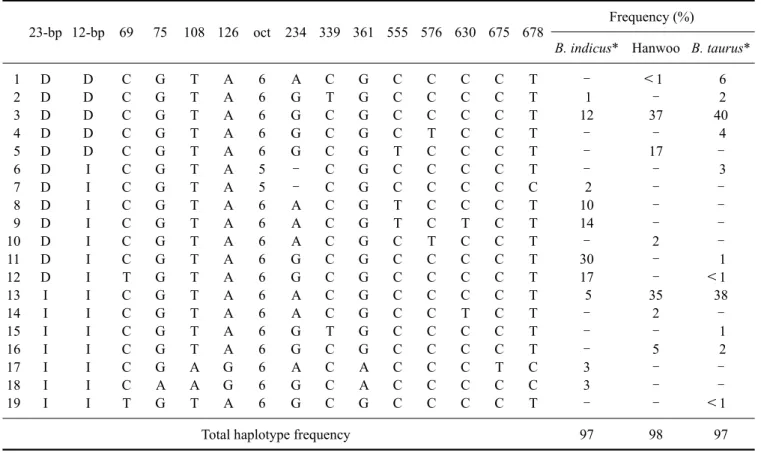
The haplotype positions are the 23-bp and 12-bp insertions (I) or deletions (D), the nucleotide position in the PRNP coding sequence, and the number of octapeptide repeats (oct). *These data were reported by Brunelle et al. [4].
However, differences in the genotype frequencies for the 23-bp indel between the BSE-affected and healthy groups were statistically significant for only German Brown cattle (p < 0.01). Moreover, differences in the genotype frequencies for the 12-bp indel between the BSE-affected and healthy groups were significant among UK Holstein (p < 0.01), German Holstein (p < 0.05), and German Brown (p < 0.01) cattle.
To estimate the combined effect of both the 23-bp and 12-bp indel polymorphisms, we performed a haplotype analysis. The results of this analysis are summarized in Table 6. We observed strong linkage disequilibrium in all populations. The major haplotypes observed were 23 del/12 del, 23 ins/12 ins, and 23 del/12 ins. In contrast, 23 ins/12 del was a minor haplotype (less than 1%) and was thus excluded from further analyses. In all breeds, the 23 del/12 del haplotype frequencies of the BSE-affected groups were higher than those of the healthy groups. On the other hand, the 23 ins/12 ins haplotype frequencies of the BSE-affected groups were lower than those of the healthy groups. The frequencies of the Hanwoo cattle were significantly different (p < 0.05) than those of all other populations.
Haplotype analysis
We analyzed the bovine PRNP haplotype structures by evaluating a combination of SNPs, the number of octapeptide repeats in the prion protein-coding region, and the 23-bp and 12-bp indel polymorphisms in the non-coding region. For clarity, we identified haplotypes with a frequency above 0.01 and found a total of 19 in Hanwoo, B. taurus, and B. indicus (Table 7). Hanwoo and B. taurus had similar patterns of these haplotype frequencies. In particular, haplotypes 3 and 13 were the most frequent in both Hanwoo and B.
taurus (72 and 78% among these populations, respectively) whereas these accounted for only 17% of B. indicus haplotypes. Furthermore, haplotype 5 accounted for 17%
of the haplotypes among the Hanwoo population, but it was rarely observed in either B. taurus or B. indicus.
Discussion
It has been established that polymorphisms in the PRNP gene are associated with susceptibility to prion diseases in humans, sheep, and mice [1,22,38]. Many studies have also explored the relationships between PRNP polymorphisms and BSE susceptibility in cattle
[16,26,33]. The majority of these studies have been focused on investigating both the protein-coding and non-coding regions of the PRNP gene to search for polymorphisms that affect BSE susceptibility. It has been demonstrated that non-synonymous alterations in the protein-coding region of PRNP can cause structural changes whereas nucleotide changes in the regulatory region including the promoter can modulate PRNP expression [33]. Of note, these variations may influence BSE susceptibility or resistance. To date, there are no known polymorphisms associated with susceptibility to BSE in cattle with the exception of the E211K variant, an analogue of the E200K variant in humans that affects CJD [10]. However, E211K has been reported in only two animals, one of which had BSE; this case of BSE was atypical rather than typical [10,25].
In the present study, we identified four variations (G234A, C555T, C576T, and C630T) in the PRNP coding region that were synonymous polymorphisms. In previous studies of the PRNP gene in Hanwoo cattle, only a few genetic variations in the PRNP coding region were reported. Jeong et al. [15] analyzed the open reading frame (ORF) region of the PRNP gene in 120 Hanwoo cattle and found two polymorphisms: the third position of codon 78 (G234A) and the third position of codon 192 (C576T). However, these authors did not find any variation in the octapeptide repeat. These polymorphisms (G234A and C576T), which were also found in our present study, are commonly found in both B. taurus and B. indicus [4]. However, C555T and C630T detected in our study have been previously found only in B. indicus [4]. Two SNPs (A467G and A669C) identified in our study are point mutations because their minor allele frequencies were especially low (less than 0.01) in the experimental population. Thus, our findings indicate that the polymorphisms found in this study cannot induce structural changes in the prion protein.
The octapeptide repeat region near the N-terminal portion of the prion protein has a binding affinity to divalent cations, and may affect protein structure and function [7]. It has been established that this protein commonly have five or six repeats [24]. The presence of extra repeats is correlated with increased TSE susceptibility as has been previously observed in transgenic mice expressing bovine PrPC with four extra octapeptide repeats as well as humans with nine octapeptide repeat insertion in the PRNP gene [6,19]. It has also been shown that Brown Swiss cattle expressing seven octapeptide repeats are more susceptible to BSE than animals of other breeds [4,34,36]. Collectively, these findings indicate that bovine PrPC containing extra octapeptide repeats may enhance susceptibility to BSE. All Hanwoo animals sampled in the present study had six octapeptide repeats, which was different from animals of other breeds with either five or six octapeptide repeats.
Thus, Hanwoo may have a relatively lower risk of being
infected with BSE based on their conserved number of octapeptide repeats encoded in the PRNP gene.
A tentative association between PRNP promoter polymorphisms, including the 23-bp and 12-bp indels, and BSE susceptibility has been previously reported in German cattle [33]. This study revealed that the frequencies of these two polymorphisms are significantly different between BSE-affected and healthy cattle populations in terms of both allele and genotype frequencies. These polymorphisms are thought to be responsible for differences in BSE incubation time and/or susceptibility, but are not involved in resistance to atypical BSE [5,33]. Results of previous reporter gene assays have suggested that both the 23-bp and 12-bp indel polymorphisms are involved in modulating the expression of bovine PRNP [32]. It has been established that the 23-bp indel polymorphism within the 5´-flanking region is responsible for a binding site for the RP58 repressor protein, which is expressed mainly in the brain, and the 12-bp indel polymorphism within intron 1 is responsible for a binding site for the SP1 transcription factor involved in the regulation of numerous promoters [13,32].
Recently, it has been reported that polymorphic differences could be the reason for changes in PRNP expression levels based on the significant correlation between 23-bp indel polymorphisms and PRNP mRNA expression in two Japanese cattle breeds [23]. Thus, the 23-bp deletion can restrict the access of the RP58 repressor and induce overexpression of the prion protein, thereby increasing BSE susceptibility, whereas the 12-bp deletion can decrease PRNP promoter activity and reduce expression of the prion protein [32]. However, the allele frequency of the 12-bp deletion has been shown to be higher in BSE-affected animals than in healthy ones [33]. These apparently contradictory results can be explained by the following logic. First, there is strong linkage between the 23-bp and 12-bp indels. In other words, the rate of crossover between the 23-bp and 12-bp indels is quite low, which leads to linkage disequilibrium. In our haplotype analysis of combinations including both 23-bp and 12-bp indels, we found that the 23 del/12 del and 23 ins/12 ins haplotypes were common (more than 80%) while the 23 del/12 ins frequency was relatively low. Very few cases of the 23 ins/12 del haplotype, which were considered statistically negligible (less than 1%), were observed in the UK Holstein, German Holstein, German Brown, German Fleckvieh, or Hanwoo cattle. Second, the 23-bp deletion seems to have a more crucial role in BSE susceptibility than the 12-bp insertion. According to the reporter gene assays previously performed by Sander et al. [32], the 23 ins/12 ins haplotype showed weaker promoter activity than the 23 del/12 del haplotype although the promoter activity of the 12-bp insertion was stronger than that of the 23-bp deletion.
These results can be explained by the previous finding that, with the 23 ins/12 ins haplotype, SP1 binding on the 12-bp