• 검색 결과가 없습니다.

Utility of Optical Coherence Tomography to Assess a Hazy Intracoronary Image after Percutaneous Coronary Intervention

N/A
N/A
Protected

Academic year: 2022

Share "Utility of Optical Coherence Tomography to Assess a Hazy Intracoronary Image after Percutaneous Coronary Intervention"

Copied!
4
0
0

로드 중.... (전체 텍스트 보기)

전체 글

(1)

44 Copyright © 2013 The Korean Society of Cardiology Korean Circulation Journal

Introduction

During percutaneuos coronary intervention (PCI) procedures, se- veral complications can occur, such as dissections, thrombi, ulcers or plaque, may appear as angiographic hazy or uncertain images. A pro- per diagnosis is important to guide the correct management in the catheterization laboratory and to improve patient outcomes. Angi- ography has important limitations to characterize those entities that, with contrast, can be diagnosed accurately thanks to intravascular imaging.

1)

Among the intracoronary imaging techniques available, intravascular ultrasound (IVUS) and optical coherence tomography (OCT) are the most commonly used for research. Both techniques provide great value for characterization of coronary lesions and for guidance of PCI. IVUS is very useful to measure the vessel wall and to evaluate plaque burden, whereas the OCT (with almost microsco-

Case Report

http://dx.doi.org/10.4070/kcj.2013.43.1.44 Print ISSN 1738-5520 • On-line ISSN 1738-5555

Utility of Optical Coherence Tomography to Assess a Hazy Intracoronary Image after Percutaneous Coronary Intervention

Sebastian Carrizo, MD, Pablo Salinas, MD, Santiago Jimenez-Valero, MD, and Raul Moreno, MD

University Hospital La Paz, Interventional Cardiology Department, Madrid, Spain
Although its use in daily practice is not common, optical coherence tomography (OCT) is a powerful research tool in invasive cardiology. This report describes a hazy angiography image after percutaneous coronary intervention that has been assessed using OCT. Based on the re- sults of the OCT, the patient underwent an elective coronary angioplasty with standard anticoagulation. After implantation of the stent, an intracoronary hazy image was seen on angiography. The use of OCT permitted a correct diagnosis and a successful treatment. This paper provides a discussion of the advantages and disadvantages of OCT, and a comparison with intravascular ultrasound. (Korean Circ J 2013;43:44-47)

KEY WORDS: Tomography, optical coherence; Intravascular ultrasonography; Cardiac catheterization; Thrombosis; Stents.

Received: April 3, 2012 Revision Received: July 11, 2012 Accepted: August 6, 2012

Correspondence: Sebastian Carrizo, MD, University Hospital La Paz, Inter- ventional Cardiology Department, Servicio de Cardiología-Sección de He- modinámica, Paseo de la Castellana 261, 28046-Madrid, Spain

Tel: 34-912071775, Fax: 34-912071775 E-mail: [email protected]

• The authors have no financial conflicts of interest.

This is an Open Access article distributed under the terms of the Creative Commons Attribution Non-Commercial License (http://creativecommons.

org/licenses/by-nc/3.0) which permits unrestricted non-commercial use, distribution, and reproduction in any medium, provided the original work is properly cited.

pic resolution) is an excellent method for characterizing luminal and intimal lesions.

2-4)

Herein, we present a case that illustrates the ability of OCT for ac- curate diagnosis of an intracoronary post-angioplasty that had an uncertain hazy image, and its usefulness as a guide for therapeutic strategy.

Case

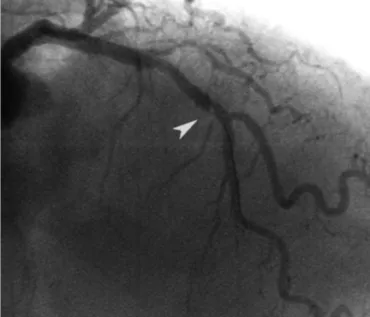
A 73-year-old female patient underwent coronary angiography af- ter being admitted with a non-ST elevation myocardial infarction. We determined that the patient had 2 diseased coronary vessels, with the culprit lesion in the right coronary artery (RCA) and a severe lesion in the left anterior descending artery (LAD) (Fig. 1). We treated the RCA lesion with implantation with a bare metal stent (BMS). We deferr- ed treatment of the LAD lesion for 3 weeks. The patient remained asymptomatic until the second procedure.

Ten hours before the second procedure, the patient was given a sub-cutaneous dose of 1 mg/kg enoxaparin. Following the current recommendation guidelines,

5)

we gave the patient a 0.3 mg/kg en- oxaparine dose by intravenous administration immediately before the angioplasty procedure; we decided against giving the patient un- fractionated heparin. We performed a predilatation procedure using a compliant balloon angioplasty in the LAD without angiographic complications, and after that we implanted a BMS of 2.5×23 mm.

In the control post-PCI angiography, we found a focal, intra-stent re-

pletion defect (Fig. 2), with distal Thrombolysis in Myocardial Infarc-

(2)

45 Sebastian Carrizo, et al.

http://dx.doi.org/10.4070/kcj.2013.43.1.44 www.e-kcj.org

tion 3 flow. Because of the uncertain interpretation by angiography, we decided to perform OCT in order to ascertain the mechanism of the angiographic hazy image (dissection, thrombus, plaque pro- lapse). We used a C7-XR, Saint Jude OCT Frequency Domain System with a Dragon Fly Catheter (St. Jude Medical, St. Paul, MN, USA). The OCT study showed an intra-stent protruding signal rich mass with irregular borders and low-backscattering, a finding compatible with a white thrombus.

The stent was fully expanded but showed some strut malapposi-

tion at the proximal border (Fig. 3). We performed manual throm- bus aspiration and obtained white thrombus material. We postdi- lated the proximal segment of the stent with a non-compliant bal- loon. The final result was significant reduction of the thrombus and correction of the stent malapposition (Fig. 4).

The patient was discharged 3 days after the procedure and did not experience any additional clinical events. At 4 months follow-up, the patient had remained asymptomatic.

Fig. 1. A severe lesion in the middle portion of the left anterior descendent

coronary artery (arrow head). Fig. 2. Intrastent luminal hazy image on the middle portion of the left an- terior descendent coronary artery (arrow head).

Fig. 3. Optical coherence tomography imaging of left anterior descending artery. Distal (A): correct apposition of the stent without intraluminal content.

Middle (B): a signal rich, low-backscattering protrusion image compatible with white thrombus (mark), which occupies the greater part of the vessel lu- men. Proximal (C): stent malapposition (arrow head) in the proximal border, with small images of thrombus.

A   B   C  

(3)

46 Utility of OCT to Assess a Hazy Intracoronary Image

http://dx.doi.org/10.4070/kcj.2013.43.1.44 www.e-kcj.org

Discussion

Acute stent thrombosis may occur in patients, with or without acu- te coronary syndrome.

4)6-12)

Rinaldi et al.

6)

identified 4 independent predictors of stent thrombosis during PCI: higher baseline platelet count, acute myocardial infarction indication, use of a coil or self- expanding stent, and preprocedural thrombus. In this particular case, a great thrombus burden was found during the first acute PCI performed in the RCA, but no angiographic thrombotic images that were found suggested LAD thrombosis prior to PCI. We had not per- formed an initial OCT, so a possible previous thrombus could be pres- ent, but had remained undetected by angiography. However, we consider that a high-risk patient, the stent malapposition and pos- sibly an inadequate anticoagulation could explain the acute stent thrombosis. An alternate explanation, such as prolapsed thrombus, could not be dismissed without a previous OCT.

Hazy angiographic images are a real issue to the invasive cardi- ologist. An incorrect diagnostic leads to an incorrect choice in thera- peutics and potential damage to the patient. The choice of IVUS or OCT in order to obtain a specific diagnosis of an intravascular lesion depends in most of the cases on the availability and or experience in the laboratory. The OCT has a spatial resolution of about 10-15 μm with a penetration depth of 2 to 3 mm. The frequency-domain OCT modality, allows for high-resolution imaging, with pullbacks of 50 mm in less than 3 seconds, with minimum use of contrast and with- out coronary occlusion requirement.

2)3)

OCT allows the characteriz-

ation of histologic composition of the lesion and a precise identific- ation of the luminal border, with high sensitivity to detect tiny dis- sections, plaque prolapse or intraluminal thrombus (even to dis- tinguish white and red thrombus).

2-4)7-12)

In contrast, IVUS has a spatial resolution much lower, around 130 μm, and does not allow the accurate characterization of some intravascular images.

4)8)9)

Comparing both intravascular image techniques and after per- forming PCI in their study, Kawamori et al.

8)

could identify throm- bus in 15% with OCT, and 5% with IVUS. In the setting of PCI for acute coronary syndrome Kubo et al.

9)

could detect thrombus in all patients with OCT, but only in 33% of patients with IVUS.

In this case, discrimination between dissections, plaque prolapsed, or thrombus was crucial to the choice of treatment. A dissection would have required a new stent implantation, and it would certain- ly have contraindicated thrombus aspiration. A plaque prolapse ge- nerally does not require additional treatment.

Optical coherence tomography is a straightforward and useful method to assess misleading angiographic lesions, probably with higher accuracy than IVUS when scanning intravascular or intra- stent images, and may be useful during PCI procedures when an- giography is uncertain.

References

1. Grewal J, Ganz P, Selwyn A, Kinlay S. Usefulness of intravascular ultra- sound in preventing stenting of hazy areas adjacent to coronary stents and its support of support spot-stenting. Am J Cardiol 2001;87:1246-9.

2. Raffel OC, Akasaka T, Jang IK. Cardiac optical coherence tomography.

Heart 2008;94:1200-10.

3. Stamper D, Weissman NJ, Brezinski M. Plaque characterization with optical coherence tomography. J Am Coll Cardiol 2006;47(8 Suppl):

C69-79.

4. Bourantas CV, Garg S, Naka KK, Thury A, Hoye A, Michalis LK. Focus on the research utility of intravascular ultrasound - comparison with oth- er invasive modalities. Cardiovasc Ultrasound 2011;9:2.

5. Popma JJ, Berger P, Ohman EM, Harrington RA, Grines C, Weitz JI. Anti- thrombotic therapy during percutaneous coronary intervention: the Seventh ACCP Conference on Antithrombotic and Thrombolytic Ther- apy. Chest 2004;126(3 Suppl):576S-99S.

6. Rinaldi MJ, Kirtane AJ, Piana RN, et al. Clinical, procedural, and phar- macologic correlates of acute and subacute stent thrombosis: results of a multicenter case-control study with 145 thrombosis events. Am Heart J 2008;155:654-60.

7. Iglesias D, Salinas P, Jiménez-Valero S. Spontaneous coronary artery dissection evaluated by optical coherence tomography. J Cardiovasc Med (Hagerstown) 2011;12:743-4.

8. Kawamori H, Shite J, Shinke T, et al. The ability of optical coherence to- mography to monitor percutaneous coronary intervention: detailed comparison with intravascular ultrasound. J Invasive Cardiol 2010;22:

541-5.

9. Kubo T, Imanishi T, Takarada S, et al. Assessment of culprit lesion mor- Fig. 4. Final optical coherence tomography imaging of the left anterior de-

scending artery. There is almost complete reduction of the thrombus (arrow

head) and correct apposition of the stent.

(4)

47 Sebastian Carrizo, et al.

http://dx.doi.org/10.4070/kcj.2013.43.1.44 www.e-kcj.org

phology in acute myocardial infarction: ability of optical coherence to- mography compared with intravascular ultrasound and coronary an- gioscopy. J Am Coll Cardiol 2007;50:933-9.

10. Kawasaki M, Bouma BE, Bressner J, et al. Diagnostic accuracy of optical coherence tomography and integrated backscatter intravascular ultra- sound images for tissue characterization of human coronary plaques.

J Am Coll Cardiol 2006;48:81-8.

11. Jang IK, Bouma BE, Kang DH, et al. Visualization of coronary athero-

sclerotic plaques in patients using optical coherence tomography:

comparison with intravascular ultrasound. J Am Coll Cardiol 2002;39:

604-9.

12. Prati F, Stazi F, Dutary J, et al. Detection of very early stent healing after primary angioplasty: an optical coherence tomographic observational study of chromium cobaltum and first-generation drug-eluting stents.

The DETECTIVE study. Heart 2011;97:1841-6.

수치

Fig. 1. A severe lesion in the middle portion of the left anterior descendent

참조

관련 문서

Keywords □ acute coronary syndrome, discharge medication patterns, Korea, tertiary hospital, follow-up evaluation, troponin-T,

Therefore, cTnT is a recommended biomarker for use in the detection of myocardial infarction (MI) and in acute coronary syndromes.[8] Indeed, several authors

Undiagnosed malignancy in patients with deep vein thrombosis: incidence, risk indicators, and diagnosis.. Monreal M, Fernandez-Llamazares J, Perandreu

이승석, 김주하, 엄태중, 최은서, “Optical coherence tomography application by using optical phase shift based on fiber optic sensor", Photonics

(Background) Gallbladder wall thickening(GWT) and gallbladder contraction are often observed in patients with acute hepatitis.. The incidence of acute hepatitis A

Connections of wind power system usually occur to voltage drop due to reactive power absorption and sometime result in higher than nominal voltages which may

We propose novel spectral domain polarization sensitive optical coherence tomography with single camera spectrometer including a multiplexed custom grating, camera

The main findings of this study indicate that early arrival from symptom onset, multiple infarctions reflected in less than six pc-ASPECTS, high initial systolic