• 검색 결과가 없습니다.

Resistive index as a predictor of early failure of kidney transplantation

N/A
N/A
Protected

Academic year: 2022

Share "Resistive index as a predictor of early failure of kidney transplantation"

Copied!
5
0
0

로드 중.... (전체 텍스트 보기)

전체 글

(1)

ⓒ 2019 The Korean Society for Transplantation

Resistive index as a predictor of early failure of kidney transplantation

Dai Sik Jeong, WeiJie He, Min Ho Shin, Nam Kyu Choi

Division of Hepato-biliary and Transplantation, Department of Surgery, Chosun University Hospital, Gwangju, Korea

Background: Ultrasonography is a simple and noninvasive examination that can be easily performed after renal transplantation because of the lack of toxicity. The resistive index (RI) was measured using Doppler ultrasound at 7 days postoperatively in patients who underwent renal transplantation. The study aimed to determine the risk of graft loss and premature death within 1 year after transplantation.

Methods: This study was conducted from January 2011 to October 2017 and involved 97 patients who underwent renal trans- plantation at the Chosun University Hospital, Kwangju, Korea. Brain-dead donors were selected. Several parameters were assessed as recipient variables. In addition, postoperative delayed renal function and complications were examined. At 7 days after surgery, the RI was measured in all patients (the mean value of three measurements taken at different positions was used).

Results: Of the 97 patients, 40 had an RI of ≥0.8 or greater. Of these, four patients died, and a total of seven developed transplant failure. Logistic regression analysis was conducted to predict the risk of transplant failure and mortality based on complex influen- ces of the relevant variables. The RI showed a relative risk value of 12.711 for transplant failure (P=0.003) and was significantly associated with mortality (P=0.001).

Conclusions: The RI was highly correlated with graft loss and recipient mortality after renal transplantation. Measurement of the RI after renal transplantation may lead to a more aggressive management of high-risk patients, and consequently improve the post-transplantation outcome.

Keywords: Duplex ultrasonography; Kidney transplantation; Transplant failure; Resistive index

Received April 11, 2019 Revised July 9, 2019 Accepted July 12, 2019

Correspondence to: Nam Kyu Choi

Division of Hepato-biliary and Transplantation, Department of Surgery, Chosun University Hospital, 365 Pilmun-daero, Dong-gu, Gwangju 61453, Korea

Tel: +82-62-220-3068, Fax: +82-62-228-3441 E-mail: [email protected]

INTRODUCTION

Renal transplantation is an established therapeutic option for patients with end-stage renal disease (ESRD). It aims to improve patients’ quality of life and reduce mortality rates [1]. This approach has significantly improved short-term outcomes of kidney transplantation over the past few decades. However, graft loss and premature mortality in transplant recipients are concerns that need to be

addressed.

Ultrasonography is a simple and noninvasive imaging modality that does not involve exposure to ionizing radia- tion and can be safely and easily used in patients under- going renal transplantation [2]. Currently, several trans- plantation centers use the intrarenal resistive index (RI), which is calculated using Doppler ultrasonography, to evaluate renal allografts [3]. In this study, the RI was cal- culated using Doppler ultrasonography on postoperative day 7 in patients undergoing renal transplantation. This study investigated the risk of graft loss and premature mortality within 1 year after transplantation.

METHODS

This study included 145 patients who underwent renal

(2)

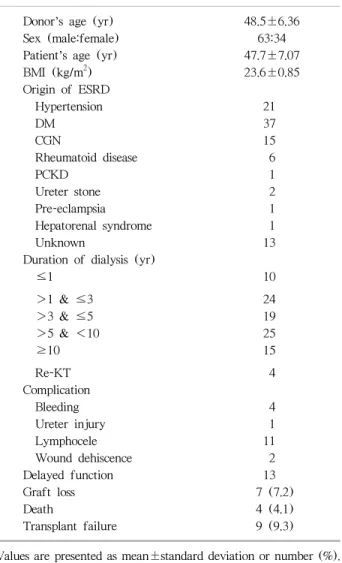
Table 1. Patient’ demographics, origin of ESRD, duration of dialysis, and outcomes

Characteristics Value

Donor’s age (yr) 48.5±6.36

Sex (male:female) 63:34

Patient’s age (yr) 47.7±7.07

BMI (kg/m

2

) 23.6±0.85

Origin of ESRD

Hypertension 21

DM 37

CGN 15

Rheumatoid disease 6

PCKD 1

Ureter stone 2

Pre-eclampsia 1

Hepatorenal syndrome 1

Unknown 13

Duration of dialysis (yr)

≤1 10

>1 & ≤3 24

>3 & ≤5 19

>5 & <10 25

≥10 15

Re-KT 4

Complication

Bleeding 4

Ureter injury 1

Lymphocele 11

Wound dehiscence 2

Delayed function 13

Graft loss 7 (7.2)

Death 4 (4.1)

Transplant failure 9 (9.3)

Values are presented as mean±standard deviation or number (%).

ESRD, end-stage renal disease; BMI, body mass index; DM, diabetes mellitus; CGN, chronic glomerular nephritis; PCKD, polycystic kidney disease; re-KT, underwent retransplantation.

HIGHLIGHTS

 All patients who underwent kidney transplantation were examined for a study of graft failure or mortality.

 The characteristics of each patient, surgical parameters and postoperative complications were investigated.

 Among these, the resistive index measured 7 days after surgery showed significant results in graft failure and mortality.

 Surgical bleeding or postoperative renal function delay did not yield significant results and further research is needed.

transplantation at the Chosun University Hospital, Kwangju, Korea between January 2011 and September 2017.

Deceased-donor and living-donor renal transplantations were performed in 120 and 25 patients, respectively. Only recipients of deceased-donor transplants were selected, and of these, 23 patients were excluded owing to in- sufficient data. Eventually, 97 patients were selected, and their postoperative outcomes were retrospectively investi- gated.

In this study, deceased donors were selected, and the variables analyzed included age and serum creatinine levels. Recipient-associated variables that were analyzed included age, sex, body mass index (BMI), and duration of dialysis. Variables analyzed postoperatively included transfusion within 24 hours after surgery, cold ischemia time, delayed renal function, and complications.

Delayed renal function was defined as the institution of dialysis within 1 week postoperatively. RI was calculated using the following formula: (peak systolic velocity–end diastolic velocity)/peak systolic velocity. The RI was calcu- lated in all patients on postoperative day 7 (the mean val- ue of three measurements obtained in different positions was used).

All statistical analysis was performed using the PASW ver. 18.0 (SPSS Inc., Chicago, IL, USA). Univariate analysis was performed for each recipient-associated variable, and the chi-square test was used to determine the association between these variables and graft loss. Variables showing P≤0.05 were subjected to multivariate logistic regression analysis. Variables showing P-value ≤0.05 were consid-

ered statistically significant. This study was approved by the Institutional Review Board of Chosun University Hospital (IRB No. 2019-02-002-001).

RESULTS

The mean ages of kidney donors and recipients were 48.5

and 47.7 years, respectively. Recipients included 63 men

and 34 women. The mean BMI was 23.6 kg/m

2

, which was

analyzed based on 25 kg/m

2

. Etiopathological contributors

to ESRD included diabetes mellitus (37 patients), hyper-

(3)

Table 2. Factors related to transplant failure and mortality based on chi-square analysis

Factor

Transplant failure Mortality

No. (%) OR (95% CI) P-value No. (%) OR (95% CI) P-value

Sex 1.547 (0.387–6.189) 0.535 0.606 (0.061–6.061) 0.667

Male 5 (7.9) 3 (4.8)

Female 4 (11.8) 1 (2.9)

Age (yr) 0.917 (0.231–3.645) 0.902 3.643 (0.365–36.324) 0.241

<50 5 (9.6) 1 (1.9)

≥50 4 (8.9) 3 (6.7)

BMI (kg/m

2

) 1.628 (0.406–6.521) 0.488 0.635 (0.063–6.358) 0.697

<25 5 (7.8) 3 (4.7)

≥25 4 (12.1) 1 (3.0)

Origin of ESRD 0.080 0.631

HTN 0 0

DM 7 (18.9) 3 (8.1)

CGN 1 (6.2) 0

Others 1 (4.2) 1 (4.2)

Duration of dialysis 0.623 0.911

Cold ischemia time 0.902 0.657

Donor age (yr) 0.389 0.118

Transfusion 8 (15.7) 8.372 (1.004–69.781) 0.022 4 (7.8) 0.052

RI 12.711 (2.437–66.281) 0.001 0.001

<0.8 2 (2.8) 0

≥0.8 7 (26.9) 4 (15.4)

Delayed function 4 (30.8) 7.022 (1.591–30.991) 0.004 2 (15.4) 7.455 (0.952–58.402) 0.028 OR, odds ratio; CI, confidence interval; BMI, body mass index; ESRD, end-stage renal disease; HTN, hypertension; DM, diabetes mellitus;

CGN, chronic glomerular; RI, resistive index.

Table 3. Factors related to transplant failure and mortality based on the logistic regression analysis

Variable

Transplant failure Mortality OR

(95% CI) P-value OR

(95% CI) P-value

Transfusion 0.104 0.187

RI 12.711 (2.437–66.281) 0.003 0.001

Delayed function

0.192 0.482

OR, odds ratio; CI, confidence interval; RI, resistive index.

tension (21), chronic glomerulonephritis (15), rheumatic disease (6), urinary stones (2), polycystic kidney disease, pre-eclampsia, and hepatorenal syndrome (1 each). Four patients had previously undergone transplantation. The duration of dialysis prior to transplantation was classified and analyzed, as shown in Table 1.

The RI was ≥0.8 in 26 patients. Of these 26, nine pa- tients showed delayed renal function. Of the 71 patients in whom the RI was <0.8, four patients showed delayed renal function. Postoperative complications observed in this study included bleeding (4 patients), ureteral injury (1), lymphocele (11), and wound-related issues (2). Graft loss occurred in seven patients. Four patients died within 1 year postoperatively, with a mortality rate of 4.1%.

Pneumonia-induced sepsis and intestinal infarction- in- duced panperitonitis occurred in two patients each.

Transplantation failure was defined as graft loss or death within 1 year after transplantation (nine cases, 9.3%).

Of the 97 patients enrolled in the study, four died and seven developed transplant failure. Transfusion within 24 hours postoperatively was required in 51 patients. Of these, four died, and eight developed transplant failure.

Delayed renal function was defined as initiation of dialysis

within 7 days postoperatively and this occurred in 13

(4)

patients. Of these, two died and four developed transplant failure.

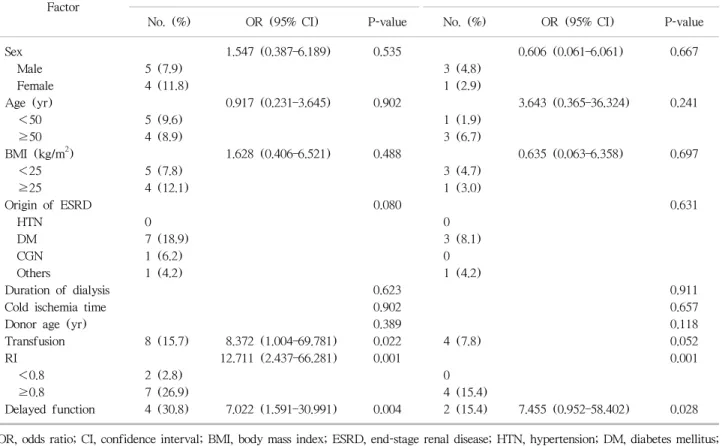
All variables were analyzed using the chi-square test to predict the risk of graft loss and death. The RI was sig- nificantly associated with transplant failure and mortality (P=0.001 for both), as was delayed renal function (P=0.004 and P=0.028, respectively) (Table 2).

Multivariate logistic regression analysis was performed to evaluate the combined effects of variables showing sig- nificant associations in the univariate analysis. Multivariate analysis revealed that the relative risk of the RI was 12.711 for transplant failure (P=0.003) and that RI was sig- nificantly associated with mortality (P=0.001) (Table 3).

However, no statistically significant association was ob- served with transfusion or delayed renal function.

DISCUSSION

Renal allograft dysfunction remains a major concern in pa- tients undergoing transplantation, and early diagnosis is critical to ensure optimal therapeutic outcomes. It is esti- mated that the early acute rejection rate is as high as 20%

of all cases of renal transplantation [4,5].

Ultrasonography combined with spectral and color Doppler imaging has contributed to significant advances in the evaluation of kidney disease over the last few decades. Additionally, ultrasonography may be used as a guide for the rejection of a transplant, kidney biopsy, and percutaneous aspiration of masses in close proximity to the kidneys [6]. Ultrasonography is useful to monitor kid- ney allograft function and related vascular complications following transplantation [7] and enables the rapid diag- nosis of complications that endanger graft survival.

The RI, which is obtained using ultrasonography is a hemodynamic index commonly used to measure blood flow resistance in organs to assess vascular disease. Several studies have reported that an increased RI is diagnostic of acute transplant dysfunction.

However, the usefulness of the RI after kidney trans- plantation remains controversial. In 1990, Perrella et al. [8]

reported that the sensitivity and specificity of the RI in di- agnosing transplant rejection were 43% and 67%, respectively. Other studies have also reported the useful-

ness of the RI; however, the specificity of RI reported by these authors was low [9].

Recent studies have reported that a high RI observed after transplantation can indicate kidney dysfunction [10]

and adverse cardiovascular events [11-13]. A previous cross-sectional study reported an association between an increased intrarenal RI after kidney transplantation and a high risk of graft loss or recipient mortality [14]. In the present study, the high RI observed after renal trans- plantation was associated with delayed graft function and a higher risk of graft loss and recipient mortality.

Currently, several centers use the RI for evaluation of graft dysfunction after kidney transplantation [3]. Several studies have suggested that a high RI is associated with an increased risk of kidney graft dysfunction and early graft loss after transplantation [14-16].

Naesens et al. [17] compared the RI with histopatho- logical findings of renal biopsies and reported that the RI was associated with the recipient’s central hemodynamic factors than with intrarenal disease of the kidney transplant. They concluded that a high RI was strongly as- sociated with graft outcomes (loss or dysfunction) and re- cipient mortality rates. Kolonko et al. [15] reported that a high RI measured during the early posttransplantation period predicts poor kidney graft function and is asso- ciated with an increased risk of all-cause graft loss. They highlighted that the predictive value of the RI is not com- pletely independent of the adverse effects of delayed graft function on premature graft loss.

Several recent studies have established the usefulness of RI. Our study also demonstrates the validity of the RI as a useful tool to predict outcomes after renal transplant- ation. The baseline RI value useful for this purpose re- mains controversial. Based on a RI of 0.9 determined in their study, Perrella et al. [8] concluded that the usefulness of the RI was low. Parolini et al. [12] reported significantly worse outcomes in patients with a RI ≥0.7. Our study showed significant results based on a RI of 0.8.

The effects of a high RI on a transplanted kidney remain unclear. The pathomechanisms associated with specific outcomes after kidney transplantation also remain unknown.

Further research is warranted to determine the optimal

cut-off value of the RI and its effects on transplanted

(5)

kidneys. The RI is significantly associated with graft loss and recipient mortality after renal transplantation and its measurement after transplantation may enable more ag- gressive management of high-risk patients and con- sequently improve post-transplantation outcomes.

ACKNOWLEDGMENTS

Conflict of Interest

No potential conflict of interest relevant to this article was reported.

ORCID

Dai Sik Jeong https://orcid.org/0000-0002-5293-7933 WeiJie He https://orcid.org/0000-0002-9876-9103 Min Ho Shin https://orcid.org/0000-0001-9706-4366 Nam Kyu Choi https://orcid.org/0000-0003-0726-1353

Author Contributions

Conceptualization: NKC. Data curation: WJH. Formal anal- ysis: DSJ. Funding acquisition: NKC. Methodology: DSJ.

Project administration: DSJ. Visualization: DSJ. Writing - original draft: DSJ. Writing - review & editing: MHS.

REFERENCES

1. Wolfe RA, Ashby VB, Milford EL, Ojo AO, Ettenger RE, Agodoa LY, et al. Comparison of mortality in all patients on dialysis, patients on dialysis awaiting transplantation, and recipients of a first cadaveric transplant. N Engl J Med 1999;341:1725-30.

2. Rodgers SK, Sereni CP, Horrow MM. Ultrasonographic eval- uation of the renal transplant. Radiol Clin North Am 2014;52:1307-24.

3. Nankivell BJ, Kuypers DR. Diagnosis and prevention of chronic kidney allograft loss. Lancet 2011;378:1428-37.

4. Fernández-Ibieta M, Nortes-Cano L, Guirao-Piñera MJ, Zambudio-Carmona G, Ruiz-Jiménez JI. Radiation-free monitoring in the long-term follow-up of pyeloplasty: are ultrasound new parameters good enough to evaluate a suc- cessful procedure? J Pediatr Urol 2016;12:230.

5. Matas AJ, Smith JM, Skeans MA, Thompson B, Gustafson SK, Schnitzler MA, et al. OPTN/SRTR 2012 annual data report: kidney. Am J Transplant 2014;14 Suppl 1:11-44.

6. Friedewald SM, Molmenti EP, Friedewald JJ, Dejong MR, Hamper UM. Vascular and nonvascular complications of renal transplants: sonographic evaluation and correlation with other imaging modalities, surgery, and pathology. J Clin Ultrasound 2005;33:127-39.

7. Nezami N, Tarzamni MK, Argani H, Nourifar M. Doppler ultrasonographic indexes in kidney transplant recipients:

its relationship with kidney function. Iran J Kidney Dis 2007;1:82-7.

8. Perrella RR, Duerinckx AJ, Tessler FN, Danovitch GM, Wilkinson A, Gonzalez S, et al. Evaluation of renal transplant dysfunction by duplex Doppler sonography: a prospective study and review of the literature. Am J Kidney Dis 1990;15:544-50.

9. Granata A, Di Nicolò P, Scarfia VR, Insalaco M, Lentini P, Veroux M, et al. Renal transplantation parenchymal com- plications: what Doppler ultrasound can and cannot do.

J Ultrasound 2014;18:109-16.

10. Mehrsai A, Salem S, Ahmadi H, Baradaran N, Taherimahmoudi M, Nikoobakht MR, et al. Role of resistive index measure- ment in diagnosis of acute rejection episodes following suc- cessful kidney transplantation. Transplant Proc 2009;41:

2805-7.

11. Hamano K, Nitta A, Ohtake T, Kobayashi S. Associations of renal vascular resistance with albuminuria and other macroangiopathy in type 2 diabetic patients. Diabetes Care 2008;31:1853-7.

12. Parolini C, Noce A, Staffolani E, Giarrizzo GF, Costanzi S, Splendiani G. Renal resistive index and long-term outcome in chronic nephropathies. Radiology 2009;252:888-96.

13. Okura T, Kurata M, Irita J, Enomoto D, Jotoku M, Nagao T, et al. Renal resistance index is a marker of future renal dysfunction in patients with essential hypertension. J Nephrol 2010;23:175-80.

14. Radermacher J, Mengel M, Ellis S, Stuht S, Hiss M, Schwarz A, et al. The renal arterial resistance index and renal allograft survival. N Engl J Med 2003;349:115-24.

15. Kolonko A, Chudek J, Zejda JE, Wiecek A. Impact of early kidney resistance index on kidney graft and patient survival during a 5-year follow-up. Nephrol Dial Transplant 2012;27:1225-31.

16. Impedovo SV, Martino P, Palazzo S, Ditonno P, Tedeschi M, Giangrande F, et al. Value of the resistive index in patient and graft survival after kidney transplant. Arch Ital Urol Androl 2012;84:279-82.

17. Naesens M, Heylen L, Lerut E, Claes K, De Wever L, Claus F, et al. Intrarenal resistive index after renal transplantation.

N Engl J Med 2013;369:1797-806.

수치

Table 1. Patient’ demographics, origin of ESRD, duration of dialysis, and outcomes
Table 3. Factors related to transplant failure and mortality based  on the logistic regression analysis

참조

관련 문서

4 observed that a CRL discrepancy of 2-6 days smaller than expected is related to an increased risk of LBW (OR 1.7), but is not associated with perinatal death. In preg-