ABSTRACT
Background: The impact of institutional case volume to graft failure rate after adult kidney transplantation is relatively unclear compared to other solid organ transplantations.
Methods: A retrospective cohort study of 13,872 adult kidney transplantations in Korea was performed. Institutions were divided into low- (< 24 cases/year), medium- (24–60 cases/
year), and high- (> 60 cases/year) volume centers depending on the annual case volume.
One-year graft failure rate was defined as the proportion of patients who required dialysis or re-transplantation at one year after transplantation. Postoperative in-hospital mortality and long-term graft survival were also measured.
Results: After adjustment, one year graft failure was higher in low-volume centers significantly (adjusted odds ratio [aOR], 1.50; 95% confidence interval [CI], 1.26–1.78;
P < 0.001) and medium-volume centers (aOR, 1.87; 95% CI, 1.57–2.23; P < 0.001) compared to high-volume centers. Low-volume centers had significantly higher mortality (aOR, 1.75;
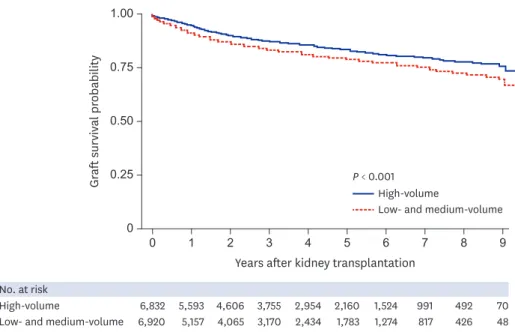
95% CI, 1.15–2.66; P = 0.01) than that of high-volume centers after adjustment. Long-term graft survival of up to 9 years was superior in high-volume centers compared to low- and medium-volume centers (P < 0.001).
Conclusion: Higher-case volume centers were associated with lower one-year graft failure rate, lower in-hospital mortality, and higher long-term graft survival after kidney transplantation.
Keywords: Kidney Transplantation; Case-Volume; One-Year Graft Failure; Mortality
INTRODUCTION
Patient outcome after major surgical procedures were superior in hospitals with experienced surgical teams with higher case volume compared to hospitals with lower case volume.1 Similar correlation has also been shown for solid organ transplantation performed with significantly higher one year mortality rates after liver transplantation and higher one year graft loss after kidney transplantation (KT) in centers with low volume compared to those with high volume.2
Original Article
Received: May 24, 2019 Accepted: Sep 3, 2019 Address for Correspondence:
Ho Geol Ryu, MD, MPH, PhD Department of Anesthesiology and Pain Medicine, Seoul National University College of Medicine, Seoul National University Hospital, 101 Daehak-ro, Jongno-gu, Seoul 03080, Korea.
E-mail: [email protected]
*Hye-Won Oh and Eun Jin Jang equally contributed to this study.
© 2019 The Korean Academy of Medical Sciences.
This is an Open Access article distributed under the terms of the Creative Commons Attribution Non-Commercial License (https://
creativecommons.org/licenses/by-nc/4.0/) which permits unrestricted non-commercial use, distribution, and reproduction in any medium, provided the original work is properly cited.
ORCID iDs Hye-Won Oh
https://orcid.org/0000-0001-9819-5915 Eun Jin Jang
https://orcid.org/0000-0002-9137-9815 Ga Hee Kim
https://orcid.org/0000-0001-8670-9050 Seokha Yoo
https://orcid.org/0000-0003-4679-6027 Hannah Lee
https://orcid.org/0000-0002-4001-1826
Hye-Won Oh ,1,2* Eun Jin Jang ,3* Ga Hee Kim ,4 Seokha Yoo ,1 Hannah Lee ,1 Tae Yoon Lim ,1 Hansol Kim ,1 and Ho Geol Ryu 1
1 Department of Anesthesiology and Pain Medicine, Seoul National University Hospital, Seoul National University College of Medicine, Seoul, Korea
2Department of Anesthesiology and Pain Medicine, Ewha Womans University Seoul Hospital, Seoul, Korea
3Department of Information Statistics, Andong National University, Andong, Korea
4Department of Statistics, College of Natural Sciences, Kyungpook National University, Daegu, Korea
Effect of Institutional Kidney
Transplantation Case-Volume on Post-Transplant Graft Failure:
a Retrospective Cohort Study
Cell Therapy &
Organ Transplantation
Tae Yoon Lim
https://orcid.org/0000-0003-2337-8156 Hansol Kim
https://orcid.org/0000-0001-6006-7280 Ho Geol Ryu
https://orcid.org/0000-0001-8952-6049 Disclosure
The authors have no potential conflicts of interest to disclose.
Author Contributions
Conceptualization: Ryu HG. Data curation: Oh HW, Kim HS, Lee H. Formal analysis: Oh HW, Jang EJ, Yoo S, Lim TY. Methodology: Ryu HG, Jang EJ, Kim GH. Validation: Oh HW, Jang EJ. Writing - original draft: Oh HW. Writing - review & editing: Jang EJ, Ryu HG.
Since the first kidney transplantation in 1954, the number of KTs have significantly increased with more than 80,000 KTs performed worldwide in 2015. According to data from the Korean Network for Organ Sharing, KTs in Korea have more than doubled during the past 10 years from less than 1,000 in 2007 to more than 2,200 in 2016.3 Although the surgical procedure itself is rather straightforward in comparison with other solid organ transplantations, preoperative preparation and postoperative management can often be challenging. Multi-professional expertise is required for optimal patient outcome in preparation and cross-matching before surgery, maintenance of immunosuppressants, prevention and treatment of infection, and monitoring graft function.
KT has both medical and surgical aspects of care. Compared to surgical procedures, the effect of case-volume in medical conditions have not been studied extensively with sporadic reports of lower intensive care unit (ICU) mortality rates in institutions with higher volume of ICU patients4 and higher cure rate of pneumonia associated with physicians who have more experience.5 However, the impact of institutional case volume on graft survival after predominantly living donor KT remains relatively unclear.
We hypothesized that similar to complex surgical procedures and medical conditions, graft survival after KT would be superior in institutions with higher case volume. A national retrospective cohort study was performed to assess the case volume effect on graft survival after KT in Korea.
METHODS
Data source and study population
The National Healthcare Insurance Service (NHIS) database of Korea includes all claims/
reimbursement data for the population contained by the government regulated National Healthcare Insurance (NHI) program and the Medical Aid program. The NHIS database was provided for analysis after de-identification of personal information.6
We identified adult patients (age ≥ 18 years) who received KT between 2007 and 2016 from the NHIS database by searching the NHI procedure code for KT (R3280) during hospitalization.
After identification of adult KT recipients, underlying comorbidities such as coronary artery disease, diabetes mellitus, hypertension, and cardiovascular disease were obtained from the database using International Classification of Diseases (ICD)-10 codes. For adjustment of the disease severity, the Elixhauser comorbidity index, which is originated from thirty disease entities using ICD-10 codes7 and shown to associate with hospital mortality,8 was used as a covariate. The Elixhauser comorbidity index is frequently utilized in health service research to adjust for confounders or to represent patient population characteristics. The Elixhauser comorbidity system may be slightly superior to Charlson comorbidity system when adjusting for comorbidities.9 Because a single KT procedure code was used for both living donor KT and deceased donor KT, anesthesia codes for elective procedures and urgent/emergent procedures were used to classify KTs into elective KT and urgent KT.
Definition of case volume
The definition of case volume was defined as the average number of KT performed per year at each institution. Although each center is assigned a code so that case volume can be determined, the code is de-identified, making it impossible to identify a specific center.
Centers were classified in accordance with case volume as follows; low-volume centers (< 24 KTs/year), medium-volume centers (24–60 KTs/year), and high-volume centers (> 60 KTs/
year). The rationale was that centers performing 2 KTs or less per month could be considered as low-volume centers, whereas centers performing more than 1 KT per week could be considered as high-volume centers.
Outcomes
One year graft survival was the primary outcome, defined as no dialysis requirement or re-transplantation, at one year after KT. Long term graft survival, in-hospital mortality, and hospital length of stay were also collected. Because death certificates are automatically reported to the NHI, mortality was detected when healthcare coverage by the NHI was terminated.
Statistical analysis
Patient characteristics were compared according to case volume using the one-way analysis of variance for continuous variables and χ2 test or Fisher's exact test for categorical variables.
Graft survival after KT according to case volume was assessed using logistic regression model after adjusting age, gender, transplantation period, and Elixhauser comorbidity index. The goodness-of fit for the logistic regression model was assessed using Hosmer-Lemeshow test. Graft survival after KT according to case volume was compared using Cox proportional hazard model after adjusting for age, gender, and Elixhauser comorbidity index.
The graft survival analysis was performed using the log-rank test according to case volume. The goodness-of fit for the Cox proportional hazard model was assessed using the likelihood ratio test and the proportional hazard assumption was explored using the log-minus-log plot. Mean and standard deviations for KT outcomes (hospital length of stay and overall cost) according to case volume were presented and compared using the one-way analysis of variance.
All analyses were performed using SAS 9.4 (SAS Institute, Cary, NC, USA). Results were considered statistically significant when P values were less than 0.05.
Ethics statement
This study was a retrospective cohort study and the study protocol was performed after approval from the Institutional Review Board (IRB) of Seoul National University Hospital (No. 1704-004-840). Informed consent was waived by the IRB.
RESULTS
From 2007 to 2016, a total of 13,872 cases of KT were performed in 74 centers in Korea.
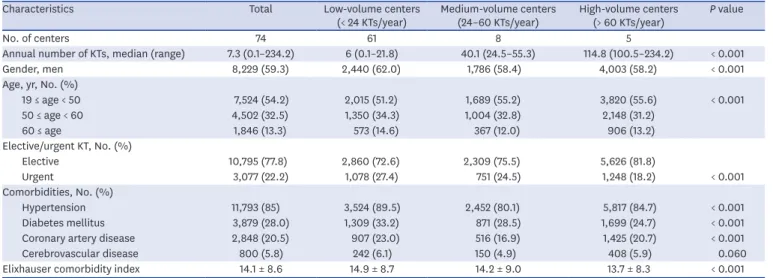
Characteristics of the patient and the center are described in Table 1. The number of KTs significantly increased over time.
The overall one year graft failure rate was 7.0% (811/11,666). One year graft failure rate was significantly lower in the high-volume centers (5.1%) compared to medium-volume (9.7%;
P < 0.001) or low-volume centers (8.2%; P < 0.001) (Table 2 and Fig. 1). Independent risk factors for one year graft failure were KT performed at medium-volume and low-volume centers (adjusted odds ratio [aOR], 1.87; 95% confidence interval [CI], 1.57–2.23; P < 0.001 and aOR, 1.50; 95% CI, 1.26–1.78; P < 0.001, respectively), urgent KT (aOR, 1.93; 95% CI, 1.66–2.25; P < 0.001), and Elixhauser comorbidity index (aOR, 1.01; 95% CI, 1.00–1.02;
P = 0.015). However, 3- and 5-year graft failure rate was significantly higher only in medium- volume centers (aOR, 1.41; 95% CI, 1.21–1.65; P < 0.001 and aOR, 1.23; 95% CI, 1.03–1.47;
P = 0.024, respectively) compared to high-volume centers. Long term graft survival analysis of up to 9 years showed superior results in high-volume centers compared to medium- and low-volume centers as shown in Fig. 2.
In-hospital mortality after KT was higher in old age, urgent KT, and higher Elixhauser comorbidity index (Table 3). After adjustment, low-volume centers had significantly higher mortality compared to high-volume centers (aOR, 1.75; 95% CI, 1.15–2.66; P = 0.010).
Medium-volume centers did not show significant difference. The overall mortality rate after KT was 4.7% (655/13,872) and adjusted risk factors were urgent KT (aOR, 2.01; 95% CI, Table 1. Patient and center characteristics
Characteristics Total Low-volume centers
(< 24 KTs/year) Medium-volume centers
(24–60 KTs/year) High-volume centers
(> 60 KTs/year) P value
No. of centers 74 61 8 5
Annual number of KTs, median (range) 7.3 (0.1–234.2) 6 (0.1–21.8) 40.1 (24.5–55.3) 114.8 (100.5–234.2) < 0.001
Gender, men 8,229 (59.3) 2,440 (62.0) 1,786 (58.4) 4,003 (58.2) < 0.001
Age, yr, No. (%)
19 ≤ age < 50 7,524 (54.2) 2,015 (51.2) 1,689 (55.2) 3,820 (55.6) < 0.001
50 ≤ age < 60 4,502 (32.5) 1,350 (34.3) 1,004 (32.8) 2,148 (31.2)
60 ≤ age 1,846 (13.3) 573 (14.6) 367 (12.0) 906 (13.2)
Elective/urgent KT, No. (%)
Elective 10,795 (77.8) 2,860 (72.6) 2,309 (75.5) 5,626 (81.8)
Urgent 3,077 (22.2) 1,078 (27.4) 751 (24.5) 1,248 (18.2) < 0.001
Comorbidities, No. (%)
Hypertension 11,793 (85) 3,524 (89.5) 2,452 (80.1) 5,817 (84.7) < 0.001
Diabetes mellitus 3,879 (28.0) 1,309 (33.2) 871 (28.5) 1,699 (24.7) < 0.001
Coronary artery disease 2,848 (20.5) 907 (23.0) 516 (16.9) 1,425 (20.7) < 0.001
Cerebrovascular disease 800 (5.8) 242 (6.1) 150 (4.9) 408 (5.9) 0.060
Elixhauser comorbidity index 14.1 ± 8.6 14.9 ± 8.7 14.2 ± 9.0 13.7 ± 8.3 < 0.001
All values for continuous variables are means ± SD and for categorical variables are percentages.
KT = kidney transplantation.
Table 2. One year graft failure after kidney transplantation
Variables One year graft failure rate,
No. (%) Unadjusted Adjusted
OR (95% CI) P value OR (95% CI) P value
Overall 811/11,666 (7.0)
Gender
Men 456/6,899 (6.6) Reference Reference
Women 355/4,767 (7.4) 1.14 (0.98–1.31) 0.081 1.15 (0.99–1.33) 0.066
Age, yr
19 ≤ age < 50 436/6,566 (6.6) Reference Reference
50 ≤ age < 60 271/3,683 (7.4) 1.12 (0.95–1.31) 0.169 1.08 (0.92–1.27) 0.340
60 ≤ age 104/1,417 (7.3) 1.11 (0.89–1.39) 0.342 1.07 (0.85–1.34) 0.569
Elective/urgent KT
Elective 496/8,740 (5.7) Reference Reference
Urgent 315/2,926 (10.8) 2.01 (1.73–2.33) < 0.001 1.93 (1.66–2.25) < 0.001
Case volume
High-volume centers, > 60 KTs/yr 304/5,942 (5.1) Reference Reference
Medium-volume centers, 24–60 KTs/yr 252/2,596 (9.7) 1.99 (1.68–2.37) < 0.001 1.87 (1.57–2.23) < 0.001 Low-volume centers, < 24 KTs/yr 255/3,128 (8.2) 1.65 (1.39–1.96) < 0.001 1.50 (1.26–1.78) < 0.001 Transplantation period
2007–2009 161/2,381 (6.8) Reference Reference
2010–2012 281/4,151 (6.8) 1.00 (0.82–1.22) 0.991 1.01 (0.83–1.24) 0.902
2013–2015 369/5,134 (7.2) 1.07 (0.88–1.29) 0.500 1.10 (0.90–1.34) 0.342
Elixhauser comorbidity index 1.01 (1.00–1.02) 0.015 1.01 (1.00–1.02) 0.017
OR = odds ratio, CI = confidence interval, KT = kidney transplantation.
1.72–2.36; P < 0.001), KT at medium-volume and low-volume centers (aOR, 1.27; 95% CI, 1.04–1.55; P = 0.02 and aOR, 1.38; 95% CI, 1.16–1.65; P < 0.001, respectively), and older age (19–49 vs. 50-59. vs. 60 and above, 2.7% vs. 5.8% vs. 10.5%, aOR, 2.35; 95% CI, 1.95–2.83;
P < 0.001 and aOR, 4.62; 95% CI, 3.78–5.65; P < 0.001, respectively).
The overall hospital length of stay was 28.1 ± 17.7 days. High-volume centers showed a significantly shorter hospital length of stay (27.3 ± 18.5 days) compared to medium- (29.3 ± 16.8 days) or low- (28.7 ± 17.0 days) volume centers (P < 0.001).
0
200 No. of kidney transplantations per year 0
10
1-year graft failure rate, %
30
20
50 100 150
High-volume centers Medium-volume centers Low-volume centers
Fig. 1. Annual number of kidney transplantations and one year graft failure rate.
6,920 5,157 4,065 3,170 2,434 1,783 1,274 817 0 0
3 5 6
1 2 4 7 8 9
1.00
0.75
0.50
aft survival prGrobability 0.25
Years after kidney transplantation P < 0.001
No. at risk
Low- and medium-volume
High-volume 6,832 5,593 4,606 3,755 2,954 2,160 991
426 492
48 70 1,524
Low- and medium-volume High-volume
Fig. 2. Graft survival after kidney transplantation depending on institutional case volume.
DISCUSSION
Our study showed that higher center volume was associated with lower graft failure rate after KT. High-volume centers (> 60 KTs per year), had lower one year graft failure rate after KT compared to low-volume centers (< 24 KTs per year). High-volume centers also showed lower mortality than low-volume centers.
There are a few reports in the literature that evaluated the case volume effect in KTs. The most recent retrospective study evaluated outcomes for adult deceased donor KT over a 15-year study period.10 Of the 206,179 deceased donor KTs analyzed, high-volume centers showed a significantly lower observed-to-expected rates of one year graft loss and one year mortality compared to low-volume centers, which is consistent with our study. In another study of 1,060 KTs performed in Taiwan, high volume centers that have performed more than 72 KTs showed lower mortality and higher 1 to 3 year graft and patient survival rates compared to low volume centers.11 Discrepancies when compared to our study include the use of 72 cumulative cases over 8 years as cutoff between high and low volume centers as opposed to annual case volume of KT and the smaller number of KTs included (1,060 vs.
13,872). In another study regarding case volume effect in pediatric KTs using data from North American Pediatric Transplant Cooperative Study database, high volume centers (>100 KTs) showed lower incidence of graft thrombosis and acute tubular necrosis, and therefore, lower graft failure rates.12 Our study is the largest adult KT study to evaluate the case volume effect in more than 13,000 patients over 10 years and demonstrated improved short-term and long- term graft survival rate in high-volume centers compared to low- or medium-volume centers.
Graft failure after KT impacts the patient's quality of life and long-term survival,13 but studies concerning risk factors of graft failure after KT is limited to specific subpopulations.
A prospective study in deceased donor KT population identified KT from circulatory death donors, expanded criteria donors, and elderly donors, and vascular thrombosis as independent risk factors graft loss within 30 days of KT requiring graft nephrectomy or Table 3. In-hospital mortality after kidney transplantation
Variables In-hospital mortality,
No. (%) Unadjusted Adjusted
OR (95% CI) P value OR (95% CI) P value
Gender
Men 66/8,229 (0.8) Reference Reference
Women 47/5,643 (0.8) 1.04 (0.71–1.51) 0.842 1.14 (0.78–1.67) 0.504
Age, yr
19 ≤ age < 50 28/7,524 (0.4) Reference Reference
50 ≤ age < 60 49/4,502 (1.1) 2.95 (1.85–4.69) < 0.001 2.77 (1.73–4.43) < 0.001
60 ≤ age 36/1,846 (2.0) 5.33 (3.24–8.75) < 0.001 4.72 (2.84–7.86) < 0.001
Elective/urgent KT
Elective 48/10,795 (0.4) Reference Reference
Urgent 65/3,077 (2.1) 4.83 (3.32–7.03) < 0.001 4.58 (3.06–6.87) < 0.001
Case volume
High-volume centers, > 60 KTs/yr 41/6,874 (0.6) Reference Reference
Medium-volume centers, 24–60 KTs/yr 19/3,060 (0.6) 1.04 (0.60–1.80) 0.885 0.93 (0.54–1.61) 0.796
Low-volume centers, < 24 KTs/yr 53/3,938 (1.3) 2.27 (1.51–3.42) < 0.001 1.75 (1.15–2.66) 0.010 Transplantation period
2014–2016 39/5,634 (0.7) Reference Reference
2011–2013 42/4,623 (0.9) 1.32 (0.85–2.04) 0.220 1.00 (0.63–1.60) 0.994
2007–2010 32/3,615 (0.9) 1.28 (0.80–2.05) 0.302 1.21 (0.73–2.01) 0.455
Elixhauser comorbidity index 1.05 (1.03–1.07) < 0.001 1.04 (1.02–1.06) < 0.001
OR = odds ratio, CI = confidence interval, KT = kidney transplantation.
dialysis.14 Although our study did show a higher graft failure rate after urgent KT compared to elective KT, the significance of our study lies in the impact of case volume on both short term and long term graft failure rate and in-hospital mortality. Another study evaluated elderly KT recipients (> 60 years) and showed ABO incompatibility, delayed graft function, cytomegalovirus infection, and hepatitis B virus infection as independent risk factors of graft failure.15
Of note, our study showed a tendency towards increased risk of one year graft failure in women compared to men (6.6% vs. 7.4%, adjusted P = 0.066). Previous reports are conflicting with some showing better graft survival in women16 and others showing better graft survival in men.17 Our results seem to be in accord with the more recent report.17 Other studies regarding the association of physician case volume and in-hospital mortality include children diagnosed with pneumonia. Physicians with more experience in treating children with pneumonia were able to provide better respiratory care, reducing hospital length of stay, in-hospital mortality, and medical costs.18 Patient mortality and risk of graft failure may be dependent on surgical and medical experience of the hospital due to complexity of the surgery and postoperative care. A multicenter retrospective study on noninvasive ventilation use during acute exacerbations of chronic obstructive pulmonary disease suggested that accumulated experience is associated with higher probability of using noninvasive ventilation, which is associated with decreased mortality.19 KT also requires comprehensive post-transplant care and patient follow-up, which may be provided more optimally in high-volume centers where care is more likely to be protocolled and specialized.
Most reported cause of patient mortality after KT include infection, cardiovascular complications, hepatic failure, and malignancy.20,21 In a study of 19,103 KTs performed between 2001 and 2012, reported risk factors of one year mortality were old age, deceased- donor KT, and pre-transplant comorbidities.22 Similarly, risk factors for in-hospital mortality in our study included old age and urgent KT. Deceased donor KT is a well-known risk factor of poor outcome after KT compared to living donor KT.23 Living and deceased donor KT could not be differentiated because the procedure code for living donor KT and deceased donor KT was identical. We attempted to distinguish between living and deceased donor KT by using the elective and urgent/emergent anesthesia codes based on the assumption that deceased donor KTs would carry urgent/emergent anesthesia codes. However, sample hospital based data obtained to verify the assumption showed significant discrepancy between the proportion of deceased donor KTs and KTs with the urgent/emergent anesthesia codes, implying that many deceased donor KTs were performed during routine hours.
However, the center case volume effect on graft failure rate and patient mortality was significant even after adjusting for the urgency of KT in our study.
Because solid organs for transplantation are an extremely valuable resource, developing standards or regulations for identifying qualified transplant centers is reasonable. In the United States, all transplant centers are required to meet quantitative and qualitative standards in order to maintain the status as a transplant center of each solid organ.24 Korea lacks such regulations and solid organ transplantations may be performed with no requirements or performance standards to meet. The one year graft failure rate of up to 30%
and high in-hospital mortality in a number of low volume centers may serve as a starting point for discussions regarding quality control for transplanting scarce solid organs.
There are some limitations to consider in our study. First, the study used administrative data with limited clinical information. However, the completeness of the data, which includes all
KT data performed in Korea for 10 years and no selection bias, and the concrete outcomes evaluated, is likely to suffice in supporting the conclusion. Second, due to lack of previous studies to use as reference, the number of KTs for defining low-, medium-, high-volume center was arbitrary. Centers were classified as high-volume centers when more than one KT was performed per week and as low-volume centers when less than one KT was performed per month.
In conclusion, high-volume centers, performing more than 60 KTs per year, were associated with lower postoperative graft failure rate and lower mortality.
REFERENCES
1. Begg CB, Cramer LD, Hoskins WJ, Brennan MF. Impact of hospital volume on operative mortality for major cancer surgery. JAMA 1998;280(20):1747-51.
PUBMED | CROSSREF
2. Axelrod DA, Guidinger MK, McCullough KP, Leichtman AB, Punch JD, Merion RM. Association of center volume with outcome after liver and kidney transplantation. Am J Transplant 2004;4(6):920-7.
PUBMED | CROSSREF
3. Korean Network for Organ Sharing. http://www.konos.go.kr. Accessed 2019 May 20.
4. Glance LG, Li Y, Osler TM, Dick A, Mukamel DB. Impact of patient volume on the mortality rate of adult intensive care unit patients. Crit Care Med 2006;34(7):1925-34.
PUBMED | CROSSREF
5. Lin HC, Xirasagar S, Chen CH, Hwang YT. Physician's case volume of intensive care unit pneumonia admissions and in-hospital mortality. Am J Respir Crit Care Med 2008;177(9):989-94.
PUBMED | CROSSREF
6. Lee J, Lee JS, Park SH, Shin SA, Kim K. Cohort profile: the National Health Insurance Service-National Sample Cohort (NHIS-NSC), South Korea. Int J Epidemiol 2017;46(2):e15.
PUBMED
7. Quan H, Sundararajan V, Halfon P, Fong A, Burnand B, Luthi JC, et al. Coding algorithms for defining comorbidities in ICD-9-CM and ICD-10 administrative data. Med Care 2005;43(11):1130-9.
PUBMED | CROSSREF
8. Elixhauser A, Steiner C, Harris DR, Coffey RM. Comorbidity measures for use with administrative data.
Med Care 1998;36(1):8-27.
PUBMED | CROSSREF
9. van Walraven C, Austin PC, Jennings A, Quan H, Forster AJ. A modification of the Elixhauser comorbidity measures into a point system for hospital death using administrative data. Med Care 2009;47(6):626-33.
PUBMED | CROSSREF
10. Barbas AS, Dib MJ, Rege AS, Vikraman DS, Sudan DL, Knechtle SJ, et al. The volume-outcome relationship in deceased donor kidney transplantation and implications for regionalization. Ann Surg 2018;267(6):1169-72.
PUBMED | CROSSREF
11. Tsao SY, Lee WC, Loong CC, Chen TJ, Chiu JH, Tai LC. High-surgical-volume hospitals associated with better quality and lower cost of kidney transplantation in Taiwan. J Chin Med Assoc 2011;74(1):22-7.
PUBMED | CROSSREF
12. Schurman SJ, Stablein DM, Perlman SA, Warady BA. Center volume effects in pediatric renal transplantation. A report of the North American Pediatric Renal Transplant Cooperative Study. Pediatr Nephrol 1999;13(5):373-8.
PUBMED | CROSSREF
13. Perl J, Zhang J, Gillespie B, Wikström B, Fort J, Hasegawa T, et al. Reduced survival and quality of life following return to dialysis after transplant failure: the Dialysis Outcomes and Practice Patterns Study.
Nephrol Dial Transplant 2012;27(12):4464-72.
PUBMED | CROSSREF
14. Hamed MO, Chen Y, Pasea L, Watson CJ, Torpey N, Bradley JA, et al. Early graft loss after kidney transplantation: risk factors and consequences. Am J Transplant 2015;15(6):1632-43.
PUBMED | CROSSREF
15. Cho H, Yu H, Shin E, Kim YH, Park SK, Jo MW. Risk factors for graft failure and death following geriatric renal transplantation. PLoS One 2016;11(4):e0153410.
PUBMED | CROSSREF
16. Richie RE, Niblack GD, Johnson HK, Green WF, MacDonell RC, Turner BI, et al. Factors influencing the outcome of kidney transplants. Ann Surg 1983;197(6):672-7.
PUBMED | CROSSREF
17. Lepeytre F, Dahhou M, Zhang X, Boucquemont J, Sapir-Pichhadze R, Cardinal H, et al. Association of sex with risk of kidney graft failure differs by age. J Am Soc Nephrol 2017;28(10):3014-23.
PUBMED | CROSSREF
18. Chen YC, Jeng MJ, Lee YS, Lo YC, Tsao PC, Yang CF, et al. The relationship between physician case volume and in-hospital mortality of critically ill children with a diagnosis of pneumonia: a cross-sectional observational analytical study. J Crit Care 2014;29(6):1046-51.
PUBMED | CROSSREF
19. Dres M, Tran TC, Aegerter P, Rabbat A, Guidet B, Huchon G, et al. Influence of ICU case-volume on the management and hospital outcomes of acute exacerbations of chronic obstructive pulmonary disease. Crit Care Med 2013;41(8):1884-92.
PUBMED | CROSSREF
20. Morales JM, Marcén R, del Castillo D, Andres A, Gonzalez-Molina M, Oppenheimer F, et al. Risk factors for graft loss and mortality after renal transplantation according to recipient age: a prospective multicentre study. Nephrol Dial Transplant 2012;27 Suppl 4:iv39-46.
PUBMED | CROSSREF
21. El-Agroudy AE, Bakr MA, Shehab El-Dein AB, Ghoneim MA. Death with functioning graft in living donor kidney transplantation: analysis of risk factors. Am J Nephrol 2003;23(3):186-93.
PUBMED | CROSSREF
22. Farrugia D, Cheshire J, Begaj I, Khosla S, Ray D, Sharif A. Death within the first year after kidney transplantation--an observational cohort study. Transpl Int 2014;27(3):262-70.
PUBMED | CROSSREF
23. Chkhotua AB, Klein T, Shabtai E, Yussim A, Bar-Nathan N, Shaharabani E, et al. Kidney transplantation from living-unrelated donors: comparison of outcome with living-related and cadaveric transplants under current immunosuppressive protocols. Urology 2003;62(6):1002-6.
PUBMED | CROSSREF
24. Centers for Medicare & Medicaid Services (CMS), Department of Health and Human Services (HHS).
Medicare program; hospital conditions of participation: requirements for approval and re-approval of transplant centers to perform organ transplants. Final rule. Fed Regist 2007;72(61):15197-280.
PUBMED