Introduction
Early stage cervical cancer is treated with radical hysterec- tomy with pelvic lymphadenectomy, and adjuvant therapy is recommended depending on the presence of risk factors for recurrence. Adjuvant radiotherapy is indicated for patients in the intermediate-risk group, which is characterized by the negative pelvic lymph nodes, parametrial invasion, and a combination of specific values of tumor size, lymphovascu- lar space invasion (LVSI), and depth of stromal invasion. The evidence for the efficacy of adjuvant radiotherapy originates from a randomized study, the Gynecologic Oncology Group
The baseline recurrence risk of patients with intermediate-risk cervical cancer
Yutaka Yoneoka, MD
1,2, Mayumi Kobayashi Kato, MD
1, Yasuhito Tanase, MD, PhD
1, Masaya Uno, MD, PhD
1, Mitsuya Ishikawa, MD, PhD
1, Takashi Murakami, MD, PhD
2, and Tomoyasu Kato, MD, PhD
11Department of Gynecology, National Cancer Center Hospital, Tokyo; 2Department of Obstetrics and Gynecology, Shiga University of Medical Science, Shiga, Japan
Objective
This study aimed to investigate the prognosis of patients with intermediate-risk cervical cancer and to evaluate the necessity of adjuvant therapy.
Methods
We conducted a retrospective chart review of patients with stage IB–II cervical cancer who underwent type III radical hysterectomy with pelvic lymphadenectomy between 2008 and 2017. In our institution, radical hysterectomy is performed as an open surgery and not as a minimally invasive surgery, and adjuvant therapy is not administered to patients with intermediate-risk cervical cancer. The intermediate-risk group included patients with 2 or more of the following factors: tumor size >4 cm, stromal invasion >1/2, and lymphovascular stromal invasion. Intermediate- risk patients with squamous cell carcinoma were included in the I-SCC group, whereas those with endocervical adenocarcinoma, usual type, or adenosquamous carcinoma were included in the I-Adeno group.
Results
There were 34 and 18 patients in the I-SCC and I-Adeno groups, respectively. The 5-year recurrence-free survival (RFS) and overall survival rates in the I-SCC group were 90.5% (95% confidence interval [CI], 85.3–95.7%) and 100%
(95% CI, 100%), respectively, whereas those in the I-Adeno group were 54.9% (95% CI, 42.0–67.9%) and 76.1%
(95% CI, 63.7–88.4%), respectively. Multivariate analysis revealed that endocervical adenocarcinoma, usual type, or adenosquamous carcinoma, and tumor size >4 cm had worse RFS.
Conclusion
The I-SCC group had good prognosis without adjuvant therapy; therefore, adjuvant therapy may be omitted in these patients. In contrast, the I-Adeno group had poor prognosis without adjuvant therapy; therefore, adjuvant therapy should be considered in their treatment.
Keywords: Uterine cervical neoplasms; Recurrence; Carcinoma; Squamous cells; Adenocarcinoma
Received: 2020.08.18. Revised: 2020.11.09. Accepted: 2020.11.10.
Corresponding author: Yutaka Yoneoka, MD
Department of Obstetrics and Gynecology, Shiga University of Medical Science, Seta Tsukinowa-cho, Otsu-shi, Shiga 520-2192, Japan
E-mail: [email protected], [email protected] https://orcid.org/0000-0002-8255-6293
Articles published in Obstet Gynecol Sci are open-access, distributed under the terms of the Creative Commons Attribution Non-Commercial License (http://creativecommons.
org/licenses/by-nc/3.0/) which permits unrestricted non-commercial use, distribution, and reproduction in any medium, provided the original work is properly cited.
Copyright © 2021 Korean Society of Obstetrics and Gynecology https://doi.org/10.5468/ogs.20243
eISSN 2287-8580
(GOG) 92 [1,2]. The GOG 92 trial showed that the adjuvant radiotherapy arm had improved progression-free survival compared to the surgery-only arm.
It has been pointed out that the GOG 92 trial had some limitations [3]. The GOG 92 trial was conducted more than 20 years ago, and the diagnostic and treatment techniques were different from those used in the present. Tumor size was estimated visually, and recurrence in the surgery-only arm was poor compared to current expectations. Further- more, the radiotherapy arm tended to have prolonged over- all survival (OS) but did not show significant differences.
We do not perform adjuvant therapy for patients with intermediate-risk cervical cancer at our institution. The prog- noses of patients show the baseline risks of recurrence and death, and the data are based on current diagnostic and therapeutic methods. To the best of our knowledge, prog- nostic data for patients in the intermediate-risk group who had no adjuvant therapy are few in recent years [3,4]. We believe that our prognostic data are valuable for reviewing the GOG 92 trial. The present study aimed to investigate the prognosis of early cervical cancer patients with intermedi- ate risk based on histological types. Moreover, we aimed to evaluate the necessity of adjuvant therapy.
Materials and methods
1. Treatment strategy in our institution
We performed type III radical hysterectomy with pelvic lymphadenectomy for stage IB–II cervical cancer classified according to the International Federation of Gynecology and Obstetrics (FIGO) 2008 system. Radical hysterectomy is per- formed as an open surgery and not as a minimally invasive surgery in our institution. Patients with positive lymph node metastasis, positive parametrial invasion, or positive surgi- cal margin received adjuvant concurrent chemoradiotherapy (CCRT), while the other patients did not.
2. Data collection
We collected cases of patients with stage IB–II (FIGO 2008) cervical cancer who underwent type III radical hysterectomy with pelvic lymphadenectomy between January 2008 and December 2017. Patients with positive lymph node metas- tasis, positive parametrial invasion, positive surgical margins, and ovarian metastasis were excluded. The histological types
included limited squamous cell carcinoma (SCC), endocervi- cal adenocarcinoma, usual type (AC), and adenosquamous carcinoma (AS). Patients’ prognoses, and clinical and tumor pathological information were obtained from medical re- cords, including age, body mass index (BMI), histological type, tumor size, stromal invasion, lymphovascular stromal invasion (LVSI), and vaginal invasion.
3. Statistical analysis
The low-risk group included patients with less than 2 and intermediate-risk group included patients with 2 or more of the following factors: tumor size >4 cm, stromal invasion
>1/2, and LVSI. In the intermediate-risk group, the I-SCC group included patients with SCC, while the I-Adeno group included patients with AC or AS. Similarly, in the low-risk group, the L-SCC group comprised patients with SCC, while the L-Adeno group comprised patients with AC or AS.
Categorical variables were compared using the χ
2test, whereas continuous variables were compared using the Mann-Whitney U test. For survival analysis, recurrence-free survival (RFS) was defined as the period from the date of operation to the date of first recurrence or date of death due to any cause. OS was defined as the period from the date of operation to the date of death of any cause. Survival curves were constructed using the Kaplan-Meier method, and a uni- variate log-rank test was used to assess the statistical signifi- cance. Multivariate analyses for RFS were performed using the Cox proportional hazard model. All statistical analyses were performed using JMP
®15 (SAS Institute Inc., Cary, NC, USA).
Results
1. Study population and clinicopathological characteristics
Overall, 213 patients with stage IB–II cervical cancer who
underwent type III radical hysterectomy with pelvic lymph-
adenectomy were identified during the study period. Of the
213 patients, 128 met the inclusion criteria and 85 were
excluded, as they were classified into the high-recurrence
group or as a rare histologic type (other than SCC, AC, or
AS). A total of 52 patients were included in the intermediate-
risk group, with 34 patients in the I-SCC group and 18 in
the I-Adeno group. There were 76 patients included in the
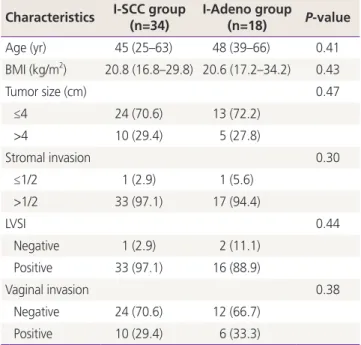
low-risk group, with 38 in the L-SCC group, and 38 in the L-Adeno group (Fig. 1). The characteristics of the I-SCC and I-Adeno groups are summarized in Table 1. The median age was 45 years (range, 25–63 years) and median BMI was 20.8 (range, 16.8–29.8) in the I-SCC group, while in the I-Adeno group, the median age was 48 years (range, 39–66 years) and the median BMI was 20.6 (range, 17.2–34.2). Ten pa- tients (29.4%) had a tumor size >4 cm, 33 patients (97.1%) had stromal invasion >1/2, 33 patients (97.1%) had positive LVSI, and 10 patients (29.4%) had positive vaginal invasion in the I-SCC group. Five patients (27.8%) had tumor size
>4 cm, 17 patients (94.4%) had stromal invasion >1/2, 16 patients (88.9%) had positive LVSI, and 6 patients (33.3%) had positive vaginal invasion in the I-Adeno group. No sig- nificant differences in patient characteristics were observed between the I-SCC and I-Adeno groups. The characteristics of patients within the L-SCC and L-Adeno groups are sum- marized in Supplementary Table 1. The L-Adeno group had a higher proportion of patients with positive vaginal invasion than the L-SCC group (P=0.04).
2. Survival analysis
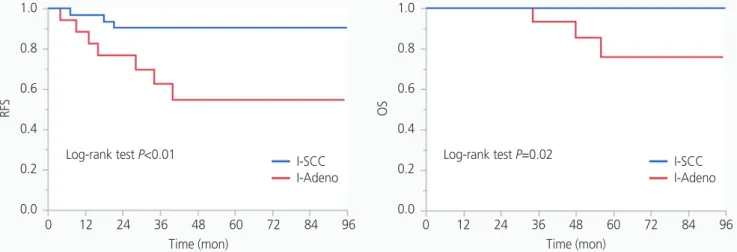
The median follow-up period was 59 months (range, 2–131 months). During the follow-up period, 3 (8.8%) patients had recurrence and no (0.0%) patients died in the I-SCC group, while 7 (38.9%) patients had recurrence and 3 (17.6%) patients died in the I-Adeno group. Kaplan-Meier
estimates of RFS and OS of the I-SCC and I-Adeno groups are presented in Fig. 2. The 5-year RFS and 5-year OS rates of the I-SCC group were 90.5% (95% confidence interval [CI], 85.3–95.7%) and 100% (95% CI, 100%), respectively.
Fig. 1. Number of patients included for analysis. Thirty-four patients were in the intermediate-risk group with squamous cell carcinoma (I-SCC group) and 18 in the intermediate-risk group with endocervical adenocarcinoma, usual type, or adenosquamous carcinoma (I-Adeno group). Thirty-eight patients were in the low-risk group with squamous cell carcinoma (L-SCC group) and 38 in the low-risk group with endocervical adenocarcinoma, usual type, or adenosquamous carcinoma (L-Adeno group). a)Histologic type other than squamous cell car- cinoma, adenocarcinoma, usual type, or adenosquamous carcinoma.
Patients with stage IB-II cervical cancer who underwent type III radical hysterectomy with pelvic lymphadenectomy between January 2008 and December 2017 (n=213)
Intemediate-risk group (n=52)
I-SCC group (n=34) I-Adeno group (n=34)
Low-risk group (n=76)
L-SCC group (n=38) L-Adeno group (n=38) High-risk group (n=68)
Rare histologyic typea) (n=17)
Table 1. Characteristics of intermediate-risk group Characteristics I-SCC group
(n=34) I-Adeno group
(n=18) P-value
Age (yr) 45 (25–63) 48 (39–66) 0.41
BMI (kg/m2) 20.8 (16.8–29.8) 20.6 (17.2–34.2) 0.43
Tumor size (cm) 0.47
≤4 24 (70.6) 13 (72.2)
>4 10 (29.4) 5 (27.8)
Stromal invasion 0.30
≤1/2 1 (2.9) 1 (5.6)
>1/2 33 (97.1) 17 (94.4)
LVSI 0.44
Negative 1 (2.9) 2 (11.1)
Positive 33 (97.1) 16 (88.9)
Vaginal invasion 0.38
Negative 24 (70.6) 12 (66.7)
Positive 10 (29.4) 6 (33.3)
Values are presented as median (range) or number of patients (%).
I-SCC group, intermediate risk group with squamous cell carcinoma;
I-Adeno group, intermediate risk group with endocervical adenocar- cinoma, usual type, or adenosquamous carcinoma; BMI, body mass index; LVSI, lymphvascular space invasion.
On the contrary, the 5-year RFS and 5-year OS rates of the I- Adeno group were 54.9% (95% CI, 42.067.9%) and 76.1%
(95% CI, 63.7–88.4%), respectively. Patients in the I-SCC group had significantly higher RFS and OS than those in the I-Adeno group (P<0.01, P=0.02). In the low-risk group, no patients had recurrence or died in the L-SCC group, and only 1 patient had recurrence and no patients died in the L-Adeno group. There were no significant differences in RFS and OS between the I-SCC and L-SCC groups, while patients in the I-Adeno group had significantly lower RFS and OS than pa- tients in the L-Adeno group (P<0.01, P<0.01). Kaplan-Meier
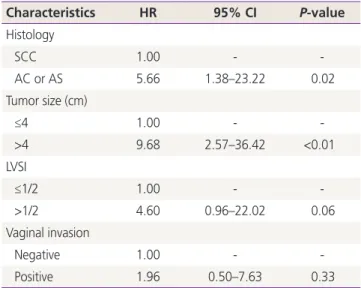
estimates of RFS and OS of the I-Adeno and L-Adeno groups are presented in Fig. 3. Multivariate analysis with histologi- cal type, tumor size, LVSI, and vaginal invasion revealed that histological type and tumor size had a significant effect on RFS (Table 2). Patients with AC or AS had low rates of RFS (hazard ratio [HR], 5.66; 95% CI, 1.38–23.22); patients with a tumor size >4 cm had low rates of RFS (HR, 9.68; 95% CI, 2.57–36.42). As all patients who had recurrence had stromal invasion >1/2 in our study, the HR could not be calculated by the depth of stromal invasion. Thus, we did not include the depth of stromal invasion in the multivariate analysis.
Fig. 2. Kaplan-Meier estimates for recurrence-free survival (RFS) and overall survival (OS) of intermediate-risk group with squamous cell carcinoma (I-SCC group) and intermediate-risk group with endocervical adenocarcinoma, usual type, or adenosquamous carcinoma (I-Adeno group). Patients in the I-SCC group had significantly higher RFS and OS than those in the I-Adeno group (P<0.01, P=0.02).
RFS OS
1.0 0.8 0.6 0.4 0.2 0.0
1.0 0.8 0.6 0.4 0.2
0.0 0 12 24 36 48 60 72 84 96
Time (mon)
0 12 24 36 48 60 72 84 96 Time (mon)
Log-rank test P<0.01 I-SCC Log-rank test P=0.02
I-Adeno I-SCC
I-Adeno
RFS OS
1.0 0.8 0.6 0.4 0.2 0.0
1.0 0.8 0.6 0.4 0.2
0.0 0 12 24 36 48 60 72 84 96
Time (mon)
0 12 24 36 48 60 72 84 96 Time (mon)
Log-rank test P<0.01 L-Adeno Log-rank test P<0.01
I-Adeno L-Adeno
I-Adeno
Fig. 3. Kaplan-Meier estimates for recurrence-free survival (RFS) and overall survival (OS) of intermediate-risk group with endocervical adenocarcinoma, usual type, or adenosquamous carcinoma (I-Adeno group) and low-risk group with endocervical adenocarcinoma, usual type, or adenosquamous carcinoma (L-Adeno group). Patients in the I-Adeno group had significantly lower RFS and OS than those in the L-Adeno group (P<0.01, P<0.01).
3. The outcome of recurrence of cases in the intermediate-risk group with squamous cell carcinoma and intermediate-risk group with endocervical adenocarcinoma, usual type, or adenosquamous carcinoma
The outcomes of recurrence of cases in the I-SCC and I-Adeno groups are shown in Table 3. In the I-SCC group, 3 patients had recurrent disease; 1 involved an intrapelvic
lymph node, 1 involved a para-aortic lymph node, and 1 had vaginal stump recurrence and involved a para-aortic lymph node. These patients received salvage radiotherapy upon recurrence. In the I-Adeno group, 7 patients had recurrent disease; 5 had intrapelvic recurrence and 2 had extrapelvic recurrence, while 3 patients died.
Discussion
Our study showed the baseline recurrence risk of cervical cancer in the intermediate-risk group based on current diag- nostic and therapeutic methods. Regarding SCC, the I-SCC group showed good prognosis without adjuvant therapy and had no significant differences in prognosis compared to the L-SCC group. On the contrary, the I-Adeno group showed a high recurrence rate without adjuvant therapy and had poor prognosis compared to the L-Adeno and I-SCC groups.
The criteria for categorizing patients in the intermediate- risk group of cervical cancer are different in each guideline or study protocol. The National Comprehensive Cancer Network guidelines [5] introduced the Sedlis criteria for intermediate- risk factors, which were adopted in the GOG 92 trial [1,2].
The guidelines defined the intermediate-risk group as in- cluding patients with at least 2 of the following risk factors:
1) greater than one-third stromal invasion, 2) capillary lym- phatic space involvement, and 3) cervical tumor diameters of
>4 cm. The Japan Society of Gynecologic Oncology (JSGO)
Table 2. Multivariate analysis of clinicopathological factors andrecurrence-free survival
Characteristics HR 95% CI P-value
Histology
SCC 1.00 - -
AC or AS 5.66 1.38–23.22 0.02
Tumor size (cm)
≤4 1.00 - -
>4 9.68 2.57–36.42 <0.01
LVSI
≤1/2 1.00 - -
>1/2 4.60 0.96–22.02 0.06
Vaginal invasion
Negative 1.00 - -
Positive 1.96 0.50–7.63 0.33
HR, hazard ratio; CI, confidence interval; SCC, squamous cell car- cinoma; AC, endocervical adenocarcinoma, usual type; AS, adeno- squamous carcinoma; LVSI, lymph-vascular space invasion.
Table 3. Outcome of recurrence cases in the intermediate risk group
Age (yr) Histology Sites of recurrence RFS (mon) Treatment for recurrence
Follow-up
period (mon) Outcome
38 SCC PLN 21 RT 104 Salvaged
32 SCC PALN 18 RT 22 Salvaged
42 SCC Vaginal stump and PALN 7 RT 59 Salvaged
52 AS Vagina 34 Brachytherapy 62 Salvaged
66 AC Vagina 13 Brachytherapy 56 DOD
44 AC Pelvic side wall 16 RT 48 DOD
49 AC Pelvic side wall 40 CCRT 92 Salvaged
41 AS Pelvic side wall 4 RT 34 DOD
48 AC Lung 28 No 48 AWD
56 AS Lung 9 Surgery 69 Salvaged
RFS, recurrence-free survival; SCC, squamous cell carcinoma; AS, adenosquamous carcinoma; AC, endocervical adenocarcinoma, usual type;
PLN, pelvic lymph node; PALN, para-aortic lymph node; RT, radiotherapy; CCRT, concurrent chemoradiotherapy; DOD, died of disease; AWD, alive with disease.