DOI: 10.4196/kjpp.2009.13.6.503
503
ABBREVIATIONS: cAMP, 3',5'-cyclic monophosphate; cGMP, guano- sine 3',5'-cyclic monophosphate; FSK, forskolin; ISO, isoproterenol;
SNP, sodium nitroprusside; ACh, acetylcholine; VDCCL, voltage- dependent L-type calcium current; GI tract, gastrointestinal tract;
ICCMY, interstitial Cells of Cajal in myenteric region; NO, nitric oxide; NANC, non-adrenergic non-cholinergic; PKA, protein kinase A; PKG, protein kinase G; KCa channel, Ca2+ activated K+ channel;
STOC, spontaneous transient outward current; CaMKII, Ca2+/ calmodulin-dependent protein kinase II; [Ca2+]i, intracellular Ca2+; KRB, Krebs-Ringer bicarbonate; EGG, electrogastrograph; VIP, vasoactive intestinal peptide; SR, sarcoplasmic reticulum; IKCa, calcium activated K+ current.
Received November 18, 2009, Revised December 1, 2009, Accepted December 5, 2009
*Corresponding to: Young Chul Kim, Department of Physiology, Chungbuk National University College of Medicine, 12, Gaeshin-dong, Heungduk-gu, Cheongju 361-763, Korea. (Tel) 82-43-261-2859, (Fax) 82-43-261-2859, (E-mail) [email protected]
†Co-corresponding author: Hyo-Yung Yun, (Tel) 82-43-269-6032, (Fax) 82-43-266-6037, (E-mail) [email protected]
Relaxation Patterns of Human Gastric Corporal Smooth Muscle by Cyclic Nucleotides Producing Agents
Young Chul Kim1,*, Woong Choi2,3, Rohyun Sung4, Heon Kim5, Ra Young You1, Seon-Mee Park6, Sei Jin Youn6, Mi-Jung Kim7, Young-Jin Song8, Wen-Xie Xu9, Sang Jin Lee1, and Hyo-Yung Yun8,†
Departments of 1Physiology, 2Pharmacology, 4Pathology, 5Preventive Medicine, 6Internal Medicine, 7Pediatric, and 8Surgery, Chungbuk National University College of Medicine, Cheongju 361-763, 3BK21 Chungbuk Biomedical Science Center, Chungbuk National University, School of Medicine, Cheongju 361-763, Korea, 9Department of Physiology, College of Medicine, Shanghai Jiaotong University, 800 Dongchun Rd. Shanghai, 200240, P.R. China
To elucidate the mechanism of cyclic nucleotides, such as adenosine 3',5'-cyclic monophosphate (cAMP) and guanosine 3',5'-cyclic monophosphate (cGMP), in the regulation of human gastric motility, we examined the effects of forskolin (FSK), isoproterenol (ISO) and sodium nitroprusside (SNP) on the spontaneous, high K+ and acetylcholine (ACh)-induced contractions of corporal circular smooth muscle in human stomach. Gastric circular smooth muscle showed regular spontaneous contraction, and FSK, ISO and SNP inhibited its phasic contraction and basal tone in a concentration-dependent manner.
High K+ (50 mM) produced sustained tonic contraction, and ACh (10 μM) produced initial transient contraction followed by later sustained tonic contraction with superimposed phasic contractions. FSK, ISO and SNP inhibited high K+-induced tonic contraction and also ACh-induced phasic and tonic contraction in a reversible manner. Nifedipine (1 μM), inhibitor of voltage-dependent L-type calcium current (VDCCL), almost abolished ACh-induced phasic contractions. These findings suggest that FSK, ISO and SNP, which are known cyclic nucleotide stimulators, inhibit smooth muscle contraction in human stomach partly via inhibition of VDCCL.
Key Words: Gastricintestinal (GI) tract, Human stomach, Relaxation, Forskolin (FSK), Isoproterenol (ISO), Sodium nitorprusside (SNP), Voltage-dependent L-type calcium current (VDCCL)
INTRODUCTION
Spontaneous rhythmical activity of gastrointesinal (GI) smooth muscle is originated from interstitial cells of Cajal (ICCMY) in myenteric region of GI tract, and regulates GI motility via spreading its pacemaker potential to smooth muscle (Huizinga et al., 1995; Sanders, 1996). In general, GI motility is regulated by various intrinsic and/or extrinsic factors of neurohormones. Among these factors, muscarinic cholinergic contraction and β-adrenergic relaxation as well as production of nitric oxide (NO) are well known (Schultz et al., 1977; Ozaki et al., 1992; Jin et al., 1993; Smith et al., 1993; Severi et al., 2006). Isoproterenol (ISO) and nitric oxide (NO) produce membrane hyperpolarization, decrease slow wave, and then inhibit contraction via activation of adenylate and guanylate cyclase in GI tract (Ozaki et al., 1992; Jin et al., 1993; Smith et al., 1993; Severi et al., 2006).
Especially, NO is recognized as a neurotransmitter of non-
adrenergic non-cholinergic (NANC) nerves in the myenteric plexus throughout the GI tract and is responsible for gastric receptive relaxation (Ozaki et al., 1992; Jin et al., 1993;
Smith et al., 1993; Tonini et al., 2000). In addition, sodium nitroprusside (SNP), known NO-releasing compound, is re- ported to stimulate guanylate cyclase and then increase in- tracellular guanosine 3',5'-cyclic monophosphate (cGMP) levels, while forskolin (FSK) to stimulate adenylate cyclase and then adenosine 3',5'-cyclic monophosphate (cAMP) levels in many smooth muscles, including GI tract (Katsuki et al., 1977; Huizinga et al., 1991; Ozaki et al., 1992; Jin et al., 1993; Smith et al., 1993; Severi et al., 2006). Therefore, the resultant activation of cAMP-dependent protein kinase A (PKA) and cGMP-dependent protein kinase G (PKG) seems to be linked to the inhibitory effects of FSK, ISO and SNP
504 YC Kim, et al
(Schultz et al., 1977; Jin et al., 1993; Smith et al., 1993).
The mechanisms of inhibition of gastric contraction by stimulators of cyclic nucleotides are still under investiga- tions. Hyperpolarization, activation of small and middle con- ductance Ca2+ activated K+ (KCa) channel, activation of spontaneous transient outward current (STOCs), inhibition of voltage-dependent L-type calcium current (VDCCL), and activation of Ca2+/calmodulin-dependent protein kinase II (CaMKII) have been suggested to be involved in the in- hibition mechanism of cAMP and cGMP (Koh and Sanders, 1996; Geeson et al., 2002; Yu et al., 2003; Zhu et al., 2005;
Kim and Perrino, 2007). Therefore, Ca2+ regulation of cAMP- and cGMP-dependent pathways seems to be important in smooth muscle motility. Recently, VDCCL has been described even in human staomach and seems to play an essential role in the regulation of intracellular Ca2+ ([Ca2+]i) (Katzka and Morad, 1989; Koh and Sanders, 1996; Kim et al., 1997;
Kim et al., 2000; Zhu et al., 2005). However, there are some controversies on the inhibition pathways of smooth muscle motility through the regulation of VDCCL and cyclic nucleotides. Hot issues to be considered are: 1) whether the effect is to increase or decrease VDCCL, and 2) whether there are interactions between cAMP- and cGMP-depend- ent pathways (Ohya et al., 1987; Ishikawa et al., 1993; Koh and Sanders, 1996; Ruiz-Velasco et al., 1998; Zhu et al., 2005).
To date, the effect of cAMP and/or cGMP which is asso- ciated with regulation of VDCCL has not yet been evaluated in human gastric smooth muscle. Therefore, we investigated the effects of cAMP and cGMP on human gastric smooth muscle, focusing on the regulation mechanism of VDCCL.
METHODS Tissue preparation
Strips were isolated from the muscle of corpus of human gastric tissues which were obtained from 13 gastric cancer patients. This experimental protocol using human stomach was approved by the Institutional Review Board for Clinical Research of Chungbuk National University College of Medicine, Korea. Specimens were removed from macrosco- pically normal tissue, immediately after surgical operation far from neoplastic area. The mucosal layers in Krebs-Ringer bicarbonate (KRB) solution were removed by scissors. For the measurement of mechanical contractions, muscle strips (0.5×2 cm, 0.5 cm thickness) from the corpus tissue with circular direction were prepared. In this process, a patholo- gist identified each muscle layers including circular smooth muscles, from human tissue using HE staining, and we also checked these muscles by dissecting under microscope. For the measurement of mechanical contractions, circular mus- cle strip from the human stomach was mounted to vertical (25 ml and 75 ml) chambers in isometric contractile meas- uring system. In this system, one end of tissue was tied tightly to fixed holder, and the other side was connected by hook type of holder to force transducer (Harvard, USA).
Force transducer was connected to PowerLab-Data Acquisi- tion System and Charter v5.5 software (ADinstruments, Colorado, USA) with IBM compatible computer for measur- ing isometric contraction. Each strip was stretched pas- sively to resting tension after 1.5∼2 hours of equilibration.
Then, contractile responses of the strip to high K+ (50 mM) were repeated two or three times until the responses were
reproducible before main experiment.
Solution and drugs
KRB solution (CO2/bicarbonate-buffered Tyrode) contained (in mM): NaCl 122, KCl 4.7, MgCl2 1, CaCl2 2, NaHCO3
15, KH2PO4 0.93, and glucose 11 (pH 7.3∼7.4, bubbled with 5% CO2/95% O2). Equimolar concentration of Na+ was re- placed by K+ for making high K+ (50 mM) solution. The external solution was changed by solutions which had pre- viously been incubated (bubbled with 5% CO2/95% O2, 36oC) in water bath before the application. All drugs used in this study were purchased from Sigma.
Statistics
The data are expressed as means±SEM. Statistical sig- nificance was estimated by Student’s t-test. p<0.05 was considered to be statistically significant.
RESULTS
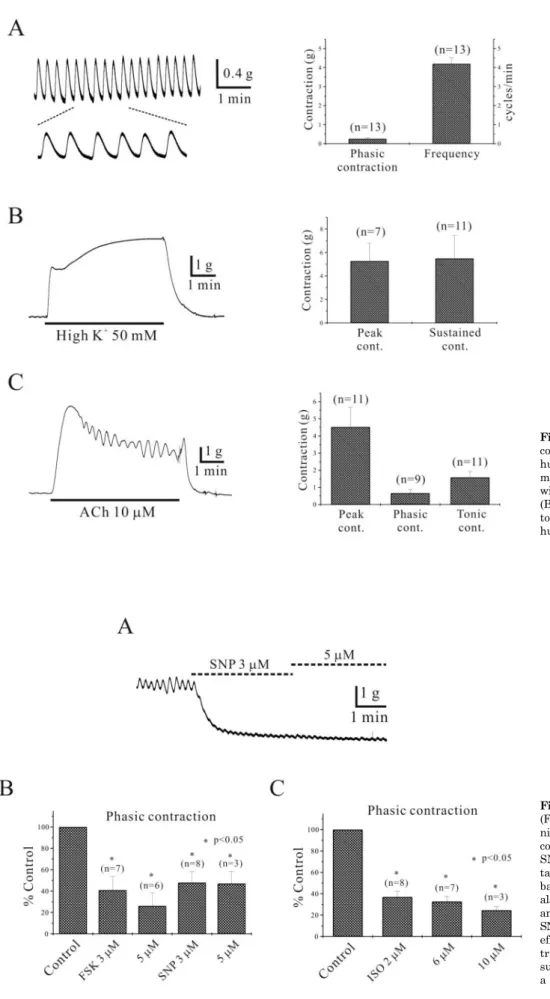
Isometric contraction of human gastric smooth muscle Isometric contractile response of human gastric corporal circular smooth muscle was studied. Human stomach showed spontaneous contraction of 0.3±0.07 g with a fre- quency of 4.2±0.32 cycles/min (n=13, respectively; Fig. 1A).
As shown in Fig. 2, high K+ (50 mM) reversibly produced tonic contraction. High K+ (50 mM) produced phasic and sustained tonic contraction of 5.3±1.54 g and 5.5±1.95 g, respectively (n=7 and 11, respectively; Fig. 1B). Application of ACh (10 μM) also produced initial transient contraction and then phasic and sustained tonic contractions of 4.5±
1.16 g, 0.7±0.22 g and 1.6±0.34 g, respectively (n=11, 9 and 11, respectively; Fig. 1C). The inhibitory effect of nifedi- pine (1 μM), which is known to inhibit voltage-dependent L-type calcium current (VDCCL) on ACh-induced phasic contraction, was also studied. Nifedipine (1 μM) inhibited ACh- induced phasic contraction to 1.7±1.71% of the control (n=4, p<0.05). Post-application of 1 and 2 μM nifedipine inhibited phasic contractions from 1.2±0.45 g to 0.03±0.03 g and 0.05±0.03 g, respectively (n=6, 4 and 6, respectively;
data not shown). ACh-induced sustained tonic contraction was decreased by nifedipine, however, not completely blocked. Nifedipine (1 and 2 μM) inhibited ACh-induced tonic contraction to 54.5±11.32% and 57.7±11.72% of the control (n=4, respectively; p<0.05; data not shown).
Effect of forskolin (FSK), isoproterenol (ISO) and sodium nitroprusside (SNP) on spontaneous contraction of human gastric corporal circular smooth muscle As shown in Fig. 2, FSK, ISO and SNP produced relaxa- tion of human stomach in a reversible manner. The sponta- neous contractions were inhibited to 40.9±12.87% and 26.1±11.98% of the control at 3 and 5 μM FSK, respectively (n=7 and 6, respectively; p<0.05; Fig. 2B),while basal tone was decreased by 5.0±0.14 g and 0.8±0.26 g, respectively (n=7 and 6, respectively; p<0.05; data not shown). Even though data not shown, 0.1 and 10 μM FSK inhibited spon- taneous contraction to 88.5±1.30% and 0% of the control, respectively (n=3 and 2, respectively; p<0.05), while basal tone was decreased by 0.2±0.07 g and 0.32±0.01 g, respec-
Fig. 1. Characterization of gastric corporal circular muscle motility in human. (A) Human gastric smooth muscle shows regular contraction with 0.3 g and 4.2 cycles/min (n=13).
(B, C) High K+ and ACh produce tonic and phasic contraction in human stomach (n=7∼11).
Fig. 2. Inhibitory effect of forskolin (FSK), isoproterenol (ISO) and sodium nitroprusside (SNP) on spontaneous contraction of human stomach. (A) SNP (3 and 5 μM) inhibited spon- taneous contraction and decreased basal tone of human stomach. FSK also inhibited spontaneous contraction and the inhibitory effects of FSK and SNP are summarized in (B). Inhibitory effect of ISO on spontaneous con- traction of human stomach is also summarized in (C). Asterisks show a statistical significance (p<0.05).
506 YC Kim, et al
Fig. 3. Effect of FSK, ISO and SNP on high K+-induced contraction in human stomach. (A) High K+ (50 mM) produced tonic contraction in human stomach, and it was inhibited by 3, 5 and 10 μM FSK to 53%, 51% and 23% of the control, respectively (n=3∼4). (B) 3, 5 and 10 μM SNP inhibited high K+ (50 mM)-induced contraction to 65%, 54% and 46% of the control, respectively (n=4∼5). Inhibitory effects of FSK, SNP and ISO on high K+ (50 mM)-induced contraction of human stomach are summarized in (C∼E). Asterisks show a statistical significance (p<0.05).
tively (n=3 and 2, respectively; p<0.05; data not shown).
As shown in Fig. 2C, ISO also inhibited gastric contraction:
2, 6 and 10 μM ISO inhibited spontaneous contractions to 37.0±5.36%, 32.7±4.83% and 24.6±3.44% of the control (n=8, 7 and 3, respectively; p<0.05; Fig. 2C), while basal tone was decreased by 0.4±0.08 g, 0.6±0.12 g and 0.6±0.4 g, respectively (n=8, 7 and 3, respectively; p<0.05; data not shown). In two cases, 0.5 μM ISO also inhibited sponta- neous contraction and basal tone to 43.6±4.01% of the con- trol and by 0.3±0.19 g, respectively (data not shown). SNP (3 and 5 μM) also inhibited spontaneous contractions to 47.9±10.42% and 47.0±11.33% of the control respectively (n=8 and 3, respectively; p<0.05; Fig. 2A and B) and basal tone was decreased by 0.7±0.16 g and 1.1±0.24 g, respec- tively (n=8 and 3, respectively; p<0.05; data not shown).
SNP (0.1 μM) also inhibited spontaneous contraction and basal tone to 82.2±8.93% of the control and by 0.1±0.01 g, respectively (n=2; data not shown).
Effect of FSK and SNP on high K+ (50 mM)-induced contraction in human stomach
As shown in Fig. 3, FSK, ISO and SNP inhibited high
K+ (50 mM)-induced contraction in human stomach. In gen- eral, high K+ (50 mM) produced initial peak, followed by sustained tonic contraction of 5.3±1.54 g and 5.5±1.95 g (n=7 and 11, respectively). FSK (3, 5 and 10 μM) inhibited high K+ (50 mM)-induced contraction to 52.8±10.97%, 51.2±15.30% and 23.2±15.65% of the control, respectively (n=3, 4 and 4, respectively; Fig. 3A and 3C). SNP (3, 5 and 10 μM) inhibited high K+ (50 mM)-induced contraction to 64.5±11.72%, 54.4±7.28% and 45.7±9.04% of the control, respectively (n=4, 5 and 4, respectively; Fig. 3B and 3D).
As shown in Fig 3E, 1, 2, 6 and 10 μM ISO also inhibited high K+ (50 mM)-induced contraction to 72.9±8.76%, 79.6±8.40%, 68.5±9.06% and 80.7±9.76% of the control, re- spectively (n=3, 5, 3 and 4, respectively; p<0.05).
Effect of FSK and SNP on acethylcholine (ACh)-induced contraction in human stomach
FSK, ISO and SNP inhibited ACh-induced contraction in a concentration-dependent manner. ACh-induced phasic contraction was inhibited to 58.3±11.46%, 44.7±1.00% and 0% of the control at 3, 5 and 10 μM of FSK, respectively (n=3, respectively; p<0.05; Fig. 4A and 4B). Furthermore,
Fig. 4. Effects of FSK, ISO and SNP on acethylcholine (ACh)-induced con- traction in human stomach. FSK, ISO and SNP inhibited ACh-induced con- traction in a concentration-dependent manner. (A) FSK (3, 5 and 10 μM) inhibited ACh-induced phasic and tonic contraction (n=3∼5). Inhibitory effect of FSK on ACh-induced con- traction is summarized in (B). Similar inhibitory effect on ACh-induced con- traction by both SNP and ISO was observed, as shown in (C) and (D).
Asterisks show a statistical signifi- cance (p<0.05).
ACh-induced sustained tonic contraction was inhibited to 46.2±14.25%, 19.2±13.84% and 11.3±13.66% of the control at 3, 5 and 10 μM of FSK (n=5, 5 and 4, respectively; p
<0.05; Fig. 4A and 4B). ISO and SNP also inhibited ACh-induced phasic contraction: 2, 6 and 10 μM ISO in- hibited ACh-induced phasic contraction to 41.5±13.81%, 45.2±10.09% and 42.3±11.96% of the control, respectively (n=5, 4 and 4, respectively; p<0.05; Fig. 4C). In the case of ACh-induced sustained tonic contraction, 2, 6 and 10 μM ISO inhibited the contraction to 49.4±11.20%, 40.3±13.77%
and 55.9±7.70% of the control (n=5, 4 and 4, respectively;
p<0.05; Fig 4C). Meanwhile, SNP (3 μM) significantly in- hibited ACh-induced phasic contraction to 11.3±8.25% and
−0.5±0.09 g, respectively (n=6; p<0.05; Fig. 4D). In the absence of SNP, ACh-induced phasic and tonic contraction were 0.8±0.32 g and 0.4±0.15 g (n=6, respectively). Post- application of SNP inhibited phasic and tonic contraction to 0.03±0.02 g and −0.5±0.09 g, respectively (n=6; p<0.05;
Fig. 4D).
DISCUSSION
In the present study, we found that FSK, ISO and SNP, known to increase cyclic nucleotides (cAMP and cGMP), in- hibited spontaneous contraction of the corporal circular smooth muscle in human stomach. In addition, FSK, ISO and SNP inhibited high K+- and ACh-induced contraction which has been shown to be activated by Ca2+ influx through VDCCL. These findings suggest that FSK-, ISO- and SNP-induced inhibition of human stomach smooth muscle contractions is associated partly with the inhibition of VDCCL. To our best knowledge, this study is the first report to show that inhibition of VDCCL is responsible for FSK-, ISO- and SNP-induced inhibition of human gastric smooth muscle contractions.
Most mechanical and electrical properties in human GI tract have been investigated using electrogastrograph (EGG) and ultrasonography (Hocke et al., 2009; Matsumoto et al., 2009), although several in vitro GI motility studies have been reported (Tonini et al., 2000; Farrelly et al., 2003;
508 YC Kim, et al
Severi et al., 2006; Wang et al., 2007). In this in vitro study, we first characterized mechanical properties. As shown in Fig. 1A and 1B, isolated circular muscle contracted rhyth- mically, and sustained tonic contraction was induced by high K+ (50 mM) (Ozaki et al., 1992). Furthermore, 10 μM ACh also induced initial transient contraction, followed by sustained tonic contraction later with superimposed phasic contractions (Fig. 1C) (Sato et al., 1994). Phasic component was blocked by 1 μM nifedipine (data not shown), however, ACh-induced sustained tonic contraction was partially in- hibited: 55% and 58% of the control by 1 and 2 μM nifedi- pine, respectively.
Many studies have suggested ISO and vasoactive in- testinal peptide (VIP) as mediators of relaxation in several types of smooth muscle (Schultz et al., 1977; Jin et al., 1993;
Smith et al., 1993; Severi et al., 2006). β-Adrenergic nerve and VIP containing neurons in myenteric plexus, which project to the smooth muscle layers, have been reported to exist in the gut, and their stimulation inhibits slow wave and contraction via increasing cAMP and/or cGMP (Andersson and Nilsson, 1972; Jin et al., 1993; Smith et al., 1993).
Furthermore, FSK and SNP, cyclic nucleotide (cAMP and cGMP) activators, have also been shown to inhibit electrical and contractile activity of GI smooth muscle (Huizinga et al., 1991; Ozaki et al., 1992; Jin et al., 1993; Smith et al., 1993; Kim et al., 2006; Severi et al., 2006). In the present study, we found the inhibitory effect of ISO in human stom- ach: ISO inhibited spontaneous contraction and basal tone in a reversible manner (Fig. 2C). Even if data not shown, 2 and 6 μM ISO inhibited the frequency of contraction, however, it was not significant (n=7 and 6, respectively; p>
0.05). FSK (3 and 5 μM) and SNP (3 and 5 μM) also in- hibited the frequency of contraction (n=6, 5, 8 and 3, re- spectively; p>0.05). And ISO significantly inhibited high K+- induced contraction and ACh-induced phasic contraction (Fig. 3E and 4C, respectively). It is generally known that increased cAMP and cGMP by FSK and SNP produced re- laxation via activation of PKA and PKG in smooth muscle, respectively (Schultz et al., 1977; Jin et al., 1993; Smith et al., 1993). As shown in Fig. 2A and 2B, FSK and SNP inhibited spontaneous contraction of human gastric corporal smooth muscle in a reversible manner: FSK (3 and 5 μM) inhibited spontaneous contraction to 41% and 26% of the control, respectively (Fig. 2B), while decreasing basal tone by 0.5 g and 0.8 g, respectively. Meanwhile, SNP (3 and 5 μM) also inhibited spontaneous contraction to 48% and 47% of the control (Fig. 2B), while decreasing basal tone by 0.7 g and 1.1 g, respectively. Since these stimulators are known to inhibit slow wave and produce hyperpolarization, then suppressing contraction, it inhibits phasic contraction and basal tone in GI tract (Andersson and Nilsson, 1972;
Jin et al., 1993; Smith et al., 1993). These findings imply that cyclic nucleotide activators such as FSK and SNP play an inhibitory role for basal tone as well as spontaneous con- traction in human stomach (Huizinga et al., 1991; Ozaki et al., 1992; Jin et al., 1993; Smith et al., 1993; Kim et al., 2006; Kim and Perrino, 2007).
To date, several mechanisms have been suggested to ex- plain cAMP and/or cGMP-induced relaxation of smooth muscles. For the cAMP-induced relaxation: 1) decrease of Ca2+ influx (Bulbring and Tomita, 1980; Ozaki et al., 1992;
Smith et al., 1993; Koh and Sanders, 1996; Zhu et al., 2005), and 2) regulation of sarcoplasmic reticulum (SR) Ca2+ up- take and Ca2+ extrusion (Casteels and Raeymakers, 1979;
Meisheri and van Breemen, 1982; Nishimura and van
Breemen, 1989). For the cGMP-mediated relaxation: 1) de- crease of Ca2+ influx (Ozaki et al., 1992; Quignard et al., 1997; Ruiz-Velasco et al., 1998; Geeson et al., 2002; Zhu et al., 2005), 2) increase of sarcoplasmic reticulum (SR) Ca2+
uptake, 3) involvement of protein kinase (Kim et al., 2006;
Kim and Perrino, 2007), and 4) increase of calcium acti- vated K+ current (IKCa) (Yu et al., 1993; Geeson et al., 2002;
Kim et al., 2006). Therefore, the inhibitory effect of cAMP and/or cGMP on smooth muscle motility seems to be asso- ciated with regulation of Ca2+ homeostasis. In general, pha- sic contraction of GI tract produces peristaltic contraction of stomach which is responsible for gastric function such as gastric emptying (Kelly and Code, 1971). Since slow wave from ICCMY activates VDCCL and generates phasic contraction of smooth muscle, the investigation of VDCCL
regulation pathway appears to be basic for understanding gastric functions (Kelly and Code, 1971). VDCCL has re- cently been described in GI smooth muscles (Katzka and Morad, 1989; Zhu et al., 2005), and seems to play an essen- tial role in the regulation of intracellular Ca2+ ([Ca2+]i) (Kim et al., 1997).
At present, regulation mechanism of VDCCL by cAMP and/or cGMP in GI smooth muscle seems complicated. In canine colon, cGMP pathway inhibited VDCCL, whereas cAMP at low concentration increased VDCCL and decreased VDCCL at high concentration. Thus, ‘cross-activation of kin- ase hypothesis’ was proposed, by which cAMP affects also cGMP-dependent pathway (Koh and Sanders, 1996; Ruiz- Velasco et al., 1998). In fact, it was reported that cAMP and cGMP were activated by VIP, and that cAMP increasd VDCCL in vascular smooth muscle (Ishikawa et al., 1993;
Taguchi et al., 1997). Recently, however, separate cAMP- PKA- and cGMP-PKG-dependent VDCCL inhibition path- ways have been reported (Ohya et al., 1987; Muraki et al., 1993; Zhu et al., 2005), whereas dehydropyridine-sensitive VDCCL has already been isolated in human gastric smooth muscle cells in 2000 (Kim et al., 2000). Neveetheless, the relationship between VDCCL and cAMP/cGMP in human stomach has not yet been evaluated. In the present study, therefore, we studied the effects of cAMP and/or cGMP on human gastric motility, based on the regulation mechanism of VDCCL (Fig. 3). However, we did not study the direct effect of cAMP and/or cGMP on VDCCL in human stomach in this study. Therefore, we plan to elucidate this mecha- nism in future.
In the present study, the relationship between FSK-, ISO- and SNP-induced relaxation and inhibition of Ca2+
influx was studied by high K+- and ACh-induced con- tractions. FSK (Fig. 3A and 3C), SNP and ISO (Fig. 3B, 3D and 3E) significantly inhibited high K+ (50 mM)-in- duced contraction. Since high K+ produces contraction through membrane depolarization which is ascribed to the activation of VDCCL, the inhibition of VDCCL seems to be one of the plausible mechanism to explain relaxation by FSK, SNP and ISO in human gastric corporal smooth muscle. In GI smooth muscle, VDCCL is known to be linked to ACh-induced phasic contraction, and ACh is known also to regulate Ca2+ current in GI smooth muscle (Sato et al., 1994). As shown in Fig. 1C, ACh produced typical con- traction patterns, which were composed of initial transient contraction, followed by sustained tonic contraction later with superimposed phasic contractions. Nifedipine (1 μM) inhibited ACh-induced phasic contraction to 1.7% of the control (data not shown), implying that the activation of Ca2+ influx via VDCCL during muscarinic stimulation is
responsible for ACh-induced phasic contraction in human stomach (Sato et al., 1994). As shown in Fig. 4, FSK, SNP and ISO inhibited ACh-induced phasic contraction. These findings strongly suggest that the inhibition of Ca2+ influx via VDCCL by FSK, ISO and SNP might be one of the im- portant regulation mechanisms of human gastric motility.
In summary, our present results indicated that FSK, ISO and SNP, which are known as cyclic nucleotide activators, have an inhibitory effect on human gastric corporal smooth muscle contractility through inhibiting VDCCL.
ACKNOWLEDGEMENTS
This work was supported by the research grant of the Chungbuk National University in 2007.
REFERENCES
Andersson R, Nilsson K. Cyclic AMP and calcium in relaxation in intestinal smooth muscle. Nature New Biol 238: 119−120, 1972.
Bulbring E, Tomita T. The action of isoprenaline on the smooth muscle of the guinea-pig taenia coli. J Physiol 304: 277−296, 1980.
Casteels R, Raeymakers L. The action of acethylcholine and cate- cholamines on an intracellular calcium store in the smooth muscle cells of the guinea pig taenia coli. J Physiol 194: 511−
569, 1979.
Farrelly AM, Ro S, Callaghan BP, Khoyi MA, Fleming N, Horowitz B, Sanders KM, Keef KD. Expression and function of KCNH2 (HERG) in the human jejunum. Am J Physiol 284: G883−G895, 2003.
Geeson J, Larsson K, Hourani SMO, Toms NJ. Sodium nitroprusside- induced rat fundus relaxation is ryanodine-sensitive and involves L-type Ca2+ channel and small conductance Ca2+-sensitive K+ channel components. Auton Autacoid Pharmacol 22: 297−301, 2002.
Hocke M, Schöne U, Richert H, Görnert P, Keller J, Layer P, Stallmach A. Every slow-wave impulse is associated with motor activity of the human stomach. Am J Physiol 296: G709−716, 2009.
Huizinga JD, Farraway L, Den Hertog A. Effect of voltage and cyclic AMP on frequency of slow-wave-type action potentials in canine colon smooth muscle. J Physiol 442: 31−45, 1991.
Huizinga JD, Thuneberg L, Kluppel M, Malysz J, Mikkelsen HB, Bernstein A. W/Kit gene required for interstitial cells of Cajal and for intestinal pacemaker activity. Nature 373: 347−349, 1995.
Ishikawa T, Hume JR, Keef KD. Regulation of Ca2+ channels by cAMP and cGMP in vascular smooth muscle cells. Circ Res 73:
1128−1137, 1993.
Jin JG, Murthy KS, Grider JR, Makhlouf GM. Activation of distict cAMP- and cGMP-dependent pathways by relaxant agents in isolated gastric muscle cells. Am J Physiol 264: G470−G477, 1993.
Katsuki S, Arnold C, Murad F. Stimulation of guanylate cyclase by sodium nitroprusside, nitroglycerine and nitric oxide in vari- ous tissue preparations and comparison to the effects of sodium azide and hydroxylamine. J Cyclic Nucleotide Res 3: 23−35, 1997.
Katzka DA, Morad M. Properties of calcium channels in guinea-pig gastric myocytes. J Physiol 413: 175−197, 1989.
Kelly KA, Code CF. Canine gastric pacemaker. Am J Physiol 220:
112−118, 1971.
Kim CH, Rhee PL, Rhee JC, Kim YI, So I, Kim KW, Park MK, Uhm DY, Kang TM. Hypotonic swelling increases L-type calcium current in smooth muscle cells of the human stomach. Exp Physiol 85: 497−504, 2000.
Kim MK, Han IS, Koh SD, Perrino BA. Role of CaM kimase II
and phospholamban in SNP-induced relaxation of murine gastric fundus smooth muscles. Am J Physiol 291: C337−C347, 2006.
Kim MK, Perrino BA. CaM kimase II activation and phospholamban phosphorylation by SNP in murine gastric antrum smooth muscles.
Am J Physiol 292: G1045−G1054, 2007.
Kim SJ, Ahn SC, Kim JK, Kim YC, So I, Kim KW. Changes in intracellular Ca2+ concentration induced by L-type Ca2+ channel current in guinea-pig gastric myocytes. Am J Physiol 8273:
C1947−C1956, 1997.
Koh SD, Sanders KM. Modulation of Ca2+ current in canine colonic myocytes by cyclic nucleotide-dependent mechanisms. Am J Physiol 271: C794−C803, 1996.
Matsumoto Y, Ito M, Tsuge M, Matsuo T, Tanaka S, Haruma K, Chayama K. Ecabet sodium induces neuronal nitric oxide synthase-derived nitric oxide synthesis and gastric adaptative relaxation in the human stomach. J Gastroenterol 44: 1118−
1124, 2009.
Meisheri KD, van Breemen C. Effects of b-adrenergic stimulation on calcium movements in rabbit aortic smooth muscle:
relationship with cyclic AMP. J Physiol 331: 429−441, 1982.
Muraki K, Bolton TB, Imaizumi Y, Watanabe M. Effect of iso- prenaline on Ca2+ channel current in single smooth muscles isolated from taenia of the guinea-pig caecum. J Physiol 471:
563−582, 1993.
Nishimura J, van Breemen C. Direct regulation of smooth muscle contractile elements by second messengers. Biochem Biophys Res Commun 163: 929−935, 1989.
Ohya Y, Kitamura K, Kuriyama H. Modulation of ionic currents in smooth muscle balls of the rabbit intestine by intracellularly perfused ATP and cyclic AMP. Pflügers Arch 408: 465−473, 1987.
Ozaki H, Blondfield DP, Hori M, Sanders KM, Publicover NG.
Cyclic AMP-mediated regulation of excitation-contraction coupling in canine gatric smooth muscle. J Physiol 447: 351−372, 1992.
Quignard JF, Frapier JM, Harricane MC, Albat B, Nargeot J, Richard S. Voltage-gated calcium channel current in human coronary myocytes. Regulation by cyclic GMP and nitric oxide.
J Clin Invest 99: 185−193, 1997.
Ruiz-Velasco V, Zhong J, Hume JR, Keef KD. Modulation of Ca2+
channels by cyclic nucleotide cross activation of opposing protein kinases in rabbit portal vein. Circ Res 82: 557−565, 1998.
Sanders KM. A case for interstitial cells of Cajal as pacemakers and mediators of neurotransmission in the gastrointestinal tract. Gastroenterology 111: 492−515, 1996.
Sato K, Sanders KM, Gerthoffer WT, Publicover NG. Sources of calcium utilized in cholinergic responses in canine colonic smooth muscle. Am J Physiol 267: C1666−C1673, 1994.
Schultz KD, Schultz K, Schultz G. Sodium nitroprusside and other smooth muscle relaxants increase cyclic GMP levels in rat ductus deferens. Nature 265: 750−751, 1977.
Severi C, Tattoli I, Corleto VD, Maselli MA, Trisolini P, Delle Fave G. Vasoactive intestinal peptide receptor subtypes and signaling pathways involved in relaxation of human stomach. Neurogas- troenterol Motil 18: 1009−1018, 2006.
Smith TK, Ward SM, Zhang L, Buxton ILO, Gerthoffer WT, Sanders KM, Keef KD. β-Adrenergic inhibition of electrical and mechanical activity in canine colon: role of cAMP. Am J Physiol 264: G708−G717, 1993.
Taguchi K, Ueda M, Kubo T. Effects of cAMP and cGMP on L-type calcium channl currents in rat mesenteric artery cells. Jpn J Pharmacol 74: 179−186, 1997.
Tonini M, Giorgio RDc, Ponti EDc, Sternini C, Spelta V, P Dionigi, Barbara G, Stanghellini V, Corinaldesi R. Role of nitric oxide- and vasoactive intestinal polypeptide-containing neurons in human gastric fundus strip relaxations. Br J Pharmacol 129:
12−20, 2000.
Wang XY, Zarate N, Soderholm JD, Bourgeois JM, Liu LW, Huizinga JD. Ultrastructural injury to interstitial cells of Cajal and communication with mast cells in Crohn’s disease. Neurogas- troenterol Motil 19: 349−364, 2007.
Yu YC, Guo HS, Li Y, Piao L, Li L, Li ZL, Xu WX. Role of calcium mobilization in sodium nitroprusside-induced increase of calcium-
510 YC Kim, et al
activated potassium currents in gastric circular myocytes of guinea-pig. Acta Pharmacol Sin 24: 819−825, 2003.
Zhu HL, Hirst GDS, Ito Y, Teramoto N. Modulation of voltage-
dependent Ba2+ currents in the guinea-pig gastric antrum by cyclic nucleotide-dependent pathways. Br J Pharmacol 146: 129−
138, 2005.