http://dx.doi.org/10.5534/wjmh.2014.32.3.159
Original Article
Received: Jul 16, 2014; Revised: Sep 11, 2014; Accepted: Oct 1, 2014 Correspondence to: Dong Il Kang
Department of Urology, Inje University Busan Paik Hopspital, 75 Bokji-ro, Busanjin-gu, Busan 614-735, Korea.
Tel: +82-51-890-6384, Fax: +82-51-892-2728, E-mail: [email protected]
*Present affiliation: Department of Urology, Kosin University College of Medicine, Busan, Korea
**Present affiliation: Department of Urology, Pusan National University Yangsan Hospital, Yangsan, Korea Copyright © 2014 Korean Society for Sexual Medicine and Andrology
This is an Open Access article distributed under the terms of the Creative Commons Attribution Non-Commercial License (http://creativecommons.
org/licenses/by-nc/3.0) which permits unrestricted non-commercial use, distribution, and reproduction in any medium, provided the original work is properly cited.
Primary Androgen Deprivation Therapy for Prostate Cancer in Koreans: A Retrospective Multicenter Study
Won Ik Seo1, Pil Moon Kang1,*, Tae Hyo Kim2, Kyung Hyun Moon3, Jae Min Chung4,**, Dong Hyun Lee5, Isaac Yi Kim6, Kweonsik Min1, Jaeil Chung1, Wansuk Kim1, Dong Il Kang1
1Department of Urology, Inje University College of Medicine, 2Department of Urology, Dong-A University College of Medicine, Busan,
3Department of Urology, University of Ulsan College of Medicine, Ulsan, 4Department of Urology, Kosin University College of Medicine, Busan, 5Department of Urology, Ewha Womans University School of Medicine, Seoul, Korea, 6Rutgers Cancer Institute of New Jersey, Rutgers, The State University of New Jersey, New Brunswick, NJ, USA
Purpose: To evaluate the characteristics of patients who received primary androgen deprivation therapy (PADT) for prostate cancer and the clinical efficacy of this treatment.
Materials and Methods: Two hundred forty patients treated by PADT were reviewed. These patients could not receive definitive therapy owing to old age, patient need, and medical comorbidity. The patients were divided into three groups according to the extent of prostate cancer: localized, locally advanced, and metastatic. Then, prostate-specific antigen (PSA) progression in these groups was analyzed.
Results: The median age of the patients was 73.0 years, and the median pretreatment PSA level was 47.0 ng/mL. Of the patients, 91.7% were treated with combined androgen blockade, and 8.3% were treated with monotherapy. Clinical factors for PSA progression were a PSA nadir and a high clinical stage. Estimated PSA recurrence-free median survival time in each group was 57, 24, and 12 months, respectively. A PSA nadir of >0.2 ng/mL and metastatic stage were independent factors for expecting a poor response to PADT (hazard ratio 4.26, p<0.001; and 2.60, p<0.001).
Conclusions: Patients with localized or locally advanced prostate cancer who did not receive definitive therapy had lower PSA progression rates than those at metastatic stage during PADT. Further, a PSA nadir of ≤0.2 ng/mL showed better progression-free survival. Therefore, PADT can be another therapeutic option in well-selected patients with localized or locally advanced prostate cancer and PSA change should be checked carefully.
Key Words: Androgen antagonists; Prostate; Prostate neoplasms
INTRODUCTION
Huggins and Hodges [1] introduced androgen depriva-
tion therapy (ADT) for prostate cancer based on the con- cept of androgen sensitivity. Its benefit as adjuvant therapy is well established, particularly in intermediate or high-
risk patients [2-6]. ADT is also a treatment option with sur- vival benefits for metastatic or incurable advanced pros- tate cancer. However, ADT is not definitive therapy for metastatic prostate cancer; therefore, the disease will progress and ultimately become castration resistant [7].
Despite a lack of data on primary androgen deprivation therapy (PADT), the number of patients receiving PADT as an alternative to other local therapies is increasing. In a 1999 to 2001 survey, PADT was the second most com- mon treatment for localized prostate cancer [8]. If patients do not want definite therapy for prostate cancer or are a high operative risk due to advanced age or medical co- morbidities, PADT is often used instead of definite local therapy [9,10]. Therefore, this retrospective study exam- ined the clinical characteristics of patients undergoing PADT for prostate cancer and evaluated the factors affect- ing disease progression while receiving this treatment.
MATERIALS AND METHODS
1. Study population
The study enrolled all prostate cancer patients regis- tered at five centers in Korea (three in Busan, one in Ulsan, and one in Seoul) who had undergone PADT for prostate cancer between 2000 and 2010. In all, 240 patients were studied. The collection and analysis of data were ap- proved by the Institutional Review Board of each medical center. We retrospectively reviewed the PADT therapy da- ta in terms of a comparison with prostate-specific antigen (PSA) progression. The patients were classified into three groups based on clinical stage: localized, locally ad- vanced, and metastatic prostate cancer. Localized prostate cancer was defined as stage T1 to 2 without nodal invasion or distant metastasis. Locally advanced prostate cancer was defined as stage T3a, T3b, or T4 or N1 associated with any T stage if combined with an absence of distant metastasis. Metastatic prostate cancer was defined by the existence of any distant metastasis. All tumor stages were based on the tumor-node-metastasis (TNM) staging system [10].
The PSA nadir was defined as the lowest PSA level while on PADT. PSA progression was defined as three consec- utive PSA increases from the PSA nadir while on PADT [9].
2. Statistical analysis
The analysis was performed using IBM SPSS Statistics version 20 (IBM Co., Armonk, NY, USA). The demo- graphic, clinical, and pathological characteristics of the subjects were examined. The data were summarized us- ing the median and range values. Clinical variables−such as age, body mass index (BMI), prostate size, and PSA lev- els−were compared among the groups by using analysis of variance. Categorical variables were compared using the chi-squared test and Fisher’s exact test.
PSA progression was analyzed using a Kaplan-Meier curve, and a Cox regression model was used to identify predictors of PSA progression by univariate and multi- variate analyses. A p value of <0.05 was considered to in- dicate statistical significance.
RESULTS
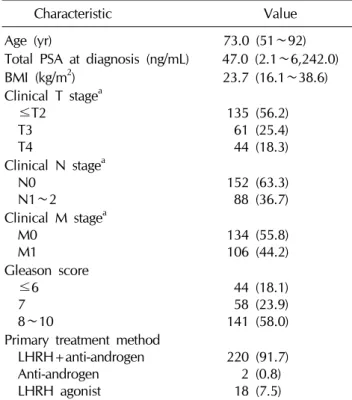
The clinical and pathological characteristics of the PADT patients are summarized in Table 1. The median fol- low-up on PADT was 24 months (range: 3∼115) months.
The median patient age was 73.0 years, and the median pretreatment PSA level was 47.0 ng/mL. Of the patients, 91.7% were treated with combined androgen blockade and 8.3% with monotherapy.
Differences among the three groups according to clin- ical stage are shown in Table 2. Of the patients, 33.3% had localized, 22.5% had locally advanced, and 44.2% had metastatic prostate cancer. There were no significant dif- ferences in follow-up period or age among the groups. The patients with metastatic prostate cancer had the lowest BMI (22.5 kg/m2). The PSA levels at diagnosis were 14.9, 27.8, and 103.9 ng/mL in the localized, locally advanced, and metastatic groups. Of the patients with locally ad- vanced prostate cancer, 48.1% had lymph node meta- stasis and 87.1% were at a more advanced stage than T3.
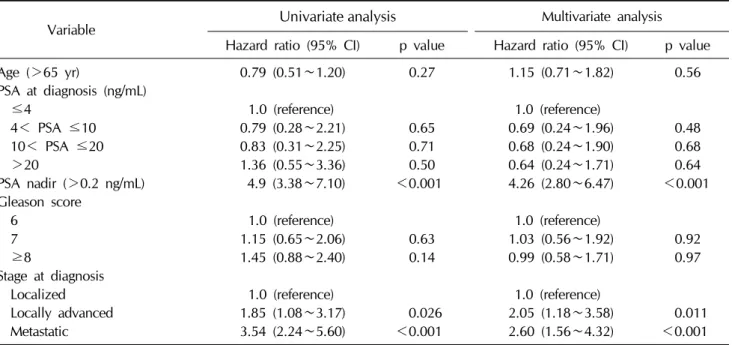
Clinical factors related to PSA progression were identi- fied using Cox regression (Table 3). In the multivariate analysis, PSA nadir and stage significantly affected PSA progression during PADT, with hazard ratios of 4.26 and 2.60 (p<0.001), respectively.
Fig. 1 shows the Kaplan-Meier analysis of the PSA pro- gression-free survival rate after 3 years according to stage;
Table 1. Characteristics of the patients treated with primary androgen-deprivation therapy
Characteristic Value
Age (yr) 73.0 (51∼92)
Total PSA at diagnosis (ng/mL) 47.0 (2.1∼6,242.0)
BMI (kg/m2) 23.7 (16.1∼38.6)
Clinical T stagea ≤T2
T3 T4
135 (56.2) 61 (25.4) 44 (18.3) Clinical N stagea
N0
N1∼2 152 (63.3)
88 (36.7) Clinical M stagea
M0
M1 134 (55.8)
106 (44.2) Gleason score
≤6 7 8∼10
44 (18.1) 58 (23.9) 141 (58.0) Primary treatment method
LHRH+anti-androgen Anti-androgen LHRH agonist
220 (91.7) 2 (0.8) 18 (7.5)
Values are presented as median (range) or number (%).
PSA: prostate-specific antigen, BMI: body mass index, LHRH:
luteinizing hormone-releasing hormone.
aAll tumor stages were based on the tumor-node-metastasis (TNM) staging system.
Table 2. Comparison of the patients treated with primary androgen-deprivation therapy according to prostate cancer stage Localized (n=80) Locally advanced (n=54) Metastatic (n=106) p value
Duration of follow-up (mo) 26.5 (4∼115) 29.5 (6∼96) 22.5 (3∼108) 0.249
Age (yr) 72.4 (56∼86) 74.0 (53∼88) 72.0 (51∼92) 0.264
BMI (kg/m2) 24.0 (17.7∼38.6) 24.1 (16.1∼30.1) 22.5 (16.6∼30.8) 0.001
Prostate size (g) 33.0 (13.9∼93.0) 38.3 (17.0∼94.9) 38.5 (16.4∼180.0) 0.017 Pre-PSA level (ng/mL) 14.9 (2.7∼982.0) 27.8 (2.1∼893.0) 103.9 (2.4∼6,242.0) <0.001
Clinical T stagea <0.001
≤T2 80 (100.0) 7 (12.9) 48 (45.3)
T3 0 (0.0) 28 (51.9) 33 (31.1)
T4 0 (0.0) 19 (35.2) 25 (23.6)
Clinical N stagea 0.001
N0 80 (100.0) 28 (51.9) 44 (41.5)
N1∼2 0 (0.0) 26 (48.1) 62 (58.5)
Clinical M stagea 0.001
M0 80 (100.0) 54 (100.0) 0 (0.0)
M1 0 (0.0) 0 (0.0) 106 (100.0)
Values are presented as median (range) or number (%).
BMI: body mass index, PSA: prostate-specific antigen.
aAll tumor stages were based on the tumor-node-metastasis (TNM) staging system.
the estimated values were 56.1%, 43.4%, and 16.1%
(p=0.001), in the localized, locally advanced, and meta- static groups, respectively. The estimated PSA re- currence-free median survival durations in the respective groups were 57, 24, and 12 months.
There was a significant difference in the survival rate be- tween a PSA nadir of ≤0.2 and >0.2 ng/mL (Fig. 2A).
Therefore, we considered a PSA level of 0.2 ng/mL to be the optimal PSA nadir after PADT. Using a PSA nadir of 0.2 ng/mL, we analyzed the progression-free survival rate in each stage. For the localized stage, the survival rate for a PSA nadir of ≤0.2 ng/mL was 62.1%, and the estimated median survival duration was 57 months, versus 15.1%
and 15 months for a PSA nadir of >0.2 ng/mL (Fig. 2B).
For locally advanced disease, the PSA progression-free survival rate was 49.3% for a PSA nadir of ≤0.2 ng/mL, and the estimated median survival duration was 29 months (Fig. 2C). In the metastatic stage, the PSA pro- gression-free survival rate was 28.9%, and the estimated median survival duration was 19 months (Fig. 2D).
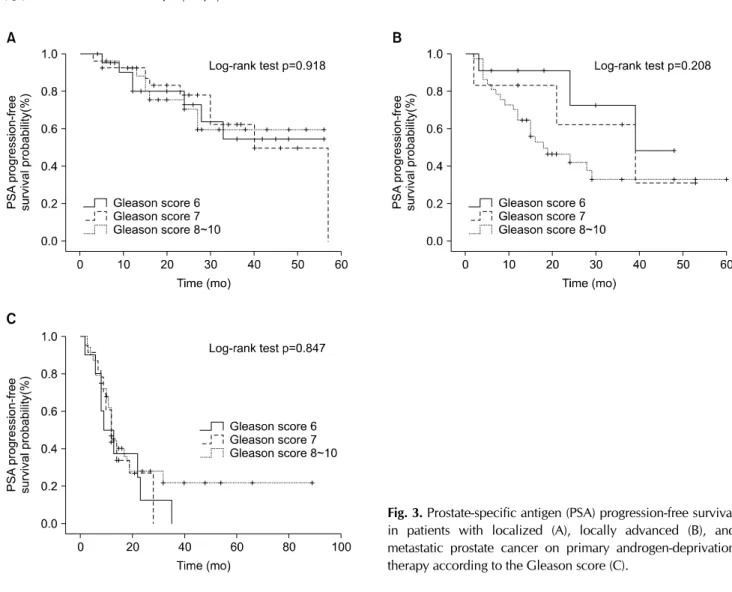
Fig. 3 shows differences in the progression-free survival rate according to Gleason score. There were no significant differences in the progression-free survival rate when ana- lyzed using Gleason scores of 6, 7, and 8 to 10 in lo- calized, locally advanced, and metastatic prostate cancer
Fig. 1. Prostate-specific antigen (PSA) progression-free survival in prostate cancer patients on primary androgen-deprivation therapy.
Table 3. Clinical factors predictive of PSA progression based on a Cox regression analysis
Variable Univariate analysis Multivariate analysis
Hazard ratio (95% CI) p value Hazard ratio (95% CI) p value
Age (>65 yr) 0.79 (0.51∼1.20) 0.27 1.15 (0.71∼1.82) 0.56
PSA at diagnosis (ng/mL)
≤4 1.0 (reference) 1.0 (reference)
4< PSA ≤10 0.79 (0.28∼2.21) 0.65 0.69 (0.24∼1.96) 0.48
10< PSA ≤20 0.83 (0.31∼2.25) 0.71 0.68 (0.24∼1.90) 0.68
>20 1.36 (0.55∼3.36) 0.50 0.64 (0.24∼1.71) 0.64
PSA nadir (>0.2 ng/mL) 4.9 (3.38∼7.10) <0.001 4.26 (2.80∼6.47) <0.001 Gleason score
6 1.0 (reference) 1.0 (reference)
7 1.15 (0.65∼2.06) 0.63 1.03 (0.56∼1.92) 0.92
≥8 1.45 (0.88∼2.40) 0.14 0.99 (0.58∼1.71) 0.97
Stage at diagnosis
Localized 1.0 (reference) 1.0 (reference)
Locally advanced 1.85 (1.08∼3.17) 0.026 2.05 (1.18∼3.58) 0.011
Metastatic 3.54 (2.24∼5.60) <0.001 2.60 (1.56∼4.32) <0.001
PSA: prostate-specific antigen, CI: confidence interval.
after PADT.
DISCUSSION
No prospective study has compared PADT with control groups (e.g., conservative treatment, surgery, or other lo- cal therapy), and bias might affect patient selection. There are also no guidelines for PADT in terms of patient in- dications, tumor characteristics, life expectancy, starting and stopping times of therapy, and duration of therapy.
Therefore, the selection of patients for PADT is important;
the tumor characteristics should also be considered. Our study also did not compare the results with the results of any other definitive therapy or active surveillance.
However, multicenter data regarding the trends and cur- rent state of PADT in Korea might assist clinicians in select- ing appropriate PADT therapy.
Although there is insufficient evidence regarding the benefits of PADT in prostate cancer management, several studies have suggested its efficacy or clinical benefits. A retrospective study of the Cancer of the Prostate Strategic Urologic Research Endeavor (CaPSURE) data analyzed 993 males treated with PADT [11]. The 5-year dis- ease-specific survival rate was 95.9%, and only 4.1% died from prostate cancer. In addition, 5 years after starting PADT, the treatment was still being applied to 67.3% of the patients. A long-term (20-year) single-center experi- ence with PADT in localized or advanced prostate cancer reported results similar to those of the CaPSURE study [12]. The 5-, 10-, and 15-year disease-specific survival rates were 95.7%, 91.7%, and 84.9%, respectively. They also compared PADT with salvage ADT−no significant differences in disease-specific survival were evident. In a study comparing radical prostatectomy and PADT, the pa- tients who underwent radical prostatectomy had a higher
Fig. 2. (A) Prostate-specific antigen (PSA) progression according to the PSA nadir. PSA progression-free survival in patients with localized (B), locally advanced (C), and metastatic prostate cancer given primary androgen-deprivation therapy according to the PSA nadir (D).
10-year overall survival due to their longer expected life span (73% vs. 41%) [13]. However, there was no sig- nificant difference in the cancer-specific survival rate (86% vs. 78%). Therefore, PADT is an alternative treat- ment for prostate cancer, particularly for patients with a short expected life span with localized or locally ad- vanced prostate cancer.
Contrasting these favorable results, a study of The Surveillance, Epidemiology, and End Result (SEER) pro- gram of national cancer institute data of patients >65 years of age suggested that a careful approach to PADT is warranted. Early PADT for localized prostate cancer, par- ticularly low-risk cancer, is associated with an increased frequency of chemotherapy use [14]. This result was based on the molecular mechanism associated with an androgen receptor [15-19]. Lu-Yao et al [20] also investigated surviv-
al after PADT in localized prostate cancer and found that PADT reduced the 10-year disease-specific survival rate with a hazard ratio of 1.17 and was associated with no benefit in the 10-year overall survival rate compared with conservative treatment. They concluded that elderly pa- tients with T1 to 2 prostate cancer derived no clinical ben- efit from PADT. However, these results did not show the uselessness of PADT but rather that the early start of PADT had no benefit as compared to conservative treatment in old-age patients.
Compared with the 75% 5-year progression-free surviv- al rate of the Portland Veterans Affairs Medical Center, the survival rate for localized and locally advanced prostate cancer in our study (56.1% and 43.4%, respectively) was relatively low [9]. In 2009, Kim et al [21] reported that the 5-year progression-free survival in Korean patients was
Fig. 3. Prostate-specific antigen (PSA) progression-free survival in patients with localized (A), locally advanced (B), and metastatic prostate cancer on primary androgen-deprivation therapy according to the Gleason score (C).
73.6%. The most important reason for the lower pro- gression-free survival rate in our study is the difference in the definition of progression. We defined progression after PADT as any increase in PSA after reaching the PSA nadir, while most studies used a definitive cut-off value for PSA, even if the patient’s PSA nadir was lower than the cut-off value, or defined PSA progression as three consecutive PSA increases. For example, if the PSA nadir after PADT is 0.1 ng/mL but the PSA continues to increase, the patient is not considered to be experiencing progression. Only when the PSA level reaches a value above the cut-off, e.g., 4 ng/mL, is the patient classified as experiencing pro- gression. Therefore, we detected patients showing PSA progression after PADT earlier than in other studies. We defined PSA progression as any PSA elevation during PADT to determine when the change in PSA occurs during PADT and to determine the optimal PSA nadir in patients with PADT.
Another possible reason for the difference as compared to other studies is the patient distribution. The median PSA in our series was 47.0 ng/mL, which was considerably higher than the 13.8 in Janoff et al [9] and 13.52 in Kim et al [21]. More advanced prostate cancer patients were se- lected for PADT in our series; this might have caused the differences in the survival rate. In addition, increasing use of surgery and radiation therapy might contribute to the low progression-free survival rate in PADT patients.
Similarly, results of a study of the Japanese population showed a tendency for the survival with PADT to decrease from 50% to 40%, comparing 2004 to 2006 vs. 2007 to 2009 [22]. Despite these differences, the Asian consensus statement on PADT recommends using PADT even in the early stage [23].
The clinical stage and PSA nadir after PADT were in- dependent predictors of PSA progression in our study. A PSA nadir greater than 0.2 ng/mL predicted a poor re-
sponse to PADT for all clinical stages. In contrast, age at di- agnosis and Gleason score were not associated with PSA progression. Young patients or those with a longer ex- pected life span tend to have more aggressive prostate can- cer; therefore, cancer progression in such individuals is more frequent than in elderly patients [24,25]. However, we found that age was not associated with cancer pro- gression among the patients who underwent PADT, per- haps because of the relatively young age used as a cut-off in this study. The Gleason score also showed no sig- nificant relationship with PSA progression after PADT for any stage, with p values of 0.918, 0.208, and 0.847 for lo- calized, locally advanced, and metastatic cancer, respectively. Therefore, contrary to expectations, cell dif- ferentiation in prostate cancer did not influence PSA pro- gression after PADT in our study.
A major limitation of this study was the lack of a control group, such as a group of patients who underwent other local definitive therapy (surgery or radiation) or active surveillance. Another limitation was that no analysis of overall survival or cancer-specific survival was performed.
Therefore, the efficacy and clinical benefits of PADT could not be estimated. However, we report the characteristics and trends of PADT in Korea through multicenter experi- ences for the first time ever, and expect this study to be a foundation for another prospective study on PADT.
CONCLUSIONS
In spite of some limitations and debates, PADT may be another option for prostate cancer control from the per- spective of a less invasive treatment. However, the in- dications for PADT must be considered carefully, includ- ing patient age, cancer stage, tumor characteristics, treat- ment-related comorbidities, and socioeconomic status.
Further, the observation for reaching the PSA nadir should be required for a response expectation. After more long- term follow-up data have been obtained, a large-scale comparison study is required to assess the efficacy of PADT.
REFERENCES
1. Huggins C, Hodges CV. Studies in prostate cancer: the ef-
fect of castration, of estrogen and of androgen injection on serum phosphatases in metastatic carcinoma of prostate.
Cancer Res 1941;1:293-7.
2. Chedin M, Filhol O, Duminy C, Bolla M, Benistant C, Roche S, et al. Characterization of two different cytoplasmic protein tyrosine kinases from human breast cancer. Carci- nogenesis 1997;18:1463-72.
3. Bolla M, Collette L, Blank L, Warde P, Dubois JB, Mirimanoff RO, et al. Long-term results with immediate an- drogen suppression and external irradiation in patients with locally advanced prostate cancer (an EORTC study): a phase III randomised trial. Lancet 2002;360:103-6.
4. Messing EM, Manola J, Sarosdy M, Wilding G, Crawford ED, Trump D. Immediate hormonal therapy compared with observation after radical prostatectomy and pelvic lympha- denectomy in men with node-positive prostate cancer. N Engl J Med 1999;341:1781-8.
5. D'Amico AV, Manola J, Loffredo M, Renshaw AA, DellaCroce A, Kantoff PW. 6-month androgen suppression plus radiation therapy vs radiation therapy alone for pa- tients with clinically localized prostate cancer: a random- ized controlled trial. JAMA 2004;292:821-7.
6. Schröder FH, Kurth KH, Fosså SD, Hoekstra W, Karthaus PP, Debois M, et al; Members of the European Organisation for the Research and Treatment of Cancer Genito-urinary Group. Early versus delayed endocrine treatment of pN1-3 M0 prostate cancer without local treatment of the primary tumor: results of European Organisation for the Research and Treatment of Cancer 30846: a phase III study. J Urol 2004;172:923-7.
7. Pagliarulo V, Bracarda S, Eisenberger MA, Mottet N, Schröder FH, Sternberg CN, et al. Contemporary role of an- drogen deprivation therapy for prostate cancer. Eur Urol 2012;61:11-25.
8. Cooperberg MR, Grossfeld GD, Lubeck DP, Carroll PR.
National practice patterns and time trends in androgen abla- tion for localized prostate cancer. J Natl Cancer Inst 2003;
95:981-9.
9. Janoff DM, Peterson C, Mongoue-Tchokote S, Peters L, Beer TM, Wersinger EM, et al. Clinical outcomes of androgen deprivation as the sole therapy for localized and locally ad- vanced prostate cancer. BJU Int 2005;96:503-7.
10. World Health Organization Classification of Tumours.
Pathology and Genetics of Tumours of the Urinary System and Male Genital Organs. Chapter 3. Tumours of the Prostate [Internet]. Lyon (France): IARC Press; 2004 [cited 2014 Jul 15]. Available from: http://www.iarc.fr/en/pub- lications/pdfs-online/pat-gen/bb7/bb7-chap3.pdf.
11. Kawakami J, Cowan JE, Elkin EP, Latini DM, DuChane J, Carroll PR; CaPSURE Investigators. Androgen-deprivation therapy as primary treatment for localized prostate cancer:
data from Cancer of the Prostate Strategic Urologic Research Endeavor (CaPSURE). Cancer 2006;106:1708-14.
12. DiBlasio CJ, Malcolm JB, Hammett J, Wan JY, Aleman MA, Patterson AL, et al. Survival outcomes in men receiving an-
drogen-deprivation therapy as primary or salvage treatment for localized or advanced prostate cancer: 20-year sin- gle-centre experience. BJU Int 2009;104:1208-14.
13. Akaza H, Homma Y, Usami M, Hirao Y, Tsushima T, Okada K, et al; Prostate Cancer Study Group. Efficacy of pri- mary hormone therapy for localized or locally advanced prostate cancer: results of a 10-year follow-up. BJU Int 2006;98:573-9.
14. Lu-Yao GL, Albertsen PC, Li H, Moore DF, Shih W, Lin Y, et al. Does primary androgen-deprivation therapy delay the receipt of secondary cancer therapy for localized prostate cancer? Eur Urol 2012;62:966-72.
15. Koivisto P, Kononen J, Palmberg C, Tammela T, Hyytinen E, Isola J, et al. Androgen receptor gene amplification: a possi- ble molecular mechanism for androgen deprivation therapy failure in prostate cancer. Cancer Res 1997;57:314-9.
16. Koivisto PA, Helin HJ. Androgen receptor gene amplifica- tion increases tissue PSA protein expression in hormone-re- fractory prostate carcinoma. J Pathol 1999;189:219-23.
17. Shi Y, Brands FH, Chatterjee S, Feng AC, Groshen S, Schewe J, et al. Her-2/neu expression in prostate cancer:
high level of expression associated with exposure to hor- mone therapy and androgen independent disease. J Urol 2001;166:1514-9.
18. Ricciardelli C, Jackson MW, Choong CS, Stahl J, Marshall VR, Horsfall DJ, et al. Elevated levels of HER-2/neu and an- drogen receptor in clinically localized prostate cancer iden- tifies metastatic potential. Prostate 2008;68:830-8.
19. Jennbacken K, Tesan T, Wang W, Gustavsson H, Damber JE, Welén K. N-cadherin increases after androgen depriva- tion and is associated with metastasis in prostate cancer.
Endocr Relat Cancer 2010;17:469-79.
20. Lu-Yao GL, Albertsen PC, Moore DF, Shih W, Lin Y, DiPaola RS, et al. Survival following primary androgen dep- rivation therapy among men with localized prostate cancer.
JAMA 2008;300:173-81.
21. Kim TS, Kang SH, Rhew HY. Efficacy of androgen depriva- tion therapy in patients with clinically localized prostate cancer. Korean J Urol 2009;50:1073-7.
22. Tanaka N, Hirayama A, Yoneda T, Yoshida K, Shimada K, Konishi N, et al. Trends of risk classification and primary therapy for Japanese patients with prostate cancer in Nara Uro-Oncological Research Group (NUORG): a comparison between 2004-2006 and 2007-2009. BMC Cancer 2013;13:
588.
23. Akaza H. Asian trends in primary androgen depletion ther- apy on prostate cancer. Cancer Biol Med 2013;10:187-91.
24. Bill-Axelson A, Holmberg L, Ruutu M, Häggman M, Andersson SO, Bratell S, et al; Scandinavian Prostate Cancer Group Study No. 4. Radical prostatectomy versus watchful waiting in early prostate cancer. N Engl J Med 2005;352:1977-84.
25. Situmorang GR, Umbas R, Mochtar CA, Santoso RB.
Prostate cancer in younger and older patients: do we treat them differently? Asian Pac J Cancer Prev 2012;13:4577-80.