Use of docetaxel plus androgen deprivation
therapy for metastatic hormone-sensitive prostate cancer in Korean patients: A retrospective study
Whi-An Kwon1,*, Jae Young Joung2,*, Jung Eun Lee2, Se Young Choi3, Sung Han Kim2, Ho Kyung Seo2, Kang Hyun Lee2, Choung-Soo Kim4
1Department of Urology, Myongji Hospital, Hanyang University College of Medicine, Goyang, 2Department of Urology, Urological Cancer Center, National Cancer Center, Goyang, 3Department of Urology, Chung-Ang University Hospital, Chung-Ang University College of Medicine, Seoul, 4Department of Urology, Asan Medical Center, University of Ulsan College of Medicine, Seoul, Korea
Purpose: We aimed to evaluate the efficacy and safety of the use of docetaxel plus androgen deprivation therapy (ADT) for meta- static hormone-sensitive prostate cancer (mHSPC) in Korean patients.
Materials and Methods: This study was conducted retrospectively. In total, 61 Korean patients with mHSPC who used docetaxel plus ADT were identified from medical records. Patients received docetaxel plus ADT at a dose of 75 mg/m2 every 3 weeks for 6 cycles. We evaluated prostate-specific antigen (PSA) response, PSA progression, progression to castration-resistant prostate cancer (CRPC), clinical progression, and adverse events.
Results: Most of the patients had high volume disease (98.3%) and 83.6% had a Gleason score of 8 or higher. The median PSA level at the start of ADT was 131.4 ng/mL. The percentage of patients whose PSA levels decreased to less than 0.2 ng/mL at 3, 6, and 12 months were 28.3%, 41.0%, and 45.0%, respectively. During a median of 12.0 months after treatment, PSA progression occurred in 13.3% of patients. Clinical progression and progression to CRPC were observed in 15.1% and 14.8%, respectively. Neutropenia grade ≥3 and febrile neutropenia occurred in 63.5% and 11.5%, respectively.
Conclusions: Comparing our findings with those of the prior chemohormonal therapy versus androgen ablation randomized trial for extensive disease in prostate cancer (CHAARTED) study, in Korean patients, the use of docetaxel plus ADT for mHSPC showed similar results for early oncologic outcomes including PSA response and time to clinical progression. However, we observed a high- er rate of adverse events, which should be considered seriously.
Keywords: Androgens; Docetaxel; Drug therapy; Prostatic neoplasms
This is an Open Access article distributed under the terms of the Creative Commons Attribution Non-Commercial License (http://creativecommons.org/licenses/by-nc/4.0) which permits unrestricted non-commercial use, distribution, and reproduction in any medium, provided the original work is properly cited.
Received: 23 January, 2019 • Accepted: 19 March, 2019 Corresponding Author: Choung-Soo Kim
Department of Urology, Asan Medical Center, University of Ulsan College of Medicine, 88 Olympic-ro 43-gil, Songpa-gu, Seoul 05505, Korea TEL: +82-31-920-1740, FAX: +82-31-920-1790, E-mail: [email protected]
ORCID: https://orcid.org/0000-0002-7464-3207
*These authors contributed equally to this study and should be considered co-first authors.
ⓒ The Korean Urological Association
www.icurology.org
Investig Clin Urol 2019;60:195-201.
https://doi.org/10.4111/icu.2019.60.3.195 pISSN 2466-0493 • eISSN 2466-054X
INTRODUCTION
Prostate cancer (PCa) is the second most common can
cer in the world and is the fifth leading cause of cancer
related mortality worldwide [1]. Localized PCa can be successfully treated with radical prostatectomy or radiation
therapy. It responds to various treatments, even if it is in a progressive or metastatic state. However, up to 40% of cases of detected PCa eventually progress to the metastatic stage [2,3]. For patients with such advanced PCa, the goal of treatment is increase survival while maintaining quality of life. Androgen deprivation therapy (ADT) is a common standard therapy for metastatic PCa (mPCa) because the androgen receptor (AR) pathway plays an important role in the development and progression of PCa cells [4]. Although ADT can induce biochemical and clinical responses in more than 90% of patients, testosterone levels remain low after a median of 24 to 36 months, but eventually progress to castrationresistant PCa (CRPC) [5]. It is currently known that the progression of CRPC is due to the manifestation of numerous resistance mechanisms induced by selective pressure during hormone therapy [610]. Castration can induce clonal selection and subsequent growth of androgen
independent cellular clones [11]. Accordingly, hormone
sensitive PCa (HSPC) should be considered a heterogeneous disease characterized by the coexistence of ARpositive and ARnegative tumor cells.
In this biological context, HSPC patients can benefit from chemotherapy in combination with hormone therapy, targeting ARnegative cells and delaying the development of resistance mechanisms. In the predocetaxel period, some randomized controlled trials have studied hormone therapy and other cytotoxic drug combinations in patients with
HSPC, but none of these studies have shown any significant and definitive benefit [12,13]. In the meantime, three large
scale phase 3 clinical trials in the past few years have begun to raise the possibility that chemohormonal treatment with docetaxel plus ADT may be clinically useful for mPCa (GETUGAFU15 [14], chemohormonal therapy versus androgen ablation randomized trial for extensive disease in prostate cancer [CHAARTED]E3805 [15], and STAMPEDE [16]).
However, the results of the above studies are all based on Western populations. Korean are known to have very different PCa characteristics from those of Westerners [1722].
Moreover, to the best of our knowledge there are no Korean studies on this subject. Therefore, the clinical usefulness of docetaxel plus ADT in Korean patients for metastatic HSPC (mHSPC) is largely unknown and requires further study.
Accordingly, we here report the clinical results of the use of docetaxel plus ADT in Korean patients with mHSPC.
MATERIALS AND METHODS
This study was conducted retrospectively. Patient data were obtained from two institutions (Korea National Cancer Center and Asan Medical Center). The collection of session data used in the study was approved by the Institutional Ethics Committee after reviewing the adopted protocols and procedures (approval number: NCC20180038, AMC20180219).
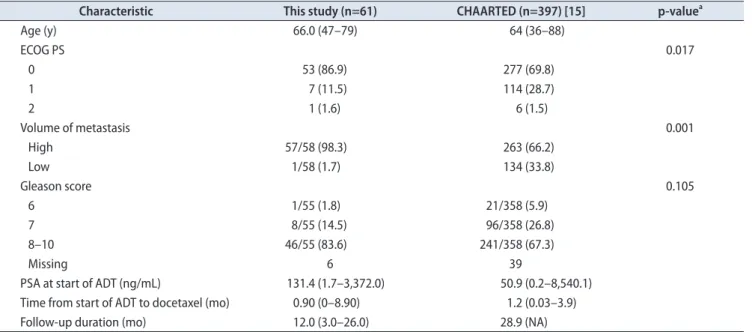
Table 1. Baseline characteristics of the patients of this study and the CHAARTED trial
Characteristic This study (n=61) CHAARTED (n=397) [15] p-valuea
Age (y) 66.0 (47–79) 64 (36–88)
ECOG PS 0.017
0 53 (86.9) 277 (69.8)
1 7 (11.5) 114 (28.7)
2 1 (1.6) 6 (1.5)
Volume of metastasis 0.001
High 57/58 (98.3) 263 (66.2)
Low 1/58 (1.7) 134 (33.8)
Gleason score 0.105
6 1/55 (1.8) 21/358 (5.9)
7 8/55 (14.5) 96/358 (26.8)
8–10 46/55 (83.6) 241/358 (67.3)
Missing 6 39
PSA at start of ADT (ng/mL) 131.4 (1.7–3,372.0) 50.9 (0.2–8,540.1)
Time from start of ADT to docetaxel (mo) 0.90 (0–8.90) 1.2 (0.03–3.9)
Follow-up duration (mo) 12.0 (3.0–26.0) 28.9 (NA)
Values are presented as median (range), number (%), number/total number (%), or number only.
CHAARTED, chemohormonal therapy versus androgen ablation randomized trial for extensive disease in prostate cancer; ECOG, Eastern Coopera- tive Oncology Group; PS, performance status; PSA, prostate-specific antigen; ADT, androgen deprivation therapy; NA, not applicable.
a:Pearson’s chi-square test was used.
In total, 61 Korean patients with mHSPC and who used docetaxel plus ADT were identified. Docetaxel plus ADT was administered to the following patients, who were enrolled in the present analysis: 1) PCa was diagnosed histologically and diagnosed as metastatic disease by imaging. 2) Eastern Cooperative Oncology Group (ECOG) performance status was less than 2. 3) Organ function was suitable for docetaxel treatment. High volume was defined as the presence of visceral metastases or ≥4 bone lesions with ≥1 beyond the vertebral bodies and pelvis.
All patients received ADT plus docetaxel at a dose of 75 mg/m2 every 3 weeks for 6 cycles without daily prednisone.
According to the organ system showing the greatest degree of toxic effects, dose adjustments were made and graded according to the National Cancer Institute (NCI) Common Terminology Criteria for Adverse Events (CTCAE, ver.
4.03). The use of growth factors was at the discretion of the researchers in case of hematologic adverse events, including grade ≥3 neutropenia or febrile neutropenia.
We evaluated prostatespecific antigen (PSA) response rate, PSA progression, clinical progression, progression to CRPC, and adverse events. A PSA response was defined as a serum PSA ≤0.2 ng/mL. We defined PSA progression according to the definition of the PSA Working Group [23].
For patients with measurable lesions, the clinical course was defined as the progression of a preceding lesion, as assessed by the Response Evaluation Criteria in Solid Tumors (RECIST, ver. 1.0) [24] or the progression of the (new) bone lesion. We defined progression to CRPC as castrate serum testosterone
<50 ng ∕ dL, three consecutive rises in PSA 1 week apart resulting in two 50% increases over the nadir, and PSA >2 ng/mL or radiological progression.
Curves for the time to PSA progressionfree survival, clinical progressionfree survival, and progression to CRPC were estimated using the Kaplan–Meier method. We assessed adverse events using the CTCAE of the NCI (ver.
4.03). All statistical analyses were performed using PASW Statistics ver. 18.0 (IBM Co., Armonk, NY, USA).
RESULTS
Between January 2016 and April 2018, 61 patients were identified and analyzed. The median age was 66.0 years (range, 47–79 years), and 86.9% (53 out of 61) had an ECOG performance status score of 0.
Most of the patients had high volume disease (98.3%, 57 out of 58), and 83.6% (46 out of 55) had a Gleason score of 8 or higher. The median PSA level at the start of ADT was
Table 2. Efficacy profiles of this study and CHAARTED trial Variable
This study (n=61) CHAARTED (n=397) [15]
p-valuea High volume disease
(n=57, 98.3%)
Low volume disease (n=1, 1.7%)
High volume disease (n=263, 66.2%)
Low volume disease (n=134, 33.8%) RECIST criteria
CR 0 (0.0)
PR 22/53 (41.5)
SD 25/53(47.2)
PD 6/53 (11.3)
Not evaluated yet 8
PSA level <0.2 ng/mL at 3 mo 15/53 (28.3)
PSA level <0.2 ng/mL at 6 mo 16/39 (41.0) 127/397 (32.0) 0.251
PSA level <0.2 ng/mL at 12 mo 9/20 (45.0) 110/397 (27.7) 0.095
PSA progression, yes 8/60 (13.3)
Clinical progression, yes 8/53 (15.1)
CRPC progression, yes 9/61 (14.8)
Time to PSA progression NR
Time to clinical progression (mo) [25] NR 33.0 (27.3–41.2)
27.3 (21.9–32.7) 42.5 (34.0–NR)
Time to CRPC (mo) [25] NR 19.4 (16.8–22.6)
14.9 (12.4–17.2) 31.0 (23.1–51.1) Values are presented as number/total number (%), number only, or median (95% confidence interval).
CHAARTED, chemohormonal therapy versus androgen ablation randomized trial for extensive disease in prostate cancer; RECIST, Response Evalu- ation Criteria in Solid Tumors; CR, complete response; PR, partial response; SD, stable disease; PD, progressive disease; PSA, prostate-specific anti- gen; CRPC, castration-resistant prostate cancer; NR, not reached.
a:Pearson’s chi-square test was used.
131.4 ng/mL (range, 1.7–3,372.0 ng/mL). The median time from the onset of ADT to docetaxel administration was 0.9 months (range, 0–8.9 months). Compared with the CHAARTED trial, our cohort had a better ECOG performance status (p=0.017) and higher volume of metastasis (p=0.001). However, there was no statistical difference in Gleason score (p=0.105).
Patient characteristics of the present study and the CHAARTED trial are shown in Table 1 [15].
Fortyone patients (67.2%, 41 out of 61) finished six cycles of docetaxel. Six patients (9.8%, 6 out of 61) stopped docetaxel because of treatmentrelated adverse events (4.9%, 3 out of 61) and followup loss (4.9%, 3 out of 61). Dose modification for docetaxel (60 mg/m2 reduction) was observed in 18 patients (29.5%, 18 out of 61).
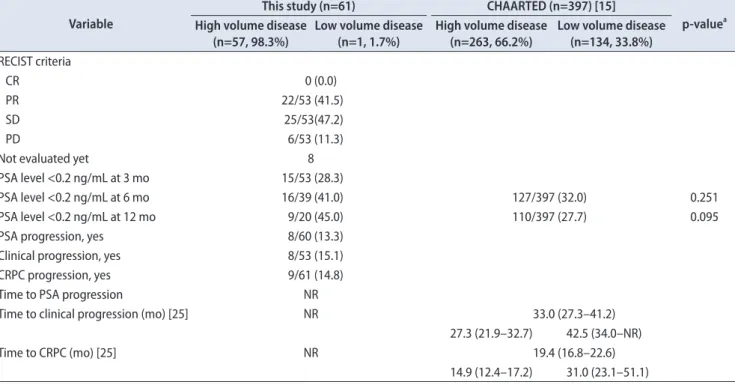
Among these 61 patients, there were 0 complete re mi
ssion, 22 partial remission, 25 stable disease, and 6 progre
ssive disease (8 patients were not yet evaluated and data for 2 patients were missing) according to the RECIST criteria.
The percentage of patients whose PSA levels decreased
to less than 0.2 ng/mL at 3, 6, and 12 months were 28.3%
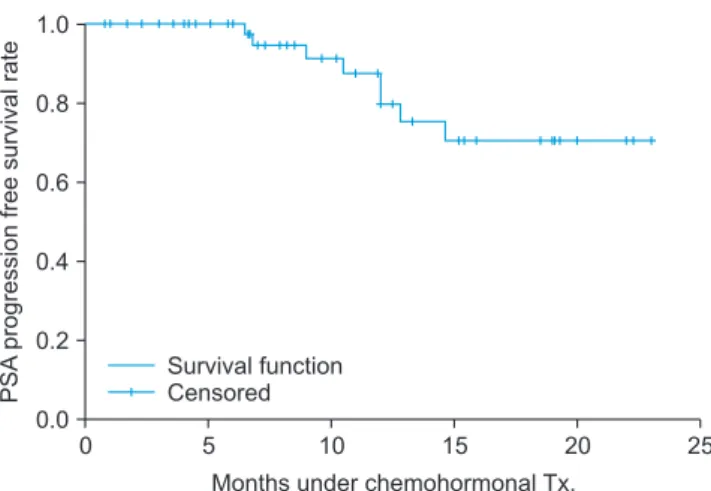
(15 out of 53), 41.0% (16 out of 39), and 45.0% (9 out of 20), respectively (Table 2) [15,25]. The median followup period was 12.0 months (range, 3.0–26.0 months). PSA progression occurred in 13.3% (8 out of 60) and the PSA progression
free survival curve is shown in Fig. 1. Clinical progression occurred in 15.1% (8 out of 53), and the clinical progression
free survival curve is shown in Fig. 2. Finally, progression to CRPC occurred in 14.8% (9 out of 61), and the progression to CRPCfree survival curve is shown in Fig. 3.
Approximately 64% of the patients who received do
cetaxel plus standard ADT developed neutropenia grade
≥3. Febrile neutropenia occurred in 11.5% of patients. The rates of neutropenia (69.2%), and neutropenia grade ≥3 of this study were higher than those of the CHAARTED trial, and febrile neutropenia was also more common but this difference was not statistically significant. Other common adverse events were anemia (88.5%), fatigue (28.8%), peripheral edema (11.5%), and sensory neuropathy (9.6%).
Detailed data of the hematologic and nonhematologic adverse events are listed in Table 3.
DISCUSSION
The main goal of this study was to determine the effi
cacy and safety of the use of docetaxel plus standard ADT in Korean patients with mHSPC. Our data show similar early oncologic results as in previous Western trials, but with more adverse effects [15,16].
The 6month PSA response in this study was 41.0%, and the 12month PSA response was 45.0%. The 6 and 12month PSA response of CHAARTED [15] were 32.0% and 27.7%, respectively. Regarding the higher PSA response in the present study, we hypothesize that this is mainly due to Fig. 1. Kaplan–Meier estimates of PSA progression-free survival rate.
PSA, prostate-specific antigen; Tx., therapy.
Fig. 3. Kaplan–Meier estimates of progression to CRPC-free survival rate. CRPC, castration-resistant prostate cancer; Tx., therapy.
Fig. 2. Kaplan–Meier estimates of clinical progression-free survival rate.
differences in tumor characteristics between patients with and without high volume disease. The incidence of adverse events varies between Western and Asian (including Korean) patients. For example, 32% of patients in the TAX 327 study (docetaxel every third week) and 12.1% of patients with neutropenia of grade ≥3 in CHAARTED had adverse effects. On the other hand, in recent phase II clinical trials using docetaxel in Japan, 97.3% of patients had grade ≥3 neutropenia [26]. In the present trial, 63.5% of patients showed neutropenia of grade ≥3. In cases of febrile neutropenia, 0% of patients in TAX 327 and 6.1% of patients in CHAARTED had grade ≥3 adverse events. In a recent Phase II clinical trial in Japan, adverse events of grade ≥3 occurred in 4% of patients [26]. In the current study, 11.5% of patients had grade ≥3 febrile neutropenia. Anemia occurred in 88.5% of all cases in this study, similar to the recent Japanese phase II clinical trial [26]. In addition, Lavoie et al.
[27] recently published a realworld population study with docetaxel for HSPC. One result of the study was that the clinical effects and hematologic adverse events of addition of docetaxel (DOC) plus ADT were worse than those reported in CHAARTED.
The National Comprehensive Cancer Network guidelines recommend that the DOC to standard ADT is a viable option for patients with metastatic hormonenaive prostate cancer (mHNPC) [28]. The ESMO Clinical Practice Guidelines (2015) have recommended it as the firstline treatment for mHNPC, and men are well suited for chemotherapy [29].
Half of St. Gallen’s panelists recommended using docetaxel as an ADT therapy in most mHNPC patients with high
volume disease [30]. However, when interpreting the above
mentioned guidelines, it is important to consider study findings showing that the aggressiveness of PCa varies between Korean and Western patients, and that higher grade, advanced stage PCa is more common in Koreans [1719].
This study has some limitations. First, it is a single arm trial with a small sample size. A large randomized controlled trial is required to evaluate good PSA response. Second, the shortterm followup period did not reveal the overall survival rate, time to clinical progression, or time to CRPC.
Third, there is a possibility that bias could have occurred because data were collected from two institutions. Under this restriction, additional followup studies are underway to identify overall survival, additional treatment methods, and late adverse events.
However, to the best of our knowledge, this is the first study of the use of docetaxel plus ADT treatment in Korean patients with mHSPC. An additional strength of this study is that it is a realworld study with a large tumor volume in most patients (98.3%).
CONCLUSIONS
In conclusion, in this study of Korean patients, the use of docetaxel plus ADT for mHSPC showed similar results as in the CHAARTED trial for early oncologic outcomes, including PSA response and time to clinical progression.
However, high rates of hematologic adverse events should be closely monitored. Moreover, dose adjustment and pro
phylactic granulocyte colonystimulating factor need to be Table 3. Adverse events of this study and CHAARTED trial
Event This study (n=52) CHAARTED (n=390) [15]
p-valuea
All Grade ≥3 All Grade ≥3
Neutropenia 36 (69.2) 33 (63.5) 47 (12.1) 0.001
Febrile neutropenia 6 (11.5) 6 (11.5) 24 (6.2) 0.147
Anemia 46 (88.5) 0 (0.0) 5 (1.3)
Fatigue 15 (28.8) 0 (0.0) 16 (4.1)
Diarrhea 2 (3.8) 0 (0.0) 4 (1.0)
Constipation 2 (3.8) 0 (0.0)
Alopecia 1 (1.9) 0 (0.0)
Sensory neuropathy 5 (9.6) 0 (0.0) 2 (0.5)
Peripheral edema 6 (11.5) 0 (0.0)
Mucositis 1 (1.9) 0 (0.0)
Allergic reaction 2 (3.8) 0 (0.0)
Others 15 (28.8) 0 (0.0)
Total 39 (75.0) 114 (29.2) 0.001
Values are presented as number (%).
CHAARTED, chemohormonal therapy versus androgen ablation randomized trial for extensive disease in prostate cancer.
a:Grade ≥3 vs. Grade ≥3, Pearson’s chi-square test was used.
considered.
CONFLICTS OF INTEREST
The authors have nothing to disclose.
ACKNOWLEDGMENTS
This study was supported by a Korean National Cancer Center Grant (No. 18100211).
REFERENCES
1. Roehrborn CG, Black LK. The economic burden of prostate cancer. BJU Int 2011;108:806-13.
2. Beltran H, Beer TM, Carducci MA, de Bono J, Gleave M, Hus- sain M, et al. New therapies for castration-resistant prostate cancer: efficacy and safety. Eur Urol 2011;60:279-90.
3. Botrel TE, Clark O, Pompeo AC, Bretas FF, Sadi MV, Ferreira U, et al. Immunotherapy with Sipuleucel-T (APC8015) in patients with metastatic castration-refractory prostate cancer (mCRPC): a systematic review and meta-analysis. Int Braz J Urol 2012;38:717-27.
4. Huggins C, Stevens RE Jr, Hodges CV. Studies on prostatic cancer: II. the effects of castration on advanced carcinoma of the prostate gland. Arch Surg 1941;43:209-23.
5. Hellerstedt BA, Pienta KJ. The current state of hormonal thera- py for prostate cancer. CA Cancer J Clin 2002;52:154-79.
6. Scher HI, Sawyers CL. Biology of progressive, castration-resis- tant prostate cancer: directed therapies targeting the androgen- receptor signaling axis. J Clin Oncol 2005;23:8253-61.
7. Nelson PS. Molecular states underlying androgen receptor activation: a framework for therapeutics targeting androgen signaling in prostate cancer. J Clin Oncol 2012;30:644-6.
8. Antonarakis ES, Lu C, Wang H, Luber B, Nakazawa M, Ro- eser JC, et al. AR-V7 and resistance to enzalutamide and abi- raterone in prostate cancer. N Engl J Med 2014;371:1028-38.
9. Mostaghel EA, Marck BT, Plymate SR, Vessella RL, Balk S, Matsumoto AM, et al. Resistance to CYP17A1 inhibition with abiraterone in castration-resistant prostate cancer: induction of steroidogenesis and androgen receptor splice variants. Clin Cancer Res 2011;17:5913-25.
10. Stanbrough M, Bubley GJ, Ross K, Golub TR, Rubin MA, Penning TM, et al. Increased expression of genes converting adrenal androgens to testosterone in androgen-independent prostate cancer. Cancer Res 2006;66:2815-25.
11. Ahmed M, Li LC. Adaptation and clonal selection models of castration-resistant prostate cancer: current perspective. Int J Urol 2013;20:362-71.
12. Millikan RE, Wen S, Pagliaro LC, Brown MA, Moomey B, Do KA, et al. Phase III trial of androgen ablation with or without three cycles of systemic chemotherapy for advanced prostate cancer. J Clin Oncol 2008;26:5936-42.
13. Wang J, Halford S, Rigg A, Roylance R, Lynch M, Waxman J.
Adjuvant mitozantrone chemotherapy in advanced prostate cancer. BJU Int 2000;86:675-80.
14. Gravis G, Fizazi K, Joly F, Oudard S, Priou F, Esterni B, et al.
Androgen-deprivation therapy alone or with docetaxel in non- castrate metastatic prostate cancer (GETUG-AFU 15): a ran- domised, open-label, phase 3 trial. Lancet Oncol 2013;14:149- 58.
15. Sweeney CJ, Chen YH, Carducci M, Liu G, Jarrard DF, Eisen- berger M, et al. Chemohormonal therapy in metastatic hor- mone-sensitive prostate cancer. N Engl J Med 2015;373:737-46.
16. James ND, Sydes MR, Clarke NW, Mason MD, Dearnaley DP, Spears MR, et al.; STAMPEDE investigators. Addition of docetaxel, zoledronic acid, or both to first-line long-term hor- mone therapy in prostate cancer (STAMPEDE): survival results from an adaptive, multiarm, multistage, platform randomised controlled trial. Lancet 2016;387:1163-77.
17. Jeong IG, Dajani D, Verghese M, Hwang J, Cho YM, Hong JH, et al. Differences in the aggressiveness of prostate cancer among Korean, Caucasian, and African American men: a ret- rospective cohort study of radical prostatectomy. Urol Oncol 2016;34:3.e9-14.
18. Choi SK, Song C, Shim M, Min GE, Park J, Jeong IG, et al.
Prevalence of high-grade or insignificant prostate cancer in Korean men with prostate-specific antigen levels of 3.0-4.0 ng/
mL. Urology 2015;85:610-5.
19. Song C, Ro JY, Lee MS, Hong SJ, Chung BH, Choi HY, et al.
Prostate cancer in Korean men exhibits poor differentiation and is adversely related to prognosis after radical prostatec- tomy. Urology 2006;68:820-4.
20. Ito K. Prostate cancer in Asian men. Nat Rev Urol 2014;11:197- 212.
21. Monn MF, Tatem AJ, Cheng L. Prevalence and management of prostate cancer among East Asian men: current trends and future perspectives. Urol Oncol 2016;34:58.e1-9.
22. Zhu Y, Wang HK, Qu YY, Ye DW. Prostate cancer in East Asia:
evolving trend over the last decade. Asian J Androl 2015;17:48- 57.
23. Bubley GJ, Carducci M, Dahut W, Dawson N, Daliani D, Eisen- berger M, et al. Eligibility and response guidelines for phase II clinical trials in androgen-independent prostate cancer:
recommendations from the Prostate-Specific Antigen Working Group. J Clin Oncol 1999;17:3461-7.
24. Therasse P, Arbuck SG, Eisenhauer EA, Wanders J, Kaplan RS, Rubinstein L, et al. New guidelines to evaluate the response
to treatment in solid tumors. European Organization for Re- search and Treatment of Cancer, National Cancer Institute of the United States, National Cancer Institute of Canada. J Natl Cancer Inst 2000;92:205-16.
25. Kyriakopoulos CE, Chen YH, Carducci MA, Liu G, Jarrard DF, Hahn NM, et al. Chemohormonal therapy in metastatic hormone-sensitive prostate cancer: long-term survival analysis of the randomized phase III E3805 CHAARTED Trial. J Clin Oncol 2018;36:1080-7.
26. Tanaka N, Nishimura K, Okajima E, Ina K, Ogawa O, Nagata H, et al. The efficacy and safety of docetaxel-based chemotherapy combined with dexamethasone 1 mg daily oral administration:
JMTO Pca 10-01 phase II trial. Jpn J Clin Oncol 2017;47:247- 51.
27. Lavoie JM, Zou K, Khalaf D, Eigl BJ, Kollmannsberger CK, Vergidis J, et al. Real-world experience with docetaxel for castration-sensitive prostate cancer from a population-based
analysis. J Clinl Oncol 2018;36(6 suppl):297.
28. National Comprehensive Cancer Network. NCCN Clinical Practice Guidelines in Oncology (NCCN Guidelines1). Pros- tate Cancer (Version 1.2016) [Internet]. Plymouth Meeting:
National Comprehensive Cancer Network [cited 2017 Nov 11].
Available from: http://www.nccn.org/professionals/physician_
gls/pdf/prostate.pdf.
29. Parker C, Gillessen S, Heidenreich A, Horwich A; ESMO Guidelines Committee. Cancer of the prostate: ESMO Clinical Practice Guidelines for diagnosis, treatment and follow-up.
Ann Oncol 2015;26 Suppl 5:v69-77.
30. Gillessen S, Omlin A, Attard G, de Bono JS, Efstathiou E, Fi- zazi K, et al. Management of patients with advanced prostate cancer: recommendations of the St Gallen Advanced Prostate Cancer Consensus Conference (APCCC) 2015. Ann Oncol 2015;26:1589-604.