The changing landscape in the management of newly diagnosed castration sensitive metastatic prostate cancer
Daniel C. Parker , Michael S. Cookson
Department of Urology, University of Oklahoma Health Sciences Center, Stephenson Cancer Center, Oklahoma City, OK, USA
Metastatic prostate cancer is a heterogeneous disease entity. Men without prior androgen deprivation therapy exposure are termed metastatic castration sensitive prostate cancer (mCSPC). The goal of this article is to update the reader on the rapidly changing landscape of treatment for men with mCSPC. Along with the options available to the clinician for treatment of men with mCSPC, the care of these patients has evolved into a multi-disciplinary field with expanding roles for medical, urologic, and radia- tion oncologists.
Keywords: Classification; Disease management; Drug therapy; Prostatic neoplasms; Therapeutics
This is an Open Access article distributed under the terms of the Creative Commons Attribution Non-Commercial License (http://creativecommons.org/licenses/by-nc/4.0) which permits unrestricted non-commercial use, distribution, and reproduction in any medium, provided the original work is properly cited.
Received: 17 November, 2019 • Accepted: 1 January, 2020
Corresponding Author: Michael S. Cookson https://orcid.org/0000-0001-8678-0551
Department of Urology, The University of Oklahoma, 920 Stanton L. Young Blvd. WP-2140, Oklahoma City, Oklahoma 73104, USA TEL: +1-405-271-6966, FAX: +1-405-271-4099, E-mail: [email protected]
ⓒ The Korean Urological Association
www.icurology.org
Investig Clin Urol 2020;61 Suppl 1:S3-7.
https://doi.org/10.4111/icu.2020.61.S1.S3 pISSN 2466-0493 • eISSN 2466-054X
INTRODUCTION
Prostate cancer is the most common non-cutaneous can- cer diagnosed in American men, and it is responsible for the second-most cancer related deaths, behind lung cancer [1]. Of the estimated 175,000 new cases of prostate cancer that will be diagnosed in 2019, 6% will present with de novo meta- static disease and still more patients each year will develop metastasis despite prior therapy with curative intent [1].
Metastatic prostate cancer is a heterogeneous disease entity, and two broad categories exist to classify men with advanced prostate cancer based on their exposure to con- tinuous androgen deprivation therapy (ADT). Men without this prior exposure and especially those who are discovered de novo, where the cancer is most likely to demonstrate a dramatic and sustained response to ADT, are termed meta- static castration sensitive prostate cancer (mCSPC). For those
patients whose disease progresses, either radiographically or biochemically, despite ADT administration, an entirely separate stratification is applied. In this instance, patients are most appropriately referred to as metastatic castration resistant prostate cancer (mCRPC). These designations have implications for patient management, and strategies and treatments that are available for these patients are aimed at converting metastatic prostate cancer into a chronic, albeit incurable, state [2].
The goal of this article is to update the reader on the rapidly changing landscape of treatment for men with mCSPC prostate cancer. Prior to 2014, the mainstay of treat- ment for these patients was monotherapy using chemical or surgical castration [3]. Since 2014, this space has expanded rapidly with clinical trials demonstrating improved survival by the addition of 5 new U.S. Food and Drug Administration approved agents [4]. Such strides have been made at induc-
ing remission in castration sensitive prostate cancer patients with these modalities that the latest frontier is now turning back to treatment of the primary tumor—an effort consid- ered futile merely 6 years ago.
Along with the options available to the clinician for treatment of men with mCSPC, the care of these patients has evolved into a multi-disciplinary field with expanding roles for medical, urologic, and radiation oncologists. Pa- tients with mCSPC will derive significant benefits include improved overall survival through access to these new com- bination treatments, and this can only be achieved through provider awareness and access to these novel therapeutics.
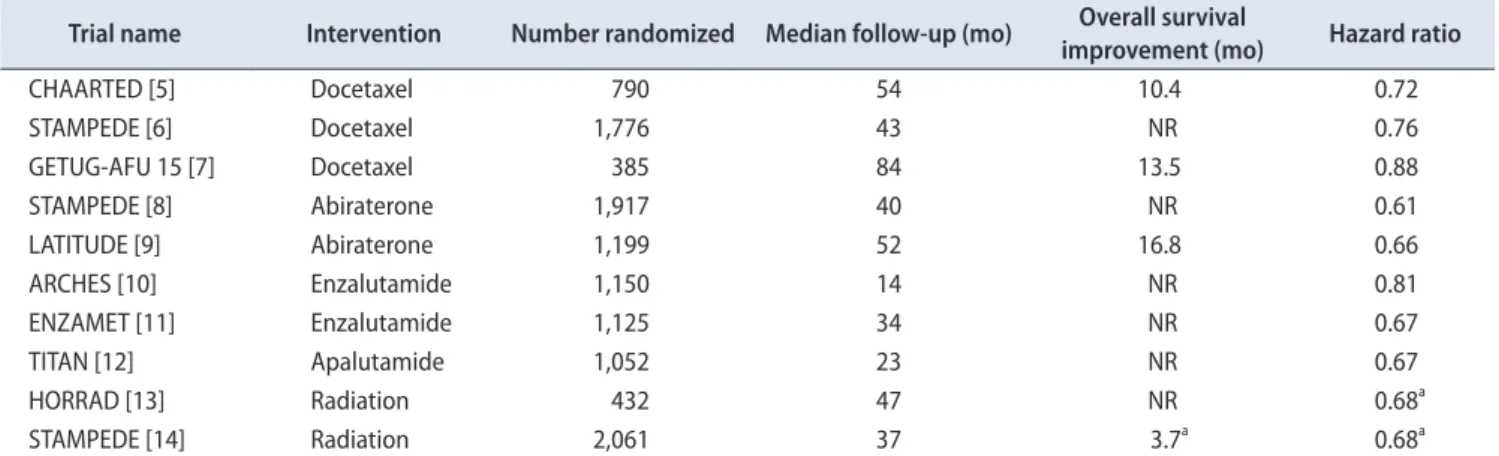
Maintenance of up-to-date knowledge across these specialties is, and will continue to be, essential to the ability of provid- ers to apply individualized therapy to patients in this com- plex space (Table 1) [5-14].
DOCETAXEL AND THE IMPORTANCE OF DISEASE BURDEN
Traditionally, docetaxel systemic chemotherapy was reserved for patients in the mCRPC space, but 3 trials analyzed in aggregate [15] have confirmed its efficacy at improving survival when given with ADT for mCSPC. The CHAARTED (Chemohormonal Therapy Versus Androgen Ablation Randomized Trial for Extensive Disease in Prostate Cancer) trial randomized 397 patients to ADT+docetaxel and compared them with 393 patients undergoing ADT alone [5].
To date, there has been roughly a 40% improvement in clini- cal progression free survival, biochemical free survival and median overall survival with addition of docetaxel. Similar results were confirmed in arm C of the STAMPEDE (Sys- temic Therapy in Advancing or Metastatic Prostate Cancer:
Evaluation of Drug Efficacy) trial which demonstrated a 38% improvement in biochemical free survival and 27%
improvement in overall survival with docetaxel [6]. Notably, initial results from the French/Belgian GETUG-AFU 15 trial were discordant from CHAARTED and STAMPEDE showing no statistically significant improvement in overall survival with the addition of chemotherapy over ADT alone [7]. However, a recent meta-analysis of CHAARTED, STAM-
PEDE and GETUG-AFU 15 has confirmed the efficacy of 6 cycles of docetaxel being safe and effective at prolonging survival in mCSPC with good long-term patient reported tol- erability at the cost of short-term quality of life detriments [15].
Not only did CHAARTED demonstrate, for the first time, that chemo/hormonal therapy administered earlier in the metastatic natural history convey significant survival advantages in prostate cancer, but also it established the im- portance of disease volume as a marker of patients who ben- efit from the most aggressive treatments. In CHAARTED, the most significant survival advantage afforded to recipi- ents of docetaxel were those with high volume metastatic disease, defined as >4 bone lesions or bone lesions outside the axial skeleton or presence of visceral metastasis. Low vol- ume, or oligometastatic, patients did not significantly benefit [5]. Other trials have adopted the same disease burden defi-
nition (STAMPEDE) and since CHARRTED was released this definition of high-volume versus low-volume disease burden has becomes perhaps the single most important pa- rameter for guiding newly diagnosed metastatic patients in their first steps down the therapeutic pathway.
Table 1. Study design and efficacy characteristics of randomized controlled trials in metastatic castration sensitive prostate cancer Trial name Intervention Number randomized Median follow-up (mo) Overall survival
improvement (mo) Hazard ratio
CHAARTED [5] Docetaxel 790 54 10.4 0.72
STAMPEDE [6] Docetaxel 1,776 43 NR 0.76
GETUG-AFU 15 [7] Docetaxel 385 84 13.5 0.88
STAMPEDE [8] Abiraterone 1,917 40 NR 0.61
LATITUDE [9] Abiraterone 1,199 52 16.8 0.66
ARCHES [10] Enzalutamide 1,150 14 NR 0.81
ENZAMET [11] Enzalutamide 1,125 34 NR 0.67
TITAN [12] Apalutamide 1,052 23 NR 0.67
HORRAD [13] Radiation 432 47 NR 0.68a
STAMPEDE [14] Radiation 2,061 37 3.7a 0.68a
CHAARTED, Chemohormonal Therapy Versus Androgen Ablation Randomized Trial for Extensive Disease in Prostate Cancer; STAMPEDE, Systemic Therapy in Advancing or Metastatic Prostate Cancer: Evaluation of Drug Efficacy; NR, not reported.
a:Low-volume cohort results only.
EMERGENCE OF ABIRATERONE WITH PREDNISONE
The STAMPEDE trial also included Arm G which ran- do mized patients in 1:1 fashion to receive ADT alone or ADT plus 1,000 mg of abiraterone acetate with 5 mg of daily prednisone [8]. The primary endpoint of the study was over- all survival and secondary endpoints included radiologic and prostatic specific antigen (PSA) progression as well as can- cer-specific survival. Addition of abiraterone and prednisone was shown to improve overall survival by 37% at 3 years of follow-up, and all secondary endpoints were met with sig- nificant improvements as well. A similarly designed trial, LATITUDE, also compared ADT alone to patients receiving abiraterone plus prednisone with the caveat that patients particularly at high-risk were studied in this trial [9]. High- risk was defined as having the presence of two stratifying criteria including ≥3 bone metastases, Gleason Score ≥8, or visceral metastasis. Overall survival was again the primary endpoint with the same secondary endpoints as STAM- PEDE. As with STAMPEDE, the overall survival benefit for patients receiving abiraterone in LATITUDE was 38% and all secondary endpoints demonstrated improvement with combination therapy.
THE ROLE OF ADDITIONAL HORMONAL AGENTS IN METASTATIC HORMONE SENSITIVE PROSTATE CANCER
Two recently released trials have investigated the role of androgen receptor (AR) targeted therapy with enzalutamide for patients with mCSPC. The ARCHES trial randomized men in 1:1 fashion to receiving 160 mg per day of enzalu- tamide with ADT or ADT with placebo [10]. Patients were stratified according to CHAARTED disease volume and receipt of prior docetaxel. Unlike trials with abiraterone, the primary endpoint in ARCHES was progression-free survival.
Men taking enzalutamide were shown to have a 61% reduc- tion in progression or death while on therapy. Importantly, Grade 3 toxicity rates were similar between patients on enzalutamide and placebo (24.3% vs. 25.6%). The ENZAMET trial was powered for overall survival as the primary end- point and similarly compared men taking enzalutamide to those on “standard care” with an open-label antiandrogen therapy [11]. Enzalutamide was shown to improve overall survival by 33%. Secondary endpoints such as PSA and clinical progression-free survival were also improved with enzalutamide.
Another AR targeting agent, apalutamide, has received
approval in the mCSPC space based on results from the TI- TAN trial [12], which compared 240 mg of apalutamide plus ADT to ADT and placebo. At 24 months of follow-up, the improvement in overall survival with apalutamide was 33%.
Finally, the results of the ARASENS trial will determine if the unique AR agent darolutamide has efficacy in mCSPC for patients undergoing docetaxel chemotherapy.
In considering the options now available to practitioners for the initial treatment of mCSPC—ADT alone, docetaxel, abiraterone plus prednisone, enzalutamide, apalutamide, and likely soon darolutamide—two important questions remain to be answered with high-level data. First, the optimum se- quencing of these therapies is unknown as is the efficacy of combining or switching between AR targeted therapies.
Second, the duration of AR therapy once a response to treat- ment has been sustained is not adequately defined by the phase 3 trials which support their use. For now, the choice of which treatment to engage remains an individualized deci- sion with disease burden, cost [16], toxicity and performance status [17] as leading factors to consider when challenged with these patients.
NEW FRONTIERS: TREATMENT OF THE PRIMARY TUMOR AND SITES OF ME- TASTASIS
Recently, two trials have been released examining the effect of radiation to the primary tumor in patients with metastatic disease. The HORRAD trial randomized men with bone-only metastasis and PSA above 20 to ADT plus radiation versus ADT alone [13]. Radiation in this trial was external beam radiation therapy at a dose of 70 Gy in 35 fractions or 58 Gy in 19 fractions. The primary endpoint of overall survival was not achieved, with the 10% improve- ment in survival among those receiving radiation not reach- ing statistical significance. However, the secondary endpoint, time-to-PSA-recurrence, was significantly improved by 22%
in the radiation group. Interestingly, the largest effect of radiation on the secondary endpoint was seen in men with low-volume bony disease, defined as fewer than 5 lesions, although this finding was obtained only through subgroup analysis for which the study was not adequately powered.
Arm H of the STAMPEDE trial randomized men with mCSPC to standard care, defined as ADT or ADT plus docetaxel, or standard care plus radiation [14]. Applications of radiation were in 55 Gy over 20 fractions or 36 Gy over 6 fractions. A prespecified subgroup analysis stratifying pa- tients based on volume of disease according to CHAARTED criteria was planned prior to initiation of the study. In terms
of the overall cohort, the 8% improvement in overall surviv- al for the radiation group was not statistically significant.
However, in subgroup analysis, the low-volume cohort had a 38% improvement in overall survival. Therefore, for now, prospective randomized evidence exists to treat the primary tumor in patients with low-volume mCSPC with radiation therapy. This question will be further tested in the PEACE-1 trial (NCT01957436) which seeks to randomize men to ADT plus docetaxel versus ADT plus docetaxel and abiraterone.
Further stratification will then proceed to split patients into a local therapy arm with radiation versus no local therapy.
A new phase 3 randomized trial of standard systemic therapy (SST) versus SST plus definitive surgery or radia- tion for patients with mCSPC is currently enrolling. SWOG 1802 (NCT03678025) will administer 6 months of SST therapy to participants followed by randomization to either surgery or radiation versus observation. High-volume as well as low-volume metastatic patients are acceptable for enroll- ment, however prior treatment with docetaxel is an exclu- sion criterion.
Only two prospective trials exist for treatment of indi- vidual metastatic sites in mCSPC. The phase 2 STOMP trial tested surgery or radiation to metastatic sites in patients with positron emission tomography and computed tomog- raphy avid lesions against observation with a primary end- point of hormone-therapy free survival [18]. Unfortunately, treatment of metastatic sites was not significantly associated with time off of ADT and quality of life between the obser- vation and treatment arms were similar as well. The POP- STAR trial also tested radiation therapy to metastatic sites in 33 men followed for local progression and freedom from ADT at median of 24 months [19]. Nearly 7% of patients experienced local progression despite radiation therapy to targeted lesions and 52% progressed to treatment with ADT during the study period. Until phase 3 trial data is available, metastasis-directed therapy for mCSPC remains investiga- tory.
CONCLUSIONS: TREATMENT OF MCSPC IN OUR PRACTICE
The landscape of treatments available for patients with mCSPC is rapidly changing, but several themes have arisen that constitute the foundation for our approach to these challenging cases. First, early involvement of a multidisci- plinary team (medical oncology, radiation oncology, clinical trials research) ensures that patients receive individualized care among options that so far have no high-level data for discrimination. Second, continuous ADT remains the back-
bone of therapy and it is generally recommended to continu- ally apply centrally acting androgen axis suppression in combination with novel agents discussed above. Third, tax- ane-based systemic chemotherapy with appears to be most impactful for those patients presenting with high-volume metastatic disease burden. Fourth, the correct sequence of non-chemotherapeutic agents against the androgen axis or AR remains in question (abiraterone, enzalutamide, apalu- tamide), but we generally agree that current high-level evidence is lacking to support switching between therapies once patients progress on an AR-targeted therapy. Lastly, the treatment of the primary tumor or selected metastasis- directed therapies should be applied only in the context of a clinical trial, as true efficacy for these strategies has yet to be demonstrated. Importantly, we await the currently ongo- ing and future randomized trials which will hopefully fur- ther advance our knowledge in the evolution of the chang- ing landscape of mCSPC.
CONFLICTS OF INTEREST
The authors have nothing to disclose.
AUTHORS’ CONTRIBUTIONS
Data aquisition, data analysis and interpretation, draft- ing of the manuscript: Daniel C. Parker. Rsearch conception and design, critical revision of the manuscript, approval of the final manuscript: Michael S. Cookson.
REFERENCES
1. Siegel RL, Miller KD, Jemal A. Cancer statistics, 2019. CA Can- cer J Clin 2019;69:7-34.
2. Montgomery RB, Mostaghel EA, Vessella R, Hess DL, Kalhorn TF, Higano CS, et al. Maintenance of intratumoral androgens in metastatic prostate cancer: a mechanism for castration- resistant tumor growth. Cancer Res 2008;68:4447-54.
3. Scher HI, Sawyers CL. Biology of progressive, castration-resis- tant prostate cancer: directed therapies targeting the androgen- receptor signaling axis. J Clin Oncol 2005;23:8253-61.
4. Weiner AB, Nettey OS, Morgans AK. Management of Meta- static Hormone-Sensitive Prostate Cancer (mHSPC): an evolv- ing treatment paradigm. Curr Treat Options Oncol 2019;20:69.
5. Sweeney CJ, Chen YH, Carducci M, Liu G, Jarrard DF, Eisen- berger M, et al. Chemohormonal therapy in metastatic hor- mone-sensitive prostate cancer. N Engl J Med 2015;373:737-46.
6. James ND, Sydes MR, Clarke NW, Mason MD, Dearnaley DP, Spears MR, et al.; STAMPEDE investigators. Addition of
docetaxel, zoledronic acid, or both to first-line long-term hor- mone therapy in prostate cancer (STAMPEDE): survival results from an adaptive, multiarm, multistage, platform randomised controlled trial. Lancet 2016;387:1163-77.
7. Gravis G, Fizazi K, Joly F, Oudard S, Priou F, Esterni B, et al.
Androgen-deprivation therapy alone or with docetaxel in non- castrate metastatic prostate cancer (GETUG-AFU 15): a ran- domised, open-label, phase 3 trial. Lancet Oncol 2013;14:149- 58.
8. James ND, de Bono JS, Spears MR, Clarke NW, Mason MD, Dearnaley DP, et al.; STAMPEDE Investigators. Abiraterone for Prostate Cancer Not Previously Treated with Hormone Therapy. N Engl J Med 2017;377:338-51.
9. Fizazi K, Tran N, Fein L, Matsubara N, Rodriguez-Antolin A, Alekseev BY, et al.; LATITUDE Investigators. Abiraterone plus prednisone in metastatic, castration-sensitive prostate cancer.
N Engl J Med 2017;377:352-60.
10. Armstrong AJ, Szmulewitz RZ, Petrylak DP, Holzbeierlein J, Villers A, Azad A, et al. ARCHES: a randomized, phase III study of androgen deprivation therapy with enzalutamide or placebo in men with metastatic hormone-sensitive prostate cancer. J Clin Oncol 2019;37:2974-86.
11. Davis ID, Martin AJ, Stockler MR, Begbie S, Chi KN, Chow- dhury S, et al.; ENZAMET Trial Investigators and the Austra- lian and New Zealand Urogenital and Prostate Cancer Trials Group. Enzalutamide with standard first-line therapy in meta- static prostate cancer. N Engl J Med 2019;381:121-31.
12. Chi KN, Agarwal N, Bjartell A, Chung BH, Pereira de Santana Gomes AJ, Given R, et al.; TITAN Investigators. Apalutamide for metastatic, castration-sensitive prostate cancer. N Engl J Med 2019;381:13-24.
13. Boevé LMS, Hulshof MCCM, Vis AN, Zwinderman AH, Twisk
JWR, Witjes WPJ, et al. Effect on survival of androgen depriva- tion therapy alone compared to androgen deprivation therapy combined with concurrent radiation therapy to the prostate in patients with primary bone metastatic prostate cancer in a prospective randomised clinical trial: data from the HORRAD trial. Eur Urol 2019;75:410-8.
14. Parker CC, James ND, Brawley CD, Clarke NW, Hoyle AP, Ali A, et al.; Systemic Therapy for Advanced or Metastatic Prostate cancer: Evaluation of Drug Efficacy (STAMPEDE) investiga- tors. Radiotherapy to the primary tumour for newly diagnosed, metastatic prostate cancer (STAMPEDE): a randomised con- trolled phase 3 trial. Lancet 2018;392:2353-66.
15. Sathianathen NJ, Philippou YA, Kuntz GM, Konety BR, Gupta S, Lamb AD, et al. Taxane-based chemohormonal therapy for metastatic hormone-sensitive prostate cancer: a Cochrane Re- view. BJU Int 2019;124:370-2.
16. Pollard ME, Moskowitz AJ, Diefenbach MA, Hall SJ. Cost- effectiveness analysis of treatments for metastatic castration resistant prostate cancer. Asian J Urol 2017;4:37-43.
17. Sharma AP, Mavuduru RS, Bora GS, Devana SK, Singh SK, Mandal AK. STAMPEDEing metastatic prostate cancer:
CHAARTing the LATITUDEs. Indian J Urol 2018;34:180-4.
18. Ost P, Reynders D, Decaestecker K, Fonteyne V, Lumen N, De Bruycker A, et al. Surveillance or metastasis-directed therapy for oligometastatic prostate cancer recurrence: a prospective, randomized, multicenter phase II trial. J Clin Oncol 2018;36:
446-53.
19. Siva S, Bressel M, Murphy DG, Shaw M, Chander S, Violet J, et al. Stereotactic Abative Body Radiotherapy (SABR) for oligo- metastatic prostate cancer: a prospective clinical trial. Eur Urol 2018;74:455-62.