65
청목노상 뽕잎으로부터 Helicobacter pylori 억제물질의 정제 및 동정
조영제1*·이경환1·차원섭1·주인식1·윤동혁1·안봉전2·이선호3·김명욱4·김정환5·천성숙5
1경북대학교 식품공학과, 2대구한의대학교 화장품약리학과, 3안동대학교 해양바이오산업연구소,
4경북해양바이오 산업연구원, 5NIP Biotech
Purification and Identification of Inhibitory Compounds from Cheongmoknosang Mulberry Leaves ( Morus alba . L.)
on Helicobacter pylori
Young-Je Cho
1*, Kyung-Hwan Lee
1, Woen-Seup Cha
1, In-Sik Ju
1, Dong-hyuck Yun
1, Bong-Jeun An
2, Seon-ho Lee
3, Myung-Uk Kim
4, Jeung-Hoan Kim
5, Sung-Sook Chun
51Department of Food Engineering, Kyungpook National University, Sangju 742-711, Korea
2Department of Cosmeceutical Science, Daegu Hanny University, Gyeongsan 712-715, Korea
3The Institute of Marine Biotechnology, Andong National University, Andong 760-749, Korea
4Gyungbuk Institute for Marine Bio-Industry, Uljin 767-801, Korea
5NIP Biotech., Munkyung 745-706, Korea Received March 27, 2009; Accepted June 9, 2009
In this study, we tried to find the subject to inhibit
H. pylorifrom
Cheongmoknosangmulberry leaves extracts and to purify and identify them. Total phenolic compounds of hot water and 80% ethanol extracts are 17.6 and 16.1 mg/g. The activity of
H. pyloriinhibition at 80% ethanol extracts was deter- mined as 15 mm clear zone. The purification of inhibitory compounds were carried on C
18column and MCI-gel CHP-20 column chromatography which were used a gradient procedure as increasing ethanol in H
2O. The chemical structure of purified inhibitory compounds on
H. pyloriwere identified chlorogenic acid, caffeic acid, and rosmarinic acid by FAB-MS,
1H-NMR,
13C-NMR and IR spectrum.
Key words: antimicrobial activity, Cheongmoknosang mulberry leaves, Helicobacter pylori, phenolic compounds, purification
서 론
의학기술의발달로평균수명이연장되어인구가노령화된반 면, 식습관의변화와운동부족으로각종암, 고혈압등 순환기 계질환과당뇨병, 간장장애등 만성퇴행성 질환이급증하고
있다[NSOK, 2003]. 천연물로부터생리활성물질을찾는연구는
오래전부터많은연구자들에의해이루어지고있으며, 이에따 른질병에대한 치료제및예방대책또는건강보조제로써식물 자원이널리이용되고있는실정이다. 현재우리나라의경우경 제성장의증대와더불어각종 성인병이증가추세에있어기능 성식품및건강식품에대한관심도가급증하고있다. 특히, 약 용 식물에대한 여러가지항암및 생리 활성기능이 밝혀짐 에따라이들을추출, 정제하여기능성식품및의약품으로개
발함으로써많은관심을가져오고있으며[Lee 등, 1999; Hong
등, 2000; Lee and Row, 2004], 뽕나무(Morus alba)잎의
GABA(γ-amino butyric acid)성분도 골수에 존재하여 acetyl choline이라 불리우는신경전달물질을증가시키고, 뇌기능을촉 진시키는 등의생리작용을 하며, 동맥경화를 없애주는작용이
있음이 밝혀지고있다[McClure 등, 1975; Shin 등, 1995; Kim
등, 1995; Cha 등, 2003].
Helicobacter pylori는만성활동성위염, 위십이지장및 소화 성 궤양의 원인균이며, 위암과 위점막연관림프 조직형위 림
프종의 중요 인자로 인식되고 있는 균이며[Goodwin and
Worsiey, 1993; Suerbaum and Michrtri, 2002; Park 등, 2003;
Kang and Lee, 2005], 국내 정상 성인의 H. pylori 감염률은
60~75% 정도로서구 여러나라와비교하여매우높은보균율을
보이고 있다[Lee 등, 1999]. 1994년 세계보건기구에서는 H.
pylori를 위암의 제 1군 발암인자로 규정한 이후 H. pylori의 중요성이더욱부각되었으며, H. pylori의병리학적 위장질환에 대한 발병기전을 밝히기 위하여 많은 연구가 진행되고 있다
[Kim, 2006]. 위염 및 위궤양환자 위점막의조직학적연구결
*Corresponding author
Phone: 82-54-530-1265; Fax: 82-54-530-1269 E-mail: [email protected]
doi:10.3839/jabc.2009.012
과에의하면 H. pylori균은위상피세포및점막층에주로부착 하는것으로 밝혀졌으며, H. pylori관련성 위염은위축성 변화 를유도하는데주도적인역할을한다[Hunt, 1996]. H. pylori의 특징적성상은 위벽상피세포에군락을형성하고, urease를생
성하여 위내 강산성의 환경에서도 균 주변의 pH를 중성으로 유지하면서생존할 수 있게된다[Won 등, 2001]. In vivo에서
의 일반적인 H. pylori의 제균방법은 크게 4가지로 구분되어, bismuth(BIS)제제를 근간으로 하는 3중 요법, proton pump inhibitor(PPi)를 근간으로 하는 3중 요법, ranitidine bismuth citrate(RBC)를 근간으로하는 3중 요법, 그리고 BIS를 근간으 로 하는 3중 요법에 PPi를 추가하는 4중요법 등이사용되고 있는데, 우리나라에서는 1차치료로 PPi에기초한 amoxicillin과
clarithromycin을 7일간투여하는 3제 요법이가장널리쓰이고
있다[Kil 등, 2004]. 이와 같이약제를사용한 제균방법은좋 은 방법일수 있으나, 항생제의장기투여시 항생제내성균주
가발생하고약제에의한부작용의우려가있어이와다른접 근법이요구되는실정이다[Kim, 2006].
따라서본 연구에서는건강식품소재로써의 응용가치가매우 높다고볼수있는뽕잎으로부터 Helicobacter pylori에대한항 균활성을가지는물질을분리, 정제하고동정하여고부가기능 성식품소재로활용하고자하였다.
재료 및 방법
시료의선정.실험재료인청목노상잎은 2007년 5월 경상북 도상주시잠사시험장에서 수집한신선한잎을 세척한후물기 를제거하고 4oC 냉장고에보관하면서사용하였다.
추출물의 제조. 청목노상뽕잎의 알콜추출물은 80% 에탄올 100 mL에 시료 1 g을 넣어 24시간 진탕한 후 상징액을
Whatman No. 1 여과지로 여과하였으며 필요에 따라 rotary vacuum evaporator에서농축하여사용하였다.
Phenol 화합물 정량. 총 페놀 화합물은 Folin-Denis 방법
[Folin and Denis, 1912]으로측정하였으며, 시료 1 mL에 95%
ethanol 1 mL와 증류수 5 mL를 첨가하고 1 N Folin-ciocalteu reagent 0.5 mL를넣어잘섞어주고, 5분간방치한후, Na2CO3 1 mL를 가한 후, 흡광도 725 nm에서 1시간 이내에 측정하여
gallic acid를 이용한표준곡선으로부터양을환산하였다.
Helicobacter pylori항균활성측정.실험에사용한균주는위,
십이지장 궤양 원인균인 H. pylori로서 표준균주인 ATCC 43504를 사용하였다. 균의 배양에는 최적배지(special peptone 0.5 g, agar 0.75 g, NaCl 0.25 g, yeast extract 0.25 g, beef extract 0.2 g 및 pyruvic acid 0.025 g)를사용하였으며미호기성 조건을 유지시켜주기 위해서 10% CO2 incubator에서 습도는
95% 이상으로유지하며배양하였으며, agar plate상에서배양은
37oC로 48~72시간동안실시하였다. 또한항균활성측정은 H.
pylori 최적배지 plate에 균분산액 100µL를 분주하여 멸균유 리봉으로 도말한 다음, 멸균된 disc paper(φ 8 mm)를 올리고
0.45µm membrane filter로제균한각추출물을 vacuum evaporator
로농축한후멸균수로희석하여 phenol 함량이 50~200µg/100
µL가되도록조절한후각추출물 100µL를 disc paper에흡수
시키고, 대조구로는 멸균수를 흡수시킨 후 37oC의 미 호기성 조건에서 48시간 동안 incubation한 다음, disc 주위의 clear zone 생성유무를확인하였다[Chun 등, 2005].
C18 column에 의한 정제. C18 open column cartridge(Flash cartridge)를 사용하여 에탄올을 0%에서 100%까지 gradient로 분당 20 mL의유속으로용출하여 TLC상에서 phenol compound
의 분리정도를 확인하였다.
MCI-gel CHP 20P에의한정제. MCI-gel은다공성 polystyren gel로써흡착성을이용하였으므로, 용출용매는일반적인 revers type인 H2O→methanol(0→100%)로 용출하여 TLC상에서
phenol compound의분리정도를확인하였다.
Thin layer chromatography. Column에의해분리된용출액 을 silica gel plate(50×50 mm)로 CHCl3:ethyl formate:ethyl acetic acid:methanol(5:2:5:0.5, v/v/v/v)의 용매를 사용하여 전 개한다음 10% H2SO4를분무하여 100oC 부근에서발색시켰다. Melting point 측정. 융해점은시료 1 mg을취하여미량융점 측정장치를이용하여측정하였다.
Infrared spectrum(IR) 측정. IR spectrum은 할로겐화알칼 리 정제법을이용하였다. 순수 분리된 시료 1 mg을 KBr 100
mg 분말과잘섞어배합하고압력을가해가압 정제를만들어
측정하였다.
핵자기 공명 분광기(Nuclear Magnetic Resonance: NMR) spectrum 측정. 1H 및 13C-NMR spectrum은 FT 방법(Pulse Fourier Transform method)을이용하여순수정제물 10 mg을측
정 용매 CDCl3+DMSO-D6-D2O에 5~20%(w/v)비율로용해시키 고 TMS(Tertamethylsilane:(CH3)4Si)를 기준물질로하여 PMR (300 MHz)로측정하였다.
FAB-mass spectrum 측정. 고체시료 1 mg을 감압상태(10−4
~10−6 mmHg)에서 negative ion FAB-mass spectrum을 이용하 여 화학적 분석법에의해측정하였다. 이 때 측정용매로써는 thioglycerol을 사용하였으며, 측정 조건에서 emitter 전류는
22~28 eV이며, 이온원의가속가압이 6~7 kV에서질량분석을하 였다.
원소 분석. 분석 시료 1 mg을 취해 48시간 감압, 건조하여 완전히수분을 제거하고자동원소분석기로시료에함유된 C 및
H의 양을분석하였으며, O는 분자량을기준으로 계산치에의 한 환산하였다.
결과 및 고찰
청목노상 잎의 phenolic 함량 측정.페놀성화합물은식물계
에널리 분포되어있는 2차대사산물의 하나로써, 다양한구조 와분자량을가지며, 이에 따라이화학적성질및생리적기능 도 매우다양하게나타난다. 한개 또는두개 이상의수산기 로 치환된방향족 고리를공통적으로 갖는데, 이러한 phenolic hydroxyl group 때문에 단백질, 효소단백질 및 기타거대 분 자들과 결합하는성질이 있으며, 2가 금속이온과의 결합력도 갖는다[Lee and Lee, 1994]. 이러한성질로 인하여 페놀성 화
합물은항바이러스작용, 항종양작용, ACE활성저해작용, 항 균작용등많은생리활성을가짐이밝혀지고있다[Shetty, 1997;
Lee 등, 1998]. 본 연구에 사용된청목노상 잎 추출물의페놀
성 화합물의함량을측정한 결과 Table 1과같이 16.1 mg/g으 로나타났다.
Helicobacter pylori항균활성 측정. 만성 위, 십이지장 질병 과 관련이있는 것으로 알려진 H. pylori에대한저해제로활 용하기위한 H. pylori 항균활성실험에서, 청목노상추출물은
Fig. 1과 같이 200µg/100µL의 농도에서 15 mm의 clear zone
을 형성하여높은저해활성을나타내었다. 이 결과는위장내
에서위궤양을일으키는원인균인 H. pylori의억제제로산업
화에적용시킬수있는 우수한 source로활용이가능할것이라
판단된다. 조등[Cho 등, 2008]은쇠비름추출물로부터 13 mm
내외의 clear zone을 얻은것으로보고하였으며, 본 연구에사
용된청목노상의 H. pylori에대한억제효과는 방부작용을하 는것으로알려진쇠비름과크게차이가없는것으로생각되어,
H. pylori저해효과가 우수하였고항균활성이 우수한것으로확 인되었다. 따라서청목노상뽕잎은 H. pylori 에대한 항균제의
원료로써활용이가능하다고판단되었다.
Column chromatography를 이용한 Helicobacter pylori 억 제물질의 정제. 청목노상뽕잎 추출물을 농축하여 C18 column (Flash cartridge)을 사용하여 revers phase type인 ethanol을
0%에서 100%로 농도를 증가시키며 20 mL/min의 유속으로 detector(UV-VIS, UV-9000, Eyela)를 사용하여 분획하였다. 분 리한 결과 9개의 fraction으로분리되었으며, 각 fraction의페놀
함량은 Table 1에서와 같이 각 fraction 별로 68.9±2.5~235.4
±0.2µg/mL까지 다양한 페놀 함량을 나타내었다. 또한 각 fraction별로 disc method를이용한 H. pylori의저해실험 결과
Table 2에서와 같이 fraction 7과 fraction 8에서 11 mm와 12
mm의 clear zone이 형성되어 단일물질로 분리하기 위해
fraction 7과 8을 다시 MCI-gel CHP-20 column을 이용하여
normal phase type인 ethanol 100%에서 0%로농도를감소시키 며 10 mL/min의유속으로용출한 결과 6개의단일물질분획 을 얻을 수 있었으며, 각 분획물은 TLC에 의한 Rf값에의해
compound A~F까지 6개의물질로분류하였고, 각 단일분획물
은 HPLC로 순도검정을 하여단일물질임을 확인하였다.
정제물의 Helicobacter pylori에 대한 항균효과. 정제물질인
compound A, B, C, D, E 및 F를 이용하여 H. pylori에대한
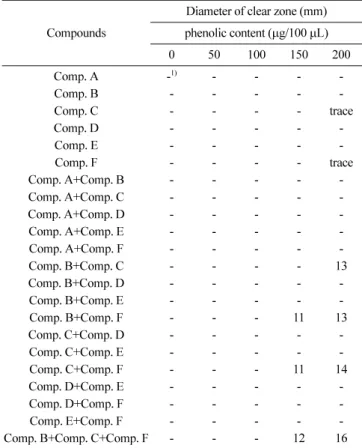
항균효과를알아보기위해 disc method로측정한결과 Table 2
에서와 같이 compound A, B, C, D, E 및 F를 단일물질로
H. pylori에처리하였을때, clear zone이매우 약하게형성되었 으며, 200µg/100µL의 농도로 compound B와 C, compound Table 1. Inhibition activity on Helicobacter pylori of purified
fractions from Cheongmoknosang mulberry leaves by C18 column Fraction Content of phenolic
(µg/mL) Diameter of clear zone (mm)
1 147.4±0.3 ND1)
2 232.3±2.7 ND
3 224.7±1.8 ND
4 235.4±0.2 ND
5 196.1±2.5 ND
6 150.0±0.4 ND
7 126.1±2.5 11
8 81.5±0.4 12
9 68.9±2.5 ND
1)Not detected
Each value represents the mean±SD (n=3).
Fig. 1. Inhibition activity on Helicobacter pylori by Cheongmoknosang mulberry leaf extracts. A: phenol contents 50µg/100µL. B: phenol contents 100µg/100µL. C: phenol contents 150µg/100µL. D: phenol contents 200µg/100µL. E: Control.
Table 2. Inhibition activity on Helicobacter pylori by purified phenolic compounds from Cheongmoknosang mulberry leaves
Compounds
Diameter of clear zone (mm) phenolic content (µg/100 µL)
0 50 100 150 200
Comp. A -1) - - - -
Comp. B - - - - -
Comp. C - - - - trace
Comp. D - - - - -
Comp. E - - - - -
Comp. F - - - - trace
Comp. A+Comp. B - - - - -
Comp. A+Comp. C - - - - -
Comp. A+Comp. D - - - - -
Comp. A+Comp. E - - - - -
Comp. A+Comp. F - - - - -
Comp. B+Comp. C - - - - 13
Comp. B+Comp. D - - - - -
Comp. B+Comp. E - - - - -
Comp. B+Comp. F - - - 11 13
Comp. C+Comp. D - - - - -
Comp. C+Comp. E - - - - -
Comp. C+Comp. F - - - 11 14
Comp. D+Comp. E - - - - -
Comp. D+Comp. F - - - - -
Comp. E+Comp. F - - - - -
Comp. B+Comp. C+Comp. F - - - 12 16
Each value represents the mean±SD (n=3).
C와 F, compound B와 F를 혼합하여 처리했을 경우에 H.
pylori에대한 항균력은각각 13, 14, 13 mm의 clear zone을형
성하는것을관찰할수있었고, compound B, C 및 F 3가지를 혼합하여 처리할경우 16 mm에 가까운 clear zone이 형성되어
저해활성이높아지는것을 확인할수있었다. 또한 compound A와 E의단일물질로처리했을경우와, compound A와 E의혼
합물을 투여할때도 clear zone은 형성되지않았다. 이러한 결 과로 볼 때 청목노상뽕잎추출물에서는 단일 물질에 의한 H.
pylori의 저해를일으키기보다는 2종 이상의혼합물질에의한
synergistic effect에의해서 H. pylori에대한저해가나타난다고 판단되었다. 또한 이 결과는 Chun 등[Chun 등, 2005]이
Oregano 등의 spice의추출물에존재하는 simple phenol들이단 일물질에 의한 H. pylori저해보다는 synergy effect에의해그
효과가발현된다고보고한것과유사하였다. 이러한현상에대 해서는분리된 simple phenol들이 H. pylori균의세포벽에어떤
mechanism으로공격을하는지추후보충연구가필요하다고판
단되었다.
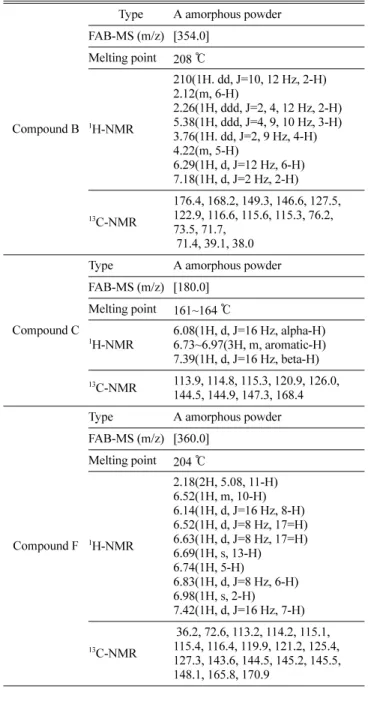
Helicobacter pylori 억제물질의 구조 동정. 정제물의항균효 과가 가장 높은 세가지 물질에 대한 구조 동정 결과는 각각
Table 3과 같이 나타났다. Compound B는 melting point가
208oC이며, negative FAB-MS에서 354의 분자량을얻었다. IR spectrum은 3250에서 OH기가, 1710에서 COO기가확인되었으 며, 선광도는 −35.2를 나타내었다. 1H-NMR spectrum은 2.10 ppm(dd, J=10, 12 Hz), 2.12 ppm(m), 2.26 ppm(ddd, J=2, 4, 12Hz), 3.76 ppm(dd, J=2, 9 Hz-H), 4.22ppm(m) 및 5.38ppm (ddd, J=4, 9, 10 Hz), 6.29 ppm(d, J=16 Hz), 6.87 ppm(d, J=8 Hz). 7.02 ppm(d, J=12 Hz) 및 7.18 ppm(d, J=2 Hz) 등으로
Barnes 등[Barnes 등, 1950]이 보고한 결과와 같아 purified comound B는 chlorogenic acid로 동정하였다(Fig. 2). Compound C는 melting point가 161~164oC이며, negative FAB-MS에서
분자량 180을얻었다. IR spectrum은 3440에서 OH기가, 1646
에서 COOH기가 확인되었으며, 또한 6.08 ppm(d, J=16 Hz), aromatic 영역에서 3H분의 6.73~6.97 ppm(m) 및 7.39 ppm(d, J=16 Hz) 등의 1H-NMR spectrum과 13C-NMR의 spectrum은
Kwon 등[Kwon 등, 2000]의 보고와 같아 compound C는 Table 3. Spectroscopic data of purified compounds with antimicrobial
activity on Helicobacter pylori
Compound B
Type A amorphous powder FAB-MS (m/z) [354.0]
Melting point 208 ℃
1H-NMR
210(1H. dd, J=10, 12 Hz, 2-H) 2.12(m, 6-H)
2.26(1H, ddd, J=2, 4, 12 Hz, 2-H) 5.38(1H, ddd, J=4, 9, 10 Hz, 3-H) 3.76(1H. dd, J=2, 9 Hz, 4-H) 4.22(m, 5-H)
6.29(1H, d, J=12 Hz, 6-H) 7.18(1H, d, J=2 Hz, 2-H)
13C-NMR
176.4, 168.2, 149.3, 146.6, 127.5, 122.9, 116.6, 115.6, 115.3, 76.2, 73.5, 71.7,
71.4, 39.1, 38.0
Compound C
Type A amorphous powder FAB-MS (m/z) [180.0]
Melting point 161~164 ℃
1H-NMR 6.08(1H, d, J=16 Hz, alpha-H) 6.73~6.97(3H, m, aromatic-H) 7.39(1H, d, J=16 Hz, beta-H)
13C-NMR 113.9, 114.8, 115.3, 120.9, 126.0, 144.5, 144.9, 147.3, 168.4
Compound F
Type A amorphous powder FAB-MS (m/z) [360.0]
Melting point 204 ℃
1H-NMR
2.18(2H, 5.08, 11-H) 6.52(1H, m, 10-H) 6.14(1H, d, J=16 Hz, 8-H) 6.52(1H, d, J=8 Hz, 17=H) 6.63(1H, d, J=8 Hz, 17=H) 6.69(1H, s, 13-H) 6.74(1H, 5-H)
6.83(1H, d, J=8 Hz, 6-H) 6.98(1H, s, 2-H) 7.42(1H, d, J=16 Hz, 7-H)
13C-NMR
36.2, 72.6, 113.2, 114.2, 115.1, 115.4, 116.4, 119.9, 121.2, 125.4, 127.3, 143.6, 144.5, 145.2, 145.5, 148.1, 165.8, 170.9
Fig. 2. Chemical structure of purified compounds with antimicrobial activity on Helicobacter pylori. A: Chlorogenic acid. B: Caffeic acid. C:
Rosmarinic acid
caffeic acid로 동정하였다(Fig. 2). Compound F는 melting point가 204oC이고선광도는 +145o이며, negative FAB-MS에서 360의 분자량을얻었다. 1H-NMR spectrum은 2.18 ppm(d, J=8 Hz), 5.08 ppm(m), 6.14 ppm(d, J=16 Hz), 6.52 ppm(d, J=8 Hz), 6.63 ppm(d, J=8 Hz), 6.69 ppm(s), 6.74 ppm(d, J=8 Hz), 6.83 ppm(d, J=8 Hz), 6.98 ppm(s) 및 7.42 ppm(d, J=16 Hz) 등
으로 Kelly 등[1976]이 보고한 결과와 같아 compound F는
rosmarinc acid로 동정하였다(Fig. 2).
초 록
본연구에서는청목노상추출물로부터 Helicobacter pylori를 억제하는물질을정제 및동정을 실시하였다. 80% 에탄올추
출물의페놀성물질의함량은 16.1 mg/g으로측정되었으며, H.
pylori 저해활성은 clear zone이 15 mm로나타났다. 저해물질의
분리는 C18 column을이용하여분리한결과 9개의 fraction으로 분리되었으며, H. pylori 저해활성을 나타낸 fraction 7과 8을 MCI-gel CHP-20 column을 이용하여 normal phase type인
ethanol 100%에서 0%로농도를감소시키며 10 mL/min의유속 으로용출한결과 6개의단일물질 분획을얻을 수있었다. 그 중세가지의물질이 H. pylori저해활성을보여 FAB-Mass, 1H
와 13C NMR과 IR spectrum을 사용하여 구조 동정한 결과
chlorogenic acid, caffeic acid 및 rosmarinic acid인 것으로 확 인되었다.
Key words: 항균활성, 청목노상 뽕잎, 헬리코박터파이로리, 페놀성물질, 정제
참고문헌
Barnes HM, Reldman JR and White WV. (1950) Isochlorogenic acid. Isolation from Coffee and Structure Studies. J. Am. Chem.
Soc., 72, 4178-4183.
Cha JY, Lee JY, Hoang IS, Whangbo D, Choi PW, Lee WC, Kim JW, Kim SY and Rhee SJ (2003) Analysis of functional components of leaves of different mulberry cultivars. J. Korean Soc. Food Sci. Nutr. 32, 15-21.
Cho YJ, Kwon OJ, Chun SS, An BJ and Kim JH (2008) Biological and antimicrobial activity of Portulaca oleacea. J.
Korean Soc. Appl. Biol. Chem. 51, 49-54.
Chun SS, Vattem DA, Lin YT and Shetty K (2005) Phenolic antioxidants from clonal oregano(Origanum vulgare) with antimicrobial activity against Helicobacter pylori. Process Biochemistry,40, 809-816.
Folin O and Denis W (1912) On phosphotungastic- phosphomolybetic compounds as color reagents. J. Biol. Chem.,
12, 239-249.
Goodwin CS and Worsiey BW (1993) Helicobacter pylori: Biological and clinical ratice. CPC press, Inc. USA.
Hong YL, Kim NH, Ahn C, Lee HY and Kim JD (2000) Studies on the biological activities of the extracts from Hovenia dulcis THUNB, Inst. Agr. Sci., Kangwon Nat'l. Univ. 11, 1-11.
Hunt RH (1996) Eradication of Helicobacter pylori infection. Am.
J. Med.100, 42S-50S.
Kang JH and Lee MS (2005) In vitro inhibition of Helicobacter pylori by Enterococcus faecium GM-1. Can. J. Microbial. 51, 629-636.
Kelly CJ, Harruff CR and Carmack M (1976) The Polyphenolic acids of Lithospermum ruderale. 11. Carbon-13 Nuclear Magnetic Resonance of Lithospermic and Rosemarinic acids. J.
Org. Chem., 41, 449-455.
Kil JH, Jung KO, Lee HS, Hwang IK, Kim YJ and Park KY (2004) Effects of kimchi on stomach and colon health of Helicobacter pylori-infected volunteers. J. Food. Sci. Nutr. 9, 161-166.
Kim NY (2006) The effect of antibiotic resistance on the eradication of Helicobacter pylori. Kor. J. Gastroenterol. 47, 82-86.
Kim JS, Kang SS, Lee MW and Kim OK (1995) Isolation of flavonoids from the leaves of Aralia continentails. Korean J.
Pharmacogn.26, 239-243.
Kwon YS, Won HM and Kim CM (2000) Flavonoids from Indigofera psedo-tinctoria stem. Kor. J. Pharmacogn. 31, 280- Lee JH and Lee SR (1994) Some physiological activity of phenolic283.
substance in plant foods. Korean J. Food Sci, Technol. 26, 317- Lee KJ and Row KH (2004) Comparison of extraction methods323.
form aglycone isoflavones from Korean Soybean, Korean J.
Biotechnol. Bioeng.19, 421-426.
Lee MJ, Chang YR and Yim NH (1998) Chemical structure of Polyphenols isolated from cacao bean and their inhibitory effect on ACE. Agricultural Chemistry and Biotechnology, 41, 110- Lee MK, Kim YG, An SW, Kim MH, Lee JH and Lee HY (1999)117.
Biological activities of Hovenia dulcis THUNB, Korean J.
Medicinal Crop Sci.7, 185-192.
Lee SH, Lim CY, Lee KH, Yeo SJ, Kim BJ, Kim SJ, Cho MJ, Rhee KH and Kook YH (1999) rpoB Gene analysis of Helicobacter pylori. J. Korean Soc. Microbial.34, 401-408.
McClure WJ, Harborne JB, Mabry TJ and Mabry H (1975) The flavonoids (part 2), In : Physiology and Functions of Flavonoids. Academic Press Inc., New york, USA. 1033-1035.
NSOK (2003) Annual report on the cause of death statistics.
National Statistical Office of Korea, Seoul, Korea.
Park JG, Yun SY, Oh S, Shin JG and Baek YJ (2003) Probiotic characteristics of Lactobacillus acidophilus KY1909 isolated from Korean brest-fed infant. Kor. J. Food Sci. Technol. 35, 1244-1247.
Shetty K (1997) Biotechnology to harness the benefits of dietary phenolics: Focus on Laminaceae, Asia Pacific J. Clin. Nutr. 6, 162-171.
Shin KH, Young HS, Lee TW and Choi JS (1995) Studies on the chemical component and antioxidant effects of Solanum lyratum.Korean J. Pharmacogn.26, 130-138.
Suerbaum S, Michetri P (2002) Helicobacter pylori infection. N Engl. J. MED.347, 1175-1186.
Won BR, Song EH, Kang GH, Chang MW and Yoon YH (2001) Inhibition effect of Lactobacillus heiviticus CU631 on urease and vacuolating toxin activity of Helicobacter pylori. J. Anim.
Sci. Technol.43, 931-940.