• 검색 결과가 없습니다.

Comprehensive Evaluation of the Anti-Helicobacter pylori Activity of Scutellariae Radix

N/A
N/A
Protected

Academic year: 2022

Share "Comprehensive Evaluation of the Anti-Helicobacter pylori Activity of Scutellariae Radix"

Copied!
7
0
0

로드 중.... (전체 텍스트 보기)

전체 글

(1)

46

Ba Wool Lee

1

, Il-Ho Park

1

, Dongsool Yim

1,2

, and Sung Sook Choi

1,

*

1

College of Pharmacy, Sahmyook University, 815, Hwarang-ro, Nowon-gu, Seoul, 01795 Republic of Korea

2

Re-creation Institute of Phytochemicals, College of Pharmacy, Sahmyook University, 815, Hwarang-ro, Nowon-gu, Seoul 01795, Republic of Korea

Abstract − The aim of this study was to evaluate the anti-Helicobacter pylori activity of fractions and major aglycon compounds (baicalein, chrysin, oroxylin A, wogonin) of Scutellariae Radix. Minimum inhibitory concentration (MIC) measurement, DPPH radical-scavenging assay, DNA protection assay, and urease inhibition analysis were performed. The ethyl acetate (EtOAc) fraction showed the potent anti-Helicobacter activity, and therefore, compounds in the EtOAc fraction were subjected to further assay. The MICs of chrysin, oroxylin A, and wogonin against Helicobacter pylori 26695 were 6.25, 12.5 and 25 µg/mL, respectively. Baicalein exhibited the most effective DPPH radical-scavenging activity. DNA protection using Fenton reaction, chrysin, oroxylin A, and wogonin showed effective DNA protective effect. This result was also confirmed by quantitative real-time polymerase chain reaction (qRT-PCR). Regarding Jack bean urease (0.5 mg/mL, 50 unit/mg) inhibition, 20 mM ofbaicalein and chrysin inhibited urease activity by 88.2% and 72.5%, respectively.

Keywords − Scutellariae Radix, Helicobacter pylori, MIC, DNA protection assay, Urease inhibitory activity

Introduction

Helicobacter pylori (H. pylori) is a major cause of upper gastric disease.

1

Gastric disease caused by H. pylori is a serious problem not only in developing countries but also in developed countries.

2

While the prevalence of infection is high in developing countries, developed countries also face difficulties due to antibiotic resistance, which makes eradication of H. pylori difficult.

3

In particular, Korean has a high incidence and mortality rate due to gastric cancer,

4

and H. pylori was responsible for 80.3% of non-cardia gastric cancer in males and 78.7% in females in 2007.

5

Even though it was expected to be decreased in the future,

6

great effort still needs to be taken for this problem. Therefore, alternative methods of eradicating H.

pylori are required.

H. pylori has various mechanisms of pathogenicity.

Structurally, its flagella and adhesins, which are responsible for motility, enable H. pylori to infiltrate mucous and epithelial cells.

2

Urease degrades urea into carbon dioxide

and ammonia, which neutralizes the acidic environment of the stomach, resulting in desensitizing of pH sensing ability of the stomach. These mechanisms facilitate survival of H. pylori in the acidic environment of the stomach, and damage to epithelial cells.

2

The immune response to H. pylori can trigger generation of excessive reactive oxygen species (ROS), which can damage the cell membrane, protein and DNA due to oxidative stress.

7

Therefore, urease inhibition and scavenging of ROS would be good strategies for treatment of diseases related to H. pylori.

In Asia-Pacific countries such as Japan and China, Scutellariae Radix (Huang-Qin) has been used as an anti- allergic, anti-inflammatory and arteriosclerosis agent.

8,9

The pharmacological effects of many active constituents of Scutellariae Radix have been investigated. In particular, the anti- H. pylori activity of flavonoids has been investi- gated, and apigenin,

10

isorhamnetin,

11

baicalin and baicalein

12

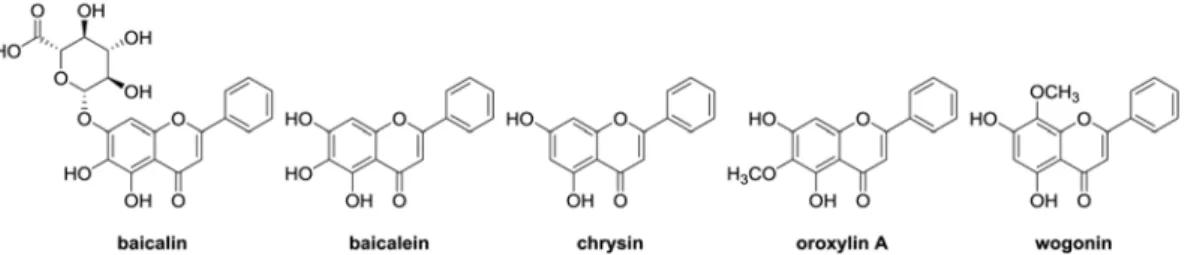
showed high levels of activity. However, in case of Scutellariae Radix most studies have focused on baicalin and baicalein, which are major components of Scutellariae Radix . Therefore, we evaluated compounds (Fig. 1) that have received less attention, including chrysin and o-methoxy-substituted flavonoids such as oroxylin A and wogonin, against H. pylori 26695. In this study, the

*Author for correspondence

SungSook Choi, College of Pharmacy, Sahmyook University, 815, Hwarang-ro, Nowon-gu, Seoul 01795, Republic of Korea.

Tel: +82-2-3399-1606; E-mail: [email protected]

(2)

anti- H. pylori, antioxidant, and urease inhibition activities of Scutellariae Radix were evaluated, to assess its anti- H.

pylori effect.

Experimental

Bacterial strains and cell line − The standard strains of H. pylori26695 (ATCC 700392) and H. pylori ATCC 43054 were purchased from the Korean Culture Type Collection (KCTC, Daejeon, Korea). H. pylori was cultured at 37°C in a standard microaerobic (5% O

2

, 10%

CO

2

and 85% N

2

gas) atmosphere on brain-heart infusion (BHI) agar (Difco, Detroit, MI) with 7% laked horse blood (Oxoid, Cambridge, CB5 8BZ, UK), 0.4% isovitalex (BBL, Sparks, MD, USA), vancomycin (6 μg/mL), amp- hotericin B (8 μg/mL) and trimethoprim (5 μg/mL). To prepare liquid media, horse serum (Sigma Co., St. Louis, USA) was used instead of blood. Human gastric epithelial AGS cells were purchased from the Korean Cell Line Bank (KCLB, Seoul, Korea) and used for genomic DNA isolation.

Chemicals − Ascorbic acid, dimethyl sulfoxide (DMSO), sodium hypochlorite (NaOCl), 2,2-diphenyl-1-picrylhydrazyl (DPPH), butylated hydroxyanisole (BHA), quercetin, baicalein and jack bean urease (type III, normal activity 50 units/mg, solid)were purchased from Sigma-Aldrich (Sigma Co., St. Louis, USA), wogonin was provided by Professor Dongsool Yim, and confirmed by NMR and MS analysis (data not shown). Chrysin and oroxylin A were purchased from Coresciences (Seoul, Korea).

Fractionation of Scutellariae Radix − Scutellariae Radix (1.2 kg) was purchased from a domestic Korean Market (Kyoungdong Crude Drugs Market, Seoul, Korea), and extracted three times with 80% MeOH at 85

o

C for 4 h and concentrated to yield a dry residue (305 g). The residue was dissolved in distilled water and fractionated successively with n-hexane, ethylacetate (EtOAc), and n-butanol (BuOH). Each fraction was concentrated and weighed (9, 15, and 74 g, respectively).

The specimen of the plant was deposited at the College of Pharmacy at Sahmyook University, Seoul, Korea.

Analysis of the extract and fractions from Scutellariae Radix by HPLC − The total methanol extracts sample and each peak fraction obtained by HPLC.

13

The HPLC system used consisted of two Waters 1525 μ pumps (Waters, USA), a sample injector (Rheodyne, Cotati, CA, USA) with a 20 μL loop, and Waters 2996 photodiode array detector. The column used was a reversed-phase Xterra RP 18 5 μm column (250 mm × 4.6 mm, Waters, USA). The mobile phase was methanol containing 1% acetic acid (solvent A)-water containing 1% acetic acid (solvent B) in the gradient mode as follow:

0 - 15 min, 25 - 60% A; 15 - 20 min, 60 - 75% A; 20 - 35 min, 75% A; 35 - 37 min, 70 - 25% A. The flow-rate was 0.7 mL/min, and the effluent was monitored at 280 nm.

Determination of minimum inhibitory concentration (MIC) and minimum bactericidal concentration (MBC) − The anti-H. pylori activity of three fractions (total, EtOAc and BuOH) and four compounds from the EtOAc fraction (baicalein, chrysin, oroxylin A, and wogonin) were assessed. Antibacterial activity was deter- mined by the twofold microdilution method.

14

H. pylori (5 × 10

5

) was in oculated in 0.3 mL of BHI broth containing each concentration of test samples, and incubated at 37

o

C under microaerobic conditions (5% O

2

, 10% CO

2

and 85% N

2

gas) for 3 days. After incubation, the lowest concentration that inhibited the growth of H.

pylori was determined as the MIC. Then, 10 μL of each culture broth were spotted on BHI agar media (free from the test sample) and incubated under the conditions mentioned above. The lowest concentration that showed no growth was determined as the MBC. For quality control, amoxicillin and H. pylori ATCC 43504 were used.

DPPH radical scavenging assay − Antioxidant activity was evaluated by DPPH assay using the method of Choi et al. with slight modification.

15

10 μL of each fraction (0.125 - 2.0 mg/mL) and compound (0.25 - 2.0 mM) were treated in a dose-dependent manner. 10 μL of each sample was mixed with 90 μL of 0.5 mM DPPH reagent, incubated for 30 min in the dark at room temperature, and absorbance at 517 nm was measured.

Fig. 1. Chemical Structures of flavonoids from Scutellariae Radix.

(3)

and quantitative real-time polymerase chain reaction (qPCR) were performed after treating DNA with Fenton reagent. DNA protection assay was performed using genomic DNA according to the method of Lee et al. with slight modification.

16

DNA was isolated from AGS cells using a GeneAll Cell SV kit (GeneAll, Seoul, Korea). 5 μL of DNA (30 μg/mL), 2 μL of samples (0.25 mg/mL of each fraction, 1 mM of each compound), 18 μL of Fenton reagent (30 mM H

2

O

2

, 50 μM ascorbic acid, and 80 μM FeCl

3

) were mixed and incubated for 30 min at 37

o

C.

Half of each sample was electrophoresed in a1.5%

agarose gel and the remainder was used for qRT-PCR.

After electrophoresis, bands intensities were quantita- tively analyzed by gel documentation system (Infinity 3000, VILBER). The primers for amplifying β-actin were as follows: F primer 5-ACCAACTGGGACGACATGGAG- 3', R primer 5'- GTGAGGATCTTCATGAGGTAGTC-3'.

The qRT-PCR procedure was as follows: the reaction mixture was composed of 2 μL of DNA template mixed with 10 μL of Power SYBR Green PCR Master Mix (Life Technologies Pty. Ltd, NY, USA), and 0.5 μL of each primer in a final volume of 20 μL. Step-One Plus Real-Time PCR System (Life Technologies Pty. Ltd, NY, USA) was used with the following reaction conditions:

95

o

C for 10 min, followed by 40 cycles of 95

o

C for 15s and 60

o

C for 60 s as the thermal cycling stage. The program for analytical melting was 15 s at 95

o

C and 60 sat 60

o

C, followed by an increase to 95

o

C at a ramp rate of 0.3

o

C per second.

Inhibition of H. pylori urease and Jack bean urease activity − Inhibition of urease activity was measured using the phenol hypochlorite method of Weather burn, with slight modification.

17

H. pylori 26695 was harvested from a BHI agar full plate and suspended in phosphate- buffered saline (PBS). Cells were disrupted using 30 s ultrasound bursts using a Sonifier at 30 W for a 50%

cycle and the centrifuged 12,000 rpm, at 4

o

C for 30 min.

The supernatant was used as enzyme solution, and the protein concentration was determined by UV-spectro- photometry. Enzyme solutions were stored at −70

o

C until use. 10 μL of H. pylori enzyme solution (1.0 mg/mL) and 2 μL of sample (1.25 - 10 mg/mL for fractions, 2.5 - 20 mM for compounds) were used for assay. To compare the inhibitory activity of four compounds against represen-

OD

control

)] × 100.

Statistical analysis − Results are means as the at least three independent experiments. Statistical significance was calculated using Studentnt’s t-test for two points.

Values of * p < 0.05, **: p < 0.01wereconsidered to indicate statistical significance.

Result and Discussion

Failure of primary treatment of H. pylori due to development of resistant strains that make eradication difficult is a major concern. In Korea, the treatment failure rate has been reported to be 20%, because of bacterial resistance to antibiotics and low patient com- pliance.

18

Accordingly, alternatives to antibiotic treatment are needed for patients harboring strains of H. pylori resistant to primary antibiotic therapy. In Asia-Pacific countries such as Japan and China, Scutellariae Radix (Huang-Qin) has been used as an anti-allergic, anti- inflammatory and arteriosclerosis agent.

8

The pharmaco- logical effects of many active constituents of Scutellariae Radix have been investigated. In particular, the anti- H.

pylori activities of flavonoids have been investigated, and apigenin,

9

isorhamnetin,

10

baicalin and baicalein

11

showed good activity. However, most studies have focused on baicalin and baicalein, major components of Scutellariae Radix . Therefore, we focused on compounds that have received less attention, including chrysin and o-methoxy- substituted flavonoids such as oroxylin A and wogonin.

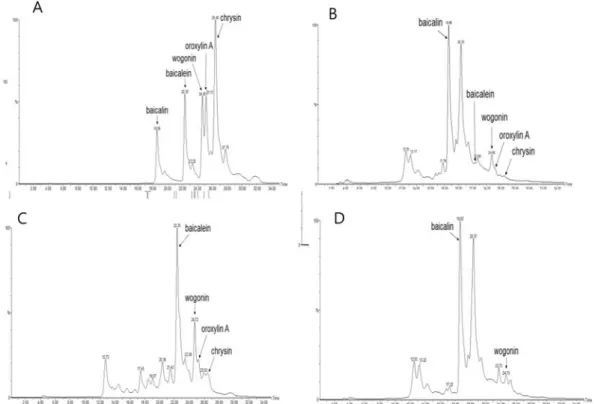
To identify the fractions and compounds from Scutellariae Radix, HPLC analysis was performed with positive control. The HPLC profiles of extract and fractions were matched with positive controls (Fig. 2). The anti- Helicobacter pylori activities of fractions and four compounds from the EtOAc fraction were investigated by determining the MIC and MBC. The EtOAc fraction showed potent antibacterial activity (Table 1). The MICs/

MBCs of the total, EtOAc and BuOH fractions were 125/

250, 31.25/31.25, and 125/125 μg/mL, respectively. Because

of potent activity of EtOAc fractions, therefore, the major

aglycon components of the EtOAc fraction (baicalein,

chrysin, oroxylin A, wogonin) were subjected to further

investigation. Chrysin showed most effective antibacterial

activity against H. pylori 26695 (Table 1). The MICs/

(4)

MBCs of baicalein, chrysin, oroxylin A and wogonin were 50/50, 6.25/12.5, 12.5/25, and 25/25 μg/mL, respec- tively. The results of the type strain of H. pylori ATCC 43504 were same pattern of H. pylori 26695 (data not shown). We evaluated the direct bactericidal activity of three fractions and four compounds against H. pylori.

Previous related studies have evaluated anti-helicobacter activity of baicalein and baicalin.

11,19

We investigated the anti- H. pylori activity of chrysin, oroxylin A, wogonin including baicalein and baicalin. As reported previously,

baicalin and baicalein showed bactericidal activity against H. pylori (Table 1). However, chrysin (unsubstituted flavone) exhibited the highest bactericidal activity, followed by o-methoxy flavone, wogonin and oroxylin A (Table 1). The MICs of chrysin, wogonin and oroxylin A were 6.25, 12.5 and 25 μg/mL, respectively. These three aglycon compounds had greater anti- helicobacter activity than baicalin glycoside. This suggests the need for further studies of the structure-activity relationship of these compounds. Chrysin seems exerted an anti- H. pylori Fig. 2. Chromatogram of five standards (baicalin, baicalein, wogonin, oroxylin A, chrysin) and each fraction of Scutellariae Radixby HPLC analysis. A: five standards; B: total extract; C: EtOAc fraction; D: n-butanol fraction.

Table 1. Anti-Helicobacter activity of fractions and compounds from Scutellria Radix

Samples H. pylori 26695

MIC

a

(µg/mL) MBC

b

(µg/mL)

Fractions

Total 125 250

EtOAc 31.25 31.25

BuOH 125 125

Compounds

Baicalin >250 >250

Baicalein 50 50

Chrysin 6.25 12.5

Oroxylin A 12.5 25

Wogonin 25 25

a: Minimum inhibitory concentration

b: Minimum bactericidal concentration

(5)

effect, suggesting that compounds with a chrysin-like structure could be novel anti- H. pylori agents.

General antioxidant activity was determined by DPPH assay. Among three fractions, the EtOAc fraction exhibited the highest DPPH radical scavenging activity at 0.125 - 2.0 mg/mL. For compounds level, baicalein showed a greater DPPH radical scavenging activity than chrysin, oroxylin A and wogonin (Fig. 3). Protection of DNA against the hydroxyl radical was examined using the Fenton reaction and qRT-PCR. Quercetin, an antioxidant flavonoid, was used as the positive control. Although all fractions showed a DNA protection effect, that of the EtOAc and BuOH fractions was higher than that of total fraction (Fig. 4A and Table 2).

Baicalein, chrysin, oroxylin A, and wogonin exerted a

protective effect (Fig. 4B, Table 2). For the quantitative comparison of four compounds, qRT-PCR was performed.

The Ct value of AGS cells (control) was 11.437 ± 0.234, and that of a sample treated only with Fenton reagent was 29.799 ± 0.215. The Ct value of the quercetin-treated sample was 12.352 ± 0.324, that of baicalein treated sample was 20.799 ± 0.215, that of chrysin treated sample was 16.877 ± 0.674, that of the oroxylin A treated sample was 17.719 ± 0.189 and that of the wogonin treated sample was 14.419 ± 0.089. From the comparison of two different radical scavenging assays, baicalein exhibited the highest DPPH radical-scavenging activity, and some extent of a hydroxyl-radical scavenging activity (Fig. 3, 4 and Table 3). However, in a DNA protection assay, the Ct value of wogonin A was 14.417 ± 0.089, compared to 20.799 ± 0.215 for baicalein. The higher the Ct value, the greater the quantity of degraded DNA. This suggests that the DPPH radical and hydroxyl radical scavenging 6: AGS cell + Fenton reagent + n-BuOH Fr./ oroxylin A; 7: AGS cell + Fenton reagent + wogonin.

Fig. 3. DPPH radicalscavenging activity of fractionsand com- pounds from ScutellariaeRadix . Each fraction (A) (0.25 - 2.0 mg/

mL) and compound (B) (0.25 - 1.0 mM) was tested and ascorbic acid and BHA (0.25 mg/mL for fractions, 1 mM for compounds) were used as positive controls. Data represent the mean ± SD of three replicates; *p < 0.05, **p < 0.01, significant difference compared to the negative control.

Fig. 4. DNA protective effect against hydrogen peroxide of fractions (A) and compounds (B) from Scutellaria Radix. (A) 1:

AGS cell; 2: AGS cell + Fenton reagent; 3: AGS cell + Fenton reagent + quercetin; 4: AGS cell + Fenton reagent + total Fr.; 5:

AGS cell + Fenton reagent + EtOAc Fr.; 6: AGS cell + Fenton reagent + n-BuOH Fr. (B)1: AGS cell; 2: AGS cell + Fenton reagent; 3: AGS cell + Fenton reagent + quercetin; 4: AGS cell + Fenton reagent + bacialein; 5: AGS cell + Fenton reagent + chrysin;

6: AGS cell + Fenton reagent + oroxylin A; 6: AGS cell + Fenton

reagent + wogonin. The concentrations of each fraction and each

compound were 0.25 mg/mL and 1 mM respectively.

(6)

mechanisms are different; moreover, the human gastric epithelial DNA protection activity is likely more relevant as DPPH does not exist in vivo. Urease inhibition was assayed. In case of H. pylori urease, when compared with 100 mM thiourea (100% inhibition), the EtOAc fraction showed the strongest inhibitory activity at 10 mg/mL (44.9%), followed by the n-BuOH fraction (28.8%). All compounds showed urease inhibition in dose-dependent manner. When compared with 100 mM thiourea (100%

inhibition), 20 mM thiourea showed 91.8% inhibition. In case of four compounds at 20 mM level, bacalein, chrysin, oroxylin A and wogonin showed 70.2%, 62.3%, 33.2%

and 33.9% inhibition, respectively (Fig. 5). In case of jack bean urease, 20 mM of baicalein, chrysin, oroxylin A and wogonin showed 88.2% 72.5%, 65.7% and 62.5%

inhibition (Fig. 6). Urease inhibitors are alternative methods of eradicating H. pylori. Several studies have attempted to identify inhibitors derived from natural products that do not have severe side effects. Forsythia suspense

20

and Mume Fructus

21

exhibited the ability to inhibit urease. Regarding Scutellariae Radix, the urease inhibitory activity of baicalin and scutellarin was inves- tigated.

22-24

We investigated the urease inhibitory activity of three fractions and four compounds. The EtOAc fraction showed 50% inhibitory activity as compared with 100 mM thiourea (Fig. 5). All compounds showed dose- dependent urease inhibition. When compared with 100 mM thiourea (100% inhibition), 20 mM thiourea showed 91.8% inhibition. In case of 20 mM compounds, baicalein, chrysin, oroxylin A and wogonin showed 70.2%, 62.3%, 33.2% and 33.9% inhibition, respectively. Especially, 20 mM chrysin exert about 60% inhibition activity compared with 100 mM thiourea. In case of most representative jack Table 3. qRT-PCR analysis of AGS cell DNA damaged by Fenton reaction.

DNA Samples Compounds Ct value

a

AGS cell none 11.437 ± 0.234

AGS cell + Fenton reagents none 29.799 ± 0.215

AGS cell + Fenton reagents Quercetin 12. 352 ± 0.324

AGS cell + Fenton reagents Baicalein 20.799 ± 0.215

AGS cell + Fenton reagents Chrysin 16. 877 ± 0.674

AGS cell + Fenton reagents Oroxylin A 17.719 ± 0.189

AGS cell + Fenton reagents Wogonin 14.417 ± 0.089

a: ct value or threshold cycle value is the cycle number at which the fluorescence generated within a reaction crosses the fluorescence threshold. Ct value is inversely proportional to the detectable amount of amplicon product.

Fig. 5. H. pylori urease inhibitory activity of fractions (A) and compounds (B) from Scutellariae Radix . Data represent the means ± SD of three replicates; *p < 0.05, **p < 0.01, significant difference compared to the negative control.

Fig. 6. Jack bean urease inhibitory activity of four compounds

from Scutellariae Radix. Data represent the means ± SD of three

replicates; *p < 0.05, **p < 0.01, significant difference compared

to the negative control.

(7)

inhibitory activity. When compared with baicalein, major components of Scutellariae Radix, MIC value of chrysin was eight times lower (50 vs 6.25 μg/mL) and chrysin showed potent DNA protection effect against hydroxyl radical. Conclusively, the EtOAc fraction of Scutellariae Radix and compounds in the EtOAc fraction showed potent anti- Helicobacter, protection of DNA from human gastric epithelial cell and urease inhibitory activities and Scutellerariae Radix can be a candidate medicinal plant for eradication of H. pylori.

Acknowledgments

The authors wish to thank Sahmyook University.

References

(1) Peek, R. M.; Blaser, M. J. Nat. Rev. Cancer 2002, 2, 28-37.

(2) Kim, B. J.; Kim, J. G. Kor. J. Med. 2015, 89, 133-141.

(3) De Francesco, V. D.; Giorgio, F.; Hassan, C.; Manes, G.; Vannella, L.; Panella, C.; Ierardi, E.; Zullo, A. J. Gastrointestin. Liver Dis. 2010, 19, 409-414.

(4) Jung, K. W.; Won, Y. J.; Kong, H. J.; Oh, C. M.; Cho, H. S.; Lee, D.H.; Lee, K. H. Cancer Res. Treat. 2015, 47, 127-141.

(5) Shin, A.; Park, S.; Shin, H. R.; Park, E. H.; Park, S. K.; Oh, J. K.;

Lim, M. K.; Choi, B. Y.; Boniol, M.; Boffetta, P. Ann. Oncol. 2011, 22, 1435-1442.

(6) Shin, A. S.; Kim, J. S.; Park, S. H. J. Gastric Cancer 2011, 11, 135- 140.

(7) Zhang, Q. B.; Nakshabendi, I. M.; Mokhashi, M. S.; Dawodu, J. B.;

(11) Ustün, O.; Ozcellik, B.; Akyön, Y.; Abbasoglu, U.; Yesilada, E. J.

Ethnopharmacol. 2006, 108, 457-461.

(12) Kang, M. H.; Lee, J. H.; Lee, Y. S.; Son, K. H.; Lee, D. H.; Kim, Y.

S.; Kang, S. S.; Bang, H. C.; Jeong, C. S. Yakhak Hoeji 2007, 51,68-74.

(13) Clinical and Laboratory Standards Institute (CLSI). Performance standards for antimicrobial susceptibility testing, 19th Informational Supplement. 2009. Document M100-S19, CLSI, Wayne, PA.

(14) Li, H. B.; Chen, F. J. Chromatogr. A. 2005, 1074, 107-110.

(15) Choi, J. S.; Oh, J. I.; Hwang, I. T.; Kim, S. E.; Chun, J. C.; Lee, B.

H.; Kim, J. S.; Kim, T. J.; Cho, K. Y. Kor. J.Pestic. Sci. 2003, 7, 92-99.

(16) Lee, J. C.; Kim, H. R.; Kim, J.; Jang, Y. S. J. Agric. Food Chem.

2002, 50, 6490-6496.

(17) Weatherburn, M. W. Anal. Chem. 1967, 39, 971-974.

(18) Choi, Y. S.; Cheon, J. H.; Lee, J. Y.; Kim, S. G.; Kim, J. S.; Kim, N. Y.; Lee, D. H.; Kim, J. M.; Jung, H. C.; Song, I. S. Korean J.

Gastroenterol. 2006, 48,156-161.

(19) Wu, J.; Hu, D.; Wang, K. X. Zhong Yao Cai 2008, 31, 707-710.

(20) Shin, S. J.; Park, C. E.; Baek, N. I.; Chung, I. S.; Park, C. H.

Biotechnol. Bioprocess Eng. 2009, 14, 140-145.

(21) Park, C. E.; Park, C. H. Korean Chem. Eng. Res. 2013, 51, 591- 596.

(22) Tan, L.; Su, J.; Wu, D.; Yu, X.; Su, Z.; He, J.; Wu, X.; Kong, S.;

Lai, X.; Lin, J.; Su, Z. Scientific World Journal. 2013, doi: 10.1155/2013/

879501.

(23) Yu, X. D.; Zheng, R. B.; Xie, J. H.; Su, J. Y.; Huang, X. Q.; Wang, Y. H.; Zheng, Y. F.; Mo, Z. Z.; Wu, X. L.; Wu, D. W.; Liang, Y. E.; Zeng, H. F.; Su, Z. R.; Huang, P. J. Ethnopharmacol. 2015, 162, 69-78.

(24) Wu, D. W.; Yu, X. D.; Xie, J. H.; Su, Z. Q.; Su, J. Y.; Tan, L. R.;

Huang, X. Q.; Chen, J. N.; Su, Z. R. Fitoterapia. 2013, 91, 60-67.

Received November 22, 2016

Revised January 10, 2017

Accepted January 12, 2017

수치

Fig. 1. Chemical Structures of flavonoids from Scutellariae Radix.
Table 1. Anti-Helicobacter activity of fractions and compounds from Scutellria Radix
Fig. 3. DPPH radicalscavenging activity of fractionsand com- com-pounds from ScutellariaeRadix
Fig. 5. H. pylori urease inhibitory activity of fractions (A) and compounds (B) from Scutellariae Radix

참조

관련 문서

3 Inhibitory effect of aqueous broccoli fermented by Lactobacillus plantarum MG208 on the adhesion of Helicobacter pylori to AGS human gastric epithelial cells.. a-d Mean values

Antagonistic activity of spent culture supernatants of lactic acid bacteria against Helicobacter pylori growth and infection in human gastric epithelial