Journal of Bacteriology and Virology 2008. Vol. 38, No. 4 p.173 – 178
Patterns of Helicobacter pylori Resistance to Metronidazole, Clarithormycin and Amoxicillin in Saudi Arabia
Mohammed Ali M. Marie*
Clinical Laboratory Department, Riyadh College of Health Sciences, King Saud University, Kingdom of Saudi Arabia
Received : August 29, 2008 Revised : September 22, 2008 Accepted : September 30, 2008
There are no generally accepted regimens for the treatment of H. pylori infection in patients with gastritis or duodenal ulcers. However, metronidazole based regimens have been reported to be among the most successful. Resistance to metronidazole, clarithromycin, and amoxicillin was determined for 46 clinical isolates of Helicobacter pylori in Saudi Arabia and tested by E test. Of these isolates, 69.5% was resistant to metronidazole (MIC > 8 mg/l), 21% to clarithromycin (MIC > 1 mg/l) and 11% were multiresistant. No resistance to amoxicillin was observed. Resistance to metronidazole was more common in isolates from females than in those form males. In conclusion, the present study demonstrates high metronidazole resistance rate of H. pylori isolates in Saudi Arabia. Regimens containing metronidazole are best avoided. Trials to test other antimicrobial combinations are recommended.
Key Words: Helicobacter pylori, Resistance, Treatment
INTRODUCTION
Helicobacter pylori (H. pylori) causes gastritis and ulcer disease and is considered as a risk factor for the devel- opment of mucosa-associated lymphoma and gastric cancer (12). Most consensus guidelines now are recommending for the eradication of H. pylori infected patients. The most commonly using treatments are triple therapies consisting of a proton pump inhibitor, clarithromycin and metro- nidazole or amoxicillin (11). The primary and secondary resistance rates reported worldwide vary from 1 to 58% for clarithromycin and from 5 to 76% for metronidazole (6,17).
Resistance to one or both of these antibiotics significantly reduces treatment success (19).
The clinical importance of this resistance makes it necessary for antibiotic treatment decisions to be based on valid and reproducible in vitro susceptibility testing results.
Reported discrepant susceptibility test results are due to variations in the methods and conditions used for suscepti- bility testing (18,20). The National Committee for Clinical Laboratory Standards (NCCLS) has recently published guidelines for in vitro susceptibility testing of H. pylori using an agar dilution method (26). Agar dilution tests are time- consuming and labor-intensive, and a large number of strains should be tested simultaneously since the media containing the antibiotic dilutions must be prepared immediately before use. The procedure is efficient for the testing of large numbers of strains, such as in susceptibility surveys, but it is not readily adaptable for the testing of small numbers of strains on an ongoing basis. The Epsilometer test (E test) method has been approved for use for the susceptibility testing of many organisms, but not for H. pylori. However, many studies have been carried out by this method with H.
173
*Corresponding author: Mohammed Ali M. Marie, Ph.D. Clinical Laboratory Department, Riyadh College of Health Sciences, King Saud University, Kingdom of Saudi Arabia.
Phone: +966 1 4471900 ext. 1281, Fax: +966 1 4481033, e-mail: [email protected]
Original Article
pylori (9,14). The proprietary antibiotic-impregnated E test strips are expensive, but less labor is required relative to the amount of labor required for agar dilution, and the MIC is read directly from the confluence of growth with the strip. Since single tests are easily carried out, E test might be a preferable method for the testing of small numbers of strains (10).
There are limited data on H. pylori resistance in Saudi Arabia. In order to find out the pattern of H. pylori suscepti- bility to antimicrobial agents in our community, the present study evaluated the reliability of results obtained by the E test methodology for determining the quantitative suscepti- bility of H. pylori to three antimicrobial agents of currently in use for H. pylori infection treatment.
MATERIALS AND METHODS
1. Clinical specimens
Forty-six gastric biopsies of patients with gastritis or duodenal ulcer were underwent endoscopically at Al-Iman General Hospital, Riyadh, Saudi Arabia. Three gastric biopsy specimens were obtained from each patient; one was used for rapid CLO test (Campylobacter like organism for determination of urease activity) (Oxoid, Basingstoke, UK) and the remaining two were placed in the sterile screw- capped tubes containing 0.5 ml Brucella broth media (Oxoid) and transported for isolation and antibiotic susceptibility test. The biopsy specimens were ground in a tissue grinder.
Using a pasture pipette, about two drops of homogenates were inoculated into H. pylori selective agar (Oxoid) and streaked with a bacteriological loop. The inoculated culture media were transferred into microaerophilic condition (jars with CampyGen, Oxoid) at 37℃ for 7 days.
2. Bacterial strains
Forty-six clinical strains of H. pylori isolated from patients with gastritis or duodenal ulcer were tested. The strains were identified by Gram staining and oxidase, catalase, and urease reactions. After identification, the bacteria were suspended in the Eppendorf tubes containing Brucella broth media with 30% glycerol and stored at - 70℃ until use.
3. Control strains
H. pylori ATCC 43504 was the reference strain used for quality control and was purchased from the American Type Culture Collection (ATCC, Rockville, MD, USA).
4. Antimicrobial agents
The antimicrobial agents tested against H. pylori included metronidazole, clarithromycin, and amoxicillin. The E test strips of each antibiotic were purchased from AB Biodisk (Solna, Dalvagen, Sweden).
5. Antimicrobial susceptibility testing
Thawed isolates were inoculated onto Mueller-Hinton agar supplemented with 5% sheep blood and were incubated under a microaerophilic atmosphere (CampyGen, Basing- stoke, UK) for 72 h at 37℃. Colonies were suspended in 2 ml of Dulbecco's modified Eagle medium (ICN Biomedicals, Livermore, CA, USA) to achieve a turbidity equivalent to that of the no. 3 McFarland opacity standard.
6. E test
Plates containing Mueller-Hinton agar supplemented with 5% heparinized horse blood were used for the E test. All antimicrobial agents except metronidazole were tested at concentrations ranging from 0.016 to 128 mg/l; Clarithro- mycin and amoxicillin were tested at 0.016 to 8 mg/l. The agar plates were inoculated by confluent swabbing of the surface with the adjusted inoculum suspensions. After the surface of the inoculated plates had dried at 37℃ inside a microaerophilic chamber, E test strips were applied onto the surface of each agar plate. The plates were incubated at 37℃ under microaerophilic conditions (CampyGen). MICs were read after 72 h of incubation on the basis of the intersection of the elliptical zone of growth inhibition with the MIC scale on the E test strip. Strains were considered as resistant when the MIC was > 8 mg/l for metronidazole,
> 1 mg/l for clarithromycin and > 0.5 mg/l for amoxicillin.
These breakpoints were used based on the recommendations from the National Committee for Clinical Laboratory Stan- dards (NCCLS) (25,29).
RESULTS
The antimicrobial susceptibility test results of all H.
pylori strains are presented in Table 1. Resistance to metronidazole was found in 32/46 isolates (69.5%) (MIC >
8 mg/l) and resistance to clarithromycin in 10 (21.7%) (MIC > 1 mg/l). No resistance to amoxicillin was observed.
Examination data in the male patients of known age (n=
22) demonstrated rates of metronidazole and clarithromycin resistance of 68.2% (n=15) and 18.2% (n=4), respectively.
In contrast, resistance rates were higher in female patients (n=24) for metronidazole (70.8%, n=17) and for clarithro- mycin (25%, n=6).
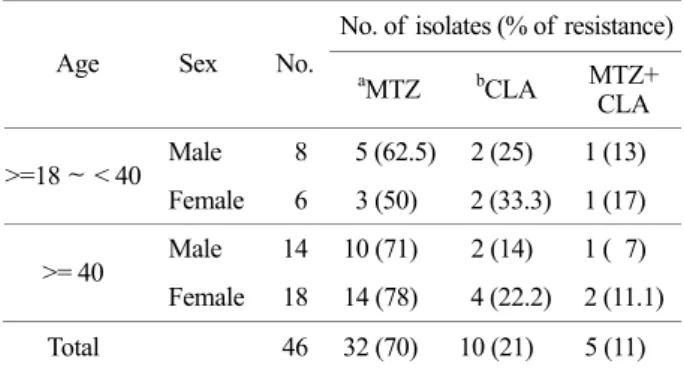
For patients aged < 40 years (n=14), 57.1% of isolates (n=8) was metronidazole-resistant and 28.5% (n=4) clarithromycin-resistant. In the >=40 years age group (n=32), resistance rates were higher for metronidazole (75%, n=24) and to a lesser extent for clarithromycin (18.8%, n=6), compared with the younger adult age group. Clarithromycin
resistance rates were higher in female than male patients in both the < 40 age group (33.3% vs 25%) and in the >=40 years age group (22.2% vs 14%). In contrast, it was only in the >=40 years group that metronidazole resistance was higher in females (78% vs 71%) (Table 2).
The proportion of female patients in the >= 40 group (n=18) infected with metronidazole-resistant H. pylori was higher (78%) than in females < 40 years (50%, n=6) (Table 2). There was no difference in clarithromycin resistance rates in females from either age group (Table 2). Similarly, antibiotic resistance rates did not differ significantly between age groups for male patients (Table 2).
DISCUSSION
The efficacy of the treatment of gastric infection caused by H. pylori could be reduced by the occurrence of primary or acquired resistance to various drugs, especially to metro- nidazole (4). This had made the susceptibility testing of H.
pylori increasingly important for the search for efficient antimicrobial combinations that allow for the eradication of this bacterium from the stomach. Many studies had used an agar dilution method (5,16), but it is difficult to perform this routinely and impractical for clinical use when testing individual isolates. The E test is now widely accepted as an alternative, providing results comparable with those of agar dilution (8,27). Moreover, E test is very easy to perform and not labor intensive (2). In this study this point was addressed by using a control strain (ATCC 43504) with Table 1. Minimum inhibitory concentrations (MICs) of
metronidazole, clarithromycin, and amoxicillin for 46 isolates of H. pylori
MICs No. (%)
MICs mg/l Metronidazole Clarithromycin Amoxicillin 0.016 2 ( 4) 7 (16) 10 (21) 0.032 2 ( 4) 10 (21) 13 (28) 0.064 2 ( 4) 4 ( 8) 17 (37) 0.125 1 ( 2) 3 ( 7) 3 ( 7)
0.25 1 ( 2) 6 (13) 3 ( 7) 0.5 1 ( 2) 3 ( 7) 0
1 0 3 ( 7) 0
2 3 ( 7) 10 (21) 0
4 0 0 0
8 2 ( 4) 0 0
16 9 (20) 0 0
32 9 (20) 0 0
64 8 (18) 0 0
128 6 (13) 0 0
46 46 46
Table 2. Rates of metronidazole and clarithromycin resistance in 46 isolates of H. pylori in relation to patient age and sex
No. of isolates (% of resistance) Age Sex No.
aMTZ bCLA MTZ+
CLA Male 8 5 (62.5) 2 (25) 1 (13)
>=18 ~ < 40
Female 6 3 (50) 2 (33.3) 1 (17) Male 14 10 (71) 2 (14) 1 ( 7)
>= 40
Female 18 14 (78) 4 (22.2) 2 (11.1) Total 46 32 (70) 10 (21) 5 (11)
a MTZ, metronidazole, b CLA, clarithromycin.
known MIC values. All the MIC values of the reference strain were maintained throughout the study. Metronidazole is the main antibiotic used in several eradication therapies for H. pylori, but resistance is well documented in developing and developed countries (5,22). In the present study the incidence of metronidazole resistance was 69.5%, a high percentage when compared to the developed countries (13).
It has been documented that metronidazole resistance is higher in female patients (7,31) This is most likely to be due to the use of metronidazole to treat gynaecological infections. Interestingly, the clarithromycin resistance rate was higher in female compared with male patients in both age groups. Higher clarithromycin resistance rate in females was documented in a multi-centre study in the United States (23). Mutations (A2142G and A2143G) in the 23S rRNA gene associated with clarithromycin resistance in H. pylori confer cross-resistance to other agents in the macrolide, lincosamide antibiotic group, including clindamycin. The higher clarithromycin resistance rates in females may again be due to treatment of gynaecological infections, as clinda- mycin is used as an alternative to metronidazole in the treatment of bacterial vaginosis (30). Continued monitoring of resistance rates in larger study populations over a longer period would be essential in order to identify potential trends.
The limitations of existing therapies has led to the development of alternative "rescue therapies" involving agents not used in first or second-line therapies, such as the rifamycin and fluoroquinolones (15). Resistance to these agents has not been examined here, in Saudi Arabia, as few validation studies to determine appropriate cut-off for resis- tance had been conducted.
Data obtained in this investigation revealed that 11% of H. pylori strains was resistant to two antibacterial agents.
Torres et al. from Mexico had reported 30.7% double resistance among H. pylori isolates (28). H. pylori resistance to these antimicrobials may be partially explained by the high prevalence of these bacteria in our population. Metro- nidazole and amoxicillin in combination with a proton pump-inhibitor were used for treatment of H. pylori infection with eradication rate of 80% in Europe (21). In
this study, 69.5% of H. pylori isolates was resistant to metronidazole and therefore, recurrence of the infection with H. pylori could be expected among patients receiving the above triple therapy.
Furthermore, countries in the Middle East such as Saudi Arabia have high prevalence of H. pylori and this could be the cause of high resistance to metronidazole and clarithro- mycin. High prevalence of H. pylori was reported by many authors previously. In 1990, Al Moagel et al, reported that 40% of the Saudi population in the age group of 5~10 years and 70% of people ≥20 years of age had H. pylori, which makes it one of the highest endemic areas in the world (3). In 1994, Mohammed et al, from Saudi Arabia reported that 145 (74%) of 196 dyspeptic patients were found infected with H. pylori (24). Moreover, the other reason of high prevalence of H. pylori resistance to metro- nidazole and clarithromycin is that Saudi Arabia has a large community of expatriates from the Far East and the Indian subcontinent where metronidazole and clarithromycin resistance are prevalent due to frequent usage of the drug for parasitic diseases and for common ailments such as diarrhea (1).
The present study suggests that culture and antimicrobial susceptibility testing of H. pylori must be performed in patients who have failed in the metronidazole based triple therapy. In conclusion, this study demonstrates high metro- nidazole resistance of H. pylori isolates in Saudi Arabia as tested by E test. Regimens containing metronidazole are best avoided. Trials to test other antimicrobial combinations are recommended.
REFERENCES
1) Ahmad MM, Rahman M, Rumi AK, Islam S, Huq F, Chowdhury MF, Jinnah F, Morshed MG, Hassan MS, Khan AK, Hasan M: Prevalence of Helicobacter pylori in asymptomatic population - a pilot serological study in Bangladesh. J Epidemiol 7: 251-254, 1997.
2) Alarcón T, Domingo D, López-Brea M: Discrepencies between E-test and agar dilution methods for testing metronidazole susceptibility of Helicobacter pylori. J
Clin Microbiol 36: 1165-1166, 1998.
3) al-Moagel MA, Evans DG, Abdulghani ME, Adam E, Evans DJ Jr, Malaty HM, Graham DY: Preva- lence of Helicobacter (formerly Campylobacter) pylori infection in Saudia Arabia, and comparison of those with and without upper gastrointestinal symptoms. Am J Gastroenterol 85: 944-948, 1990.
4)Axon AT: Helicobacter pylori therapy: effect on peptic ulcer disease. J Gastroenterol Hepatol 6: 131-137, 1991.
5) Baker CN, Stocker SA, Culver DH, Thornsberry C:
Comparison of the E test to agar dilution, broth microdilution, and agar diffusion susceptibility testing techniques by using a special challenge sobacteria. J Clin Microbiol 29: 533-538, 1991.
6) Best LM, Haldane DJ, Bezanson GS, Veldhuyzen van Zanten SJ: Helicobacter pylori: primary susceptibility to clarithromycin in vitro in Nova Scotia. Can J Gastroenterol 11: 298-300, 1997.
7) Cameron EA, Powell KU, Baldwin L, Jones P, Bell GD, Williams SG: Helicobacter pylori: antibiotic resistance and eradication rates in Suffolk, UK, 1991 -2001. J Med Microbiol 53: 535-538, 2004.
8) Cederbrant G, Kahlmeter G, Ljungh A: The E-test for antimicrobial susceptibility testing of Helicobacter pylori. J Antimicrob Chemother 31: 65-71, 1993.
9)Chaves S, Gadanho M, Tenreiro R, Cabrita J:
Assessment of metronidazole susceptibility in Helico- bacter pylori: statistical validation and error rate analysis of breakpoints determined by the disk diffusion test. J Clin Microbiol 37: 1628-1631, 1999.
10)Chida-Sakata N, Baba M, Inagawa H, Wada A, Tanaka T, Hoshihara Y, Takemoto T: Significance of anaerobic preincubation of Helicobacter pylori for measuring metronidazole susceptibility by the Etest.
Microbiol Immunol 43: 397-401, 1999.
11) de Wit NJ, Mendive J, Seifert B, Cardin F, Rubin G: Guidelines on the management of H. pylori in primary care: development of an implementation strategy. Fam Pract 17: S27-S32, 2000.
12) Fallone CA, Barkun AN, Halwani E: Does Helico- bacter pylori eradication prevent gastric cancer?. Dig Liver Dis 33: 803-804, 2001.
13) Fock KM: Peptic ulcer disease in the 1990s: an Asian perspective. J Gastroenter Hepatol 12: S23-S28, 1997.
14)Franzin L, Pennazio M, Cabodi D, Paolo RF, Gioannini P: Clarithromycin and amoxicillin suscepti- bility of Helicobacter pylori strains isolated from adult patients with gastric or duodenal ulcer in Italy. Curr Microbiol 40: 96-100, 2000.
15) Gisbert JP, Pajares JM: Helicobacter pylori "rescue"
therapy after failure of two eradication treatments.
Helicobacter 10: 363-372, 2005.
16) Glupczynski Y, Labbé M, Hansen W, Crokaert F, Yourassowsky E: Evaluation of the E test for quan- titative antimicrobial susceptibility testing of Helico- bacter pylori. J Clin Microbiol 29: 2072-2075, 1991.
17) Glupczynski Y, Mégraud F, Lopez-brea M, Andersen LP: European multicentre survey of in vitro anti- microbial resistance in Helicobacter pylori. Eur J Clin Microbiol Infect Dis 20: 820-823, 2001.
18) Grignon B, Tankovic J, Mégraud F, Glupczynski Y, Husson MO, Conroy MC, Emond JP, Loulergue J, Raymond J, Fauchère JL: Validation of diffusion methods for macrolide susceptibility testing of Helico- bacter pylori. Microb Drug Resist 8: 61-66, 2002.
19) Heep M, Kist M, Strobel S, Beck D, Lehn N: Secon- dary resistance among 554 isolates of Helicobacter pylori after failure of therapy. Eur J Clin Microbiol Infect Dis 19: 538-541, 2000.
20) King A: Recommendations for susceptibility tests on fastidious organisms and those requiring special han- dling. J Antimicrob Chemother 48: 77-80, 2001.
21) Lind T, Mégraud F, Unge P, Bayerdörffer E, O'marin C, Spiller R, Veldhuyzen Van Zanten S, Bardhan KD, Hellblom M, Wrangstadh M, Zeijlon L, Cederberg C: The MACH2 study: Role of omeprazole in eradication of Helicobacter pylori with 1-week triple therapies. Gastroenterology 116: 248-253, 1999.
22)Mégraud F, Lehn N, Lind T, Bayerdörffer E, O'Morain C, Spiller R, Unge P, Veldhuyzen van Zanten S, Wrangstadh M, Burman CF: Antimicro- bial susceptibility testing of Helicobacter pylori in a large multicenter trial: the MACH 2 study. Antimicrob Agents Chemother 43: 2747-2752, 1999.
23)Meyer JM, Silliman NP, Wang W, Siepman NY, Sugg JE, Morris D, Zhang J, Bhattacharyya H, King EC, Hopkins RJ: Risk factors for Helicobacter pylori resistance in the United States: the surveillance of
H. pylori antimicrobial resistance partnership (SHARP) study, 1993-1999. Ann Intern Med 136: 13-24, 2002.
24) Mohamed AE, al Karawi A, al Jumah A, Ahmed AM, Sharig S, Yasawy MI, Osaba O: Helicobacter pylori: incidence and comparison of three diagnostic methods in 196 Saudi patients with dyspepsia.
Hepatogastroenterology 41: 48-50, 1994.
25)National Committee for Clinical Laboratory Standards (NCCLS): Performance standards for anti- microbial susceptibility testing: Eleventh Informational Supplement. National Committee for Clinical Laboratory Standards, Villanova, PA, 1999.
26)National Committee for Clinical Laboratory Standards (NCCLS): Performance standards for antimicrobial susceptibility testing and approved standard M7-A5. Informational Supplement; M100-S10.22.
National Committee for Clinical Laboratory Standards, Wayne, PA, 2000.
27)Piccolomini R, Di Bonaventura G, Catamo G, Carbone F, Neri M: Comparative evaluation of the E test, agar dilution, and broth microdilution for testing susceptibilities of Helicobacter pylori strains to 20 antimicrobial agents. J Clin Microbiol 35: 1842-1846,
1997.
28)Torres J, Camorlinga-Ponce M, Pérez-Pérez G, Medrazo-De la Garza A, Dehesa M, González- Valencia G, Muñoz O: Increasing multidrug resistance in Helicobacter pylori strains isolated from children and adults in Mexico. J Clin Microbiol 39: 2677-2680, 2001.
29) Utrup LJ, Flamm R, Osato M, Ferraro MJ, Reller LB, Barry A, Bush K, Silliman N: Susceptibility testing standardization and quality control ranges for Helicobacter pylori [abstract C-31]. In Program and Abstracts of the 98th General Meeting of the American Society for Microbiology. American Society for Microbiology, Washington DC, 1998.
30) Wang G, Taylor DE: Site-specific mutations in the 23S rRNA gene of Helicobacter pylori confer two types of resistance to macrolide-lincosamide-streptogramin B antibiotics. Antimicrob Agents Chemother 42: 1952 -1958, 1998.
31) Wolle K, Leodolter A, Malfertheiner P, König W:
Antibiotic susceptibility of Helicobacter pylori in Germany: stable primary resistance from 1995 to 2000.
J Med Microbiol 51: 705-709, 2002.