Patterns of Information Seeking Behaviour of Law
Students in Digital Environment: A Study
Rajesh Kumar Das *
Department of Information Science and Library Management, University of Dhaka Bangladesh
E-mail: [email protected]
Anwesha Jadab
Library and Information Services Asian University for Women Chittagong, Bangladesh
E-mail: [email protected]
Open Access
Accepted date: December 8, 2016 Received date: September 21, 2016 *Corresponding Author: Rajesh Kumar Das
MPhil Student
Department of Information Science and Library Management University of Dhaka
Dhaka, Bangladesh
E-mail: [email protected]
All JISTaP content is Open Access, meaning it is accessible online to everyone, without fee and authors’ permission. All JISTaP content is published and distributed under the terms of the Creative Commons Attribution License (http:/ creativecommons. org/licenses/by/3.0/). Under this license, authors reserve the copyright for their content; however, they permit anyone to unrestrictedly use, distribute, and reproduce the content in any medium as far as the original authors and source are cited. For any reuse, redistribution, or reproduction of a work, users must clarify the license terms under which the work was produced.
ABSTRACT
Nowadays the enormous growth of modern information communication technologies and its massive use have influenced information users all over the world. Such a digital environment has drastically changed the information seeking patterns of information users of every community. These also tend law students to use various legal information sources and services in digital environments while seeking information. But there have been few empirical user studies on the aspect of digital information seeking behaviours of law students in either law or library and information science literatures. This paper aims to draw out patterns of information seeking behavior of students of law in digital environments at the University of Dhaka. A stratified random sample survey was conducted for this study. The results show that students prefer the electronic format of information rather than printed format. Major e-resources used by them and the influential factors of use were also iden-tified in this study. This study also ideniden-tified some crucial problems for seeking information and provides suggestions for the development of electronic legal information systems.
Keywords: Information Seeking Behaviour, Digital Environment, Law Students, Bangladesh
J Inf Sci Theory Pract 5(1): 15-25, 2017
http://dx.doi.org/10.1633/JISTaP.2017.5.1.2
1. INTRODUCTION
Today we are living in an information society. In-formation is the life-blood of modern times and has a profound impact on all aspects of a digital citizenry. In today’s world overall development mostly depends on proper access and use of information. Without valid and up-to-date information, it is hardly possible to progress in any field of life (Bajpai, 1990). Information simply can be defined as an entity or concept or process that directs data to accomplish the journey towards knowledge, and further, to wisdom. This quest per-vades the sole basis of human information behaviour. It encompasses an extensive array of user behaviour con-cerned with information activities ranging from gener-ating information need to seeking, sharing, and use of information for effective information systems design (Khoo, 2014). However, the nature of this information has undergone a massive change with the proliferation of modern information communication technologies (ICTs) and their ease of use. Cloud computing, cyber bullying, blogospheres, folksonomy, social bookmark-ing, harvesting web content, and so on have been the common phenomenon to information seekers today. Such a technological environment has been contribut-ing to man’s capacity to cope with the mass of informa-tion surrounding him (Nahl, 1998). From the psycho-logical aspect, such a kind of ‘user coping skill’ (Faibisoff & Ely, 1974) often poses great difficulty for individuals to take proper decisions for extracting information from data storage or the cloud. Thus it has remarkably affected the information seeking behavior of informa-tion users from diverse knowledge domains.
Law is a knowledge intensive domain which serves as principal source of legal cognition for all and for the legal community in particular. The legal fraternity needs to cope with legal information for a multitude of background work that includes reviewing and compil-ing statutes, procedural rules, evidence, bills, amend-ments, pertinent documentation, and much more. Therefore, legal information is a valuable resource for legal practitioners, especially for law students who generally learn how to become lawyers (Oke-Samuel, 2008). Law students, like legal practitioners, work in information-rich constant flux, with ongoing trends of statutes and other legal affairs for learning and legal re-search (Kerins, Madden, & Fulton, 2004). But the ways
of legal information provision have changed radically in the last few years with the entrance of law into the so-called knowledge soup. In the same vein, library and information centers are shifting from traditional to electronic modes of operation to support computer assisted legal research. Library 2.0 principles are now creating a new paradigm into law library services. Some popular digital law library platforms such as LexisNexis and Westlaw render legal information sup-port from various legal domains which are either per-sonalized or interconnected in the database. Besides these, there are many general search engines (such as Google) and law-specific search engines (such as Find-Law) that provide legal information over the network. These tend to enable law students use various legal in-formation sources and services in digital environments while seeking information.
Systematic investigation of different types of user groups helps to identify different characteristics of users: their need (Wilson, 2000; 2006), information seeking behavior (Wilson, 2000; Prabha, 2013), infor-mation use pattern, and reasons for using one or more information sources (Murugan, 2011) irrespective of various disciplines or professions. Within the field of user studies, information seeking behavior is a highly researched area that helps to reveal the usage of a par-ticular system or service for further improvement. As noted by Marchionini (1992), “Computer-augmented information seeking will become increasingly more pervasive and more complex” (p. 161), and it has been now raised as an imperative to investigate digital information seekers as ‘behavioural evidence’ for re-cording perceptions and requirements of users and to take decisions on them. Thus proper understanding of information seeking behavior as a user study is a necessity for planning, designing, and beginning the latest information services based on existing ones. It therefore motivates the present study to investigate the information seeking behaviour of law students in such digital environments.
2. LITERATURE REVIEW
have focused on understanding the information seeking behavior of law students in digital environments.
Anyaogu (2014) reports the results of a study ex-ploring the information need and seeking behaviour of post-graduate law students of NIALS library, Nigeria and found out that law textbooks were the most used source for information seeking by students. Ogba’s study (2013) also indicated that law students use text-books as a print information source while reference books, newspapers, periodicals, and so on are a less used source. A recent study by Kadli and Hanchinal (2015) on information seeking behaviour of law dents in two law colleges of Mumbai identified the stu-dents’ high dependency rate on books along with other online and offline legal databases. It also showed that e-mail is the most popular Internet application used by the students and they always become aware about free online databases through friends, teachers, library staff, library websites, library blogs, brochures, and so on.
As Aforo and Lamptey (2012) state that the library is the first gateway of call for every academic, law students have to depend heavily on library and infor-mation centers for fulfilling their inforinfor-mation needs. Oguntuase and Falaiye (2004) also opined that there is a positive correlation between adequacy of library materials and frequency of library visits by the user. Ukpanah and Afolabi (2011) defined a law library as an assemblage of legal information in an organized manner for use of those either seeking to qualify or who have qualified as lawyers, along with those performing or administering law. Tuyo (2006) also buttressed the need of adequate collections in a law library that must be responsible for providing relevant information regarding quality and quantity of materi-als in its holdings. Ossai (2009) conducted library use patterns of law students at the University of Benin and found that law students avoid seeking any form of re-lationship with and assistance from library staff when they run into difficulty. The study also showed that Ni-gerian law students do not use OPAC (Online Public Access Catalogue) in accessing library resources. They were also found to be shelve-browsers. Thus instead of using OPAC to access library resources, they preferred going directly to the shelves and moving round until they find a book related to their area of research. On-wudinjo, Ogbonna, and Nwadiogwa (2015) investigat-ed the use of law library collections of undergraduate
students of the Faculty of Law, Nnamdi Azikiwe Uni-versity, Awka and found that a majority (75.8%) of the students are satisfied with their law library resources.
Yemisi and Mostert (2013) undertook a study on information seeking behavior and ICT utilization skills of undergraduate law students in Adekunle Ajasin Uni-versity. The study found that most students preferred both print and electronic sources. They also noted that the Internet is the only used tool, moreover, ‘when it is necessary’ and the Internet was mainly used through mobile phones. Abbas, MacFarlane, and Göker (2014) investigated the impact of smartphones on informa-tion seeking behavior of law students throughout the Higher Education Institute (HEI) of the UK in relation with information delivery services using mobile tech-nology. They also suggested library and information professionals to be more proactive for rendering infor-mation services to students through the smartphone as a means to deliver information products. Yemisi and Mostert (2012) observed that law students do not fully utilize ICT resources when seeking information in the library, and they also do not seem to have been exposed to the core information retrieval tools required for the law profession and are not skilled enough to use gad-gets such as computers, the Internet, and information databases available in the law library. Rai’s (2013) study towards the use of electronic legal resources examined the information seeking behaviour of legal researchers of academic law libraries in Delhi. The study shows that most legal researchers (almost 97%) preferred legal databases and computer aided legal research to fulfill their information needs. The major problems identified in this study that dissatisfy the researcher are: restricted access, slow connection, search and login problems, lack of library support services, and so on. The study also buttresses the need for library orientation and online information search skill programs as practical solutions for the aforesaid problems.
resources simultaneously. In this regard Onwudinjo, Nwosu, and Ugwu (2014) put emphasis on periodic assessment of collections of law libraries by regulato-ry authorities for the modification of collections that could best fit with the curriculum. As a practical solu-tion Niedwieckie (2005) focused on the ‘metacognitive skills’ and control of learning by using several tech-nological tools (i.e. learning blogs, message boards, and other online tools) to help students plan, monitor, and evaluate their learning more effectively. Aldaihani (2003) also put emphasis on teaching and training stu-dents on legal informatics and legal databases.
3. RESEARCH QUESTION
The goal of this study is to explore the patterns of information seeking behavior of law students in digital environments by addressing the following research questions:
RQ 1: What is the current status of information seeking behaviors of students of law in digital environments?
RQ 2: Which factors influence law students to use e-resources?
RQ 3: What are the challenges students face for seeking electronic legal information?
RQ 4: What are the strategies that can be applied for the improvement of legal information sources and services?
4. RESEARCH METHODOLOGY
This study includes survey methodology with the help of a structured questionnaire comprised of di-chotomous, multiple choice, rating, and opinion ques-tions. Students of the Faculty of Law at the University of Dhaka were used as the population in this study. This faculty is considered as a pioneer of legal edu-cation in Bangladesh, as formal legal eduedu-cation was started through its establishment in 1921. At present it offers a four year LL.B. (Bachelor of Laws), a one year general LL.M. (Master of Laws) and specialized LL.M., M.Phil., and Ph.D. degrees. In this study only LL.B. and LL.M. are included, as these two programs are offered in the regular basis by the faculty. Stratified
random sampling technique was used to select re-spondents from law students registered in the 2015-16 session of the Faculty of Law, University of Dhaka. At first the students were divided into two strata: LLB and LLM. Then 100 students were taken randomly from each stratum to constitute a total of 200. Question-naires were distributed to the study sample between October and December 2015 for collecting the data. Among the distributed questionnaire, 183 were re-turned usable (response rate of 91.5%). Collected data were analyzed using simple descriptive statistics and SPSS version 20.0.
5. RESULTS OF THE STUDY 5.1 Respondents
Fig. 1 illustrates the distribution of respondents by gender. It shows that out of 183 participants 55 were male and 40 were female, accounting for 52% of strata 1, and 50 were male and 38 were female from strata 2, that formed 48% of the study sample.
5.2. Purpose of Seeking Information
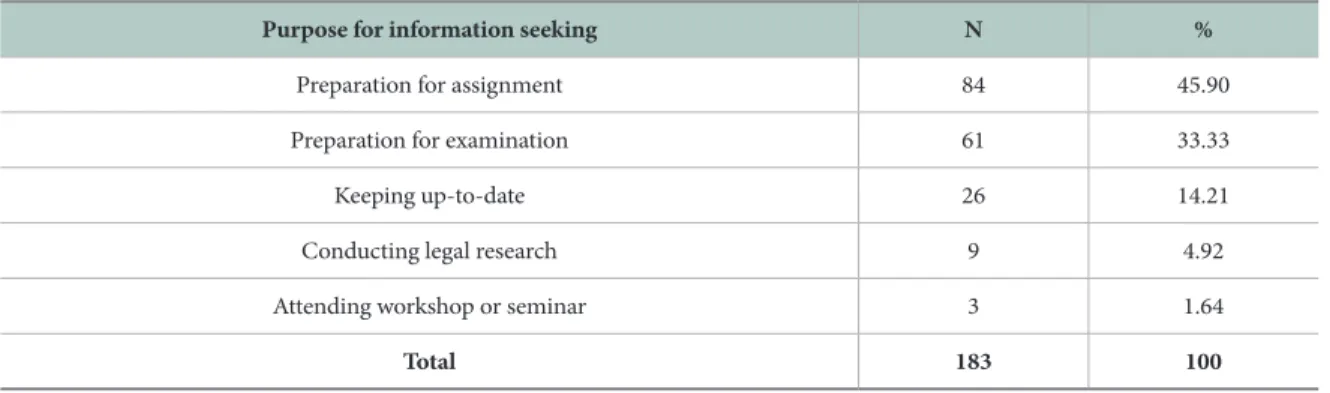
Respondents were asked to mention the reason why they seek information. Results revealed that the high-est (45.9%) of the respondents’ purpose for seeking information is for the preparation for assignments, fol-lowed by 33.33% for preparation for examinations. The third highest purpose of seeking information by the respondents is for keeping up-to-date with a total of 14.21%, while 4.92% seek information for conducting legal research and only 1.64% for attending workshops or seminars (Table 1).
5.3. Information Sources Used for Information Seeking
Table 1. Purpose for Seeking Information (N=183)
Purpose for information seeking N %
Preparation for assignment 84 45.90
Preparation for examination 61 33.33
Keeping up-to-date 26 14.21
Conducting legal research 9 4.92
Attending workshop or seminar 3 1.64
Total 183 100
Table 2. Source of Information used by Students (N=183)
Information source N % Textbooks 95 51.91 Encyclopedia 33 18.04 Law reports 21 11.47 Law journals 13 14.21 Legal digest 9 7.10 Case report 7 2.73 Thesis 5 1.64 Total 183 100
5.4. Frequency of Library Use
Fig. 2 shows the frequency of library use by students of law to seek information. In this study physical li-brary visiting has been taken into consideration to determine how often the law students still visit the library physically in the digital age. It reflects that the majority of students (95, 41.91%) are ‘daily’ users of the library; followed by 72 (29.34%) students who are ‘weekly’ users of the library. Besides these, 13.75 % indicate that they use the library ‘monthly’, but 8.51% use the library ‘rarely.’ However, small percentage of students (6.49%) stated that they use the library 'not at all' for seeking information.
5.5. Preferred Format of Information
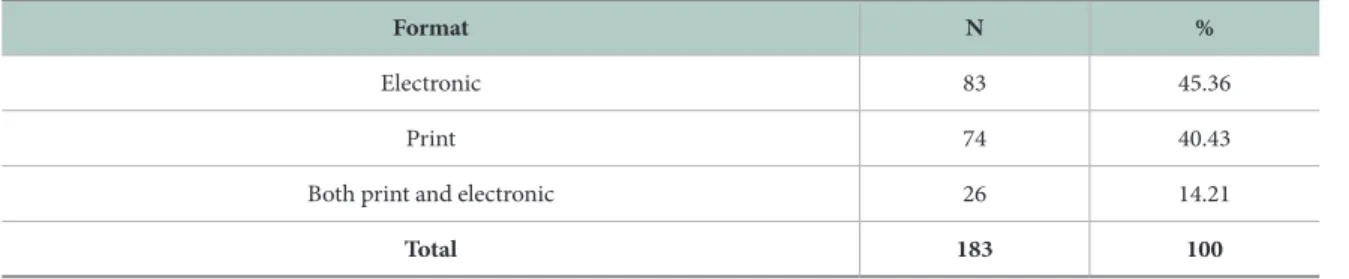
Students were asked to mention their preference for format of information. Table 3 indicates that the high-est level of preference of information formats students mentioned was electronic format 83 (45.36%), fol-lowed by printed formats (40.43%). In addition to that, only 26 (14.21%) of students preferred both print and electronic formats.
5.6. Usage of Major E-resources
The results show that law students use legal databas-es more (86) than any other e-rdatabas-esourcdatabas-es for seeking information. General search engine use is at the
sec-Table 3. Preference of Students between Print and Electronic Format (N=183)
Format N %
Electronic 83 45.36
Print 74 40.43
Both print and electronic 26 14.21
Total 183 100
ond position (41) as an e-resource used by students. Besides these, also a good number of students (33) use OPAC. In addition to these two types of electronic information resources, the digital library is used by 17. However, audiovisual and multimedia (3) and CD-ROM databases (3) are less-used e-resources by the students (Fig. 3).
5.7. Online Legal Databases Used by Students
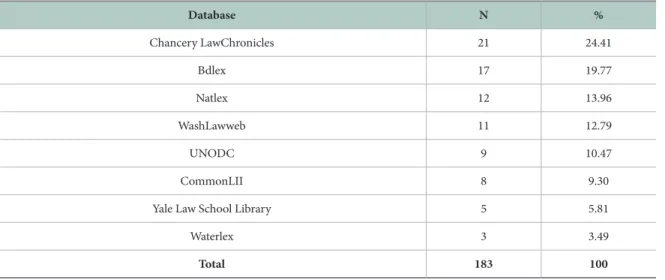
Table 4 shows that Chancery Law Chronicles are the mostly used legal databases by the students of law with a frequency of 21 (24.41%), followed by BdLex with a frequency of 17 (19.77%), NatLex with 12 (13.96%), and WashLawWeb with 11 (12.79%). Besides these UNODC, CommonLII, Yale Law School Library, and Waterlex are used by 10.47%, 9.30%, 5.81%, and 3.49% respondents respectively. E-resources and online legal databases were not available in the library as shown by their lowest scores in terms of availability. This implies that online legal databases were moderately used re-sources by the law students found in this study.
5.8. Factors Affecting the Use of E-resources
Table 5 depicts that on a 5-point Likert scale the highest mean score is4.09 for the construct of “Ease
of use” and the second highest mean score is 4.05 for the construct of “Availability of information,” followed by 3.68 for the construct of “Ease of understanding,” 3.52 for the construct of “Convenience of use,” 3.49 for the statement of “Faster communication,” 3.36 for the construct of “Currency of information,” and 2.93 for “Completeness of Coverage.” Finally, the lowest mean score is 2.51 for the construct of “Open Access.”
The authors further examined the relationships be-tween the six factors of faster communication, curren-cy of information, availability of content, completeness of coverage, ease of use, and open access. The result of correlation analysis based on Pearson r coefficients presented in Table 6 reveal that for open access, all other 5 factors (faster communication, currency of in-formation, availability of content, completeness of cov-erage, and ease of use) are positively correlated at the 0.01 alpha level. Availability of content is moderately associated with faster communication, currency of in-formation, and open access (r = 0.432, 0.129, and 0.615, respectively at the 0.01 alpha level). In particular, ease of use is most closely correlated with the completeness of coverage. So the results depict that users are likely to prefer open access mainly based on the factors of open access, while ease of use correlated to availability of content and completeness of coverage.
Table 4. Online Legal Database Used by Law Students (N=183) Database N % Chancery LawChronicles 21 24.41 Bdlex 17 19.77 Natlex 12 13.96 WashLawweb 11 12.79 UNODC 9 10.47 CommonLII 8 9.30
Yale Law School Library 5 5.81
Waterlex 3 3.49
Total 183 100
Table 5. Factors Affecting e-resource Use (Valid N=183)
Constructs Range (Min-Max) Mean SD.
Faster communication 1-5 3.49 0.91 Currency of information 2-5 3.36 0.84 Availability of content 1-5 4.05 1.09 Completeness of coverage 2-5 2.93 0.47 Convenience of use 2-5 3.52 0.71 Ease of understanding 1-5 3.68 0.93 Open access 2-5 2.51 0.39 Ease of use 1-5 4.09 1.78
Table 6. Correlation Analysis among Factors Affecting e-resource Use (*p<0.05 ** p<0.01)
Constructs communicationFaster informationCurrency of Availability of content Completeness of coverage Open access Ease of use
5.9. Problems Faced in Accessing Electronic Legal Information
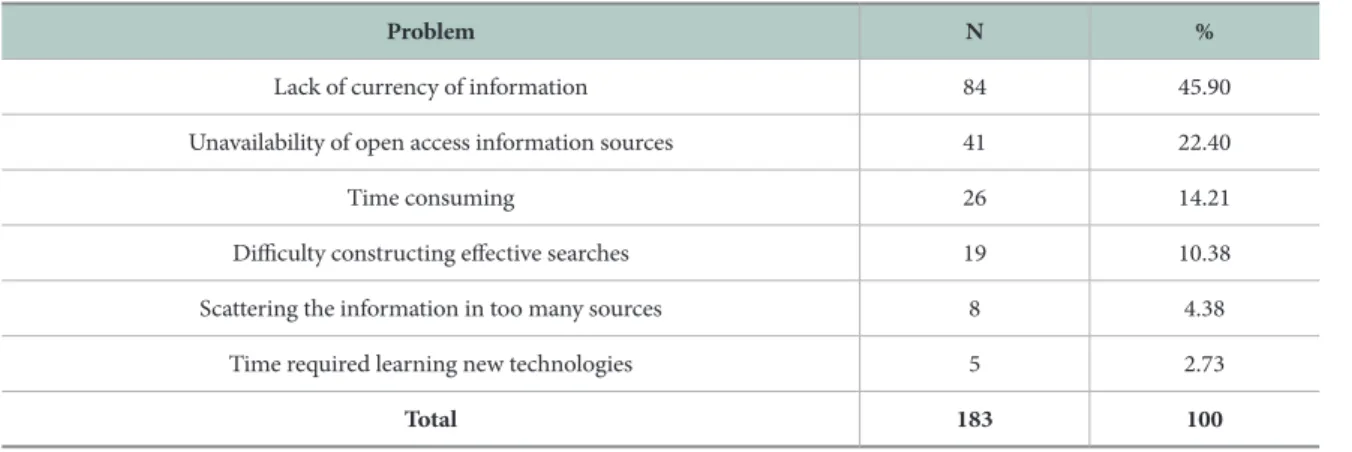
In electronic environments, students face problems accessing electronic legal information. As summarized in Table 7, six problems were listed that students en-counter during information seeking and use. The most common problem law students faced were lack of cur-rency of information (45.9%); that means they could hardly find all the information needed. Other major problems included unavailability of open access legal information sources, accounting for 22.40% of total respondents. In addition, 14.21% stated it was so time consuming to find information, 10.38% face difficulty constructing effective searches, and 4.38% got bored from the scattering of information in many sources. However, only 2.73% mentioned about the problem of time required for learning new technologies.
5.10. Suggestion for the Improvement of Electronic Legal Information Systems
The respondents were asked to provide their own views on how to overcome problems towards the im-provement of electronic legal information systems. The summary of their views can be summarized as: integration of ICTs with libraries and legal informa-tion provision; updating the library collecinforma-tion with more law textbooks, law reports, digests, and so on; funding from government and other legal agencies for conducting legal research; provision of open access of online legal databases by library and government;
pro-vision of international law and statute as well as digital law library platforms like LexisNexis and Westlaw; training time to time for improved searching experi-ence of law students and information service provid-ers; and arrangement of information literacy programs for the students.
6. DISCUSSION AND CONCLUSION
This study aimed to gain insights on information seeking behaviour of law students in the digital en-vironment, exploring implications of these findings for the development of electronic legal information sources and services. The four research questions were answered based on quantitative analysis of 183 ques-tionnaires. For pursuing research question 1, the study explored the purpose of seeking information, informa-tion source, frequency of library use, preferred format of information, and usage of major e-resources and online legal databases for law students. 45.9% of stu-dents reported that they seek information for prepara-tion for assignments, which is the highest level of their reason for information seeking. Concerning the use of information sources, this study found that most partic-ipants (51.91%) heavily rely on textbooks. This study also reveals that 51.91% frequently use the library. An important finding of this research is that law students highly prefer electronic information resources for seeking information. But still they also prefer print
for-Table 7. Problems Faced in Information Seeking (N=183)
Problem N %
Lack of currency of information 84 45.90
Unavailability of open access information sources 41 22.40
Time consuming 26 14.21
Difficulty constructing effective searches 19 10.38
Scattering the information in too many sources 8 4.38
Time required learning new technologies 5 2.73
mats of information. It is observed from the study that students use an extensive range of electronic informa-tion resources. General search engines are heavily used by students whereas e-journal and OPAC are also used by a good number of respondents in this study. The findings reaffirmed the dominant use of online sources by law students in fulfilling information needs.
For answering research question 2, several factors were found that influence law students in selecting electronic legal information sources. Most of the re-spondents agreed significantly (with a mean score of 4.09) that they use e-resource for the open access of information in the electronic environment and promptness in seeking information. The most inter-esting result found in this study is that for open access, all other 5 factors, e.g. faster communication, currency of information, availability of content, completeness of coverage, and ease of use are positively correlated and the factor availability of content is moderately associ-ated with faster communication, currency of informa-tion, and open access. Moreover, ease of use is most closely associated with the completeness of coverage.
For answering research question 3, this study also reveals some challenges that are encountered by stu-dents while seeking information. Lack of currency of information in many electronic sources is rated as the most rated critical problem by law students in legal information seeking. Thus it is evident from the study that law students at the University of Dhaka cannot fulfill information needs properly due to unavailabil-ity and lack of currency of information, unfamiliarunavailabil-ity with the search strategy, lack of time, and so on.
The fourth research question addresses suggestions to overcome these challenges and to improve the le-gal information sources and services. Libraries can play a pivotal role in this regard. Librarians should be more proactive in issuing current law literature and subscribing to online journals for furthering the legal research of students. Integration of ICT into library and information centers through mobile technology, Instant Messaging Reference services (IMRS), e-mail alert services, and so on can be helpful for fulfilling the immediacy of legal information users. Development of an open access legal information system should be made available for law students so that they can use in-formation effectively. In addition, various international legal databases like WestLaw, LexisNexis, and Eurolex
should be subscribed to by law libraries and govern-ment for facilitating a wide range of legal information resources. Heavy emphasis should be given on train-ing of law students to learn and practice more about accessing digital legal information. So to improve in-formation skill and meta-cognitive strategies, training programs on information literacy, online searching, and so on should be arranged by libraries and other legal agencies from time to time. Thus this study yields some strategies that can be adopted for satisfying the information need of law students.
However, this study also has some limitations. First, because of the small sampling size, generalization be-yond the context of the study may be difficult to infer. Second, the findings of this study relate to a specific content area that may not generalize to other content areas or information seeking tasks. These limitations urge a need for further research, which may investigate legal information seeking behavior from a whole coun-try perspective. Future research can also be conducted on open access legal information sources to design a model legal information service based on the informa-tion seeking behavior of the legal community in Ban-gladesh. Thus this study would be helpful to serve as a baseline and indication for shaping future research and for gaining insights on the legal information domain to develop a legal information system.
REFERENCES
Abbas, Z., MacFarlane, A., & Göker, A. (2014). Smart-phones for law students—Persuasive, pervasive and legal: A research study. Legal Information Manage -ment, 14(3), 174-180.
Aforo, A., & Lamptey, R. (2012). Information needs and the information seeking behaviour of Law Lectur-ers in Kwame Nkrumah UnivLectur-ersity of Science and Technology, Kumasi, Ghana. International Research Journal of Arts and Social Sciences, 1(4), 75-80. Al-Daihani, S. (2008). Information behavior of Kuwaiti
legal professionals (doctoral dissertation). Lough-borough University.
library, Lagos, Nigeria. Library Philosophy and Prac-tice, paper no. 1128. Retrieved from http://digital-commons.unl.edu/libphilprac/1128.
Bajpai, S. (1999). Modern information retrieval. New Delhi: Ess Ess.
Faibisoff, S., & Ely, D. (1974). Information and infor-mation needs. Retrieved from http://eric.ed.gov /?id=ED100311.
Kadli, J., & Hanchinal, V. (2015). Information seeking behaviour of law students in the changing digital environment. DJLIT, 35(1), 61-68. http://dx.doi. org/10.14429/djlit.35.1.8099
Kerins, G., Madden, R., & Fulton, C. (2004). Informa-tion seeking and students studying for professional careers: The cases of engineering and law students in Ireland. Information Research, 10(1). Retrieved from http://www.informationr.net/ir/10-1/pa-per208.html.
Khoo, C. S. (2014). Issues in information behaviour on social media. LIBRES: Library and Information Sci -ence Research Electronic Journal, 24(2), 75-96. Marchionini, G. (1992). Interfaces for end-user
infor-mation seeking. Journal of the American Society for Information Science, 43(2), 156-163.
Murugan, V. (2011). User studies and user education. International Journal of Library and Information Science, 3(9), 187-189.
Nahl, D. (1998). Learning the Internet and the structure of information behavior. Journal of the American Society for Information Science, 49(11), 1017-1023. Ogba, O. C. (2013). Exploring the information seeking
behaviour of final year law students in Ekiti State University. International Journal of Scientific & Technological Research, 2(5), 300-309.
Oguntuase, F., & Falaiye, Z. (2004). Meeting information needs of rural communities through repackaging of information. Nigerian Library and Information Science Review, 22(1), 1-12.
Oke-Samuel, O. (2008). Clinical legal education in Ni-geria. Griffith Law Review, 17(1), 139-150.
Olorunfemi, D., Mostert, B., & Ocholla, D. (2012). Information seeking behaviour of law students in a developing country: A literature review. In Byroenne Omondi, SCECSAL: Information for Sustainable Development in a Digital Environment, Nairobi. Retrieved from http://www.lis.uzulu.ac.za/ research/2012/Yemisi%20and%20Mostert%20
SCECSAL,%20UZ,%207.pdf.
Olorunfemi, D., & Mostert, B. (2013). The information seeking behaviour of law students at Adekunle Aja-sin University, Nigeria. In D. J. Barbosa, et al. (Eds.), Communications in Computer and Information Sci-ence (pp. 542-549). Berlin: Springer.
Onwudinjo, O., Nwosu, C., & Ugwu, C. (2014). Ac-creditation issues in Faculty of Law of Nigerian Universities: Imperatives for law libraries, laws and statutes. Library Philosophy and Practice, paper no. 1172. Retrieved from http://digitalcommons.unl. edu/libphilprac/1172.
Onwudinjo, O., Ogbonna, U., & Nwadiogwa, O. (2015). Utilization of law library collections for improving academic performance by undergraduate law stu-dents of Nnamdi Azikiwe University, Awka. Library Philosophy and Practice, paper no. 1223. Retrieved from http://digitalcommons.unl.edu/libphil-prac/1223.
Onwudinjo, O. (2015). Law Journal Collections: Ac-creditation issues and imperatives for law libraries. Library Philosophy and Practice, paper no. 1237. Retrieved from http://digitalcommons.unl.edu/lib-philprac/1237.
Ossai, N. (2009). Library use patterns of law students at the University of Benin, Benin City, Nigeria. Simbi -osis, 6(1), 1-17.
Ossai, N. (2011). How law students utilize information resources: A case study of the University of Benin, Benin City. International Journal of Library and In -formation Science, 3(1), 1-14.
Prabha, K. (2013). Information seeking behaviour of different types of users in selected libraries of Delhi. International Research: Journal of Library & Infor-mation Science, 3(2), 308-323.
Ukpanah, M. E., & Afolabi, M. (2011). Availability of cited law resources by law students in the Universi-ties of Uyo and Calabar law libraries, Nigeria. Nige-rian Libraries, 44(2), 40-57.
Wilson, T. (2000). Human Information behavior. In -forming Science, 3(2), 49-56.