ISSN 2234-3806 • eISSN 2234-3814
https://doi.org/10.3343/alm.2018.38.3.249
Budget Impact of the Accreditation Program for
Clinical Laboratories on Colorectal Cancer Screening via Fecal Immunochemical Testing: Results from the National Cancer Screening Program in Korea
Jae Kwan Jun, M.D.1, Na Young Sung, Ph.D.1, Seung Hoon Song, M.P.H.1, Seri Hong, M.D.1, Mi-Ae Jang, M.D.2, Junghan Song, M.D.3, Jeong-Ho Kim, M.D.4, Won-Ki Min, M.D.5, and You Kyoung Lee, M.D.2
National Cancer Control Institute1, National Cancer Center, Goyang; Department of Laboratory Medicine and Genetics2, Soonchunhyang University Bucheon Hospital, Soonchunhyang University College of Medicine, Bucheon; Department of Laboratory Medicine3, Seoul National University Bundang Hospital, Seoul National University College of Medicine, Seongnam; Department of Laboratory Medicine4, Yonsei University College of Medicine, Seoul; Department of Laboratory Medicine5, Asan Medical Center, University of Ulsan College of Medicine, Seoul, Korea
Background: False-positive fecal immunochemical test (FIT) results in the National Can- cer Screening Program (NCSP) for colorectal cancer may lead to unnecessary procedures, such as colonoscopies, increasing the medical costs. We estimated reductions in the cost of National Health Insurance according to the accreditation status of screening facilities participating in the NCSP for colorectal cancer.
Methods: We used data collected between 2007 and 2010 from NCSP and the Korea Central Cancer Registry to identify patients with colorectal cancer. We also ascertained the history of the accreditation of each facility by the Korean Laboratory Accreditation Program (KLAP). Budget impact was defined as a reduction in medical costs achieved when the false-positive rate of the non-accredited facilities decreased relative to that of the accred- ited facilities.
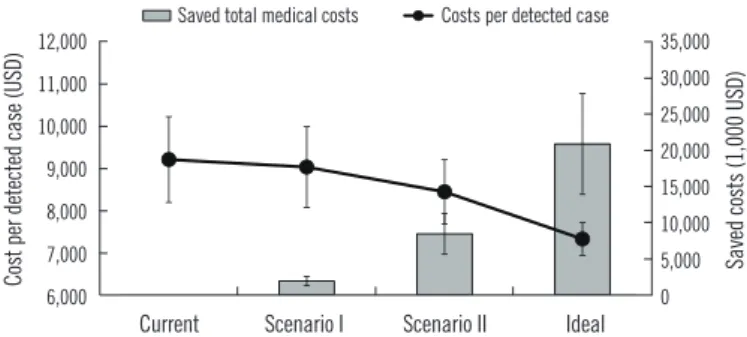
Results: A total of 3,285 screening facilities participated in the NCSP. Of these, 196 were accredited by the KLAP. The false-positive rate of the accredited facilities was 2.47%, and that of the non-accredited facilities was 6.83%. Medical costs were estimated to be re- duced by approximately 19 million US dollars (USD), and the cost of detecting one case of colorectal cancer was estimated to decrease from 9,212 USD to 7,332 USD if the false- positive rate of non-accredited facilities were decreased to that of the accredited facilities.
Clinics were estimated to have the largest associated cost reduction.
Conclusions: Quality assurance in clinical laboratories could lower false-positive rates and prevent the use of unnecessary procedures, ensuring patient safety and increasing the cost-effectiveness of FIT screening in the NCSP for colorectal cancer.
Key Words: Quality improvement, Colorectal cancer, Fecal immunochemical test, Orga- nized screening, Quality assurance, Laboratory accreditation, Cost reduction
Received: July 10, 2017
Revision received: September 12, 2017 Accepted: November 29, 2017 Corresponding author: You Kyoung Lee Department of Laboratory Medicine and Genetics, Soonchunhyang University Bucheon Hospital, Soonchunhyang University College of Medicine, 170 Jomaru-ro, Wonmi-gu, Bucheon 14584, Korea
Tel: +82-32-621-5941 Fax: +82-32-621-5944 E-mail: [email protected]
© Korean Society for Laboratory Medicine This is an Open Access article distributed under the terms of the Creative Commons Attribution Non-Commercial License (http://creativecom- mons.org/licenses/by-nc/4.0) which permits unrestricted non-commercial use, distribution, and reproduction in any medium, provided the original work is properly cited.
INTRODUCTION
The incidence of colorectal cancer is rapidly increasing, making it an important disease in Korea [1]. The National Cancer Screen-
ing Program (NCSP) was implemented in 2002 for stomach, breast, and cervical cancer screening. In 2004, colorectal can- cer screening using fecal immunochemical tests (FITs) was in- troduced. FITs measure the concentration of hemoglobin in fe-
2017-03-16 https://crossmark-cdn.crossref.org/widget/v2.0/logos/CROSSMARK_Color_square.svg
Jun JK, et al.
Impact of accreditation on screening by FIT
ces qualitatively or quantitatively [2], and are simple, noninva- sive, and inexpensive tests, widely used as an organized popu- lation screening method. FITs have been shown to generate fewer false-positive results than guaiac fecal occult blood tests or an alternative test [3].
Although the participation rate for colorectal cancer screening has rapidly increased with the number of cancer screening fa- cilities, issues with the quality assurance of these facilities have been noted [4]. Since 2008, Korean Society of Laboratory Medi- cine (KSLM), Korean Society of Gastrointestinal Endoscopy (KSGE), and the National Cancer Center of Korea have implemented the National Quality Improvement Program for colorectal cancer screening to evaluate facilities participating in the NCSP, with the goal of improving the quality of colorectal cancer screening [5-8].
Annually, approximately 3.8 million FITs are performed as a part of the NCSP. Of these, examinees with positive FITs undergo additional colonoscopies, with subsequent polypectomies or bi- opsies if a lesion or polyp found during initial colonoscopy ap- pears suspicious for colorectal cancer [4, 9]. Although false- positive results are often observed in FITs, they could be mini- mized with quality assurance efforts, and the unnecessary im- plementation of further tests could be reduced. Consequently, medical costs could be reduced.
The standardization of clinical laboratories should be consid- ered in terms of laboratory practices (including laboratory pro- cedures, policies, and personnel) and laboratory methods (com- mercial products). A recent report has indicated that the accred- itation of clinical laboratories improved the accuracy of the labo- ratory results [10].
This study aimed to estimate the impact of false-positive re- sults from the NCSP screening facilities with and without partici- pation in the quality assessment program on the health insur- ance budget.
METHODS
1. Measures of effectiveness
We reviewed the NCSP database between 2007 and 2010, in- cluding data of Korean men and women over 50 years of age.
The results of FIT screening were reported as either positive or negative, regardless of the use of qualitative or quantitative meth- ods. For elucidation of cancer occurrence, we used data from the Korea Central Cancer Registry as a gold standard. Individu- als were diagnosed as having colorectal cancer in accordance with the International Classification of Disease, 10th revision (ICD-
10), codes C18, C19, and C20, within one year of cancer screen- ing. Details of the database construction have been previously described [4, 11].
The number of detected colorectal cancer cases and false- positive and false-negative cases was calculated using the con- structed database. To estimate the effects of colorectal cancer screening, we assessed the cost of diagnosing colon cancer as the outcome of positive FIT [12]. The financial impact of false- negative results of FIT screening was not included in the analy- sis of this study. This study was approved by the Institutional Re- view Board of the National Cancer Center (IRB; #NCCNCS 12641).
2. Quality assurance in clinical laboratories
The Korean Laboratory Accreditation Program (KLAP), founded by KSLM in 1999, is a quality assessment program. Detailed in- formation regarding the KLAP is available elsewhere [5]. The screening facilities participating in the NCSP for colorectal can- cer were categorized by the number of patient beds as follows:
general hospitals (100 beds or more), hospitals (30–99 beds), and clinics (less than 30 beds). The facilities were assessed an- nually to determine whether they received accreditation from the KLAP and were categorized as “accredited” or “non-accred- ited”.
3. Cost estimation
We considered the budget impact on the National Health Insur- ance, rather than the direct and indirect medical expenses of NCSP participants. Furthermore, medical expenses for this study included only the cost of FITs and additional confirmation tests, not any medical expenses incurred after the diagnosis. The cost of screening and diagnosis was calculated based on the costs of the clinic in 2010. We made several assumptions to calculate the expenses. First, only 60% of examinees with positive FIT re- sults underwent colonoscopy [13]. We also conducted sensitiv- ity analyses with fractions of 40% and 80%, which were arbitrarily chosen as the percentages of examinees undergoing colonos- copy. Second, 30% of the examinees who underwent colonos- copy had polyps and subsequently underwent polypectomy and biopsy. The cost of polypectomy and biopsy were imposed based on the number of polyps, but was calculated according to mini- mum cost standards (1–3 polyps). Third, other indicators, ex- cept false-positive rates, were not affected by the KLAP.
We defined the KLAP budget impact as a reduction in additio- nal screening costs when the false-positive rate of non-accred- ited screening facilities decreased to that of the accredited facili- ties. We set up scenarios to evaluate budget impact on the in-
crease in the number of screening facilities with KLAP accredi- tation based on the stage as follows: current, maintenance of the proportion of current accredited facilities; scenario I, assump- tion that all the screening facilities of general hospitals were ac- credited; scenario II, assumption that all the screening facilities of general hospitals and hospitals were accredited; ideal, assump- tion that all the screening facilities were accredited.
RESULTS
A total of 3,285 screening facilities participated in the NCSP be- tween 2007 and 2010. Of these, 196 facilities were accredited by the KLAP. These facilities were mostly (95.4%) general hos-
pitals. There were only five accredited clinics, and these included 272,521 examinees (representing 13.2% of the total number of FITs) (Table 1).
Conversely, most of the non-accredited screening facilities were clinics, and the number of facilities and FITs were 2,018 and 3,511,521, respectively. The false-positive rate for all the accredited screening facilities was 2.47%, which was lower than that for non-accredited facilities (6.83%). The false-positive rates for accredited general hospitals, hospitals, and clinics were 2.64%, 2.90%, and 1.37%, respectively, and those for non-accredited screening facilities were 5.52%, 8.51%, and 6.41%, respec- tively (Table 2).
Non-accredited facilities incurred costs of 81,373,334 US dol-
Table 1. Number of screening facilities and examinees in the National Cancer Screening Program for colorectal cancer between 2007 and 2010 according to accreditation by the Korean Laboratory Accreditation Program
Screening facilities*
Accredited Non-accredited
Facilities
N (%) FITs
N (%) Facilities
N (%) FITs
N (%)
General hospital 187 (95.4) 1,780,829 (86.2) 180 (5.8) 978,875 (15.9)
Hospital 4 (2.0) 13,044 (0.6) 891 (28.8) 1,658,602 (27.0)
Clinic 5 (2.6) 272,521 (13.2) 2,018 (65.3) 3,511,521 (57.1)
Total 196 (100.0) 2,066,394 (100.0) 3,089 (100.0) 6,148,998 (100.0)
*Screening facilities were categorized by the number of patient beds as follows: general hospitals with 100 or more beds, hospitals with 30 to 99 beds, and clinics with less than 30 beds.
Abbreviation: FIT, fecal immunochemical test.
Table 2. Outcomes of the National Cancer Screening Program for colorectal cancer between 2007 and 2010 according to accreditation by the Korean Laboratory Accreditation Program
Screening results Accredited Non-accredited
Cancer* No cancer Total FPR (%) Cancer No cancer Total FPR (%)
Overall 2.47 6.83
Positive 2,126 50,992 53,118 8,984 419,178 428,162
Negative 1,991 2,011,285 2,013,276 5,481 5,715,355 5,720,836
General hospital 2.64 5.52
Positive 1,861 46,896 48,757 1,324 53,911 55,235
Negative 1,755 1,730,317 1,732,072 846 922,794 923,640
Hospital 2.90 8.51
Positive 14 378 392 2,486 140,817 143,303
Negative 13 12,639 12,652 1,444 1,513,855 1,515,299
Clinic 1.37 6.41
Positive 251 3,718 3,969 5,174 224,450 229,624
Negative 223 268,329 268,552 3,191 3,278,706 3,281,897
*Cancer is defined as cases that have been registered with the ICD-10 codes C18, C19, and C20 in the Korea Central Cancer Registry within one year after the FIT for national colorectal cancer screening.
Abbreviations: FPR, false-positive rate; FIT, fecal immunochemical test.
Jun JK, et al.
Impact of accreditation on screening by FIT
lars (USD) for FIT expenses and additional tests; however, if the false-positive rate decreased to that of accredited facilities, these costs would decline to approximately 62,594,315 USD, result- ing in a financial reduction effect of approximately 18,779,019 USD (Table 3). In the current status of accreditation, the cost of detecting a single case of colorectal cancer is approximately 9,212 USD; however, accreditation of all screening facilities would reduce the cost to approximately 7,332 USD. The greatest finan- cial reduction effect would be achieved with accreditation of all the clinics (Fig. 1).
DISCUSSION
The false-positive rates of the FIT screening facilities participat- ing in the NCSP differed according to the accreditation of the quality assessment program. Accredited screening facilities had remarkably lower false-positive rates than those of the non-ac- credited facilities. These differences were clearly shown to be associated with the type of screening facility. If the false-positive rates of non-accredited screening facilities decreased to that of accredited facilities, then colorectal cancer could be detected more efficiently, reducing insurance costs associated with the Table 3. Estimated costs of the National Cancer Screening Program for colorectal cancer according to accreditation by the Korean Labora- tory Accreditation Program
Accredited Non-accredited Reducible medical
cost (a–b)§ % Reducible medical cost (a–b/a) Cost Cost (a) Expected cost (b)‡
Overall
FIT screening 17,244,594 51,314,983 51,314,983
Colonoscopy* 1,787,387 14,407,383 5,406,340
Polypectomy† 1,666,717 13,434,713 5,041,347
Biopsy† 274,950 2,216,255 831,645
Total 20,973,649 81,373,334 62,594,315 18,779,019 23.1
General hospital
FIT screening 14,861,480 8,168,966 8,168,966
Colonoscopy* 1,640,643 1,858,623 911,787
Polypectomy† 1,529,880 1,733,144 850,230
Biopsy† 252,376 285,908 140,258
Subtotal 18,284,378 12,046,641 10,071,241 1,975,400 16.4
Hospital
FIT screening 108,856 13,841,464 13,841,464
Colonoscopy* 13,191 4,822,056 1,700,503
Polypectomy† 12,300 4,496,510 1,585,698
Biopsy† 2,029 741,766 261,584
Subtotal 136,375 23,901,796 17,389,249 6,512,547 27.2
Clinic
FIT screening 2,274,258 29,304,554 29,304,554
Colonoscopy* 133,554 7,726,704 1,785,125
Polypectomy† 124,538 7,205,059 1,664,608
Biopsy† 20,544 1,188,581 274,602
Subtotal 2,552,895 45,424,898 33,028,889 12,396,009 27.3
Unit cost: US dollar (USD), 1 USD=1,118 Korean Won (KRW); FIT screening=8.3 USD; colonoscopy=56.1 USD; polypectomy=174.3 USD; biopsy=28.8 USD.
*Among the patients with positive FIT results, 60% of the eligible examinees underwent colonoscopy; †The proportion of examinees who underwent polypec- tomy and biopsy was 30% of the total number of colonoscopies; ‡The estimated costs when the false-positive rate of the non-accredited screening facilities was reduced to that of the accredited screening facilities; §The difference between the actual and expected costs of the non-accredited screening facilities.
Abbreviation: FIT, fecal immunochemical test.
Jun JK, et al.
Impact of accreditation on screening by FIT
colorectal cancer NCSP. Notably, this budget-saving effect was most apparent to clinics.
According to the World Health Organization, accreditation is the most commonly used external mechanism to improve stan- dard-based quality in the medical field [14]. The KLAP is a qual- ity assurance system for clinical laboratories in Korea and is de- signed to assess a comprehensive quality standard checklist re- lated to the practices of clinical laboratories through peer review.
The KLAP checklist is designed to determine and manage the structure, process, and outcome of the laboratory practice, and to continually identify focus areas and encourage activities for improvement. This process appears to improve the quality of laboratory practice by enhancing the confidence and ability of laboratory workers [5].
Only 6% of the facilities participating in the NCSP for colorec- tal cancer screening were accredited by the KLAP; these facili- ties were primarily general hospitals. The five accredited clinics were institutions offering comprehensive health checkups and performing approximately 272,000 FITs. There were 2,018 (65.3%) non-accredited clinics, performing approximately 3,511,000 (57.1%) FITs. Of these non-accredited screening facilities, over 600 facilities examined fewer than 100 FITs annually. Screening facilities with lower hospital volume have a lower awareness of and willingness to participate in external quality control of their clinical laboratories, due to the financial burden involved. Since 2007, KSLM has conducted an external quality assessment of FITs, using external quality assessment materials. A total of 650 general hospitals and hospitals participated in the external qual-
ity assessment of KSLM between 2007 and 2009, and the num- ber of participating facilities has not increased [6, 7].
If all facilities participating in the NCSP for colorectal cancer could maintain the false-positive rates of accredited facilities, this would result in financial savings of approximately 19 million USD, with the largest effects observed in clinics and the smallest ef- fects observed in general hospitals (clinics, 12,396,009 USD;
hospitals, 6,512,547 USD; and general hospitals, 1,975,400 USD). However, there are 2,018 clinics requiring additional ac- creditation, compared with only 180 general hospitals and 891 hospitals. The financial reduction effect per additional accred- ited facility was the largest for general hospitals and the smallest for clinics (general hospitals, 10,974 USD; hospitals, 7,309 USD;
and clinics, 6,143 USD).
In contrast to the considerable interest generated by quality assurance for invasive screening tests, such as colonoscopy, the importance of quality assurance for FITs has not yet been exten- sively studied [8, 15]. However, in the NCSP, if the FIT result is positive, additional colonoscopy tests are recommended [16].
Therefore, appropriate assessment of quality assurance based on FITs may minimize unnecessary colonoscopies. Once the accuracy of FIT screening is improved and the harm from screen- ing is minimized, the NCSP will be more effective and efficient [17, 18].
The screening interval for colorectal cancer based on the NCSP was changed from two years to one year in 2012, and continu- ous efforts to increase the participation rates will increase the number of FIT examinees [4]. If four million FITs are implemented annually as a part of the NCSP, the health insurance budget re- lated to the NCSP for colorectal cancer can save 10,168,208 USD each year by quality control efforts. However, it is not easy to implement a quality assessment program for all the screening facilities participating in the NCSP; therefore, general hospitals and hospitals are preferentially encouraged to participate in the quality assessment programs. Internal and external quality as- sessment programs for clinics need to be developed to provide high-quality colorectal cancer screening. Furthermore, strate- gies to increase the hospital volume of clinics participating in the NCSP should also be developed.
This study had several limitations. First, assessment items in- cluded in the KLAP did not include items related to FITs. The presence of accreditation in the KLAP did not directly reflect the reliability of the FIT process. This may explain the reason for lower false-positivity of accredited laboratories than that of non-accred- ited ones. However, KLAP accreditation could be used as an in- dicator of the overall status of a laboratory. Second, we did not Fig. 1. Changes in the reduction in medical costs according to the
proportion of facilities accredited by the Korean Laboratory Accredi- tation Program (KLAP). The error bars on the gray bars and black circles represent the colonoscopy performed assuming 40% and 80% sensitivity, respectively.
Current, Maintenance of the proportion of KLAP-accredited facili- ties; Scenario I, Assumption of accreditation of all general hospitals by the KLAP; Scenario II, Assumption of accreditation of all general hospitals and hospitals by the KLAP; Ideal, Assumption of accredi- tation of all screening facilities by the KLAP.
19
0 5,000 10,000 15,000 20,000 25,000 30,000 35,000
6,000 7,000 8,000 9,000 10,000 11,000 12,000
Current Scenario I Scenario II Ideal
Saved costs (1,000 USD)
Cost per detected case (USD)
Saved total medical costs Costs per detected case 292
293 294
295
296
297 298
299
300
301
Fig. 1. Changes in the reduction in medical costs according to the proportion of facilities accredited by the Korean Laboratory Accreditation 302
Current: Maintenance of the proportion of KLAP-accredited facilities Scenario I: Assumption of accreditation of all general hospitals by the KLAP Scenario II: Assumption of accreditation of all general hospitals and hospitals by the KLAP 12,000
11,000 10,000 9,000 8,000 7,000 6,000
35,000 30,000 25,000 20,000 15,000 10,000 5,000 0 Current Scenario I Scenario II Ideal
Cost per detected case (USD) Saved costs (1,000 USD)19
0 5,000 10,000 15,000 20,000 25,000
6,000 7,000 8,000 9,000 10,000
Current Scenario I Scenario II Ideal
Saved costs (1,000 USD)
Cost per detected case (
Saved total medical costs Costs per detected case 295
296
297
298
299 300
301
Fig. 1. Changes in the reduction in medical costs according to the proportion of facilities accredited by the Korean Laboratory Accreditation 302
Current: Maintenance of the proportion of KLAP-accredited facilities Scenario I: Assumption of accreditation of all general hospitals by the KLAP Scenario II: Assumption of accreditation of all general hospitals and hospitals by the KLAP
19
0 5,000 10,000 15,000 20,000 25,000
6,000 7,000 8,000 9,000 10,000
Current Scenario I Scenario II Ideal
Saved costs (1,000 USD)
Cost per detected case (
Saved total medical costs Costs per detected case 295
296
297
298
299 300
301
Fig. 1. Changes in the reduction in medical costs according to the proportion of facilities accredited by the Korean Laboratory Accreditation 302
Current: Maintenance of the proportion of KLAP-accredited facilities Scenario I: Assumption of accreditation of all general hospitals by the KLAP Scenario II: Assumption of accreditation of all general hospitals and hospitals by the KLAP
Saved total medical costs Costs per detected case
Jun JK, et al.
Impact of accreditation on screening by FIT
consider different FIT cut-off levels according to equipment and test reagents from different manufacturers. Third, the range of the health insurance budget was restricted to the cost of screen- ing and diagnosis and did not include any other medical expen- ses, such as treatment or out-of-pocket costs. Finally, we did not consider the effects of false-negative results on the budget. Al- though the impact on the budget was considered, we could not distinguish between preventable (missing interval cancers) and unavoidable cases (true interval cancers).
In conclusion, participation of laboratories in a quality assess- ment program could reduce false-positive rates and minimize the requirement of unnecessary tests, thereby increasing the cost-effectiveness of colorectal cancer screening programs. Strat- egies to encourage screening facilities to participate in quality assessment programs should be developed. Moreover, efforts to develop quality assessment programs according to hospital type are required to improve the quality of cancer screening services.
Authors’ Disclosure of Potential Conflict of Interest
The authors declare that there is no conflict of interest relevant to this article.
Acknowledgements
This study was supported by the Soonchunhyang University Re- search Fund, and by a Grant-in-Aid for the Korea Centers for Dis- ease Control and Prevention, Republic of Korea (#2014-187).
REFERENCES
1. Jung KW, Won YJ, Oh CM, Kong HJ, Lee DH, Lee KH. Cancer statistics in Korea: incidence, mortality, survival, and prevalence in 2014. Cancer Res Treat 2017;49:292-305.
2. Park MJ, Choi KS, Lee YK, Jun JK, Lee HY. A comparison of qualitative and quantitative fecal immunochemical tests in the Korean national colorec- tal cancer screening program. Scand J Gastroenterol 2012;47:461-6.
3. Young GP, Symonds EL, Allison JE, Cole SR, Fraser CG, Halloran SP, et al. Advances in fecal occult blood tests: the FIT revolution. Dig Dis Sci 2015;60:609-22.
4. Suh M, Song S, Cho HN, Park B, Jun JK, Choi E, et al. Trends in partic- ipation rates for the National Cancer Screening Program in Korea, 2002- 2012. Cancer Res Treat 2017;49:798-806.
5. Shin BM, Chae SL, Min WK, Lee WG, Lim YA, Lee DH, et al. The imple- mentation and effects of a clinical laboratory accreditation program in Korea from 1999 to 2006. Korean J Lab Med 2009;29:163-70.
6. Yoo SJ, Cha YJ, Min WK, Lee YK, Chae SL, Shin BM, et al. Current sta- tus of external quality assessment of fecal occult blood test. Korean J Lab Med 2010;30:726-33.
7. Jeon CH, Lee AJ, Kim KD. Annual report on external quality assessment scheme for urinalysis and faecal occult blood testing in Korea (2014). J Lab Med Qual Assur 2015;37:179-89.
8. Cha JM, Moon JS, Chung IK, Kim JO, Im JP, Cho YK, et al. National En- doscopy Quality Improvement Program remains suboptimal in Korea.
Gut Liver 2016;10:699-705.
9. Lin JS, Piper MA, Perdue LA, Rutter CM, Webber EM, O’Connor E, et al. Screening for colorectal cancer: updated evidence report and system- atic review for the US Preventive Service Task Force. JAMA 2016;315:
2576-94.
10. Jang MA, Yoon YA, Song J, Kim JH, Min WK, Lee JS, et al. Effect of ac- creditation on accuracy of diagnostic tests in medical laboratories. Ann Lab Med 2017;37:213-22.
11. Shin A, Choi KS, Jun JK, Noh DK, Suh M, Jung KW, et al. Validity of fe- cal occult blood test in the National Cancer Screening Program, Korea.
PLoS One 2013;8:e79292.
12. Lee HY, Park EC, Jun JK, Choi KS, Hahm MI. Comparing upper gastro- intestinal X-ray and endoscopy for gastric cancer diagnosis in Korea.
World J Gastroenterol 2010;16:245-50.
13. Choi KS, Lee HY, Jun JK, Shin A, Park EC. Adherence to follow-up after a positive fecal occult blood test in an organized colorectal cancer screen- ing program in Korea, 2004-2008. J Gastroenterol Hepatol 2012;27:
1070-7.
14. International Society for Quality in Health Care and World Health Orga- nization. Department of Organization of Health Services Delivery. Quality and accreditation in health care services: a global review. Geneva: World Health Organization, 2003.
15. Robertson DJ, Kaminski MF, Bretthauer M. Effectiveness, training and quality assurance of colonoscopy screening for colorectal cancer. Gut 2015;64:982-90.
16. Suh M, Choi KS, Park B, Lee YY, Jun JK, Lee DH, et al. Trends in can- cer screening rates among Korean men and women: results of the Ko- rean National Cancer Screening Survey, 2004-2013. Cancer Res Treat 2016;48:1-10.
17. Knudsen AB, Zauber AG, Rutter CM, Naber SK, Doria-Rose VP, Pabin- iak C, et al. Estimation of benefits, burden, and harms of colorectal can- cer screening strategies: modeling study for the US Preventive Services Task Force. JAMA 2016;315:2595-609.
18. Lee KS and Park EC. Cost-effectiveness of colorectal cancer screening interventions with their effects on health disparity being considered. Can- cer Res Treat 2016;48:1010-9.