Vol. 19, No. 8 pp. 322-328, 2018
A Study on Evaluation Development of PBL in a Mongolian University
Natsagdorj Bayarmaa, Keunsoo Lee
*Dept. of Computer Science and Engineering (Computer System Institute) Hankyong National University
몽골 대학에서의 PBL 수업 평가 개발 연구
바야르마, 이근수*
한경대학교 컴퓨터공학과 & 컴퓨터 시스템 연구소
Abstract The purpose of this study is to examine the performance of Problem-Based Learning (PBL) based on Google Classroom(GC). GC is an easy and free online learning that plays an important role in education and training recently. Students become increasingly independent in self-directed learning while sharing ideas and resources, transferring knowledge actively across domains and researching for solutions to the given problem in PBL. Students can check the submission date on the task page and start the task with a single click, and teachers can quickly check if the task is complete, and score it directly from GC. Designed The Evaluation of Problem -Based Learning based on GC in this study. The students read the given materials and identify the purpose of the subjects and selected the learning issues, investigated them. After then they discuss the subjects and make the reports. The students work to study them with research papers, books and internet materials. The research findings showed that PBL based on GC was effective in learning together. Students had positive attitude in their PBL learning environment. This study suggests it is possible that the development of PBL Evaluation on the GC.
요 약 본 연구의 목적은 구글 클래스룸(GC)을 기반으로 문제중심학습(PBL)의 평가를 조사하는 것입니다. GC는 쉽고 자유 로운 온라인 학습으로 최근 교육과 훈련에 중요한 역할을 하고 있다. 학생들은 아이디어와 자원을 공유하고, 도메인 전체에 걸쳐 지식을 적극적으로 전달하고 PBL의 주어진 문제에 대한 해결책을 연구하면서 점점 더 자기 주도적인 학습에 독립적이 된다. 학생들은 과제 페이지에서 제출일을 확인하고 클릭 한 번으로 과제를 시작할 수 있고 선생님은 과제 완료 여부를 빠르 게 확인할 수 있으며 GC에서 점수를 바로 매길 수 있다. 본 연구에서는 GC를 기반으로 한 PBL의 평가를 설계하였다. 학생들 은 주어진 자료를 읽고 과목의 목적을 파악하여 학습 문제를 조사한다. 그 후에 그들은 주제를 토론하고 보고서를 작성하여 연구 논문, 책, 인터넷 자료를 가지고 그것들을 공부한다. 연구 결과는 GC에 기반을 둔 PBL이 함께 학습하는 데 효과적이라 는 것을 보여 주었다. 학생들은 PBL학습 환경에서 긍정적인 태도를 보였다. 이 연구는 GC에서 PBL평가의 개발이 가능하다 는 것을 제안한다.
Keywords : Creative learning, Evaluation design, Google Classroom, Motivation, PBL
*Corresponding Author : Keunsoo Lee(Hankyong National Univ. & Computer System Institute) Tel: +82-31-670-5161 email: [email protected]
Received June 28, 2018 Revised July 13, 2018
Accepted August 3, 2018 Published August 31, 2018
1. Introduction
The increasing use of student-centered approaches
like problem-based learning(PBL) by learning and development educators has raised interest in how to design Evaluation of PBL. In a recent meta-analysis of
research comparing the learning outcomes from PBL versus lecture-based course design, Walker and Leary (2009) find five controlled experiments from the field of business that showed significant, positive effects for PBL compared to traditional teaching methods. there are so many researches and cases about PBL in the developed countries. The researches have revealed positive relationships between PBL and improvement in professional skills, including social skills, critical thinking and problem solving (Hmelo- Silver, 2004;
Hung etal., 2007; Loyens, Kirschner and Paas, 2012;
Schmidt, Rotgans and Yew, 2011; Schmidt, van der Molen, te Winkel and Wijnen, 2009). These researches and others showing promising outcomes continue to fuel interest in and support for PBL[1]. Even though we are going to apply PBL firstly in Mongolia. It is new there so we have to design simple and suitable PBL design and evaluation of PBL. What is the role of teachers and how do they influence the PBL process and evaluation? Fortunately, The PBL researches are rich with that can be applied to offer recommendations in Mongolia. While PBL has been frequently a culture shock to new students faced with its alien paradigm, one might say the same thing about the shock to educators who try to use this technique in their classes.
Besides the fundamental challenge of creating a good problem, educators are faced with the task of deciding how to evaluate the technique’s effectiveness and how to assess whether students have met the overall learning objectives for the course[2]. The implementation of PBL is not easy more especially in new institutions; as challenges encountered may include resources, organizational issues and a shift in culture for the academic staff [3].
The purpose of this research is to explore, examine The Evaluation of PBL and design The Evaluation Model of PBL on GC which is suited in Mongolian University.
This paper contains Introduction in Chapter 1, Evaluation of PBL, Evaluation of PBL through GC and
Conclusion in Chapter 3.
2. The main body
2.1 The Evaluation Model of PBL
PBL's student-centered focus and emphasis on self-directed learning create unique challenges for development of an effective assessment techniques[2].
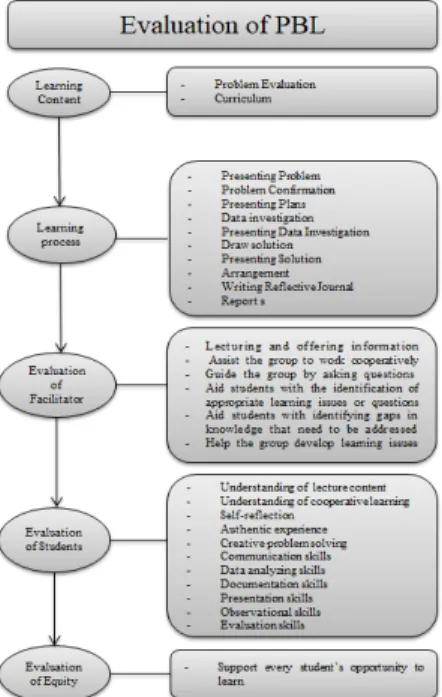
The evaluation of PBL must evaluate the core elements of PBL, including Learning Content, Learning Process, Evaluation of Facilitator, Evaluation of Students and Evaluation of Equity.
2.1.1 Evaluation of Learning Content
At the end of term students ask to complete an evaluation sheet with reference to each problem they have completed and evaluate module on GC Forms.
PBL curriculum is designed with integration of knowledge which is needed for the students in order to get a deep understanding of knowledge, to have proper schemas and retrieve them in order to understand present problems and to solve the similar problems later in their professional life[4].
Problem and curriculum examined in this section.
PBL curriculum as including the following features[5]:
•using the stimulus material to help students discuss an important problem, question, or issue;
•presenting the problem as a simulation of professional practice or a real-life situation;
•appropriately guiding students’ critical thinking and providing limited resources to help them learn from defining and attempting to solve the given problem;
•having students work cooperatively as a group, exploring information in and out of class, with access to a tutor who knows the problem well and can facilitate the group’s learning process;
Fig. 1. Evaluation Strategy of PBL
•getting students to identify their own learning needs and make appropriate use of available resources;
•reapplying this new knowledge to the original problem and evaluating their learning processes.
Reflection helps students (a) relate their new knowledge to their prior understanding, (b) mindfully abstract knowledge, and (c) understand how their learning and problem-solving strategies might be applied. At the completion of a problem, students reflect on what they have learned, how well they collaborated with the group, and how effectively they directed their learning[6].
2.1.2 Learning process
Learning process is examined by following steps:
(1) Presenting Problem, (2) Problem Confirmation, (3) Presenting Plans, (4) Data investigation (5) Presenting Data Investigation, (6) Draw solution, (7) Presenting Solution, (8) Arrangement, (9) Writing Reflective Journal, (10) Reports.
2.1.3 Evaluation of Facilitator
Students ask to evaluate their Facilitator by completing a validated questionnaire based on Lecturing and offering information, Assisting the group to work cooperatively, Guiding the group by asking questions, Aiding students with the identification of appropriate learning issues or questions, Aiding students with identifying gaps in knowledge that need to be addressed, Helping the group develop learning issues.
2.1.4 Evaluation of Student(skill/attitude) Evaluation of Students is relates to Understanding of lecture content, Understanding of cooperative learning, Self-reflection, Authentic experience, Creative problem solving, Communication skills, Data analyzing skills, Documentation skills, Presentation skills, Observational skills, Evaluation skills.
2.1.5 Evaluation of Equity
The facilitator has to support every student's opportunity to learn. Students ask to evaluate Equity by completing a validated questionnaire and reflective journal.
2.2 Evaluation of PBL through GC
Evaluate GC based on the feedback from the teachers, and lastly identifies the usability and features of the tool based on students.
2.2.1 Assessment tools on GC
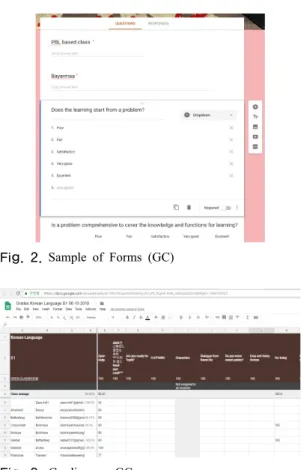
At the end of the programme, students are asked to complete evaluation files with reference to each problem they have completed on their GC forms Fig.
2.
Grading is often more complicated than a simple point value. To be as accurate with feedback as possible, educator can now use decimal points when grading assignments in GC Fig.3.
Fig. 2. Sample of Forms (GC)
Fig. 3. Grading on GC
Using Quizzes in Forms allows educators to take real-time assessments of students’ understanding of a topic. Teachers able to import grades from Quizzes directly into GC. Automatic summaries all quiz responses, including[7]:
• Frequently missed questions
• Graphs marked with correct answers
• Average, median, and range of scores
More than test grades, meaningful feedback can improve learning. GC launched question-by-question grading in Quizzes in Google Forms to help teachers save time by batch grading assessments. Teachers will have the option to add feedback as well.
2.2.2 Sources of Data
Students use paper, Forms were used as a mode of answering the questionnaire. The result generated from
CVS format data were exported for pivot analysis using Google sheets[7].
Fig. 4. CVS format on GC
Responses to all open questions about peer-assessment and concise observations of focus groups were collated into a single document. Raw data themes, in the form of direct quotations, functioned as the essential unit of analysis. In keeping with the context of qualitative research, inductive data analysis strategies were used with themes and categories emerging from the data rather than the data being grouped into pre-determined categories(Patton, 1990).
All of evaluation tools prepared for GC and Google Forms. GC is extremely useful in understandability, attractiveness, and operability. While it is extremely useful in the assessment and collaborative learning.
2.3 Evaluation of students in PBL
PBL is Student-Centered approach which is focused on learning outcomes firstly. Students achieved among others, are the generic skills through the learning process. Evaluation of Students is examined learning process and outcomes. These generic skills include application of knowledge, teamwork and communication skill, professionalism and leadership skill, critical thinking skill and problem solving skills(Stepien, et al, 1993) Ramsden(2003) suggests that evaluation is a way of understanding the effects of teaching on student learning. The teacher can see the student's development
opportunities to interact with students effectively. PBL used GC and Forms for Evaluation development of PBL and identify following contents
2.3.1 Understanding of lecture content PBL is really interested in is the student's ability to perform in a professional context, to recognize their need to acquire new knowledge and skills, and to view learning holistically rather than atomistically[8]
2.3.2 Understanding of cooperative learning Students can participate and work within a particular context. This session emphasises the cooperative or collaborative nature of the enquiry and PBL environment.
2.3.3 Self-reflection
Self-reflection allows students to think more carefully about what they do and do not know, and what they additionally need to know to accomplish certain tasks. Students hand them in or post them on GC each week and receive a mark at the end of each term. Students tend to be more open and honest about their learning than one would expect and these can be criterion referenced. They might also be linked to other electronic communications activities such as conferencing or providing feedback to peers[8].
2.3.4 Authentic experience
Evaluate the students in Authentic learning process.
Did they work for meaningful and creative outcomes?
Did they experience authentic learning through PBL?
PBL engages all the senses, allowing students to create a meaningful, useful, shared outcomes. They are real life problems or simulated tasks that provide the learner with opportunities to connect directly with the real world. PBL provides a learner with support to achieve useful outcomes worth sharing with their community and their world[9].
2.3.5 Creative problem solving
Evaluate the students to work creatively or not in this session. Problem of the PBL refers to any situation that presents a challenge, offers an opportunity, or represents a troubling concern. Creative problem solving means devising ways to answer, to meet, or to satisfy a situation by changing self or situation.
2.3.6 Communication skills
Communicating well is one of those abilities that is often overlooked, and yet those who have it are at a substantial advantage to those who are not. Fortunately, many communication skills can be learned. During PBL, Did students work friendly together? Did they develop their communication in Content Strategy, Correspondence, Analysing, Editing, Emailing, Technical Writing?
2.3.7 Data analyzing skills
Analytical skills refer to the ability to collect and analyze information, problem-solve, and make decisions[10].
These strengths can help solve PBL problems and improve upon its overall creativity. Did students analyse any problems usefully?
2.3.8 Documentation skills
Did students develop their Documentation skills in Writing, Presenting, Smartphone Synchronization, Photo Documentation, Video Documentation, Animation Documentation, Tons of New Cool Apps?
2.3.9 Presentation skills
Students present the components of work they have researched for their contribution to the overall solution or management of the problem. Through presentation, students learn about overcoming nerves and anxiety, highlight key points with pausing, pacing and sign posting, moderate their volume, pitch and tone, engage their audience, deal with questions and interruptions, talk without a script, use presentation slides effectively etc[11].
2.3.10 Observational skills
In PBL, students work together and motivate each other. They learn to notice tension in a group, sense individual feelings, recognize is someone is being left out, acknowledge reaction to comments during study together [12].
2.3.11 Evaluation skills
While PBL, students evaluate each others and him/herself. It is good to learn how to do tasks appropriately. Students made references to 'reflecting on strengths and weakness' as a means of improving future performance[13].
3. Conclusion
The result of from this research support and extend research in the Evaluation of PBL. Examined the Evaluation strategies of Problem-Based Learning (PBL) and developed Evaluation on GC for PBL. It will be useful in Mongolian University. One of the more important session of the Evaluation of PBL is Student's evaluation. Tried to explain about Evaluation of Students in this research. GC based PBL and Evaluation may more enable students to give feedback which is relevant to their perceptions of valuable learning and meaningful evaluation in PBL.
References
[1] J. Woo, H. Han, S. Lee, “An Exploratory Study on Smart Learning Environment”, The Journal of The Institute of Internet, Broadcasting and Communication, Vol.16, No.1, pp.21-31, 2016.
DOI:https://dx.doi.org/10.7236/JIIBC.2016.16.1.21 [2] D. Moon, “Development and Evaluation of an English
Speaking Task Using Smartphone and Text-to-Speech”, The Journal of the Institute of Internet, Broadcasting and Communication, Vol.16, No.5, pp.13-20, 2016.
DOI:https://dx.doi.org/10.7236/JIIBC.2016.16.5.13 [3] Y. N. Hong, “An investigation of predictability among
variables having an effect on problem solving skill and
and Communication, Vol.16, No.5, pp.221-228, 2016.
DOI: https://dx.doi.org/10.7236/JIIBC.2016.16.5.221 [4] K. S. Jang, “The Procedural Design and Evaluation of
RPT Learning Model for NLE Beginners”, The Journal of The Institute of Internet, Broadcasting and Communication, Vol.17, No.4, pp.163-172, 2017.
DOI: https://dx.doi.org/10.7236/JIIBC.2017.17.4.163 [5] Y. J. Joo, A. Chung, M. Choi, “Identification of the
Structural Relationship between Goal Orientation, Teaching Presence, Approaches to Learning, Satisfaction and Academic Achievement of Online Continuing Education Learners”, The Journal of The Institute of Internet, Broadcasting and Communication, Vol.16, No.2, pp.137-144, 2016.
DOI: https://dx.doi.org/10.7236/JIIBC.2016.16.2.137 [6] K. S. Scott, “A Multilevel Analysis of Problem-Based
Learning Design Characteristics”, Interdisciplinary Journal of Problem-based Learning, Vol.8, No.2, Oct, 2014.
DOI: https://dx.doi.org/10.7771/1541-5015.1420
[7] Robert Waters and Michael McCracken, “Assessmant and Evaluation in Problem-Based learning”, Georgia Institute of Technology, pp.1-3
[8] D. Amoako-Sakyi, H. Amonoo-Kuofi, “Problem-based learning in resource-poor settings: lessons from a medical school in Ghana”, BMC Meical Education, Vol.15, No.1, Dec. 2015.
DOI: https://dx.doi.org/10.1186/s12909-015-0501-4 [9] T. S. Prihatiningsih, N. Qomariyah, “Evaluation of a
Problem Based Learning Curriculum Using Content Analysis”, International Journal of Evaluation and Research in Education (IJERE), Vol.5, No.3, pp.205-210, September 2016.
DOI: https://dx.doi.org/10.11591/ijere.v5i3.4540 [10] D. K. P. Wong, D. O. B. Lam, “Problem-Based Learning
in Social Work:A Study of Student Learning Outcomes”, Research on Social Work Practice, Vol.17, No.1, Jan. 2007.
DOI: https://dx.doi.org/10.1177/1049731506293364 [11] C. E. Hmelo-Silver, “Problem-Based Learning: What and
How Do Students Learn?”, Educational Psychology Review, Vol.16, No.3, pp.235-266, Sep. 2009.
DOI:https://dx.doi.org/10.1023/B:EDPR.0000034022.16470.f3 [12] eSchoolMedia & eSchool News https://www.
eschoolnews.com/2017/08/01/google-classroom-forms-up dates/
[13] K. Hwang, H. Kwon, S. Lee, D. Park, “Preliminary Study on Global Clipboard System”, The Journal of The Institute of Internet, Broadcasting and Communication, Vol.17, No.5, pp.223-229, 2017.
DOI: https://dx.doi.org/10.7236/JIIBC.2017.17.5.223 [14] Ranald Macdonald, “Assessment Strategies For Enquiry
and Problem- Based Learning”, pp.87
[15] http://authenticlearning.weebly.com/ Authentic Learning [16] https://www.thebalancecareers.com/ The balance careers,
Analytical Skills Definition, List, and Examples [17] https://etonx.com/courses/public-speaking Essential skills
courses for teenagers, EtonX, 2018
Get the Job”, https://money.usnews.com, Apr, 2011 [19] T. Papinczak, L. Young, M. Groves, “Peer Assessment
in Problem- Based Learning: A Qualitative Study”, Advances in Health Sciences Education, Vol.12, pp.169-186, 2007.
DOI:https://dx.doi.org/10.1007/s10459-005-5046-6
Natsagdorj Bayarmaa [Full member]
•Feb. 2015 : Mongolian Educational Univer,. Dept. of Economy, M.A
•Sep. 2012 ~ Jun. 2015 : Dornod Univer., Professor
•2015 ~ current : Hankyong National Univer., Department of Computer Science & Engineering (Computer system Institute) Studying at Doctor's course
<Research interests>
PBL, Educational Engineering, Engineering Design, Accounting, Economy, and Marketing
Keunsoo Lee [Full member]
•Feb. 1988 : Soongsil Univ., Dept.
of Computer Science, M.S
•Aug. 1993 : Soongsil Univ.,Dept.
of Computer Science, Ph.D
•1989 ~ current : Hankyong National University., Dept. of Computer Science & Engineering (Computer system Institute), Professor
<Research interests>
Computer Vision, Image Processing, Fuzzy Theory, Motion Understanding, Video Retrieval. Ubiquitous computing, PBL, Educational Engineering, and Engineering Design