Progress in Superconductivity Vol.9 No.2 pp.173-176 30 April 2008
- 173 -
Flux Pinning in MgB 2 Film with Columnar Grains
D. H. Kim *,a , H. Y. Kim a , T. J. Hwang a , S. H. Lee a , W. K. Seong b , W. N. Kang b
a
Department of Physics, Yeungnam University, Gyeongsan, Korea
b
Department of Physics, Sungkyunkwan University, Suwon, Korea Received 2 April 2008
기둥형 결정립 구조를 지닌 MgB 2 박막에서 자속고정 현상
김동호 *,a , 김혜영 a , 황태종 a , 이상한 a , 성원경 b , 강원남 b
Abstract
MgB
2films grown by hybrid physical chemical vapor deposition under appropriate growth conditions commonly exhibit columnar grain structure. The grain boundaries between adjacent columnar grains have been reported to be good flux pinning centers. In this work, we measured the angular dependence of critical current density (J
c) and observed the enhanced flux pinning when an external magnetic field was aligned parallel to the columnar direction. This J
cwas almost comparable to the J
cfor intrinsic pinning case up to 1 T at low temperatures, indicating that grain boundary pinning is very effective. At high fields, however, J
cdecreased rapidly resulting from the fact that the density of flux pinning centers provided by grain boundaries was outnumbered by the flux density.
Keywords : MgB
2films, Grain-boundary flux pinning
I. Introduction
Flux pinning in MgB
2superconductor is one of widely studied subjects since its discovery because MgB
2is a potential candidate for use in electric power applications and electronic devices. Many efforts have been put forward to enhance the critical current density (J
c) and upper critical field (B
c2) of bulk MgB
2mostly by doping impurities [1] or increasing electrical connectivity between grains [2]. Unlike high- temperature superconductors, grain boundaries do not obstruct current flow and furthermore they can be good flux pinning centers. In case of MgB
2films, especially in the form of columnar growth, the role of grain boundaries as strong flux pinning centers has been clearly observed [3-5].
In this work, we studied the flux pinning exerted by grain boundaries in MgB
2film by measuring angular dependence of J
cand resistivity (ρ). Flux pinning force
*Corresponding author. Fax : +82 53 964 0952
e-mail : [email protected]
174 D. H. Kim et al.
densities, F
p=-J
c×B, for magnetic fields parallel to the columnar direction were analyzed to understand the pinning mechanism by grain boundaries.
II. Experiments
MgB
2films were grown on (0001) Al
2O
3substrate by hybrid physical chemical vapor deposition (HPCVD). The HPCVD system consists of a vertical quartz reactor with a uniquely designed inductive heating susceptor to compensate for the low sticking coefficient of Mg. Before the film deposition, the quartz tube was first purged with high purity Ar and H
2gas. The susceptor, along with the Al
2O
3substrate and Mg pieces, was heated inductively to 630°C in 150 Torr of the hydrogen flow. Then B
2H
6gas (5%) in H
2was introduced at a flow rate of 50 sccm into the reactor to start the deposition of the MgB
2films. In our present work, the total gas flow rate was kept at a 150 sccm and the react total pressure was 150 Torr. The structure of MgB
2films were investigated by scanning electron microscope (SEM) and X-ray diffraction.
Thickness of a particular film used in this study was 0.5 μm and the film was patterned by using conventional photolithography and Ar-ion milling to form a bridge of 8 μm × 600 μm for J
cmeasurement.
All the transport properties were measured by using a horizontal rotator in Physical Property Measurement System (Quantum Design).
III. Results and Discussion
XRD measurement on this film showed (0001) and (0002) peaks similar to the earlier results indicating that the film was c-axis oriented perpendicular to the substrate [5]. The c-axis lattice constant was 0.3510 nm, slightly smaller that that 0.3524 nm of bulk MgB
2. Resistive transition in an ambient field showed the onset of the superconducting transition at 39.4 K and the zero resistance at 38.9 K.
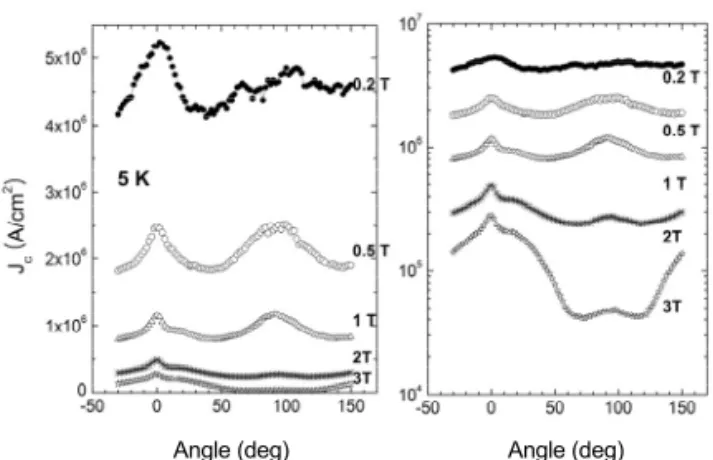
J
cwas measured in magnetic fields while rotating the sample. The bias current and B was always
perpendicular to each other in maximum Lorentz force configuration. Fig. 1 shows the angular dependence of J
cmeasured at 5 K in magnetic fields. J
cwere determined by a rather high voltage criterion of 10 μV/cm considering the fact that this criterion corresponds to an actual voltage of 0.6 μV between the voltage electrodes. The angular position of 0°
corresponds to external magnetic field parallel to the ab-plane (B||ab), and that of 90° corresponds to B||c.
We observed two J
cpeaks at 0° and 90°, and the former is due to the intrinsic and/or surface pinning and the latter is due to the flux pinning provided by grain boundaries. The values of J
cfor grain-boundary pinning are comparable to those for intrinsic pinning.
The effect of grain-boundary flux pinning lasts even to 3 T as shown in the logarithmic plot in the right panel of Fig. 1.
Angle (deg) Angle (deg)
Fig. 1. Angular dependence of J
cmeasured at 5 K. The right panel is a re-plot in the logarithmic scale in order to clearly show the grain-boundary pinning effect in high fields.
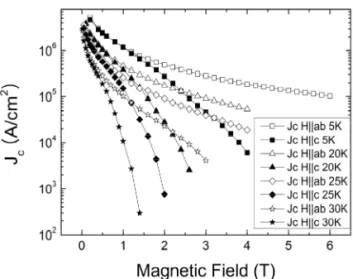
Fig. 2 compares J
cfor B||c with J
cfor B||ab at various temperatures. J
cfor both directions are almost the same up to a certain crossover field, after that, J
cfor B||c drops rapidly with increasing B. This rapid
drop of J
cabove the crossover field (B
g) is due to the
fact that the density of flux pinning centers provided
by grain boundaries was outnumbered by the flux
density. B
gwas found to be decreasing with
increasing T, probably resulting from the decrease of
thermodynamic critical field, which is proportional to
pinning energy, with T.
Flux Pinning in MgB
2Film with Columnar Grains 175
Fig. 2. Magnetic field dependence of J
cfor B||ab and B||c at various temperatures. Two J
c’s are comparable to each other up to certain fields.
Angle (deg)
Fig. 3. Angular dependence of resistivity measured at 0.5 T.
No resistive dip due to the grain-boundary pinning is observed except at 34.5 K, of which the expanded view is shown in the lower panel.
However, the angular dependence of the resistivity in magnetic fields did not show any obvious resistance dip at B||c. A typical angular dependence of the resistivity measured for 0.5 T at several temperatures during the superconducting transition is shown in Fig.
3. The data plotted in Fig. 3 show an angular dependence of anisotropic material with no special feature at 90°, except at 34.5 K very close to the zero resistance where a resistance dip is barely visible as shown in the lower panel of Fig. 3. This indicates that flux pinning by grain boundary is effective only when the T and B are somewhat away from the B
c2phase boundary. A similar behavior was observed in some samples grown by the same method [5].
Fig. 4. Flux pinning force densities at various temperatures.
The solid line is the magnetic field dependence in Eq. (1).
Flux pinning force densities, F
p=-J
c×B, is a useful tool to identify the mechanism of flux pinning. The functional form of the B dependence of F
pvaries with the dominant flux pinning mechanism. The most relevant formula known for representing the grain-boundary flux pinning is given as
2 5 . 0