한방비만학회지 제13권 제1호, 2013 JKOMOR
Original Article
다기관 증례 수집을 통한 정상, 과체중, 비만군에서의 한의 병증 및 건강과 관련된 삶의 질에 대한 연구
이재철ㆍ동상옥ㆍ이시우
한국한의학연구원
Study of Korean Medicine’s Pathological Symptoms and
Health-Related Quality of Life among Normal, Overweight, and Obese Groups from Multi-Center Case Report
Jaechul Lee, Sang Oak Dong, Siwoo Lee
Korea Institute of Oriental Medicine
Received: May 15, 2013 Revised: June 5, 2013 Accepted: June 6, 2013
Objectives: This work aimed to investigate differentiations of Korean medicine’s pathological symptoms and SF-12 sub scales among normal, overweight and obese subjects from multi-center case report.
Methods: From 2009 to 2011 survey were carried out to 1,589 subjects who took treatment or were hospitalized in 7 Korean medicine hospitals and 3 Korean medicine clinic. Survey include Korean medicine’s pathological symptoms and SF-12. Whole survey were obtained from subjects with interviewers. Obesity degree was divided into three groups by body mass index: Normal group is from 18.5 below 23, overweight from 23 below 25 and obese group is over 25. Chi-square test was performed to reveal differentiation response rate of pathologic symptoms among obesity groups. ANOVA test was carried out for compare each group’s SF-12 sub scales.
Results: Patients of overweight or obesity have more symptoms such as skin itching, swelling, weakness in lower legs, and feverish with swollen joints. Contrary, normal weight group responded symptoms of dry skin more than those of obese group. As a fatigue, obese group have more fatigue feeling at afternoon and evening, compared to high frequency response of normal weight groups’ morning fatigue. Obese groups shows low physical scores of health related quality of life, in contrast, high mental scores of that.
Conclusions: This is first work of pathologic symptoms shown by obese groups. This would contribute to standardization of Korean medicine’s pattern identification as suggestion of classification point for obese groups.
Key Words: Diagnosis, Quality of life Correspondence to: Siwoo Lee
Korea Institute of Oriental Medicine, 1672 Yuseong-daero, Yuseong-gu, Daejeon 305-811, Korea Tel: +82-42-868-9555 Fax: +82-42-868-9388 E-mail: [email protected]
Copyright © 2013 by The Society of Korean Medicine for Obesity Research
서 론
비만은 고혈압, 당뇨, 뇌졸중, 동맥경화, 심장병 등 각종 질환의 위험인자이며, 우리나라에서도 비만환자의 증가와 함께 비만 치료의 중요성이 대두되고 있다1). 이에 한의학을 활용한 비만 치료 및 관련 연구가 증가하고 있으며, 침과 약 물의 복합처치 연구 및 한약 처방을 중심으로 연구가 진행
되고 있다2).
한의학을 활용한 비만 치료에 있어 치료 도구의 효과를 극대화하고 적절한 대응군을 선택하는 측면에서 변증은 중 요하다고 할 수 있으며, 이에 변증을 구성하는 망문문절(望 聞問切)의 사진(四診)과 관련된 지표에 대한 기초 연구에 대한 필요성이 증대되고 있다.
그러나 비만과 관련된 한의 진단 지표에 대한 연구는 그
Table 1. General Characteristics of Subjects
Characteristic
Classification divided obesity degree
Total (N=1589) Normal weight
(N=722)
Overweight (N=389)
Obesity (N=478) Gender
Male Female Age (yr) BMI (kg/m2) Education
Under middle school High school Over college
214 (37.5) 508 (49.9) 44.68±16.78 21.01±1.23
198 (36.5) 201 (45.5) 323 (53.5)
146 (25.6) 243 (23.8) 51.79±14.94 23.91±0.58
139 (25.6) 111 (25.1) 139 (23.0)
210 (36.8) 268 (26.3) 53.17±14.94 27.29±1.98
206 (37.9) 130 (29.4) 142 (23.5)
570 (100.0) 1,019 (100.0) 48.98±16.28 23.61±3.02
543 (100.0) 442 (100.0) 604 (100.0) Values are presented as number (%) or mean±standard deviation.
중요도에 비해 아직 초보적인 단계로, Kang 등3), Hwang 등4)이 시도한 변증 설문지와 비만환자간의 비교 연구 등이 있으나 현재 공인된 변증 설문이 없는 상태에서 진행한 연 구라는 한계가 있다.
변증은 맥진, 설진 등 객관적인 진단과 함께 환자가 호소 하는 병증이나 기타 제반증상 등 여러 자각증상을 종합하여 도출되나, 맥진이나 설진 등은 아직까지 표준화된 측정기기 나 진단 표준안이 부재한 편이다. 이러한 특성으로 인해 변 증 연구는 설문지를 중심으로 한 자가 기입 또는 전문가 인 터뷰 방식의 변증도구가 대부분이다. 그러나 설문형태의 변 증도구도 이를 구성하는 개별 자각증상에 대한 유병률 연구 는 미진한 편이며, 비만과 관련된 변증지표에 대한 연구는 초기단계라고 할 수 있다.
이에 본 연구에서는 비만에 따른 변증 진단 지표의 차이 를 비교하기 위해 한의 병증 설문을 대규모, 다기관 증례 수 집을 통해 시도하였다. 더불어 심신자각증상과 건강과 관련 된 삶의 질이 연관성이 있다는 연구 결과5)를 바탕으로 건강 과 관련된 삶의 질과의 경향성 비교를 통해 비만정도에 따 른 자각증상과 삶의 질 추이를 분석하였으며 이에 일정한 결과를 얻었기에 보고하고자 한다.
대상 및 방법
1. 연구대상
2009년부터 2011년까지 한방병원 7곳, 한의원 3곳의 외 래환자 및 입원환자 총 1,589명을 대상으로 하였다.
2. 연구방법
대상자에게 병증 설문지(Appendix)와 SF-12를 인터뷰 방식으로 설문하였다. 병증 설문지는 각 부위별 증상 및 몸 상태 변화에 따라 나타나는 증상을 복수 선택할 수 있도록 구성했다. SF-12는 SF-36의 축약 설문지6)로 총 12개 문항 으로 구성되어 있으며, 8개의 하위 척도와 2개의 주요 개념 으로 제시하는 건강과 관련된 삶의 질(health-related quality of life)을 측정한다7). 체질량지수 기준은 정상군은 18.5~23 미만, 과체중은 23~25 미만, 비만은 25 이상인 경 우로 규정했다8).
3. 통계분석
병증 설문 문항은 다중 응답문항이며, 병증 중 1개 이상 있다고 응답한 경우와 없다고 응답한 경우를 나눈 후 카이 제곱 검정을 시행했으며, 카이제곱 검정에서 유의하게 나타 난 항목의 세부 병증에 대해 다중 응답 분석을 시행하였다.
SF-12의 8개의 하위 척도 및 2개의 상위 개념에 대해 대상 자군 간 ANOVA를 시행한 후 사후검정으로 Scheffee test 를 시행하였다.
결 과
1. 인구학적 특성
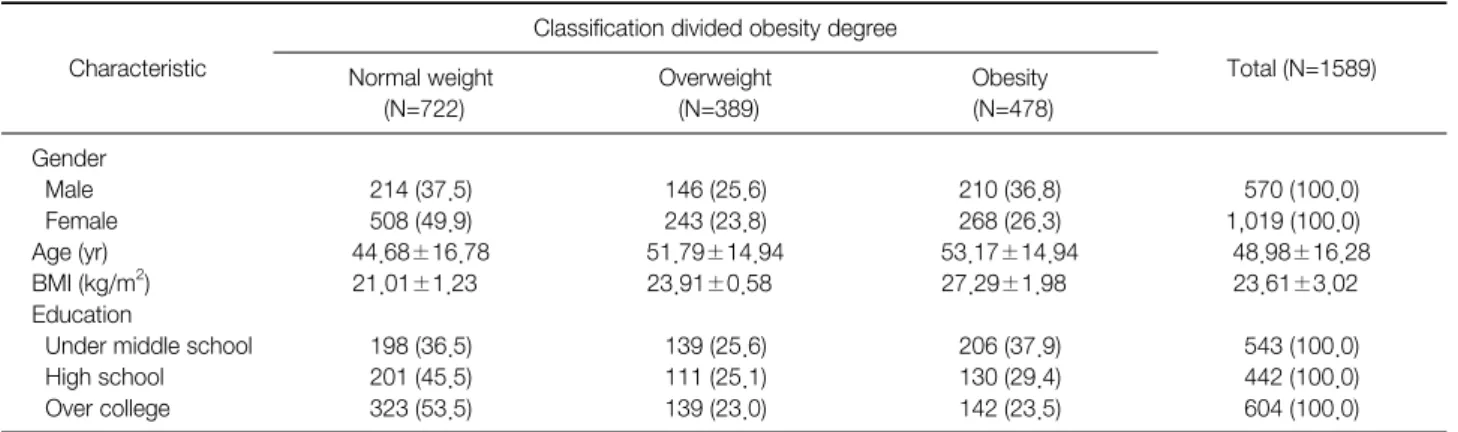
대상자의 특성은 다음과 같다(Table 1).
2. 비만군별 병증 설문 응답 비교
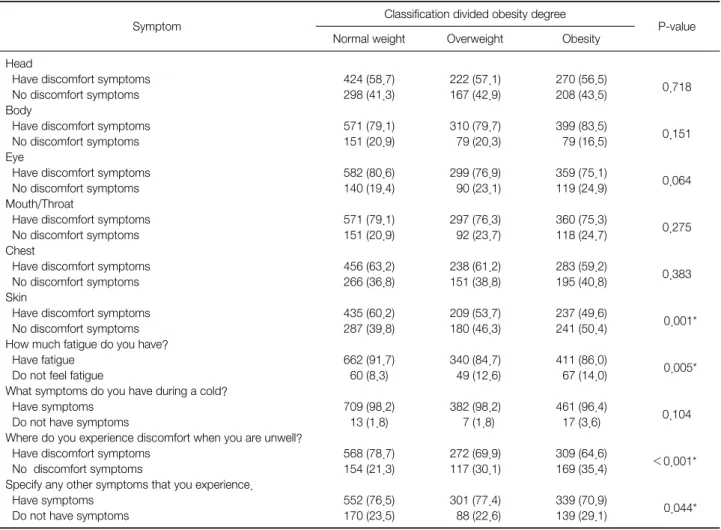
대상자별 병증 설문 문항 응답차이는 다음과 같다(Table 2).
Table 2. Symptoms Questionnaire Response Differentiation among Classification Divided Obesity Degree
Symptom Classification divided obesity degree
P-value Normal weight Overweight Obesity
Head
Have discomfort symptoms No discomfort symptoms Body
Have discomfort symptoms No discomfort symptoms Eye
Have discomfort symptoms No discomfort symptoms Mouth/Throat
Have discomfort symptoms No discomfort symptoms Chest
Have discomfort symptoms No discomfort symptoms Skin
Have discomfort symptoms No discomfort symptoms How much fatigue do you have?
Have fatigue Do not feel fatigue
What symptoms do you have during a cold?
Have symptoms Do not have symptoms
Where do you experience discomfort when you are unwell?
Have discomfort symptoms No discomfort symptoms
Specify any other symptoms that you experience.
Have symptoms Do not have symptoms
424 (58.7) 298 (41.3)
571 (79.1) 151 (20.9)
582 (80.6) 140 (19.4)
571 (79.1) 151 (20.9)
456 (63.2) 266 (36.8)
435 (60.2) 287 (39.8)
662 (91.7) 60 (8.3)
709 (98.2) 13 (1.8)
568 (78.7) 154 (21.3)
552 (76.5) 170 (23.5)
222 (57.1) 167 (42.9)
310 (79.7) 79 (20.3)
299 (76.9) 90 (23.1)
297 (76.3) 92 (23.7)
238 (61.2) 151 (38.8)
209 (53.7) 180 (46.3)
340 (84.7) 49 (12.6)
382 (98.2) 7 (1.8)
272 (69.9) 117 (30.1)
301 (77.4) 88 (22.6)
270 (56.5) 208 (43.5)
399 (83.5) 79 (16.5)
359 (75.1) 119 (24.9)
360 (75.3) 118 (24.7)
283 (59.2) 195 (40.8)
237 (49.6) 241 (50.4)
411 (86.0) 67 (14.0)
461 (96.4) 17 (3.6)
309 (64.6) 169 (35.4)
339 (70.9) 139 (29.1)
0.718
0.151
0.064
0.275
0.383
0.001*
0.005*
0.104
<0.001*
0.044*
Values are presented as number (%).
*P<0.05.
각 병증 설문의 응답에 대한 ANOVA test 결과 머리의 불편한 부위, 몸의 통증 부위, 입과 목의 불편 증상, 가슴의 불편증상, 감기 호소 증상은 대상자군 간 설문 응답 문항 차 이가 나타나지 않았다. 피부의 불편증상, 피로 정도, 컨디션 이 안 좋을 때 증상, 기타 불편증상에서는 응답의 차이가 나 타났다.
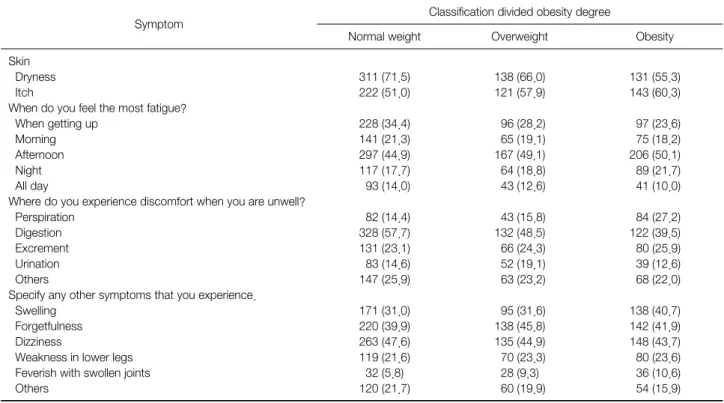
3. 대상자별 유의한 응답항목의 빈도수 차이 비교 카이제곱 검정에서 유의하게 나타난 응답 항목에 대해 증상의 빈도수 차이는 다음과 같다(Table 3).
피부가려움, 오후ㆍ저녁 피로감, 몸이 안 좋을 때 발한ㆍ대 변문제, 기타 증상에서 붓기ㆍ하지무력, 관절종통 문항에서 비만군으로 갈수록 응답이 증가하는 경향을 보였고, 피부 건조감, 기상 시ㆍ아침ㆍ종일의 피로감, 몸이 안 좋을 때 소
화문제, 기타 증상에서 어지러움은 비만군으로 갈수록 응답 이 감소하였다. 과체중군에서 응답률이 상대적으로 높은 문 항은 몸이 안 좋을 때 소변문제, 기타 증상에서 건망으로 나 타났다.
4. 대상자별 건강과 관련된 삶의 질 척도 비교 대상자군에 따른 SF-12의 각 척도별 ANOVA 분석 결 과는 다음과 같다(Table 4).
신체적 기능(physical function), 사회적 기능(social func- tion, SF), 정서적 역할(role limitation emotion, RE), 정신적 건강(mental health, MH)의 4개 범주와 신체적 요소 요약 (physical component summary, PCS)와 정신적 요소 요약 (mental component summary, MCS)의 상위 개념에서 군 간 차이를 나타냈다.
Table 3. Sub-questions Frequency among Classification Divided Obesity Degree, which Belong to Significant Symptoms Questions
Symptom Classification divided obesity degree
Normal weight Overweight Obesity
Skin Dryness Itch
When do you feel the most fatigue?
When getting up Morning Afternoon Night All day
Where do you experience discomfort when you are unwell?
Perspiration Digestion Excrement Urination Others
Specify any other symptoms that you experience.
Swelling Forgetfulness Dizziness
Weakness in lower legs Feverish with swollen joints Others
311 (71.5) 222 (51.0)
228 (34.4) 141 (21.3) 297 (44.9) 117 (17.7) 93 (14.0)
82 (14.4) 328 (57.7) 131 (23.1) 83 (14.6) 147 (25.9)
171 (31.0) 220 (39.9) 263 (47.6) 119 (21.6) 32 (5.8) 120 (21.7)
138 (66.0) 121 (57.9)
96 (28.2) 65 (19.1) 167 (49.1) 64 (18.8) 43 (12.6)
43 (15.8) 132 (48.5) 66 (24.3) 52 (19.1) 63 (23.2)
95 (31.6) 138 (45.8) 135 (44.9) 70 (23.3) 28 (9.3) 60 (19.9)
131 (55.3) 143 (60.3)
97 (23.6) 75 (18.2) 206 (50.1) 89 (21.7) 41 (10.0)
84 (27.2) 122 (39.5) 80 (25.9) 39 (12.6) 68 (22.0)
138 (40.7) 142 (41.9) 148 (43.7) 80 (23.6) 36 (10.6) 54 (15.9) Values are presented as number (%).
Table 4. ANOVA Test Results of Comparison between SF-12’s 8 Sub-Scale and Two Main Dimension among Classification Divided Obesity Degree
SF-12 Scale Classification divided obesity degree
F P-value
Normal weight Overweight Obesity
Physical functioning Role-physical Bodily pain General health Vitality
Social functioning Role-emotional Mental health
Physical component summary Mental component summary
46.35±11.05 46.43±10.00 45.63±10.75 36.30±10.53 46.72±11.13 46.67±10.21 41.52±11.58 44.31±10.22 45.21±10.30 43.81±9.84
44.87±11.47 46.43±10.66 45.58±11.56 36.47±10.55 46.66±11.71 48.36±10.19 43.16±11.81 45.71±10.03 43.97±10.82 45.98±9.20
43.71±11.98 46.11±11.18 45.35±11.85 35.91±10.94 47.24±12.04 47.59±10.91 43.75±12.51 45.77±10.79 43.05±11.32 46.54±10.57
7.898 0.155 0.088 0.334 0.375 3.525 5.612 3.759 6.005 12.653
<0.001*
0.857 0.915 0.716 0.687 0.030*
0.004*
0.024*
0.003*
<0.001*
Values are presented as mean±standard deviation.
*P<0.05.
5. 삶의 질 척도에 대한 사후 검정
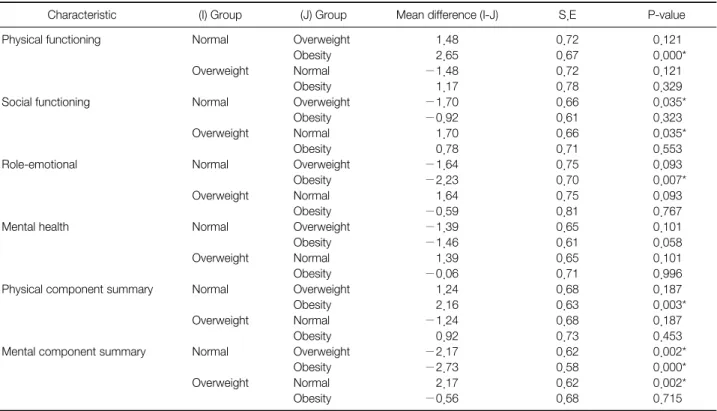
대상자별 유의한 척도에 대해 Scheffee test를 통해 사후 검정을 실시한 결과는 다음과 같다(Table 5).
정상군이 비만군보다 높은 점수를 나타낸 것은 신체적 기능과 PCS이고 SF에서는 과체중군이 정상군보다 높은 점 수를 보였으며, RE에서는 비만군이 정상군보다 높은 점수 를 나타내었다. MCS 점수에서는 과체중군과 비만군이 정
상군보다 통계적으로 유의하게 높았다.
고 찰
비만이나 체질량지수의 차이는 ‘비수(肥瘦)’의 개념으로 이해할 수 있으며, 이에 대해서 내경에서는 비수에 따라 기 혈의 상태가 다름을 언급하였고, 특히 자침법(刺鍼法)을 구
Table 5. Scheffee Test Results of Significant SF-12’s 8 Sub-Scale and Two Components among Classification Divided Obesity Degree
Characteristic (I) Group (J) Group Mean difference (I-J) S.E P-value
Physical functioning
Social functioning
Role-emotional
Mental health
Physical component summary
Mental component summary
Normal
Overweight
Normal
Overweight
Normal
Overweight
Normal
Overweight
Normal
Overweight
Normal
Overweight
Overweight Obesity Normal Obesity Overweight Obesity Normal Obesity Overweight Obesity Normal Obesity Overweight Obesity Normal Obesity Overweight Obesity Normal Obesity Overweight Obesity Normal Obesity
1.48 2.65
−1.48 1.17
−1.70
−0.92 1.70 0.78
−1.64
−2.23 1.64
−0.59
−1.39
−1.46 1.39
−0.06 1.24 2.16
−1.24 0.92
−2.17
−2.73 2.17
−0.56
0.72 0.67 0.72 0.78 0.66 0.61 0.66 0.71 0.75 0.70 0.75 0.81 0.65 0.61 0.65 0.71 0.68 0.63 0.68 0.73 0.62 0.58 0.62 0.68
0.121 0.000*
0.121 0.329 0.035*
0.323 0.035*
0.553 0.093 0.007*
0.093 0.767 0.101 0.058 0.101 0.996 0.187 0.003*
0.187 0.453 0.002*
0.000*
0.002*
0.715 S.E: standard error.
*P<0.05.
분하여 활용할 것을 제시하였다9).
내경 이후 여러 의가들이 비수에 따른 진단과 치료방법 의 상이함을 제시했다.『東醫寶鑑』「雜病篇」 辨證門 肥瘦 辨病候에서도 비대하고 살집이 두터우면 치료가 어렵다고 하였고, 비인(肥人)에서는 기허(氣虛)로 인해 한증(寒證)과 습증(濕證)이 많고 수인(瘦人)은 혈허(血虛)로 인해 조증 (燥證)이나 열증(熱證)이 많다고 제시하였다10).
이처럼 비수에 따라 증후의 특성이 다르다는 문헌상의 결과와 마찬가지로, 병증 설문에서도 과체중이거나 비만군 인 경우 피부가 가려움ㆍ붓기ㆍ하지무력ㆍ관절종통에 대한 응답률이 높은 경향이 보이는데, 이는 습증의 범주로 해석 이 가능하다고 생각한다. 반대로 정상군이 피부 건조감에 대한 응답이 많은 것은 조증의 징후로 이해가 가능하다. 다 만 비만군으로 갈수록 오후ㆍ저녁 피로감이 심하다는 응답 이 증가하는 것과 정상군일수록 기상 시ㆍ아침ㆍ종일의 피 로감에 대한 응답이 증가하는 것은 경향성이 반대로 나타나 나 이를 설명할 수 있는 근거는 찾기 어려웠다. 소화문제ㆍ 어지러움은 비만군으로 갈수록 응답이 감소하였는데, 수인 (瘦人)이 혈허(血虛)하다는 특징10)을 바탕으로 이해가 가
능할 것으로 보인다. 소변문제와 건망은 과체중군에서 응답 이 상대적으로 많았는데, 여기에 대해서는 추가 연구가 필 요할 것으로 생각한다.
삶의 질 지표에서는 신체적 기능과 PCS에서만 비만군이 낮은 점수를 나타냈으며, SF, RE, MCS 점수에서는 정상군 이 과체중군이나 비만군보다 낮은 점수를 나타냈다. 이는 기존연구에서도 다양한 결과가 나타나는데, Doll 등11)의 연 구에 의하면 체질량지수 25에서 30 미만을 과체중으로, 30 이상 40 미만을 중등도 비만, 40 이상을 비만환자로 규정하 고 SF-36 지표를 비교한 결과 체질량지수가 증가할수록 전 반적인 삶의 질은 낮아지며, 특히 신체적인 건강에서 두드 러진다고 보고했다. 그러나 감정적인 측면에서는 질환 등으 로 인해 좀 더 근거가 요구된다고 하였다. Larsson 등12)도 동일한 체질량지수를 기준으로 스웨덴인의 비만과 삶의 질 을 평가한 결과 과체중과 비만 사이에서는 지표의 차이가 나타나나 정상과 과체중 사이에서는 차이가 나타나는 지표 가 없는 것으로 보고하였다. Park 등13)의 삶의 질이 체질량 지수와 연관이 뚜렷하지 않고 중등도 이상인 경우에만 유용 할 거라는 보고도 있다.
이처럼 변증지표로서의 신체적인 증상은 비만 정도에 따 라 상이하게 나타나고 신체적인 건강도 비만할수록 제한되 나, MH는 비만과 연관되어 있다고 하기에는 어려운 측면 이 있다. 변증이 신체적인 것과 정신적인 것을 함께 판단하 여 진단하는 과정임을 고려하면 비만군별로 정신적인 변증 증상 및 변증유형에 대한 추가 연구가 필요할 것으로 보인 다.
한편, 본 연구에서는 병증 설문이 다중 응답문항이라 세 부 문항에 대해 빈도 분석 이외에는 차이를 검증하는 분석 을 시도할 수 없었던 것과, 본 연구의 대상자가 한방 의료기 관에 내원하거나 입원한 사람으로, 일반인과 비교 연구를 시행하지 못한 점이 한계로 나타났다.
결 론
1. 정상군, 과체중군, 비만군을 대상으로 다기관 대규모 병증 설문 연구를 진행한 결과 과체중이거나 비만군은 피부 가려움ㆍ붓기ㆍ하지무력ㆍ관절종통에 대한 응답률이 높은 경향이 보이며 정상군일수록 피부 건조감이 응답이 많았다.
비만군은 오후ㆍ저녁 피로감이 심하다는 응답이 많았고, 정 상군은 기상시ㆍ아침ㆍ종일의 피로감에 대한 응답이 증가 하는 경향성이 나타났다. 소화문제ㆍ어지러움은 비만군의 응답률이 낮았다.
2. 삶의 질에서는 신체적 기능 측면에서 비만일수록 제한 이 되나 정신적인 측면은 과체중 또는 비만이 정상군보다 높은 점수를 나타내었다.
본 연구는 변증 요소의 일부로서 병증 설문의 응답경향 을 비만 정도에 따라 비교한 최초의 연구이다. 본 연구는 비 만으로 인해 응답률이 높은 병증과 다른 원인으로 인해 응 답하는 병증을 구분하는 단서를 제공할 수 있을 것으로 보 이며, 이는 변증 표준화에 기여할 수 있을 것으로 기대한다.
감사의 글
이 논문은 2012년 정부(미래창조과학부)의 재원으로 한국 연구재단의 지원을 받아 수행된 연구임(No. 2006-2005175).
References
1. Sim KW, Lee SW, Lee HS. The relationship between body mass index and morbidity in Korea. J Korean Soc Study Obes. 2001 ; 10(2) : 147-55.
2. Moon S, Kong J, Kwon Y, Song Y, Han AL, Kwon Y, et al.
Review of clinical studies on Oriental medicine treatment for obesity in the Korean literature. Korean J Orient Med. 2010 ; 16(3) : 85-93.
3. Kang KW, Moon JS, Kang BG, Kim BY, Choi SM. The comparison of pattern identification diagnosis according to sym- ptom scale based on obesity pattern identification questionnaire.
J Soc Korean Med Obes Res. 2009 ; 9(1) : 37-44.
4. Hwang MJ, Park KS, Song MY. Analysis of Oriental obesity pattern identification questionnaire on overweight and obese Korean adult women. J Soc Korean Med Obes Res. 2008 ; 8(2) : 63-72.
5. Kwon SS, Baek SH. A study of the psychosomatic self-reported symptom factors affecting health-related quality of life (HRQOL) among the dental technicians. J Korean Dent Technol Assoc. 2011 ; 33(1) : 79-92.
6. Gandek B, Ware JE, Aaronson NK, Apolone G, Bjorner JB, Brazier JE, et al. Cross-validation of item selection and scoring for the SF-12 health survey in nine countries: results from the IQOLA project. J Clin Epidemiol. 1998 ; 51(11) : 1171-78.
7. Nam BH, Lee SW. Testing the validity of the Korean SF-36 health survey. J Korean Soc Health Statistics. 2003 ; 28(2) : 3-24.
8. Anuurad E, Shiwaku K, Nogi A, Kitajima K, Enkhmaa B, Shimono K, et al. The new BMI criteria for Asians by the regional office for the Western Pacific region of WHO are suitable for screening of overweight to prevent metabolic syndrome in elder Japanese workers. J Occupational Health.
2003 ; 45(6) : 335-43.
9. Ilza Veith KR. The Yellow Emperor's classic of internal medicine. New ed. Oakland : University of California Press.
2002.
10. Heo J. Translation commitee of Donguibogam, translation of Donguibogam. Seoul: Beob-in. 1999.
11. Doll HA, Petersen SEK, Stewart-Brown SL. Obesity and physical and emotional well-being: associations between body mass index, chronic illness, and the physical and mental components of the SF-36 questionnaire. Obes Res. 2000 ; 8 : 16070.
12. Larsson U, Karlsson J, Sullivan M. Impact of overweight and obesity on health-related quality of life--a Swedish population study. Int J Obes Relat Metab Disord. 2002 ; 26(3) : 417-24.
13. Park Y, Shin HC, Kim CH. Health-related quality of life in people with overweigh and large waist circumference. Korean J Fam Med. 2000 ; 6 : 753-61.
Appendix. 병증 설문 문항
병증 설문지
아래 항목은 평소 불편 증상을 중심으로 최근 6개월 내의 본인의 생활습관에 대해 기재합니다. 해당되는 경우에 ✔하시고 애매한 경우는 담당자에게 문의하시기 바랍니다. (*) 부분은 중복체크 가능합니다.
머리
(*)머리부위에 불편한 부위가 있습니까?
1☐앞머리 2☐옆머리 3☐뒷머리 4☐머리 전체 5☐없다(몸 문항으로 이동)
(*)머리가 불편한 부위가 있는 경우 불편할 때 양상은 어떻습니까?
1☐무겁다 2☐열 나듯이 아픔 3☐찌르듯 아픔 4☐메스꺼우면서 아픔 5☐텅 빈 느낌
몸 (*)머리 외 아래부위에 통증이 있습니까?
1☐어깨 혹은 뒷목 2☐등 3☐허리 4☐무릎 5☐없다
눈 (*)눈 쪽에 불편한 증상이 간혹 있습니까?
1☐눈의 통증 2☐건조 3☐충혈 4☐눈 피로 5☐눈이 뻑뻑하거나 껄끄럽다 6☐없다
입/목 (*)입 쪽에 불편한 증상이 간혹 있습니까?
1☐입마름증 2☐입 냄새 3☐입안 자주 헌다 4☐기침 5☐가래 6☐인후통 7☐없다
가슴 (*)가슴 쪽에 불편한 증상이 간혹 있습니까?
1☐ 답답함 2☐아픔 3☐심장 뛰는 느낌 4☐두근거림 5☐자주 한숨 쉼 6☐없다
피부 (*)피부 쪽에 불편함이 간혹 있습니까?
1☐피부건조 2☐피부 가려움 3☐없다
피로
평소 피곤함의 정도가 어떻습니까?
1☐없다(감기 문항으로 이동)
2☐약간
3☐중간
4☐심하다
} ⇨
(*)피곤함이 있다면 주로 어느 시간대에 많이 피곤합니까?
(모두 체크)
1☐기상 시 2☐오전대 3☐오후대 4☐밤 5☐하루 종일
감기
(*)감기가 걸렸을 때 주로 호소하는 증상은 어떤 증상입니까?
1☐무증상 2☐열 3☐두통 4☐어지러움 5☐콧물 및 코막힘 6☐귀가 멍함
7☐기침(가래) 8☐목부위 통증 9☐몸살 10☐팔다리 저림
11☐식욕감퇴 혹은 소화 장애
컨디션
(*)몸 컨디션이 안 좋을 때 자주 문제가 생기는 부위는 어느 쪽입니까?
1☐땀 분비 2☐소화 3☐대변 4☐소변
5☐기타( ) 6☐없다
기타
(*)기타 불편한 증상을 아래에서 모두 고르거나 적어주세요.
1☐붓는다 2☐건망 3☐어지럼증 4☐하지무력 5☐관절 붓고 열남
6☐기타 증상( ) 7☐없다