• 검색 결과가 없습니다.

Mixed Squamous Cell and Glandular Papilloma of the Lung in a 64-Year-Old Woman

N/A
N/A
Protected

Academic year: 2021

Share "Mixed Squamous Cell and Glandular Papilloma of the Lung in a 64-Year-Old Woman"

Copied!
4
0
0

로드 중.... (전체 텍스트 보기)

전체 글

(1)

Korean J Thorac Cardiovasc Surg 2014;47:55-58 □ Case Report □ http://dx.doi.org/10.5090/kjtcs.2014.47.1.55 ISSN: 2233-601X (Print) ISSN: 2093-6516 (Online)

− 55 −

1

Department of Thoracic and Cardiovascular Surgery, Chonnam National University Hwasun Hospital, Chonnam National University Medical School,

2

Department of Pathology, Chonnam National University Hospital, Chonnam National University Medical School

Received: September 2, 2013, Revised: September 11, 2013, Accepted: September 17, 2013

Corresponding author: Sang Yun Song, Lung and Esophageal Cancer Clinic, Department of Thoracic and Cardiovascular Surgery, Chonnam National University Hwasun Hospital, 322 Seoyang-ro, Hwasun 519-763, Korea

(Tel) 82-61-379-7663 (Fax) 82-61-379-7665 (E-mail) [email protected]

C

The Korean Society for Thoracic and Cardiovascular Surgery. 2014. All right reserved.

CC
This is an open access article distributed under the terms of the Creative Commons Attribution Non-Commercial License (http://creative- commons.org/licenses/by-nc/3.0) which permits unrestricted non-commercial use, distribution, and reproduction in any medium, provided the original work is properly cited.

Mixed Squamous Cell and Glandular Papilloma of the Lung in a 64-Year-Old Woman

Ju Sik Yun, M.D.

1

, Do Wan Kim, M.D.

1

, Yoo Duk Choi, M.D.

2

, Kook Joo Na, M.D.

1

, Sang Yun Song, M.D.

1

Mixed squamous cell and glandular papilloma of the lung is an extremely rare benign epithelial tumor showing a mixture of squamous and glandular epithelium. Here, we report a case of mixed squamous cell and glandular pap- illoma that presented as a solitary nodule in the left lower lobe of a 64-year-old woman. Chest computed tomog- raphy demonstrated a lobulated mass in the basal segment of the left lower lobe. The patient underwent a lobec- tomy under the suspicion of lung malignancy. The histopathological diagnosis was mixed squamous cell and glan- dular papilloma.

Key words: 1. Lung neoplasms 2. Papilloma

3. Mixed squamous cell and glandular papilloma

CASE REPORT

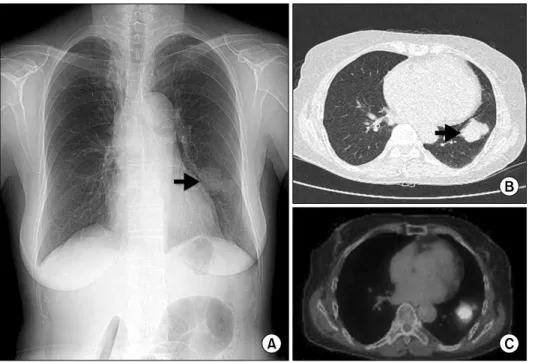
A 64-year-old-woman with no respiratory symptoms was referred to our hospital with a left lower lung mass detected in a chest X-ray during a routine health examination. She was a never-smoker and had no history of any medical con- ditions, except for pulmonary tuberculosis that had been cured by medication 15 years previously. The chest X-ray re- vealed a mass approximately 3 cm in size, which was located in the left lower lung field with a well-defined border (Fig.

1A). The chest computed tomography (CT) revealed a 4×3-cm mass that was lobulated but not infiltrating the sur- rounding lung parenchyme in the left lower lobe mediobasal segment. The mass was homogenous with minimal necrotic findings in a small portion and was not enhanced upon con- trast enhancement (Fig. 1B). No abnormality was revealed by

the bronchoscopic gross and cytological examination. The blood test and the tumor marker study were normal. The positron emission tomography (PET)/CT revealed that the maximal standardized uptake value (SUV) was 6.7 in the left lower lung mass without mediastinal lymph node uptake (Fig.

1C). On the basis of the above examinations, we suspected

lung malignancy that was in the operable stage; therefore, we

planned surgical wedge resection biopsy and lobectomy if

malignancy was confirmed. In the operation, the mass was

resected by wedge resection with stapling and was diagnosed

as adenocarcinoma upon a frozen section examination. There-

fore, the patient underwent lobectomy, and the postoperative

course was uneventful. Histopathologically, mixed squamous

and mucin-secreting glandular epithelium covered the fi-

brovascular cores. In the focal area, mucin-secreting glandular

epithelium showed a complex structure. Further, acantholytic

(2)

Ju Sik Yun, et al

− 56 −

Fig. 1. (A) Chest X-ray shows a nodule (arrow) in the left lower lung field. (B) Chest computed tomog- raphy scan shows 4×3 cm lobulated nodule in the basal segment of the left lower lobe. (C) Further, a posi- tron emission tomography scan shows increased uptake (maximal standardized uptake value of 6.7) in these nodular lesions.

squamous epithelial nests were mixed with mucin-filled epi- thelial cells with neutrophil and lymphoplasmacytic infiltrates (Fig. 2A–C). Immunohistochemically, the tumor cells were positive for cytokeratin (CK5/6 and CK7) and p63 (Fig. 2D).

The Ki-67 proliferation index was less than 1%. These find- ings of the histopathological examination and immunohisto- chemical stain were compatible with mixed squamous and glandular papilloma. During the 18 months of follow-up, the patient has remained well and has not reported any medical problems.

DISCUSSION

Papilloma of the lung is a rare benign epithelial tumor that is sub-classified into three categories: squamous cell papil- loma, glandular papilloma, and mixed squamous cell and glandular papilloma (mixed papilloma). Clinically, it is pre- sented as three distinct types: multiple papilloma, in- flammatory polyps, and solitary respiratory papilloma [1].

According to the pathological definitions, mixed squamous and glandular papilloma is an endobronchial papillary tumor showing a mixture of squamous and glandular epithelium, one third of which should be composed of the second epi- thelial type. The mixed papilloma was formerly called transi-

tional papilloma [1].

Mixed papillomas are extremely rare. Tryfon et al. [2] re- ported a clinicopathological summary of mixed papillomas af- ter reviewing 11 previously published reports and 5 of their cases in an article on the solitary papillomas of the lower airways. The male:female ratio was 4:1. The age distribution presented two peaks, in the third and the sixth decades. The most common symptom was coughing, but no presenting symptoms were specific to the mixed papillomas. We found 6 additional cases of mixed papilloma, which were not included in Tryfon’s review, and most of them were Korean or Japanese patients, excepting only one case [3-8].

No specific etiologies have been implicated in the evolution of mixed papilloma. Smoking has no etiologic implications.

In contrast to squamous cell papilloma, which has an associa- tion with human papilloma virus (HPV) subtypes 6 and 11, HPV has not been detected in the few cases of mixed papil- loma that have been studied [1].

Most of the previously reported cases presented with a central rather than peripheral location; we found only 4 cases of peripherally located lesions, including our case [3,4,6].

Mixed papilloma located centrally can lead to bronchial ob-

struction or irritating manifestations such as cough, dyspnea,

bleeding, or fever. Because of its location, size, and tumor

(3)

Mixed Squamous Cell and Glandular Papilloma

− 57 −

Fig. 2. Pathological findings. (A) Mixed squamous and mucin-secreting glandular epithelium covered the fibrovascular cores (H&E, ×20), (B) mucin-secreting glandular epitheliums (H&E, ×1,000), and (C) acantholytic squamous epithelial nests (H&E, ×1,000), and immunohistochemical staining. (D) The tumor cells were positive for p63.

characteristics, mixed papillomas are usually suspected to be malignant lesions before a histopathological examination. PET/

CT findings of these tumors have rarely been reported [3].

The malignant lesions usually have high maximal SUV.

However, the maximal SUV is not a good parameter for dif- ferentiating the benign tumor from lung malignancy, because both of them can show a high SUV.

A typical histological examination reveals that endobronchial lesions are composed of fibrovascular cores with scattered lymphoplasmacytic infiltrates lined by squamous and glan- dular epithelium with mucinous material. Mixed papillomas presenting as pulmonary tumors should be distinguished from well-differentiated squamous cell carcinomas, papillary ad-

enocarcinomas, and other benign tumors, such mucus gland adenoma and papillary adenoma [6]. Immunohistochemical studies can be helpful in developing a differential diagnosis.

A malignant transformation occurs in some cases. Tryfon

found a malignant transformation rate of 25% (4 of 16 cas-

es). The observed malignancies were adenocarcinoma, squ-

amous cell carcinoma, and low-grade differentiation cells of

carcinoma [2]. Because a cytological examination is not help-

ful in differentiating mixed papilloma from lung cancer, and

malignant transformations have been reported previously,

complete surgical resection is mandatory for definitive diag-

nosis and curative treatment.

(4)

Ju Sik Yun, et al

− 58 − CONFLICT OF INTEREST

No potential conflict of interest relevant to this article was reported.

REFERENCES

1. Flieder DB, Thivolet-Bejui F, Popper H. Mixed squamous cell and glandular papilloma. In: Travis WD, Brambilla E, Muller-Hermelink HK, Harris CC, editors. Pathology and ge- netics: tumours of the lung, pleura, thymus, and heart. Lyon:

IARC Press; 2004. p. 78-81.

2. Tryfon S, Dramba V, Zoglopitis F, et al. Solitary papillomas of the lower airways: epidemiological, clinical, and ther- apeutic data during a 22-year period and review of the literature. J Thorac Oncol 2012;7:643-8.

3. Abiko T, Koizumi S, Takanami I, Tanaka F. 18F-FDG-PET/

CT findings in primary pulmonary mixed squamous cell and glandular papilloma. Ann Nucl Med 2011;25:227-9.

4. Sung CO, Kim J, Do IG, Han J. Solitary pulmonary mixed squamous cell and glandular papilloma: a brief case report.

Korean J Pathol 2008;42:393-5.

5. Kadota K, Haba R, Katsuki N, et al. Cytological findings of mixed squamous cell and glandular papilloma in the lung.

Diagn Cytopathol 2010;38:913-7.

6. Jang SH, Kim TS, Zo JI, Han J. Mixed squamous cell and glandular papilloma presented with peripheral lung mass: a case report. J Lung Cancer 2012;11:94-6.

7. Inamura K, Kumasaka T, Furuta R, et al. Mixed squamous cell and glandular papilloma of the lung: a case study and literature review. Pathol Int 2011;61:252-8.

8. Paganin F, Prevot M, Noel JB, Frejeville M, Arvin-Berod C, Bourdin A. A solitary bronchial papilloma with unusual en- doscopic presentation: case study and literature review.

BMC Pulm Med 2009;9:40.

수치

Fig. 1. (A) Chest X-ray shows a  nodule (arrow) in the left lower lung  field. (B) Chest computed  tomog-raphy scan shows 4×3 cm lobulated  nodule in the basal segment of the  left lower lobe
Fig. 2. Pathological findings. (A) Mixed squamous and mucin-secreting glandular epithelium covered the fibrovascular cores (H&E, ×20),  (B)  mucin-secreting glandular epitheliums (H&E, ×1,000), and (C) acantholytic squamous epithelial nests (H&

참조

관련 문서

The expression levels of apoptotic related proteins and caspase dependent proteins by the ostreolysin purified from P.ostreatus on cell viability in FaDu human

Concentration-Dependent inhibition of cell viability by adenosine in human oral fibroblast and FaDu human head and neck squamous cell carcinoma · · ·

It also suggest that cell proliferation inhibits by a novel signal transduction for adenosine effect in human FaDu hypopharynx squamous cell carcinoma cells....

Differential Expression of Desmoglein1, Desmoglein3, Epithelial Membrane Antigen, Ber-EP4 and CD10 in Basal Cell Carcinoma and Squamous Cell Carcinoma

Objective: The purpose of this study was to analyze recent trend in incidence of basal cell carcinoma and squamous cell carcinoma in patients from the Gwangju City

These results of the histologic distribution of lamina propria, adipose tissue, and glandular tissue of the hard palatal mucosa and the topography of the greater palatine

1 John Owen, Justification by Faith Alone, in The Works of John Owen, ed. John Bolt, trans. Scott Clark, "Do This and Live: Christ's Active Obedience as the

Method We obtained blood samples from 49 patients who underwent surgical treatment for esophageal squamous cell cancer (ESCC) We performed ctDNA analysis with