• 검색 결과가 없습니다.

The Factors Affecting Recurrence of Symptoms after Infrainguinal Arterial Endovascular Angioplasty

N/A
N/A
Protected

Academic year: 2021

Share "The Factors Affecting Recurrence of Symptoms after Infrainguinal Arterial Endovascular Angioplasty"

Copied!
6
0
0

로드 중.... (전체 텍스트 보기)

전체 글

(1)

ISSN: 2233-601X (Print) ISSN: 2093-6516 (Online)

Departments of

1

Thoracic and Cardiovascular Surgery and

2

Radiology, Pusan National University Hospital

Received: March 6, 2014, Revised: September 15, 2014, Accepted: September 15, 2014, Published online: December 5, 2014

Corresponding author: Sung Woon Chung, Department of Thoracic and Cardiovascular Surgery, Pusan National University Hospital, 179 Gudeok-ro, Seo-gu, Busan 602-739, Korea

(Tel) 82-51-240-7263 (Fax) 82-51-243-9389 (E-mail) [email protected]

C

The Korean Society for Thoracic and Cardiovascular Surgery. 2014. All right reserved.

CC
This is an open access article distributed under the terms of the Creative Commons Attribution Non-Commercial License (http://creative- commons.org/licenses/by-nc/3.0) which permits unrestricted non-commercial use, distribution, and reproduction in any medium, provided the original work is properly cited.

The Factors Affecting Recurrence of Symptoms after Infrainguinal Arterial Endovascular Angioplasty

Mi Ju Bae, M.D.

1

, Jong Geun Lee, M.D.

1

, Sung Woon Chung, M.D.

1

, Chung Won Lee, M.D.

1

, Chang Won Kim, M.D.

2

Background: This study reports the result of endovascular treatment for arterial occlusive disease limited to femo- ropopliteal lesions, focusing on the recurrence of symptoms instead of patency. Methods: This was a retrospective, single-center study. From April 2007 to November 2011, 48 limbs in 38 patients underwent endovascular stenting or balloon angioplasty to treat femoropopliteal arterial occlusive disease. The factors affecting the recurrence of symptoms were analyzed. Results: The mean age of the patients was 69.60±7.62 years. Among the baseline characteristics of the patients, initial hyperlipidemia was the most important factor affecting the recurrence of symp- toms (relative risk=5.810, p=0.031). The presence of a dorsal arch was also a significant factor (relative risk=0.675, p=0.047). Conclusion: The major factors that affect the recurrence of symptoms after endovascular treatment for femoropopliteal arterial occlusive lesions are hyperlipidemia and the presence of a dorsal arch. Therefore, the us- age of lipid-lowering agents after endovascular treatment and taking the presence of a dorsal arch into consid- eration are important elements of managing the recurrence of symptoms.

Key words: 1. Atherosclerosis 2. Angioplasty 3. Lower extremity 4. Symptoms

INTRODUCTION

Percutaneous transluminal angioplasty (PTA) is performed in cases of peripheral arterial occlusive disease to maintain blood flow to the distal part of the limbs by expanding oc- clusive, stenotic, or atherosclerotic vascular lesions using spe- cial technologies and instruments with small incisions or punctures [1]. The recurrence of symptoms after PTA may have multiple causes including in-stent stenosis, the occurrence of new lesions, and the effects of other comorbidities [2].

However, patients with problematic arterial lesions may not

complain of any significant symptoms; major causes for this include the progressive development of collateral vessels and decreased activity of the patient, which contributes to reduced tissue oxygen demand.

There are many studies analyzing the patency of endovas- cular stents, but few focus on the recurrence of symptoms.

This study retrospectively analyzes the factors affecting the recurrence of symptoms in patients who underwent endovas- cular stenting or balloon angioplasty for femoropopliteal arte- rial occlusive disease.

http://dx.doi.org/10.5090/kjtcs.2014.47.6.517

(2)

Table 1. Demography of the patients (n=38)

Variable Value

Male sex 31 (81.6)

Hypertension 28 (73.7)

Diabetes 23 (60.5)

Cerebral infarction 9 (23.7)

Hyperlipidemia 8 (21.1)

Coronary arterial occlusive disease 8 (21.1) Chronic obstructive pulmonary disease 1 (2.6)

Current smoking 24 (63.2)

Age (yr) 69.60±7.62

Smoking (pack year) 30.68±22.88

TransAtlantic Inter-Society Consensus II classification

(Limbs)

A 7 (14.6)

B 27 (56.3)

C 8 (16.7)

D 6 (12.5)

Values are presented as number (%) or mean±standard deviation.

METHODS

This study was a single-center, retrospective study from April 2007 to November 2011. PTA was performed on a total of 80 patients to treat femoropopliteal lesions. Endovascular treatment was performed on eleven patients due to embo- lisms, and 29 patients with concomitant iliac arterial lesions were excluded. Two patients with primary failure after PTA were also excluded, because it was difficult to determine whether their symptoms had recurred. In total, 48 limbs were reviewed from 38 patients who had undergone endovascular stenting or balloon angioplasty limited to femoropopliteal ar- terial stenotic or occlusive lesions. All procedures were car- ried out by a single interventional radiologist and were su- pervised by vascular surgeons. The following information was collected about the patients: sex, age, comorbidities, smoking history, TransAtlantic Inter-Society Consensus (TASC) II classification, the number of distal runoff vessels, the pres- ence of a dorsal arch, the recurrence of symptoms, symp- tom-free duration, and follow-up duration. Recurring symp- toms included disabling claudication (walking<100 meters), resting pain, an unhealed ulcer, and minor or major tissue loss [2].

The factors related to symptom recurrence were analyzed using Cox proportional hazards regression models, t-tests, chi-square tests, and Fisher’s exact tests. The endpoints were the recurrence of these symptoms or development of asso- ciated symptoms with greater severity than before the endo- vascular repair. Results are expressed as means with 95%

confidence intervals where appropriate, and p-values<0.05 were considered statistically significant. The statistical analy- ses were performed using IBM SPSS ver. 20.0 (IBM Co., Armonk, NY, USA).

RESULTS

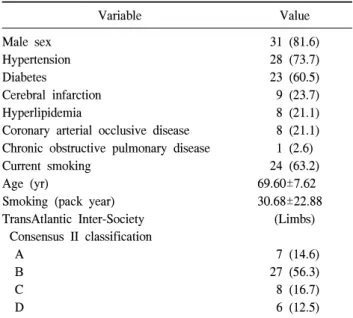
The mean age of the patients was 69.60±7.62 years. There were 28 hypertensive patients (74%), 23 diabetic patients (61%), and eight patients with hyperlipidemia (21%). In addi- tion, 24 patients smoked at the time of their procedure, and the average smoking history was 30.68 pack-years (Table 1).

There were seven TASC A lesions, 27 TASC B lesions, eight

TASC C lesions, and six TASC D lesions according to the TASC II classification (Table 1) [3].

Twenty-one limbs (43.7%) had recurring symptoms within the follow-up period. When patients with recurring symptoms after endovascular treatment visited the hospital, computed to- mography angiography was performed to reevaluate these lesions. Re-intervention was performed in eight limbs. The symptoms in the other 13 limbs improved with additional medication.

The groups with and without symptom recurrence after en- dovascular treatment are compared in Table 2. Hyperlipidemia, the presence of a dorsal arch, and the smoking history ex- pressed in pack-years were significantly different in the base- line characteristics of the groups. As a result, those without symptom recurrence had a lower amputation rate, lower re-in- tervention rate, higher primary patency, and higher secondary patency than those with symptom recurrence did.

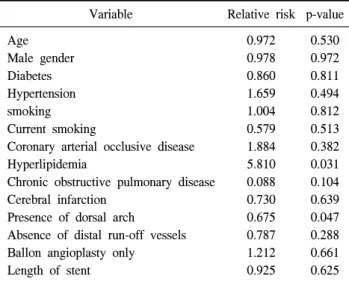
The results of the Cox proportional hazards analysis of symptom recurrence are presented in Table 3. Significant fac- tors were hyperlipidemia and the presence of a dorsal arch.

There were eight patients with hyperlipidemia with 10 in- volved limbs, which was the basis for our statistical analysis.

The differences between the groups with and without hyper-

lipidemia are summarized in Table 4. The recurrence of

(3)

Table 2. Comparison of with or without symptom-recur groups

Variable Without symptom-recur With symptom-recur p-value

Age (yr) 68.85 70.57 0.444

Sex (male, %) 81.4 85.7 0.700

Diabetes (%) 61.5 63.6 0.942

Hypertension (%) 69.2 81.8 0.123

Smoking (pack year) 23.30 37.86 0.040

Current smoking (%) 57.7 63.6 0.446

Coronary arterial occlusive disease (%) 11.5 31.8 0.078

Cerebral infarction (%) 15.4 31.8 0.422

Hyperlipidemia (%) 4.8 31.03 0.009

Chronic obstructive pulmonary disease (%) 0 9 0.162

Absent of distal run-off (%) 18.5 28.6 0.216

Presence of dorsal arch (%) 85.1 42.3 0.004

Ballon angioplasty only (%) 40.7 52.3 0.433

TransAtlantic Inter-Society Consensus II (%)

A 16.4 13.6 0.797

B 53.8 59.1 0.935

C 19.2 13.6 0.641

D 11.5 13.6 0.903

Amputation (%) 0 31.8 0.005

Primary patency (%) 84.7 27.3 0.002

Secondary patency (%) 95.1 63.6 0.010

No. of stent 0.61 0.68 0.858

Length of stent (mm) 69.61 99.15 0.779

Table 3. Result of Cox-proportional hazard analysis of recurrence of symptom

Variable Relative risk p-value

Age 0.972 0.530

Male gender 0.978 0.972

Diabetes 0.860 0.811

Hypertension 1.659 0.494

smoking 1.004 0.812

Current smoking 0.579 0.513

Coronary arterial occlusive disease 1.884 0.382

Hyperlipidemia 5.810 0.031

Chronic obstructive pulmonary disease 0.088 0.104

Cerebral infarction 0.730 0.639

Presence of dorsal arch 0.675 0.047

Absence of distal run-off vessels 0.787 0.288

Ballon angioplasty only 1.212 0.661

Length of stent 0.925 0.625

symptoms in patients with hyperlipidemia was 5.8 times high- er than that in patients without hyperlipidemia according to the Cox regression models (p=0.031) (Table 3, Fig. 1A).

There were also statistically significant differences in the re-

currence of symptoms and the symptom-free duration even though there were more TASC C and D lesions in patients without hyperlipidemia (Table 4).

Another factor that had an effect on the symptom-free du- ration was the presence of a dorsal arch prior to the endovas- cular procedure. The presence of a dorsal arch was confirmed by direct angiography before the procedure. A dorsal arch was observed in 37 limbs (62%). At 12 months, 68% of pa- tients with a dorsal arch were symptom-free compared to 58% of patients without a dorsal arch. In addition, at 24 months, 55% of patients with a dorsal arch were symp- tom-free compared to 14% of patients without a dorsal arch.

The absence of a dorsal arch at the procedure was a sig- nificant risk factor for the recurrence of symptoms (relative risk=0.675, p=0.047) (Fig. 1B). In contrast, smoking pack- years or smoking at the time of the procedure did not have a statistically significant effect according to the Cox propor- tional hazards regression models.

Stent insertions were more likely not to result in the re-

currence of symptoms than the use of balloon angioplasty

(4)

Table 4. Comparison of hyperlipidemia and without hyperlipidemia group

Variable Hyperlipidemia(−) (n=38) Hyperlipidemia(+) (n=10) p-value

Symptom recurrence 12 9 0.029

Mean symptom free duration (day) 716.70 389.27 0.001

Length of stent (mm) 70.52 95.01 0.416

Amputation 0 7 0.318

Re-intervention 0 8 0.177

TransAtlantic Inter-Society Consensus

A 7 0

B 18 9

C 8 0

D 5 1

Fig. 1. Symptom-free rates related to (A) hyperlipidemia (p=0.031), and (B) the presence of a dorsal arch (p=0.047). All factors were ana- lyzed by survival analysis.

Table 5. Comparison of TASC A, B group and TASC C, D group

Variable TASC

A, B group

TASC

C, D group p-value

No. of limbs 34 14

Recurrence of symptoms 16 (47) 6 (43%) 0.796

Re-intervention 6 (18) 2 (14%) 0.572

Amputation 4 (12) 3 (21%) 0.400

Amputation-free rate (%) 88 79 0.046

No. of stent 0.556 0.857 0.162

Length of stent (mm) 58.24 117.86 0.023 Symptom-free rate

after 600 days (%)

78 60 0.411

Values are presented as number (%) unless otherwise specified.

Table 6. Results of logistic regressions about ‘length of stent’

Result Relative risk p-value

Symptom recur rate 1.001 0.004

Amputation rate 1.005 0.05

Primary patency 0.998 0.04

Secondary patency 0.989 0.05

alone. Well-preserved distal runoff vessels were also correlated with a lower likelihood of symptom recurrence. However, these results were not statistically significant (Tables 2, 3).

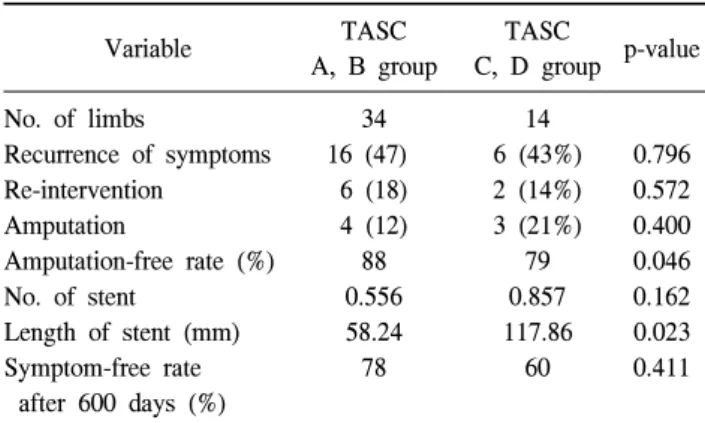
The TASC A and B group is compared with the TASC C and D group in Table 5. In the TASC A and B group, 88%

of limbs were not amputated, which is significantly higher than the corresponding value of 79% in the TASC C and D groups (p=0.046). The symptom-free duration of the TASC A and B group was longer (p=0.036), and the TASC C and D group required significantly longer stent insertions (p=0.023).

Longer stent insertions were associated with symptom re-

(5)

currence and decreased primary patency (Table 6).

DISCUSSION

Depending on the site of the lesion, PTA has a low mor- bidity rate and good long-term patency rate. It has been es- tablished as the primary treatment for aorta and iliac arterial lesions [4]. Compared to bypass surgery for the treatment of infra-inguinal arterial occlusions, PTA has a lower associated morbidity but lower primary patency [4,5]. Recently, due to progress in the equipment used in PTA, the primary patency of endovascular angioplasties for superficial femoral arterial lesions has been improved [6,7].

At our center, we were not able to carry out follow-up ex- ams on every patient on a regular basis after PTA; follow-up exams were performed when a patient complained of symp- tom recurrence during his/her follow-up visits. Most of these patients showed stenosis or occlusions due to the involvement of related vessel walls, but some symptomatic patients did not have any problems in their vessels. On the other hand, some patients did not report any recurrence of symptoms al- though their long-term follow-up computed tomography scans consistently showed occlusions in the treated vessels. Based on these findings, we concluded that it would be more appro- priate to study the factors affecting symptom recurrence after the operation rather than focusing solely on patency.

This study tracks endovascular angioplasties limited to the superficial femoral artery performed over four years.

Twenty-one limbs (44%) had recurring symptoms within the follow-up period. Re-intervention was performed in eight limbs (17%). Administrating additional medication improved the symptoms in the other 13 limbs.

The risk factors associated with peripheral arterial disease presented in the TASC II guidelines are male gender, older age, diabetes, smoking, hypertension, dyslipidemia, hyper- homocysteinemia, increased C-reactive protein, and renal in- sufficiency [3]. Of these factors, this study identified hyper- lipidemia as the factor influencing symptom recurrence to a statistically significant extent. In light of the fact that lip- id-lowering agents were used in all patients after endovas- cular treatment, it is more precise to say that initial hyper- lipidemia was strongly associated with symptom recurrence.

In addition, the symptom-free rate was higher in cases where angiography before the endovascular procedure showed the presence of a dorsal arch. Even if a dorsal arch is pres- ent, it may not be visualized in computed tomography an- giography because of the slow flow of contrast material.

Thus, the presence of a dorsal arch must be confirmed before an endovascular procedure is performed.

Several studies have shown that the number of runoff ves- sels improves outcomes in patients with infra-inguinal arterial occlusive disease undergoing endovascular angioplasty [2,8,9].

In contrast, another study has reported that the number of ti- bial vessels did not significantly influence the outcomes of 289 limbs in 236 patients with primary endovascular stenting of the femoral and popliteal arteries, as determined at seven years after surgery [10]. In this study, the number of distal runoff vessels likewise did not have a statistically significant effect.

Primary patency was established in 85% of patients whose symptoms did not recur, and secondary patency was estab- lished in 95% of such patients, as shown in Table 2. Thus, there were some cases of patients with non-patent revascular- ized vessels who nonetheless did not show any symptoms. In contrast, there were some cases of patients with patent re- vascularized vessels who did show symptoms. Such cases are associated with the development of collateral vessels and have been described in many papers [11-14].

Collateral vessels develop from pre-existing arterioles, which enlarge in response to shear stress forces precipitated by inflow arterial occlusions [13]. Collateral vessels provide a natural bypass system, protect against critical limb ischemia, and may reduce leg symptoms in peripheral artery occlusive disease [12]. Following arterial occlusion, collateral vessels first increase rapidly in number and later grow larger in di- ameter, as has been observed in animal models [14]. As de- scribed by McDermott et al. [11], the presence of more nu- merous collateral vessels is associated with better functional performance in patients with peripheral arterial disease, al- though there was no significant association between collateral size and functional performance. However, these collateral ves- sels typically do not fully restore lower extremity perfusion, and furthermore, the ability of collateral vessels to compensate for occlusions is impaired by risk factors of disease [12].

However, standardized systems do not yet exist to evaluate

(6)

collateral vessels. Additional research into factors influencing the development of collateral systems is required to control ischemic symptoms regardless of the patency of the stent.

Another factor associated with recurring ischemic symp- toms is the patients’ activity level. A decreased activity level corresponding to the aging process results in decreased oxy- gen demands in the lower limbs, thus reducing the symptoms of ischemia. However, maximal collateral vessel enlargement occurs during exercise [15]. Therefore, it is important to bal- ance these factors through proper exercise.

In conclusion, several studies have reported factors affect- ing primary patency after PTA, but the results of these stud- ies are still ambiguous. This study demonstrated that hyper- lipidemia and the presence of a dorsal arch affect the re- currence of symptoms after PTA.

CONFLICT OF INTEREST

No potential conflict of interest relevant to this article was reported.

ACKNOWLEDGMENTS

This study was supported by a 2-year research Grant of Pusan National University.

REFERENCES

1. Fogarty TJ, Cranley JJ, Krause RJ, Strasser ES, Hafner CD.

A method for extraction of arterial emboli and thrombi. Surg Gynecol Obstet 1963;116:241-4.

2. Ravin RA, Faries PL. Infrainguinal disease: endovascular treatment. In: Cronenwett JL, Johnston KW, editors. Ruther- ford’s vascular surgery. 8th ed. Philadelphia: Saunders/

Elsevier; 2014. p. 1782-800.

3. Norgren L, Hiatt WR, Dormandy JA, et al. Inter-society consensus for the management of peripheral arterial disease

(TASC II). J Vasc Surg 2007;45 Suppl S:S5-67.

4. Parsons RE, Suggs WD, Lee JJ, Sanchez LA, Lyon RT, Veith FJ. Percutaneous transluminal angioplasty for the treat- ment of limb threatening ischemia: do the results justify an at- tempt before bypass grafting? J Vasc Surg 1998;28:1066-71.

5. Treiman GS, Treiman RL, Ichikawa L, Van Allan R. Should percutaneous transluminal angioplasty be recommended for treatment of infrageniculate popliteal artery or tibioperoneal trunk stenosis? J Vasc Surg 1995;22:457-63.

6. Kudo T, Chandra FA, Ahn SS. The effectiveness of percuta- neous transluminal angioplasty for the treatment of critical limb ischemia: a 10-year experience. J Vasc Surg 2005;41:

423-35.

7. Cheng SW, Ting AC, Ho P. Angioplasty and primary stent- ing of high-grade, long-segment superficial femoral artery disease: is it worthwhile? Ann Vasc Surg 2003;17:430-7.

8. Davies MG, Saad WE, Peden EK, Mohiuddin IT, Naoum JJ, Lumsden AB. Impact of runoff on superficial femoral artery endoluminal interventions for rest pain and tissue loss. J Vasc Surg 2008;48:619-25.

9. DeRubertis BG, Pierce M, Chaer RA, et al. Lesion severity and treatment complexity are associated with outcome after percutaneous infra-inguinal intervention. J Vasc Surg 2007;

46:709-16.

10. Lee JJ, Katz SG. The number of patent tibial vessels does not influence primary patency after nitinol stenting of the fem- oral and popliteal arteries. J Vasc Surg 2012;55:994-1000.

11. McDermott MM, Carroll TJ, Kibbe M, et al. Proximal su- perficial femoral artery occlusion, collateral vessels, and walking performance in peripheral artery disease. JACC Cardiovasc Imaging 2013;6:687-94.

12. Ziegler MA, Distasi MR, Bills RG, et al. Marvels, mys- teries, and misconceptions of vascular compensation to pe- ripheral artery occlusion. Microcirculation 2010;17:3-20.

13. Palmer-Kazen U, Wahlberg E. Arteriogenesis in peripheral arterial disease. Endothelium 2003;10:225-32.

14. Shyy YJ, Hsieh HJ, Usami S, Chien S. Fluid shear stress induces a biphasic response of human monocyte chemo- tactic protein 1 gene expression in vascular endothelium.

Proc Natl Acad Sci U S A 1994;91:4678-82.

15. Prior BM, Lloyd PG, Ren J, et al. Time course of changes

in collateral blood flow and isolated vessel size and gene

expression after femoral artery occlusion in rats. Am J

Physiol Heart Circ Physiol 2004;287:H2434-47.

수치

Table 1. Demography of the patients (n=38) Variable Value Male  sex 31  (81.6) Hypertension 28  (73.7) Diabetes 23  (60.5) Cerebral  infarction 9  (23.7) Hyperlipidemia 8  (21.1)
Table 3. Result of Cox-proportional hazard analysis of recurrence  of symptom
Table 6. Results of logistic regressions about ‘length of stent’

참조

관련 문서

Factors affecting post-traumatic stress of general hospital nurses after the epidemic of Middle East respiratory syndrome infection: Journal of Korean Clinical

While regional recurrence is one of most im- portant prognostic factors in oral cavity cancer, the optimal management of recurrent lymph node metastasis is worthy of

웹 표준을 지원하는 플랫폼에서 큰 수정없이 실행 가능함 패키징을 통해 다양한 기기를 위한 앱을 작성할 수 있음 네이티브 앱과

_____ culture appears to be attractive (도시의) to the

- quadriceps tendon 이 슬개골 하연에서 tibial tuberocity에 부착.

In the chapters of Journey of Renewal that describe the Mission Accountability Framework there will be flashbacks to the story of Richmond Corps, showing clearly how

1 John Owen, Justification by Faith Alone, in The Works of John Owen, ed. John Bolt, trans. Scott Clark, "Do This and Live: Christ's Active Obedience as the

The study analyzed how the individual, environmental and regional factors that constitute career decision factors affect career determination of students