• 검색 결과가 없습니다.

Epidemiology and Outcomes of Acute Flank Pain in University-Affiliated Regional Emergency Medical Centers

N/A
N/A
Protected

Academic year: 2021

Share "Epidemiology and Outcomes of Acute Flank Pain in University-Affiliated Regional Emergency Medical Centers"

Copied!
7
0
0

로드 중.... (전체 텍스트 보기)

전체 글

(1)

Urogenit Tract Infect 2018;13(1):14-20

http://crossmark.crossref.org/dialog/?doi=10.14777/uti.2018.13.1.14&domain=pdf&date_stamp=2018-4-25

Epidemiology and Outcomes of Acute Flank Pain

in University-Affiliated Regional Emergency Medical Centers

Seon Tae Kim, Young Hwang, Seung Chol Park

1

, Jea Whan Lee

1

Departments of Emergency Medicine and

1

Urology, Wonkwang University School of Medicine, Iksan, Korea

Purpose: Acute abdominal pain accounts for 7-10% of all emergency department visits. The purpose of this study is to investigate the epidemiology and outcome of acute flank pain at regional emergency medical centers (EMC) and to investigate the necessity of urologists.

Materials and Methods: We retrospectively reviewed all records of EMC visits for flank pain between 1 July 2015 and 30 June 2017. The renal colic was defined according to the code allocation of the Korean standard classification of disease-6 code N132, N200-N203, and N210-N211. The results of this study were retrospectively analyzed and the characteristics of the patients.

Results: The total number of visits to the EMC was 67,792, and the number of visits for acute abdominal pain was 9,641. The number of visits for acute flank pain was 1,133 and the number of patients was 1,018. The departments included emergency medicine (n=235), urology (n=711), internal medicine (n=132), general surgery (n=19), gynecology (n=10), and others (n=26). The causes of urological flank pain were urolithiasis in 628 cases, infection in 41 cases, and other diseases in 42 cases.

Among these, 244 cases were admitted, and 193 cases of them were urolithiasis patients, and 171 patients underwent stone removal surgery.

Conclusions: According to our study, patients with flank pain accounted for 11.8%

of patients with abdominal pain. However, considering hospitalization and frequency of surgery, it is necessary to take the national measurement for the long-term supply of urology.

Keywords: Renal colic; Epidemiology; Hospital emergency service

Copyright 2018, Korean Association of Urogenital Tract Infection and Inflammation. All rights reserved.

This is an open access article distributed under the terms of the Creative Commons Attribution Non-Commercial License (http://creativecommons.org/licenses/by-nc/4.0) which permits unrestricted non-commercial use, distribution, and reproduction in any medium, provided the original work is properly cited.

Received: 24 March, 2018 Revised: 14 April, 2018 Accepted: 14 April, 2018

Correspondence to: Jea Whan Lee http://orcid.org/0000-0003-1368-1928 Department of Urology, Wonkwang University School of Medicine, 460 Iksan-daero, Iksan 54538, Korea

Tel: +82-63-859-1335, Fax: +82-63-842-7379 E-mail: [email protected]

Original Article

INTRODUCTION

Acute abdominal pain, traditionally defined as a pain of non-traumatic origin with a maximum duration of 5 days [1], is one of the most common symptoms that causes people to visit the emergency center, making up approximately 7-10% of all emergency department (ED) visits [2]. Despite the relatively high incidence, abdominal pain may be a symptom of serious underlying diseases, and the challenging

differential diagnosis may lead to medical litigation or undesirable outcomes [3,4].

Despite substantial improvements in the diagnostic

approach to acute abdominal pain, many diagnostic pitfalls

remain due to the extensive use of imaging techniques

(especially computed tomography [CT]), which can be

associated with a substantial number of misdiagnoses and/or

avoidable surgery [5,6]. Acute flank pain is the most common

clinical symptom of urinary tract stones and is a common

(2)

Table 1. Number and rate of patients admitted with renal colic

Variable Data

All cases 67,792

Acute abdominal pain 9,641 (14.2)

Acute flank pain 1,133 (1.7)

Acute flank pain patient 1,018 Sex

Male 547 (53.7)

Female 471 (46.3)

Mean age (y) 53.8

Male 51.7

Female 56.3

Treated by urology cases 711

Treated by urology patient 622 Sex

Male 388 (62.4)

Female 234 (37.6)

Mean age (y) 52.8

Male 51.8

Female 55.3

Values are presented as number only or number (%).

cause of visiting the ED on a global scale. The lifetime risk of urinary tract calculi is estimated to range from 5-12%

in Europe and in United States, affecting 13% of males and 7% of females [7]. Furthermore, the lifetime recurrence rate has been estimated to be as high as 50% within 10 years of the initial urolithiasis episode [8]. Several previous studies have shown a worldwide trend toward an increasing prevalence of urolithiasis [9]. Proper assessment by the emergency physician is essential for the management of these patients, since the underlying cause of acute abdominal pain can involve a variety of medical specialties, including gynecology, general surgery, internal medicine, and urology. In particular, there is a great heterogeneity in choosing the most appropriate diagnostic approach and treatment because of individual inclination and expertise, rather than following a strict set of guidelines.

An accurate knowledge of all other causes of acute abdominal pain is highly important, and therefore patients may be classified as having urgent management (i.e., requiring treatment within 24 hours to prevent the onset of serious complications) or not requiring urgent management [1]. Acute flank pain may be characterized by a sudden, severe flank or lower back pain that may radiate down to the genitalia. Additional symptoms may include nausea, vomiting, macroscopic, or microscopic hematuria. The diagnosis of urinary stone is usually based on history, clinical symptoms, and physical examination.

Recently, it has been preferred to undergo non-contrast CT scan [10]. Most patients with acute flank pain can be managed conservatively with pain medication, hydration, and prophylactic treatment of expected stone excretion [11].

Although most patients complaining of flank pain visit the ED, the current epidemiology of the acute flank pain in the emergency medical centers (EMC) remains unclear, with the reduced number of the urology resident and the deterioration of the working conditions. The purpose of this study is to investigate the epidemiology and outcome of acute flank pain in EMC in a small city and to investigate the necessity of urologists.

MATERIALS AND METHODS

We retrospectively analyzed the epidemiology and clinical outcome of patients with flank pain in one university-affiliated EMC between July 1, 2015 and June

30, 2017. This university hospital is in a mid-sized city with a population of 301,202 (counted on 2017); it is considered as a regional EMC with 790 beds. This facility is also the only hospital in the area with a regional trauma center. Patients who visited the EMC with kidney colic pain were sorted with the codes of N132, N200-N203, and N210-N211. All records of EMC visits were retrospectively analyzed to address non-traumatic flank pain. Patients were classified according to their number of visits, since some patients visited repeatedly. According to the arrival time at EMC (00:00-06:00, 06:00-12:00, 12:00-18:00, and 18:00-24:00), groups were divided into 6-hour intervals.

The results of this study were retrospectively analyzed and the characteristics of the patients were analyzed according to age, sex, and arrival time at EMC. All data was processed using Microsoft Office Excel 2007 (Microsoft, Redmond, WA, USA) and all statistical analyzes were performed using an SPSS statistics ver. 17.0 (SPSS Inc, Chicago, IL, USA).

RESULTS

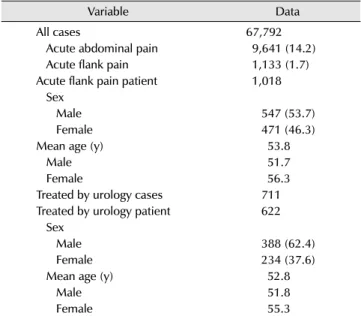
The total number of visits to the EMC for 3 years was 67,792, and the number of visits for acute abdominal pain was 9,641, which accounted for 14.2% of the total visits.

Of these, the number of visits due to flank pain was 1,133 episodes, which were 1.7% of the total number and 11.8%

of the episodes of acute abdominal pain. The number of

(3)

Fig. 1. Analysis of patient's arrival time in the emergency room. Fig. 2. Seasonal analysis.

Table 2. Care trends of patients with acute flank pain in the emergency room

Variable Data

All cases 1,251 (100)

Emerency medicine 273 (21.8)

Urology 722 (57.7)

Internal medicine 158 (12.6)

General surgery 22 (1.8)

Gynecology 11 (0.9)

Others 65 (5.2)

Diagnosis

Urinary stone 699 (61.7)

Infection 231 (20.4)

Others 203 (17.9)

After treatment

Inpatients 349 (30.8)

Outpatients 784 (69.2)

The final medical department 1,133 (100.0)

Emerency medicine 235 (20.7)

Urology 711 (62.8)

Internal medicine 132 (11.7)

General surgery 19 (1.7)

Gynecology 10 (0.9)

Others 26 (2.3)

Values are presented as number (%).

patients was 1,018, and the mean age of the patients with flank pain was 53.8 years. There were 547 males and 471 females. The mean age of males was 51.7 years, and the mean age of females was 56.3 years (Table 1). Given that the cause of flank pain may vary at the time of admission, various tests, such as abdominal CT, was performed.

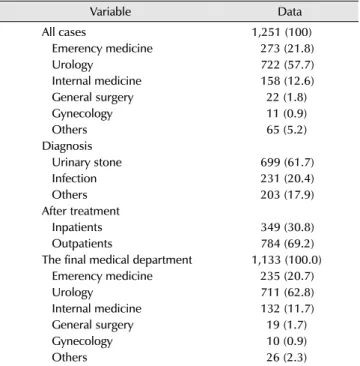
Depending on the result of these tests, emergency calls were sent to various departments; and departments without any actual treatment were excluded. The number of calls to each department was counted and compared; emergency

medicine (n=273), urology (n=722), internal medicine (n=158), general surgery (n=22), gynecology department (n=11), and others (n=65). Other departments included thoracic surgery, neurosurgery, gynecology surgery, and dermatology, with side muscle pain, thoracic intercostal neuralgia, and herpes zoster. The final medical department was decided by the final discharge and treatment decision.

The final departments included the ED (n=235), urology (n=711), internal medicine (n=132), general surgery (n=19), gynecology (n=10), and others (n=26).

There were 349 inpatients and 784 outpatients. Urolithiasis was diagnosed in 699 cases, infection in 231 cases, and other diseases in 203 cases (Table 2). Patients were divided into 4 groups by 6-hour intervals according to the arrival time (00:00-06:00, 06:00-12:00, 12:00-18:00, and 18:00- 24:00). When we compared the time of arrival, we found 262 cases between 00:00 to 06:00, 319 cases between 06:00 to 12:00, 254 cases between 12:00 to 18:00, and 298 between 18:00 to 24:00 (Fig. 1). When compared by seasonal characteristics, there were 271 cases from March to May, 303 cases from June to August, 293 cases from September to November, and 266 cases from December to February (Fig. 2). In 711 patients with final department as urology, the mean age was 52.8 years, 433 males and 278 females.

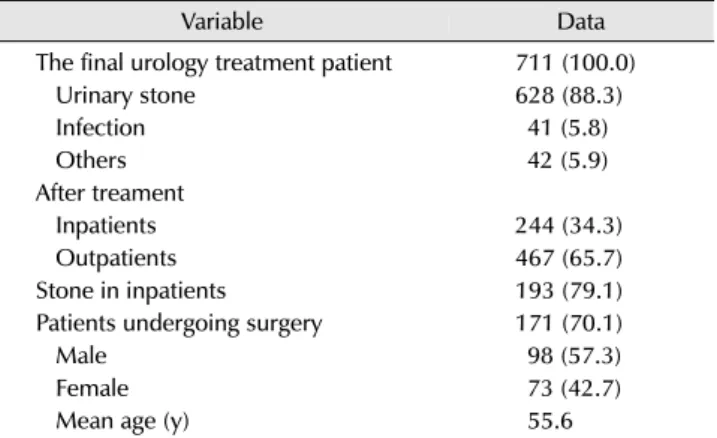
There were 628 cases of urinary calculi, 41 cases of infectious

diseases, including pyelonephritis, and 42 cases of renal

infarct, hydronephrosis, and so on. The number of

admission was 244, and remaining 467 patients visited the

outpatient clinic or carried out to other hospitals. Of the

244 patients who were hospitalized, 193 were admitted

to the hospital for urinary stone; of which, 171 patients

(4)

Table 3. Care trend of urology patients in the emergency room

Variable Data

The final urology treatment patient 711 (100.0)

Urinary stone 628 (88.3)

Infection 41 (5.8)

Others 42 (5.9)

After treament

Inpatients 244 (34.3)

Outpatients 467 (65.7)

Stone in inpatients 193 (79.1)

Patients undergoing surgery 171 (70.1)

Male 98 (57.3)

Female 73 (42.7)

Mean age (y) 55.6

Values are presented as number (%) or mean.

underwent stones removal surgery. Of the patients who underwent surgery, 98 were male and 73 were female.

The mean age was 55.6 years (Table 3). When we compared the visit time of patients who underwent endoscopic urology, there was 183 cases from 00:00 to 06:00, 197 cases from 06:00 to 12:00, 154 cases from 12:00 to 18:00, 177 cases from 18:00 to 24:00 (Fig. 1). When compared by seasonal characteristics, there were 161 cases between March and May, 196 cases between June and August, 194 cases between September and November, and 160 cases between December and February (Fig. 2).

DISCUSSION

There is undeniable evidence suggesting that acute abdominal pain of non-traumatic origin is one of the most frequent complaints causing people to visit the ED.

According to the results of a previous study that was conducted by a hospital with similar size to those in Italy, this condition represented 5.76% of total the ED visits during a 1-year period [2]. According to a previous study that evaluated 46 EDs in Korea in 2010, 1.8% of visits to the ED were due to acute flank pain [12]. According to the results of this study, the number of visits to our EMC due to acute abdominal pain during the 3-year period was 14.2%.

Of these, the number of visits due to flank pain was 1.7%

of the total number of visits and 11.8% of the cases of acute abdominal pain. In this way, the proportion of patients and the problems that may arise when visiting patients remains at similar levels.

Despite significant improvements in diagnostic approaches, the use of imaging techniques, such as ultrasound and

abdominal CT, remains nonspecific to abdominal pain, which represented one-third of the major causes of acute abdominal pain in our patient population. The widespread use of accurate imaging techniques was found to bring marginal improvements of diagnostic specificity in the last decades, particularly for surgical diseases [6], but has not generated a significant reduction of the admission rate [2].

Despite reliable evidence of rare diagnostic performance [13,14], plain abdomen X-ray is still widely prescribed at 35-45% of all cases of acute abdominal pain in different facilities [14,15]. The differential diagnosis of acute abdominal pain in an adult population is rather broad, including appendicitis, peptic ulcer, urinary stone, inflammatory bowel disease, hepatobiliary disease (e.g., biliary colic, cholecystitis and pancreatitis), referred pain due to pneumonia, and several other diseases that mimic abdominal pain [16,17]. In young women, gynecologic disorders (e.g., ectopic pregnancy, endometriosis, and pelvic inflammatory disease) are additional conditions that should be considered in the differential diagnosis [18,19].

Since the underlying cause for acute flank pain may involve many different medical specialties, such as gynecology, general surgery, internal medicine, and urology, appropriate assessment is an essential requisite for the proper management and care of these patients. In particular, there is a great heterogeneity in choosing the most appropriate diagnostic approach and treatment due to individual propensity and expertise, rather than following a strict set of guidelines. An accurate knowledge of all other causes of acute abdominal pain is important, and therefore, patients may be classified as needing urgent care (i.e., requiring treatment within 24 hours to prevent the onset of serious complications) or not requiring urgent care [1].

Currently, the process of admission at the ED in our institution is as follows: patient makes the visit; then a basic evaluation is performed, and according to the results of the examination, emergency call is sent to various departments. It is important to have these available personal approaches or therapies to avoid problems for patients.

Patients who visited our EMC due to flank pain were treated

by the following departments: ED (n=273), urology (n=722),

internal medicine (n=158), general surgery (n=22),

gynecology (n=11), and the others (n=65). Other departments

included thoracic surgery, neurosurgery, orthopedic surgery,

and dermatology with side muscle pain, thoracic intercostal

(5)

neuralgia, and herpes zoster. The final medical department is the department which decided the final discharge and treatment. These departments included the department of emergency medicine (n=235), urology (n=711), internal medicine (n=132), general surgery (n=19), gynecology (n=10), and others (n=26). In the case of these patients, the proportion of urologists in patients with flank pain was very high when three years of data were analyzed by a single research institution. However, as it is now recognized as a surgical field, there is a need for support from various perspectives on the reality that urology consultation is getting harder in the ED due to the lack of residents and on-duty urologists.

In a 1-year study, demographic, epidemiologic, and clinical data from patients with renal colic in ED in Korea [12]. The male to female ratio for urinary stones was 2:1, with the highest incidence in the early 50s and 60s [20,21].

In this study, males were more likely to develop urinary stones than females, but they did not differ from the other studies when compared with the average age if the rates were not so different.

In a prior study, circadian variations in acute flank pain were observed and characterized by a morning peak independent of gender or the presence of demonstrable kidney stones [22]. Another study have documented that the highest and lowest rates of hospital visits due to acute flank pain were recorded in the morning and during the night, respectively [23]. In a recent Korean study, the symptoms of flank pain showed an important circadian pattern with a morning peak and an afternoon dip [12].

The time of morning peak, as reported by Cupisti and colleagues [21], was between 9 am and 12 pm. Urinary stone formation may be affected by many factors, such as stone-forming components, urinary pH, as well as inhibitors and promoters of crystallization. Most, if not all, renal functions (e.g., glomerular filtration, urine production, and renal solute excretion) exhibit temporal changes that lead to increased nighttime urine concentration that could act as a predisposing factor for the morning occurrence of renal colic attacks. In addition, the rates of urine production and renal solute excretion reach minimum levels during the night [24]. For this reason, our study showed the highest peak during the morning. One specificity is that most of the side pain occurs during the morning and patients with urinary stones also show a peak during the

mornings. Perhaps it is thought that the cause of other kidney and urinary tract diseases as well as stones is similar structure. Likewise, our study showed that the greatest incidence of acute flank pain occurred during the summer, but the lowest incidence was observed during the winter.

This seasonal variation in the incidence of acute flank pain in Korea was highest in July, August, and September, after the warmest months of the year. Furthermore, seasonal variations in acute flank pain did not differ significantly by gender or age. However, a study conducted in Iraq found a correlation between acute flank pain onset and the autumn months, and a Norwegian study associated a high incidence of acute flank pain with the autumn and winter months [25]. In other studies, the peak incidence of acute flank pain was shown to occur during the summer, and the mean number of acute flank pain visits per day and the mean daily temperature showed a very high and significant correlation [26,27]. In contrast, a study conducted in Sweden failed to observe any seasonal correlations [28].

As shown in this study, there may be a subtle seasonal and time variances with respect to flank pain. Although large-scale studies on relatively large metropolitan areas have recently been announced, studies of single research periods, such as trauma centers in small and medium-sized cities is limited. Moreover, when comparing current urological and surgical problems, it is difficult to arrive at a proper treatment due to the lack of residents and specialists in EMC, especially in small- and medium-sized cities. As shown in this study, the majority of flank pain is related to stones, and about one-third of patients were hospitalized, requiring surgical treatment. Although this rapid diagnosis and treatment may provide many benefits to patients, there are not many hospitals in which the urology clinic is practiced. Institutional and national support as well as complementary measures are urgently needed to increase the number of urology residents and the activation of urology and surgery.

CONCLUSIONS

This study provides important epidemiological and

clinical information for patients with acute flank pain in

small- and medium-sized cities. According to our study,

patients with flank pain account for 11.8% of abdominal

pain patients. Sixty-four percent of patients underwent

(6)

Urology. We hope that the epidemiologic and clinical features derived from this study may facilitate further investigation to better understand the causes of renal colic, and to better the Urology clinic at regional EMC may not be the only patient with flank pain. In the long term, it may be necessary to take measures at the national level to increase the medical supply and urologists.

CONFLICT OF INTEREST

No potential conflict of interest relevant to this article was reported.

ACKNOWLEDGMENTS

This paper was supported by Wonkwang University in 2018.

REFERENCES

1. Gans SL, Pols MA, Stoker J, Boermeester MA; expert steering group. Guideline for the diagnostic pathway in patients with acute abdominal pain. Dig Surg 2015;32:23-31.

2. Hastings RS, Powers RD. Abdominal pain in the ED: a 35 year retrospective. Am J Emerg Med 2011;29:711-6.

3. Selbst SM, Friedman MJ, Singh SB. Epidemiology and etiology of malpractice lawsuits involving children in US emergency departments and urgent care centers. Pediatr Emerg Care 2005;21:165-9.

4. Kachalia A, Gandhi TK, Puopolo AL, Yoon C, Thomas EJ, Griffey R, et al. Missed and delayed diagnoses in the emergency department: a study of closed malpractice claims from 4 liability insurers. Ann Emerg Med 2007;49:196-205.

5. Patterson BW, Venkatesh AK, AlKhawam L, Pang PS. Abdominal computed tomography utilization and 30-day revisitation in emergency department patients presenting with abdominal pain. Acad Emerg Med 2015;22:803-10.

6. Medford-Davis L, Park E, Shlamovitz G, Suliburk J, Meyer AN, Singh H. Diagnostic errors related to acute abdominal pain in the emergency department. Emerg Med J 2016;33:253-9.

7. Preminger GM, Tiselius HG, Assimos DG, Alken P, Buck C, Gallucci M, et al. 2007 guideline for the management of ureteral calculi. J Urol 2007;178:2418-34.

8. Wilkinson H. Clinical investigation and management of patients with renal stones. Ann Clin Biochem 2001;38:180-7.

9. Lee HN, Yoon HN, Shim BS. The trend change of incidence and treatment of urolithiasis between the 1980s and 2000s. Korean J Urol 2007;48:40-4.

10. Liu W, Esler SJ, Kenny BJ, Goh RH, Rainbow AJ, Stevenson GW.

Low-dose nonenhanced helical CT of renal colic: assessment of ureteric stone detection and measurement of effective dose equivalent. Radiology 2000;215:51-4.

11. Graham A, Luber S, Wolfson AB. Urolithiasis in the emergency department. Emerg Med Clin North Am 2011;29:519-38.

12. Hong DY, Kim JW, Lee KR, Park SO, Baek KJ. Epidemiologic and clinical characteristics of patients presenting with renal colic in Korea. Urol J 2015;12:2148-53.

13. Paolillo C, Spallino I, Cervellin G, Catena F. Is there still a role for abdominal plain X-ray in acute abdomen? Emerg Care J 2015;11:50-1.

14. Laméris W, van Randen A, van Es HW, van Heesewijk JP, van Ramshorst B, Bouma WH, et al. Imaging strategies for detection of urgent conditions in patients with acute abdominal pain: diagnostic accuracy study. BMJ 2009;338:b2431.

15. Caporale N, Morselli-Labate AM, Nardi E, Cogliandro R, Cavazza M, Stanghellini V. Acute abdominal pain in the emergency department of a university hospital in Italy. United European Gastroenterol J 2016;4:297-304.

16. Palmer J, Pontius E. Abdominal pain mimics. Emerg Med Clin North Am 2016;34:409-23.

17. Cervellin G, Lippi G. Abdominal migraine in the differential diagnosis of acute abdominal pain. Am J Emerg Med 2015;33:864.e3-5.

18. Tayal VS, Bullard M, Swanson DR, Schulz CJ, Bacalis KN, Bliss SA, et al. ED endovaginal pelvic ultrasound in nonpregnant women with right lower quadrant pain. Am J Emerg Med 2008;26:81-5.

19. Cervellin G, Comelli I, Sartori E, Lippi G. A four-year survey on unexpected pregnancy diagnoses in a large urban emergency department in Parma, Italy. Int J Gynaecol Obstet 2014;

127:51-4.

20. Chen YK, Lin HC, Chen CS, Yeh SD. Seasonal variations in urinary calculi attacks and their association with climate: a population based study. J Urol 2008;179:564-9.

21. Cupisti A, Pasquali E, Lusso S, Carlino F, Orsitto E, Melandri R.

Renal colic in Pisa emergency department: epidemiology, diagnostics and treatment patterns. Intern Emerg Med 2008;3:241-4.

22. Manfredini R, Gallerani M, Cecilia Ol, Boari B, Fersini C, Portaluppi F. Circadian pattern in occurrence of renal colic in an emergency department: analysis of patients’ notes. BMJ 2002;324:767.

23. Boari B, Manfredini R. Circadian rhythm and renal colic.

Recenti Prog Med 2003;94:191-3.

24. Robert M, Roux JO, Bourelly F, Boularan AM, Guiter J, Monnier L. Circadian variations in the risk of urinary calcium oxalate stone formation. Br J Urol 1994;74:294-7.

25. Laerum E. Urolithiasis in general practice. An epidemiological study from a Norwegian district. Scand J Urol Nephrol 1983;17:313-9.

26. Cervellin G, Comelli I, Comelli D, Cortellini P, Lippi G, Meschi

(7)

T, et al. Regional short-term climate variations influence on the number of visits for renal colic in a large urban Emergency Department: results of a 7-year survey. Intern Emerg Med 2011;6:141-7.

27. Cervellin G, Comelli I, Comelli D, Meschi T, Lippi G, Borghi L.

Mean temperature and humidity variations, along with patient

age, predict the number of visits for renal colic in a large urban Emergency Department: results of a 9-year survey. J Epidemiol Glob Health 2012;2:31-8.

28. Ahlstrand C, Tiselius HG. Renal stone disease in a Swedish

district during one year. Scand J Urol Nephrol 1981;15:143-6.

수치

Table 1. Number and rate of patients admitted with renal colic
Fig. 1. Analysis of patient's arrival time in the emergency room. Fig. 2. Seasonal analysis.
Table 3. Care trend of urology patients in the emergency room

참조

관련 문서

_____ culture appears to be attractive (도시의) to the

The index is calculated with the latest 5-year auction data of 400 selected Classic, Modern, and Contemporary Chinese painting artists from major auction houses..

▶ Should you not be able to submit the document(s) (Apostille, academic certificate by Chinese Ministry of Education, certificate by a Korean consulate, bank statement with

Diffuse pain in lumbar muscles;some radiation to buttocks Localized lumbar pain: similar findings to lumbar strain Leg pain often worse than back

(1.1 points) According to the passage, which of the following is NOT mentioned as the nature of pain.. ① Pain is not tied to any referent in

1 John Owen, Justification by Faith Alone, in The Works of John Owen, ed. John Bolt, trans. Scott Clark, "Do This and Live: Christ's Active Obedience as the

Depending on Tennis Forehand Stroke with elbow pain and without elbow pain Kinematic Analysis of

Comparison of pain scale between the conventional and 2-step needle insertion technique according to the injection area ··· 11... The combination of pain scale and