The Association between Uric Acid and Chronic Kidney Disease in Korean Men: A 4-Year Follow-up Study
There have been many studies between serum uric acid (UA) and chronic kidney disease (CKD). However, as far as we know, little research has been done to examine the prospective association between serum UA and development of CKD in Korean men. This prospective cohort study was performed using 18,778 men who participated in a health checkup program both on January, 2005 and on December, 2009. CKD was defined as an estimated glomerular filtration rate < 60 mL/min per 1.73 m2. The odds ratio (OR) from binary logistic regressions for the development of CKD was determined with respect to the quintiles grouping based on serum UA. During 74,821.4 person-years of follow-up, 110 men were found to develop CKD. The OR for the development of CKD increased as the quintiles for baseline serum UA levels increased from the first to fifth quintiles (1.00 vs 1.22, 1.19, 2.59, and 3.03, respectively, p for linear trend < 0.001) after adjusting for covariates. The adjusted OR comparing those participants with hyperuricemia ( ≥ 7.0 mg/
dL) to those with normouricemia ( < 7.0 mg/dL) was 1.96 (1.28-2.99). Elevated serum UA levels were independently associated with increased likelihood for the development of CKD in Korean men (IRB number: KBC10034).
Key Words: Uric Acid; Kidney Failure, Chronic Jae-Hong Ryoo,1,2 Joong-Myung Choi,1
Chang-Mo Oh,1,3 and Min-Gi Kim4
1Department of Preventive Medicine, School of Medicine, Kyung Hee University, Seoul; 2Department of Occupational Medicine, Kangbuk Samsung Hospital, Sungkyunkwan University School of Medicine, Seoul; 3The Korea Central Cancer Registry, National Cancer Center, Goyang; 4Department of Occupational and Environmental Medicine, Dongguk University, Gyeongju Hospital, Gyeongju, Korea
Received: 16 December 2012 Accepted: 6 April 2013 Address for Correspondence:
Min-Gi Kim, MD
Department of Occupational and Environmental Medicine, Dongguk University, Gyeongju Hospital, 87 Dongdae-ro, Gyeongju 780-350, Korea
Tel: +82.10-2481-5422, Fax: +82.54-748-9300 E-mail: [email protected]
http://dx.doi.org/10.3346/jkms.2013.28.6.855 • J Korean Med Sci 2013; 28: 855-860 Nephrology
INTRODUCTION
Chronic kidney disease (CKD) is associated with end stage re- nal disease as well as cardiovascular morbidity and mortality (1-3). CKD is a worldwide public health problem, and thus, identification and management of modifiable CKD risk factors are important to deploy for the prevention of adverse effects.
The most important established risk factors for CKD are diabe- tes and hypertension (4-7). Obesity and metabolic syndrome are also known as independent predictors for the development of CKD (8-10).
Uric acid (UA) is a final byproduct produced by purine me- tabolism in humans. It is strongly associated with renal failure and cardiovascular disease (11, 12), and it is found at particu- larly high serum levels in people with hypertension and meta- bolic syndrome, as well as those suffering UA related metabolic abnormalities (e.g., dyslipidemia or insulin resistance) (13, 14).
Recent concerns relating UA and CKD have been identified with some epidemiologic studies reporting an association be- tween hyperuricemia and CKD (15-18). Despite the existence of these studies, there is scarce longitudinal data available about the relationship between serum UA levels and the development of CKD by Chronic Kidney Disease Epidemiology Collabora- tion (CKD-EPI) equation in the Korean population, where the genetic and environmental backgrounds differ from that of west-
ern countries. Therefore, we conducted a prospective cohort study in order to investigate whether or not serum UA is useful as an independent predictor for the development of CKD in ap- parently healthy Korean men.
MATERIALS AND METHODS Study participants
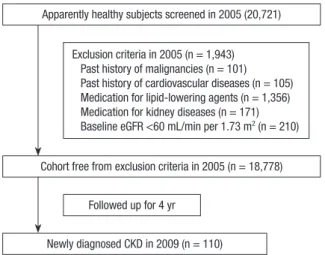
All employees of Korean companies participate in an annual health examination, as required by Korea’s Industrial Safety and Health law. The participants in this study were composed of individuals who had received a comprehensive health exam- ination at baseline (2005) and were then re-examined 4 yr later (2009), with both examination conducted at Kangbuk Samsung Hospital. Initially, 20,721 individuals were identified as poten- tial participants, and of these, 1,943 (9.4%) were excluded for the following reasons: past history of malignancies (n = 101, 0.5%); past history of cardiovascular disease (n = 105, 0.5%);
administration of medications for lipid-lowering (n = 1,356, 6.5%) or kidney diseases (n = 171, 0.8%) at the time of examina- tion. Based on the baseline (2005) medical records, 210 (1.0%) subjects were also excluded due to the observation of baseline eGFR < 60 mL/min per 1.73 m2. After these exclusions, the to- tal number of eligible study participants was 18,778 (Fig. 1).
Measurements
The initial health examinations performed in 2005 included a medical history evaluation, a physical examination, a question- naire about health-related behavior, and anthropometric and biochemical measurements. The medical and drug prescrip- tion history were assessed by the examining physicians as part of the examination. All participants were asked to respond to a health-related behavior questionnaire which included the top- ics of alcohol consumption, smoking and exercise. The ques- tions about alcohol intake included the frequency of alcohol consumption on a weekly basis and the typical amount con- sumed on a daily basis ( ≥ 20 g/day). We considered persons reporting that they smoked at the time of the questionnaire to be current smokers. In addition, the participants were asked about the frequency per week of physical activities they engage in that lasts long enough to produce perspiration such as jog- ging, bicycling and swimming ( ≥ 1 time/week). The diagnosis of diabetes mellitus was defined as a fasting blood glucose level of at least 126 mg/dL, or the current use of blood glucose–low- ering agents. Hypertension was defined as either the current use of antihypertensive medication or as having a measured blood pressure (BP) ≥ 140/90 mmHg at the initial examination.
Blood specimens were sampled from an antecubital vein after more than 12 hr of fasting. Serum levels of creatinine, glucose, total cholesterol, triglycerides, low-density lipoprotein (LDL) cholesterol, high-density lipoprotein (HDL) cholesterol and UA were measured using Bayer Reagent Packs on an automated chemistry analyzer (Advia 1650 Auto Analyzer; Bayer Diagnos- tics, Leverkusen, Germany). The measurement techniques em- ployed included the hexokinase method for glucose, an enzy- matic colorimetric assay for serum lipids, and an immunora- diometric assay for insulin (Biosource, Nivelles, Belgium). The serum UA method was based on the Fossati enzymatic reaction using uricase with a Trinder-like endpoint (Advia 1650 Auto Analyzer). Insulin resistance was calculated using the homeo-
stasis model assessment of insulin resistance (HOMA-IR) as de- scribed by Matthews et al. (19): fasting serum insulin (μU/mL) × fasting blood glucose (mmol/L)/22.5. Serum creatinine (SCr) was measured using the alkaline picrate (Jaffe) method. Kidney function was estimated using the glomerular filtration rate (GFR) which was calculated using the CKD-EPI equation: eGFR = 141 × min (SCr/K, 1)a× max (SCr/K, 1)-1.209× 0.993age× 1.018 [if fe- male] × 1.159 [if Black], where SCr is serum creatinine, K is 0.7 for females and 0.9 for males, “α” is -0.329 for females and -0.411 for males, min indicates the minimum of SCr/K or 1 and max indicates the maximum of SCr/K or 1 (20). CKD was defined as an eGFR of < 60 mL/min per 1.73 m2.
Trained nurses obtained sitting BP levels using a standard mer- cury sphygmomanometer. The first and fifth Korotkoff sounds were utilized in order to estimate the systolic and diastolic BP.
Height and weight were measured after an overnight fast with the shoeless participants wearing a lightweight hospital gown.
Statistical analyses
One-way ANOVA and χ2-test were used to analyze the statistical differences between the characteristics of the study participants at the time of enrollment in relation to the quintiles of serum UA levels. Categories for serum UA results were comprised of the following quintiles: < 5.1 mg/dL, 5.1 to 5.7 mg/dL, 5.7 to 6.3 mg/dL, 6.3 to 7.0 mg/dL and ≥ 7.0 mg/dL. Age-adjusted and multivariable-adjusted logistic regression analyses (models 1, 2 and 3, with the latter adjusted for age) were performed to in- clude HOMA-IR, triglyceride, BMI, alcohol intake, smoking sta- tus, regular exercise, hypertension and diabetes mellitus.
In addition, we compared the development of CKD in hyper- uricemic participants (serum UA ≥ 7.0 mg/dL) vs normourice- mic participants. Statistical analyses were performed using SPSS 17.0 for Windows software package (SPSS, Chicago, IL, USA).
All reported P values were two-tailed and those with results <
0.05 were considered to be statistically significant.
Ethics statement
This study was approved by the Institutional Review Board of Kangbuk Samsung Hospital, Sungkyunkwan University, School of Medicine in Seoul, Korea (IRB number: KBC10034). All par- ticipants gave their written informed consent.
RESULTS
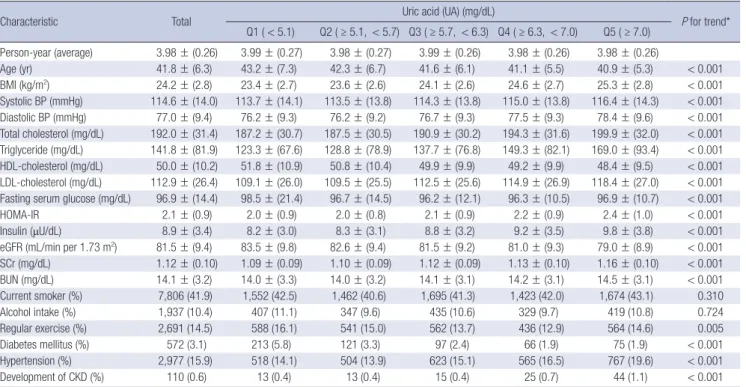
The metabolic characteristics of the participants, arranged ac- cording to serum UA quintiles, are shown in Table 1. Overall, the mean ± S.D age of the participants was 41.8 ± 6.3 yr.
During 74,821.4 person-years of follow-up, 110 cases of CKD had developed by 2009. At baseline, a graded increasing trend in relation to serum UA quintiles was observed for systolic and diastolic BP, BMI, total cholesterol, triglyceride, LDL-cholester- Apparently healthy subjects screened in 2005 (20,721)
Cohort free from exclusion criteria in 2005 (n = 18,778)
Newly diagnosed CKD in 2009 (n = 110) Followed up for 4 yr
Exclusion criteria in 2005 (n = 1,943) Past history of malignancies (n = 101) Past history of cardiovascular diseases (n = 105) Medication for lipid-lowering agents (n = 1,356) Medication for kidney diseases (n = 171) Baseline eGFR <60 mL/min per 1.73 m2 (n = 210)
Fig. 1. Selection of study participants.
ol, HOMA-IR, blood creatinine, insulin, BUN and percentage of Hypertension. Age, HDL-cholesterol, fasting serum glucose, eGFR, percentage of regular exercise, and diabetes mellitus show- ed a graded decreasing trend in relation to serum UA quintiles.
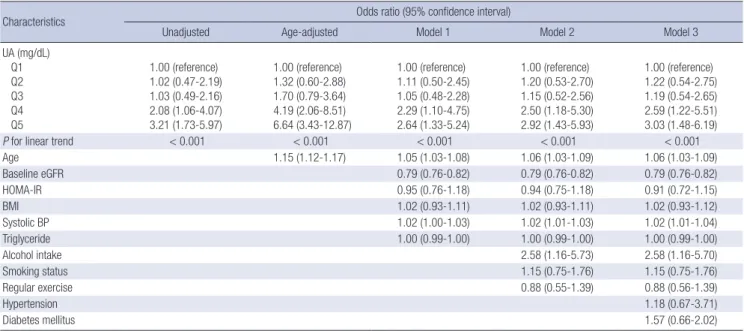
The metabolic characteristics of the participants relative to the development of CKD during the 4 yr follow-up period are shown in Table 2. During the follow-up period, CKD occurred in 110 of the total participants. Table 3 presents the odds ratio (OR) and 95% confidence intervals (CI) for the likelihood of de- velopment of CKD relative to the quintile groups established for serum UA level. In the categorical analyses, the likelihood of developing CKD increased with increasing serum UA quintile (P for trend < 0.001). In unadjusted analyses whereby Q1 was utilized as a reference, the Q4 and Q5 groups were found to be significantly associated with a greater likelihood for the devel- opment of CKD. This difference remained significant even after further adjustments for covariates in models 1, 2, and 3. After adjusting for age, baseline eGFR, systolic BP, HOMA-IR, triglyc- eride, BMI, alcohol intake, smoking status, regular exercise, hy- pertension and diabetes mellitus, the OR and 95% CI associated with the likelihood for development of CKD with respect to groups Q2, Q3, Q4, and Q5 were 1.22 (0.54-2.75), 1.19 (0.54- 2.65), 2.59 (1.22-5.51), and 3.03 (1.48-6.19), respectively.
Table 4 presents the multivariate-adjusted OR and 95% CI for the development of CKD by comparing the hyperuricemic (≥ 7.0 mg/dL) vs normouricemic (< 7.0 mg/dL) participants.
Table 1. Baseline characteristics of participants relative to quintile grouped by UA levels (n = 18,778)
Characteristic Total Uric acid (UA) (mg/dL)
P for trend*
Q1 ( < 5.1) Q2 ( ≥ 5.1, < 5.7) Q3 ( ≥ 5.7, < 6.3) Q4 ( ≥ 6.3, < 7.0) Q5 ( ≥ 7.0) Person-year (average) 3.98 ± (0.26) 3.99 ± (0.27) 3.98 ± (0.27) 3.99 ± (0.26) 3.98 ± (0.26) 3.98 ± (0.26)
Age (yr) 41.8 ± (6.3) 43.2 ± (7.3) 42.3 ± (6.7) 41.6 ± (6.1) 41.1 ± (5.5) 40.9 ± (5.3) < 0.001
BMI (kg/m2) 24.2 ± (2.8) 23.4 ± (2.7) 23.6 ± (2.6) 24.1 ± (2.6) 24.6 ± (2.7) 25.3 ± (2.8) < 0.001
Systolic BP (mmHg) 114.6 ± (14.0) 113.7 ± (14.1) 113.5 ± (13.8) 114.3 ± (13.8) 115.0 ± (13.8) 116.4 ± (14.3) < 0.001 Diastolic BP (mmHg) 77.0 ± (9.4) 76.2 ± (9.3) 76.2 ± (9.2) 76.7 ± (9.3) 77.5 ± (9.3) 78.4 ± (9.6) < 0.001 Total cholesterol (mg/dL) 192.0 ± (31.4) 187.2 ± (30.7) 187.5 ± (30.5) 190.9 ± (30.2) 194.3 ± (31.6) 199.9 ± (32.0) < 0.001 Triglyceride (mg/dL) 141.8 ± (81.9) 123.3 ± (67.6) 128.8 ± (78.9) 137.7 ± (76.8) 149.3 ± (82.1) 169.0 ± (93.4) < 0.001 HDL-cholesterol (mg/dL) 50.0 ± (10.2) 51.8 ± (10.9) 50.8 ± (10.4) 49.9 ± (9.9) 49.2 ± (9.9) 48.4 ± (9.5) < 0.001 LDL-cholesterol (mg/dL) 112.9 ± (26.4) 109.1 ± (26.0) 109.5 ± (25.5) 112.5 ± (25.6) 114.9 ± (26.9) 118.4 ± (27.0) < 0.001 Fasting serum glucose (mg/dL) 96.9 ± (14.4) 98.5 ± (21.4) 96.7 ± (14.5) 96.2 ± (12.1) 96.3 ± (10.5) 96.9 ± (10.7) < 0.001
HOMA-IR 2.1 ± (0.9) 2.0 ± (0.9) 2.0 ± (0.8) 2.1 ± (0.9) 2.2 ± (0.9) 2.4 ± (1.0) < 0.001
Insulin (μU/dL) 8.9 ± (3.4) 8.2 ± (3.0) 8.3 ± (3.1) 8.8 ± (3.2) 9.2 ± (3.5) 9.8 ± (3.8) < 0.001
eGFR (mL/min per 1.73 m2) 81.5 ± (9.4) 83.5 ± (9.8) 82.6 ± (9.4) 81.5 ± (9.2) 81.0 ± (9.3) 79.0 ± (8.9) < 0.001 SCr (mg/dL) 1.12 ± (0.10) 1.09 ± (0.09) 1.10 ± (0.09) 1.12 ± (0.09) 1.13 ± (0.10) 1.16 ± (0.10) < 0.001
BUN (mg/dL) 14.1 ± (3.2) 14.0 ± (3.3) 14.0 ± (3.2) 14.1 ± (3.1) 14.2 ± (3.1) 14.5 ± (3.1) < 0.001
Current smoker (%) 7,806 (41.9) 1,552 (42.5) 1,462 (40.6) 1,695 (41.3) 1,423 (42.0) 1,674 (43.1) 0.310
Alcohol intake (%) 1,937 (10.4) 407 (11.1) 347 (9.6) 435 (10.6) 329 (9.7) 419 (10.8) 0.724
Regular exercise (%) 2,691 (14.5) 588 (16.1) 541 (15.0) 562 (13.7) 436 (12.9) 564 (14.6) 0.005
Diabetes mellitus (%) 572 (3.1) 213 (5.8) 121 (3.3) 97 (2.4) 66 (1.9) 75 (1.9) < 0.001
Hypertension (%) 2,977 (15.9) 518 (14.1) 504 (13.9) 623 (15.1) 565 (16.5) 767 (19.6) < 0.001
Development of CKD (%) 110 (0.6) 13 (0.4) 13 (0.4) 15 (0.4) 25 (0.7) 44 (1.1) < 0.001
Categorical data presented as (%); continuous data presented as mean (standard deviation). *P value by ANOVA for continuous variables and chi square test for categorical vari- ables. UA, uric acid; BMI, body mass index; BP, blood pressure; HDL, high-density lipoprotein; LDL, low-density lipoprotein; HOMA-IR, homeostasis model assessment of insulin resistance; eGFR, estimated glomerular filtration rate; SCr, serum creatinine; CKD, chronic kidney disease.
Table 2. Baseline characteristics of participants relative to development of chronic kidney disease (CKD) during the 4-yr follow-up period.
Characteristic
Total participants (n = 18,778)
P value*
CKD
(n = 110) Non-CKD
(n = 18,668)
Age (yr) 48.4 ± (8.5) 41.8 ± (6.3) < 0.001
BMI (kg/m2) 24.9 ± (2.5) 24.2 ± (2.8) 0.013
Systolic BP (mmHg) 119.6 ± (17.5) 114.6 ± (14.0) 0.004 Diastolic BP (mmHg) 80.6 ± (10.4) 77.0 ± (9.4) < 0.001 Total cholesterol (mg/dL) 193.9 ± (33.5) 192.0 ± (31.4) 0.529 Triglyceride (mg/dL) 147.5 ± (101.2) 141.7 ± (80.7) 0.459 HDL-cholesterol (mg/dL) 48.4 ± (9.2) 50.0 ± (10.2) 0.106 LDL-cholesterol (mg/dL) 114.2 ± (31.4) 112.9 ± (26.4) 0.678 Fasting serum glucose (mg/dL) 100.2 ± (17.3) 96.9 ± (14.4) 0.050
HOMA-IR 2.2 ± (1.0) 2.1 ± (0.9) 0.414
Insulin (μU/dL) 8.9 ± (4.7) 8.9 ± (3.4) 0.966
eGFR (mL/min per 1.73 m2) 67.4 ± (5.9) 81.6 ± (9.4) < 0.001 SCr (mg/dL) 1.26 ± (0.10) 1.12 ± (0.10) < 0.001
BUN (mg/dL) 15.8 ± (3.4) 14.1 ± (3.2) < 0.001
UA(mg/dL) 6.7 ± (1.5) 6.0 ± (1.2) 0.002
Current smoker (%) 36 (33.0) 7,771 (42.0) 0.059
Alcohol intake (%) 7 (6.2) 1,930 (10.4) 0.175
Regular exercise (%) 30 (27.5) 2,661 (14.4) < 0.001
Diabetes mellitus (%) 7 (6.4) 565 (3.0) 0.042
Hypertension (%) 33 (30.0) 2,945 (15.8) < 0.001
*P value by t-test for continuous variables and chi square test for categorical vari- ables. UA, uric acid; BMI, body mass index; BP, blood pressure; HDL, high-density li- poprotein; LDL, low-density lipoprotein; HOMA-IR, homeostasis model assessment of insulin resistance; eGFR, estimated glomerular filtration rate; SCr, serum creatinine;
CKD, chronic kidney disease.
With the normouricemic participants set as the reference, the OR and 95% CI for the development of CKD with respect to the hyperuricemic participants was 1.96 (1.28-2.99).
DISCUSSION
The major finding of our study was that high serum UA levels increased the risk for the development of CKD, independent of confounding variables. Thus, serum UA levels are useful as a predictor of disease susceptibility in apparently healthy Korean men. Our findings provide significant evidence that hyperuri- cemia is associated with the development of CKD, regardless of other well-known risk factors such as aging, alcohol intake, smo- king, hypertension and diabetes mellitus.
In this study, only men were considered eligible study partic- ipants. The application of the CKD-EPI equation is not the same
for men and women, and pre-menopausal women have lower serum UA levels than men or post-menopausal women, as es- trogen stimulates urinary urate excretion (21).
The importance of serum UA as an independent predictor for CKD progression remains a topic of ongoing debate. A num- ber of studies have reported that hyperuricemia is associated with the development of CKD (15-18), while others have pro- duced contrary results (22, 23). In a population-based study in- cluding epidemiological follow-up data from 13,338 partici- pants in two community-based cohorts, the Atherosclerosis Risks in Communities and the Cardiovascular Health Study (Weiner et al.) evaluated the association between elevated se- rum UA and increased risk of incident kidney disease in a gen- eral US population over an extended follow-up period. They re- ported that each 1 mg/dL increase in UA increased the risk of developing CKD by 7%-11% (15). Obermayr et al. evaluated the prospective cohort of the Vienna Health Screening Project and found that elevated levels of serum UA independently increased the risk for developing new-onset kidney disease (16). On the other hand, Sturm et al. reported that serum UA was not an in- dependent predictor for CKD progression as evidenced by a 7-yr follow-up study, The Mild to Moderate Kidney Disease (MM- KD) Study (22).
There are a number of mechanisms by which hyperuricemia increases the risk for the development of CKD. Clinical evidence exists indicating that hyperuricemia raises BP due to endotheli- al dysfunction caused by UA (24). Another study in rats suggests that hyperuricemic conditions alter glomerular hemodynamics and cause cortical renal vasoconstriction as evidenced by a sig- Table 3. Odds ratio (OR) and 95% confidence intervals (CI) for the likelihood of development of chronic kidney disease (CKD) relative to quintile groups established for serum uric acid (UA) levels
Characteristics Odds ratio (95% confidence interval)
Unadjusted Age-adjusted Model 1 Model 2 Model 3
UA (mg/dL) Q1 Q2 Q3 Q4 Q5
1.00 (reference) 1.02 (0.47-2.19) 1.03 (0.49-2.16) 2.08 (1.06-4.07) 3.21 (1.73-5.97)
1.00 (reference) 1.32 (0.60-2.88) 1.70 (0.79-3.64) 4.19 (2.06-8.51) 6.64 (3.43-12.87)
1.00 (reference) 1.11 (0.50-2.45) 1.05 (0.48-2.28) 2.29 (1.10-4.75) 2.64 (1.33-5.24)
1.00 (reference) 1.20 (0.53-2.70) 1.15 (0.52-2.56) 2.50 (1.18-5.30) 2.92 (1.43-5.93)
1.00 (reference) 1.22 (0.54-2.75) 1.19 (0.54-2.65) 2.59 (1.22-5.51) 3.03 (1.48-6.19)
P for linear trend < 0.001 < 0.001 < 0.001 < 0.001 < 0.001
Age 1.15 (1.12-1.17) 1.05 (1.03-1.08) 1.06 (1.03-1.09) 1.06 (1.03-1.09)
Baseline eGFR 0.79 (0.76-0.82) 0.79 (0.76-0.82) 0.79 (0.76-0.82)
HOMA-IR 0.95 (0.76-1.18) 0.94 (0.75-1.18) 0.91 (0.72-1.15)
BMI 1.02 (0.93-1.11) 1.02 (0.93-1.11) 1.02 (0.93-1.12)
Systolic BP 1.02 (1.00-1.03) 1.02 (1.01-1.03) 1.02 (1.01-1.04)
Triglyceride 1.00 (0.99-1.00) 1.00 (0.99-1.00) 1.00 (0.99-1.00)
Alcohol intake 2.58 (1.16-5.73) 2.58 (1.16-5.70)
Smoking status 1.15 (0.75-1.76) 1.15 (0.75-1.76)
Regular exercise 0.88 (0.55-1.39) 0.88 (0.56-1.39)
Hypertension 1.18 (0.67-3.71)
Diabetes mellitus 1.57 (0.66-2.02)
Model 1: adjusted for age, baseline eGFR, systolic BP, HOMA-IR, triglyceride and BMI. Model 2: adjusted for Model 1 plus alcohol intake, smoking status and regular exercise.
Model 3: adjusted for Model 2 plus hypertension and diabetes mellitus. Q1, quintile 1; Q2, quintile 2; Q3, quintile 3; Q4, quintile 4; Q5, quintile 5; UA, uric acid; BP, blood pres- sure; HOMA-IR, homeostasis model assessment of insulin resistance; eGFR, estimated glomerular filtration rate; SCr, serum creatinine; CKD, chronic kidney disease.
Table 4. Odds ratio (OR) and 95% confidence intervals (CI) for the likelihood of the development of chronic kidney disease (CKD) relative to elevated serum uric acid (UA) levels
Model of CKD OR (CI) in hyperuricemia ( ≥ 7.0 mg/dL) No (n = 14,868) Yes (n = 3,910) P value No. of the development of CKD 66 (0.4) 44 (1.1) < 0.001
Unadjusted 1.00 (reference) 2.55 (1.74-3.74) < 0.001 Model 1 1.00 (reference) 1.89 (1.25-2.87) < 0.001 Model 2 1.00 (reference) 1.95 (1.27-2.95) < 0.001 Model 3 1.00 (reference) 1.96 (1.28-2.99) < 0.001 Model 1: adjusted for age, baseline eGFR, systolic BP, HOMA-IR, triglyceride and BMI.
Model 2: adjusted for Model 1 plus alcohol intake, smoking status and regular exer- cise. Model 3: adjusted for Model 2 plus hypertension and diabetes mellitus.
nificant increase of afferent and efferent arteriolar resistances.
A decrease in the glomerular plasma flow and ultrafiltration coefficient resulted in a 35% decrease in single nephron GFR but an increase in glomerular pressure (25).
The major strengths of this study include the large sample size and the prospective study design. Furthermore, estimating eGFR using the recently developed CKD-EPI equation is known to be more accurate in the eGFR range > 60 mL/min per 1.73 m2. Participants with baseline eGFR < 60 mL/min per 1.73 m2 were excluded. Nevertheless, some limitations should be con- sidered. First, the study participants were recruited from indi- viduals who actively sought to evaluate their health status at a health promotion center; thus, this study may show a partici- pant selection bias. Second, the participant’s serum creatinine levels were measured only once a year. Third, we used an eGFR instead of a directly measured GFR in order to define CKD. A recent review article reported that current eGFR had greater in- accuracy in populations without known CKD than in those with the disease (26). Nevertheless, current eGFR facilitates the de- tection, evaluation and management of CKD, and many orga- nizations recommend the use of equations that estimate GFR in epidemiologic studies and in clinical evaluation of renal func- tion (26). Therefore, our findings are applicable to clinical and public health practice settings. In addition, ethnic factors char- acteristic of Asian populations are not well-established for the use of equations that estimate GFR. Therefore, these equations need to be validated with additional studies including large Asian cohorts.
In conclusion, this epidemiologic prospective cohort study indicates that high serum UA levels are associated with an in- creased likelihood for the development of CKD over a 4-yr fol- low-up period, and these associations are significant after ad- justing for age, baseline eGFR, systolic BP, HOMA-IR, triglycer- ide, BMI, alcohol intake, smoking status, regular exercise, hy- pertension and diabetes mellitus, all of which are known inde- pendent risk factors for development of CKD. These findings highlight the importance of regular surveillance and monitor- ing of serum UA for the goal of circumventing the manifestation of CKD and its progression into cardiovascular disease and end- stage renal disease.
DISCLOSURE
The authors have no conflicts of interest to disclose.
REFERENCES
1. Go AS, Chertow GM, Fan D, McCulloch CE, Hsu CY. Chronic kidney disease and the risks of death, cardiovascular events, and hospitaliza- tion. N Engl J Med 2004; 351: 1296-305.
2. Kiberd B. The chronic kidney disease epidemic: stepping back and look-
ing forward. J Am Soc Nephrol 2006; 17: 2967-73.
3. Weiner DE, Tighiouart H, Amin MG, Stark PC, MacLeod B, Griffith JL, Salem DN, Levey AS, Sarnak MJ. Chronic kidney disease as a risk factor for cardiovascular disease and all-cause mortality: a pooled analysis of community-based studies. J Am Soc Nephrol 2004; 15: 1307-15.
4. Fox CS, Larson MG, Leip EP, Culleton B, Wilson PW, Levy D. Predictors of new-onset kidney disease in a community-based population. JAMA 2004; 291: 844-50.
5. National Kidney Foundation. K/DOQI clinical practice guidelines for chronic kidney disease: evaluation, classification, and stratification. Am J Kidney Dis 2002; 39: S1-266.
6. Nagahama K, Inoue T, Iseki K, Touma T, Kinjo K, Ohya Y, Takishita S.
Hyperuricemia as a predictor of hypertension in a screened cohort in Okinawa, Japan. Hypertens Res 2004; 27: 835-41.
7. Sundström J, Sullivan L, D’Agostino RB, Levy D, Kannel WB, Vasan RS.
Relations of serum uric acid to longitudinal blood pressure tracking and hypertension incidence. Hypertension 2005; 45: 28-33.
8. Ejerblad E, Fored CM, Lindblad P, Fryzek J, McLaughlin JK, Nyrén O.
Obesity and risk for chronic renal failure. J Am Soc Nephrol 2006; 17:
1695-702.
9. Hsu CY, McCulloch CE, Iribarren C, Darbinian J, Go AS. Body mass in- dex and risk for end-stage renal disease. Ann Intern Med 2006; 144: 21-8.
10. Iseki K, Ikemiya Y, Kinjo K, Inoue T, Iseki C, Takishita S. Body mass in- dex and the risk of development of end-stage renal disease in a screened cohort. Kidney Int 2004; 65: 1870-6.
11. Fukui M, Tanaka M, Shiraishi E, Harusato I, Hosoda H, Asano M, Ka- dono M, Hasegawa G, Yoshikawa T, Nakamura N. Serum uric acid is as- sociated with microalbuminuria and subclinical atherosclerosis in men with type 2 diabetes mellitus. Metabolism 2008; 57: 625-9.
12. Nakagawa T, Kang DH, Feig D, Sanchez-Lozada LG, Srinivas TR, Sautin Y, Ejaz AA, Segal M, Johnson RJ. Unearthing uric acid: an ancient factor with recently found significance in renal and cardiovascular disease. Kid- ney Int 2006; 69: 1722-5.
13. Liu PW, Chang TY, Chen JD. Serum uric acid and metabolic syndrome in Taiwanese adults. Metabolism 2010; 59: 802-7.
14. Klein BE, Klein R, Lee KE. Components of the metabolic syndrome and risk of cardiovascular disease and diabetes in Beaver Dam. Diabetes Care 2002; 25: 1790-4.
15. Weiner DE, Tighiouart H, Elsayed EF, Griffith JL, Salem DN, Levey AS.
Uric acid and incident kidney disease in the community. J Am Soc Ne- phrol 2008; 19: 1204-11.
16. Obermayr RP, Temml C, Gutjahr G, Knechtelsdorfer M, Oberbauer R, Klauser-Braun R. Elevated uric acid increases the risk for kidney disease.
J Am Soc Nephrol 2008; 19: 2407-13.
17. Iseki K, Ikemiya Y, Inoue T, Iseki C, Kinjo K, Takishita S. Significance of hyperuricemia as a risk factor for developing ESRD in a screened cohort.
Am J Kidney Dis 2004; 44: 642-50.
18. Chonchol M, Shlipak MG, Katz R, Sarnak MJ, Newman AB, Siscovick DS, Kestenbaum B, Carney JK, Fried LF. Relationship of uric acid with progression of kidney disease. Am J Kidney Dis 2007; 50: 239-47.
19. Matthews DR, Hosker JP, Rudenski AS, Naylor BA, Treacher DF, Turner RC. Homeostasis model assessment: insulin resistance and beta-cell func- tion from fasting plasma glucose and insulin concentrations in man. Di- abetologia 1985; 28: 412-9.
20. Levey AS, Stevens LA, Schmid CH, Zhang YL, Castro AF 3rd, Feldman
HI, Kusek JW, Eggers P, Van Lente F, Greene T, et al. A new equation to estimate glomerular filtration rate. Ann Intern Med 2009; 150: 604–12.
21. Johnson RJ, Rideout BA. Uric acid and diet: insights into the epidemic of cardiovascular disease. N Engl J Med 2004; 350: 1071–3.
22. Sturm G, Kollerits B, Neyer U, Ritz E, Kronenberg F; MMKD Study Group.
Uric acid as a risk factor for progression of non-diabetic chronic kidney disease? the Mild to Moderate Kidney Disease (MMKD) Study. Exp Ge- rontol 2008; 43: 347-52.
23. Madero M, Sarnak MJ, Wang X, Greene T, Beck GJ, Kusek JW, Collins AJ, Levey AS, Menon V. Uric acid and long-term outcomes in CKD. Am J Kidney Dis 2009; 53: 796-803.
24. Zoccali C, Maio R, Mallamaci F, Sesti G, Perticone F. Uric acid and en- dothelial dysfunction in essential hypertension. J Am Soc Nephrol 2006;
17: 1466-71.
25. Sánchez-Lozada LG, Tapia E, Santamaría J, Avila-Casado C, Soto V, Ne- pomuceno T, Rodríguez-Iturbe B, Johnson RJ, Herrera-Acosta J. Mild hyperuricemia induces vasoconstriction and maintains glomerular hy- pertension in normal and remnant kidney rats. Kidney Int 2005; 67: 237- 47.
26. Stevens LA, Coresh J, Greene T, Levey AS. Assessing kidney function:
measured and estimated glomerular filtration rate. N Engl J Med 2006;
354: 2473-83.