Trans-Radial versus Trans-Femoral Intervention for the Treatment of Coronary Bifurcations: Results from Coronary Bifurcation Stenting Registry
Trans-radial (TR) approach is increasingly recognized as an alternative to the routine use of trans-femoral (TF) approach. However, there are limited data comparing the outcomes of these two approaches for the treatment of coronary bifurcation lesions. We evaluated outcomes of TR and TF percutaneous coronary interventions (PCI) in this complex lesion.
Procedural outcomes and clinical events were compared in 1,668 patients who underwent PCI for non-left main bifurcation lesions, according to the vascular approach, either TR (n = 503) or TF (n = 1,165). The primary outcome was major adverse cardiac events (MACE), including cardiac death, myocardial infarction (MI), and target lesion revascularization (TLR) in all patients and in 424 propensity-score matched pairs of patients. There were no significant differences between TR and TF approaches for procedural success in the main vessel (99.6% vs 98.6%, P = 0.08) and side branches (62.6% vs 66.7%, P = 0.11). Over a mean follow-up of 22 months, cardiac death or MI (1.8% vs 2.2%, P = 0.45), TLR (4.0% vs 5.2%, P = 0.22), and MACE (5.2% vs 7.0%, P = 0.11) did not significantly differ between TR and TF groups, respectively. These results were consistent after propensity score-matched analysis. In conclusion, TR PCI is a feasible alternative approach to conventional TF approaches for bifurcation PCI (clinicaltrials.gov number: NCT00851526).
Key Words: Bifurcation; Percutaneous Coronary Intervention; Trans-Radial Approach Seungmin Chung,1,* Sung-Ho Her,2,*
Pil Sang Song,1 Young Bin Song,1 Joo-Yong Hahn,1 Jin-Ho Choi,1 Sang Hoon Lee,1 Yangsoo Jang,3 Jung Han Yoon,4 Seung-Jea Tahk,5 Seung-Jung Park,6 Seung-Hyuk Choi,1 Ki Bae Seung,2 and Hyeon-Cheol Gwon1
1Division of Cardiology, Department of Medicine, Samsung Medical Center, Sungkyunkwan University School of Medicine, Seoul; 2Division of Cardiology, Department of Internal Medicine, The Catholic University of Korea College of Medicine, Seoul;
3Division of Cardiology, Severance Cardiovascular Hospital, Yonsei University College of Medicine, Seoul; 4Division of Cardiology, Wonju Christian Hospital, Wonju; 5Division of Cardiology, Ajou Univeristy Hospital, Suwon; 6Department of Cardiology, University of Ulsan College of Medicine, Asan Medical Center, Seoul, Korea
*Seungmin Chung and Sung-Ho Her contributed equally to this work.
Received: 25 May 2012 Accepted: 4 January 2013 Address for Correspondence:
Seung-Hyuk Choi, MD
Division of Cardiology, Cardiac and Vascular Center, Samsung Medical Center, Sungkyunkwan University School of Medicine, 81 Irwon-ro, Gangnam-gu, Seoul 135-710, Korea Tel: +82.2-3410-1631, Fax: +82.2-3410-3849 E-mail: [email protected]
This work was supported by the Korean Society of Interventional Cardiology, Seoul, Republic of Korea.
http://dx.doi.org/10.3346/jkms.2013.28.3.388 • J Korean Med Sci 2013; 28: 388-395
INTRODUCTION
Coronary bifurcation lesions constitute a complex anatomy sub- set that is encountered in 15-20% of all percutaneous coronary intervention (PCI) (1). The trans-femoral (TF) approach is the usual and preferred vascular approach method used in PCI for coronary bifurcation lesions in most catheterization laborato- ries. However, significantly higher rates of local vascular com- plications have been reported in patients undergoing TF cathe- terization (2).
Compared with the TF approach, trans-radial (TR) PCI is as- sociated with similar procedural success rates and clinically sig-
nificant reductions in procedure-related bleeding complications (2-5). Thus, the TR approach is increasingly recognized as an alternative to the routine use of the TF approach (2, 4, 6). How- ever, owing to practical, patient, and technical problems, the implementation of TR approach has remained limited in more complex coronary lesion subsets, such as coronary bifurcation lesions. There are limited data regarding the efficacy and safety of the TR PCI for coronary bifurcation lesions. The purpose of this study was to compare the impacts of the TR and TF ap- proaches on efficacy and safety in patients with coronary bifur- cation lesions.
MATERIALS AND METHODS Study population
We conducted this study using the Coronary Bifurcation Stent- ing (COBIS) Registry. The methods and patient population of the COBIS registry have been described previously (7). Briefly, the COBIS registry is a retrospective multicenter registry dedi- cated to bifurcation lesion PCI that includes data for patients treated at 16 major coronary intervention centers in Korea. In- clusion criteria were: 1) coronary bifurcation lesions which were treated solely with at least 1 drug-eluting stent (DES) between January 2004 and June 2006; and 2) a main vessel diameter ≥ 2.5 mm and side branch diameter ≥ 2.0 mm. Exclusion criteria were the presence of cardiogenic shock, ST-segment elevation myocardial infarction (MI) within 48 hr, and left main coronary artery bifurcation lesions. Among 1,668 patients, a total of 753 patients were available for analysis of in-hospital bleeding. The registry was sponsored by the Korean Society of Interventional Cardiology.
Procedural details
The vascular approach method was decided by the operator’s discretion for each patient. Intravascular ultrasound (IVUS) guided stenting was encouraged to achieve optimal stent ex- pansion and lesion coverage. Stent type was selected per the treating physician’s discretion at the time of the study, namely, sirolimus-eluting Cypher stent (Cordis, Johnson & Johnson, New Brunswick, NJ, USA), paclitaxel-eluting Taxus stent (Bos- ton Scientific, Natick, MA, USA), and other. Stent techniques to treat coronary bifurcation lesions included: main vessel stent- ing only, T-stenting, crush, V-stenting, culotte, and other. Final kissing ballooning (FKB) was performed in cases with subopti- mal results after crossover stenting at the ostium of the side branch and, in cases with 2-stent implantations.
All patients were administered loading doses of aspirin (300 mg) and clopidogrel (300 to 600 mg) or ticlopidine (500 mg) be- fore coronary intervention, unless they had previously received these antiplatelet medications. During the procedure, antico- agulation therapy was performed according to current practice guidelines by the Korean Society of Interventional Cardiology (8), and use of glycoprotein IIb/IIIa inhibitors was determined by the operator. After procedures, aspirin was prescribed indef- initely and clopidogrel or ticlopidine was prescribed for at least 6 months.
Patient follow-up
Demographic, clinical, angiographic, procedural, and outcome data were collected with the use of a web-based reporting sys- tem. Additional information was obtained by further inquiries into medical records or telephone contact if necessary. All base- line and procedural cine coronary angiograms were reviewed
and qualitatively analyzed at the angiographic core laboratory in the Cardiac and Vascular Center, Samsung Medical Center, Seoul, Korea. All patients were evaluated by a clinic visit or by phone at 1, 3, 6, and 12 months and annually thereafter.
Definition and study end points
Baseline bifurcation anatomy was assessed according to the Medina classification (9). Medina type (1.1.1), (1.0.1), and (0.1.1) lesions were defined as true bifurcation lesions. Angiographic success was defined as the achievement of a Thrombolysis In Myocardial Infarction (TIMI) flow grade of 3 with a final residu- al stenosis of < 30% for the main vessel or < 50% for the side branch by visual estimation. Procedural success was defined as angiographic success without in-hospital death, MI, or emer- gent coronary artery bypass surgery. After PCI, elevations of the creatine kinase-myocardial band greater than 3 times the upper limit of normal, assuming a normal baseline biomarker value, were considered indicative of peri-procedural MI (10).
The peri-procedural period included the first 48 hr after PCI.
Peri-procedural complications were defined as the occurrence of coronary arterial dissection or abrupt closure during PCI, car- diac death, emergent bypass surgery, coronary perforation or cardiac tamponade during PCI. Death that could not be attrib- uted to non-cardiac etiology was considered cardiac death. MI was diagnosed by electrocardiographic changes and/or a rise and fall of cardiac biomarkers in the presence of ischemic symp- toms that were not related to the index procedure during follow- up. Target lesion revascularization (TLR) was defined as any re- peated PCI or bypass grafting surgery to treat a luminal re-nar- rowing in-stent or within a 5 mm border adjacent to the stent.
Target vessel revascularization (TVR) was repeat revasculariza- tion of the target vessel by PCI or bypass graft surgery. Stent thrombosis was adjudicated according to Academic Research Consortium definitions as definite, probable, or possible (11).
Bleeding events were evaluated during hospitalization and char- acterized according to TIMI study criteria (TIMI major, TIMI minor bleeding), in addition to any reported bleeding (12). Ad- ditionally, the amount of bleeding was measured by changes in hemoglobin or hematocrit pre- and post-intervention.
The primary objective of our study was to compare long-term major adverse cardiac events (MACE) between patients treated by TR and TF approaches. MACE was defined as the occurrence of cardiac death, MI, and TLR in hospital and during follow-up.
Statistical analysis
Patient demographics, clinical, angiographic, and procedural characteristics were described in the TR and TF groups using means for continuous variables and frequencies for categorical variables. Proportions were compared between groups using chi-square test and Fisher’s exact test as appropriate. Group means were compared using Student’s t test. Cumulative event
rates were estimated by the Kaplan-Meier method and assessed by the log-rank statistic. Differences in the incidence rates of in- dividual clinical outcomes and composite outcomes between TR and TF groups were investigated by multivariable Cox pro- portional hazards models after confirming that the proportion-
al hazards assumption was met. Adjusted hazard ratios and their 95% confidence intervals were estimated with potential con- founders entered as covariates (age, sex, diabetes, chronic renal failure, clinical presentation of acute coronary syndrome, FKB, periprocedural complications, and TR approach). To reduce Table 1. Baseline clinical, angiographic, and procedural characteristics
Parameters
Total population (n = 1,668) Propensity-matched population (n = 848) Trans-radial
(n = 503)
Trans-femoral
(n = 1,165) P value Trans-radial
(n = 424)
Trans-femoral
(n = 424) P value
Age 62 ± 11 62 ± 10 0.46 62 ± 11 62 ± 10 0.98
Age ≥ 65 yr 230 (45.7) 485 (41.6) 0.12 189 (44.6) 174 (41.0) 0.30
Female 151 (30.0) 401 (34.4) 0.08 123 (29.0) 127 (30.0) 0.76
Diabetes mellitus 139 (27.6) 374 (32.1) 0.07 118 (27.8) 118 (27.8) > 0.99
Hypertension 286 (56.9) 701 (60.2) 0.21 241 (56.8) 227 (53.5) 0.33
Dyslipidemia 74 (14.7) 447 (38.4) < 0.01 58 (13.7) 145 (34.2) < 0.01
Current smoking 116 (23.1) 289 (24.8) 0.45 105 (24.8) 105 (24.8) 0.94
Peripheral artery occlusive disease 3 (0.6) 22 (1.9) 0.046 3 (0.7) 2 (0.5) 0.65
Cerebrovascular accident 21 (4.2) 66 (5.7) 0.21 19 (4.5) 19 (4.5) > 0.99
Chronic renal failure 7 (1.4) 48 (4.1) < 0.01 7 (1.7) 5 (1.2) 0.56
Prior myocardial infarction 36 (7.2) 103 (8.8) 0.25 29 (6.8) 32 (7.5) 0.69
Acute coronary syndrome 266 (52.9) 703 (60.3) 0.01 216 (50.9) 220 (51.9) 0.78
Left ventricular ejection fraction (%) 59 ± 10 60 ± 10 0.18 60 ± 10 59 ± 10 0.65
Left ventricular ejection fraction < 50% 68 (13.5) 135 (11.6) 0.27 55 (13.0) 63 (14.9) 0.43
Multi-vessel coronary artery disease 242 (48.1) 560 (48.2) 0.98 203 (47.9) 210 (49.5) 0.63
Location
Right coronary artery
Left anterior descending coronary artery Left circumflex coronary artery
30 (6.0) 375 (74.6) 98 (19.5)
58 (5.0) 901 (77.3) 206 (17.7)
0.44
26 (6.1) 317 (74.8) 81 (19.1)
26 (6.1) 319 (75.2) 79 (18.6)
0.98
Bifurcation type by Medina classification 0,0,1
0,1,0 0,1,1 1,0,0 1,0,1 1,1,0 1,1,1
6 (1.2) 32 (6.4) 44 (8.7) 38 (7.6) 38 (7.6) 64 (12.7) 281 (55.9)
21 (1.8) 132 (11.3) 165 (14.2) 78 (6.7) 66 (5.7) 134 (11.5) 569 (48.8)
< 0.01
7 (1.7) 32 (7.5) 43 (10.1)
36 (8.5) 39 (9.2) 60 (14.2) 207 (48.8)
9 (2.1) 29 (6.8) 41 (9.7) 28 (6.6) 36 (8.5) 49 (11.6) 232 (54.7)
0.66
True bifurcation by Medina classification 363 (72.3) 800 (68.7) 0.14 289 (68.2) 309 (72.9) 0.13
Bifurcation angle (°) 52 ± 17 51 ± 17 0.37 53 ± 17 52 ± 15 0.30
Baseline minimal luminal diameter (mm) in main vessel, proximal
in main vessel, distal in side branch
1.24 ± 0.61 1.64 ± 0.71 1.59 ± 0.53
1.29 ± 0.59 1.55 ± 0.64 1.51 ± 0.52
0.13 0.02 0.01
1.27 ± 0.62 1.68 ± 0.72 1.61 ± 0.53
1.25 ± 0.56 1.63 ± 0.65 1.60 ± 0.49
0.69 0.33 0.75
Glycoprotein IIb/IIIa inhibitor 23 (4.6) 35 (3.0) 0.11 24 (5.7) 9 (2.1) 0.01
Intravascular ultrasound 99 (19.7) 433 (37.2) < 0.01 103 (24.3) 101 (23.8) 0.87
Guiding catheter size (Fr) 6 ± 0.6 7 ± 0.6 < 0.01 6 ± 0.7 7 ± 0.6 < 0.01
6 Fr guiding catheter 385 (76.5) 145 (12.4) < 0.01 250 (59.0) 63 (14.9) < 0.01
Stent technique single stent T-stenting Crush Culottes Kissing
448 (89.1) 47 (9.3) 4 (0.8) 1 (0.2) 3 (0.6)
929 (79.7) 94 (8.1) 95 (8.2) 7 (0.6) 40 (3.4)
< 0.01
368 (86.8) 48 (11.3) 4 (0.9) 1 (0.2) 3 (0.7)
368 (86.8) 39 (9.2) 11 (2.6) 4 (0.9) 2 (0.5)
0.19
Final kissing balloon 253 (50.3) 397 (34.1) < 0.01 173 (40.8) 189 (44.6) 0.27
Stent type Sirolimus-eluting Paclitaxel-eluting Others
321 (63.8) 172 (34.2) 10 (2.0)
749 (64.3) 401 (34.4) 15 (1.3)
0.56
262 (61.8) 143 (33.7) 19 (4.5)
271 (63.9) 135 (31.8) 18 (4.2)
0.82
Maximal stent diameter in main vessel (mm) 3.12 ± 0.32 3.14 ± 0.31 0.32 3.12 ± 0.33 3.12 ± 0.31 0.86
Total stent length in main vessel (mm) 29.4 ± 11.8 31.2 ± 13.3 0.01 28.9 ± 11.6 29.4 ± 11.7 0.54
Data represented as No. (%) or mean ± SD.
selection bias for approach type and potential confounding, a 1:1 matched propensity score analysis was performed. Propen- sity scores were calculated using all variables listed in Table 1, and estimated using multiple logistic regression analysis. The TR patients were ordered and sequentially matched to the near- est unmatched TF patients according to the estimated propen- sity score. We assessed the balance in baseline covariates be- tween the 2 groups in a propensity score-matched population.
The discrimination and calibration abilities of the propensity score model were assessed using the c-statistic and the Hosmer- Lemeshow statistic. Additionally, to determine whether similar outcomes between the 2 groups were consistent in the various subgroups, we performed subgroup analyses. The ten pre-spec- ified subgroups were age (< 75 or ≥ 75 yr), sex, diabetes melli- tus, acute coronary syndrome versus stable angina patients, and left ventricular ejection fraction (< 50 or ≥ 50% by 2D-echocar- diography), true bifurcation, guiding catheter (≤ 6 Fr or > 6 Fr), IVUS, 2-stent technique, and FKB. All analyses were conducted using SPSS software, version 17 (SPSS Inc., Chicago, IL, USA), and 2-tailed P values of 0.05 or less were considered statistically significant.
Ethics statement
This study was approved by the institutional review board (IRB) of Samsung Medical Center (IRB approval number: 2007-04- 042). In addition, the local IRB at each participating hospital approved this study and waived the requirement for informed consent for access to each institutional PCI registry.
RESULTS
Among 1,919 patients registered, 251 patients failed to fulfill the inclusion criteria as determined by core laboratory cineangio- graphic analysis and were excluded. A total of 1,668 patients were included in this study. TR PCI was performed in 503 (30%) patients and TF PCI was performed in 1,165 (70%) patients.
Baseline clinical, angiographic, and procedural characteristics
Overall Population: Baseline clinical characteristics are repre-
sented in Table 1. Significant differences in clinical characteris- tics were found between patients treated by the TR approach and those treated by the TF approach. Overall, patients in the TR group were less likely to have dyslipidemia, peripheral artery occlusive disease, and chronic renal failure, and were less likely to present with acute coronary syndrome.
Angiographic and procedural characteristics are shown in Table 1. There were also significant differences in angiographic and procedural characteristics between the two groups. Types of bifurcation defined by Medina classification were significant- ly different between the two groups. The prevalence of true bi- furcation and glycoprotein IIb/IIIa inhibitor administration tended to be higher in the TR group but the differences were not statistically significant. In contrast, the rates of IVUS guid- ance, and use of the 2-stent technique were significantly higher in patients treated with a TF approach. FKB, however, was per- formed more frequently with TR access. For TR patients receiv- ing 2-stents for PCI (10.9%, 55 patients), bifurcation stent tech- niques included T-stenting (85.5%), crush (7.2%), culotte (1.8%), and V-stenting (5.5%). Among TF bifurcation cases treated with a 2-stent strategy (20.3%, 236 patients), techniques were T-stent- ing (39.8%), crush (40.3%), culotte (3.0%), and V-stenting (16.9%).
Total stent length in the main vessel was longer in the TF than TR group.
Propensity-Matched Population: After performing propensi- ty score-matching for all patients, a total of 424 matched pairs of patients were created (Table 1). The c-statistic for the propen- sity score model was 0.869, which indicates good discrimina- tion. There were no significant differences in the baseline clini- cal, angiographic, and procedural characteristics for the pro- pensity-matched subjects except for prevalence of dyslipid- emia, glycoprotein IIb/IIIa inhibitor use, and guiding catheter size.
Procedural and clinical outcomes
Overall Population: Despite differences in baseline characteris- tics, the overall procedural success rates were high and were similar between the two approaches (Table 2). The difference between the two groups in the occurrence of peri-procedural complications and peri-procedural MI were not statistically sig- Table 2. Procedural outcomes
Procedural outcomes
Total population (n = 1,668) Propensity-matched population (n = 848) Trans-radial
(n = 503) Trans-femoral
(n = 1,165) P value Trans-radial
(n = 424) Trans-femoral
(n = 424) P value Procedural success
in main vessel in side branch
501 (99.6) 315 (62.6)
1,149 (98.6) 777 (66.7)
0.08 0.11
422 (99.5) 245 (57.8)
420 (99.1) 279 (65.8)
0.41 0.02
Peri-procedural complication* 4 (0.8) 13 (1.1) 0.55 1 (0.2) 7 (1.7) 0.03
Peri-procedural myocardial infarction 140 (27.8) 273 (23.4) 0.06 98 (23.1) 93 (21.9) 0.68
Data represented as No. (%). *Peri-procedural complications were defined as the occurrence of coronary arterial dissection or abrupt closure during PCI, cardiac death, emer- gent bypass surgery, coronary perforation, or cardiac tamponade during PCI.
nificant, although there was a tendency for more frequent occur- rence of peri-procedural MI in the TR than TF group.
Complete clinical follow-up data were obtained for 97.8% of the overall patients with a median follow-up of 672 days (inter- quartile range 437-965 days), although the follow-up period was longer for TR patients (median 721 days vs 661 days, P < 0.01).
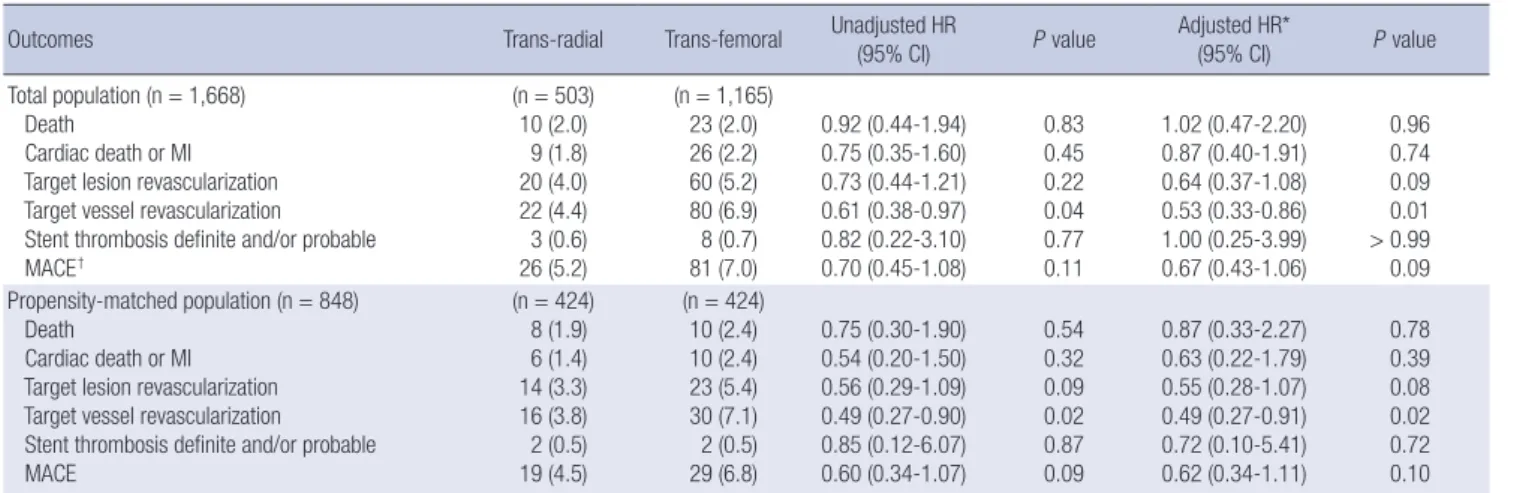
There were no significant differences in rates of MACEs (5.2%
vs 7.0%, P = 0.11, Fig. 1A), or individual endpoints, including cardiac death or MI (1.8% vs 2.2%, P = 0.45), and TLR (4.1% vs 5.2%, P = 0.22) between the TR and TF groups, respectively.
Definite and probable stent thrombosis rates were also similar between the TR and TF groups (0.6% vs 0.5%, P = 0.77). How- ever, TVR rates were lower in TR group than in TF group (4.4%
vs 6.9%, P = 0.04). All hazard ratios and 95% confidence intervals for clinical endpoints were subjected to multivariable adjustment (Table 3). The TR approach was not an independent predictor of MACEs, cardiac death or MI, and TLR during follow-up.
Propensity-Matched Population: Procedural success rates in the main vessel were similar between the two groups, but pro- cedural success rates in the side branch were lower with the TR approach than with the TF approach. Periprocedural complica- tions occurred more frequently in the TF group (1 cardiac death, 3 emergent bypass surgery, and 3 coronary arterial dissection or abrupt closure during PCI) than in the TR group (1 cardiac death) (Table 2). There were also no significant differences in rates of MACEs (4.5% vs 6.8%, P = 0.09, Fig. 1B), cardiac death or MI (1.4% vs 2.4%, P = 0.32), TLR (3.3% vs 5.4%, P = 0.09), or stent thrombosis (0.5% vs 0.5%, P = 0.87) between the TR and TF groups. However, TVR rates were lower in TR group than in TF group (3.8% vs 7.1%, P = 0.02). Even after multivariable ad- justment in the propensity score-matched patients, the TR ap- proach was not an independent factor predicting endpoints during follow-up (Table 3).
Table 3. Clinical outcomes
Outcomes Trans-radial Trans-femoral Unadjusted HR
(95% CI) P value Adjusted HR*
(95% CI) P value
Total population (n = 1,668) Death
Cardiac death or MI Target lesion revascularization Target vessel revascularization Stent thrombosis definite and/or probable MACE†
(n = 503) 10 (2.0) 9 (1.8) 20 (4.0) 22 (4.4) 3 (0.6) 26 (5.2)
(n = 1,165) 23 (2.0) 26 (2.2) 60 (5.2) 80 (6.9) 8 (0.7) 81 (7.0)
0.92 (0.44-1.94) 0.75 (0.35-1.60) 0.73 (0.44-1.21) 0.61 (0.38-0.97) 0.82 (0.22-3.10) 0.70 (0.45-1.08)
0.83 0.45 0.22 0.04 0.77 0.11
1.02 (0.47-2.20) 0.87 (0.40-1.91) 0.64 (0.37-1.08) 0.53 (0.33-0.86) 1.00 (0.25-3.99) 0.67 (0.43-1.06)
0.96 0.74 0.09 0.01
> 0.99 0.09 Propensity-matched population (n = 848)
Death
Cardiac death or MI Target lesion revascularization Target vessel revascularization Stent thrombosis definite and/or probable MACE
(n = 424) 8 (1.9) 6 (1.4) 14 (3.3) 16 (3.8) 2 (0.5) 19 (4.5)
(n = 424) 10 (2.4) 10 (2.4) 23 (5.4) 30 (7.1) 2 (0.5) 29 (6.8)
0.75 (0.30-1.90) 0.54 (0.20-1.50) 0.56 (0.29-1.09) 0.49 (0.27-0.90) 0.85 (0.12-6.07) 0.60 (0.34-1.07)
0.54 0.32 0.09 0.02 0.87 0.09
0.87 (0.33-2.27) 0.63 (0.22-1.79) 0.55 (0.28-1.07) 0.49 (0.27-0.91) 0.72 (0.10-5.41) 0.62 (0.34-1.11)
0.78 0.39 0.08 0.02 0.72 0.10 Data represented as No. (%). *Adjusted covariates included age, sex, diabetes, acute coronary syndrome, chronic renal failure, final kissing ballooning, periprocedural complica- tions, type of stent used, and type of approach; †MACE was defined as the occurrence of cardiac death, myocardial infarction, and target lesion revascularization. CI, confidence interval; HR, hazard ratio.
Fig. 1. Kaplan-Meier curves for major adverse cardiac events (MACE) according to the vascular approach. (A) Kaplan-Meier curves for MACE in the overall population treated by trans-radial approach (TR group) versus trans-femoral approach (TF group). (B) Kaplan-Meier curves for MACE in propensity-matched patients.
Survival free from MACE (%) Survival free from MACE (%)
Months Months
0 6 12 18 24 0 6 12 18 24
503 492 470 305 244
1,165 1,133 1,082 707 483 424 416 397 270 215
424 407 388 230 161
TR group
TF group TR group
TF group
No. at risk No. at risk
TR group TF group
TR group TF group
P = 0.11 P = 0.09
100
90
80
100
90
80
A B
Bleeding events
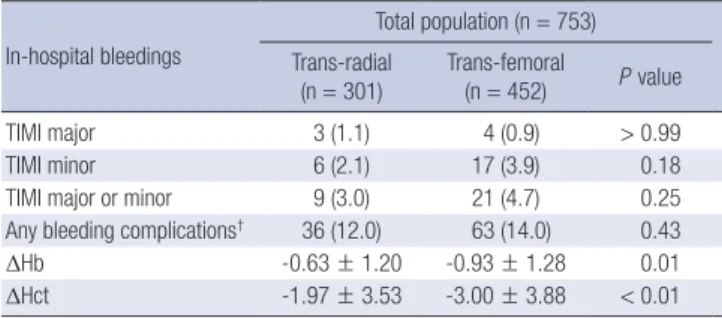
Among a total of 1,668 patients, records of in-hospital bleeding events were collected in 753 patients. When bleeding events were characterized according to TIMI study criteria, no differ- ences were observed in the rates of in-hospital bleeding events between the TR group and the TF group, even though the amount
of bleeding measured by changes in hemoglobin (-0.63 ± 1.20 g/dL vs -0.93 ± 1.28 g/dL, P = 0.01) or hematocrit (-1.97 ± 3.53%
vs -3.00 ± 3.88%, P < 0.01) was significantly smaller in the TR group than in the TF group (Table 4).
Subgroup analysis
In subgroup analysis, there were no significant interactions be- tween the effects on MACE of the vascular approach types (TR or TF) and the eight pre-specified subgroups of age (< 75 or
≥ 75 yr), sex, diabetes mellitus, acute coronary syndrome ver- sus stable angina patients, and left ventricular ejection fraction (< 50 or ≥ 50% by 2D-echocardiography), guiding catheter (≤ 6 Fr or > 6 Fr), IVUS and 2-stent technique (Fig. 2). However, there was a tendency for significant interactions to exist between the presence or absence of true bifurcation lesions and MACE (P for interaction = 0.06). While the MACE rate was not significant- ly different between the groups in true bifurcations lesions, the MACE rate was substantially lower in the TR group than in the TF group among patients with non-true bifurcation lesions. In Table 4. In-hospital bleeding complications*
In-hospital bleedings
Total population (n = 753) Trans-radial
(n = 301)
Trans-femoral
(n = 452) P value
TIMI major 3 (1.1) 4 (0.9) > 0.99
TIMI minor 6 (2.1) 17 (3.9) 0.18
TIMI major or minor 9 (3.0) 21 (4.7) 0.25
Any bleeding complications† 36 (12.0) 63 (14.0) 0.43
ΔHb -0.63 ± 1.20 -0.93 ± 1.28 0.01
ΔHct -1.97 ± 3.53 -3.00 ± 3.88 < 0.01
Data represented as No. (%) or mean ± SD. *In hospital bleeding complication data were available in 753 patients; †Any bleeding complications was defined as the occur- rence of TIMI major, minor, minimal bleeding and puncture site bleeding or hemato- ma. TIMI, thrombolysis in myocardial infarction.
Fig. 2. Subgroup analyses for major adverse cardiac events in 10 subgroups of the two vascular approach groups. CI, confidence interval; HR, hazard ratio; TF, trans-femoral;
TR, trans-radial.
Subgroups Age
< 75 yr 1,493
≥ 75 yr 175
Sex
Male 1,116
Female 552
Diabeters
No 1,155
Yes 513
Presentation
Non-ACS 699
ACS 969
LVEF
< 50% 1,465
≥ 50% 203
True bifurcation
No 504
Yes 1,164
Guiding catheter
≤ 6 Fr 530
≥ 7 Fr 1,138 Stenting technique 1-stent 1,377
2-stent 291
Final kissing ballooning
No 1,018
Yes 650
IVUS guidance
No 1,136
Yes 532
0.83 0.71 0.44-1.12 0.53 0.11-2.46
0.13 0.89 0.53-1.51
0.43 0.18-1.02
0.38 0.80 0.48-1.35
0.50 0.21-1.21
0.31 0.50 0.23-1.11
0.87 0.51-1.48
0.38 0.75 0.46-1.20
0.45 0.13-1.58
0.06 0.29 0.09-0.96
0.89 0.54-1.34
0.77 3.64 0.85-15.6
0.74 0.34-1.60
0.22 0.64 0.39-1.05 1.29 0.48-3.48
0.01 0.22 0.08-0.62
1.08 0.63-1.84
0.46 0.62 0.37-1.02
0.93 0.35-2.42
Number of patients Hazard ratio 95% CI P for interation
Favors TF Favors TR
0 1 2 4 16
addition, there was a significant interaction between FKB and MACE (P for interaction = 0.01). MACE rate was significantly higher in the FKB group than in non-FKB group and the MACE rate was substantially lower in the TR group than in the TF group among patients without FKB.
DISCUSSION
There are few data comparing TR and TF approaches for the treat- ment of coronary bifurcation lesions in the DES era. To our knowl- edge, this study represents one of the largest surveys of TR PCI for coronary bifurcation lesions and the only comparative study of vascular approach methods for coronary bifurcation lesions.
The main findings of this study are: 1) TR PCI for coronary bifurcation lesion is associated with a high procedural success rate; and 2) TR PCI, compared with TF PCI for coronary bifur- cation lesions, is associated with similar long-term clinical out- comes, even after propensity score-matched adjustment.
When compared with earlier studies (2), contemporary trials demonstrate no differences in procedural failure between vas- cular approach strategies for coronary intervention (5, 13-15).
However, the expansion of TR PCI to more complex and high risk lesion subsets has been restricted by several limitations.
This perception is especially relevant for coronary bifurcation lesions, considering the technical challenges of guiding cathe- ter support, limitations of catheter size and often the simultane- ous need for multiple angioplasty catheters. Even though there are limitations of TR PCI, procedural success rates in our study were similar between the two vascular approach methods, dem- onstrating the feasibility of TR PCI for coronary bifurcation le- sions. The choice of interventional guiding catheter is influenced by the site of arterial access. Although radial artery size general- ly limits the arterial sheath to 6-French, advanced PCI devices, the increased inner diameter of guiding catheters combined with the decreased profile of balloons and stents have allowed bifurcation procedures through radial access. There were no differences in the procedural outcomes between the two vas- cular approaches for bifurcation PCI in our study. Similar pro- cedural success rates may be attributed in part to techniques, such as provisional 1-stent technique, that are now regarded as standard techniques for most bifurcation PCI and are feasible through radial 6-French access, and the use of IVUS guidance (16, 17) which is not excluded by a TR approach.
TR PCI had a tendency to have more favorable long-term clin- ical outcomes than TF PCI, but the difference was not statisti- cally significant in our study. Our results do not differ from those of larger comparative studies that established the relationship between TR PCI and decreased early- and late-term mortality (3, 18). Bleeding amounts measured by hemoglobin or hema- tocrit changes before and after PCI were lower in the TR group than in the TF group. While the in-hospital bleeding complica-
tion rates were not significantly different between the two groups, TIMI major or minor bleeding had a tendency to occur less fre- quently in the TR group than in the TF group in our study. These findings may in part be due to the tendency for lower MACE rate in the TR group than in the TF group in our study. Bleeding complications after PCI are associated with increased risk of post-PCI morbidity and mortality (19, 20). However, as our re- sults are based on inadequate data, they should be interpreted carefully. FKB was more frequently performed in TR patients, which may account for the similar rates of MACEs between the two groups, even though there was a lower cardiac risk profile in TR patients. Our COBIS investigators previously suggested that FKB might be harmful for coronary bifurcation lesions treat- ed with 1-stent technique mainly due to increased TLR (21).
We recognize that the present study has several limitations.
First, comparisons to this analysis are limited by its non-ran- domized and retrospective design, in which operator bias and unmeasured confounders may preclude any definite conclu- sions, despite multivariable adjustment. However, we tried to overcome this limitation through propensity score-matching analysis. Second, we did not have data describing procedure time, contrast amount, radiation times, length of hospital stay, or data for the numbers or ratio of crossover between the TR group and TF group due to technical reasons. By way of exam- ple, crossover from TR to TF vascular approach is one of the im- portant determining factors of procedural success during chal- lenging PCI. Another important consideration is that there were insufficient data available for bleeding events. Among a total of 1,668 patients, records of in-hospital bleeding events were col- lected in 753 patients. These inadequate data might explain the lack of statistically significant differences in bleeding events be- tween the two groups, even though changes in hemoglobin or hematocrit were significantly less in the TR group than in TF group. These results should be confirmed by a well designed large randomized trial.
In the present study, we evaluated the use of TR PCI for bifur- cation lesions and compared our results with those for TF PCI.
Compared with the TF approach, TR PCI for coronary bifurca- tion lesions is feasible and is associated with similar procedural success rates, as well as comparable long-term clinical safety and efficacy. Based on the results of the present study, we con- clude that PCI with the TR approach is a good alternative strat- egy in coronary bifurcation lesions intervention.
ACKNOWLEDGMENTS
The authors have no conflicts of interest to disclose.
REFERENCES
1. Latib A, Colombo A. Bifurcation disease: what do we know, what should
we do? JACC Cardiovasc Interv 2008; 1: 218-26.
2. Agostoni P, Biondi-Zoccai GG, de Benedictis ML, Rigattieri S, Turri M, Anselmi M, Vassanelli C, Zardini P, Louvard Y, Hamon M. Radial versus femoral approach for percutaneous coronary diagnostic and interven- tional procedures; systematic overview and meta-analysis of random- ized trials. J Am Coll Cardiol 2004; 44: 349-56.
3. Chase AJ, Fretz EB, Warburton WP, Klinke WP, Carere RG, Pi D, Berry B, Hilton JD. Association of the arterial access site at angioplasty with transfusion and mortality: the M.O.R.T.A.L Study (Mortality benefit Of Reduced Transfusion after percutaneous coronary intervention via the Arm or Leg). Heart 2008; 94: 1019-25.
4. Jolly SS, Amlani S, Hamon M, Yusuf S, Mehta SR. Radial versus femoral access for coronary angiography or intervention and the impact on ma- jor bleeding and ischemic events: a systematic review and meta-analysis of randomized trials. Am Heart J 2009; 157: 132-40.
5. Rao SV, Ou FS, Wang TY, Roe MT, Brindis R, Rumsfeld JS, Peterson ED.
Trends in the prevalence and outcomes of radial and femoral approach- es to percutaneous coronary intervention: a report from the National Cardiovascular Data Registry. JACC Cardiovasc Interv 2008; 1: 379-86.
6. Hamon M, Rasmussen LH, Manoukian SV, Cequier A, Lincoff MA, Rupprecht HJ, Gersh BJ, Mann T, Bertrand ME, Mehran R, et al. Choice of arterial access site and outcomes in patients with acute coronary syn- dromes managed with an early invasive strategy: the ACUITY Trial. Eu- roIntervention 2009; 5: 115-20.
7. Song YB, Hahn JY, Choi SH, Choi JH, Lee SH, Jeong MH, Kim HS, Seong IW, Yang JY, Rha SW, et al. Sirolimus- versus paclitaxel-eluting stents for the treatment of coronary bifurcations results: from the COBIS (Coronary Bifurcation Stenting) Registry. J Am Coll Cardiol 2010; 55: 1743-50.
8. Seung KB, Koh YS, Koo BK, Lim DS, Ahn CM, Park SJ, Jeong MH, Hong YJ, Chung WS. Part 2. practical guidelines for coronary intervention. In:
Korean Society of Inteventional Cardiology. The manual of interventional cardiology, 2nd ed. Seoul: ML Communications Co. Ltd, 2011, p23-66.
9. Medina A, Suárez de Lezo J, Pan M. A new classification of coronary bi- furcation lesions. Rev Esp Cardiol 2006; 59: 183.
10. Thygesen K, Alpert JS, White HD, Jaffe AS, Apple FS, Galvani M, Katus HA, Newby LK, Ravkilde J, Chaitman B, et al. Universal definition of myocardial infarction. Circulation 2007; 116: 2634-53.
11. Cutlip DE, Windecker S, Mehran R, Boam A, Cohen DJ, van Es GA, Steg PG, Morel MA, Mauri L, Vranckx P, et al. Clinical end points in coronary stent trials: a case for standardized definitions. Circulation 2007; 115:
2344-51.
12. Bovill EG, Terrin ML, Stump DC, Berke AD, Frederick M, Collen D, Feit F, Gore JM, Hillis LD, Lambrew CT, et al. Hemorrhagic events during therapy with recombinant tissue-type plasminogen activator, heparin,
and aspirin for acute myocardial infarction: results of the Thrombolysis in Myocardial Infarction (TIMI), Phase II Trial. Ann Intern Med 1991;
115: 256-65.
13. Achenbach S, Ropers D, Kallert L, Turan N, Krähner R, Wolf T, Garlichs C, Flachskampf F, Daniel WG, Ludwig J. Transradial versus transfemo- ral approach for coronary angiography and intervention in patients above 75 years of age. Catheter Cardiovasc Interv 2008; 72: 629-35.
14. Brueck M, Bandorski D, Kramer W, Wieczorek M, Höltgen R, Tillmanns H. A randomized comparison of transradial versus transfemoral ap- proach for coronary angiography and angioplasty. JACC Cardiovasc In- terv 2009; 2: 1047-54.
15. Yang YJ, Kandzari DE, Gao Z, Xu B, Chen JL, Qiao SB, Li JJ, Qin XW, Yao M, Wu YJ, et al. Transradial versus transfemoral method of percutane- ous coronary revascularization for unprotected left main coronary ar- tery disease: comparison of procedural and late-term outcomes. JACC Cardiovasc Interv 2010; 3: 1035-42.
16. Kim JS, Hong MK, Ko YG, Choi D, Yoon JH, Choi SH, Hahn JY, Gwon HC, Jeong MH, Kim HS, et al. Impact of intravascular ultrasound guid- ance on long-term clinical outcomes in patients treated with drug-elut- ing stent for bifurcation lesions: data from a Korean multicenter bifurca- tion registry. Am Heart J 2011; 161: 180-7.
17. Park SJ, Kim YH, Park DW, Lee SW, Kim WJ, Suh J, Yun SC, Lee CW, Hong MK, Lee JH, et al. Impact of intravascular ultrasound guidance on long-term mortality in stenting for unprotected left main coronary artery stenosis. Circ Cardiovasc Interv 2009; 2: 167-77.
18. Sciahbasi A, Pristipino C, Ambrosio G, Sperduti I, Scabbia EV, Greco C, Ricci R, Ferraiolo G, Di Clemente D, Giombolini C, et al. Arterial access- site-related outcomes of patients undergoing invasive coronary proce- dures for acute coronary syndromes (from the ComPaRison of Early In- vasive and Conservative Treatment in Patients With Non-ST-ElevatiOn Acute Coronary Syndromes [PRESTO-ACS] Vascular Substudy). Am J Cardiol 2009; 103: 796-800.
19. Doyle BJ, Rihal CS, Gastineau DA, Holmes DR Jr. Bleeding, blood trans- fusion, and increased mortality after percutaneous coronary interven- tion: implications for contemporary practice. J Am Coll Cardiol 2009; 53:
2019-27.
20. Rao SV, Eikelboom JA, Granger CB, Harrington RA, Califf RM, Bassand JP. Bleeding and blood transfusion issues in patients with non-ST-seg- ment elevation acute coronary syndromes. Eur Heart J 2007; 28: 1193-204.
21. Gwon HC, Hahn JY, Koo BK, Song YB, Choi SH, Choi JH, Lee SH, Jeong MH, Kim HS, Seong IW, et al. Final kissing ballooning and long-term clinical outcomes in coronary bifurcation lesions treated with 1-stent technique: results from the COBIS Registry. Heart 2012; 98: 225-31.