Performance Evaluation of Five Different Disseminated Intravascular Coagulation (DIC) Diagnostic Criteria for Predicting Mortality in Patients with Complicated Sepsis
Disseminated intravascular coagulation (DIC) is a major complication in sepsis patients. We compared the performance of five DIC diagnostic criteria, focusing on the prediction of mortality. One hundred patients with severe sepsis or septic shock admitted to intensive care unit (ICU) were enrolled. Routine DIC laboratory tests were performed over the first 4 days after admission. The overall ICU and 28-day mortality in DIC patients diagnosed from five criteria (International Society on Thrombosis and Haemostasis [ISTH], the Japanese Association for Acute Medicine [JAAM], the revised JAAM [R-JAAM], the Japanese Ministry of Health and Welfare [JMHW] and the Korean Society on Thrombosis and Hemostasis [KSTH]) were compared. Both KSTH and JMHW criteria showed superior performance than ISTH, JAAM and R-JAAM criteria in the prediction of overall ICU mortality in DIC patients (odds ratio 3.828 and 5.181, P = 0.018 and 0.006, 95% confidence interval 1.256-11.667 and 1.622-16.554, respectively) when applied at day 1 after admission, and survival analysis demonstrated significant prognostic impact of KSTH and JMHW criteria on the prediction of 28-day mortality (P = 0.007 and 0.049, respectively) when applied at day 1 after admission. In conclusion, both KSTH and JMHW criteria would be more useful than other three criteria in predicting prognosis in DIC patients with severe sepsis or septic shock.
Keywords: Criteria; Diagnosis; Disseminated Intravascular Coagulation; Mortality; Sepsis Sang Ook Ha,1* Sang Hyuk Park,2,3*
Sang-Bum Hong,4 and Seongsoo Jang5
1Department of Emergency Medicine, Hallym University Medical Center, Hallym University Sacred Heart Hospital, Anyang, Korea; 2Department of Laboratory Medicine, Pusan National University School of Medicine, Pusan National University Hospital, Busan, Korea; 3Biomedical Research Institute, Pusan National University Hospital, Busan, Korea; 4Department of Pulmonary and Critical Care Medicine, University of Ulsan College of Medicine and Asan Medical Center, Seoul, Korea; 5Department of Laboratory Medicine, University of Ulsan College of Medicine and Asan Medical Center, Seoul, Korea
* Sang Ook Ha and Sang Hyuk Park contributed equally to this work as first authors.
Received: 26 April 2016 Accepted: 13 August 2016 Address for Correspondence:
Seongsoo Jang, MD
Department of Laboratory Medicine, University of Ulsan College of Medicine, Asan Medical Center, 88 Olympic-ro 43-gil, Songpa-gu, Seoul 05505, Korea
E-mail: [email protected]
Funding: This research was supported by the National Research Foundation of Korea (NRF) grant funded by the Korean government (2005-0049489).
http://dx.doi.org/10.3346/jkms.2016.31.11.1838 • J Korean Med Sci 2016; 31: 1838-1845
INTRODUCTION
Disseminated intravascular coagulation (DIC) is characterised by thrombotic occlusion and bleeding (1,2). Although the diag- nosis of DIC is important for patients in the medical intensive care unit (ICU), no single laboratory test with satisfactory per- formance for the accurate diagnosis of DIC is currently avail- able (3). Currently, the most commonly used diagnostic criteria for DIC are the International Society on Thrombosis and Hae- mostasis (ISTH) criteria, the Japanese Association for Acute Medicine (JAAM) criteria and the Japanese Ministry of Health and Welfare (JMHW) (4). In 1993, the Korean Society on Throm- bosis and Hemostasis (KSTH) also developed diagnostic crite- ria for DIC (5). However, the performance of KSTH diagnostic criteria has not yet been validated and not accepted as com- monly used DIC diagnostic criteria.
Although previous studies showed that the Japanese criteria
(JAAM and Revised-JAAM [R-JAAM]) possess higher sensitivity than both ISTH and JMHW criteria (6,7), these studies have some statistical bias such as overlap of subgroup that the DIC patients diagnosed from JAAM and R-JAAM criteria included the majority of DIC patients diagnosed from the ISTH criteria.
Several studies also evaluated the prognostic impact of various DIC criteria based on the acute physiology and chronic health evaluation (APACHE) II score, the sequential organ failure as- sessment (SOFA) score, and mortality (7-10). However, most of these studies included heterogeneous patient cohort and few studies addressed the prognostic impact of various DIC diag- nostic criteria in specific patient subgroup with severe sepsis and septic shock. In the present study, we aimed to compare the performance of five DIC diagnostic criteria focused on the mortality prediction as an outcome parameter in patients with severe sepsis or septic shock, while including the KSTH criteria.
Laboratory Medicine
MATERIALS AND METHODS Patient selection
Patient records and information was anonymized and de-iden- tified prior to analysis. Among patients with severe sepsis or septic shock admitted to the medical ICU from May to August 2012, only patients in whom the routine DIC laboratory tests (platelet, D-dimer, fibrin/fibrinogen degradation product [FDP], prothrombin time [PT], activated partial thromboplastin time [aPTT], and fibrinogen) during the first consecutive 4 days after admission were performed, were enrolled in the present study.
Patients with Child Pugh grade C liver cirrhosis, hematologic diseases, medication such as anticoagulant therapy or chemo- therapy, and age younger than 20 years old were excluded from the present. Finally, total 100 patients with severe sepsis or sep- tic shock were included in the present study.
Collection of clinical data and sample acquisition of patients
Electronic medical records were reviewed and basic demogra- phic data including age, gender, use of continuous renal replace- ment therapy (CRRT), ventilator use, blood culture, and initial vital signs were obtained retrospectively, and both APACHE II and SOFA scores were calculated. Peripheral blood samples of enrolled patients were collected within 2 hours of admission to
the ICU (Day 1) and at consecutive three days (Day 2-4), with the interval of 24 hours. Routine DIC diagnostic tests mentioned above were performed with all samples obtained. The samples for laboratory tests were blindly transferred to laboratory room without clinical information.
Definitions of criteria used in the patient classification Systemic inflammatory response syndrome (SIRS) score was calculated according to the general SIRS guideline. Sepsis was defined as the presence (probable or documented) of infection together with systemic manifestations of infection (general vari- ables, inflammatory variables, hemodynamic variables, organ dysfunction variables, and tissue perfusion variables). Severe sepsis was defined as sepsis plus sepsis-induced organ dysfunc- tion or tissue hypoperfusion (sepsis-induced hypotension, lac- tate above upper limits laboratory normal, urine output < 0.5 mL/kg/hr for more than 2 hours despite adequate fluid resusci- tation, acute lung injury with PaO2/FiO2< 250 in the absence of pneumonia as infection source, acute lung injury with PaO2/ FiO2< 200 in the presence of pneumonia as infection source, creatinine > 2.0 mg/dL, bilirubin > 2 mg/dL, platelet count
< 100,000/μL, INR > 15). Finally, septic shock was defined as sepsis-induced hypotension persisting, despite adequate fluid resuscitation. Hypotension was defined by a systolic arterial pres- sure below 90 mmHg, a mean arterial pressure < 70 mmHg, or
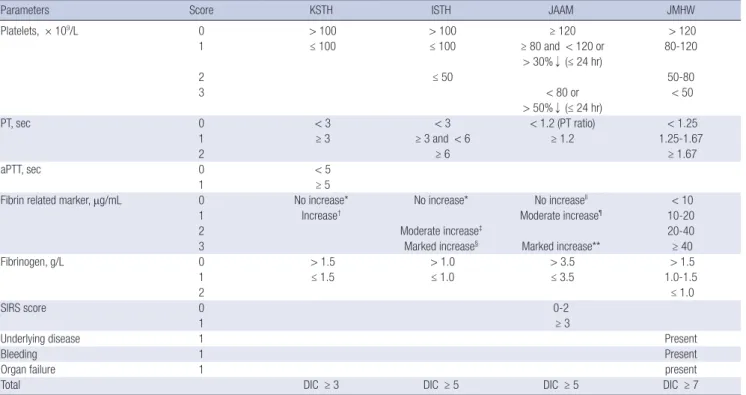
Table 1. Summary of five different DIC diagnostic criteria applied in the present study
Parameters Score KSTH ISTH JAAM JMHW
Platelets, × 109/L 0 > 100 > 100 ≥ 120 > 120
1 ≤ 100 ≤ 100 ≥ 80 and < 120 or 80-120
> 30%↓ (≤ 24 hr)
2 ≤ 50 50-80
3 < 80 or < 50
> 50%↓ (≤ 24 hr)
PT, sec 0 < 3 < 3 < 1.2 (PT ratio) < 1.25
1 ≥ 3 ≥ 3 and < 6 ≥ 1.2 1.25-1.67
2 ≥ 6 ≥ 1.67
aPTT, sec 0 < 5
1 ≥ 5
Fibrin related marker, μg/mL 0 No increase* No increase* No increasell < 10
1 Increase† Moderate increase¶ 10-20
2 Moderate increase‡ 20-40
3 Marked increase§ Marked increase** ≥ 40
Fibrinogen, g/L 0 > 1.5 > 1.0 > 3.5 > 1.5
1 ≤ 1.5 ≤ 1.0 ≤ 3.5 1.0-1.5
2 ≤ 1.0
SIRS score 0 0-2
1 ≥ 3
Underlying disease 1 Present
Bleeding 1 Present
Organ failure 1 present
Total DIC ≥ 3 DIC ≥ 5 DIC ≥ 5 DIC ≥ 7
R-JAAM criteria have same score system with JAAM except fibrinogen score.
aPTT = activated partial thromboplastin time, DIC = disseminated intravascular coagulation, FDP = fibrin/fibrinogen degradation product, ISTH = International Society on Throm- bosis and Haemostasis, JAAM = Japanese Association for Acute Medicine, JMHW = Japanese Ministry of Health and Welfare, KSTH = Korean Society on Thrombosis and He- mostasis, PT = prothrombin time, R-JAAM = Revised JAAM, SIRS = systemic inflammatory response syndrome.
*D-dimer < 1.0; †D-dimer ≥ 1.0; ‡1.0 ≤ D-dimer < 5.0; §D-dimer ≥ 5.0; llFDP < 10; ¶10 ≤ FDP < 25; **FDP ≥ 25.
a reduction in systolic blood pressure of > 40 mmHg from base- line (11). The clinical severity of each patient was evaluated ac- cording to the APACHE II and SOFA scores.
Comparison of baseline clinical and laboratory characteristics between survivors and non-survivors The diagnosis of DIC based on the ISTH, JAAM, revised JAAM, JMHW, and KSTH criteria which are summarized in Table 1, were done separately at each four consecutive days (day 1-4) in each patient using data obtained at that day. All patients were categorized into survivors and non-survivors according to the estimation at the final follow-up time period (overall ICU and 28-day mortality). Both clinical and laboratory characteristics obtained at Day 1 (baseline) were compared between two pa- tient subgroups in the Table 2.
Evaluation of distribution characteristics in patients diagnosed as DIC according to five different diagnostic criteria
The number of patients diagnosed with DIC according to the five DIC diagnostic criteria was evaluated separately during 4 days mentioned above. When five different DIC diagnostic cri- teria were applied separately, the distribution characteristics of patients diagnosed as DIC at each day and in overall period (defined as from day 1 to day 4) were analysed. These results are summarized in the Table 3.
Performance of five different DIC diagnostic criteria in the prediction of overall ICU and 28-day mortality
Multivariate logistic regression analysis and receiver operating characteristics (ROC) analysis were performed to estimate prog- nostic impact of five different DIC diagnostic criteria diagnosed at Day 1 and overall period in the prediction of overall ICU mor- tality. In addition, the sensitivity, specificity, negative predictive value, positive predictive value, and accuracy of five different DIC diagnostic criteria diagnosed at Day 1 and overall period in the prediction of overall ICU mortality were analysed. Finally, the 28-day mortality of patients with DIC diagnosed by each set of five different DIC diagnostic criteria at Day 1 and overall pe- riod, were analysed and compared using a Kaplan-Meier sur- vival analysis.
Statistical analysis
The normality of the data distribution was evaluated using the Kolmogorov-Smirnov test. All continuous variables were ex- pressed as the median (with 25th-75th percentile) because they did not show normal distribution. Comparison of categorical and continuous variables were performed using the χ2 test (or Fisher’s exact test for small number less than 5 in each subgroup) and the Mann-Whitney U test, respectively. Prognostic impact of five different DIC diagnostic criteria for the prediction of mor-
Table 2. Comparison of baseline clinical and laboratory characteristics in total 100 patients between survivors and non-survivors
Variables Survivors
n = 69
Non-survivors
n = 31 P value
Age, yr 67.0 (54.0-75.0) 67.0 (50.0-72.0) 0.394
Sex (M:F ratio) 45:24 22:9 0.572
Clinical outcomes
CRRT use, No. (%) 15 (21.7) 11 (35.5) 0.147 Ventilator use, No. (%) 35 (50.7) 25 (80.6) 0.005
Bacteraemia, No. (%) 23 (33.3) 9 (29.0) 0.670
Gram (+), No. (%) 12 (17.4) 5 (16.1) Gram (-), No. (%) 28 (40.6) 16 (51.6)
Fungus, No. (%) 2 (2.9) 2 (6.5)
Tuberculosis, No. (%) 1 (1.4) 0 (0.0)
Sources of infection 0.130
CNS, No. (%) 1 (1.4) 0 (0.0)
Lung, No. (%) 32 (46.4) 17 (54.8)
Heart, No. (%) 0 (0.0) 1 (3.2)
GI, No. (%) 17 (24.6) 4 (12.9)
GU, No. (%) 6 (8.7) 0 (0.0)
MS & skin, No. (%) 6 (8.7) 2 (6.5) Unknown, No. (%) 7 (10.1) 7 (22.6)
Septic shock, No. (%) 49 (71.0) 21 (67.7) 0.741 APACHE II score 23.0 (19.3-27.0) 26.0 (21.0-31.0) 0.051 SOFA score 11.0 (8.0-12.0) 12.0 (9.0-13.0) 0.089
SIRS score 3.0 (3.0-3.5) 3.0 (3.0-4.0) 0.877
Lactate, mM/L 3.2 (2.0-5.6) 3.4 (2.3-5.2) 0.951
Initial vital sign
Respiratory rate/min 26.0 (23.0-30.0) 27.0 (23.0-32.0) 0.279 Heart beats/min 108.0 (94.0-135.0) 125.0 (111.0-139.0) 0.031 Temperature, °C 37.2 (36.7-38.2) 37.4 (36.7-38.1) 0.875 Coagulation markers
Platelet, × 109/L 131.0 (79.5-205.5) 74.0 (36.0-107.0) < 0.001
PT, sec 14.0 (12.7-17.0) 16.1 (14.0-18.0) 0.045
aPTT, sec 39.0 (32.0-45.0) 44.0 (38.0-59.0) 0.030 D-dimer, μg/mL 5.0 (3.0-10.0) 7.0 (3.0-14.1) 0.605 FDP, μg/mL 29.0 (14.0-46.0) 30.0 (13.0-55.0) 0.882 Fibrinogen, g/L 4.4 (3.2-5.4) 3.3 (2.0-5.4) 0.047 Antithrombin III 63.0 (48.0-75.0) 53.0 (33.5-64.8) 0.019 P values were obtained from the Pearson’s χ2 test (for dichotomous variables) and the Mann-Whitney U test (for continuous variables) and the results were expressed as the median and interquartile range (IQR, 25th-75th percentile).
APACHE = acute physiology and chronic health evaluation, aPTT = activated partial thromboplastin time, CNS = central nervous system, CRRT = continuous renal replace- ment therapy, F = female, FDP = fibrin degradation product, GI = gastrointestinal, GU = genitourinary, M = male, MS = musculoskeletal, PT = prothrombin time, SOFA = se- quential organ failure assessment.
tality were evaluated using multivariate logistic regression anal- ysis, ROC analysis and Kaplan-Meier curve analysis. For all com- parisons, tests were two-tailed and P values < 0.05 were regard- ed as statistically significant. SPSS 18.0.0 software for Windows (SPSS, Inc., Chicago, IL, USA) was used for all statistical analyses.
Ethics statement
The present study was approved by the institutional review board of the Asan Medical Center for conducting a pilot study for the performance evaluation of five DIC diagnostic criteria, focusing on mortality as an outcome parameter (IRB 2012-0500). Due to the purely observational, retrospective, and non-interventional
nature of this study, informed consent was deemed unneces- sary and was not obtained.
RESULTS
Comparison of baseline clinical and laboratory characteristics between survivors and non-survivors The non-survivors showed significantly higher incidence of ventilator use (P = 0.005), a higher APACHE II score (P = 0.049) and a faster heart rate (P = 0.031) than the survivors. Compari- son of baseline coagulation markers between the survivors and non-survivors demonstrated that the non-survivors show lower platelet count (P < 0.001), lower fibrinogen level (P = 0.047), lower antithrombin III level (P = 0.019), more prolonged PT (P = 0.045) and aPTT (P = 0.030) than the survivors (Table 2).
Evaluation of distribution characteristics in patients diagnosed as DIC according to five different diagnostic criteria
During the overall period, the number of patients diagnosed as DIC according to the JAAM and R-JAAM criteria (69 and 74 pa- tients, respectively) was 1.5-fold greater than the number of pa- tients diagnosed as DIC according to the KSTH and ISTH crite- ria (47 and 46 patients, respectively). For the early diagnosis of DIC (on Day 1), the number of patients diagnosed as DIC ac- cording to the JAAM and R-JAAM criteria (55 and 62 patients, respectively) was 2-fold greater than the number of patients di- agnosed as DIC according to the KSTH and ISTH criteria (29 and 32 patients, respectively). Satisfactory agreement (kappa =
0.76, P < 0.001) regarding the diagnosis of DIC between the ISTH and KSTH criteria was observed in 88 patients. The patients group diagnosed as DIC according to the JAAM and R-JAAM criteria on overall period included all patients diagnosed as DIC according to the KSTH, JMHW and ISTH criteria (Table 3).
Multivariate analysis of five different DIC diagnostic criteria applied at Day 1 and overall period in the prediction of overall ICU mortality
Multivariate logistic regression analysis revealed that after ad- justing for the APACHE II score, SOFA score, CRRT use, ventila- tor use, heart rate, and antithrombin III level, only the KSTH and JMHW criteria possess independently significant prognos- tic value in the prediction of overall ICU mortality when applied at day 1 after admission (odds ratio [OR] 3.828 and 5.181, P = 0.018 and 0.006, 95% confidence interval [CI] 1.256-11.667 and 1.622- 16.554, respectively) (Table 4). Identical analysis also showed that only the KSTH and JMHW criteria possess independently significant prognostic value in the prediction of overall ICU mor- tality when the results of overall periods are integrated (OR 4.588 and 4.690, P = 0.007 and 0.014, 95% CI 1.521-13.841 and 1.368- 16.085, respectively).
Performance of five different DIC diagnostic criteria in the prediction of overall ICU and 28-day mortality
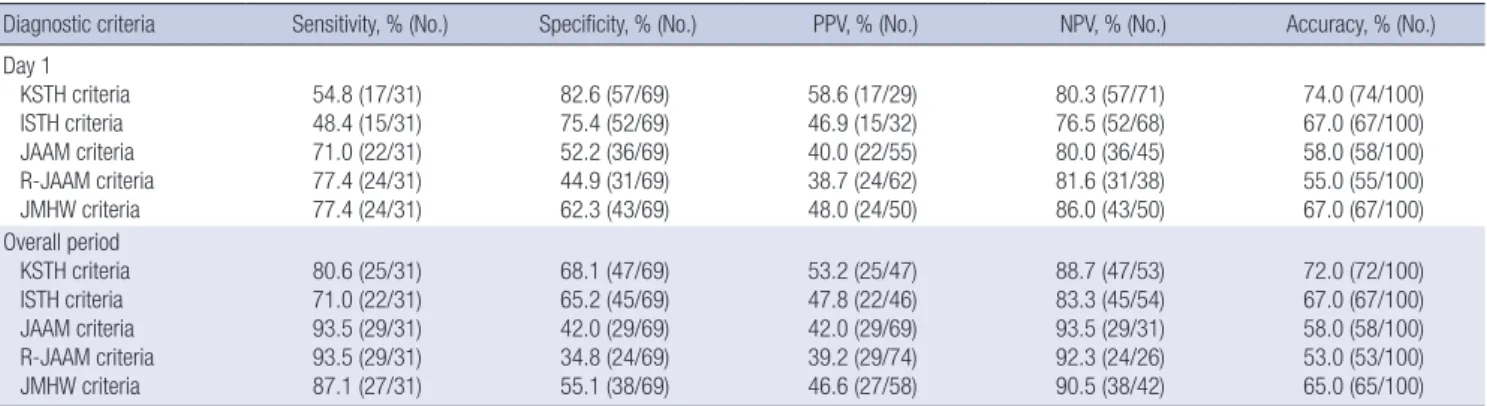
ROC analysis showed higher AUC value of both KSTH and JM- HW criteria in the prediction of overall ICU mortality when ap- plied at Day 1 (area under the curve [AUC] 0.687 and 0.699, P = 0.003 and 0.002, 95% CI 0.568-0.806 and 0.589-0.808, respective- ly) and overall periods (AUC 0.744 and 0.711, P < 0.001 and 0.001, 95% CI 0.640-0.848 and 0.606-0.815, respectively) than ISTH (AUC 0.619 and 0.681, P = 0.058 and 0.004, 95% CI 0.496-0.741 and 0.567-0.795, respectively), JAAM (AUC 0.616 and 0.678, P = 0.065 and 0.005, 95% CI 0.498-0.733 and 0.572-0.783, respective- ly), and R-JAAM criteria (AUC 0.612 and 0.642, P = 0.075 and 0.024, 95% CI 0.495-0.728 and 0.532-0.751, respectively). In ad- dition, both KSTH and JMHW criteria showed comparable or higher accuracy in the prediction of overall ICU mortality when applied at Day 1 as well as when applied at overall periods com- pared to other three criteria (Table 5).
Table 3. Distribution characteristics of patients diagnosed as DIC according to five different diagnostic criteria
Diagnostic criteria Day 1* Day 2 Day 3 Day 4 Overall period* Non-DIC
KSTH criteria 29 13 5 0 47 53
ISTH criteria 32 11 3 0 46 54
JAAM criteria 55 9 1 4 69 31
R-JAAM criteria 62 9 2 1 74 26
JMHW criteria 50 7 1 0 58 42
The number indicates the number of patients who were newly diagnosed on each day.
DIC = disseminated intravascular coagulation, ISTH = International Society on Thrombosis and Haemostasis, JAAM = Japanese Association for Acute Medicine, R-JAAM = Revised JAAM, JMHW = Japanese Ministry of Health and Welfare, KSTH = Korean Society on Thrombosis and Hemostasis.
*P value < 0.001.
Table 4. Multivariate analysis of five different DIC diagnostic criteria applied at Day 1 in the prediction of overall ICU mortality
Diagnostic criteria Odds ratio 95% CI P value
KSTH criteria 3.828 1.256-11.667 0.018
ISTH criteria 1.398 0.441-4.435 0.570
JAAM criteria 2.748 0.906-8.336 0.074
R-JAAM criteria 2.285 0.582-8.978 0.236
JMHW criteria 5.181 1.622-16.554 0.006
ISTH = International Society on Thrombosis and Haemostasis, JAAM = Japanese As- sociation for Acute Medicine, JMHW = Japanese Ministry of Health and Welfare, KSTH
= Korean Society on Thrombosis and Hemostasis, R-JAAM = Revised JAAM.
Table 5. Performance of five different DIC diagnostic criteria in the prediction of overall ICU mortality when applied at Day 1 and overall period
Diagnostic criteria Sensitivity, % (No.) Specificity, % (No.) PPV, % (No.) NPV, % (No.) Accuracy, % (No.) Day 1
KSTH criteria ISTH criteria JAAM criteria R-JAAM criteria JMHW criteria
54.8 (17/31) 48.4 (15/31) 71.0 (22/31) 77.4 (24/31) 77.4 (24/31)
82.6 (57/69) 75.4 (52/69) 52.2 (36/69) 44.9 (31/69) 62.3 (43/69)
58.6 (17/29) 46.9 (15/32) 40.0 (22/55) 38.7 (24/62) 48.0 (24/50)
80.3 (57/71) 76.5 (52/68) 80.0 (36/45) 81.6 (31/38) 86.0 (43/50)
74.0 (74/100) 67.0 (67/100) 58.0 (58/100) 55.0 (55/100) 67.0 (67/100) Overall period
KSTH criteria ISTH criteria JAAM criteria R-JAAM criteria JMHW criteria
80.6 (25/31) 71.0 (22/31) 93.5 (29/31) 93.5 (29/31) 87.1 (27/31)
68.1 (47/69) 65.2 (45/69) 42.0 (29/69) 34.8 (24/69) 55.1 (38/69)
53.2 (25/47) 47.8 (22/46) 42.0 (29/69) 39.2 (29/74) 46.6 (27/58)
88.7 (47/53) 83.3 (45/54) 93.5 (29/31) 92.3 (24/26) 90.5 (38/42)
72.0 (72/100) 67.0 (67/100) 58.0 (58/100) 53.0 (53/100) 65.0 (65/100) ISTH = International Society on Thrombosis and Haemostasis, JAAM = Japanese Association for Acute Medicine, NPV = negative predictive value, PPV = positive predictive value, R-JAAM = revised JAAM, JMHW = Japanese Ministry of Health and Welfare, KSTH = Korean Society on Thrombosis and Hemostasis.
Fig. 1. Comparison of five different DIC diagnostic criteria in terms of predicting 28-day mortality when applied at Day 1. Kaplan-Meier survival curve analysis shows that the KSTH (A) and JMHW (E) criteria could significantly predict 28-day mortality when applied at Day 1. However, ISTH (B), JAAM (C) and R-JAAM (D) criteria could not significantly predict 28-day mortality when applied at Day 1.
ISTH = International Society on Thrombosis and Haemostasis, JAAM = Japanese Association for Acute Medicine, JMHW = Japanese Ministry of Health and Welfare, KSTH = Korean Society on Thrombosis and Hemostasis, R-JAAM = revised JAAM.
Cumulative survival (%)
Follow up (day)
0 5 10 15 20 25 30
100 80 60 40 20 0
P = 0.007
DIC (-)
DIC (+)
Cumulative survival (%)
Follow up (day)
0 5 10 15 20 25 30
100 80 60 40 20 0
P = 0.146
DIC (-)
DIC (+)
A B
Cumulative survival (%)
Follow up (day)
0 5 10 15 20 25 30
100 80 60 40 20 0
P = 0.271
DIC (-)
DIC (+)
Cumulative survival (%)
Follow up (day)
0 5 10 15 20 25 30
100 80 60 40 20 0
P = 0.203
DIC (-)
DIC (+)
C D
Cumulative survival (%)
Follow up (day)
0 5 10 15 20 25 30
100 80 60 40 20 0
P = 0.049
DIC (-)
DIC (+)
E
Subsequently performed Kaplan-Meier survival curve analy- sis showed that both KSTH and JMHW criteria are statistically significant in terms of predicting 28-day mortality when applied at Day 1 and overall period (P = 0.007 and P = 0.012, respective- ly vs. P = 0.049 and P = 0.014, respectively) (Fig. 1). The JAAM criteria were statistically significant for the prediction of 28-day mortality only when applied at overall period (P = 0.010).
DISCUSSION
We compared the ability of five sets of DIC diagnostic criteria, including the non-validated KSTH criteria, to predict overall ICU and 28-day mortality in patients with severe sepsis or sep- tic shock. Our present study showed that both KSTH and JMHW criteria possess superior performance than the ISTH, JAAM and R-JAAM criteria in the prediction of overall ICU and 28-day mor- tality.
Several guidelines for the diagnosis of DIC were published.
Di Nisio et al. (4) recommended the use of the ISTH, JMHW or JAAM criteria. Levi et al. (3) used ISTH criteria and evaluated mortality to judge the efficacy of the DIC criteria. On the other hand, Wada et al. (12,13) recommended the JAAM criteria while emphasizing the importance of early diagnosis and treatment.
Although the KSTH DIC scoring system has the advantage of being concise and relatively easy to use for calculations without a weighted score, the KSTH criteria are currently not accepted as an international diagnostic method due to a lack of clinical application data. However, a previous study compared the KSTH criteria and ISTH criteria, and reported a K-coefficient of 0.78 (6). Moreover, a study by Lee et al. (5) reported a concordance rate of 84.7% and K-coefficient of 0.6 between the ISTH criteria and KSTH criteria, and concluded that the KSTH criteria is more sensitive predictor of mortality than the ISTH criteria. In the present study, we found a similar concordance rate (88.0%) and K-coefficient (0.76) which is higher than the earlier reported concordance rate for the ISTH/JMHW criteria (67.4%) (14) and the ISTH/JAAM criteria (86.5%) (15).
The patient cohort in the present study who were diagnosed as DIC according to the ISTH, JMHW and JAAM criteria on day 1-4 showed a similar distributions to that reported previously.
Gando et al. (6,7) and Hayakawa et al. (15) reported that the JAAM criteria is the most sensitive diagnostic criteria for the di- agnosis of septic DIC, whereas the ISTH criteria are the most specific. Similarly, our present results showed that DIC cases diagnosed according to the JAAM criteria included all patients diagnosed as DIC according the KSTH, JMHW and ISTH crite- ria. However, our study showed higher incidence of DIC than result of Gando et al. (16) for patients with severe sepsis or sep- tic shock (JAAM DIC 69% vs. 46.8%). We hypothesize that en- rollment of patients having more severe severity in our present study may be attributable to this result (septic shock 70% vs. 45%,
APACHE II score 24.7 vs. 23.2, SOFA score 10.5 vs. 8.5, respec- tively).
Many studies showed that these characteristics above men- tioned of each DIC criteria are reflected by the extent of mortal- ity. Gando et al. (6) reported that the prediction rates of mortal- ity using the ISTH criteria (51.9%) and JMHW (50.0%) are high- er than those predicted by the JAAM criteria (43.8%). Takemitsu et al. (17) reported a similar performance between these two sets of criteria in terms of predicting mortality. The mortality rates predicted by the ISTH, JMHW and JAAM criteria in that study were 40.6%, 35.5%, and 31.7%, respectively. The sensitivi- ty/specificity of the ISTH, JMHW and JAAM criteria for the pre- diction of mortality were 50.4%/71.4%, 51.3%/64.9%, and 80.0%/
33.2%, respectively. Our present study showed similar results that both ISTH and JMHW criteria are more specific than the JAAM criteria in the prediction of overall ICU mortality. Our present study found the sensitivity/specificity of the ISTH, JMHW and JAAM criteria for predicting mortality as 48.4%/75.4%, 77.4%/
62.3%, and 71.0%/52.2%, respectively, when applied at Day 1.
Few studies have used logistic regression and ROC analysis to evaluate the DIC diagnostic criteria and mortality outcomes.
Angstwurm et al. (10) analysed ISTH criteria for the prediction of mortality using the ROC analysis, and reported AUC of 0.735.
Gando et al. (8) applied logistic regression analysis in the evalu- ation of the JAAM criteria on the prediction of mortality and re- ported OR of 1.223. Iwai et al. (9) reported that only the APACHE II score is independently associated with mortality (P < 0.001, OR 1.21); however, the JAAM criteria also showed a low, non- significant OR for the prediction of mortality after the removal of confounding factors (P = 0.066, OR 0.29). Recently, Gando et al. (16) reported that the JAAM criteria applied at day 1 (OR 1.282, P < 0.001) and the Delta JAAM DIC score applied at day 1 (OR 0.770, P < 0.001) are independent predictors of 28-day mortali- ty in DIC patients with severe sepsis. In the present study, the delta DIC score did not predict ICU mortality significantly, but tended to reduce mortality when the delta score increases. How- ever, our present study demonstrated that both KSTH and JMHW criteria applied on Day 1 and overall period significantly pre- dicted the overall ICU mortality. Kaplan-Meier curve analysis also showed that the ability of the KSTH and JMHW criteria on Day 1 and overall period to predict 28-day mortality was signifi- cantly high.
The possible explanations for these results are as follows: first, fibrinogen is an acute phase protein increased during inflam- matory responses. Therefore, in certain situation that DIC is ac- companied by inflammation, we would expect that a decrease in fibrinogen levels in DIC can be masked by the increase of fi- brinogen level due to inflammatory process. Bakhtiari et al. (18) reported that exclusion of fibrinogen level from the ISTH DIC score would not affect the accuracy of scoring system in the de- tection of DIC in critically ill patients. Gando et al. (7) made the
R-JAAM criteria based on the little effect of fibrinogen level on the prediction of outcome in the DIC patients. However, Kim et al. (19) showed that the OR of the low fibrinogen level (< 1.0 g/
L) is 2.13 (P = 0.024) and Gando et al. (16) reported that the fi- brinogen is an independent predictor for 28-day mortality (OR 0.998, P = 0.033). The present study showed that fibrinogen on Day 1 transformed to nominal variable is an independent pre- dictor for ICU mortality in univariable analysis. Especially, the KSTH criteria showed the best statistical significance (P = 0.007, OR 9.479, 95% CI 1.839-48.853).
Second, only the KSTH criteria included the aPTT as a vari- able. Our present study showed that the aPTT (P = 0.042, OR 1.024, 95% CI 1.001-1.048), D-dimer (P = 0.042, OR 1.037, 95%
CI 1.001-1.075), and platelet (P = 0.002, OR 0.988, 95% CI 0.981- 0.996) except PT (P = 0.083, OR 1.061, 95% CI 0.992-1.134) were risk factors for ICU mortality. In additional analysis using nomi- nal variable of marker transformed by the KSTH criteria, aPTT was a more useful marker for ICU mortality than PT (P = 0.027, OR 2.705, 95% CI 1.121-6.527 vs. P = 0.286, OR 1.629, 95% CI 0.665-3.990, respectively) (data not shown). We assumed the reason for these results. First, a prolonged PT, which reflects the inhibition of hemostasis cascade from the release of tissue fac- tor (extrinsic pathway), happens faster than a prolonged aPTT which is related to the inhibition of intrinsic pathway. Second, at the early stage of sepsis, factor VIII levels are likely to be in- creased because factor VIII is an acute phase reactant. As a re- sult, the prolongation of aPTT may be masked by an increase in factor VIII levels in early sepsis patients with DIC. Kinasewitz et al. (20) and Kim et al. (19) reported that the abnormality rate in PT is hihger than that in aPTT (93.4% vs. 63.1% and 68.4% vs.
47.3%, respectively) for patients with sepsis. In conclusion, we suggest that PT is an early marker for the detection of DIC, and aPTT is a marker for the reflection of severity in DIC.
Our present study had certain limitations. First, our small sample size would be main limitation. We could not calculate appropriate sample size due to lack of previous study compar- ing DIC diagnostic criteria in the prediction of mortality in pa- tients with severe sepsis or septic shock. Unavoidably, our pres- ent pilot study included small number of patients compared with other studies. Second, single center design for clarification and generalization of analysis results would be another limita- tions. More comprehensive and well-designed multicenter pro- spective study focused on this issue should be performed. Third, our present study limited study population as patients with se- vere sepsis or septic shock and possible selection bias may af- fect the study results. Especially, as previously discussed, it is needed to consider that our present study enrolled more severe septic patients. More comprehensive study in the DIC patients caused from other diseases should be required for the general- ization of our present study results. In addition, although our present study showed higher AUC values of KSTH and JMHW
criteria than other three criteria, AUC values of all five criteria were below 0.7, which may remain a concern that these level can be regarded as an adequate evidence of diagnostic value.
Therefore, we suggest that clinicians should be warned not to predict prognosis entirely based on the DIC criteria.
In conclusion, our present study showed that both KSTH and JMHW criteria would be more useful than other three criteria in predicting prognosis in DIC patients with severe sepsis or sep- tic shock, and more comprehensive study would be required for the confirmation of our present study results.
DISCLOSURE
The authors have no potential conflicts of interest to disclose.
AUTHOR CONTRIBUTION
Conception of the study: Jang SS, Hong SB. Acquisition of data:
Ha SO, Park SH. Statistical analyses: Ha SO, Park SH. Manuscript preparation: Ha SO, Park SH. Manuscript approval: all authors.
ORCID
Sang Ook Ha http://orcid.org/0000-0002-2651-1023 Sang Hyuk Park http://orcid.org/0000-0001-7284-6273 Sang-Bum Hong http://orcid.org/0000-0003-2737-7695 Seongsoo Jang http://orcid.org/0000-0002-0045-1747
REFERENCES
1. Levi M, de Jonge E, van der Poll T. Sepsis and disseminated intravascular coagulation. J Thromb Thrombolysis 2003; 16: 43-7.
2. Levi M, Ten Cate H. Disseminated intravascular coagulation. N Engl J Med 1999; 341: 586-92.
3. Levi M, Toh CH, Thachil J, Watson HG. Guidelines for the diagnosis and management of disseminated intravascular coagulation. British Com- mittee for Standards in Haematology. Br J Haematol 2009; 145: 24-33.
4. Di Nisio M, Baudo F, Cosmi B, D’Angelo A, De Gasperi A, Malato A, Schia- voni M, Squizzato A; Italian Society for Thrombosis and Haemostasis. Di- agnosis and treatment of disseminated intravascular coagulation: guide- lines of the Italian Society for Haemostasis and Thrombosis (SISET). Thromb Res 2012; 129: e177-84.
5. Lee JH, Song JW, Song KS. Diagnosis of overt disseminated intravascular coagulation: a comparative study using criteria from the International Society versus the Korean Society on Thrombosis and Hemostasis. Yon- sei Med J 2007; 48: 595-600.
6. Gando S, Wada H, Asakura H, Iba T, Eguchi Y, Okamoto K, Ohtomo Y, Ka- wasugi K, Koga S, Koseki K, et al. Evaluation of new Japanese diagnostic criteria for disseminated intravascular coagulation in critically ill patients.
Clin Appl Thromb Hemost 2005; 11: 71-6.
7. Gando S, Iba T, Eguchi Y, Ohtomo Y, Okamoto K, Koseki K, Mayumi T, Murata A, Ikeda T, Ishikura H, et al. A multicenter, prospective validation of disseminated intravascular coagulation diagnostic criteria for critically
ill patients: comparing current criteria. Crit Care Med 2006; 34: 625-31.
8. Gando S, Saitoh D, Ogura H, Mayumi T, Koseki K, Ikeda T, Ishikura H, Iba T, Ueyama M, Eguchi Y, et al. Natural history of disseminated intravascu- lar coagulation diagnosed based on the newly established diagnostic cri- teria for critically ill patients: results of a multicenter, prospective survey.
Crit Care Med 2008; 36: 145-50.
9. Iwai K, Uchino S, Endo A, Saito K, Kase Y, Takinami M. Prospective exter- nal validation of the new scoring system for disseminated intravascular coagulation by Japanese Association for Acute Medicine (JAAM). Thromb Res 2010; 126: 217-21.
10. Angstwurm MW, Dempfle CE, Spannagl M. New disseminated intravas- cular coagulation score: a useful tool to predict mortality in comparison with acute physiology and chronic health evaluation II and logistic organ dysfunction scores. Crit Care Med 2006; 34: 314-20.
11. Bone RC, Balk RA, Cerra FB, Dellinger RP, Fein AM, Knaus WA, Schein RM, Sibbald WJ. Definitions for sepsis and organ failure and guidelines for the use of innovative therapies in sepsis. The ACCP/SCCM Consen- sus Conference Committee. American College of Chest Physicians/Soci- ety of Critical Care Medicine. Chest 1992; 101: 1644-55.
12. Wada H, Wakita Y, Nakase T, Shimura M, Hiyoyama K, Nagaya S, Mori Y, Shiku H. Outcome of disseminated intravascular coagulation in relation to the score when treatment was begun. Mie DIC Study Group. Thromb Haemost 1995; 74: 848-52.
13. Wada H, Asakura H, Okamoto K, Iba T, Uchiyama T, Kawasugi K, Koga S, Mayumi T, Koike K, Gando S, et al. Expert consensus for the treatment of disseminated intravascular coagulation in Japan. Thromb Res 2010; 125:
6-11.
14. Wada H, Gabazza EC, Asakura H, Koike K, Okamoto K, Maruyama I, Shi- ku H, Nobori T. Comparison of diagnostic criteria for disseminated intra- vascular coagulation (DIC): diagnostic criteria of the International Soci- ety of Thrombosis and Hemostasis and of the Japanese Ministry of Health and Welfare for overt DIC. Am J Hematol 2003; 74: 17-22.
15. Hayakawa M, Gando S, Hoshino H. A prospective comparative study of three sets of criteria for disseminated intravascular coagulation: ISTH cri- teria vs Japanese criteria. Clin Appl Thromb Hemost 2007; 13: 65-72.
16. Gando S, Saitoh D, Ogura H, Fujishima S, Mayumi T, Araki T, Ikeda H, Ko- tani J, Kushimoto S, Miki Y, et al. A multicenter, prospective validation study of the Japanese Association for Acute Medicine disseminated in- travascular coagulation scoring system in patients with severe sepsis. Crit Care 2013; 17: R111.
17. Takemitsu T, Wada H, Hatada T, Ohmori Y, Ishikura K, Takeda T, Sugiya- ma T, Yamada N, Maruyama K, Katayama N, et al. Prospective evaluation of three different diagnostic criteria for disseminated intravascular coag- ulation. Thromb Haemost 2011; 105: 40-4.
18. Bakhtiari K, Meijers JC, de Jonge E, Levi M. Prospective validation of the International Society of Thrombosis and Haemostasis scoring system for disseminated intravascular coagulation. Crit Care Med 2004; 32: 2416-21.
19. Kim GY, Park SY, Yoon HJ, Suh JT, Kang SY, Lee WI. Investigation of hemo- static changes in patients with sepsis. Korean J Lab Med 2007; 27: 157-61.
20. Kinasewitz GT, Yan SB, Basson B, Comp P, Russell JA, Cariou A, Um SL, Utterback B, Laterre PF, Dhainaut JF; PROWESS Sepsis Study Group. Uni- versal changes in biomarkers of coagulation and inflammation occur in patients with severe sepsis, regardless of causative micro-organism [IS- RCTN74215569]. Crit Care 2004; 8: R82-90.