274
©The Korean Society of Food Science and Technology
식육추출가공품 중 갈비탕에서의 Staphylococcus aureus 성장예측모델 개발
손나리·김안나·최원석·윤상현·서수환·주인선·김순한·곽효선·조준일*
식품의약품안전처 식품의약품안전평가원 식품위해평가부 미생물과
Development of a predictive model describing the growth of
Staphylococcus aureus in processed meat product galbitang
Na-Ry Son, An-Na Kim, Won-Seok Choi, Sang-Hyun Yoon, Soo-Hwan Suh, In-Sun Joo, Soon-Han Kim, Hyo-Sun Kwak, and Joon-Il Cho*
Food Microbiology Division, Food Safety Evalution Department, Ministry of Food and Drug Safety Evaluation
Abstract In this study, predictive mathematical models were developed to estimate the kinetics of Staphylococcus aureus growth in processed meat product galbitang. Processed meat product galbitang was inoculated with 0.1 mL of S. aureus culture and stored at 4, 10, 20, 37oC. The µmax (maximum specific growth rate) and LPD (lag phase duration) values were calculated. The primary model was used to develop a response surface secondary model. The growth parameters were analyzed using the square root model as a function of storage temperature. The developed model was confirmed by calculating RMSE (Root Mean Square Error) values as statistic parameters. The LPD decreased, but µmax increased with an increase in the storage temperature. At 4, 10, 20 and 37oC, R2 was 0.99, 0.98, 0.99 and 0.99, respectively; RMSE was 0.39. The developed predictive growth model can be used to predict the risk of S. aureus contamination in processed meat product galbitang; hence, it has potential as an input model for the risk assessment.
Keywords: Staphylococcus aureus, predictive model, processed meat product galbitang
서
론
최근 우리나라의 사회구조 및 식생활 패턴의 변화, 핵가족화 및 여성의 사회참여 증가로 편의성 및 경제성 등을 앞세워 완전 조리 상태의 식품과 즉석섭취 및 편의식품 등의 소비가 증가하 는 것으로 나타났다(1). 이러한 시대상황은 조리된 식품, 반 조리 식품 등 새로운 식품 가공 기술에도 영향을 주어 비교적 조리시 간이 긴 갈비탕류의 음식도 가정에서 간단한 과정만 거치면 쉽 게 섭취할 수 있는 가공식품으로 생산되고 있다. 현재 세계적으 로 식품의 위생과 안전성 확보를 위해 과학 기술을 기반으로 한 체계적인 노력은 계속되고 있지만, 여전히 병원성 미생물에 의한 식중독 발생은 증가 추세로 대량화 및 집단화 특성을 보이고 있 다(2). 특히 우리나라의 경우 과거 쌀을 비롯한 곡류 위주의 음 식문화에서 육류 위주의 음식문화로 전환됨으로써 동물성 식품 매개 식중독 사고 사례가 증가하고 있으며 식품의약품안전처에 서 제공하는 식중독 발생 통계치에 따르면 2014년도에 국내 식 중독 발생에 따른 원인식품으로 육류 및 그 가공품이 두 번째로 높은 것으로 보고되었다. Staphylococcus aureus는 자연계에 광범 위하게 분포하고 있으며 식품에 오염되는 경로도 매우 다양하므 로 식품위생상 중요하게 다루어지고 있는 세균이며 전 세계적으 로도 S. aureus에 의한 식중독 발생빈도는 세 번째로 높은 것으 로 보고되고 있다(3,4). 최근 생물학적 위해요소인 미생물에 의한 식중독 예방 대책으 로 미생물 위해평가의 중요성이 강조되고 있으며 이에 대한 평 가 방법으로 예측미생물학(predictive food microbiology, PFM)이 크게 대두되고 있다(5,6). 이는 pH, Aw (water activity), NaCl의 함량과 같은 내부적인 요인(intrinsic factor)과 식품의 생산과 저 장기간, 온도, 포장 방법, 습도 등의 외부적인 요인(extrinsic factor) 에 따라 식품 중 미생물의 성장과 사멸을 예측할 수 있는 수학 적 방법이다(7,8). 미생물의 성장을 수학적 모델에 의해 예측하고 평가할 수 있기 때문에 기존의 미생물 검사와 비교 시 정량적이 고 신속한 예측이 가능하여 식중독 예방에 큰 효과가 있는 것으 로 평가되고 있다(9). 현재 국내·외의 많은 나라에서 육류와 채 소류 등의 원재료와 즉석섭취식품을 대상으로 다양한 병원성 미 생물에 대한 성장예측모델을 개발하고 있다(10). 이 중 S. aureus 에 대한 연구는 즉석섭취식품이나 햄, 칠면조 및 닭고기, 우유 등 에 대한 연구가 이루어졌으며 국내에서는 학교급식에 대한 조리 식품에 대한 모델 개발로 한정되어 있다(11-14). S. aureus의 주요 원인 식품으로 축산제품이 대두되고 있으며, 축산제품에 속하는 식육추출가공품 중 갈비탕은 우리나라의 대 표적인 전통 탕반류로서 대량 보급이 가능한 대중식품의 특성을 가지고 있기 때문에 장기유통이 가능한 상품으로 다양한 형태로 유통·판매되고 있다(15,16). 따라서 본 연구에서는 유통·판매되는 식육추출가공품 중 냉 동유통 제품과 멸균 처리된 실온제품에 대한 위해성은 배제하고 냉장상태로 유통·판매되는 갈비탕의 제품을 대상으로 성장예측 *Corresponding author: Joon-Il Cho, Food Microbiology Division,food Safety Evalution Department, Ministry of Food and Drug Safety Evaluation, Cheongju, Chungbuk 28159, Korea
Tel: +82-43-719-4305 Fax: +82-43-719-4300 E-mail: [email protected]
Received January 10, 2017; revised February 10, 2017; accepted February 12, 2017
모델을 적용하여 S. aureus의 성장 변화를 예측할 수 있는 수학 적 모델을 개발하여 조건변화에 대한 식육추출가공품 중 갈비탕 의 안전관리에 활용하고자 하였다.
재료 및 방법
시료 수거 국내에 유통·판매되는 식육추출가공품 중 갈비탕 시료는 전 국단위 26개 지역의 대형마트, 농협, 축협 등에서 구매하여 아이 스박스에 보관하여 시험장소로 이동하였으며 실험 전까지 냉장 온도 4oC에 보관되었다. 표준균주본 연구에 사용된 표준균주는 S. aureus ATCC 14458 (isolated from human), ATCC 27664 (isolated from chicken tetrazzini), ATCC 23235 (isolated from turkey salad), ATCC 13565 (isolated from ham) 및 ATCC 19095 (isolated from leg abscess)으로 American Type Culture Collection (ATCC)에서 분양 받았으며, tryptic soy broth (TSB, Difco Laboratories, Detroiy, MI, USA)에 전 배양하여 1 mL을 vial tube에 50% 글리세롤(glycerol)을 첨가 하여 −70oC에 동결 보관하면서 실험에 사용하였다.
시험 균 액 제조
표준균주의 단일 집락을 취하여 TSB 10 mL에 접종하여 35oC
에서 24시간 동안 배양한 후 4oC에서 1,912×g으로 15분간 원심
분리하여 cell pellet을 얻고 이를 인산완충용액(PBS; phosphate buffer solution)으로 2회 세척한 다음 각각의 배양액을 혼합 후 PBS를 이용해 희석하였다. 다양한 선행연구에서 최소인체위해용 량의 장독소를 생성하는 S. aureus의 균체 농도는 5 log CFU/mL 수준으로 보고되어 있어 본 연구에서는 유도기부터 성장패턴을 보고자 2 log CFU/mL 수준으로 희석하여 이를 시험 균액으로 사용하였다(17-19). 시료 준비 및 균 액 접종 송 등(20)의 연구에 따라 대상 식품에 대한 유사한 조건으로 하여 예측모델을 개발하기 위하여 각 시료를 clean bench에서 기 존의 형태를 최대한 유지하며 판매되는 완제품의 평균 용량에 맞 추어 진공팩에 250 g씩 취하였으며 희석한 시험 균 액 100 μL를 접종하여 균체 농도는 2 log CFU/g 수준이 되게 하였다. 접종된 시료는 각각의 저장 온도(4, 10, 20, 37oC)에 보관하면서 균수를 측정하였다. 균의 성장 측정 S. aureus가 접종된 식육추출가공품 시료를 4, 10, 20, 37oC에 서 저장하면서 온도별로 10-15회 정도 시료를 분석하였다. 시료 에 PBS 225 mL를 첨가한 후 균질기(BagMixer®, Interscience, St. Nom, France)를 이용하여 2분 동안 균질화 시킨 후 10진 희석법 으로 희석하여 Baird Parker RPF 배지에 도말하여 균수의 변화 를 확인하였다. 성장예측모델 개발
본 연구에서는 갈비탕에서 S. aureus의 Baranyi model을 이용 하여 1차 모델을 개발하였으며, 최대생장률(μmax; maximum specific growth rate, log CFU/g·h), 유도기(LPD; lag phase duration, h), 초기 세균수(N0; the initial bacterial counts, log CFU/g) 및 최대
생장 세균수(Nmax; the final bacterial counts, log CFU/g)를 온도별
생장패턴 결과를 이용하여 도출하였다. [Baranyi model]
μmax: maximum specific growth rate
N0: the initial bacterial counts Nmax: the final bacterial counts
q0: a parameter defining the initial physiological state of the cells t: time
S. aureus의 생장예측 2차 모델은 Square root model과 Polyno-mial equation을 활용하여 매개변수에 대해 저장 온도가 미치는 영향을 계산하였다.
[Square root model]
μmax: maximum specific growth rate
a: slope of linear equation T: storage temperature
Tmin: theoretical minimum temperature [Polynomial equation]
Ln(μmax)=a+bT+cT2
μmax: Maximum specific growth rate
T: Temperature
a, b, c: Constant number 성장예측모델의 적합성 평가
개발된 S. aureus 성장예측모델 식을 평가하고자 통계적 지표 인 Root Mean Square Error (RMSE)을 산출하였다. RMSE는 실 험을 통해 얻어진 값과 예측 값과의 차이를 이용하여 얻어지는 수치로, 이 값이 0에 가까울수록 개발된 모델의 적합도가 높아진다.
[RMSE]
obs: observed value pred: predicted value n: number of observation
결과 및 고찰
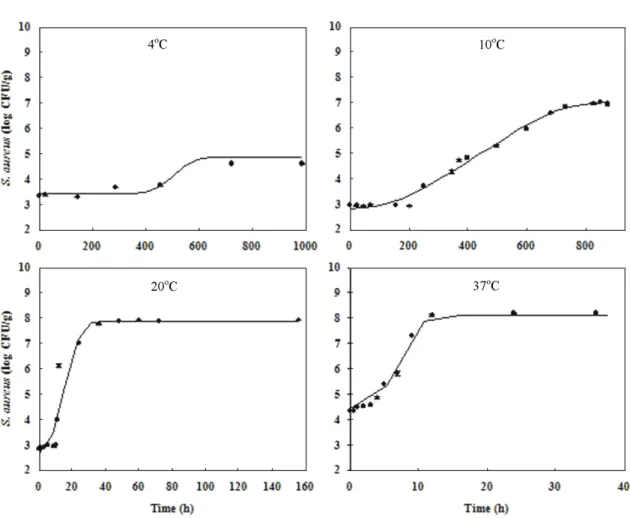
온도별 S. aureus의 생장패턴 갈비탕에서 온도에 따른 S. aureus의 성장변화는 Fig. 1과 같다. 황색포도상구균은 저장 온도(4, 10, 20, 37oC)에서 모두 증가하였 고 4oC는 670시간, 10oC는 348시간, 20oC는 11시간, 및 37oC는 5 시간 이후에 성장이 나타나기 시작했다. 온도별 최대 성장은 4oC 의 경우 724시간에서 4.60, 10oC의 경우 852시간에서 7.02, 20oC Nt N0 μmax At ln 1 exp(μmax×At) 1–exp N( max–N0) ---+ – × + = At t 1 μmax ---ln exp(–μmax) q+ 0 1+q0 ---⎝ ⎠ ⎛ ⎞ + = μmax = α T T( – min) Σ obs pred( – )2 n
---의 경우 156시간에서 7.93 및 37oC의 경우 48시간에서 8.31 log CFU/g 수준으로 확인되었다. 초기 오염도에 비해 보관 초기에는 균의 증식이 모든 온도에서 나타났으나 최대 성장 이후에는 감 소하는 경향을 나타내었다. 37oC의 경우 가장 뚜렷한 균의 감소 경향을 보였으며 10oC 이하에서 보관한 식품에서의 S. aureus은 급속한 성장은 이루어지지 않으나 오랜 시간 생존하는 것으로 확 인되어 다양한 미생물 성장패턴 연구 결과와 유사한 것으로 나 타났다(21,22). 성장예측모델 개발 각 온도별(4, 10, 20, 37oC) 갈비탕에 오염된 S. aureus의 생육 결과를 바탕으로 Baranyi model을 이용하여 유도기(LPD)와 최대 성장률(μmax, maximum specific growth rate)을 산출하였다(Fig. 1).
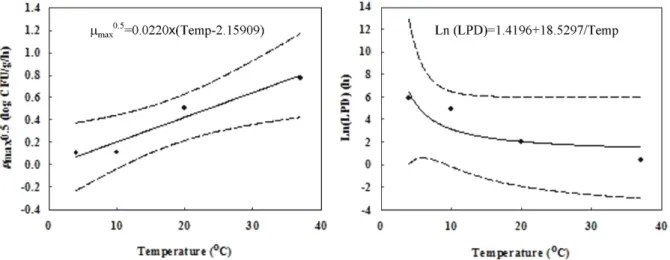
최대성장률(μmax)은 온도가 높아질수록 증가하여 37oC에서 0.601 log CFU/g·h으로 최대값을 보였고, 유도기(LPD)는 온도와 반비 례적으로 감소하는 경향을 나타내어 4oC에서 최대 357.67 h으로 확인되었다(Table 1). 따라서 최대성장률과 유도기 모두 온도에 대해 유의적인 차이가 있는 것으로 조사되었다. 갈비탕에서 S. aureus의 μmax와LPD에 대한 저장 온도의 영향
을 평가하기 위해 μmax는 square root model, LPD는 polynomial
equation을 사용하여 2차 모델을 개발하였다. 개발된 2차 모델의 결정계수 R2값은 μ
max와LPD에서 각각 0.97, 0.85로 1에 근접하
는 것으로 나타나 적합성이 높음을 확인하였다. μmax의 2차 모델
식으로 사용된 square root model은 으로 표현되며, 이때 Tmin은
미생물 생장가능 최저온도를 의미한다. 따라서 S. aureus는 갈비 탕이 2oC 이상의 저장온도에서 보관될 때 생장 가능 할 것으로 사료된다(Fig. 2). 성장예측모델의 적합성 평가 통계적 지표인 RMSE 값을 산출하여 모델의 통계적 적합성을 확인하였으며 이를 위하여 모델 개발에는 사용되지 않은 15oC 저 장 온도에서 추가 실험을 진행하였다. 각 온도별(4, 10, 20, 37oC) S. aureus의 관측값과 개발한 1, 2차 모델을 통해 산출된 S. aureus 의 예측값을 이용하여 RMSE 값을 산출하였으며, 0에 가까울수 록 모델이 적합하다고 평가할 수 있다(23). 갈비탕의 RMSE 값 은 0.39로 도출되어 모델이 적합한 것으로 확인되었다(Table 2). Fig. 1. Survival patterns of S. aureus in Galbitang of processed meat product during storage at 4, 10, 20, and 37oC
Table 1. Kinetic parameters calculated by the Baranyi model for S. aureus growth in Galbitang of processed meat product during storage at 4, 10, 20, and 37oC Storage temperature (oC) LPD (h) μmax (log CFU/g·h) R 2 4 357.67 0.011 0.99 10 136.61 0.012 0.98 20 7.14 0.260 0.99 37 1.49 0.601 0.99
요
약
본 연구는 축산물에 대하여 쉽게 오염될 수 있는 S. aureus에 대해 축산제품에 속하는 식육추출가공품 중 갈비탕에 대해 식중 독 예방과 식품의 안전성을 확보하기 위하여 Baranyi model을 이 용하여 성장 예측모델을 개발하였다. DMFit 프로그램을 이용하 여 S. aureus의 유도기(LPD)와 최대성장률(μmax, maximum
spe-cific growth rate)을 산출하였다. S. aureus의 성장곡선은 4, 10, 20, 37°C의 보관 온도에서 측정하였다. Baranyi model의 LPD의 값은 4, 10, 20, 37oC의 저장 온도에서 각각 256.04, 152.60, 5.41, 3.78 h으로 온도에 반비례 한 것으로 나타났다. 또한 μmax의 값은 4, 10, 20, 37oC의 저장 온도에서 각 각 0.003, 0.007, 0.258, 0.528 log CFU/g·h으로 온도에 비례 한 것으로 나타났다. 또한 일차식의 적합성을 나타내는 R2값은 모 두 0.9 이상으로 나타나 실험값과 예측값의 상관관계가 높은 것 을 알 수 있었다. RMSE 값은 0.39로 비교적 0에 근접하게 나타 난 것을 볼 수 있으며 개발된 예측모델의 적합성이 높다고 할 수 있다. 따라서 개발된 모델을 이용할 경우 식육추출가공품 중 갈 비탕의 다양한 생산 환경과 온도에 따라 S. aureus의 성장을 예 측할 수 있을 것이라고 사료된다. 갈비탕을 생산, 보관 및 판매 하는 산업체에서 널리 활용할 수 있을 것이라고 생각되며 이를 위해평가에서 또한 충분히 활용가능 할 것이라고 생각되어진다.
감사의 글
본 연구는 식품의약품안전평가원 2015년도 연구개발과제에 의 하여 이루어진 것으로 추후 미생물 기준을 설정함에 있어 과학 적인 근거로 활용될 예정임.References
1. Bahk GJ, Chun SJ, Park KH, Hong CH, Kim JW. Survey on the foodborne illness experience and awareness of food safety prac-tice among Korean consumers. J. Food Hyg. Saf. 18: 139-145 (2003)
2. Cho JI, Lee SH, Lim JS, Kwak HS, Hwang IG. Development of a predictive model describing the growth of Listeria Monocytoge-nes in fresh cut vegetable. J. Food Hyg. Saf. 1: 25-30 (2011) 3. Kang YS, Yoon SK, Jwa SH, Lee DH, Woo GJ. Prevalence of
Staphylococcus aureus in kimbap. J. Food Hyg. Saf. 17: 31-35 (2002)
4. Bean NH, Goulding JS, Matthew TD, Angulo FJ. Surveillance for foodborne disease outbreaks-United States 1988-1992. J. Food Prot. 60: 1265-1286 (1997)
5. Koseki S, Isobe S. Prediction of pathogen growth on iceberg let-tuce under real temperature history during distribution from farm to table. Int. J. Food Microbiol. 104: 239-248 (2005)
6. Amit P, Theodore PL, Francisco D. Comparison of pri-mary pre-dictive models to study the growth of Listeria monocytogenes at low temperatures in liquid cultures and selection of fastest grow-ing ribotypes in meat and turkey product slurries. J. Food Micro-biol. 25: 460-470 (2008)
7. Chen H. Use of linear, Weibull and log-logistic functions to model pressure inactivation of seven foodborne pathogens in milk. J. Food Microbiol. 24: 197-204 (2007)
8. Dligentte-Muller ML, Cornu M, Pouillot R, Denis JB. Use of Bayesian modelling in risk assessment: Application to growth of Listeria monocytogenes and food flora in cold-smoked salmon. J. Food Microbiol. 106: 195-208 (2006)
9. Park SY, Choi JW, Chung DH, Kim MG, Lee KH, Kim KS, Bahk GJ, Bae DH, Park SK, Kim KY, Kim CH, Ha SD.. Devel-opment of apredictive mathematical model for the growth kinetics of Listeria monocytogenes in sesame leaves. Food Sci. Biotech-nol. 16: 238-242 (2007)
10. Park Hs, Bahk GJ, Park KH, Pak JY, Ryu K. Predictive Model for Growth of Staphylococcus aureus in Suyuk. Korean J. Food Sci. An. 30: 487-494 (2010)
11. Chung MS. Study on the risk management for risk reduction of Staphylococcus aureus in ready-to-eat foods (II). The final report of Korea Food and Drug Administration research project. Korea Health Industry Development Institute pp. 157-185 (2007)
12. Castillejo-Rodriguez AM, Gimeno RMG, Cosano GZ, Alcala EB, Perez MRR. Assessment of mathematical models for predicting Staphylococcus aureus growth in cooked meat products. J. Food Prot. 65: 659-665 (2002)
Fig. 2 Developed model for effect of temperature on the lag phase duration (LPD) and maximum specific growth rate (μmax) of in Galbitang of processed meat product by Baranyi model
Table 2. Developed model for effect of temperature on the lag phase duration (LPD) and maximum specific growth rate (μmax) of in Galbitang of processed meat product by Baranyi model
Sample RMSE
13. Fujikawa H, Morozumi S. Modeling Staphylococcus aureus growth and enterotoxin production in milk. Food Microbiol. 23: 260-267 (2006)
14. Kim EJ. Analysis of microbiological hazards and quantitative microbial risk assessment of Staphylococcus aureus inoculated onto potentially hazardous foods in school foodservice operations. MS thesis, Yonsei University, Seoul, Korea (2004)
15. Korean Dietetic Association. The Standard Recipe In: A Guide-line for Foodservice Management. 283, Seoul, Korea (2007) 16. Han KS, Lee EJ, Hong SP. The prediction of shelf-life of
com-mercialy sterilized Korean soups using accelerated experiment. Korean J. Food Cook. Sci. 21: 149-154 (2005)
17. FDA(Food and Drug Administration): Bad bug book. 2nd edition (2012)
18. Abigail MF, Catherine AB, Lief Rustvold D, Kim AH, Jessica H, James EL, Margret O. Clinical impact of a real-time PCR assay for rapid identification of Staphylococcal bacteremia. J. Clin.
Microbiol. 50: 127-133 (2012)
19. Park Ms, Cho JI, Lee SH, Bahk GJ. The analysis for minimum infective dose of foodborne disease pathogens by Meta-analysis. J. Food Hyg. Saf. 29: 305-311 (2014)
20. Song JY, Kim YS, Hong CH, Bahk GJ. Growth and predictive model of wild-type Salmonella spp. on temperature and time dur-ing cut and package processdur-ing in cold pork meats. J. Food Hyg. Saf. 28: 7-12 (2013)
21. Cho JI, Lee SH, Choi JH, Choi EJ, Hwang IG. Analysis of prev-alence and survival pattern of Staphylococcus aureus from dried seasoned fishes. J. Food Hyg. Saf. 26: 366-369 (2011)
22. Park SG, Hwang YO, Jung JH, Lee KM. Biological characteris-tics of Staphylococcus aureus isoalted from food borne patients in Seoul. J. Food Hyg. Saf. 16: 159-167 (2001)
23. Baranyi J, Ross T, Roberts TA, McMeekin TA. Effects of param-eterization on the performance of empirical models used in ‘pre-dictive microbiology’. Food Microbiol. 13: 83-91 (1996)